
Commercial Data Cabling: Top 5 Proven Best Practices
Commercial data cabling is the lifeline of modern business operations, ensuring seamless communication for essential services like voice, data, and video across your network. For any business aiming to maintain efficient and dependable operations, a robust and organized cabling infrastructure is crucial. It significantly boosts network efficiency by stabilizing your network environment, which is why many enterprises are transitioning to advanced systems that handle higher speeds, such as Gigabit or even 10 Gigabit networks. These improvements address the increasing demands for bandwidth and keep the companies competitive. Here’s why commercial data cabling is crucial:
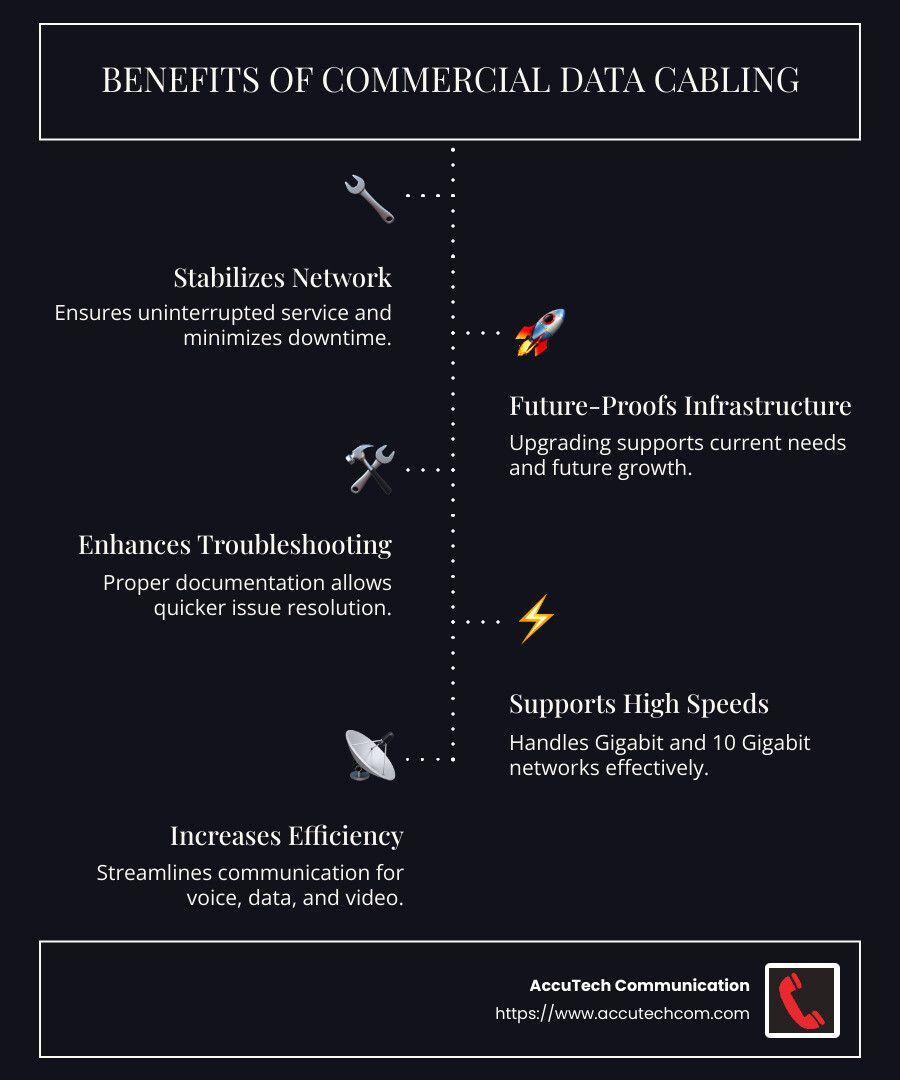
- Stabilizes Network Environment: A reliable cabling system supports uninterrupted service and minimizes downtime.
- Future-Proofs Infrastructure: Upgrading to faster networks meets today’s needs and anticipates future growth.
- Improves Troubleshooting: Properly labeled and documented cabling allows quicker diagnosis and resolution of issues.
I’m Corin Dolan, your guide to navigating commercial data cabling. With experience dating back to 1993, I’ve assisted countless businesses across Massachusetts, New Hampshire, and Rhode Island in enhancing their communication systems through efficient and high-performance cabling solutions.
Common commercial data cabling vocab:
– cable installation contractors
– low voltage cabling
– telecommunications contractor
Understanding Commercial Data Cabling
Commercial structured cabling is the backbone of any modern business infrastructure. It connects everything from computers and phones to servers and security systems, ensuring smooth and reliable communication across your organization.
What is Commercial Structured Cabling?
Commercial structured cabling refers to a standardized approach to organizing and installing cables in a business setting. This system supports various hardware uses and is designed to be flexible and scalable, allowing for easy upgrades and modifications as technology advances.
Structured cabling is built around a framework that includes several key components:
- Entrance Facilities: The point where the external network connects to the internal network.
- Equipment Room: Houses equipment and wiring consolidation points.
- Backbone Cabling: Connects different areas of the building, providing a pathway for data.
- Telecommunications Room: The central hub for network connections.
- Horizontal Cabling: Connects telecommunications rooms to individual workstations.
- Work Area: Where end-user equipment connects to the network.
Why is Network Cabling Important?
Network cabling is critical for maintaining a stable and efficient business environment. It ensures data is transmitted quickly and accurately, reducing the risk of network failures or slowdowns.
A well-organized network cabling system also simplifies maintenance and troubleshooting, saving time and money. When cables are clearly labeled and documented, technicians can quickly identify and resolve issues, minimizing downtime.
Types of Data Wiring
When it comes to data wiring, there are several types to consider, each with its own advantages and use cases:
- Twisted Pair Cabling: Commonly used for telephone and computer networks. It’s cost-effective and easy to install.
- Coaxial Cables: Typically used for cable television and other analog signals. Coaxial cables are known for their durability and ability to carry high-frequency signals.
- Fiber Optic Cable: Offers high-speed data transmission over long distances. Fiber optic cables are ideal for businesses that require large bandwidth and fast internet speeds.
In summary, commercial data cabling is not just about connecting devices; it’s about creating a robust framework that supports your business’s current and future communication needs. By investing in a well-designed cabling system, you ensure your business remains competitive and prepared for technological advancements.
Let’s dive deeper into the key components of structured cabling next.
Key Components of Structured Cabling
Understanding the key components of structured cabling is essential to designing a reliable and efficient network. Each component plays a specific role in ensuring data flows smoothly across your business infrastructure.
Entrance Facilities
The Entrance Facilities are the gateway to your network. This is where external service providers connect their cables to your internal network. It’s crucial to have these connections well-organized and protected to avoid any disruptions in service. Proper planning here can prevent future headaches.
Equipment Room
The Equipment Room is the heart of your network. It houses all the essential hardware, including servers, switches, and routers. This room is where the magic happens, as it consolidates and distributes data across your network. Keeping this area cool and well-organized is key to maintaining equipment longevity and performance.
Backbone Cabling
Think of Backbone Cabling as the highway of your network. It connects different parts of your building, allowing data to travel quickly and efficiently. This cabling is often fiber optic, providing the high-speed data transfer necessary for modern businesses. Ensuring your backbone cabling is robust and up-to-date is vital for handling large data loads.
Telecommunications Room
The Telecommunications Room acts as the central hub for your network connections. It’s where horizontal cabling from different areas of your building converge. This room is essential for managing and routing data to its correct destination. Proper cable management and labeling here can make troubleshooting much easier.
Horizontal Cabling
Horizontal Cabling connects the telecommunications room to individual workstations. This is the last leg of the journey for data before it reaches end-users. Typically using twisted pair cables, this cabling needs to be neatly organized and labeled to ensure easy maintenance and scalability.
Work Area
Finally, the Work Area is where users interact with the network. This includes everything from computers and phones to printers and other devices. Ensuring that the connections in this area are secure and easily accessible is crucial for user satisfaction and productivity.
By understanding and implementing these key components, businesses can create a structured cabling system that not only meets current needs but is also prepared for future advancements. A well-designed system is a strategic investment that pays off in reliability and efficiency.
Next, we’ll explore the different types of data cabling that make up these components.
Types of Data Cabling
In commercial data cabling, choosing the right type of cable is crucial. Each type has its own strengths and ideal use cases. Let’s explore the most common types: twisted pair, coaxial cables, and fiber optic cables.
Twisted Pair
Twisted pair cables are the most common type of cabling used in network setups. They consist of pairs of wires twisted together, which helps reduce interference and improve signal quality. These cables are categorized by their performance capabilities:
- Cat5e: This is an improved version of Cat5, supporting speeds up to 1 Gbps. It’s perfect for Ethernet, Fast Ethernet, and Gigabit Ethernet networks. The increased number of twists in the wires makes it more resistant to crosstalk and signal attenuation.
- Cat6 and Cat6a: For high-performance networks, Cat6 and its augmented version, Cat6a, are ideal. They support speeds up to 10 Gbps over shorter distances, making them suitable for data centers and demanding applications.
Twisted pair cables are versatile and cost-effective, making them a popular choice for many businesses.
Coaxial Cables
Coaxial cables are often used for video transmission and some data applications. They consist of a central conductor, an insulating layer, a metallic shield, and an outer insulating layer. This structure provides excellent protection against electromagnetic interference, making them ideal for applications like CCTV and cable television systems.
While not as common for data networking as twisted pair or fiber optic, coaxial cables are still valuable in specific scenarios where interference is a concern.
Fiber Optic Cables
When it comes to high-speed and long-distance data transmission, fiber optic cables are the gold standard. They use light to transmit data, allowing for incredibly fast speeds and minimal signal loss over long distances. This makes them perfect for backbone cabling and connecting different parts of a large building or campus.
Fiber optics come in two main types:
- Single-mode fiber: Ideal for long-distance communication, it uses a single light path and is often used in telecommunications and internet backbone applications.
- Multi-mode fiber: Suitable for shorter distances, it supports multiple light paths and is commonly used in LANs and data centers.
Choosing fiber optic cabling can future-proof a network, providing the capacity needed for growing data demands and advanced applications.
Understanding the strengths and applications of each type of data cabling can help businesses build a network that is both efficient and scalable. Up next, we’ll dive into the best practices for installing these cables to ensure a reliable and organized network infrastructure.
Installation Best Practices
When installing commercial data cabling, following best practices can make a big difference in performance and maintenance. Let’s explore some key aspects like cable management, rack layout, IDF installation, and labeling and documenting.
Cable Management
Proper cable management is crucial for maintaining an organized and efficient network. It involves arranging cables in a way that minimizes clutter and maximizes airflow. This not only helps in extending the life of your equipment but also makes future maintenance and upgrades easier.
- Use cable trays and ties: These tools help keep cables neatly bundled and prevent tangling.
- Avoid sharp bends: Ensure cables aren’t bent at sharp angles as this can damage them.
- Separate power and data cables: This reduces interference and maintains signal quality.
Rack Layout
A well-planned rack layout is essential for housing network equipment securely and efficiently. It involves organizing servers, switches, and other devices in a way that optimizes space and accessibility.
- Plan for growth: Leave room for future equipment additions.
- Ensure proper ventilation: Good airflow is vital for preventing overheating.
- Use vertical and horizontal cable managers: These keep cables organized and easily accessible.
IDF Installation
An Intermediate Distribution Frame (IDF) is a critical component in network infrastructure. It connects end-user devices to the main distribution frame (MDF), helping distribute network signals efficiently.
- Strategic placement: Position the IDF to minimize cable lengths and maximize performance.
- Secure mounting: Ensure racks are securely fastened to prevent equipment damage.
- Organize connections: Group similar connections together for easier troubleshooting and maintenance.
Labeling and Documenting
Labeling and documenting your cabling setup is a small step that saves a lot of time and frustration later. It makes troubleshooting and maintenance much easier and ensures everyone understands the network layout.
- Label both ends of each cable: This makes it easy to identify connections.
- Use a consistent labeling system: Consistency helps avoid confusion.
- Maintain up-to-date documentation: Keep records of all changes to the network layout.
By following these best practices, businesses can ensure a reliable, efficient, and easy-to-maintain network infrastructure. This sets the stage for smooth operations and future growth. Next, we’ll tackle some frequently asked questions to clear up any lingering doubts about commercial data cabling.
Frequently Asked Questions about Commercial Data Cabling
What is commercial structured cabling?
Commercial structured cabling is the standardized framework for all your business’s communication needs. It includes the physical cables and hardware that connect your IT equipment, ensuring seamless data, voice, and video transmission.
Standards and Best Practices: Adhering to standards like ANSI/TIA-568 ensures that your cabling system is reliable and future-proof. This standard outlines everything from cable types to installation methods, helping businesses maintain a consistent and high-quality network infrastructure.
What are the types of data cabling?
Understanding the different types of data cabling is crucial for choosing the right one for your needs. Here are the main types:
- Twisted Pair: This is the most common type of cabling used in commercial settings. It’s ideal for short to medium distances and supports both voice and data transmission. Cat 5e, Cat 6, and Cat 6a are popular twisted pair cables, each offering different levels of performance.
- Coaxial Cable: Known for its durability and resistance to interference, coaxial cable is often used for video and broadband internet connections. It’s less common in modern network setups but still valuable for specific applications.
- Fiber Optic Cable: If speed and distance are your priorities, fiber optic is the way to go. It uses light to transmit data, making it fast and efficient over long distances. Fiber optic is perfect for data centers and high-performance networks.
What type of cable is used in data centers?
Data centers demand high efficiency and reliability, which is why fiber optic cable is the go-to choice. It offers unparalleled speed and capacity, essential for handling large volumes of data. However, copper cables are also used for shorter connections due to their cost-effectiveness and ease of installation.
AC/DC Power: In addition to data cabling, data centers also require robust power cabling. This ensures that all equipment operates smoothly without interruptions.
In summary, choosing the right cabling type depends on your specific needs, including distance, data volume, and budget. By understanding these options, you can make informed decisions that improve your network’s performance and reliability.
Conclusion
At AccuTech Communications, we understand that a robust cabling infrastructure is the backbone of any successful business. Since 1993, we have been a trusted provider of certified service for network cabling, business phone systems, and data center technologies across Massachusetts, New Hampshire, and Rhode Island.
Our Commitment to Quality: We pride ourselves on delivering high-quality installations that adhere to the latest industry standards. Our technicians are trained to ensure that every project meets the stringent requirements set by ANSI/TIA-568, ensuring that your network is both reliable and future-proof.
Competitive Pricing: In today’s competitive market, we know that cost is a crucial factor. That’s why we offer competitive pricing without compromising on quality. Our transparent pricing model is designed to provide you with the best value for your investment, making us a cost-effective choice for businesses of all sizes.
Local Expertise: Being based in Massachusetts gives us a unique understanding of the local business landscape. We are committed to supporting our community with custom solutions that meet the specific needs of businesses in our region.
For those looking to improve their network infrastructure, AccuTech Communications is your reliable partner. Our dedication to excellence and customer satisfaction sets us apart in the industry.
Ready to upgrade your network? Contact us today to discuss your needs and find how we can help you cable the future.
