
Commercial Network Cabling: Top Benefits in 2024
Commercial network cabling forms the backbone of modern business infrastructure, weaving together crucial components like data centers, telecommunication systems, and security networks into a cohesive unit. With demands for high-speed, reliable connectivity constantly growing, businesses rely on carefully organized cabling solutions to maintain seamless operations.
Key Points to Understand:
– Commercial network cabling is vital for efficient business operations.
– Structured cabling provides improved organization and future-proofing.
– Ensures integration of multiple technologies like AV and security.
In today’s technology-driven world, robust telecommunications infrastructure is non-negotiable for mid-to-large scale businesses. This includes employing structured cabling systems to support rapid data transfer and secure communications. Such infrastructure is especially critical in sectors like healthcare, where operational efficiency and compliance with stringent standards are imperative.
As an expert in the field, I am Corin Dolan from AccuTech Communications. With decades of experience in commercial network cabling across Massachusetts, New Hampshire, and Rhode Island, I am committed to providing custom, high-performance solutions that scale with your business needs and stand up to the test of time. Our approach ensures that your infrastructure remains cutting-edge and efficient, laying the groundwork for your organization’s future growth.
Learn more about commercial network cabling:
– ethernet cable installer
– network cabling installation Massachusetts
– structured cabling system
Understanding Commercial Network Cabling
When it comes to commercial network cabling, there are three primary types of cables that businesses use to ensure efficient and reliable communication: twisted pair, coaxial, and fiber optic cables. Each type has its own unique characteristics and applications.
Twisted Pair Cables
Twisted pair cables are a staple in many commercial network setups. These cables consist of pairs of insulated copper wires twisted together, which helps to reduce electromagnetic interference. This design makes them a popular choice for transmitting data over shorter distances. They’re often used in structured cabling systems for connecting computers and other devices to local networks.
A common variant is the Cat 5e or Cat 6 cable, which is capable of supporting higher bandwidths and faster data transfer rates. This makes twisted pair cables suitable for most office environments where moderate data speeds are adequate.
Coaxial Cables
Coaxial cables are widely used for transmitting television signals and are also found in some network setups. They consist of a central conductor surrounded by an insulating layer, a metallic shield, and an outer insulating layer. This construction provides excellent resistance to signal interference and allows coaxial cables to carry data over longer distances than twisted pair cables.
In commercial settings, coaxial cables are often used in video surveillance systems or for connecting to broadband internet services. They are particularly valued for their durability and ability to maintain signal quality over extended distances.
Fiber Optic Cables
Fiber optic cables represent the pinnacle of data transmission technology. Unlike twisted pair and coaxial cables, fiber optics use light to transmit data, resulting in incredibly high speeds and bandwidth capabilities. This makes them ideal for environments where large volumes of data need to be transferred quickly and reliably.
Fiber optic cables are increasingly being integrated into commercial network cabling systems, especially in data centers and large corporate campuses. They offer best performance and are a key component in future-proofing business infrastructure.

Why Fiber Optics?
– Speed: Fiber optics can transmit data at speeds that far exceed traditional copper cables.
– Distance: They can carry signals over much longer distances without degradation.
– Security: Fiber optic cables are difficult to tap into, making them a secure option for sensitive data.
In conclusion, understanding the different types of network cables is crucial for designing an effective commercial network cabling system. Each type of cable serves a specific purpose and choosing the right one depends on the specific needs and infrastructure of the business. As technologies evolve, so do the capabilities of these cables, ensuring that businesses remain connected and competitive in a digital world.
Transitioning into the next topic, the components of structured cabling systems play a pivotal role in how these cables are organized and used within a business environment.
Components of Structured Cabling Systems
A structured cabling system is like the nervous system of a building, connecting all the tech and communication devices seamlessly. It comprises several key components that ensure everything works smoothly and efficiently.
Entrance Facilities
The entrance facilities are where the external service provider’s network connects to the building’s internal network. This is typically the first point of contact for incoming data and communication lines. It includes the cables, connecting hardware, protection devices, and other equipment needed to connect to the telecom provider.
Equipment Room
Think of the equipment room as the brain of the network. It houses all the critical network equipment like servers, routers, and switches. This room is where the main distribution frame (MDF) is located, serving as the central point for network connections within the building.
Backbone Cabling
Backbone cabling acts as the spine of the network, connecting different equipment rooms, telecommunications rooms, and entrance facilities. It enables high-speed data transfer across various parts of a building or even between buildings. This cabling is crucial for ensuring that data can flow smoothly and reliably throughout the entire network infrastructure.
Telecommunications Room
The telecommunications room, sometimes called the telecom closet, is a smaller hub that connects the backbone cabling to individual workstations or devices. It contains the equipment and wiring needed to connect horizontal cabling to the backbone cabling. Each floor or section of a building typically has its own telecommunications room.
Horizontal Cabling
Horizontal cabling runs from the telecommunications room to individual outlets or workstations. It’s the final link that connects devices like computers, phones, and printers to the network. This cabling usually spans a single floor and includes the cables, jacks, patch panels, and jumpers necessary for connecting end-user devices.
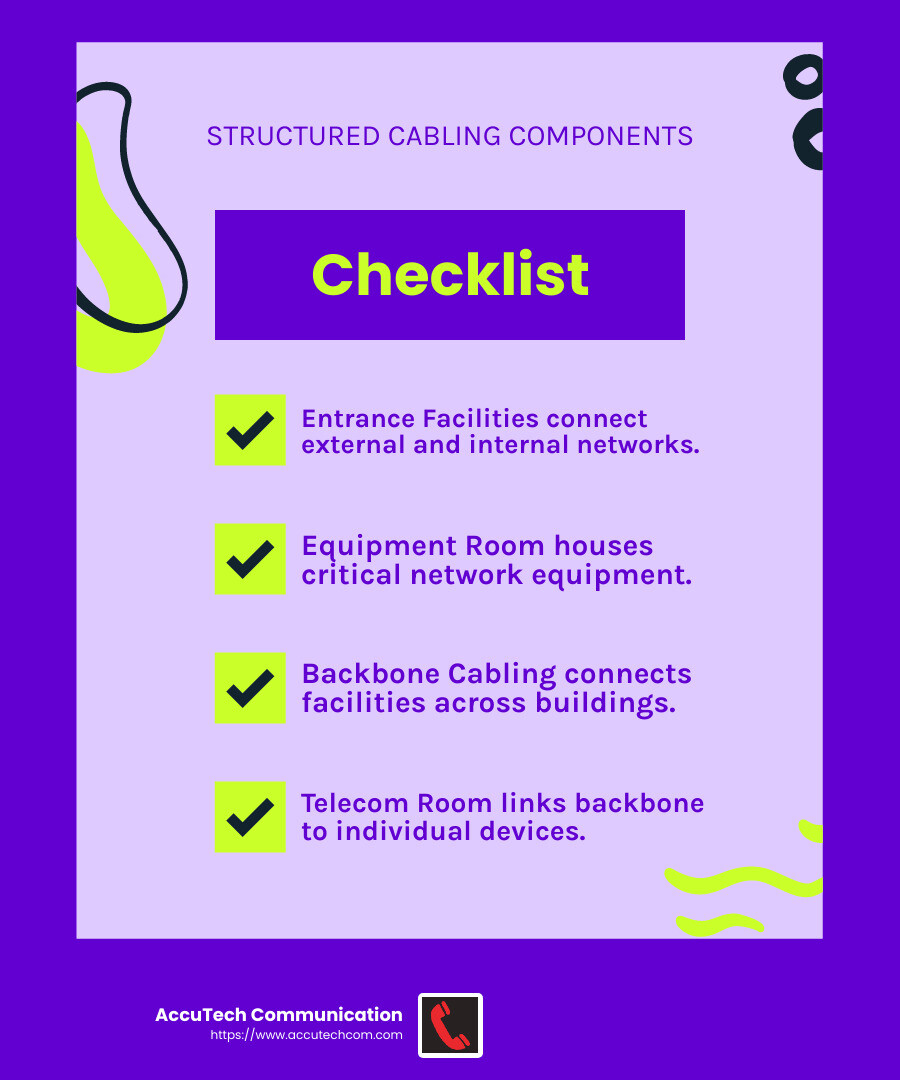
These components work together to create a robust and flexible structured cabling system that supports the communication needs of a business. By organizing and standardizing the cabling infrastructure, businesses can enjoy reliable and scalable network performance, essential for adapting to future technological advancements.
Next, we’ll explore the importance of standards in commercial network cabling and how they ensure consistency and quality across installations.
The Importance of Standards in Commercial Network Cabling
Standards are the backbone of commercial network cabling. They ensure that all installations are consistent, reliable, and efficient. One of the key standards in this field is the ANSI/TIA-568. This is a set of guidelines developed by the Telecommunications Industry Association (TIA) to ensure that cabling systems are compatible and perform optimally.
ANSI/TIA-568: The Gold Standard
The ANSI/TIA-568 standard covers everything from cable types to installation methods. It helps in defining how to design, install, and maintain cabling systems. This ensures that no matter who installs the system, the outcome is predictable and meets performance expectations.
International Standards
Beyond the ANSI/TIA-568, there are international standards that align with these guidelines. This global alignment is crucial for companies operating in multiple countries. It ensures that their telecommunications infrastructure is consistent worldwide, reducing the risk of incompatibility and performance issues.
Why Standards Matter
- Consistency: Standards ensure that cabling systems are uniform. This consistency makes troubleshooting and maintenance easier.
- Quality Assurance: By adhering to standards, businesses can be confident that their network infrastructure will support high-speed connectivity and future growth.
- Interoperability: Standards allow different systems and devices to work together seamlessly, which is essential in today’s interconnected world.
- Scalability: A standardized system can easily adapt to new technology and increased demands, saving businesses time and money in the long run.
In summary, adhering to these standards is not just about following rules—it’s about ensuring a robust, reliable, and scalable network infrastructure that can support a business’s evolving needs. Next, we’ll dig into the benefits of structured cabling for businesses and how it can drive efficiency and growth.
Benefits of Structured Cabling for Businesses
Structured cabling is more than just a bunch of wires; it’s the backbone of a modern business’s communication system. It offers several key benefits that can help businesses thrive in today’s world.
High-Speed Connectivity
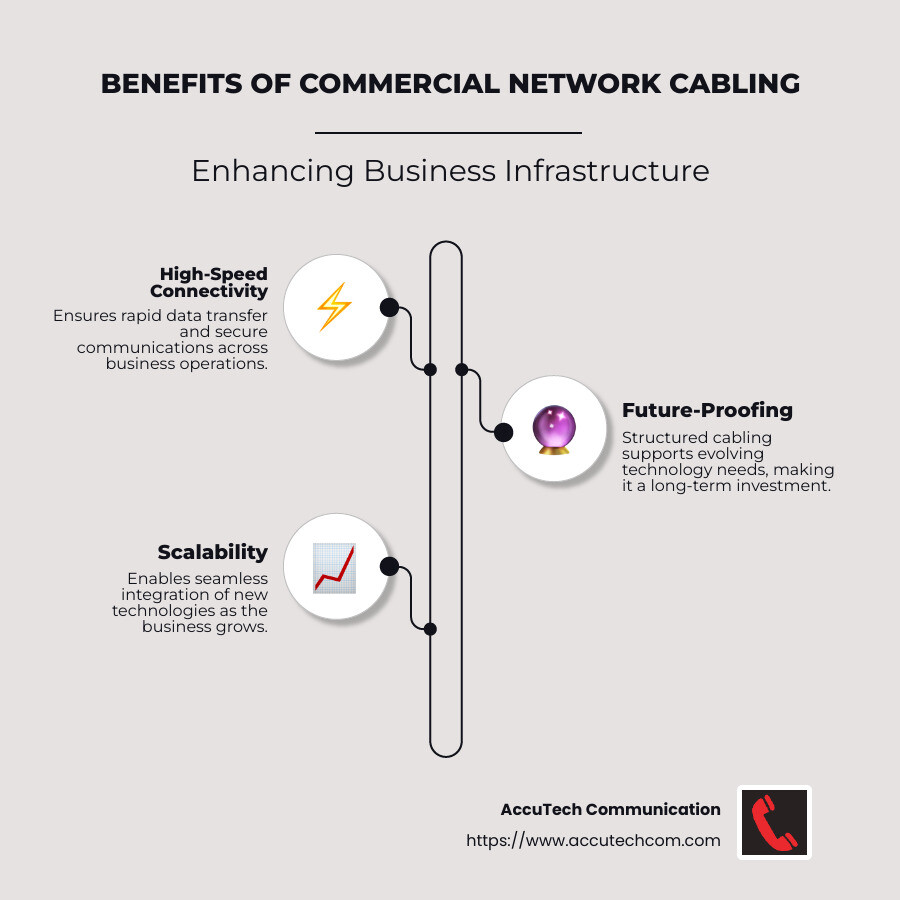
When speed is king, structured cabling provides businesses with the high-speed connectivity they need. It supports fast data transfer rates, which are crucial for activities like video conferencing and cloud computing. With the right setup, your business can enjoy seamless communication and data processing.
Future-Proofing
Technology changes rapidly, and businesses need to keep up. Structured cabling is designed with the future in mind. It allows you to easily upgrade your network without starting from scratch. This means that as new technologies emerge, your business can adapt quickly and efficiently.
Scalability
As your business grows, so will your network needs. Structured cabling systems are inherently scalable. Whether you’re adding new devices, expanding to new locations, or increasing your bandwidth, a well-designed cabling system can accommodate these changes with minimal disruption.
Efficiency
Efficiency is about doing more with less, and structured cabling helps businesses achieve this. By organizing and standardizing your network infrastructure, it reduces the complexity of your IT systems. This makes troubleshooting and maintenance easier, saving you time and money.
In summary, structured cabling is a smart investment for any business looking to improve connectivity, prepare for future growth, scale operations, and improve overall efficiency. Next, we’ll address some frequently asked questions about commercial network cabling to help you make informed decisions for your business.
Frequently Asked Questions about Commercial Network Cabling
What are the types of network cables used in commercial settings?
In commercial settings, three main types of network cables are commonly used: twisted pair, coaxial cables, and fiber optic cables.
- Twisted Pair Cables: These are often used for telephone and Ethernet networks. They consist of pairs of wires twisted together to reduce electromagnetic interference. Twisted pair cables are cost-effective and suitable for short to medium distances.
- Coaxial Cables: Known for their durability and ability to carry signals over longer distances, coaxial cables are often used for cable television and internet connections. They have a single copper conductor at the center, a plastic layer providing insulation, and a braided metal shield.
- Fiber Optic Cables: These are the go-to choice for high-speed and long-distance data transmission. Fiber optic cables use light to transmit data, which allows for faster speeds and greater bandwidth compared to other types. They are ideal for commercial settings that require reliable and high-speed internet access.
How much does it cost to install commercial network cabling?
The cost of installing commercial network cabling can vary widely based on several factors:
- Project Size: Larger projects with extensive cabling requirements will naturally cost more. The number of devices and the complexity of the network design are key considerations.
- Cable Type: The type of cable used can significantly impact the cost. For instance, fiber optic cables are generally more expensive than twisted pair cables due to their superior performance and installation complexity.
- Infrastructure Needs: If your building requires significant infrastructure upgrades, such as additional conduits or pathways, this will increase the overall cost.
While it’s challenging to provide a specific cost range without details, businesses should consider these factors when budgeting for network cabling installations.
What is structured cabling and why is it important?
Structured cabling is a standardized approach to creating a network infrastructure. It involves organizing and managing cables in a way that supports the current and future needs of a business.
- Streamlined Infrastructure: A structured cabling system simplifies your network by organizing cables neatly and logically. This reduces clutter and makes it easier to manage and troubleshoot your network.
- Future Growth: As your business evolves, your network needs will change. Structured cabling allows for easy upgrades and expansions, ensuring that your infrastructure can grow with your business. This flexibility is crucial for adapting to new technologies and increasing demands.
Structured cabling is important because it provides a reliable, scalable, and efficient foundation for your business’s communication needs. It ensures that your network can support high-speed connectivity and adapt to future changes, making it a smart investment for long-term success.
In the next section, we will conclude our exploration of commercial network cabling by highlighting how AccuTech Communications can help you achieve your business goals with certified service and competitive pricing.
Conclusion
At AccuTech Communications, we understand the critical role that commercial network cabling plays in a business’s success. Since 1993, we have been committed to delivering certified, reliable services to businesses across Massachusetts, New Hampshire, and Rhode Island. Our team is dedicated to ensuring that your network infrastructure is not only up to current standards but is also prepared for future growth.
Certified Service: Our technicians are highly trained and certified, ensuring that every installation meets industry standards. This commitment to quality means you can trust your network will perform optimally, supporting your business’s communication needs without interruption.
Competitive Pricing: We strive to provide our clients with cost-effective solutions without compromising on quality. Our competitive pricing model allows businesses of all sizes to access top-tier network cabling services, ensuring that you get the best value for your investment.
Massachusetts Expertise: With locations throughout Massachusetts, including Metro-west Boston, Marlborough, and Worcester, we are your local experts in network cabling. Our deep understanding of the region’s unique needs allows us to tailor our solutions to meet the specific demands of businesses in this area.
Whether you’re looking to upgrade your current network infrastructure or install a new system, AccuTech Communications is here to help. Our expertise in structured cabling ensures that your network is ready to support your business today and scale with you tomorrow.
Ready to improve your business’s connectivity? Contact us today to learn more about our comprehensive network cabling solutions and how we can help your business thrive.
