
Communication Service Provider: Essential in 2025
Why Communication Service Providers Are Essential in Today’s Digital World
A communication service provider is a company that offers telecommunications services or a combination of information and media services, content, entertainment, and application services over networks. These providers leverage network infrastructure as a functional platform to deliver essential connectivity services to businesses and consumers worldwide.
Key types of communication service providers include:
- Telecommunications Carriers – Traditional phone companies offering voice and data services
- Internet Service Providers (ISPs) – Companies providing internet connectivity to homes and businesses
- Mobile Network Operators (MNOs) – Wireless carriers offering cellular services and mobile data
- Cloud Communications Providers – Companies delivering communication services via cloud platforms
- Managed Service Providers (MSPs) – Organizations managing communication services on behalf of businesses
The global communication service providers market is valued at approximately $1.4 trillion, with the largest markets spanning the Asia Pacific region, Europe, and North America. These providers manage the critical infrastructure required to deliver communication services, including networks, servers, and telecommunications equipment that keep our interconnected world running smoothly.
For businesses today, CSPs are more than just service vendors – they’re essential partners enabling everything from basic internet connectivity to advanced unified communications systems. Whether it’s ensuring your business phone systems maintain crystal-clear voice quality or implementing structured cabling that can scale with your growth, the right communication infrastructure forms the backbone of operational success.
As the owner of AccuTech Communications with over 30 years of experience serving businesses across Massachusetts, New Hampshire, and Rhode Island, I’ve witnessed how the communication service provider landscape has evolved to meet increasingly complex business needs. My team and I specialize in designing scalable communication solutions that align with business goals, from modern structured cabling systems to reliable business phone systems.
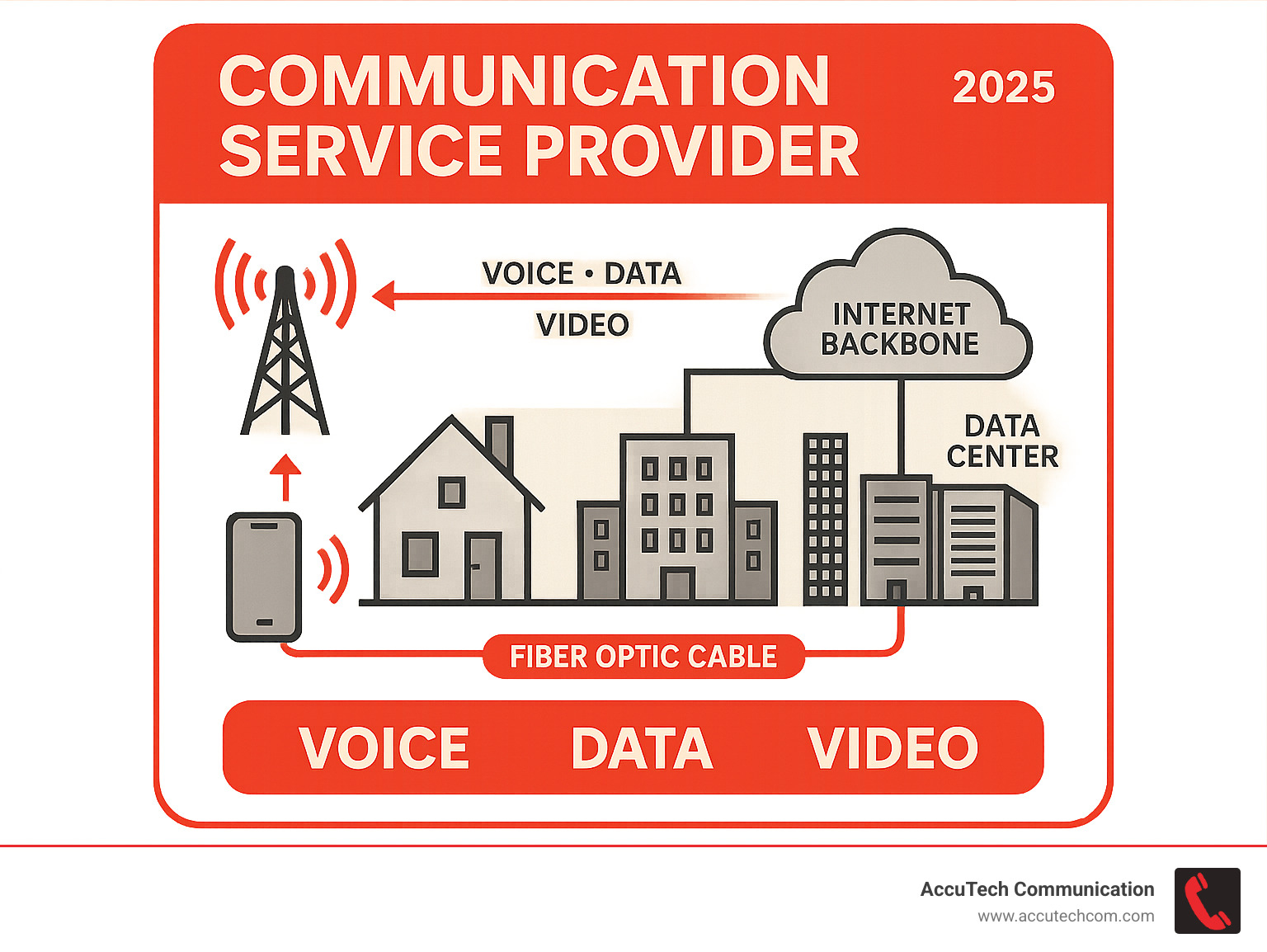
What is a Communication Service Provider (CSP)?
Picture this: every time you send a text, hop on a video call, or stream your favorite show, there’s an entire invisible network working behind the scenes to make it happen. That’s where communication service providers come in – they’re the companies that make our connected world possible.
According to Gartner, a communication service provider (CSP) offers telecommunications services or some combination of information and media services, content, entertainment, and application services over networks. Think of them as the digital architects who build and maintain the highways that carry all our conversations, emails, and cat videos across the globe.
But CSPs do much more than just flip a switch to turn on your internet. They’re juggling multiple complex responsibilities every single day. Service delivery means getting connectivity from their massive networks right to your device – whether that’s setting up your home Wi-Fi or configuring a business phone system. Network infrastructure management involves the heavy lifting of building, maintaining, and constantly upgrading the physical backbone of communication, from fiber-optic cables to data centers.
When something goes wrong (and let’s face it, technology has its moments), CSPs provide customer support to get you back online quickly. They also handle the less glamorous but essential task of billing and payments – tracking usage, generating bills, and processing payments for millions of customers.
The Main Types of Communication Service Providers
The world of CSPs isn’t one-size-fits-all. Different providers specialize in different pieces of the communication puzzle, each playing a vital role in keeping us connected.
Telecommunications carriers, or telcos, are the old-school veterans of the industry. These companies started with landline phones decades ago but have evolved into communication powerhouses. Today, they offer everything from traditional voice services to high-speed broadband, often owning miles of fiber-optic cables and switching centers that form the backbone of our communication infrastructure.
Internet Service Providers (ISPs) are your gateway to the online world. They’re the companies that bring internet connectivity to your home or business using various technologies like DSL, cable, fiber-optic, or even satellite connections. For most people, their ISP is their main touchpoint with a communication service provider.
Cloud communications providers represent the new generation of CSPs. Instead of owning massive physical infrastructure, they leverage cloud computing to deliver services over the internet. This includes Voice over Internet Protocol (VoIP) systems, unified communications platforms that combine voice, video, and messaging, and contact center solutions. Their cloud-based approach offers incredible flexibility and scalability.
Managed service providers (MSPs) take a different approach entirely. While they may not own the underlying network infrastructure, they specialize in managing and optimizing communication systems for businesses. Think of them as your communication consultants – they handle everything from business phone systems to network security, letting you focus on running your business instead of troubleshooting tech issues.
The Critical Role of Internet and Data Services
Asking someone to imagine life without internet is like asking them to imagine life without electricity. Internet and data services have become absolutely essential for everything we do, and CSPs are the ones making it all possible.
Broadband internet isn’t a luxury anymore – it’s a fundamental utility that powers our digital lives. Whether you’re running a small business in Massachusetts or managing a large operation across New England, reliable internet connectivity is the foundation that everything else builds on.
Fiber-optic technology has been a game-changer in this space. These incredibly thin glass fibers can carry massive amounts of data at the speed of light, offering best speed and reliability. Over our 30 years serving businesses throughout Massachusetts, New Hampshire, and Rhode Island, we’ve seen how proper fiber optic cabling installation can transform a company’s capabilities.
But connectivity isn’t just about the line coming into your building. Structured cabling creates the organized internal network that connects every computer, phone, and device in your office. It’s like having a well-designed highway system inside your building – everything flows smoothly and efficiently when it’s done right.
CSPs serve as the data transmission backbone of our modern economy. They’re constantly investing in network connectivity solutions to ensure information can flow reliably across vast distances and within our organizations. Without their continuous innovation and infrastructure investment, our digital world would simply stop working.
The Technology Powering Modern Communication

It’s amazing how far we’ve come from the days when making a phone call meant cranking a handle and asking an operator to connect you. The technological evolution that communication service providers have driven over the decades reads like science fiction—except it’s all real and happening right now.
Think about it: we’ve gone from those early landlines with their copper wires carrying analog signals to today’s digital networks that can stream 4K movies while you’re video chatting with someone on the other side of the world. This change didn’t happen overnight. It’s been the result of countless innovations, massive investments, and the relentless work of CSPs to push the boundaries of what’s possible.
The shift from analog to digital was just the beginning. Today’s networks don’t just carry more data—they’re smarter, more efficient, and incredibly more capable than anything we could have imagined even a decade ago. Every time you send a photo, stream a video, or join a virtual meeting, you’re benefiting from years of technological advancement that CSPs have carefully integrated into their infrastructure.
Foundational Advancements in Network Technology
The magic behind today’s seamless communication experiences comes from several key technologies that have revolutionized how communication service providers deliver their services.
5G networks represent perhaps the most exciting leap forward in recent years. While earlier generations of cellular technology were impressive, 5G is in a league of its own. We’re talking about speeds that can download a full movie in seconds, latency so low it feels instantaneous, and the capacity to connect millions of devices in a single area. But here’s the really exciting part—5G isn’t just about faster phones. It’s opening doors to autonomous vehicles, remote medical procedures, and smart cities that seemed like pure fantasy just a few years ago.
Fiber-optic communication continues to be the unsung hero of our connected world. These thin strands of glass carry information as pulses of light, traveling at incredible speeds without the interference that plagues traditional copper wires. When your video calls are crystal clear and your cloud applications respond instantly, you can thank fiber optics. It’s the backbone that makes everything else possible.
Edge computing is changing the game by bringing processing power closer to where it’s actually needed. Instead of sending every piece of data to a distant server farm, edge computing handles tasks locally. This means faster responses, less network congestion, and better performance for time-sensitive applications. Imagine a smart factory where machines can make split-second decisions without waiting for instructions from a faraway data center—that’s the power of edge computing.
The Internet of Things (IoT) has transformed everyday objects into smart, connected devices. Your thermostat, security camera, and even your refrigerator can now communicate over networks that CSPs maintain. Supporting billions of these devices requires robust, secure connectivity that can handle everything from a simple temperature reading to complex industrial sensor data.
While all these high-tech innovations grab headlines, the foundation of reliable communication still depends on quality network cabling. Whether it’s copper or fiber, the physical infrastructure within buildings and campuses must be installed correctly to deliver the speeds and reliability that modern networks promise. For businesses looking to ensure their internal networks can handle today’s demands, investing in proper network cabling is essential.
Artificial Intelligence and Machine Learning are becoming the brains behind modern networks. CSPs use these technologies to predict when equipment might fail, optimize data traffic, spot security threats, and automate routine maintenance tasks. It’s like having a super-smart assistant that never sleeps, constantly working to keep networks running smoothly.
Future Trends Shaping the CSP Industry
The communication service provider industry never stands still, and several exciting trends are already shaping what comes next.
Increased 5G adoption will continue accelerating as more areas get coverage and new applications emerge. We’re just scratching the surface of what becomes possible when ultra-fast, low-latency connectivity is everywhere.
The expansion of IoT ecosystems means we’ll see even more connected devices in our homes, cities, and workplaces. From smart streetlights that adjust based on traffic to healthcare monitors that can predict medical emergencies, the possibilities are endless.
Cloud-based platforms are changing how communication services are delivered. Instead of buying and maintaining expensive equipment, businesses can access sophisticated communication tools through the cloud, getting enterprise-level features with the flexibility to scale up or down as needed.
Network automation powered by AI will make networks even more reliable and efficient. These systems will be able to fix problems before users even notice them and optimize performance automatically based on changing conditions.
Finally, improved customer experience through personalization means CSPs will use data analytics to offer services custom to individual needs. Instead of one-size-fits-all solutions, customers will get recommendations and support that match their specific usage patterns and preferences.
The future of communication technology looks incredibly bright, and CSPs are the ones making it all possible.
Navigating Key Industry Challenges and Strategies

Running a communication service provider today feels a bit like trying to change the tires on a race car while it’s still speeding around the track. The industry moves at breakneck pace, and CSPs must juggle multiple complex challenges while continuing to deliver reliable service to millions of customers.
Competition in the CSP space is absolutely fierce. Every provider is fighting for market share, which means they’re constantly under pressure to offer better services, more competitive pricing, and superior customer experiences. It’s not enough to just maintain the status quo anymore.
The capital investment requirements are staggering. Building out 5G networks, laying thousands of miles of fiber-optic cable, and maintaining massive data centers requires billions of dollars. These aren’t optional upgrades either – they’re essential for staying competitive and meeting customer expectations.
Meanwhile, evolving customer demands keep raising the bar. People expect lightning-fast internet speeds, crystal-clear video calls, and seamless connectivity everywhere they go. What seemed impossibly fast five years ago is now considered the bare minimum.
Perhaps most challenging of all is technological disruption. New technologies emerge constantly, and CSPs must decide which ones to accept, which ones to watch, and which ones might make their current infrastructure obsolete. It’s like playing chess while someone keeps changing the rules mid-game.
Regulatory and Security Concerns
If you think keeping up with technology is tough, try navigating the maze of regulations that govern the CSP industry. Data privacy regulations have become incredibly complex, with different rules in different regions. European GDPR requirements, various state-level privacy laws, and federal regulations all create a patchwork of compliance requirements that CSPs must master.
Understanding frameworks like the Privacy Act isn’t just about avoiding fines – it’s about building trust with customers who are increasingly concerned about how their personal information is handled. When people share their data with a communication service provider, they expect it to be protected with the highest standards.
Cybersecurity threats pose another constant headache. CSP networks are incredibly attractive targets for hackers because they handle so much sensitive data and critical infrastructure. A successful attack doesn’t just hurt the provider – it can disrupt essential services for entire communities.
Network security requires round-the-clock vigilance. CSPs invest heavily in monitoring systems, threat detection, and rapid response capabilities. They’re essentially running a 24/7 digital security operation while simultaneously delivering communication services.
The challenge of infrastructure protection extends beyond just cyber threats. Physical security of data centers, cell towers, and network equipment is equally critical. A single point of failure can cascade into widespread service disruptions.
Growth and Expansion Strategies for CSPs
Despite these challenges, successful CSPs are finding innovative ways to grow and expand their reach. Investing in new technology remains the foundation of any growth strategy. Whether it’s rolling out 5G networks, upgrading to fiber-optic infrastructure, or implementing AI-powered network management, technology investments are essential for staying competitive.
Expanding into underserved markets presents tremendous opportunities. Rural areas and emerging markets often lack reliable high-speed internet access, creating genuine demand for CSP services. These expansions can be challenging logistically, but they offer the chance to build loyal customer bases in markets with less competition.
Strategic partnerships have become increasingly popular as a way to expand capabilities without massive solo investments. CSPs might partner with cloud providers, content companies, or specialized technology firms to offer more comprehensive services to their customers.
Mergers and acquisitions allow CSPs to quickly scale their operations and eliminate competition. While these deals are complex and expensive, they can create stronger companies with more resources to invest in infrastructure and innovation.
The push toward service diversification is perhaps the most interesting trend we’re seeing. CSPs are expanding beyond basic connectivity to offer managed IT services, cybersecurity solutions, cloud platforms, and even entertainment content. This approach helps them become more valuable to customers while creating multiple revenue streams.
At AccuTech Communications, we’ve seen how important it is for businesses to have flexible, scalable infrastructure that can adapt to these changing service offerings. Our structured cabling services provide the solid foundation that businesses need to take advantage of new technologies and services as they become available. After three decades in this business, we know that the right infrastructure today opens up possibilities you might not even imagine yet.
The Indispensable Role of CSPs in the Digital Economy

When I think about how dramatically our world has changed over the past few decades, one thing becomes crystal clear: communication service providers have quietly become the backbone of modern society. They’re not just companies that provide internet and phone services—they’re the invisible force that keeps our entire digital economy humming along.
Remember March 2020? When the world suddenly shifted to remote work practically overnight, it wasn’t magic that made it possible. CSPs had already built the robust networks that allowed millions of people to transform their kitchen tables into offices. Video calls with colleagues in different time zones, cloud-based collaboration tools, and secure connections to company servers—all of this became our new normal because the infrastructure was already there, waiting for us.
The same applies to how we learn today. Whether it’s a first-grader attending virtual school or a graduate student accessing online lectures from a university thousands of miles away, enabling remote work and supporting online education have become foundational services. CSPs ensure that a student in rural New Hampshire can access the same educational resources as someone in downtown Boston, breaking down barriers that once seemed impossible to overcome.
Then there’s the explosion of online shopping. Every time you click “buy now,” your order travels through networks maintained by CSPs. From the moment you browse products to when you receive that delivery notification, powering e-commerce happens entirely on their infrastructure. It’s remarkable when you think about it—a simple purchase involves data racing across fiber-optic cables, through data centers, and back to your device in milliseconds.
But perhaps most importantly, CSPs play a critical role in facilitating emergency services. When disaster strikes, their networks become lifelines. First responders coordinate rescue efforts, families check on loved ones, and emergency alerts reach everyone who needs them. This isn’t just about convenience—it’s about saving lives.
What really excites me is how CSPs are bridging geographical divides. I’ve seen how reliable network infrastructure can transform a small business in rural Massachusetts, giving them the same competitive advantages as companies in major metropolitan areas. When we install quality structured cabling or set up business phone systems, we’re not just providing technical services—we’re opening doors to new opportunities.
As someone who’s been in this industry for over 30 years, I’ve watched CSPs evolve from simple phone companies into the engine of digital change. They’ve created the foundational infrastructure that makes innovation possible, economic growth achievable, and social connections stronger than ever before.
At AccuTech Communications, we’re proud to be part of this ecosystem, providing the network solutions that help businesses across Massachusetts, New Hampshire, and Rhode Island tap into the incredible potential that modern communication technology offers.
Conclusion
When you step back and look at the bigger picture, it’s remarkable how much our daily lives depend on communication service providers. They’re not just companies that send you monthly bills – they’re the invisible architects building the digital world we live in every day. From the moment you wake up and check your phone to the late-night video call with family across the country, CSPs are quietly working behind the scenes to make it all possible.
These providers truly serve as the engine of digital change. They’re constantly pushing boundaries, pouring billions into cutting-edge technologies like 5G networks and lightning-fast fiber optics. They’re the ones taking risks on new innovations, testing AI-powered network management, and figuring out how to connect the next billion devices that will inevitably join our digital ecosystem.
The foundational infrastructure they build and maintain isn’t just about keeping us connected – it’s about open uping human potential. Think about it: every startup that launches, every student who learns online, every grandparent who video chats with grandchildren, every emergency call that saves a life – none of it happens without the reliable networks that CSPs provide.
Of course, this responsibility comes with real challenges. Navigating complex privacy laws, defending against sophisticated cyber threats, and keeping up with our ever-growing appetite for bandwidth isn’t easy. But the best CSPs rise to meet these challenges because they understand what’s at stake.
At AccuTech Communications, we’ve witnessed how the right communication infrastructure can transform a business. Since 1993, we’ve been helping companies across Massachusetts, New Hampshire, and Rhode Island build the reliable backbone they need to thrive in our hyper-connected world. Whether it’s designing robust network cabling that can grow with your business, implementing crystal-clear business phone systems, or ensuring your data center is ready for whatever technology comes next, we understand that quality infrastructure is the foundation of success.
We believe that great communication services aren’t just about staying connected – they’re about opening doors to possibilities you might not have even imagined yet. When your network is reliable, your team can focus on what they do best instead of worrying about dropped calls or slow internet.
Ready to see how solid communication infrastructure can empower your business? We’d love to show you what’s possible. Learn more about business communication services and find how we can help build the foundation for your company’s future success.
