Why Communication Services Matter for Your Business Success
Communication services are the technologies that connect your business to customers, employees, and partners. This ecosystem includes everything from business phone systems and network cabling to cloud platforms and internet connectivity. Powering a global market worth over $8 trillion, these services are the engine for modern business operations.
For businesses in sectors like healthcare and manufacturing, choosing the right services is a strategic decision. It’s about ensuring reliability, security, and scalability. Your communication infrastructure must support daily operations without interruption, protect sensitive data, and grow with your company.
This often comes down to a choice between on-premise systems, which offer maximum control, and cloud-based solutions that provide flexibility and scalability. However, the true backbone of any high-performing system is professional network cabling. Without a solid, professionally installed network, even the most advanced technology will fail to deliver, leading to dropped calls and slow data.
At AccuTech Communications, we’ve spent over 30 years helping businesses in Massachusetts, New Hampshire, and Rhode Island build reliable communication infrastructure. We design and install systems that support long-term growth by meeting both immediate needs and future demands.
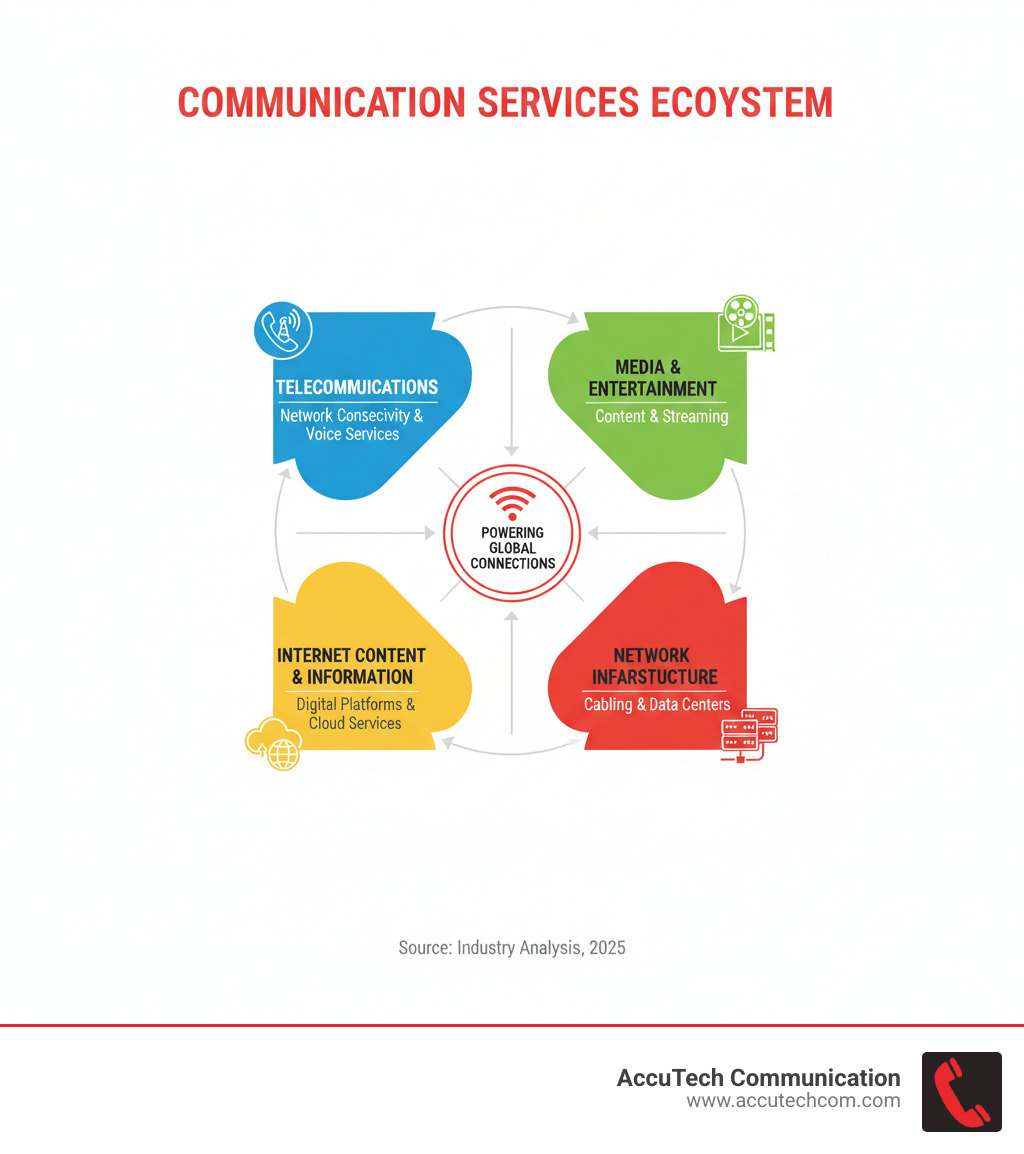
The Spectrum of Modern Communication Services
The communication services sector is a dynamic ecosystem that powers how we connect and share information. It’s broadly divided into a few key areas. Telecommunications provides the foundational infrastructure for voice and data, including fixed-line networks, wireless carriers, and internet service providers. Above this layer sits Internet Content & Information, which includes the online platforms, cloud services, and social media that facilitate digital interaction.
Together, these segments drive innovation and enable the digital economy. The constant evolution of digital services, from streaming media to cloud-based business applications, creates ever-increasing demand for faster, more reliable networks. This is where the foundational infrastructure becomes critical.
Foundational Telecom and Digital Services
At the heart of all business communication lies the telecommunications infrastructure. These core services are the bedrock upon which all other digital interactions are built:
- Fixed-line and Wireless Access: These include traditional wired connections, which still offer essential reliability, and wireless networks (Wi-Fi, cellular) that provide the mobility modern businesses demand.
- Internet and Data Services: This is the gateway to the digital world, encompassing everything from broadband and fiber optic access to the secure transmission of data between locations for cloud computing and remote work.
- Voice over IP (VoIP) and Traditional Telephony: VoIP has revolutionized business phones by running voice over the internet, offering flexibility and advanced features. Traditional phone services still play a role for businesses with legacy systems.
- Cloud-Based Applications: The shift to the cloud has given rise to countless business applications delivered as a service, facilitating collaboration, data storage, and operational efficiency.
These foundational and digital services are not just about making calls; they enable seamless data flow and support critical business applications. For businesses in Massachusetts, New Hampshire, and Rhode Island, a strong telecommunications foundation is the first step toward a truly connected and productive operation.
Essential Communication Services for Your Business
For any business in Massachusetts, New Hampshire, or Rhode Island, communication services must be flawless. Dropped calls, slow data, and system downtime lead to lost revenue and frustrated clients. This is especially true for healthcare facilities coordinating patient care or manufacturing plants managing supply chains.
Choosing the right services isn’t about flashy features; it’s about finding a solution that is reliable, secure, and scalable. Your system must protect sensitive data, meet compliance standards like HIPAA, and grow with your business.
More info about business communication services
Business Phone Systems: Your Voice in the World
Your phone system is a critical first impression. The main choice is between on-premise and cloud-hosted solutions.
- On-Premise PBX Systems: You own and control the hardware, which resides at your location. This is ideal for industries like healthcare or manufacturing that require data to remain internal and need deep customization. It involves a higher upfront investment and requires ongoing maintenance.
- Hosted VoIP Systems: Your phone system runs over the internet, managed by a provider for a monthly fee. This offers flexibility for remote teams, simple scalability, and advanced features like auto-attendants without large capital expenses.
- Hybrid Systems and SIP Trunks: Many businesses blend both approaches. A hybrid system might keep a core PBX on-site while adding cloud features for remote workers. SIP Trunks modernize an existing PBX by delivering phone service over the internet, which also helps meet e911 compliance under the Ray Baum Act by providing precise location information to emergency responders.
Network Infrastructure: The Backbone of Your Communication Services
You can have the best phone system and fastest internet, but without professional network cabling, none of it will work properly. Your network infrastructure is the backbone of all your communication services.
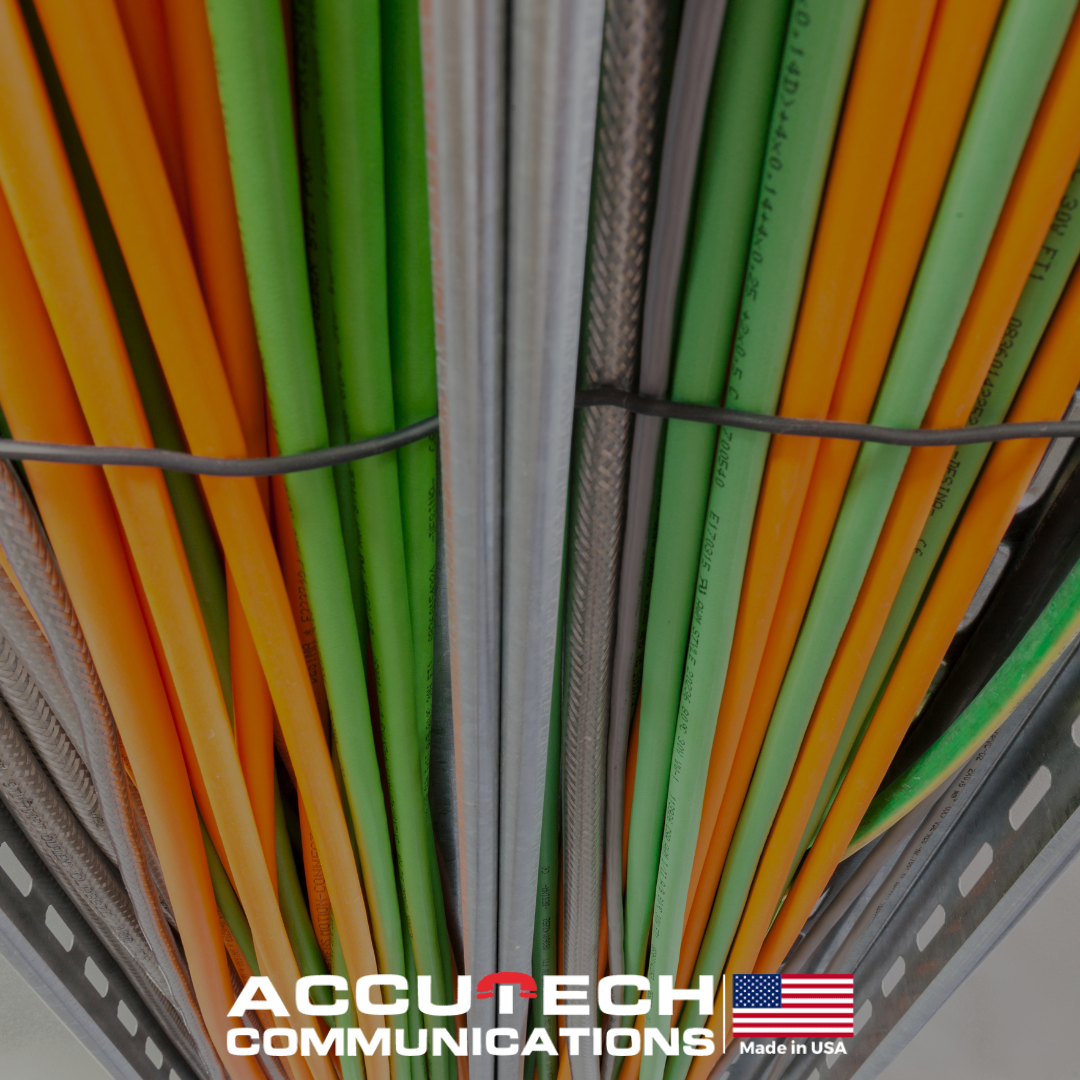
Structured cabling is an organized, standardized approach to building a complete infrastructure for voice, data, and video. A properly designed system makes future upgrades straightforward. We install reliable copper cabling (Cat5e, Cat6, Cat6A) for most LAN needs and design data center technologies for businesses with mission-critical server applications.
Professional installation is crucial. Poor workmanship leads to signal degradation and performance issues that are expensive to fix. Our certified technicians ensure your network is optimized for performance and built to last, a commitment backed by over 30 years of experience.
More info about structured cabling services
More info about network cabling installation
Future-Proofing Your Connectivity with Emerging Technologies
The world of communication services is racing forward. For businesses in Massachusetts, New Hampshire, and Rhode Island, the infrastructure installed today must be ready for tomorrow’s innovations. This means making smart, strategic investments to avoid costly future upgrades.

Technologies like 5G and Artificial Intelligence (AI) are reshaping connectivity. 5G offers faster speeds and lower latency for mobile teams and connected devices, while AI is optimizing network management and customer service. These advancements, along with the rise of the Internet of Things (IoT), all depend on one critical component: a high-capacity network.
At the heart of these emerging technologies is fiber optic cabling. Unlike copper, fiber offers virtually unlimited bandwidth, is immune to interference, and provides the rock-solid backbone that modern applications demand. Investing in fiber today is the best way to prepare for the data-intensive needs of the future.
More info about fiber optic cabling installation.
The Role of APIs and IoT
Two major trends driving infrastructure needs are APIs and the Internet of Things (IoT).
- Application Programming Interfaces (APIs) allow businesses to integrate voice, video, and chat directly into their own software, creating seamless user experiences. For example, a patient portal could include a built-in video consultation feature. This integration requires a reliable network to handle the data flow. Learn about modern communication APIs.
- The Internet of Things (IoT) involves connecting devices like sensors, cameras, and equipment monitors to your network. This creates a massive amount of data traffic that requires careful network capacity planning. A robust structured cabling and fiber optic foundation is essential to support the device density and data volume of IoT, preventing bottlenecks that can slow down your entire operation.
Preparing for these technologies means investing in network infrastructure that can handle the load. We design networks with future growth in mind, ensuring you have the capacity to support your connected business now and in the future.
Key Factors in Choosing Your Communication Services Provider
Selecting a provider for your communication services is about choosing a long-term partner. The relationship matters as much as the technology. When evaluating providers, focus on these key factors:
- Service Level Agreements (SLAs): An SLA is your guarantee of service quality, outlining uptime, performance, and support response times. When your system goes down, every minute counts.
- Customer Support: You need a responsive team that understands your systems and can resolve problems quickly. For critical operations in healthcare or manufacturing, this is non-negotiable.
- Local Expertise: A provider who knows the infrastructure in Massachusetts, New Hampshire, and Rhode Island understands local codes and can provide faster on-site service. Our experience in this region since 1993 is a key advantage for our clients.
Security and Compliance in Communication Services
Protecting your communication data isn’t optional. A breach can lead to financial loss and legal consequences. Data security is foundational, involving encryption, access controls, and threat monitoring.
For many businesses, regulatory compliance is critical. We have extensive experience helping healthcare facilities maintain HIPAA compliance by ensuring their phone systems and network infrastructure meet strict standards for protecting patient data. While regulations like GDPR and certifications like SOC 2 are also important, the core principle is the same: your provider must have robust controls to protect your data. We weave cybersecurity best practices into every installation to keep your business secure and compliant.
Scalability: Preparing Your Communication Services for Growth
Your communication infrastructure should enable growth, not hinder it. Scalability is crucial for ensuring your systems can keep pace with your business.
Planning for future business needs means choosing flexible infrastructure. Hosted VoIP systems, for example, make it easy to add or remove users. A well-designed structured cabling system can support new technologies without a complete overhaul. This proactive planning helps you avoid bottlenecks and ensures your investment has a longer lifespan. We design systems with your five-year plan in mind, providing a robust foundation that supports your ambitions.
Frequently Asked Questions about Communication Services
Here are answers to the questions we hear most often from business owners across Massachusetts, New Hampshire, and Rhode Island.
What are the main types of communication services for a business?
Business communication services fall into a few core categories that work together:
- Business Phone Systems: Your primary tool for voice communication, available as on-premise PBX or cloud-hosted VoIP systems.
- Network Infrastructure: The physical backbone of your communications, primarily structured cabling (copper and fiber optic) that connects your office.
- Internet and Data Services: Your connection to the outside world, including broadband or fiber internet access.
- Digital Collaboration Tools: Services like video conferencing, messaging, and email that keep your team connected.
We help businesses integrate these pieces into a cohesive, reliable system. More info about business communication services.
How do I choose between an on-premise and a cloud-based phone system?
The choice depends on your specific needs for control, cost, and flexibility.
- Choose On-Premise PBX if: You need maximum control over your hardware, require data to be stored internally for compliance (e.g., healthcare), and have the resources for a larger upfront investment and ongoing maintenance.
- Choose Cloud-Based VoIP if: You prioritize flexibility for remote workers, predictable monthly costs, and simple scalability. It’s ideal for growing businesses that want advanced features without managing hardware.
Many businesses also use a hybrid approach, combining the best of both worlds.
Why is professional network cabling important for my business?
Professional network cabling is the foundation for all your communication services. Without it, even the best technology will underperform. Its importance comes down to four key benefits:
- Reliability: Properly installed cabling prevents dropped calls, slow data speeds, and network outages.
- Scalability: A structured system is built to accommodate future growth and new technologies without a complete overhaul.
- Troubleshooting: Organized, labeled cabling makes identifying and fixing problems faster and less expensive.
- Safety and Compliance: Professional installation adheres to building codes, reducing safety risks.
Investing in professional installation from certified technicians ensures your network is reliable and built to last.
More info about network cabling installation and structured cabling services.
Conclusion: Building Your Connection Strategy
As we’ve seen, communication services are a complex but vital part of your business. From your phone system to your network cabling, the choices you make directly impact your efficiency, security, and ability to grow. Investing in a solid foundation is not just a technical decision—it’s a strategic one.
The right infrastructure, whether it’s an on-premise PBX, a flexible VoIP system, or a professionally installed fiber optic network, will support your operations for years to come. It ensures you can meet compliance standards, avoid frustrating downtime, and scale with confidence.
You don’t have to steer these decisions alone. At AccuTech Communications, we’ve spent over 30 years providing certified, reliable service to businesses across Massachusetts, New Hampshire, and Rhode Island. We specialize in building communication infrastructures that work, custom to the unique needs of industries like healthcare and manufacturing.
Our commitment is to quality and long-term partnership. We design and install systems that keep your business running smoothly today and prepare you for tomorrow. Your success depends on staying connected, and we’re here to build that foundation with you.
Get a consultation for your business communication needs and find how the right infrastructure can transform the way you work.