
Companies That Install Fiber Optic Cable: 5 Top-Rated Picks 2025
The Fiber Revolution: Powering Modern Connectivity
Companies that install fiber optic cable are essential partners in today’s digital change. If you’re looking for qualified fiber installation providers, here are the top categories to consider:
- Tier-1 Infrastructure Leaders – Global fiber manufacturers and carriers that handle large-scale national deployments
- Regional Service Experts – Local specialists with knowledge of area permits and codes
- Design-Build Firms – End-to-end solution providers that handle planning through installation
- Emergency & Maintenance Specialists – 24/7 support services for network restoration
- Campus & Industrial Installers – Niche providers specializing in specific environments like healthcare or manufacturing
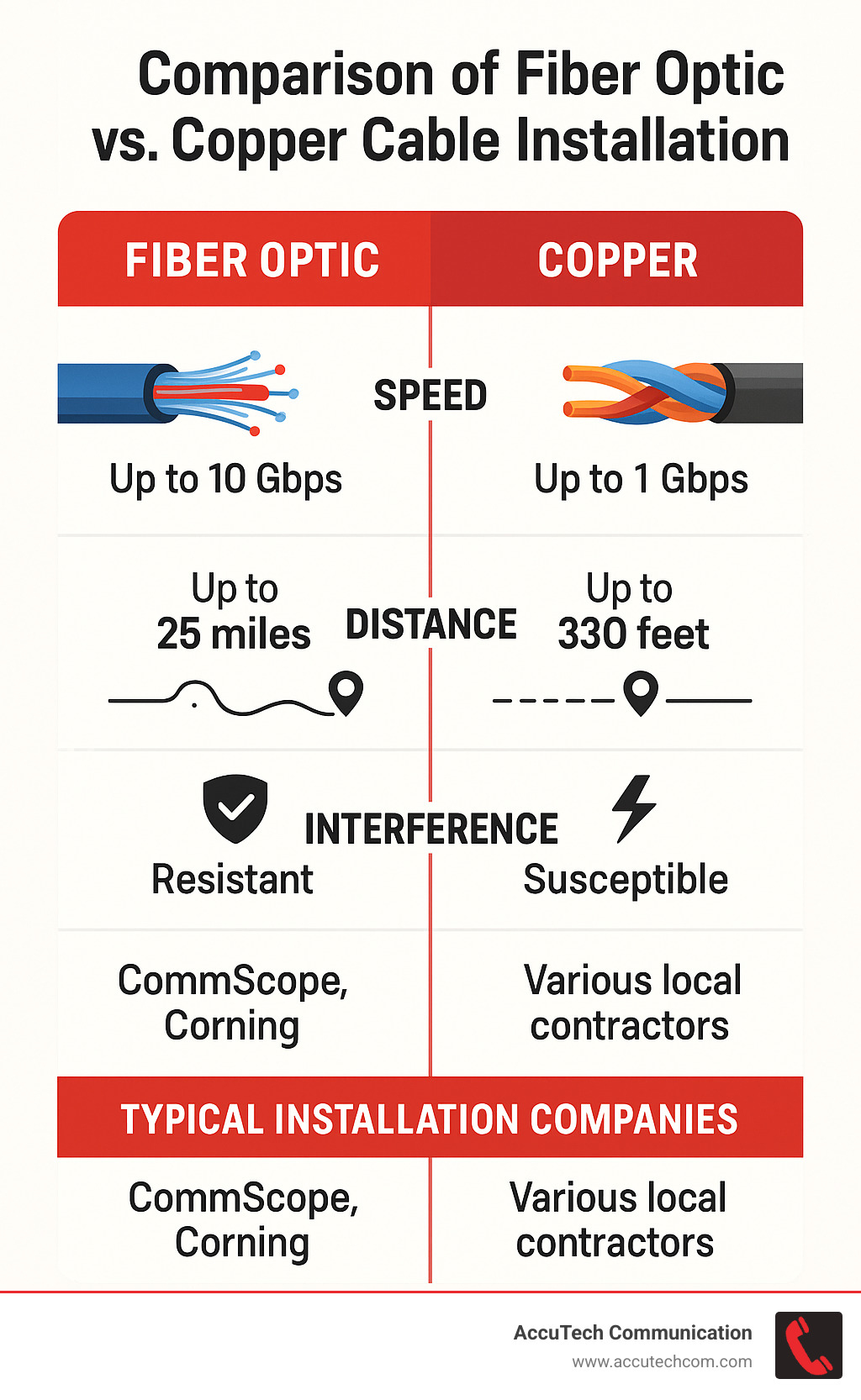
Fiber optic cabling has revolutionized modern communication, offering speeds up to 10 gigabits per second—far exceeding traditional copper networks. This technology uses thin strands of glass or plastic to transmit data via light signals, providing best bandwidth, reliability, and immunity to electromagnetic interference.
The global fiber optics market is booming, valued at $6.81 billion in 2020 and projected to reach $9.91 billion by 2027 with a compound annual growth rate of 4.6%. This growth reflects the increasing demand for high-speed connectivity across all sectors.
When selecting companies that install fiber optic cable, consider their:
- Industry certifications (BICSI, CFOT)
- Experience with your specific environment
- Testing and documentation processes
- Maintenance and support offerings
- Fusion splicing capabilities
I’m Corin Dolan, owner of AccuTech Communications with over 25 years of experience partnering with companies that install fiber optic cable across New England. My team has implemented fiber solutions for healthcare facilities, educational institutions, and enterprises seeking reliable, high-performance network infrastructure.
Companies that install fiber optic cable terms to learn:
– how to install fiber optic cable
– fiber optic splicing technician
– underground fiber optic cable installation
Why Fiber? Business & Home Benefits
Since 1993, we’ve helped countless businesses across Massachusetts, New Hampshire, and Rhode Island transform their operations with fiber optic technology. The benefits aren’t just impressive on paper—they create real, measurable differences for our clients.
Blazing Speed is often the first thing our customers notice. At up to 10 gigabits per second, fiber enables your team to run multiple bandwidth-hungry applications simultaneously. Imagine seamless video conferences, cloud applications, and large file transfers all happening without a hiccup—that’s the fiber difference.
Ever had equipment interference disrupt your network? Fiber’s complete Electromagnetic Immunity eliminates that headache entirely. Unlike copper, fiber optic cables don’t conduct electricity and aren’t affected by nearby power lines or machinery. This makes them perfect for healthcare settings with sensitive medical equipment or manufacturing floors with heavy machinery.
“We went from constant network issues disrupting patient care to a rock-solid infrastructure we simply don’t worry about anymore,” one of our healthcare clients told us after their fiber upgrade.
Distance limitations become a thing of the past with fiber. While copper signals degrade quickly, fiber optic signals can travel miles without repeaters. This makes campus environments and multi-building installations not just possible, but cost-effective.
As your business grows, fiber grows with you. The Future-Proof Bandwidth capacity means your physical infrastructure stays the same while only endpoint equipment needs upgrading. This scalability protects your investment for years to come.
When downtime equals lost revenue, fiber’s Superior Reliability becomes invaluable. Less susceptible to moisture, temperature changes, and physical damage, fiber keeps your critical systems running when you need them most.
More info about How Fiber Optic Cabling Can Improve Your Business Performance
The global demand for fiber connectivity continues to surge. According to international telecommunications research, internet users reached 4.13 billion in 2019 (53.6% of the global population) and are projected to exceed 5 billion by 2025. This exponential growth is driving massive investment in fiber infrastructure worldwide, with the Asia-Pacific region leading deployment through aggressive infrastructure initiatives.
When considering companies that install fiber optic cable, it’s important to understand how this technology delivers concrete benefits that traditional copper simply cannot match. At AccuTech, we’ve seen how fiber transforms businesses—from healthcare facilities with life-critical systems to educational institutions connecting multiple buildings across sprawling campuses.
Menu of Fiber Cables & Services You Can Order
When partnering with companies that install fiber optic cable, you’ll find a world of options custom to your connectivity needs. Let’s explore the fiber landscape together so you can make choices that serve your organization today and tomorrow.
Fiber Cable Types
Single-mode Fiber (SMF) is like the highway of fiber options – thin (just 9 microns at its core) but built for distance and speed. We often recommend single-mode when connecting buildings across a campus or establishing backbone infrastructure that needs to last. It uses laser light sources to achieve impressive bandwidth over miles of distance. Yes, it costs a bit more upfront, but it’s the definition of future-proofing your investment.
Multi-mode Fiber (MMF) is your friendly neighborhood option with a wider core (50 or 62.5 microns) that allows multiple light paths simultaneously. It’s perfect for shorter runs within buildings or data centers where distance tops out around 550 meters. The beauty of multi-mode? It delivers excellent performance for most internal applications at a more budget-friendly price point. It comes in several flavors (OM1 through OM5), with newer versions offering increasingly impressive bandwidth capabilities.
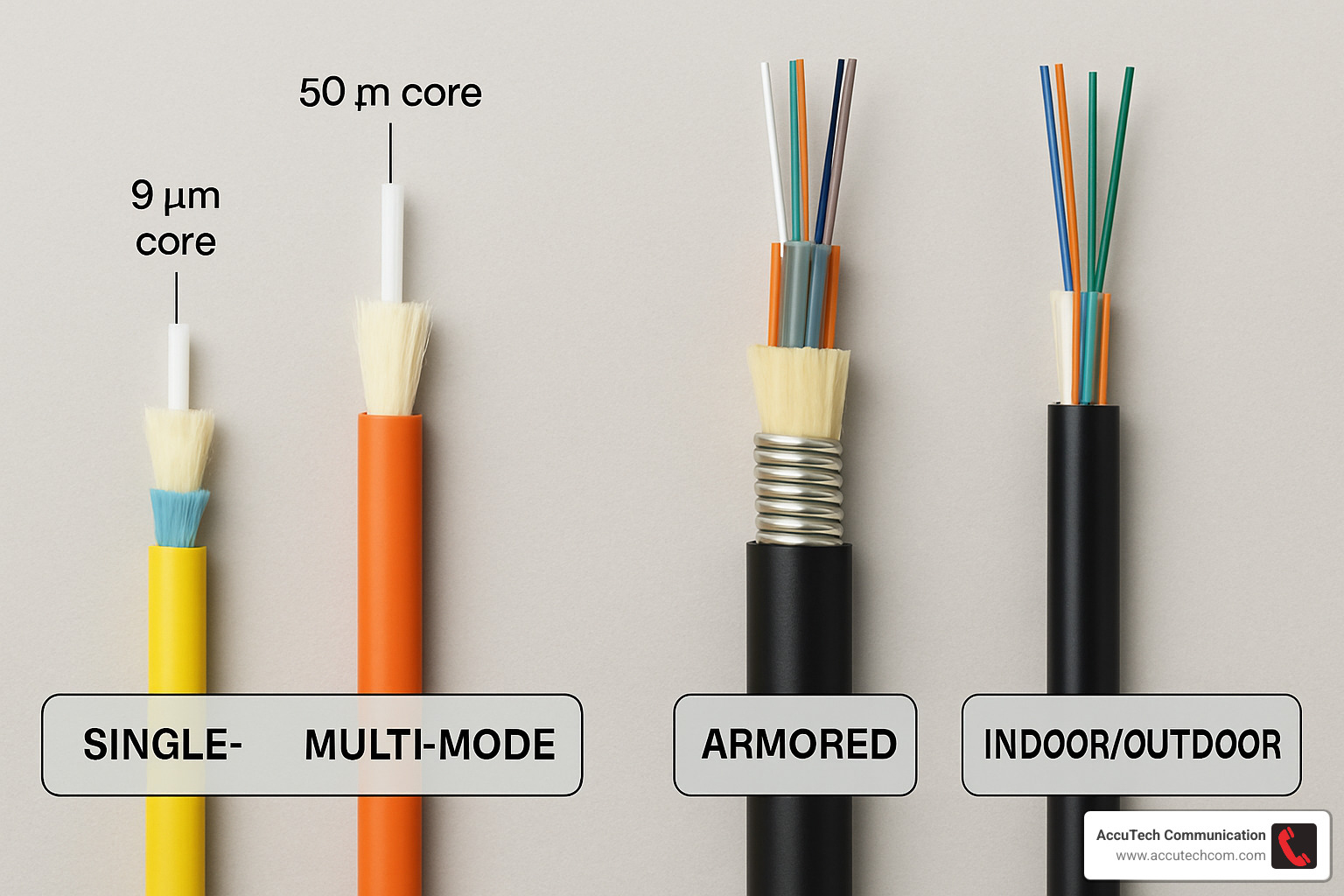
Need fiber that can brave the elements? Indoor/Outdoor Cables are specially designed to withstand Mother Nature’s challenges – UV rays, moisture, and temperature swings won’t faze these hardy options. They’re essential for New England campus environments where our seasonal weather can be… unpredictable.
For environments where your cable might take a beating, Armored Fiber adds a protective metal layer that shields against physical damage. We’ve installed these in manufacturing facilities, underground pathways, and anywhere cables might face mechanical stress or accidental encounters with equipment.
Air-blown Fiber represents installation innovation at its finest. Rather than pulling cables through conduit, we use compressed air to “blow” fiber through pre-installed microducts. The genius? When you need to upgrade in the future, there’s no digging or major disruption – just blow in new fiber. Many of our forward-thinking clients love this approach.
| Feature | Single-mode Fiber | Multi-mode Fiber |
|---|---|---|
| Core Size | 9 microns | 50-62.5 microns |
| Distance | Several miles | Up to 550 meters |
| Bandwidth | Higher | Lower |
| Light Source | Laser | LED |
| Cost | Higher | Lower |
| Applications | Long-haul, ISP, building-to-building | Data centers, within-building |
Installation Services
Beyond the physical cables, professional companies that install fiber optic cable offer specialized services that ensure your network performs flawlessly:
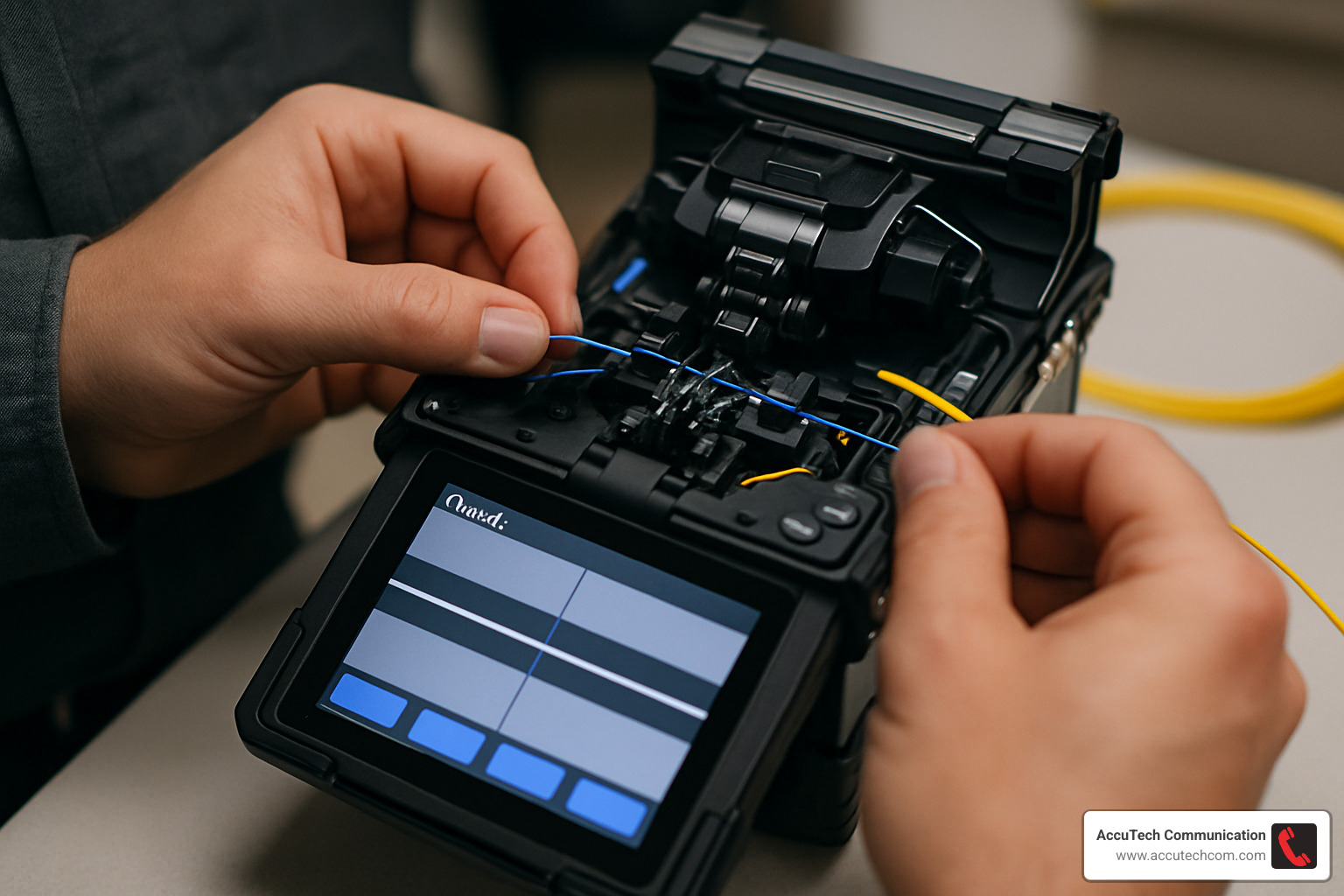
Fusion Splicing is where art meets science in fiber installation. Our technicians use precision equipment to melt fiber ends together with an electric arc, creating seamless connections with minimal signal loss. It’s fascinating to watch – the fibers align with microscopic precision before being permanently joined. This technique delivers significantly better performance than mechanical splices.
Every installation needs Testing & Certification to verify it meets industry standards. We use sophisticated tools like Optical Time Domain Reflectometers (OTDRs) and power meters to measure performance down to the decimal point. You’ll receive comprehensive documentation of all test results – essential for warranties and future troubleshooting.
Great networks begin with thoughtful Network Design. Before we run a single cable, we analyze your current needs, anticipated growth, and building architecture to create an optimal fiber pathway. This planning prevents costly mistakes and ensures your network has room to grow as your organization evolves.
Fiber is remarkably durable, but Maintenance Plans help keep it performing at its peak. Regular inspections, cleaning of connection points, and preventive checks can identify potential issues before they impact your operations. Many of our Massachusetts, New Hampshire and Rhode Island clients appreciate the peace of mind that comes with scheduled maintenance.
When the unexpected happens, our Emergency Restoration service springs into action. Fiber cuts or equipment failures don’t follow a 9-to-5 schedule, which is why we offer rapid response to minimize your downtime. Our local presence means we can reach most sites quickly when minutes matter.
More info about Types of Fiber Optic Cable
More info about Fiber Optic Cable Installation Services
Top 5 Profiles of Companies That Install Fiber Optic Cable
When searching for companies that install fiber optic cable, you’ll encounter several distinct types of providers in the marketplace. Understanding these different categories will help you find the perfect partner for your specific project needs, whether you’re upgrading a single office or connecting multiple campuses.
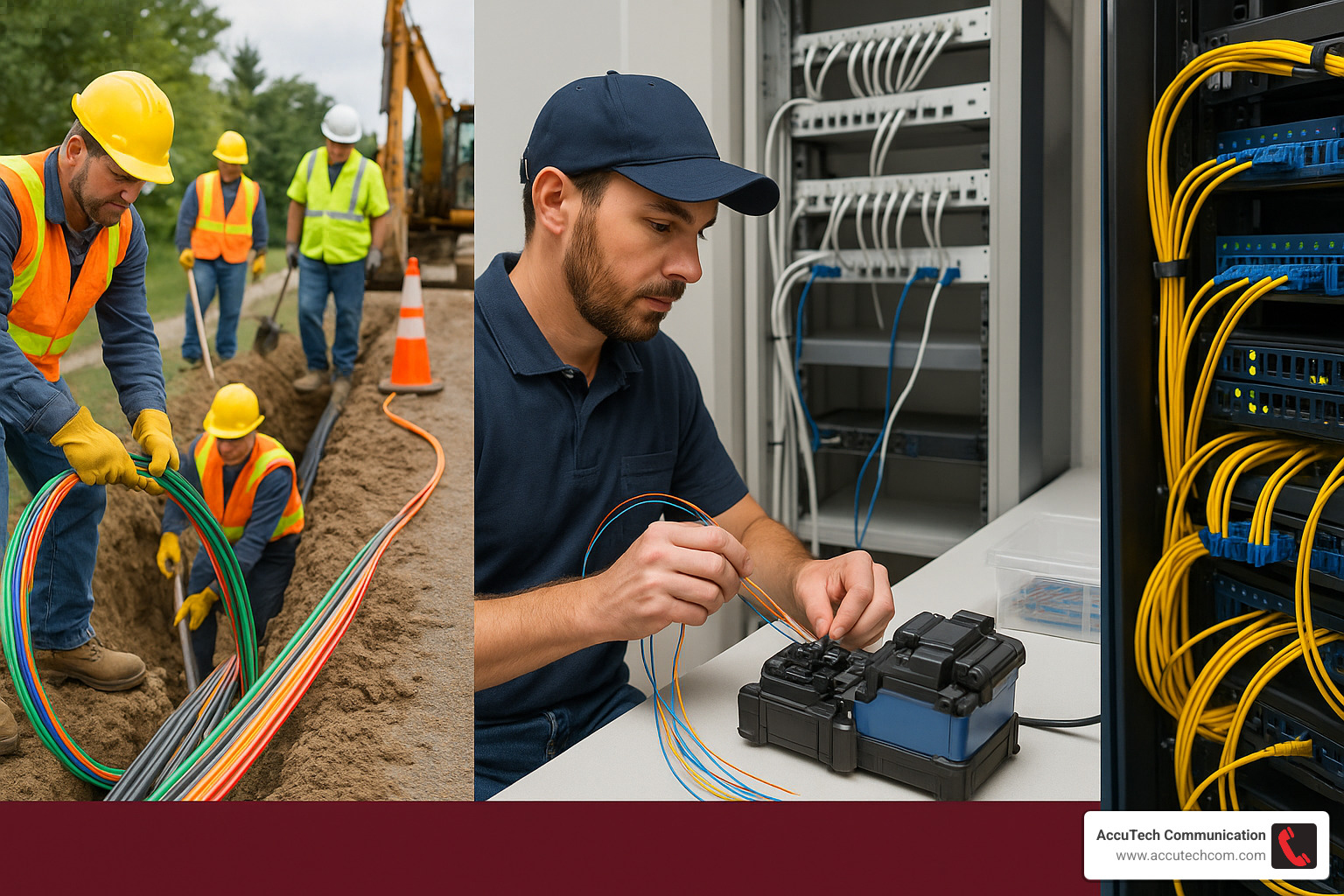
Tier-1 Infrastructure Leaders — global companies that install fiber optic cable
These are the heavy hitters of the fiber world. Think of them as the interstate highway builders of the digital landscape. They specialize in massive infrastructure projects that span hundreds or even thousands of miles, connecting cities and regions with high-capacity fiber backbones.
These organizations typically work with major telecommunications carriers, internet service providers, and large enterprises. What makes them unique is their ability to mobilize enormous crews across multiple regions simultaneously. They maintain extensive equipment fleets and have steerd the complex web of nationwide permits and regulations countless times.
While their capabilities are impressive, their focus on large-scale deployments means they often set minimum project thresholds that can be out of reach for smaller businesses. They’re perfect if you need a fiber network that crosses state lines, but might be overkill for connecting your office to the building next door.
Regional Service Experts — local companies that install fiber optic cable for SMBs
This is where AccuTech Communications fits in the ecosystem. Since 1993, we’ve been serving businesses throughout Massachusetts, New Hampshire, and Rhode Island with a perfect balance of technical expertise and local knowledge.
Regional specialists like us offer something the national giants can’t – personalized service and deep familiarity with local building codes and permit requirements. We’ve built relationships with local utilities and municipalities over decades, which helps streamline the often-complex permitting process.
One of our healthcare clients recently told us, “What we appreciated most was how quickly you responded when we had questions. We never felt like just another project number.” That’s the advantage of working with a regional expert – we’re your neighbors, not just your vendor.
Our regional focus allows us to be more cost-effective for mid-sized deployments while still maintaining the technical expertise needed for sophisticated installations. We’re large enough to handle multi-site projects but small enough to give your project the attention it deserves.
Design-Build & Integration Firms
These turnkey solution providers handle everything from initial network design through installation, testing, and integration with your existing systems. Think of them as the general contractors of the fiber world – they coordinate all aspects of complex projects so you don’t have to.
Design-build firms excel at creating comprehensive solutions that incorporate fiber alongside other technologies like wireless networks, security systems, and structured cabling. Their holistic approach eliminates the headache of coordinating multiple vendors, reducing project risk and ensuring all components work seamlessly together.
These firms often specialize in specific environments like data centers or smart buildings, bringing valuable expertise to these complex settings. If you’re looking for a “set it and forget it” approach where one team handles everything from blueprint to final testing, a design-build firm might be your best match.
Emergency & Maintenance Specialists
When disaster strikes your fiber network, these are the teams you want on speed dial. Emergency specialists focus on keeping existing fiber networks operational through both preventive maintenance and rapid emergency response.
With 24/7/365 support availability and specialized troubleshooting equipment, these teams can quickly mobilize when minutes of downtime translate to thousands in lost revenue. Many offer Service Level Agreements (SLAs) with guaranteed response times, providing peace of mind for organizations with mission-critical networks.
Beyond emergency response, these specialists often provide preventive maintenance programs that can identify potential issues before they cause outages. Their detailed documentation and fiber auditing services help organizations understand their existing infrastructure and plan for future growth.
Campus & Industrial Niche Installers
Some environments present unique challenges that require specialized expertise. Campus and industrial niche installers focus on specific settings like healthcare facilities, manufacturing plants, or educational campuses.
These specialists understand the distinct requirements of their chosen industries. A healthcare fiber installer, for example, knows how to work around sensitive medical equipment and implement infection control measures during installation. Manufacturing specialists understand the challenges of deploying fiber in environments with high electromagnetic interference or extreme temperatures.
Their industry-specific knowledge allows them to anticipate and address challenges that general installers might miss. They’re familiar with relevant compliance standards (like HIPAA for healthcare or specific safety protocols for industrial settings) and have developed specialized techniques for these environments.
More info about Fiber Optic Contractors
From Blueprint to Light Speed: Inside a Professional Fiber Installation
When you partner with professional companies that install fiber optic cable like AccuTech Communications, you’re not just buying a service – you’re investing in a carefully orchestrated process that’s been refined through decades of experience. Let me walk you through what really happens when we install fiber at your facility:
1. Site Survey & Needs Assessment
Every great fiber installation begins with listening. Our engineers start by visiting your location to understand your unique environment and requirements. We’ll examine your current setup, discuss your bandwidth needs (both current and future), and identify any potential challenges like tight spaces or environmental concerns.
I remember a healthcare client who was frustrated after two other vendors said their building couldn’t accommodate fiber. During our thorough site survey, we finded an unused pathway that provided the perfect route – a detail others had missed simply because they rushed this critical first step.
2. Network Design & Engineering
With survey data in hand, our engineering team creates a comprehensive design that’s custom specifically to your facility. We determine the optimal fiber types, count the exact number of strands needed, map out cable pathways, and identify all termination points.
We follow what we call a “FieldFirst™” approach – ensuring our engineering prints match actual field conditions to prevent costly surprises later. This attention to detail is why our installations typically finish on time and within budget.
3. Permitting & Compliance
Before a single fiber is laid, we handle all the paperwork headaches for you. This includes securing necessary building permits, arranging right-of-way access for underground work, coordinating with utilities, and ensuring compliance with all relevant codes and regulations.
Having worked in Massachusetts, New Hampshire, and Rhode Island since 1993, we’ve built strong relationships with local authorities that help streamline what can otherwise be a frustrating process for inexperienced installers.
4. Installation Methods
Depending on your facility and requirements, we’ll employ the most appropriate installation methods:
For underground installations, we use specialized trenching and boring equipment that creates pathways while minimizing disruption to your property. For aerial installations, we carefully attach fiber to existing utility poles, coordinating with pole owners throughout the process. Inside your building, we’ll use existing conduit where possible or create new pathways through ceilings and walls – always maintaining fire ratings and building integrity.
5. Fiber Termination & Splicing
This is where the real magic happens. Our certified technicians use advanced fusion splicing equipment to permanently join fiber strands with electric arcs, creating connections with minimal signal loss. It’s a bit like performing microsurgery – requiring steady hands, specialized tools, and years of experience.
For equipment connections, we carefully terminate fibers with the appropriate connectors (SC, LC, ST, etc.), using precision tools and microscopes to ensure perfect end-face geometry. All splice points are protected with appropriate enclosures based on your environment – whether that’s inside a climate-controlled data center or buried in a weather-exposed junction box.
6. Testing & Certification
We never consider a job complete until we’ve thoroughly verified everything works perfectly. Our comprehensive testing includes:
OTDR Testing that provides a complete “map” of your fiber, showing every splice point, bend, and potential issue along the path. Think of it as an X-ray for your fiber network.
Power Meter Testing to measure actual light loss across each fiber link, ensuring everything meets or exceeds industry standards.
End-to-End Verification confirming connectivity and performance across your entire network.
7. Documentation & Handover
Your installation concludes with detailed documentation that becomes invaluable for future maintenance and upgrades. We provide updated as-built drawings showing actual cable routes, comprehensive test results establishing your performance baseline, clear labeling of all cables and connection points, and complete warranty information.
One IT director told me this documentation saved them thousands of dollars years later when they needed to expand their network – they didn’t have to pay someone to trace and identify existing infrastructure because our documentation was so thorough.
8. Ongoing Maintenance & Support
The relationship doesn’t end at installation. We offer ongoing support including regular preventive maintenance to keep your fiber performing optimally, rapid-response troubleshooting if issues arise, and assistance with network modifications as your needs evolve.
At AccuTech Communications, we’ve refined this process through thousands of installations across New England since 1993. Our methodical approach minimizes disruption while ensuring you get a reliable, future-proof fiber infrastructure that keeps your organization connected at light speed.
More info about Fiber Optic Cable Installation
Cost, Trends & Frequently Asked Questions
The fiber optic world is changing faster than ever, and keeping up with these shifts helps you make smarter choices when selecting companies that install fiber optic cable. After installing thousands of fiber networks across New England since 1993, we’ve watched these technologies evolve dramatically.
Current Market Trends
The rollout of 5G networks is creating a massive demand for fiber infrastructure. Think of it as the invisible backbone that makes all those lightning-fast wireless connections possible. This 5G expansion is pushing installation companies like ours to develop faster deployment techniques while maintaining quality.
Residential areas are experiencing a fiber revolution too. The pandemic accelerated the need for enterprise-grade connectivity at home, and Fiber to the Home (FTTH) deployments continue growing rapidly. I’ve personally seen neighborhoods transform as residents gain access to the same connectivity previously reserved for businesses.
“The first thing our clients notice after upgrading to fiber isn’t just speed—it’s reliability,” explains our senior technician. “When you’re no longer dealing with constant connectivity issues, it changes how you work and live.”
Environmental consciousness has also reached the fiber world. At AccuTech, we’ve acceptd minimally invasive trenching techniques and recycled materials wherever possible. Our customers appreciate that we can deliver cutting-edge connectivity while respecting the environment.
The boundaries between wired and wireless networks continue blurring, with fiber providing essential backhaul for distributed antenna systems and small cell deployments. This convergence means the best companies that install fiber optic cable now need expertise across multiple technologies.
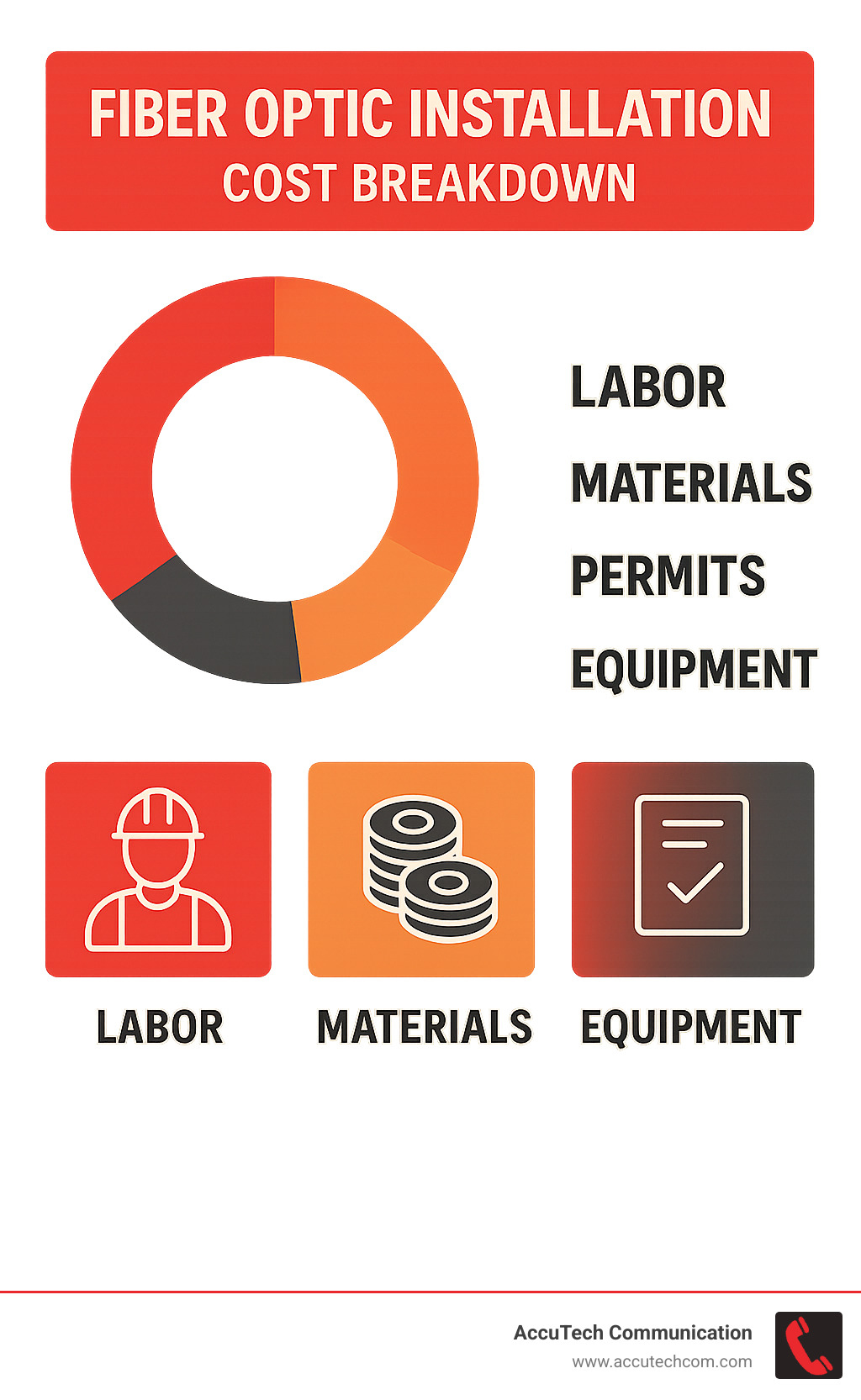
What drives the cost of companies that install fiber optic cable?
Several factors influence what you’ll pay for a professional fiber installation:
Distance and route complexity play major roles in determining cost. A straight shot between two nearby buildings is naturally less expensive than a complex route through challenging terrain. Underground installations typically cost more than aerial ones due to the trenching or boring required, but often provide better long-term reliability and aesthetics.
Fiber type and count significantly impact material costs. While single-mode fiber generally costs more upfront than multi-mode, it often proves more economical long-term due to its future-proof capabilities. We always recommend considering future needs—installing higher strand counts initially is almost always more cost-effective than adding capacity later.
The expertise level of the installation team matters tremendously. Properly trained fiber technicians with specialized certifications command premium rates, but their precision prevents costly problems down the road. As one client told us after experiencing problems with a previous installer: “Paying for expertise upfront is much cheaper than fixing mistakes later.”
Environmental challenges like historic districts, harsh weather conditions, or buildings with special requirements add complexity. In Massachusetts, we frequently work in historic buildings where special care must be taken to preserve architectural features while installing modern infrastructure.
Permitting and compliance costs vary widely depending on location. Having installed fiber throughout Massachusetts, New Hampshire, and Rhode Island since 1993, we’ve developed strong relationships with local authorities that help streamline this often complex process.
How long does a typical installation take?
The timeline for fiber installation varies significantly based on scope and complexity:
The planning phase typically takes 2-4 weeks for complex projects, including site surveys, design work, and permitting. For simpler installations, we can often complete planning in just a few days. This phase is crucial—rushing through planning almost always leads to problems during installation.
The actual installation phase depends heavily on your specific environment:
– Simple office installations might be completed in 1-2 days
– Campus environments typically require 1-3 weeks
– Complex urban deployments or long-distance runs can take several months
Testing and documentation usually adds 1-3 days to the timeline, depending on the number of fiber strands and connection points. This step is non-negotiable for quality installations—proper testing prevents surprises after the installation team leaves.
At AccuTech, we provide detailed project timelines during the proposal phase and maintain regular communication throughout your project. Our clients consistently mention this transparency as one of the reasons they choose us over other companies that install fiber optic cable.
What standards & certifications should installers carry?
When evaluating fiber installation companies, look for these important credentials:
BICSI Certifications demonstrate a commitment to industry best practices. These include RCDD (Registered Communications Distribution Designer), DCDC (Data Center Design Consultant), OSP (Outside Plant Designer), and various technician certifications. These aren’t just fancy acronyms—they represent significant training and expertise.
Fiber-specific certifications like CFOT (Certified Fiber Optic Technician) and manufacturer certifications from leading fiber producers ensure technicians understand the nuances of working with delicate glass fibers.
Safety credentials are non-negotiable. Look for OSHA compliance, confined space certification (for underground work), and proper training for aerial installations. Safety practices protect both workers and your property.
Industry standards compliance ensures your installation meets or exceeds TIA/EIA-568 standards for telecommunications cabling, relevant NFPA and NEC codes, and IEEE standards for network performance. These standards exist for good reason—they ensure your network will perform reliably for years to come.
At AccuTech Communications, we maintain a comprehensive certification program for our technicians and regularly update our training. This commitment to professional development is why organizations throughout Massachusetts, New Hampshire, and Rhode Island have trusted us with their critical infrastructure since 1993.
Scientific research on energy impact
Conclusion
Looking back at everything we’ve covered, choosing the right companies that install fiber optic cable isn’t just a technical decision—it’s a strategic investment in your organization’s future. Fiber technology has fundamentally changed how businesses operate, delivering speeds, reliability, and capacity that were unimaginable just a few years ago.
Since opening our doors in 1993, we at AccuTech Communications have had the privilege of guiding countless businesses across Massachusetts, New Hampshire, and Rhode Island through their fiber journey. We’ve seen how proper fiber infrastructure transforms operations—from healthcare facilities securely transmitting sensitive patient data to schools supporting thousands of students’ devices simultaneously.
When you’re evaluating potential fiber installation partners, keep these critical factors in mind:
Industry experience matters tremendously. A company that has worked extensively in your specific environment understands the unique challenges you face.
Professional certifications demonstrate a commitment to quality and ongoing education. This isn’t a field where you can learn once and be set for life—technology evolves constantly.
Testing protocols reveal a lot about an installer’s attention to detail. Comprehensive testing and clear documentation prevent headaches down the road.
Support capabilities will determine your experience long after the initial installation. The best relationships are partnerships that continue for years.
Client references tell the real story. Ask for examples of similar projects and speak with those clients directly.
I’ll never forget what the operations director at one of our manufacturing clients told me after we completed their fiber upgrade: “We finally have a network that keeps up with our production demands instead of slowing us down.” That’s the real value of quality fiber infrastructure—it removes technology as a bottleneck and turns it into a competitive advantage.
Whether you’re connecting buildings across a campus, upgrading your data center, or preparing for future growth, partnering with the right installation team makes all the difference. At AccuTech Communications, we believe technical expertise is just the beginning—it’s the personalized service and genuine care for your success that truly set an installation partner apart.
The future of connectivity is undeniably fiber. With the right infrastructure in place, your business will be ready to accept whatever innovations come next.
More info about fiber optic cabling installation
