
Data cabling for offices: 7 Powerful Solutions for 2025
Why Data Cabling for Offices Matters More Than You Think
Data cabling for offices is the invisible backbone that keeps your business running smoothly. When done right, it delivers reliable network performance, supports future growth, and saves you from costly downtime headaches.
Quick Answer: What You Need to Know About Data Cabling for Offices
- Cable Types: Cat6 and Cat6a offer the best balance of cost and performance for most offices
- Lifespan: Quality installations last 10-15 years with proper maintenance
- Standards: TIA/EIA-568 compliance ensures reliability and future compatibility
- ROI: Professional installation prevents the 75% business activity impact from network downtime
- Planning: Structured cabling design supports voice, data, and video on one network
Modern offices depend on rock-solid network connections. Whether you’re running electronic health records, processing patient data, or managing critical communications, unreliable cabling can bring operations to a grinding halt.
The good news? Proper office cabling doesn’t have to be a nightmare. With the right approach, standards compliance, and professional installation, you can build a network infrastructure that grows with your business and keeps your team productive.
Network downtime can affect as much as 75% of business activity – a statistic that makes quality cabling investment a no-brainer for any serious organization.
I’m Corin Dolan, owner of AccuTech Communications, and I’ve been helping businesses across Massachusetts, New Hampshire, and Rhode Island solve their data cabling for offices challenges since 1993.
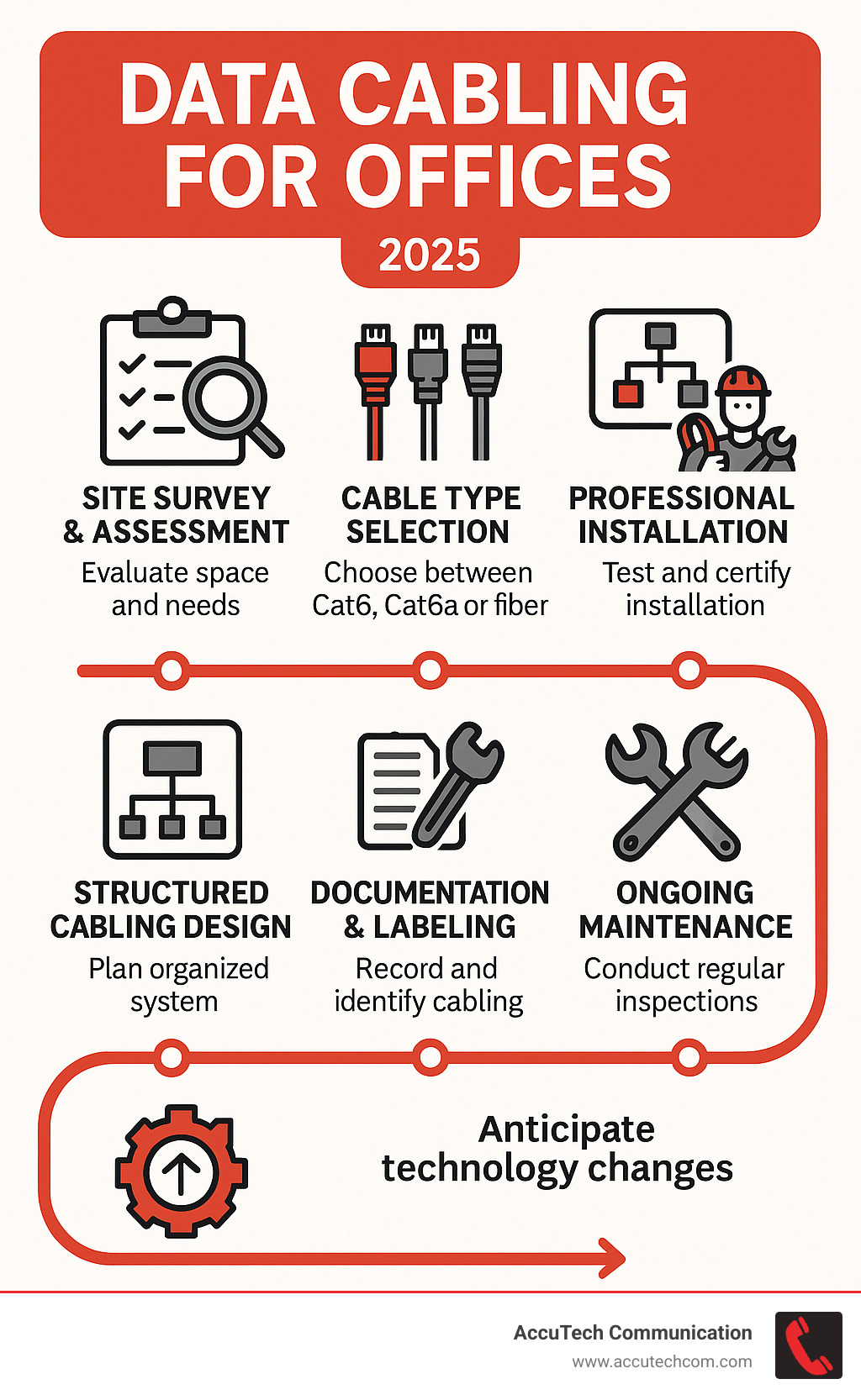
Data Cabling for Offices: Core Concepts and Standards
Data cabling for offices isn’t just about running some wires through the ceiling and hoping for the best. There’s a whole world of cable types, standards, and best practices that separate a professional installation from a future headache.
What is Data Cabling for Offices?
Data cabling for offices is your building’s nervous system – the structured network of cables that carries everything from phone calls to video conferences to critical file transfers.
Modern office cabling is designed around voice-data-video convergence. Instead of running separate cables for phones, computers, security cameras, and wireless access points, everything runs on one unified network. This approach saves money, reduces clutter, and makes your IT team’s life much easier.
Your office cabling has two main parts: backbone cabling connects your server room to distribution points throughout your building, while horizontal cabling extends from these points to every desk and device that needs network access.
Key Standards Every Office Must Meet
Professional data cabling for offices installations must follow specific standards that ensure reliability and compatibility.
TIA/EIA-568 is the gold standard for commercial building cabling in North America. This standard covers everything from cable categories to color coding, ensuring your installation works with equipment from any manufacturer.
ISO/IEC 11801 provides the international perspective on structured cabling, often with stricter requirements that can future-proof your installation.
Fire safety codes are non-negotiable. Plenum-rated cables must be used in air-handling spaces, while riser-rated cables are required in vertical shafts between floors. Using the wrong cable type isn’t just a performance issue – it’s a serious safety violation.
Here’s how the most common cable categories stack up:
| Cable Type | Max Speed | Distance | Best Use | Future-Proof Rating |
|---|---|---|---|---|
| Cat5e | 1 Gbps | 100m | Basic office needs | Limited |
| Cat6 | 10 Gbps* | 55m* | Standard business | Good |
| Cat6a | 10 Gbps | 100m | High-performance | Excellent |
| Cat7 | 10+ Gbps | 100m | Specialized apps | Excellent |
| Fiber | 100+ Gbps | 2km+ | Backbone/long runs | Outstanding |
*Cat6 supports 10 Gbps only up to 55 meters
Cat6 and Cat6a cables are the sweet spot for most modern offices. Cat6a supports 10GBase-T over the full 100-meter distance, making it an excellent choice for organizations planning ahead. Fiber-optic cables shine for backbone connections and long runs.
Testing and certification aren’t optional extras – they’re proof that your installation meets these standards. Every cable run should be tested with certified equipment and documented with results that prove compliance.
From Blueprint to Reality: Planning & Designing Your Office Cabling Layout
Think of planning your data cabling for offices like designing a house – you wouldn’t start building without blueprints, and you shouldn’t start pulling cables without a solid plan.
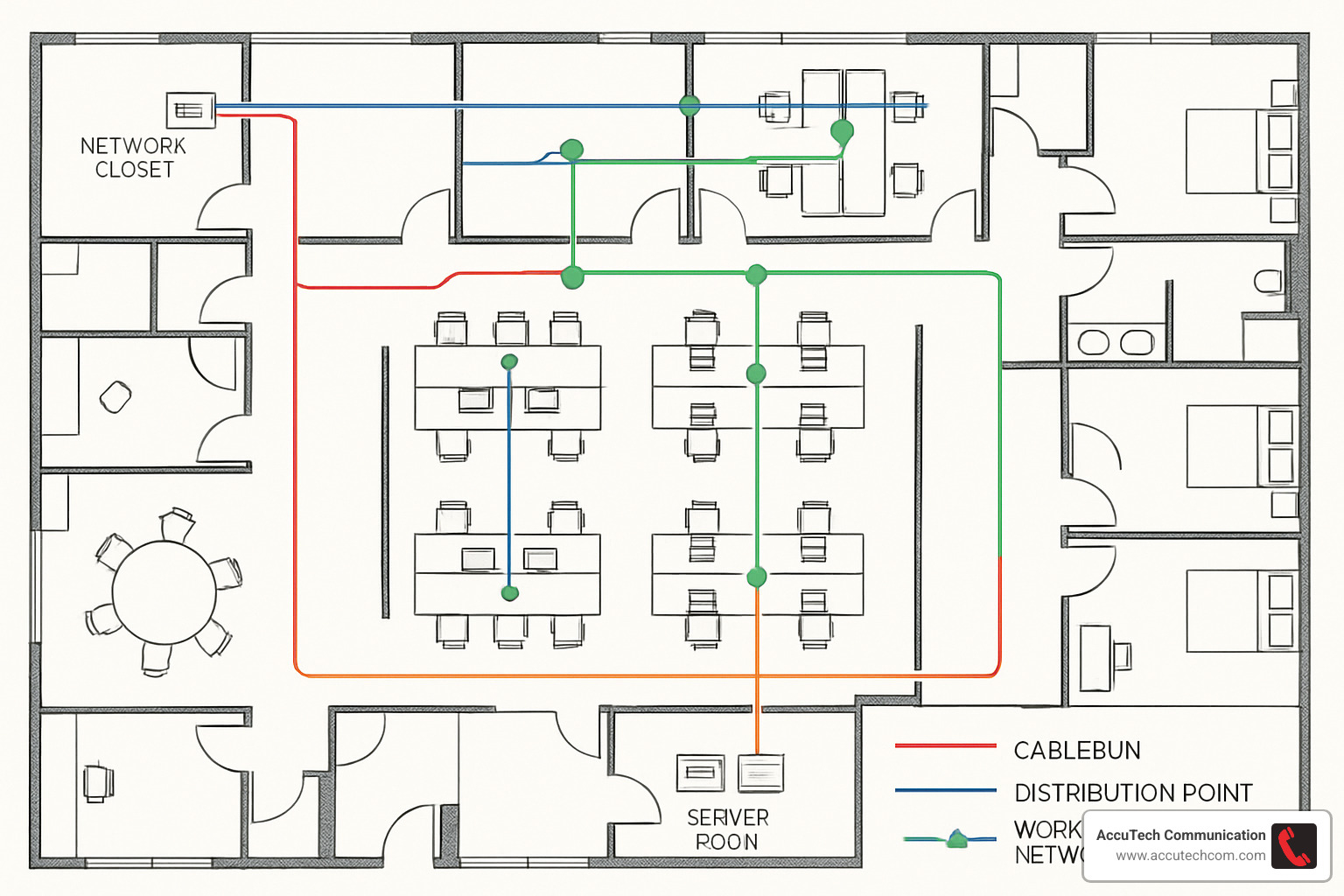
The site survey is where everything begins. We walk through your space, asking questions that might seem obvious but save headaches later. Where do people actually work? How do they use their devices? What’s hiding behind that drop ceiling?
Floor-plan mapping helps us visualize cable pathways before we start drilling holes. We’re looking for the path of least resistance while avoiding obstacles like structural beams, plumbing, and electrical systems.
Capacity planning ensures your network won’t hit a wall when your business grows. High-density office spaces are everywhere now, with more devices per square foot than ever before. We typically plan for about 50% more capacity than you need today.
Cable pathway design creates organized routes using cable trays, J-hooks, and conduits that protect your cables while keeping them accessible for future changes.
Power over Ethernet budgeting becomes critical when you’re supporting IP phones, wireless access points, and security cameras through your data cables. Cat6a cabling supports PoE++ applications, delivering up to 100 watts per port.
More info about Office Cabling Solutions
Data Cabling for Offices and Future Growth
Smart businesses plan for growth, and data cabling for offices should grow with you. Modular designs use patch panels and structured pathways that accommodate additional cables without major surgery.
Extra drops at each workstation provide flexibility for changing needs. Today’s workstation might need two data connections, but tomorrow you might add a VoIP phone, wireless access point, or additional monitor.
10 Gigabit Ethernet readiness ensures your cabling can handle tomorrow’s bandwidth demands. Cat6a cabling supports these speeds when you’re ready to upgrade your network equipment.
Documentation & Labeling Essentials
Poor documentation turns even the best cabling into a management nightmare. Without proper labeling, simple changes become expensive detective work.
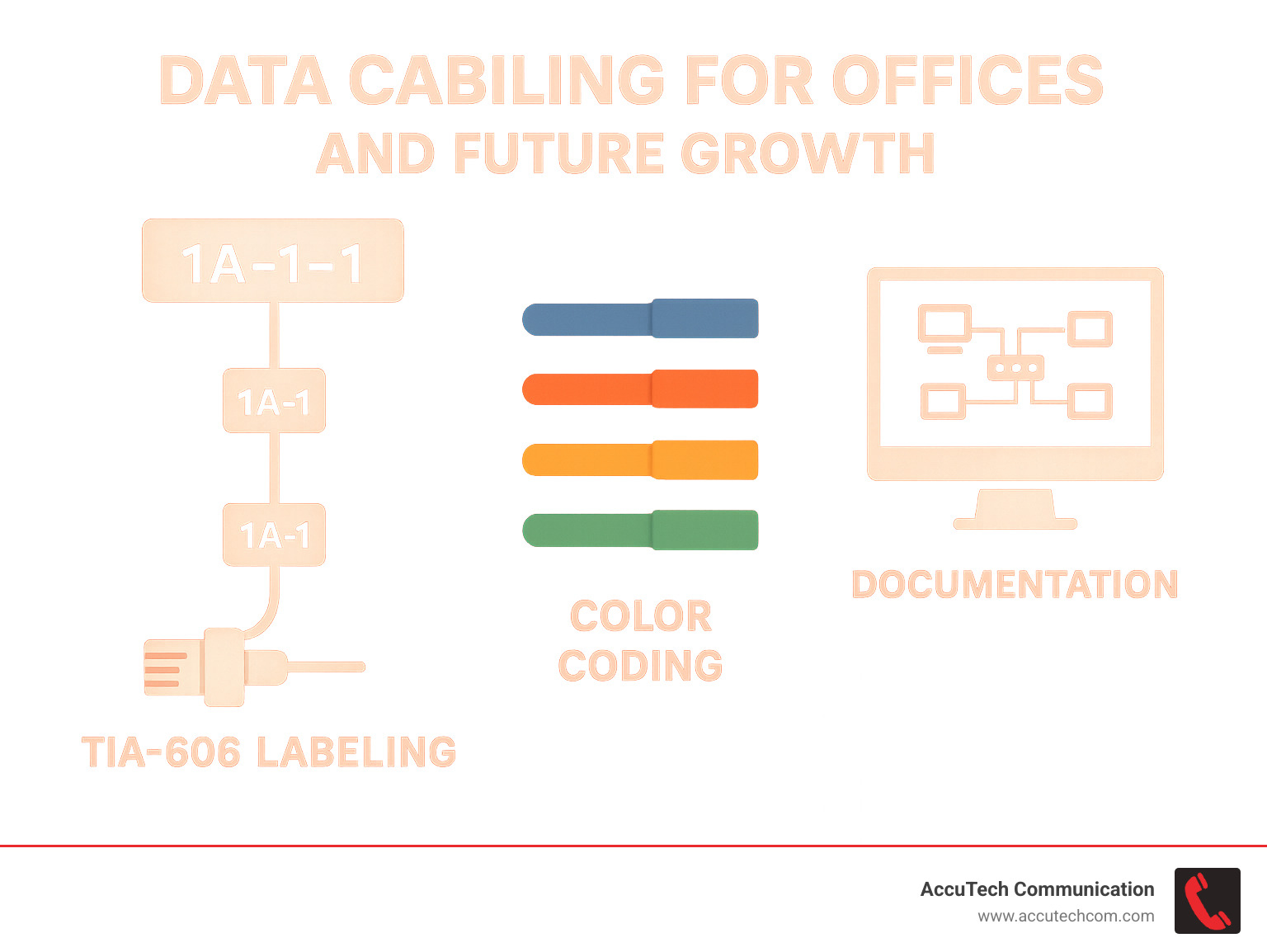
TIA-606 labeling standards provide a framework for consistent cable identification. Every cable gets a unique identifier that makes sense to anyone working on the system.
Color-coding helps technicians quickly identify cable types and purposes. We use consistent color schemes – blue for horizontal runs, orange for central office connections, yellow for security systems.
Digital diagrams capture the complete network layout in searchable, updatable formats. These living documents help with troubleshooting and planning changes.
Installation Playbook: Best Practices, Mistakes to Avoid, Compliance
Getting your data cabling for offices installed right the first time makes all the difference between a network that hums along quietly and one that keeps you awake at night.
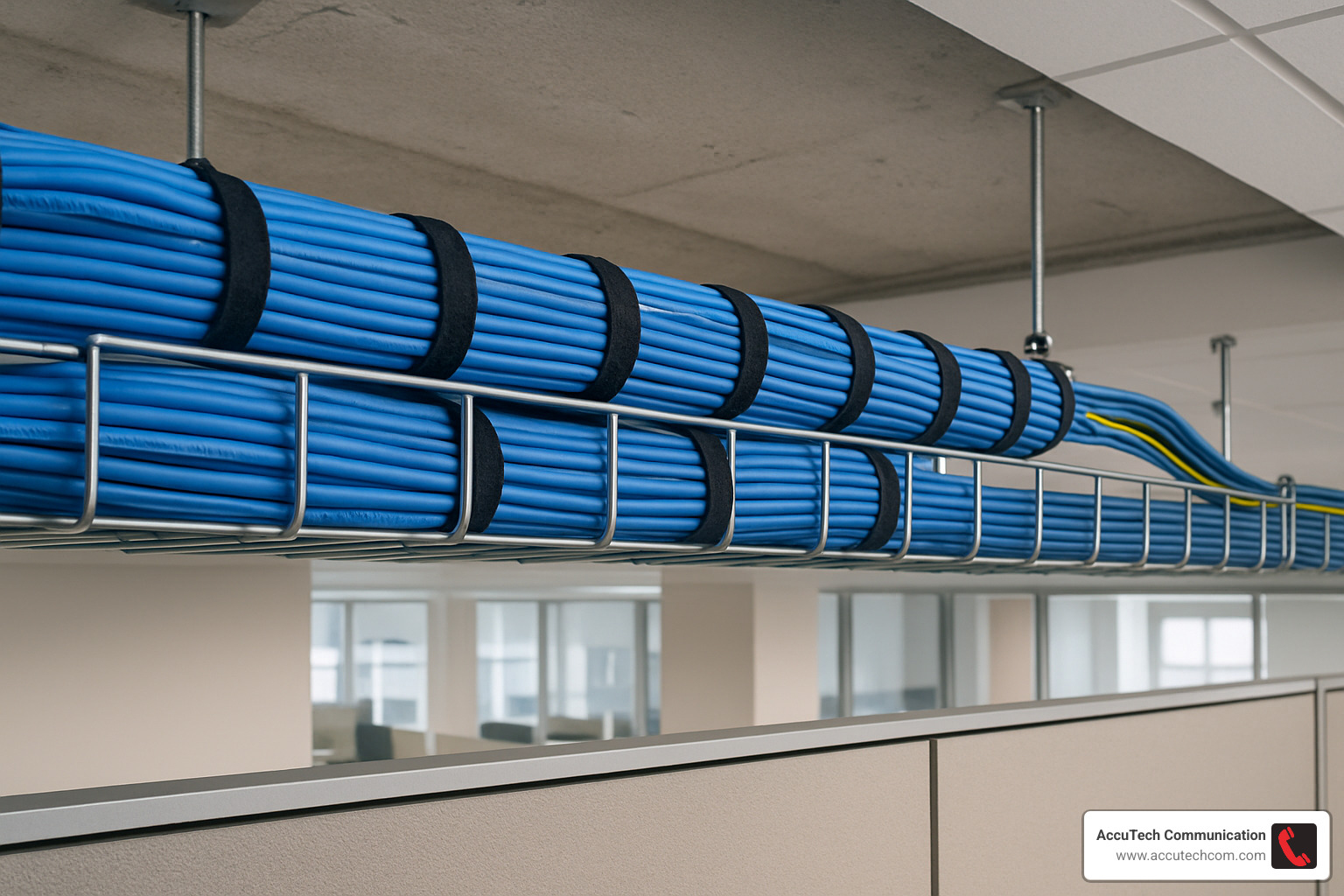
The foundation of professional installation starts with proper cable support systems. Cable trays and J-hooks protect your investment with specific spacing requirements and the right hardware for each cable type.
Bend radius rules are straightforward – every cable has a minimum bend radius, typically four times the cable diameter for Cat6a. Violate these limits and you’ll get signal problems that are frustrating to diagnose.
Keeping data cables separated from power lines prevents electromagnetic interference that can turn your network into a sluggish mess. We maintain proper distances from electrical wiring and high-voltage circuits.
Fire safety compliance isn’t optional. Plenum-rated cables must go in air-handling spaces because they produce less smoke and fewer toxic gases if there’s ever a fire.
Quality patch panels organize everything beautifully and make future changes much easier. Every single cable run gets Fluke testing to prove it meets performance standards.
More info about Cabling Installation
Structured Data Cabling for Offices Installation Checklist
Our installation teams work from detailed checklists covering essential tools like cable pullers, punch-down tools, and certification equipment.
Rack layout planning considers equipment spacing for airflow and cable management. PoE power budget verification ensures your switches can power all those IP phones and wireless access points.
Required test results include wire map verification, length measurements, insertion loss testing, return loss measurements, and crosstalk testing.
Common Pitfalls & How to Dodge Them
Overtight cable ties can damage cables and cause intermittent problems. We use proper tension and prefer Velcro ties that secure cables without cutting into jackets.
Unlabeled cable runs turn every troubleshooting session into a frustrating puzzle. Every cable gets labeled at both ends with matching identifiers.
WiFi dead zones often happen when cabling and wireless planning don’t coordinate. We plan access point locations during the cabling design phase.
Code violations create safety hazards and legal headaches. We stay current with local building codes and fire safety requirements to ensure every installation meets compliance standards.
Keeping the Network Healthy: Maintenance, Troubleshooting & Upgrading
Think of your data cabling for offices system like a reliable car – with proper maintenance, it’ll serve you faithfully for 10-15 years, supporting multiple generations of network equipment upgrades.
Routine inspections are your first line of defense against network problems. We recommend annual visual inspections of all accessible cabling, looking for obvious damage, loose connections, and environmental issues.
Certification reports create a valuable historical record of your network’s health. Baseline measurements help identify degradation trends before they cause problems.
Signs of failure usually show up gradually: slow network speeds, frequent disconnections, difficulty getting new equipment to connect properly, and visible cable damage all indicate problems that need professional attention.
Upgrade triggers help you plan improvements before problems impact operations: major technology changes, increased bandwidth demands, significant business growth, or reaching the 10-year mark on your installation.
More info about Office Data Cabling
Troubleshooting Data Cabling for Offices
When network problems strike, systematic troubleshooting gets you back online quickly.
Slow speeds often result from cable damage, improper terminations, or electromagnetic interference from new equipment. We use specialized test equipment to measure actual performance against expected results.
Intermittent connections are particularly frustrating because they seem to fix themselves, then break again. These usually hide in loose connections, damaged cables, or environmental factors like temperature changes.
Cable mapping becomes essential when troubleshooting complex installations. We use tone generators and cable mappers to trace connections through ceiling spaces and cable trays.
Future-Proofing & Emerging Trends
PoE++ technology (IEEE 802.3bt) delivers up to 100 watts per port, enabling LED lighting systems, large digital displays, and high-power wireless access points. Cat6a cabling handles these power requirements beautifully.
Wi-Fi 6E backhaul requirements highlight why quality cabling remains essential even in wireless-heavy environments. The new 6 GHz band can deliver incredible wireless speeds, but only when supported by robust wired backhaul connections.
Cat8 cabling supports 40 Gbps speeds over short distances, primarily for data center applications. While most offices don’t need these speeds today, Cat8 represents the cutting edge of copper cabling technology.
Scientific research on high-speed cabling continues advancing the field with new materials and designs that push the boundaries of what’s possible.
Budget & ROI: Making the Business Case
Let’s talk money – because every smart business decision comes down to the numbers. When you’re considering data cabling for offices, you’re investing in the foundation that keeps your business running smoothly.
Here’s a sobering statistic: network downtime can affect as much as 75% of business activity. When your network goes down, three-quarters of your operations grind to a halt.
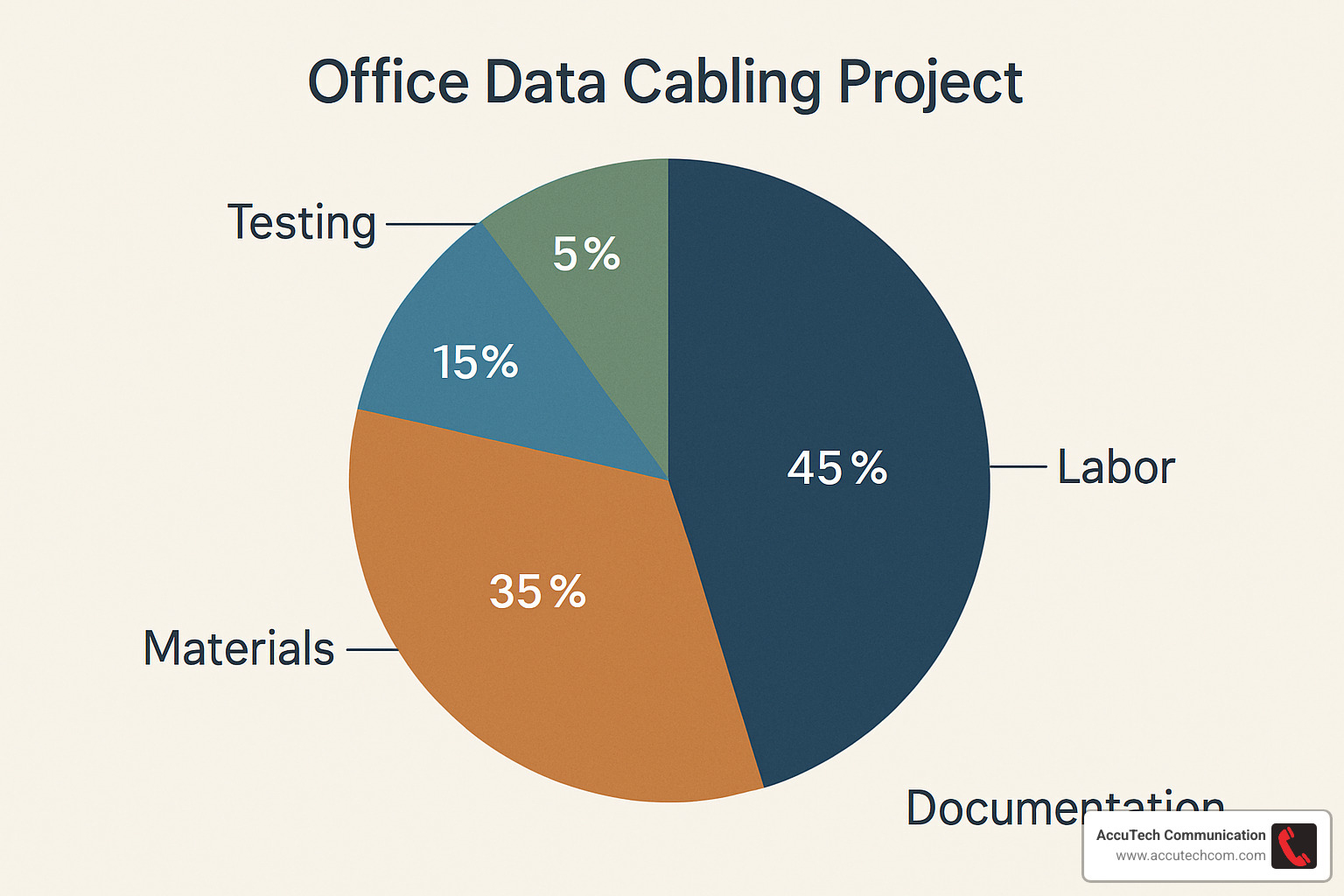
The cost-per-drop calculation helps you understand what you’re really paying for. Materials typically represent 30-40% of your total investment. The rest goes toward skilled labor, professional testing, proper documentation, and project management.
We recently helped a logistics company redesign their network infrastructure. Their custom cabling solution led to a 25% reduction in delivery times and significant savings in fuel and labor costs.
Quality warranties protect your investment with 25-year manufacturer warranties on materials and multi-year warranties on workmanship.
More info about The Importance of Professional Cabling Installation for Your Business
Copper vs. Fiber: Choosing Wisely
Distance makes the decision easier in many cases. Copper cabling handles runs up to 100 meters beautifully. When you need to connect buildings or span long distances, fiber becomes the clear winner.
Bandwidth requirements tell an interesting story. Most current office applications work perfectly with gigabit speeds that copper delivers reliably. However, fiber provides virtually unlimited upgrade potential with speeds of 100 Gbps and beyond.
The installation cost comparison requires looking beyond the initial price tag. Copper costs less upfront, while fiber requires higher initial investment but delivers longer service life and incredible upgrade flexibility.
When to Call in the Pros
Certified installers bring expertise that prevents expensive mistakes. Our team maintains industry certifications and stays current with local requirements.
Compliance assurance protects your business from liability while ensuring optimal performance. Professional installers understand building codes, fire safety requirements, and industry standards.
Extended warranties provide protection that far exceeds typical equipment warranties, often lasting years beyond the useful life of connected network equipment.
At AccuTech Communications, we’ve been helping businesses throughout Massachusetts, New Hampshire, and Rhode Island make smart data cabling for offices investments since 1993. Our certified team delivers reliable installations at competitive prices.
Conclusion
Building reliable data cabling for offices shouldn’t keep you up at night wondering if your network will crash tomorrow. When you get the fundamentals right – proper planning, quality materials, professional installation, and regular maintenance – your cabling infrastructure becomes the solid foundation that quietly supports your business for 10-15 years.
Your office cabling is like the plumbing in your building. When it works well, nobody thinks about it. When it fails, everything stops. The difference is that network downtime can affect up to 75% of business activity, making quality cabling infrastructure business insurance.
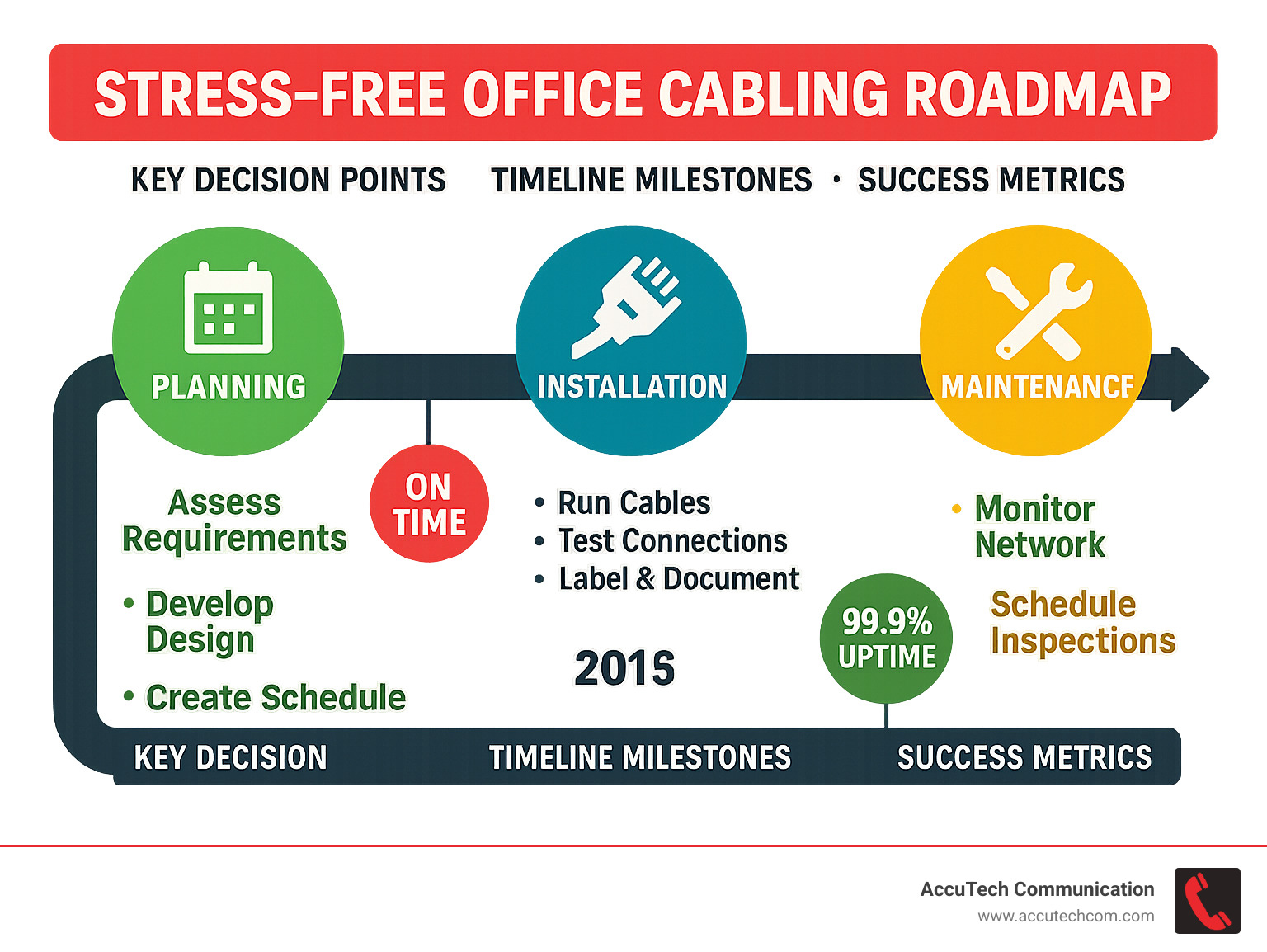
The path to stress-free office cabling starts with choosing Cat6 or Cat6a cabling for that sweet spot between performance and future-proofing. Following TIA/EIA standards ensures your installation plays nicely with equipment from any manufacturer. Planning for 50% more capacity than your current needs sounds expensive until you consider the alternative – tearing apart walls to add more cables later.
Investing in certified installation maximizes your ROI by ensuring compliance, preventing costly rework, and delivering valuable 25-year warranties. Proper documentation and labeling turns future troubleshooting from a detective story into a quick fix.
At AccuTech Communications, we’ve watched Massachusetts, New Hampshire, and Rhode Island businesses struggle with cabling challenges since 1993. We’ve also seen how the right approach transforms network infrastructure from a source of stress into a competitive advantage. Our certified technicians understand that every business is different, and our competitive pricing makes quality installation accessible.
Whether you’re moving into new office space, upgrading a system that’s showing its age, or dealing with mysterious network slowdowns, we’re here to help. Our free site surveys take the guesswork out of planning by providing clear assessments and practical recommendations.
Data cabling for offices doesn’t have to be complicated or stressful. With three decades of experience solving these challenges, we know how to design and install systems that work reliably from day one.
More info about Structured Cabling Services
Your network infrastructure deserves better than crossed fingers and hope. Let our experience guide you to a cabling solution that actually works – one that gives you the reliable foundation your business needs to grow and thrive.
