
Data Cabling Price Per Point: Essential Guide 2025
Understanding Your Network Cabling Investment
Researching the data cabling price per point is a critical step in planning one of your business’s most important infrastructure investments. The cost per connection, or “point,” is the foundation for budgeting your entire network project.
Typical Price Per Point:
- Standard Office: $120 – $220
- Large Business/Warehouse: Up to $200+
- Complex Installations: $250 – $350+
This price typically includes a Cat6 cable run, a wall plate with a keystone jack, termination at both ends, and basic testing and labeling. However, final costs are influenced by cable type, building complexity, project size, and regional labor rates. That new construction is often 30-40% less expensive than retrofitting an existing building.
Your network cabling is the backbone of your business communications. I’m Corin Dolan, owner of AccuTech Communications. Since 1993, my team has helped businesses across Massachusetts, New Hampshire, and Rhode Island make smart cabling decisions. We’ve installed thousands of data points, giving us deep insight into what drives costs and delivers long-term value.
Understanding the Average Data Cabling Price Per Point
When planning network infrastructure, the first question is often, “What’s the data cabling price per point?” This pricing unit is essential for accurate budgeting. A “data point” or “data drop” is a single, complete network connection from a device (like a computer or phone) to your network closet. This per-drop pricing model is straightforward and scalable, whether you need 10 connections or 500. It’s the foundation for estimating structured cabling projects and offers transparency, helping you prioritize work if you’re on a tight budget.
What’s Included in a Standard Data Cabling Price Per Point?
A quote for data cabling price per point covers more than just wire; it’s a complete, tested connection.

- Labor: The largest cost component, covering the skilled work of routing the cable from the network closet to its destination.
- Ethernet Cable: Typically a high-quality Cat6 cable that meets industry standards for reliable performance.
- Wall Plate & Keystone Jack: The professional wall-mounted connection point for your devices.
- Termination: The precise connection of the cable to the keystone jack and a patch panel in your telecommunications room.
- Basic Testing: Verification that the connection works and meets performance standards.
- Labeling: Clear marking of every cable and port, which simplifies future troubleshooting and network changes.
For more details on these components, see our guide on what network cabling is.
Typical Cost Ranges in MA, NH, and RI
In Massachusetts, New Hampshire, and Rhode Island, the data cabling price per point reflects regional labor rates and the unique challenges of New England buildings. A standard office with dropped ceilings and clear cable paths will fall into a predictable price range.
However, complex scenarios like hard ceilings, concrete walls, or historic buildings require specialized techniques that increase the investment. An experienced installer can identify these challenges during a site survey, which is why we always recommend a detailed assessment before finalizing your budget. For more on how building complexity affects your project, explore our information on network cabling installation.
Key Factors That Drive Your Final Cost Per Point
The base data cabling price per point is a starting figure; the final cost is shaped by several key factors. Understanding these variables helps you budget accurately. The most significant drivers are labor complexity, your building’s unique challenges, and the project’s scale. For a comprehensive overview, our commercial data cabling services page offers valuable insights.
The Critical Role of Labor and Technician Expertise
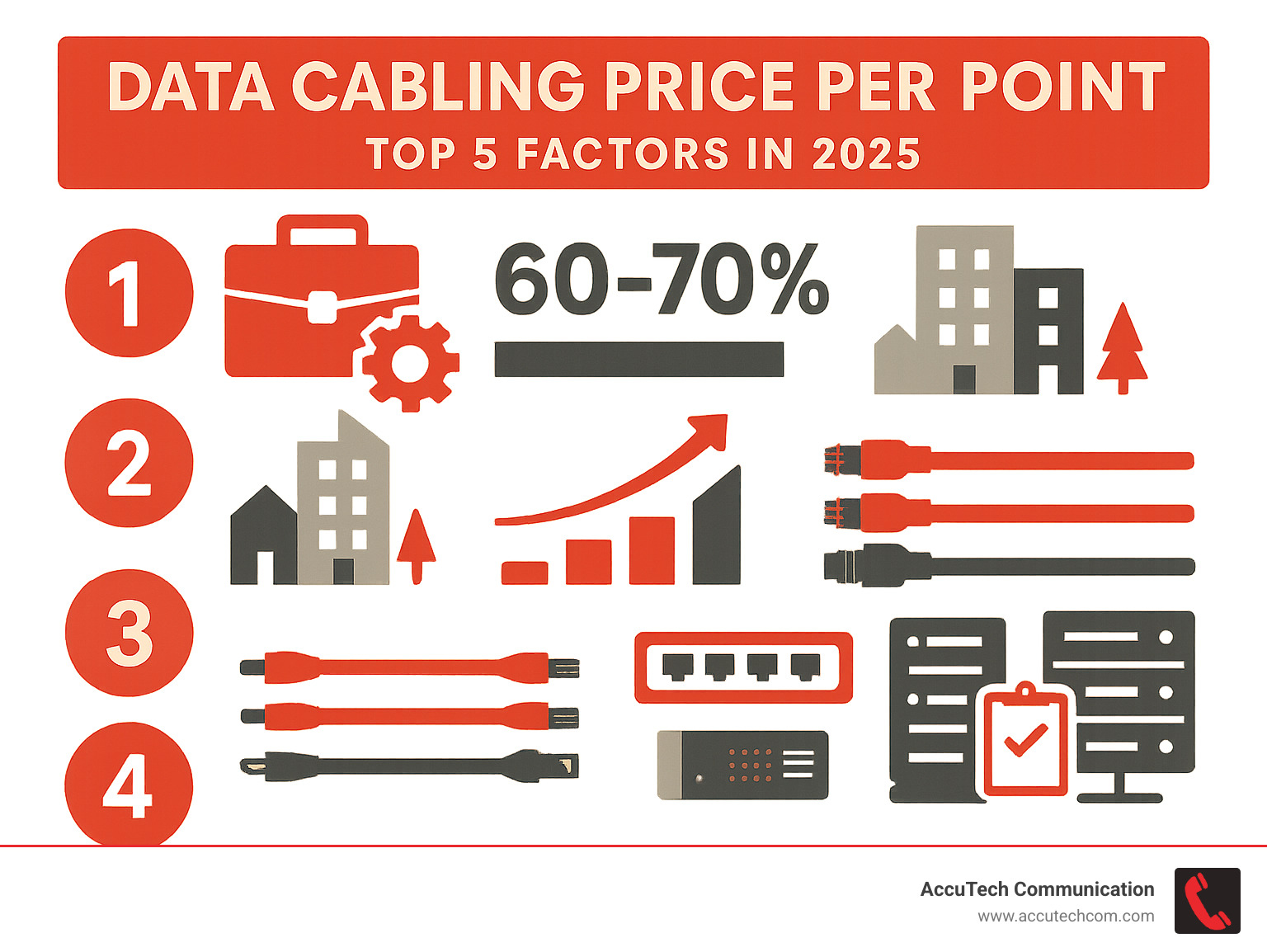
Labor typically accounts for 60-70% of your total cabling project cost. This isn’t just hours on-site; it’s the expertise, precision, and problem-solving skills of the technician.
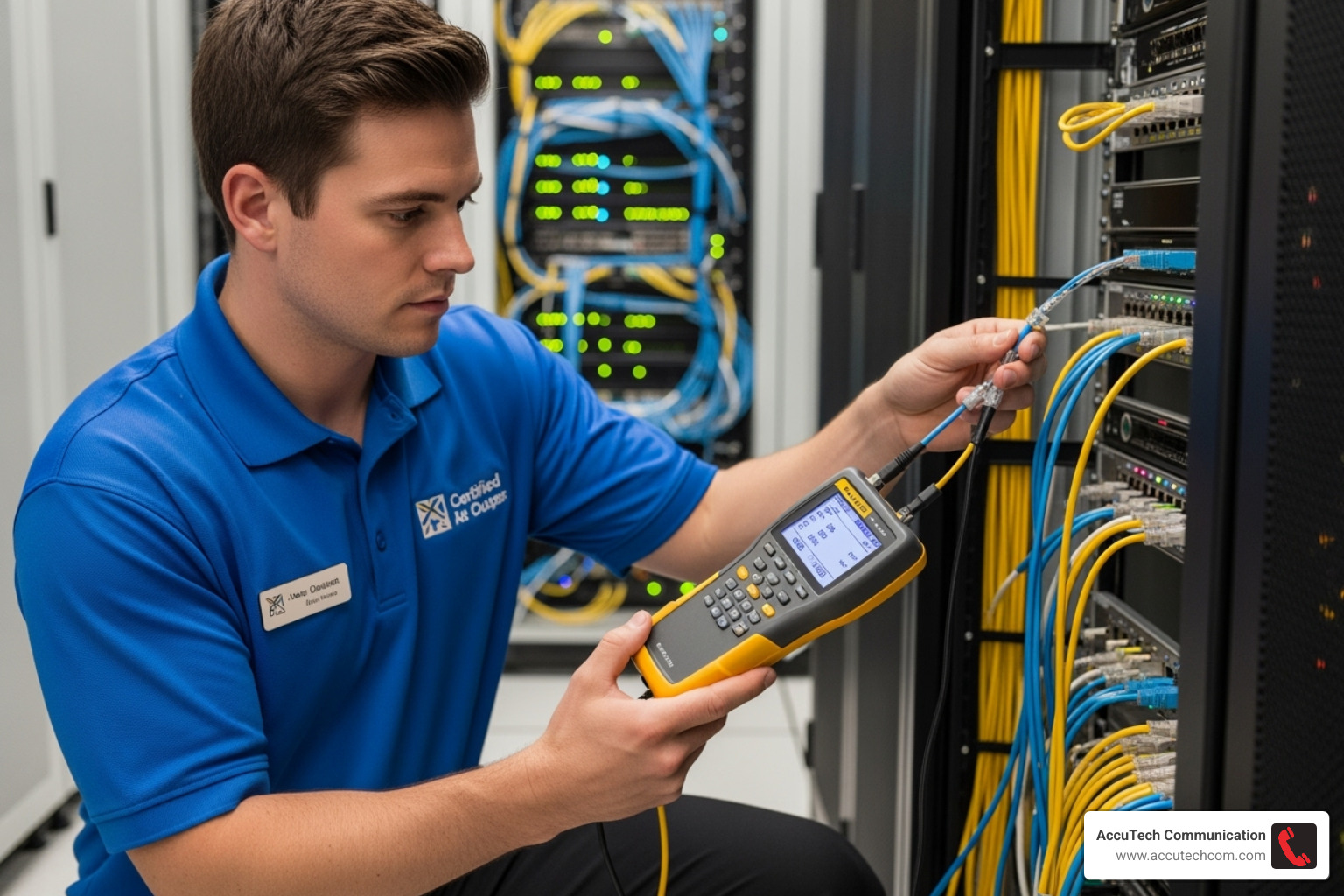
Hourly rates for cabling professionals can range from $30 to $120, depending on certification and experience. A certified technician installs faster, troubleshoots effectively, and ensures long-term system performance. Choosing the lowest bidder often leads to network problems and costly repairs later. A skilled, certified professional ensures the job is done right the first time. Learn more about The Importance of Professional Cabling Installation for Your Business.
Building Type and Environmental Complexity
Your building’s physical characteristics greatly impact the data cabling price per point.
- New Construction vs. Retrofit: Installing cable during new construction, when walls are open, can cost 30-40% less than retrofitting an existing, finished building.
- Ceilings and Walls: Dropped ceilings allow for easy access, while hard ceilings (plaster, concrete) require more labor and specialized tools. Similarly, drilling through brick or concrete walls is more intensive than drywall.
- Plenum Spaces: Air-handling spaces above ceilings require special fire-rated (plenum) cable, which costs 20-30% more than standard cable but is mandated by fire codes for safety.
- Industrial Settings: Warehouses or manufacturing plants may need cables run in protective conduit to shield against damage or interference, adding to the cost. For more details, see our guide on conduit installation cost.
How Project Scale Affects the Data Cabling Price Per Point
Project size creates economies of scale. Small office installations (e.g., 10 drops) have a higher per-point cost because fixed expenses are spread across fewer connections. In contrast, large enterprise projects (500+ drops) benefit from efficiencies, lowering the average data cabling price per point.
Port density also matters. Installing multiple connections in one location is far more efficient than running single cables to scattered areas. This is why we recommend planning for future growth by adding extra drops during the initial project. Our office data cabling services can help optimize your layout for current and future needs.
How Cable Type Choice Impacts Your Budget
The cable you choose is a strategic decision that affects your network’s speed, reliability, and future-readiness. While the data cabling price per point varies by cable type, investing more upfront can prevent costly re-cabling projects later as your bandwidth needs grow. Your choice determines how well your network handles video conferencing, cloud backups, and other demanding applications. For a full overview, see our guide on Types of Network Wiring.
| Cable Type | Speed Capability | Installed Cost Per Foot (General Range) | Best Use Case |
|---|---|---|---|
| Cat5e | Up to 1 Gigabit | Lower | Basic office networks, VoIP, home use where budget is primary concern. |
| Cat6 | 1-10 Gigabit (up to 55m) | Moderate | High-speed office networks, data centers for shorter runs, future-proofing for most businesses. |
| Cat6a | 10 Gigabit (up to 100m) | Moderate to Higher | Data centers, large enterprise networks, long-term future-proofing for 10G applications. |
| Fiber Optic | Multi-Gigabit (10G, 40G, 100G+) | Higher | Network backbones, connections between buildings, high-bandwidth applications, long distances, environments with EMI. |
Copper Cabling: Cat5e vs. Cat6 vs. Cat6a
- Cat5e (Category 5e): A budget-friendly choice that handles Gigabit Ethernet well, suitable for businesses with straightforward network needs.
- Cat6 (Category 6): The recommended standard for most businesses. It reliably supports Gigabit speeds and can handle 10-Gigabit speeds over shorter distances (up to 55 meters), with better performance and less interference than Cat5e.
- Cat6a (Category 6a): The “augmented” future-proof option, supporting 10-Gigabit Ethernet over the full 100-meter distance. It’s more robust and ideal for noisy electrical environments, though it adds about 20-30% to the data cabling price per point compared to Cat6.
All these copper cables are backward compatible, so installing a higher category today prepares you for tomorrow’s technology. For technical details, see our Ethernet Cable Wiring guide.
Advanced Options: Cat7, Cat8, and Fiber Optics

Cat7 and Cat8 are high-performance cables designed for data centers, supporting speeds up to 40 Gbps over very short distances. They are typically overkill for standard office environments.
Fiber optic cabling uses light pulses through glass strands, offering dramatic performance advantages. It is the ideal choice for distances over 100 meters, massive bandwidth needs (10G, 40G, or 100G), and environments with high electromagnetic interference (EMI), such as manufacturing plants or hospitals. While the investment is higher due to material and specialized labor costs, fiber delivers performance that copper cannot match in these scenarios. Learn more in our guide, What is Fiber Optic Cabling and Why is it Important?.
Beyond the Drop: Uncovering Additional & Hidden Costs
Budgeting for a network project requires looking beyond the data cabling price per point. Additional expenses for infrastructure, compliance, and testing are essential for a reliable, high-performance network. These aren’t “hidden” costs but necessary components of a professional installation. We believe in transparency, walking clients through these elements upfront. For a complete overview, see our breakdown of structured cabling costs.
Essential Infrastructure: Racks, Patch Panels, and Cable Management
Your data cables need an organized home base. Key infrastructure includes:
- Server Racks and Cabinets: To securely house switches, servers, and other network equipment.
- Patch Panels: Where every data drop terminates, creating an organized and manageable system. They are essential for troubleshooting and network changes.
- Cable Management: Components like cable trays, J-hooks, and conduits protect cables, prevent tangles, and ensure proper routing, especially in harsh environments.
- Grounding and Bonding: Crucial for protecting equipment from electrical surges and ensuring network safety and performance.
These elements are vital for a professional network, especially in larger projects like a data center build out cost.
The Cost of Compliance: Permits, Firestopping, and Cable Ratings
Adhering to building codes and safety regulations is a non-negotiable investment in safety and reliability.
- Cable Ratings: Plenum-rated cable is required by fire code for air-handling spaces and costs 20-30% more than standard riser cable. Shielded cable may be needed in environments with high electromagnetic interference.
- Building Permits: Your project may require permits to ensure it meets local safety standards.
- Firestopping: When cables penetrate fire-rated walls, firestop sleeves and sealants are mandatory to prevent the spread of fire and smoke.
Our certified technicians ensure your installation complies with all regulations, including NEC code requirements.
The Value of Certification and Testing
Cable certification is a health check for your network, verifying that every connection performs to specification. While it adds a small percentage to the budget, it’s a critical investment.
- Performance Validation: Using specialized equipment like Fluke certifiers, we test every cable to ensure it supports the required speeds.
- Manufacturer Warranties: Most 25-year manufacturer warranties are only valid if the system is installed by certified technicians and fully tested. Without certification, you risk voiding your warranty.
- Troubleshooting Baseline: Detailed test reports create a baseline that makes future diagnostics faster and cheaper.
The peace of mind from a certified network is worth the investment. For more on performance, see this scientific research on coaxial vs twisted pair speeds.
Smart Budgeting: Estimating Costs and Saving Money
With smart planning, you can accurately estimate your data cabling price per point and find opportunities to save money without sacrificing quality. Good preparation is key to a smooth project. For more on the process, see our guide on network cabling installation.
How to Accurately Estimate Your Project Costs
An accurate estimate begins with a thorough assessment of your needs.
- Get an On-Site Survey: This is crucial. A walkthrough allows an installer to spot challenges like concrete walls or complex utility layouts that affect the budget.
- Count Every Connection: Remember to include VoIP phones, wireless access points (WAPs), security cameras, and printers—not just desktop computers.
- Plan for Future Growth: We recommend adding 15-20% more data drops than you currently need. Installing extra cable now is far cheaper than adding it later.
- Request an Itemized Quote: A detailed quote breaking down materials and labor helps you understand costs and compare proposals effectively.
Common Mistakes to Avoid When Budgeting
Businesses often stumble into preventable budgeting pitfalls. Key mistakes include:
- Underestimating the number of drops needed.
- Ignoring future technology needs and outgrowing the system too quickly.
- Choosing the cheapest quote, which often leads to poor quality, network problems, and higher long-term costs.
- Skimping on testing and certification, which can void warranties and complicate troubleshooting.
- Forgetting to budget for essential infrastructure (racks, patch panels) and compliance costs (permits, firestopping).
To help you avoid these issues, we’ve compiled a guide on 5 Common Mistakes to Avoid When Installing Network Cabling.
Strategies to Reduce Costs Without Sacrificing Quality
You can optimize your data cabling price per point without cutting corners on quality.
- Time Your Installation: Scheduling work during new construction or major renovations can reduce labor costs by 30-40% due to open access.
- Bundle Your Services: Larger projects benefit from economies of scale on materials and labor.
- Phase Your Implementation: For massive projects, a phased approach can spread costs over time while maintaining a cohesive design.
- Standardize Configurations: Using a consistent layout across floors or locations improves installation efficiency and reduces labor costs.
Frequently Asked Questions about Data Cabling Costs
Here are answers to the most common questions we receive about data cabling price per point from businesses in Massachusetts, New Hampshire, and Rhode Island.
What’s the average cost per data drop for Cat6 in a standard office?
In our service areas (MA, NH, and RI), a standard Cat6 data drop in an accessible office environment typically ranges from $150 to $225. This price can be lower for very large projects due to economies of scale or higher for smaller jobs or those with difficult installations, such as hard ceilings, concrete walls, or long, complex cable runs. The final data cabling price per point depends on project size and site-specific conditions.
Is it cheaper to install multiple data points in one location?
Yes, absolutely. Installing a faceplate with two, three, or four ports at a single location is significantly more cost-effective than running single cables. The labor to pull a bundle of four cables to one spot is only marginally more than pulling one. The main additional cost is for the extra materials (cables, jacks). This strategy provides substantial savings and is ideal for workstations, conference rooms, and future-proofing.
Does a 25-year manufacturer warranty really matter?
Yes, it is crucial. A 25-year warranty is an insurance policy for your network’s physical foundation, guaranteeing its performance for decades. However, this warranty is almost always contingent on the system being installed and tested by certified Data Cable Installers according to the manufacturer’s strict standards. Without proper certification testing, the warranty is typically void, leaving you unprotected if a cable fails. It’s a vital part of protecting your long-term investment.
Conclusion: Investing in a Future-Proof Network Foundation
Evaluating the data cabling price per point is more than a line item on a budget; it’s a strategic investment in your business’s future. Your network cabling is the circulatory system for your organization’s data and communications.
As we’ve covered, costs are shaped by labor expertise, building complexity, cable type, and project scale. The most important takeaway is that quality matters more than the lowest price. A well-installed, certified cabling system is a long-term asset that supports everything your business does. While technology like computers and phones will be replaced every few years, your structured cabling will serve you for decades, making it one of the smartest investments you can make.
At AccuTech Communications, we’ve helped businesses in Massachusetts, New Hampshire, and Rhode Island build reliable network foundations since 1993. We focus on balancing cost with performance, ensuring you get a system that meets today’s needs and is ready for tomorrow’s growth. Our commitment to quality installation and transparent pricing prevents the costly downtime and surprises that come from cutting corners.
A properly designed network is an advantage. Learn more about The Advantages of Structured Cabling for Your Business.
Ready to build a network that stands the test of time? Explore our Network Cabling Installation Services and let’s plan your future-proof infrastructure today.
