
Data Point Installation Cost: Ultimate Guide 2025
Understanding the Core of Your Network: Data Points
Understanding the data point installation cost is crucial for businesses and homeowners looking to build or upgrade their network infrastructure.
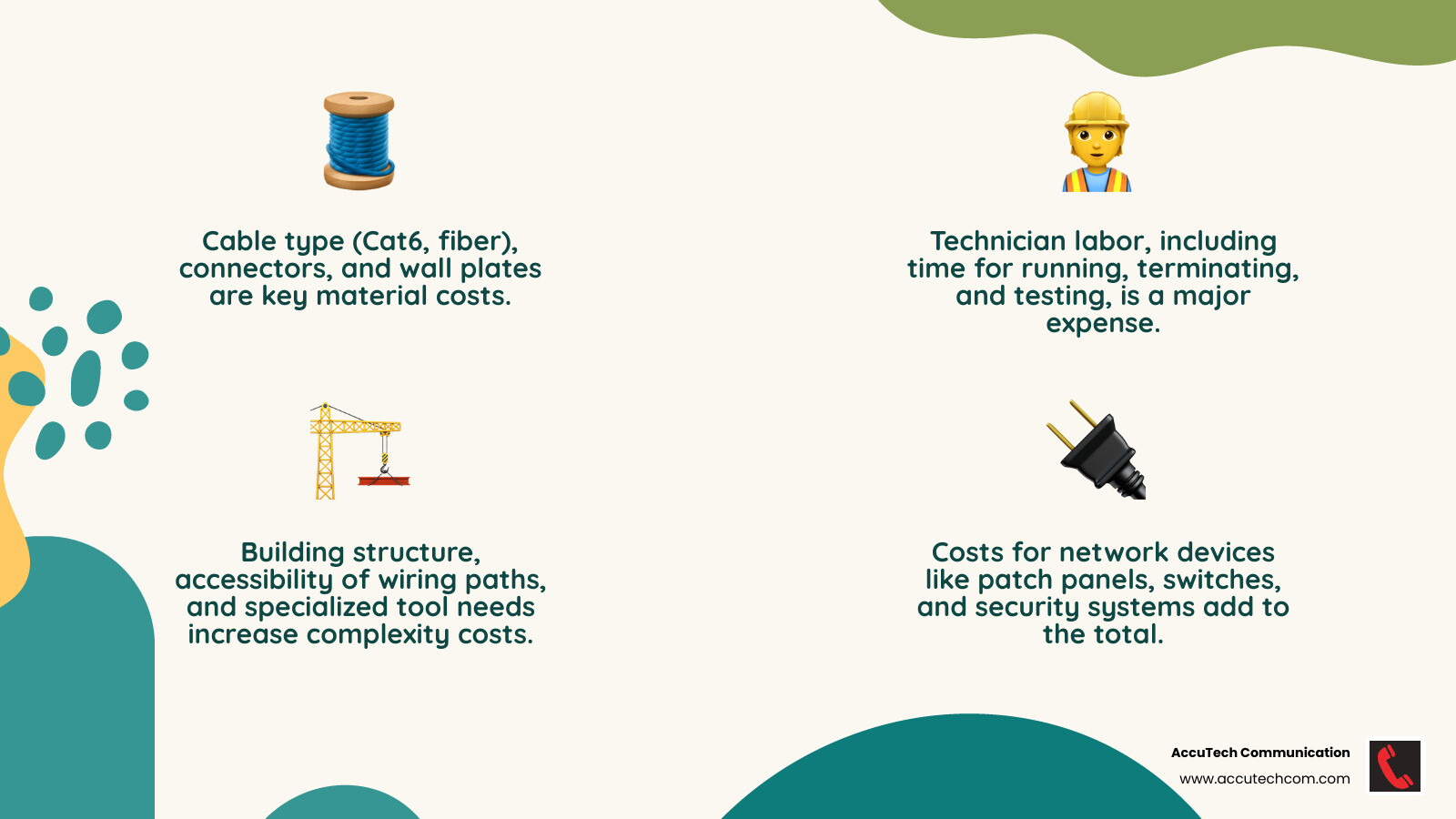
To estimate your data point installation cost, consider these key components:
- Materials: This includes the cable (like Cat6 or fiber optic), connectors, wall plates, and any necessary mounting hardware.
- Labor: The time and skill required for technicians to run, terminate, and test the cabling.
- Complexity: Factors like the building’s structure, accessibility of wiring paths, and the need for specialized tools can increase this.
- Additional Equipment: Costs for network devices such as patch panels, switches, or even security systems.
- Permits: Local regulations might require permits and inspections, adding to the overall expense.
A data point is essentially a physical connection within your building’s network. Think of it as a dedicated outlet, much like an electrical socket, but for data transfer. It typically features an Ethernet port or network jack, allowing devices to connect directly to your wired network.
Reliable and fast internet access is a necessity. For businesses, a robust wired network is the backbone of daily operations. It ensures stable, high-speed data transfer between computers, servers, IP cameras, and other devices. While Wi-Fi offers convenience, wired connections provide superior stability, speed, and security, crucial for uninterrupted productivity and sensitive data handling.
I’m Corin Dolan, owner of AccuTech Communications. With years of experience, I specialize in optimizing business communication networks and understanding the intricacies of data point installation cost.
Understanding the Average Data Point Installation Cost
When planning a network upgrade, the average data point installation cost is a primary concern. While costs vary based on many factors, this overview provides a general guide for professional network wiring.
For a single data point, the installation cost can range from a lower to a higher price point. If you’re looking to install multiple data points, the cost per point generally becomes more economical as the initial setup and travel time are amortized across more installations. In the US, the typical range for data point installation in 2024 is often cited between $200 and $500 per data point.
The general hourly rate for a data cabling installer often falls around $100. This labor cost is a significant component of the overall expense, alongside materials and installation complexity. At AccuTech Communications, we pride ourselves on offering certified, reliable service with competitive pricing, ensuring you get quality work without breaking the bank.
Data Point Installation Cost by Cable Type
The type of cable chosen for your data points is a primary determinant of the overall data point installation cost. Different cables offer varying speeds, bandwidths, and performance characteristics, which directly influence their material cost and the complexity of their installation.
Here’s a comparison of common data cable types:
| Cable Type | Speed | Best For | Material Cost per Foot | Average Installed Cost per Point |
|---|---|---|---|---|
| Cat5e | Up to 1 Gbps | Basic home networks, older systems | Lower | Lower |
| Cat6 | Up to 10 Gbps (over shorter distances) | Modern home/small office networks | Moderate | Moderate |
| Cat6a | Up to 10 Gbps (over full distances) | High-performance networks, future-proofing | Higher | Higher |
| Fiber Optic | Up to 100 Gbps+ | Data centers, long distances, high security | Highest | Highest |
- Twisted Pair (Cat5e, Cat6, Cat6a): These are the most common types of Ethernet cables, consisting of twisted copper wires.
- Cat5e is the most affordable but is gradually being phased out due to its lower speed capabilities compared to newer standards.
- Cat6 is an excellent choice for many small-scale projects, offering speeds up to 10 Gigabits per second (Gbps) over runs up to 90 meters.
- Cat6a (augmented) extends the 10 Gbps capability to the full 100-meter distance, making it ideal for more robust installations.
- Cat7 and Cat7a (augmented) offer even higher performance, providing 10 Gbps over 100 meters and higher frequencies, often with individual shielding for reduced crosstalk. While they offer optimal performance, they are generally more expensive than Cat6/6a.
Ethernet ports are the physical interfaces where these cables connect to devices.
- Coaxial Cable: While traditionally used for television and internet (cable modem) connections, coaxial cable can also be used for data points. Its installation cost typically ranges from $150 to $300 per data point.
- Fiber Optic Cable: This is the fastest, most reliable, and most expensive option. Fiber optic cables transmit data using light signals, making them immune to electromagnetic interference and ideal for very long distances and extremely high bandwidth requirements. The material cost for fiber optic cables can range from $2 to $4 per linear foot, leading to higher overall installation costs per data point, typically between $400 and $800.
Choosing the right cable type involves balancing current needs with future demands and budget. We can help you assess your requirements to select the most suitable and cost-effective solution for your specific application.
Typical Data Point Installation Cost for Homes
A robust home network is increasingly essential for today’s digital lifestyle, supporting everything from seamless streaming and competitive gaming to reliable remote work and smart home device integration. For a comprehensive installation involving multiple data points, the cost per point generally aligns with the broader ranges mentioned earlier, typically between $200 and $500 per data point in the US.
For new home construction, the cost to wire a house with electrical and network cabling can be estimated on a per-square-foot basis, often ranging from $4 to $9 per square foot. This translates to an overall cost of $6,000 to $22,500 for a 1,500 to 2,500 square foot home. This investment ensures that your home is future-proofed, providing the stable, high-bandwidth connections needed for current and emerging technologies. Investing in structured cabling during new construction is always more cost-effective than retrofitting later.
Commercial Data Point Installation Cost Breakdown
For businesses, a professionally installed network is a critical operational asset. The data point installation cost for commercial settings can vary widely based on the scale and complexity of the project.
- Small Office Networks: Installing a hardwired computer network in a small office building might cost between $500 and $1,000. This typically involves connecting a few key devices and setting up basic network infrastructure.
- Larger Office Buildings: For a more extensive setup in a large office building, the cost can range from $2,000 to $6,000. This often includes more data drops, longer cable runs, and more complex routing.
- Enterprise-Level Networks: For large enterprises with 100+ network nodes (connection points), the typical investment range can be from $50,000 to $250,000 or more.
Key cost factors for commercial network installation include the hardware (such as servers, routers, and switches), the extensive cabling required, and the labor hours involved. For businesses, the network often includes specialized components like server rooms, patch panels for centralized cable management, and robust network switches to handle high volumes of data traffic.
Commercial projects often involve different tiers of network size, each with its own typical investment:
- Small Office (10-25 nodes): Investment range typically $5,000 – $15,000.
- Medium Business (25-100 nodes): Investment range typically $15,000 – $50,000.
- Large Enterprise (100+ nodes): Investment range typically $50,000 – $250,000+.
A well-designed and expertly installed network provides crucial benefits such as reduced downtime, increased productivity, lower IT support costs, extended equipment lifespan, and improved security. These benefits represent a significant return on investment for businesses. We understand the unique needs of businesses in Massachusetts, New Hampshire, and Rhode Island, and our commercial data cabling services are designed to ensure your operations run smoothly.
More info about Commercial Data Cabling
Key Factors That Influence Installation Pricing
Understanding the variables that influence your data point installation cost is essential for accurate budgeting and avoiding surprises. Many factors can sway the final price of your project, and knowing what to expect helps you make informed decisions.
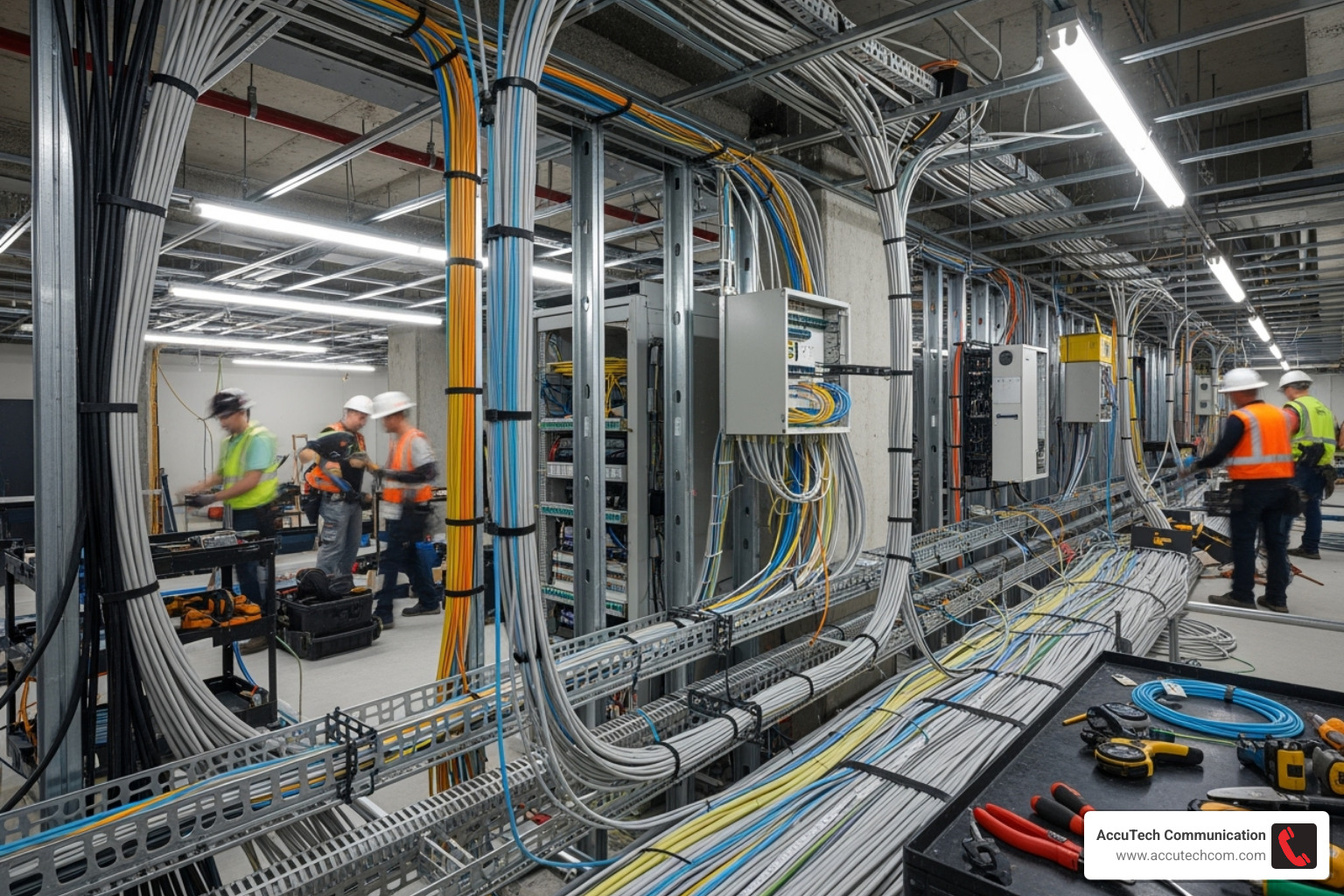
The number of data points significantly impacts your overall cost. Installing more points at once typically lowers the cost per point, as installers can work more efficiently and spread their setup costs across multiple installations.
Cable length is another straightforward factor. The farther your data point is from the main network hub, the more cable is needed, which adds to both material costs and installation time.
Installation complexity is a key factor. Running cable through an open ceiling is simple, but threading it through finished walls, around corners, or in tight spaces requires more skill and time. Working around existing utilities or complex architectural features will increase the labor portion of your data point installation cost.
The building type makes a significant difference. Commercial installations often require more robust systems and must meet stricter building codes, while residential projects are typically more straightforward.
Timing matters tremendously. New construction installations are ideal because walls are open and everything is accessible. Retrofit projects in existing buildings require more creativity, and may involve opening and patching walls.
Accessibility can impact a project’s efficiency. An unfinished basement or accessible attic space keeps costs down. Working in cramped crawl spaces or during off-hours to avoid disrupting your business will add to the final bill.
Wall material presents its own challenges. Drywall is relatively easy to work with, but brick, concrete, or old plaster walls require specialized tools and more time.
Geographic location affects pricing too. Labor rates and material costs vary by region, and our service areas in Massachusetts, New Hampshire, and Rhode Island each have their own market considerations.
Beyond the obvious costs, several potential hidden expenses can arise:
- Drywall repair and painting if walls need opening
- Conduit installation for cable protection in certain environments
- Network hardware upgrades like new switches or patch panels
- Permit fees required by local regulations
- Hazardous material testing in older buildings
- General contractor markup if cabling is part of a larger project
The key is planning ahead and working with experienced professionals who can spot potential complications early. At AccuTech Communications, we’ve been navigating these variables since 1993, so we know how to give you realistic expectations from the start.
Best Practices for a Reliable and Cost-Effective Network
A smooth, efficient network requires more than just plugging in cables; it demands smart planning and industry best practices. A properly designed network will perform reliably for years, accommodate future technology, and turn your initial data point installation cost into a true long-term investment.
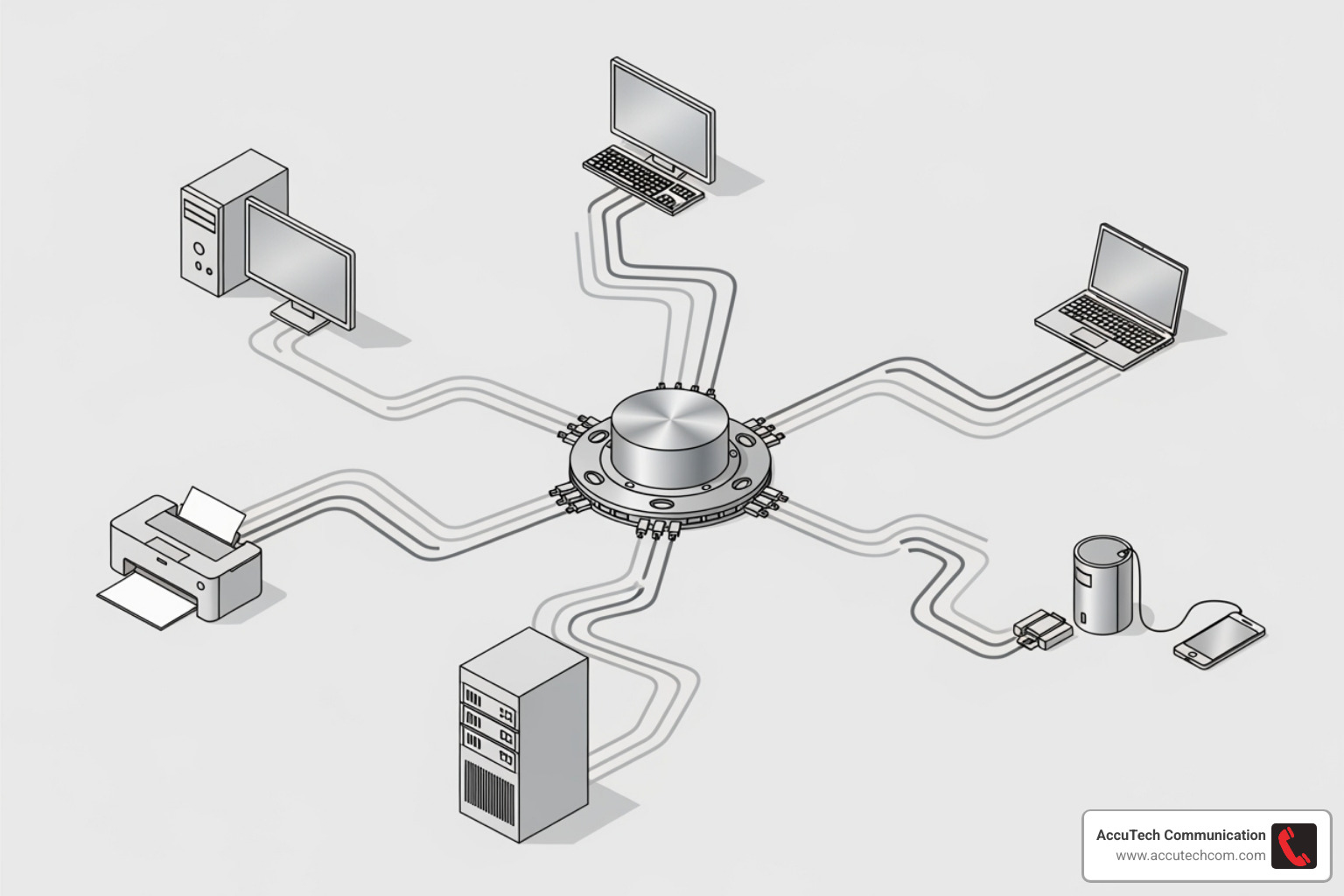
A key part of good planning is understanding network topology—the arrangement of your network devices and cables. The most popular choice, and one we often recommend, is the star topology. In this setup, all devices connect back to a central spot, like a hub, switch, or router. If one cable has an issue, only that single device goes offline, not the entire network. This simplifies troubleshooting and is usually the most cost-effective setup for homes and offices. Other topologies, like mesh or tree, are more complex and expensive, reserved for specialized needs.
Effective cable management is incredibly important. It improves network performance, simplifies troubleshooting, and makes future changes easier. Here are some powerful best practices: Always label cables clearly at both ends. Test every connection after installation to ensure it works perfectly; replace any faulty cables immediately. When bundling cables, use soft Velcro ties instead of tight plastic zip ties to prevent cable damage. Leave a little slack in your cables, as this extra length can be a lifesaver for future moves or reconfigurations. Finally, keep thorough documentation of your cabling, including network diagrams and equipment lists, to save headaches down the road.
Future-proofing your network means making smart choices now to avoid costly overhauls later. While it might mean a slightly higher data point installation cost upfront, choosing higher-grade cabling like Cat6a or even fiber optic for critical connections can save you significant money and disruption in the long run. It ensures your network can handle increasing demands for speed and bandwidth.
Beyond the cables, several essential network devices act as the brains and brawn of your wired network:
- Routers direct data between your local network and the internet.
- Switches allow multiple devices within your network to communicate with each other efficiently.
- Firewalls act as security guards, protecting your network from unauthorized access.
- Servers (especially for businesses) store shared data and manage resources.
At AccuTech Communications, our structured cabling services are all about designing and installing your network infrastructure with these best practices in mind. We build a foundation that is both reliable today and scalable for your needs tomorrow.
More info about Structured Cabling Services
Frequently Asked Questions about Data Point Installation
We hear many questions about network wiring, and understanding the data point installation cost is often a top concern. Here are some of the most common inquiries we receive.
How long does it take to install network wiring?
The time required to install network wiring varies based on the project’s size and complexity.
Installing a single data point in an accessible location could take just a few hours. A multi-room project for a home or small office might take a full day to a few days.
For new construction wiring, with open walls, the initial phase can take one to three weeks or more, depending on the property size and number of data points. Retrofit wiring in an existing building usually takes more time, as it requires careful work to minimize disruption. Factors like running cables through conduit, drilling into concrete, or working in confined spaces will also add to the installation time.
No matter the complexity, our team at AccuTech Communications is dedicated to working efficiently and professionally to complete every project on schedule while upholding our high standards of quality.
What is the difference between Cat6 and Cat7 cabling?
When considering your data point installation cost, understanding the difference between Cat6 and Cat7 cabling is important. Both are effective, but they have key differences.
Cat6 cable is a popular choice for modern homes and businesses, offering a great balance of performance and affordability. It supports speeds up to 1 Gigabit per second (Gbps) over 100 meters and can handle 10 Gbps over shorter runs, operating at frequencies up to 250 MHz. It is typically unshielded but designed to resist signal interference (crosstalk) better than older cables. Cat6a (Augmented Cat6) is an improved version that supports a full 10 Gbps over the entire 100-meter distance and operates at 500 MHz, making it an excellent choice for future-proofing.
Cat7 cable offers top-tier performance, supporting 10 Gbps over 100 meters and operating at frequencies up to 600 MHz. The biggest difference is its shielding: each wire pair is individually shielded, and the entire cable is also shielded. This significantly reduces crosstalk and protects against external electromagnetic interference. Due to its complex construction, Cat7 is generally more expensive than Cat6 or Cat6a. Cat7a (Augmented Cat7) pushes performance even further, supporting frequencies up to 1000 MHz.
While Cat7 offers superior performance, Cat6a provides excellent speed and reliability for most business and home needs at a more favorable data point installation cost. For extreme bandwidth needs or environments with high electromagnetic interference, Cat7 or fiber optic may be worth considering.
Why is a wired network better than Wi-Fi for my business?
While Wi-Fi offers convenience, a wired network provides significant advantages for a business. The benefits to productivity, security, and reliability make the data point installation cost a worthwhile investment.
- Speed and Performance: Wired Ethernet networks are consistently faster and more reliable than Wi-Fi, offering higher data speeds and greater bandwidth crucial for tasks like large file transfers, cloud applications, and video conferencing.
- Reliability: Wired connections are more stable and not susceptible to interference from other wireless devices, thick walls, or distance from the router. This ensures a consistent, uninterrupted data flow.
- Lower Latency: Wired networks have much lower latency (delay) than Wi-Fi, which is critical for real-time applications like VoIP phone systems, video conferencing, and remote desktop access.
- Security: Data transmitted over cables is much harder for unauthorized individuals to intercept compared to over-the-air Wi-Fi signals, making it the smarter choice for sensitive business data.
- Reduced Interference: Wired systems are immune to the radio frequency interference that can degrade Wi-Fi performance in busy office environments.
For businesses across Massachusetts, New Hampshire, and Rhode Island, a robust network is essential. Our network cabling services are designed to provide a stable, secure, and high-performing business environment.
More info about Network Cabling Services
Conclusion: Investing in Your Connectivity for a Faster Future
Understanding the data point installation cost is the first step, but the true value lies in a professionally installed network. In today’s hyper-connected world, a reliable, high-speed network is a fundamental utility for both homes and businesses, as essential as electricity.
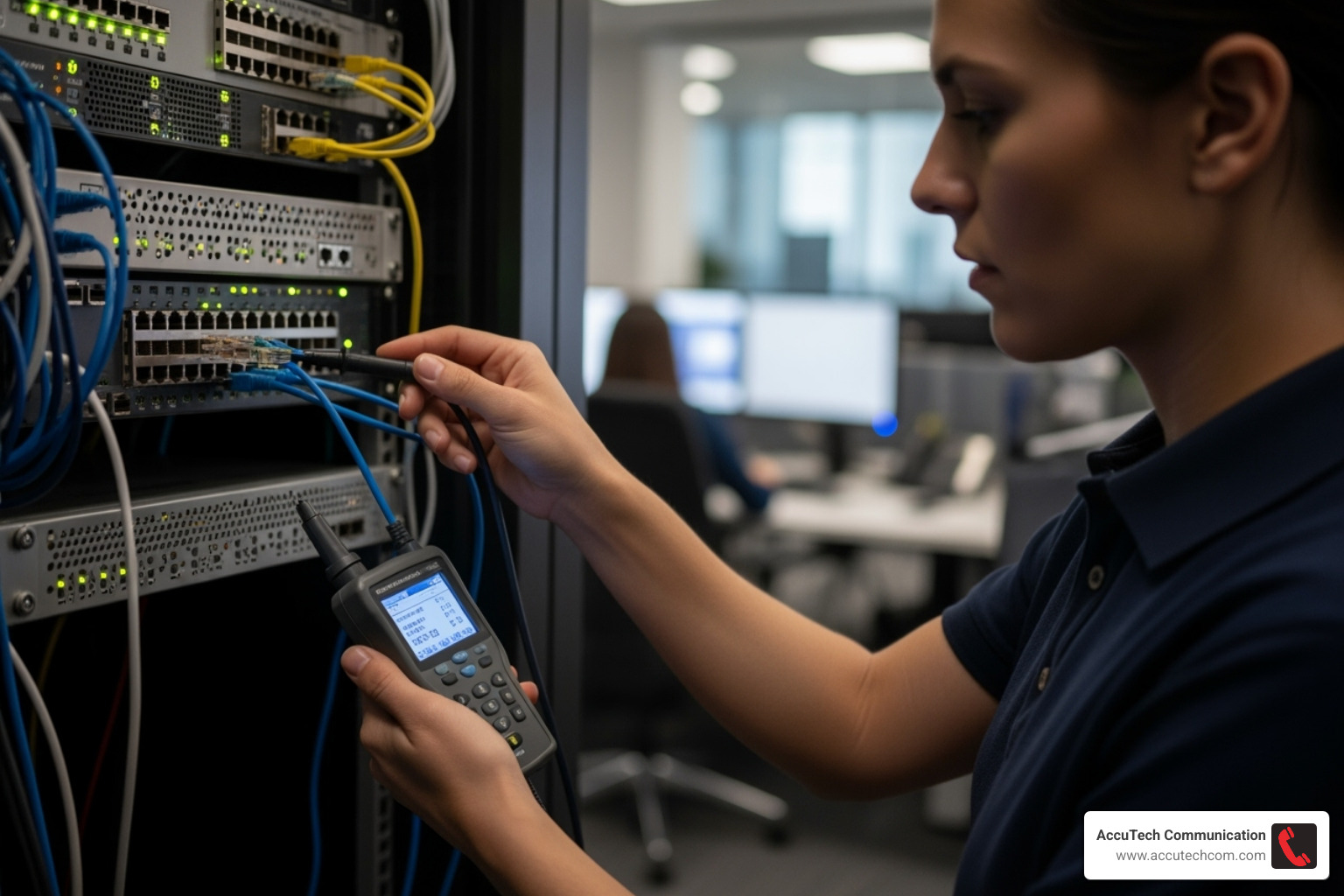
We’ve seen how factors like cable type, number of points, and installation complexity all influence the final data point installation cost.
Understanding these factors is about making a smart investment. A professionally installed network is the silent backbone of your home or business, leading to less downtime, increased productivity, and improved data security. It’s an infrastructure built to grow with you and accommodate future technology.
Cutting corners on this vital infrastructure might save money now, but it often leads to higher costs later in repairs and lost productivity. The long-term peace of mind and efficiency from a professional installation are priceless.
Here at AccuTech Communications, we believe in building connections that last. Since 1993, we’ve been the trusted partners for businesses across Massachusetts, New Hampshire, and Rhode Island, delivering top-notch network cabling, business phone systems, and data center solutions. Our promise is simple: certified, reliable service with competitive pricing. We’re here to build a high-performance network that fits your unique needs.
If you’re in our service area and ready to upgrade your connectivity, don’t guess about the data point installation cost. Getting a precise quote from our friendly, certified professionals is the smartest first step towards a faster, more reliable future.
Ready to take the leap? We’re just a click away to help you plan your perfect network.
Contact us for a detailed quote on your data cabling installation project
