
Enterprise Wireless Network Solutions: 10 Powerful Benefits 2025
Navigating the Complex World of Enterprise Connectivity
Enterprise wireless network solutions are comprehensive systems designed to provide secure, reliable, and high-performance wireless connectivity across business environments of all sizes. Unlike home networks, these solutions must support hundreds or thousands of simultaneous connections while maintaining security and performance.
Top Enterprise Wireless Network Solutions in 2024:
1. Advanced AI-Driven Systems – Best for AI-driven operations with 90-day free trial
2. Budget-Friendly Business WiFi – Best value starting at $0.83/device/month
3. Cloud-Managed Enterprise Systems – Best for simplified management with cloud-based dashboard
4. High-Performance Enterprise WiFi – Best for scalability with support for up to 5.3 Gbps speeds
5. Cost-Effective Enterprise Solutions – Best for budget-conscious deployments with free software licensing
Today’s businesses face unprecedented challenges in their wireless infrastructure. With the explosion of connected devices, remote work requirements, and bandwidth-hungry applications, the traditional approach to Wi-Fi no longer suffices. Modern enterprise environments require intelligent, scalable, and secure wireless solutions that can adapt to changing needs while remaining cost-effective.
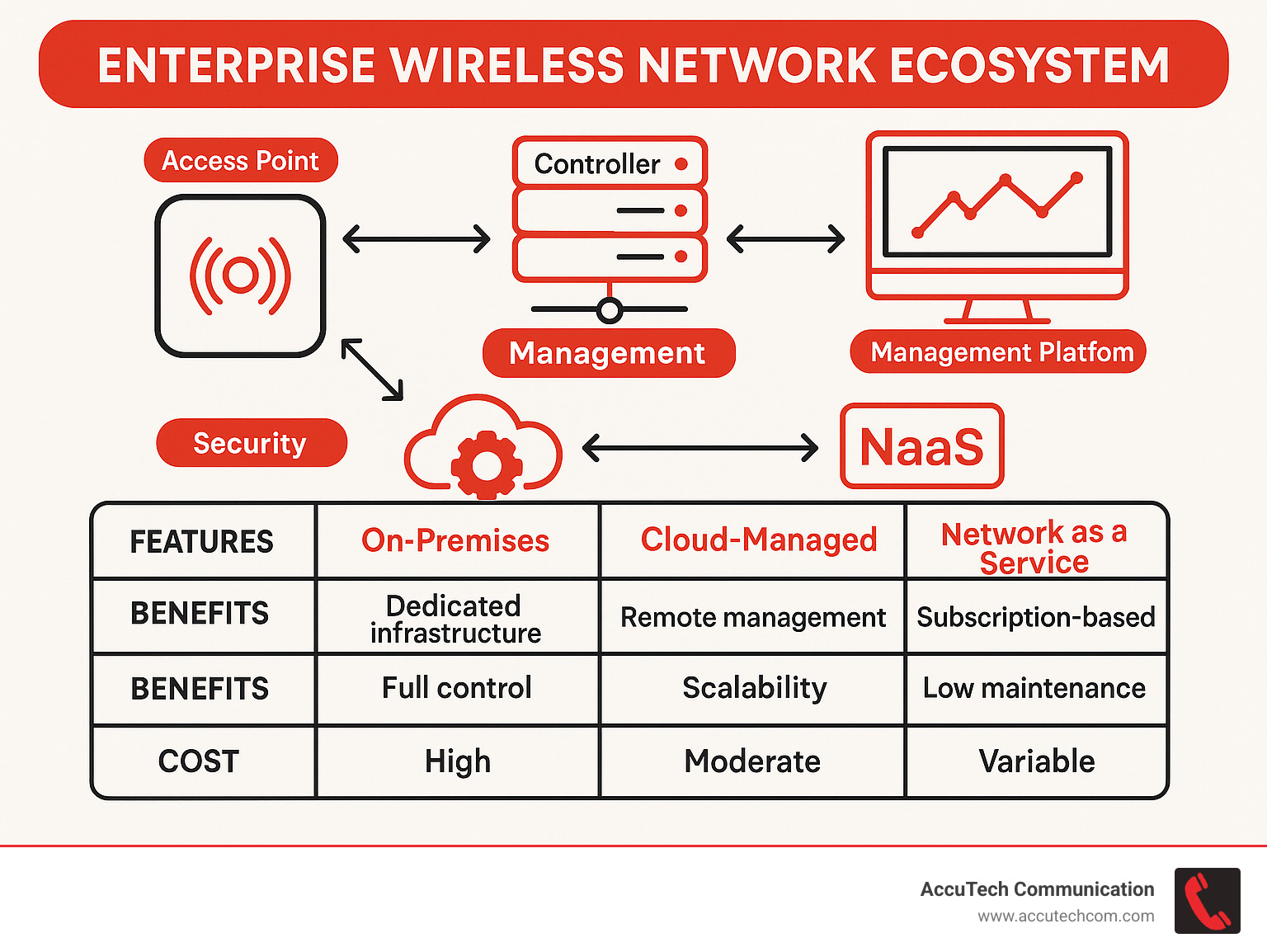
The wireless landscape has evolved dramatically in recent years. Wi-Fi 6 and 6E have introduced significant performance improvements, while cloud management platforms have transformed how networks are deployed and maintained. Organizations now face critical decisions about whether to pursue traditional on-premises deployments, cloud-managed solutions, or accept the growing trend of Network as a Service (NaaS).
I’m Corin Dolan, owner of AccuTech Communications with over 25 years of experience designing and implementing enterprise wireless network solutions across Massachusetts, New Hampshire, and Rhode Island for businesses ranging from healthcare facilities to educational institutions.
Basic enterprise wireless network solutions glossary:
– wireless networking solutions for hospitality
– wireless network problems and solutions
– wireless network security issues and solutions
Enterprise Wi-Fi 101: What Makes It Different?
When businesses sit down with us to discuss upgrading from consumer-grade to enterprise wireless network solutions, I often see their eyes widen at the fundamental differences. Trust me—enterprise Wi-Fi isn’t just home Wi-Fi with a bigger engine. It’s an entirely different vehicle designed for a completely different journey.
Think about the capacity needs alone. Your home network might handle a dozen devices on a busy day. But in a business environment? We’re talking hundreds or even thousands of connections happening simultaneously. I recently helped a manufacturing client whose facility needed to support over 300 devices across three shifts—a task that would bring any home router to its knees.
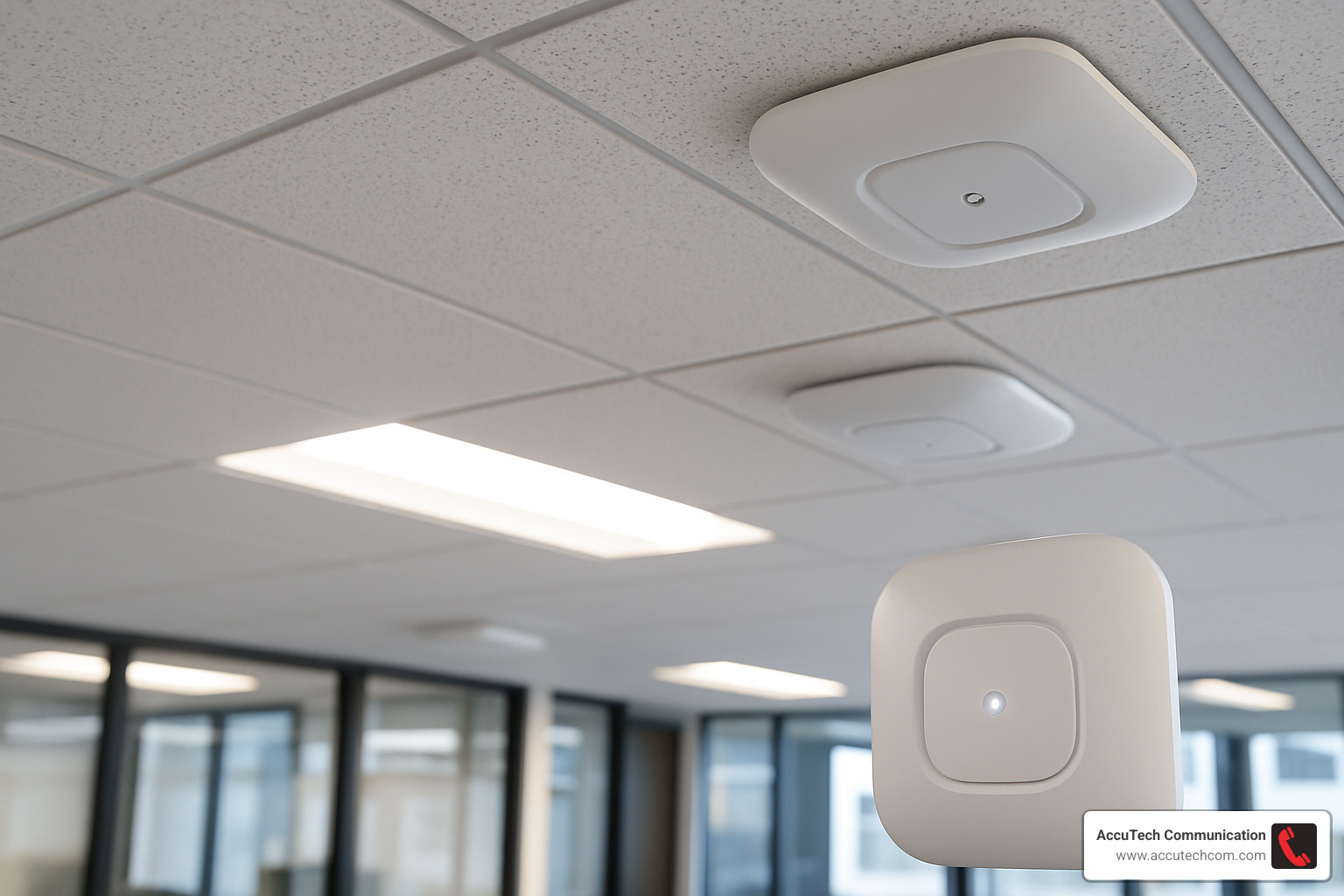
Security is another world entirely. While your home network might use a simple password, enterprise wireless network solutions implement industrial-strength protection like WPA3-Enterprise. This creates unique encryption keys for each user—imagine having a different house key for every family member that changes daily. Add 802.1X authentication, which verifies user identities against databases like RADIUS servers, and you’ve got security that means business.
Have you ever had your video call drop when walking from your kitchen to your living room? That wouldn’t fly in a hospital where doctors need continuous connections while moving between patient rooms. That’s why seamless roaming capabilities are built into enterprise systems, allowing people to move throughout large facilities without disconnections or hiccups.
Business environments also demand sophisticated features that home networks simply don’t offer: multi-SSID support lets you create separate networks for different departments or purposes; Quality of Service (QoS) ensures your critical applications get priority bandwidth; and robust BYOD management helps secure all those personal devices connecting to your network. Modern enterprise wireless network solutions are also built ready for the IoT explosion, with special onboarding protocols and security measures for everything from security cameras to smart building sensors.
Home vs Enterprise Feature Matrix
| Feature | Home Wi-Fi | Enterprise Wi-Fi |
|---|---|---|
| User Capacity | 5-15 devices | Hundreds to thousands |
| Radio Design | Typically dual-band | Tri-band, multi-radio design |
| Management | Basic app or web interface | Comprehensive dashboard with analytics |
| Redundancy | None | Controller failover, AP redundancy |
| Power | Wall outlet | Power over Ethernet (PoE) |
| Roaming | Basic or none | Fast, seamless roaming with 802.11r/k/v |
| Security | WPA2/WPA3-Personal | WPA3-Enterprise, 802.1X, RADIUS |
| Monitoring | Basic status | Detailed performance analytics |
| Guest Access | Simple password | Captive portal, social login, vouchers |
| Firmware Updates | Manual or basic scheduling | Centralized deployment with testing |
I’ve seen this change while working with clients across Massachusetts and Rhode Island. A local college we worked with initially thought they just needed “better Wi-Fi” but quickly realized they needed a completely different approach to support their digital learning initiatives. The move to enterprise-grade wireless isn’t just about eliminating dead spots—it’s about building a foundation that can support your organization’s growth for years to come.
The density of modern work environments, the mobility needs of your team, and the security demands of today’s threat landscape all require a network that was purpose-built for business. As I often tell clients during our first meeting: “Home Wi-Fi connects devices. Enterprise wireless network solutions connect businesses.”
The Business Case: Benefits & Challenges of Enterprise Wireless Network Solutions
When businesses invest in enterprise wireless network solutions, they’re not just buying better Wi-Fi—they’re creating a foundation for digital change. At AccuTech, we’ve seen how the right wireless infrastructure can revolutionize operations for our clients across Massachusetts and Rhode Island.
Think about your current wireless setup. Is it merely a utility, or is it actively helping your business grow? The difference matters more than you might think.
Key Benefits Breakdown
The most successful wireless deployments we’ve implemented share several common advantages. Centralized management tops the list—imagine having a single dashboard where you can see every connected device, troubleshoot issues, and make network-wide changes in minutes instead of days. One of our healthcare clients reduced their IT response time by 70% after implementing this kind of unified visibility.
Improved productivity isn’t just a buzzword when it comes to enterprise wireless. When your team can collaborate over video without freezing, access cloud applications without timeouts, and move throughout your facility without losing connection, real work gets done. We’ve seen manufacturing clients eliminate “dead zones” that were previously causing workflow bottlenecks.
Scalability becomes crucial as your business grows. Rather than ripping and replacing your network every few years, enterprise wireless network solutions allow you to expand gradually. A retail client of ours started with three stores and has since expanded to twelve locations—all while maintaining the same wireless architecture.
The analytics capabilities of modern wireless systems provide insights you might never have considered. Which areas of your office get the most foot traffic? When do you experience peak usage? These data points help with everything from space planning to staffing decisions. One university client finded underused campus spaces that were repurposed, saving thousands in planned construction costs.
Guest access management transforms visitor experiences while keeping your main network secure. Custom-branded portals, simple social login options, and appropriate usage limits create professional impressions without compromising security. For hospitality clients especially, this feature has become non-negotiable.
Lastly, future-proofing your network provides peace of mind in a rapidly changing technology landscape. Enterprise solutions typically support emerging standards and offer clearer upgrade paths than consumer-grade alternatives.
Common Pain Points to Watch
Despite these compelling benefits, we believe in transparent conversations about potential challenges. After all, forewarned is forearmed.
RF interference and congestion remain persistent challenges, especially in dense urban environments like Boston or Providence. The invisible radio waves that carry your data are vulnerable to disruption from neighboring networks, building materials, and even microwave ovens. Proper site surveys and ongoing RF management are essential countermeasures.
Security vulnerabilities demand constant vigilance. While wireless convenience enables productivity, it also creates potential entry points for bad actors. Implementing strong encryption, multi-factor authentication, and regular security audits isn’t optional—it’s essential protection for your business data.
Integration with legacy systems can present unexpected problems. That warehouse management system from 2005 might not play nicely with your shiny new wireless network. We’ve helped many Massachusetts businesses bridge these technology gaps with careful planning and specialized configurations.
Management complexity sometimes catches organizations off-guard. The same powerful features that make enterprise wireless so valuable also require expertise to properly configure and maintain. Consider whether your team has the bandwidth and knowledge to manage these systems, or if partnering with specialists like AccuTech makes more sense.
Finally, cost management requires looking beyond the initial price tag. While enterprise wireless requires more upfront investment than consumer-grade alternatives, the total cost of ownership often tells a different story when you factor in reduced downtime, longer equipment lifespan, and fewer support calls.
By weighing these benefits and challenges thoughtfully, you’ll be better positioned to make wireless infrastructure decisions that truly serve your business goals rather than becoming technology for technology’s sake.
Choosing the Right Enterprise Wireless Network Solutions
Finding the perfect enterprise wireless network solution isn’t just about picking the shiniest new technology—it’s about finding the right fit for your specific business needs. At AccuTech Communications, we’ve walked hundreds of Massachusetts, New Hampshire, and Rhode Island businesses through this process, and we’ve learned a thing or two along the way.
Evaluation Checklist — Enterprise Wireless Network Solutions
Before you start comparing vendors or getting lost in technical specs, take a step back and think about what your organization truly needs. Here’s a checklist we’ve refined over our decades of experience:
First, consider your physical space. How much square footage needs coverage? What are your buildings made of—concrete that blocks signals or open spaces that allow them to travel? Do you need outdoor coverage for courtyards or parking lots? Any remote offices that need to connect seamlessly?
Next, think about the people using your network. How many employees will connect simultaneously during your busiest periods? Are there conference rooms that suddenly fill with devices during meetings? Do you run bandwidth-hungry applications like video conferencing or design software? And don’t forget about growth—where will you be in 3-5 years?
Security needs vary dramatically by industry. Are you handling patient data that must meet HIPAA requirements? Processing credit cards under PCI DSS rules? Different regulations demand different security approaches, and we’ll help you steer those requirements.
Your IT team’s capabilities matter too. Do you have wireless networking experts in-house, or would you benefit from more automated, cloud-based management? Are you managing multiple locations that need central oversight? What kinds of reports and analytics would help you make better business decisions?
Don’t forget about integration. Your wireless network doesn’t exist in isolation—it needs to work with your existing infrastructure, authentication systems like Active Directory, specialized equipment, and business-critical applications.
Finally, let’s talk money. Are you more comfortable with upfront capital expenses or predictable monthly operational costs? Have you considered the total cost over 5 years, including maintenance and inevitable upgrades? What kind of licensing model works best for your budgeting process?
On-Prem vs Cloud vs NaaS Decision Guide
Today’s enterprise wireless network solutions typically come in three flavors, each with its own set of advantages:
On-Premises Solutions put you in the driver’s seat. You own the hardware and software outright, giving you maximum control over your network and data. You can customize to your heart’s content and may find this approach necessary for certain regulatory compliance scenarios. The trade-off? Higher upfront costs and full responsibility for keeping everything running smoothly.
Cloud-Managed Solutions offer a happy medium. You still own the hardware, but the management platform lives in the cloud, letting your IT team monitor and adjust settings from anywhere with internet access. Software updates happen automatically, and scaling across multiple locations becomes much simpler. Your costs split between hardware purchases and ongoing subscription fees.
Network as a Service (NaaS) has become increasingly popular, especially for businesses that want to focus on their core operations rather than network management. Think of it as your complete wireless solution bundled into a predictable monthly fee—hardware, software, maintenance, and support all wrapped into one. Your IT team can redirect their energy toward initiatives that directly impact your bottom line.
As one of our manufacturing clients in Worcester put it: “Moving to a NaaS model allowed us to redirect our IT team’s focus from maintaining infrastructure to developing applications that drive business value.”
When weighing these options, don’t just think about today—consider how your needs might evolve over the next few years. The right wireless solution grows with you, providing both immediate reliability and long-term flexibility.
According to scientific research on Wi-Fi 6 optimization, newer technologies like Wi-Fi 6 can dramatically improve performance in high-density environments—something to consider as you evaluate your options.
Emerging Technologies Shaping Enterprise Wireless Network Solutions
The world of enterprise wireless network solutions is never standing still. Like watching a child grow, we’ve seen remarkable changes in wireless technology over the last few years. At AccuTech Communications, we’re constantly testing and evaluating these innovations to ensure our clients throughout Massachusetts, New Hampshire, and Rhode Island stay ahead of the curve.
Wi-Fi 6/6E/7 — Speed & Spectrum Leap
Remember when we thought Wi-Fi 5 was fast? Wi-Fi 6 (802.11ax) has completely changed the game with theoretical speeds reaching up to 9.6 Gbps. But it’s not just about speed – it’s about efficiency. Think of it like upgrading from a two-lane country road to an eight-lane highway with smart traffic management.
The real magic comes from technologies like OFDMA (Orthogonal Frequency-Division Multiple Access), which allows multiple devices to share channels simultaneously. It’s like having a skilled traffic cop directing data instead of a simple stop light.
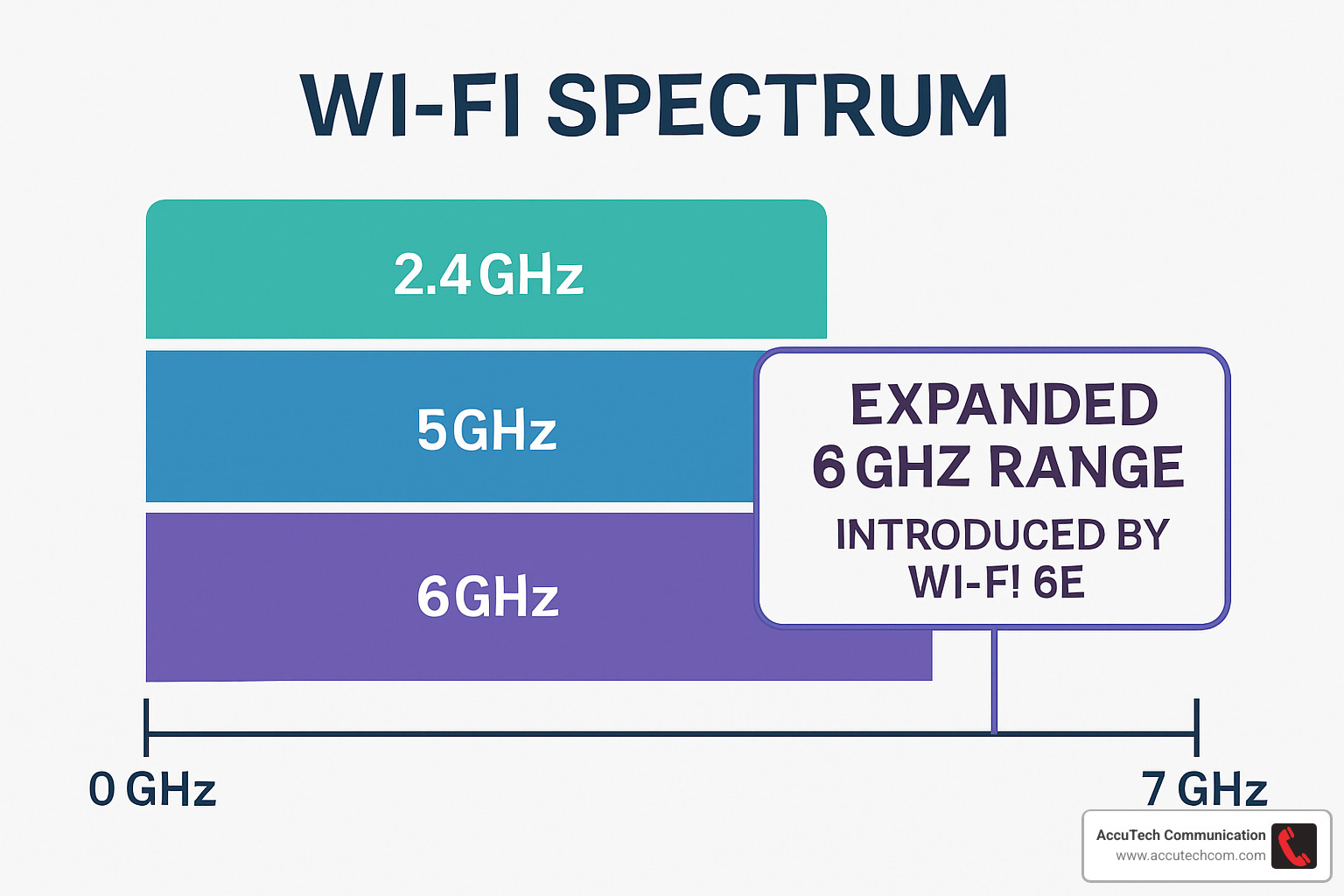
Wi-Fi 6E takes things further by expanding into the newly available 6 GHz spectrum. Imagine your network was a crowded restaurant with limited seating, and suddenly a whole new dining room opens up. That’s what 6E brings – breathing room in a previously congested space. This is particularly valuable in dense environments like downtown Boston offices or busy Worcester healthcare facilities.
Looking ahead, Wi-Fi 7 (802.11be) is on the horizon with even more impressive capabilities:
Multi-Link Operation will let your devices use multiple frequency bands simultaneously – like being able to drive on several highways at once to reach your destination faster.
Wider channels (320 MHz, double what Wi-Fi 6 offers) will provide more data throughput, while 4K QAM modulation will pack more information into each transmission.
The result? Theoretical speeds exceeding 30 Gbps – enough to download an entire 4K movie in seconds rather than minutes.
AI-Driven Automation & Analytics for Enterprise Wireless Network Solutions
Remember the days when network problems meant hours of manual troubleshooting? Those days are rapidly disappearing thanks to artificial intelligence in enterprise wireless network solutions.
AI-powered systems are changing network management from a reactive headache to a proactive breeze. It’s like having a skilled mechanic who not only fixes your car when it breaks down but anticipates problems before they happen and keeps everything running smoothly.
These intelligent systems can automatically identify and fix network issues before users even notice them. They optimize channel selection and power levels based on actual usage patterns, not just theoretical models. They can spot unusual behavior that might indicate security threats, giving your team a heads-up before damage occurs.
One of our educational clients in Marlborough was amazed when their AI-driven system reduced wireless help desk tickets by over 60% within just six months. “It’s like having an extra IT person who never sleeps,” their director told us with a smile.
Natural language interfaces like Juniper’s Marvis Virtual Network Assistant are making troubleshooting more intuitive. Instead of digging through complex logs, IT staff can simply ask questions like, “Why is the third-floor conference room having connectivity issues?” and receive clear, actionable answers.
Secure Access & Compliance in High-Density Environments
As wireless becomes the primary way employees connect to corporate resources, security approaches have had to evolve. It’s no longer enough to build a strong wall around your network – you need intelligent security that verifies everyone and everything, all the time.

Zero Trust Network Access (ZTNA) has become the gold standard. Rather than assuming devices inside your network are trustworthy, zero trust verifies every user and device, every time. Think of it as moving from a nightclub with a simple ID check at the door to one that checks IDs at every single bar and lounge inside.
WPA3-Enterprise improves encryption and authentication protections while actually simplifying deployment – a rare win-win in the security world.
For businesses with growing IoT deployments, network segmentation has become essential. By isolating Internet of Things devices on separate network segments, you contain potential breaches and ensure compliance with regulations. It’s like keeping the children’s pool separate from the main swimming area – if something unfortunate happens in one, it doesn’t affect the other.
For our clients in regulated industries across New England, automated compliance reporting has been a game-changer. These tools generate documentation demonstrating adherence to regulations like HIPAA, PCI-DSS, or industry-specific standards, turning what used to be days of manual work into an automated process.
These security advancements aren’t just technical improvements – they’re essential tools for risk management and compliance in today’s increasingly regulated business environment. For organizations in healthcare, finance, or government sectors, they’re as necessary as locks on your doors.
For more insights on wireless security approaches, check out our guide to wireless network security issues and solutions.
Deployment Playbook: Best Practices for Performance, Security & Scalability
Successfully implementing enterprise wireless network solutions isn’t just about buying the right equipment—it’s about thoughtful planning and execution. After hundreds of deployments across New England, our team at AccuTech Communications has developed a practical playbook that ensures your wireless network delivers reliability, performance, and room to grow.
Site Surveys & Structured Cabling Foundation
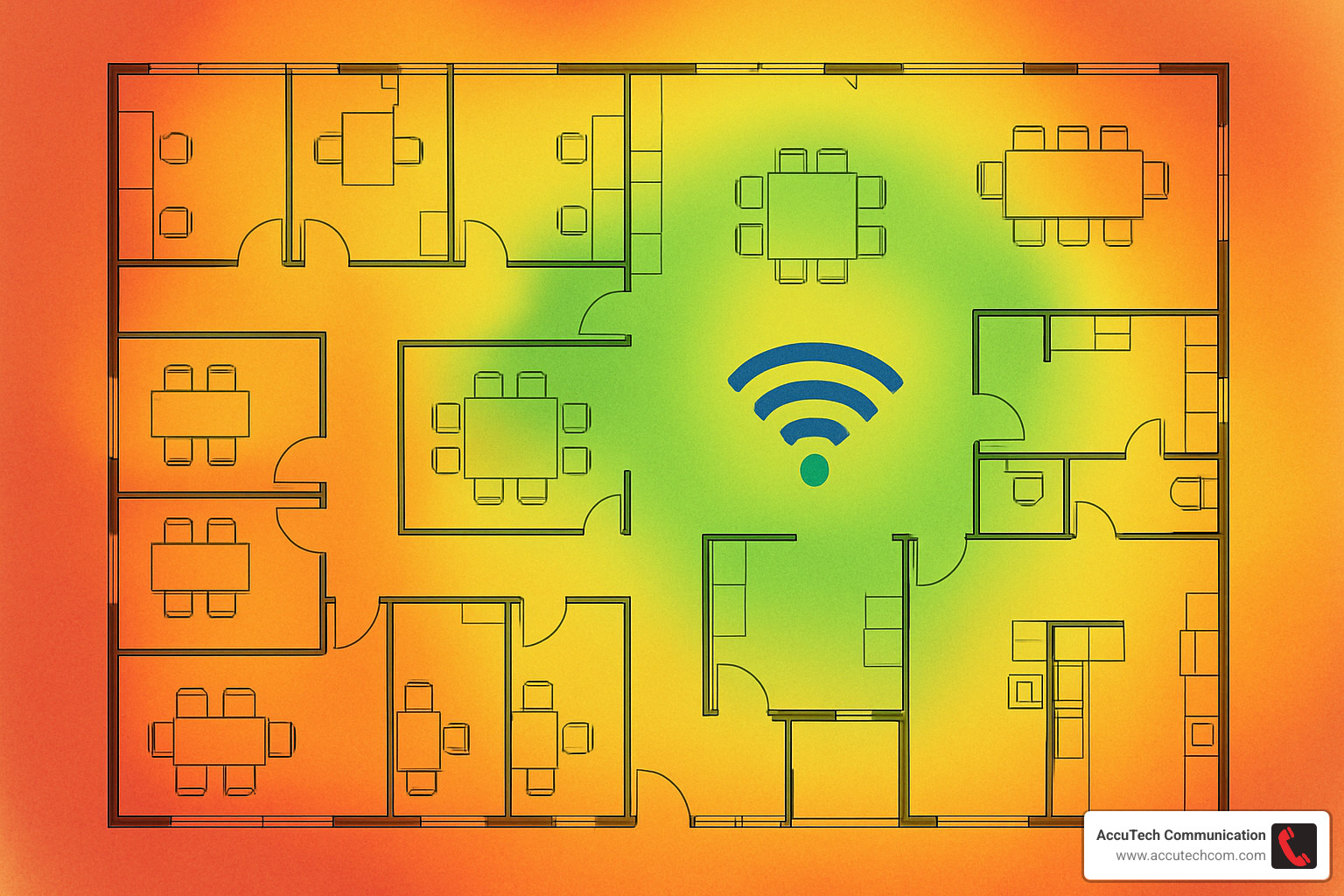
Think of a site survey as the blueprint for your wireless success. Without this critical first step, you’re essentially installing access points blindfolded. A proper survey includes:
- Walking through your physical space to assess building materials (concrete, glass, and metal all affect signals differently), identifying potential interference sources, and mapping coverage requirements
- Analyzing the existing RF spectrum to spot potential conflicts before they become problems
- Creating predictive models that show optimal access point placement
- Testing to verify our design assumptions actually work in your environment
We often remind clients that “your wireless network is only as good as the wired network supporting it.” This isn’t just a catchy phrase—it’s absolutely true. The structured cabling beneath your wireless system needs serious attention, including:
Cable quality matters enormously. We recommend Category 6A cabling for future-proofing and supporting multi-gigabit connections to access points. Our technicians certify every cable run to ensure it meets industry standards.
Power over Ethernet (PoE) planning ensures your access points receive consistent power. Modern access points need proper PoE standards (802.3at/bt) and sufficient power budget at your switches.
Switch capacity must provide enough backhaul bandwidth to prevent bottlenecks. There’s nothing more frustrating than having great wireless coverage that slows to a crawl because the switches can’t keep up!
Redundancy pathways protect against single points of failure for critical infrastructure. This might mean backup power sources or alternate cable paths for key areas.
Our network cabling installation services and business network cabling services in MA provide the rock-solid foundation your wireless network needs to thrive.
Ongoing Optimization & Monitoring
Deploying your network is just the beginning of the journey. The real work happens in the day-to-day management that keeps everything running smoothly.
First, we establish performance baselines by documenting normal operation parameters, setting thresholds for key metrics (signal strength, SNR, client counts), and creating user experience measurements. Without knowing what “normal” looks like, you can’t identify when things start to drift.
Proactive monitoring catches issues before they impact your business. We implement 24/7 monitoring for all network components, configure alerts for potential problems, and regularly review performance trends. One healthcare client in Boston saw a 40% reduction in wireless-related issues after implementing our proactive approach—dramatically improving how their clinicians felt about their mobile workstations.
Regular maintenance keeps everything running at peak performance. This includes scheduling firmware updates during low-impact windows (nobody wants updates happening during a critical meeting!), periodically reassessing the RF environment as conditions change, and conducting quarterly performance reviews.
Capacity planning prevents growing pains. We monitor growth in device count and bandwidth consumption, project future needs based on established trends, and plan upgrades before capacity constraints impact performance. This forward-thinking approach prevents those “emergency” upgrades that always seem to cost more and cause more disruption.
Future-Proofing Enterprise Wireless Network Solutions
Technology moves quickly, and today’s cutting-edge solution can become tomorrow’s limitation. We help you stay ahead of the curve with strategic planning.

Modular infrastructure design gives you flexibility for the future. We select platforms with clear upgrade paths, implement components that can be individually updated without ripping out the entire system, and design with extra capacity headroom for growth.
Multi-Gig wired infrastructure prepares for tomorrow’s wireless speeds. This means deploying switches supporting 2.5/5/10 Gbps connections, installing cabling that exceeds current requirements, and implementing fiber backbones where appropriate. The small premium paid today saves significant costs down the road.
Flexible management platforms adapt to changing needs. We choose solutions that support multiple deployment models, ensure API availability for integration with emerging technologies, and select vendors with strong innovation track records and clear roadmaps.
Scalable architecture accommodates business growth. We design for both horizontal expansion (more devices) and vertical scaling (more capabilities), implement hierarchical management for multi-site growth, and plan for geographic expansion.
By incorporating these principles, we help clients avoid costly “rip-and-replace” cycles, extending the useful life of their wireless investments while maintaining competitive capabilities. After all, the most expensive network is the one you have to replace before you’ve realized its full value.
Through our network cabling services, we ensure that your enterprise wireless network solutions rest on a solid foundation that supports both current needs and future growth.
Frequently Asked Questions about Enterprise Wireless Network Solutions
Over our decades of serving businesses throughout Massachusetts, New Hampshire, and Rhode Island, we’ve heard many of the same questions about enterprise wireless network solutions. Let me share some honest answers to the questions we hear most often:
What’s the primary difference between enterprise and home Wi-Fi?
Think of it this way: home Wi-Fi is like a family sedan, while enterprise wireless network solutions are more like a commercial fleet of vehicles.
Enterprise Wi-Fi is built to handle hundreds or even thousands of devices simultaneously, not just the handful of laptops and phones in your home. The management systems are vastly different too – enterprise systems give you powerful dashboards where you can see everything happening on your network and make changes across all access points with a few clicks.
Security is another huge difference. Enterprise systems offer industrial-strength protection with WPA3-Enterprise encryption, identity verification through 802.1X authentication, and sophisticated tools that can spot and block suspicious activity.
I remember one financial services client in Boston who put it perfectly: “We tried scaling up consumer Wi-Fi and it was like trying to deliver packages across the city using bicycles – it technically worked, but it couldn’t handle the load and kept breaking down.”
How can an organization secure an enterprise wireless network without hindering users?
The security-usability balance is something we work with every day. The trick is using layers of security that do their job without constantly getting in users’ way.
Strong authentication is your foundation – using 802.1X with certificates means your users authenticate securely but only need to set it up once. Network segmentation creates separate lanes for different types of users and devices, containing any potential security issues.
For visitors, a user-friendly guest system with simple captive portals or social login options provides security without frustration. Meanwhile, role-based access ensures people can access what they need based on their job function – not too much, not too little.
Behind the scenes, continuous monitoring watches for unusual behavior without disrupting normal work. When all these elements work together, security becomes nearly invisible to your users while still protecting your business.
One healthcare client told us after implementing these approaches: “For the first time, we’re not getting complaints about security slowing people down – but our security team is sleeping better at night.”
What does Network as a Service mean for budgeting and staffing?
NaaS represents a fundamental shift in how businesses consume technology. Instead of buying equipment outright (capital expenditure), you’re essentially subscribing to a service (operational expenditure) that includes everything you need.
From a budget perspective, this means more predictable monthly costs rather than large, cyclical investments. Your enterprise wireless network solutions arrive as a complete package – hardware, software, maintenance, and support all wrapped into one subscription. This typically eliminates those painful surprise expenses when something breaks or needs upgrading.
For your team, NaaS can be transformative. Rather than needing specialized networking experts on staff, you can redirect your IT talent toward projects that directly improve your business. Your people can focus on defining what the business needs from the network, not wrestling with the technical implementation.

I’ll never forget what the IT director at a Worcester manufacturing company told me after switching to NaaS: “This solved two problems at once – we couldn’t hire qualified network engineers in this market, and we needed our existing IT staff focused on our digital change. Now we have better network performance and two engineers working on projects that actually grow our business.”
For many New England organizations facing IT staffing challenges, NaaS provides access to enterprise-grade expertise without the headache of recruiting specialized talent in a competitive market.
Conclusion
Navigating the complex landscape of enterprise wireless network solutions requires careful consideration of current needs, future growth, and evolving technologies. As we’ve explored throughout this guide, the right approach depends on your organization’s specific requirements, constraints, and objectives.
At AccuTech Communications, we’ve spent nearly three decades helping businesses across Massachusetts, New Hampshire, and Rhode Island build robust, scalable wireless infrastructures that support their operations today while preparing for tomorrow’s challenges. Our experience has shown that the most successful implementations share several common elements:
- Thorough planning and assessment: Understanding the physical environment, user needs, and application requirements before deployment prevents costly adjustments later.
- Integrated approach: Treating wireless as part of a holistic network strategy rather than an isolated component ensures seamless operation across all connectivity methods.
- Focus on fundamentals: Building on a solid foundation of structured cabling, appropriate switching infrastructure, and robust security practices.
- Ongoing optimization: Recognizing that network requirements evolve and implementing processes for continuous monitoring and improvement.
- Partnership mindset: Working with experienced providers who understand both the technology and your business objectives.
The convergence of Wi-Fi 6/6E, artificial intelligence, cloud management, and as-a-service consumption models has created unprecedented opportunities for organizations to transform their wireless infrastructure from a basic utility into a strategic asset. Those who successfully steer these options can create competitive advantages through improved productivity, improved customer experiences, and greater operational agility.
As you consider your next steps, the most important measure of success isn’t technical specifications or feature lists—it’s how effectively your wireless infrastructure supports your organization’s mission and objectives. With careful planning and the right partner, your enterprise wireless network can become an enabler of innovation rather than a limitation.
For businesses throughout Boston, Worcester, and across New England looking to explore how modern enterprise wireless network solutions can transform their operations, our team at AccuTech Communications is ready to help. With our deep expertise in both network cabling services and wireless technologies, we provide end-to-end solutions that deliver reliable, high-performance connectivity for today’s demanding business environments.
