
Fiber Optic commercial: 5 Most Memorable & Powerful Ads 2025
Illuminating the Message: The Art of Fiber Optic Commercials
Fiber optic commercial advertisements have become a cornerstone of telecommunications marketing, showcasing the technology that powers our connected world. If you’re researching these commercials, here’s what you need to know:
- Key Messages: Speed (up to 1000 Gbps), reliability (99% uptime), and future-proofing capabilities
- Common Themes: Light imagery, instant downloads, and seamless connectivity
- Evolution: From technical demonstrations to emotional storytelling
- Target Audience: Primarily businesses and tech-conscious consumers
- Major Players: National telecommunications providers and specialized regional carriers
Fiber optic commercial spots have evolved dramatically since their inception. What began as technical demonstrations highlighting glass strands and light pulses has transformed into compelling narratives about how this technology changes lives and businesses. The most effective ads balance technical specifications with emotional appeal, showing both the impressive 100 Gbps speeds and the human impact of uninterrupted connectivity.
Modern commercials often emphasize:
- Symmetrical upload and download speeds (unlike traditional broadband)
- Reliability during peak usage times
- Improved security features
- Environmental benefits compared to copper alternatives
I’m Corin Dolan, owner of AccuTech Communications with over 25 years of experience planning and installing fiber optic commercial networks for businesses across Massachusetts, New Hampshire, and Rhode Island. Having witnessed the evolution of fiber technology from niche application to mainstream necessity, I’ve helped countless organizations translate the promises seen in commercials into real-world performance.
The Evolution of Fiber Optic Advertising
The story of fiber optic commercial advertising feels almost like watching a child grow up. Back in the 1980s, these ads featured serious-looking scientists in pristine lab coats, carefully explaining how impossibly thin strands of glass could somehow carry phone calls and data using nothing but light. Fast forward to today, and you’ll find emotionally powerful stories about businesses thriving and families connecting, all thanks to the invisible magic of fiber connectivity.
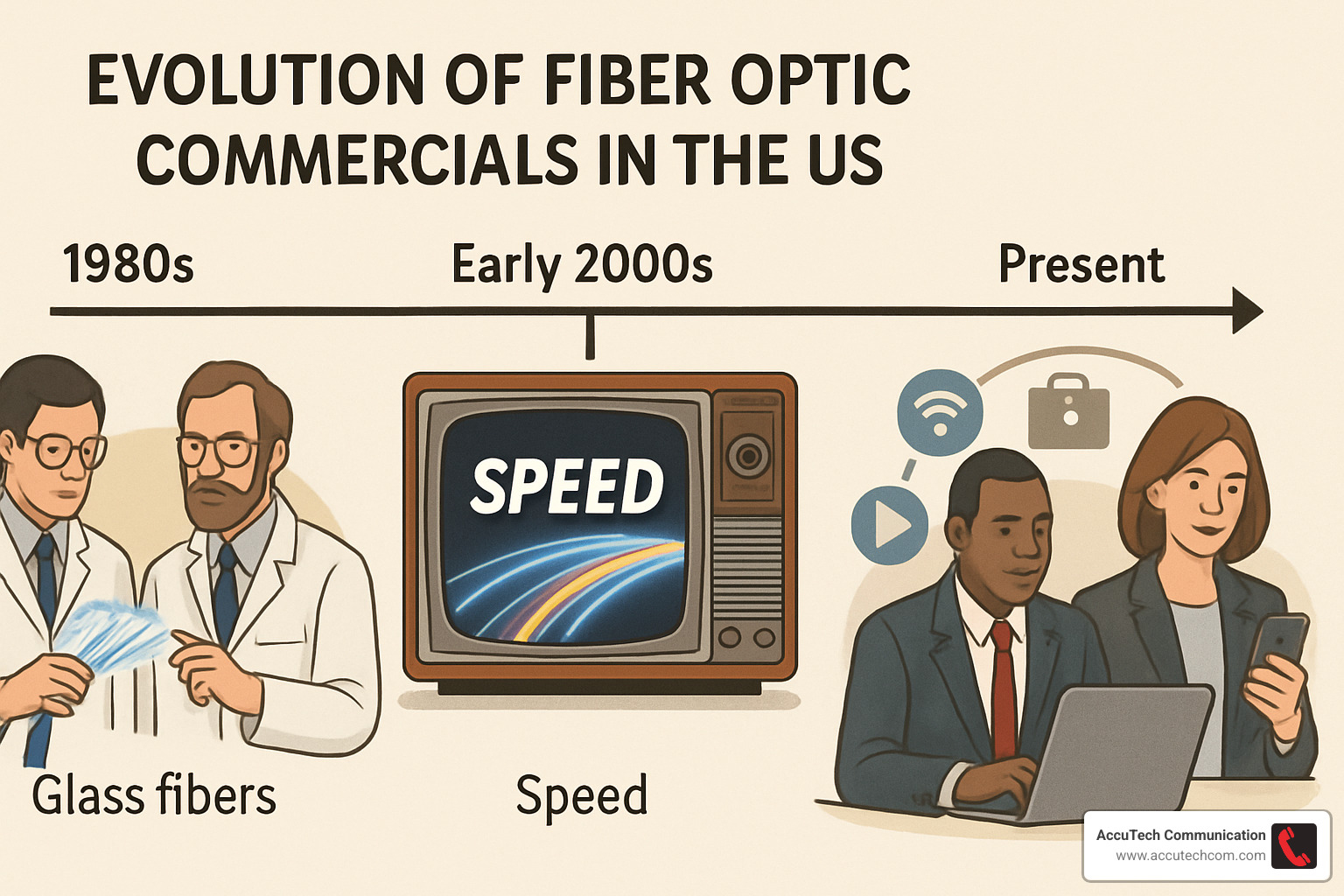
Remember when most people had never even heard of transmitting data through light pulses? Those early commercials had to start with the basics. They featured simple animations showing information zipping through glass strands like futuristic highways. The focus was squarely on explaining the breakthrough rather than what you could actually do with it.
Then came the broadband boom of the early 2000s. As internet usage became part of everyday life for homes and businesses, fiber optic commercial messaging shifted gears. Suddenly it was all about speed comparisons: “Up to 10x faster than cable!” Those early promises of 10-50 Mbps seemed at the time, though they make us smile now in our multi-gigabit world.
Today’s streaming-dominated landscape has transformed fiber advertising yet again. While numbers still matter—especially when talking to IT directors and CEOs—modern commercials increasingly show the human side of connectivity. Instead of dwelling on technical specifications, they showcase what happens when a business never has to worry about their connection dropping during a crucial client presentation.
Early Tech Demos → Emotion-Driven Narratives
The first fiber optic commercial spots looked more like science documentaries than ads. They took viewers inside laser laboratories and showed dramatic close-ups of light pulses traveling through transparent fibers. These weren’t just advertisements—they were educational pieces introducing a fundamentally new concept.
“I remember installing some of our first commercial fiber systems in Massachusetts when businesses were still trying to wrap their heads around the technology,” says our lead technician at AccuTech Communications. “Those early commercials actually made our job easier—they handled the initial education so we could focus on the nitty-gritty implementation details.”
As fiber technology matured through the years, the marketing approach grew up alongside it. By the mid-2000s, we started seeing satisfied business customers rather than scientists in white coats. The message transformed from “here’s this amazing new technology” to “here’s what this technology can do for your business.” This shift marked a crucial evolution in fiber optic commercial messaging.
Today’s ads often tell compelling stories that stick with you—the small family business that expanded nationwide thanks to reliable connectivity, the rural hospital that revolutionized patient care with telemedicine, or the manufacturer that streamlined operations by moving everything to the cloud. The fiber technology itself has become the supporting character rather than the star of the show.
Digital Change & the Bandwidth Race
The explosion of cloud applications, remote work, and high-definition video has turned fiber optic commercial messaging into something of a bandwidth arms race. Modern advertisements cleverly highlight how fiber handles multiple simultaneous demands without breaking a sweat—a critical selling point for growing businesses.
As one memorable recent commercial put it: “When everyone in your office is uploading to the cloud, downloading reports, and video conferencing simultaneously, the question isn’t whether your internet will slow down—it’s by how much. Unless you have fiber.”
This bandwidth competition has pushed advertisers to make increasingly bold claims backed by impressive numbers. Where early fiber optic commercial spots simply promised “fast internet,” today’s ads specify exact speeds with phrases like “upload and download at 1000 Mbps” or even “5 Gbps business fiber—because waiting isn’t part of your business plan.”
The COVID-19 pandemic put this trend into overdrive. As remote work suddenly became standard practice, businesses needed robust, reliable connectivity more urgently than ever before. Fiber optic commercial messaging quickly adapted, emphasizing how fiber infrastructure supports distributed teams, hybrid work models, and the increased reliance on video conferencing that’s now part of everyday business life.
For deeper technical insights on the science behind these claims, you might find this scientific research on intermodal dispersion enlightening.
5 Memorable Fiber Optic commercial Spots
Over the years, I’ve watched fiber optic commercial spots evolve from technical demonstrations to compelling storytelling. Some advertisements have truly stood the test of time, creating lasting impressions that shaped how businesses view connectivity. Let’s take a peek at five campaigns that managed to translate complex technology into powerful, relatable messages.

These standout commercials each tackled fiber technology from a unique angle—whether emphasizing lightning speeds, rock-solid reliability, future-ready infrastructure, seamless team collaboration, or sustainable innovation. What made them special was their ability to transform technical jargon into benefits that resonated with real business needs.
Fiber Optic commercial #1 – “Blink and It’s Done”
Commercial where a business owner downloaded massive files in literally the blink of an eye? This spot brilliantly visualized what symmetrical gigabit speeds actually mean in practice. While copper-based internet services struggled with uploads, this fiber optic commercial showed both directions happening instantaneously.
What really set this ad apart was its focus on low latency alongside raw speed. It wasn’t just about transferring large files quickly—it was about the immediate responsiveness that makes cloud applications feel like they’re running locally. The tagline “Fiber that works at the speed of business” perfectly captured this promise of zero waiting time.
“It’s funny how often clients reference this exact commercial when explaining their network goals,” our project manager at AccuTech Communications told me recently. “They’ll simply say, ‘You know that ad where everything happens instantly? That’s what we need.’ It created this perfect shorthand for what fiber can deliver.”
Fiber Optic commercial #2 – “Office of Tomorrow”
This forward-thinking fiber optic commercial took us beyond basic internet connectivity to show a smart building where everything from climate controls to security systems operated over a unified fiber network. Rather than just promising faster downloads, it painted a picture of comprehensive building automation made possible by robust fiber infrastructure.
What made this ad particularly effective was how it positioned fiber within broader digital change trends. By demonstrating how a scalable LAN could support dozens of interconnected systems, it framed fiber not as a simple utility but as the foundation for business evolution.
Unlike many commercials targeting business owners with general productivity promises, “Office of Tomorrow” spoke directly to IT decision-makers in their own language. It addressed concepts like scalability, future-proofing, and unified management—concerns that keep network administrators up at night.
At AccuTech Communications, we’ve seen this integrated vision become reality for many clients throughout Massachusetts. Modern commercial buildings increasingly depend on fiber backbones to support everything from access control to energy management systems—exactly as this prescient commercial predicted.
Fiber Optic commercial #3 – “Unbreakable Connection”
Following several high-profile internet outages that left businesses scrambling, this powerful fiber optic commercial shifted the conversation from speed to reliability. The ad opened with scenes of business disruption caused by connectivity failures—production lines grinding to a halt, frustrated customers, missed deadlines—before transitioning to businesses operating smoothly thanks to dependable fiber connections.
The commercial’s genius was highlighting fiber’s 99.9% uptime guarantee and built-in redundancy features in terms of business outcomes rather than technical specifications. It made concepts like “five nines reliability” tangible by showing the real-world consequences of staying connected when it matters most.
“After major weather events hit New England, we always see increased interest in redundant fiber systems,” our operations director at AccuTech Communications shared. “This commercial explained complex concepts like path diversity and automatic failover in ways that business owners could immediately understand—in terms of keeping their operations running when competitors might be down.”
Fiber Optic commercial #4 – “Light-Speed Collaboration”
As hybrid work models became the new normal, this memorable fiber optic commercial showcased teams collaborating seamlessly across multiple locations. It particularly emphasized crystal-clear VoIP calls and lag-free video conferencing—applications where fiber’s low latency and consistent performance create noticeable improvements.
The ad cleverly demonstrated fiber’s symmetrical bandwidth advantage by showing simultaneous two-way video streams remaining perfectly clear even during peak usage times. For businesses struggling with choppy video calls on traditional broadband connections, this direct comparison made fiber’s benefits immediately obvious.
What made “Light-Speed Collaboration” especially relatable was its authentic portrayal of modern work environments. Rather than showing idealized offices, the fiber optic commercial depicted realistic hybrid meetings with some participants in conference rooms and others at home kitchens or spare bedrooms. This reflected the actual working conditions many businesses now steer—and highlighted how fiber connectivity creates consistent experiences regardless of location.
Fiber Optic commercial #5 – “Future on Glass”
Looking beyond today’s applications, this forward-thinking fiber optic commercial showcased emerging technologies that will demand fiber’s capabilities tomorrow. The spot featured augmented reality design sessions, edge computing applications, and energy-efficient data processing—all enabled by robust fiber infrastructure.
The commercial made a compelling connection between fiber connectivity and sustainability goals, highlighting how fiber networks consume significantly less energy than copper alternatives while enabling more efficient operations through smart technology and optimized resource usage.
“We often tell clients that fiber isn’t just about solving today’s connectivity challenges—it’s about preparing for tomorrow’s,” explains our senior consultant at AccuTech Communications. “This commercial captured that future-focused perspective perfectly, showing how today’s fiber installation becomes the foundation for technologies that may still be years away from mainstream adoption.”
What made “Future on Glass” particularly effective was addressing the long-term investment aspect of fiber installation. Unlike commercials focused solely on immediate benefits, this one emphasized how today’s fiber infrastructure would support technologies still in development, protecting businesses against future obsolescence.
Core Messages Decoded: From Screen to Server Room
Behind the polished visuals and compelling narratives of fiber optic commercial advertisements lie specific technical claims about performance, reliability, and capabilities. Let’s decode these messages and examine how they translate to actual network implementations.
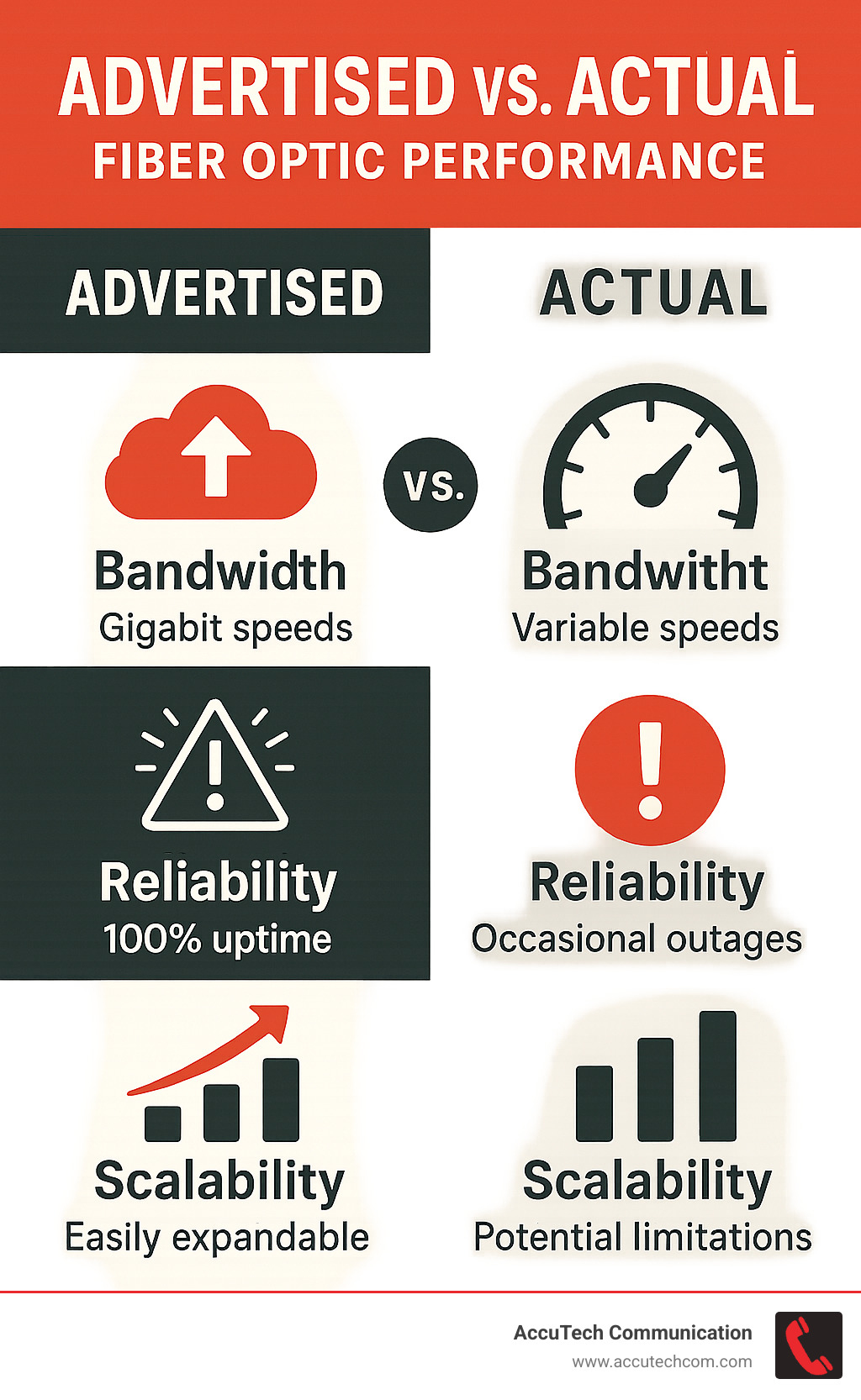
When you watch those glossy fiber optic commercial spots, you’re bombarded with impressive claims about lightning-fast speeds and rock-solid reliability. But what’s really happening when those promises move from your TV screen to your server room?
Most fiber commercials focus on five core benefits: blazing bandwidth with gigabit speeds, improved business productivity, future-proof scalability, improved data security, and unwavering reliability with guaranteed uptime. These aren’t empty promises – fiber truly delivers these advantages – but the devil is in the details of implementation.
At AccuTech Communications, we’ve spent decades helping businesses throughout Massachusetts, New Hampshire, and Rhode Island bridge the gap between commercial promises and real-world performance. We know that turning those slick marketing claims into tangible benefits requires expertise, proper planning, and attention to detail.
Turning Hype Into Hardware
When a fiber optic commercial promises you’ll be “downloading at the speed of light,” what does that actually mean for your server room? The reality involves selecting the right fiber types, proper installation techniques, and compatible networking equipment.
For connecting buildings or reaching service provider networks, single-mode OS2 fiber is typically your best bet. This fiber type has a narrow core (about 9 microns) that allows light to travel in a single path, minimizing signal degradation over long distances. When commercials show seamless connections between multiple office locations, OS2 fiber is what makes that possible.
Inside your building, multi-mode OM3, OM4, or OM5 fiber often makes more sense. These have larger cores (50 microns) allowing multiple light paths, though they’re limited to shorter distances. The grade you choose depends on your bandwidth needs and growth plans – OM4 supports higher speeds than OM3, while OM5 adds wavelength division multiplexing for even greater capacity.
“One thing fiber optic commercial spots never mention is bend radius,” shares our lead installer at AccuTech. “Fiber cables can’t make sharp turns without causing signal loss or damage. When we install systems, we carefully plan cable routing to maintain proper bend radius – something DIY installations often miss completely.”
Fiber count is another crucial consideration that rarely makes it into the commercials. While a single fiber strand carries tremendous data, redundancy and future expansion require additional strands. Most of our commercial installations use cables with multiple fiber strands (6, 12, 24, or more) to support growth and provide backup paths when needed.
Trust Is Tested, Not Televised
When fiber optic commercial spots promise “99.9% reliability,” they’re quietly referring to rigorous testing and quality assurance processes – none of which make for exciting television. In reality, ensuring fiber network performance involves sophisticated testing equipment and meticulous attention to detail.
At AccuTech Communications, we use Optical Time Domain Reflectometers (OTDR) to verify every fiber installation. This equipment sends light pulses through the fiber and analyzes the reflections to identify issues – including microscopic faults completely invisible to the naked eye. It’s not glamorous enough for a commercial, but this testing is essential to delivering the reliability those ads promise.
Fusion splicing represents another behind-the-scenes technology crucial to fiber performance. This process uses an electric arc to melt fiber ends together, creating connections with minimal signal loss. When a fiber optic commercial claims “seamless connectivity,” proper fusion splicing is what makes that possible in the real world.
“Those 20-year lifespan claims you hear in fiber advertising? Absolutely achievable – but only with proper installation and protection,” explains our operations manager. “Proper strain relief, appropriate pathway selection, and quality termination all contribute to that longevity. These details don’t make for compelling TV, but they make all the difference in how your network actually performs.”
More info about how to test fiber optic cable
Action Plan: Building the Network Your Favorite Ad Promised
Those dazzling Fiber Optic commercial spots make everything look so simple, don’t they? A few clicks and suddenly your business is operating at light speed! But as someone who’s been installing fiber networks since 1993, I can tell you there’s a bit more to it than that glossy 30-second spot suggests.
Let’s talk about how to actually build the network you’ve been dreaming about since that commercial caught your eye.
The journey begins at your building’s demarcation point—that’s where your service provider’s responsibility ends and yours begins. From there to your server room and throughout your facility, you’ll need to make several crucial decisions that those Fiber Optic commercial spots conveniently skip over.
“We’ve seen businesses get stars in their eyes from commercials promising instant downloads and perfect video calls,” says our installation team leader at AccuTech Communications. “We love that enthusiasm! But turning that vision into reality requires thoughtful planning and expertise.”
The DIY versus professional installation decision is your first major fork in the road. While those Fiber Optic commercial ads might make installation look as easy as plugging in a toaster, the reality involves specialized fusion splicing equipment, OTDR testing tools, and years of experience knowing exactly how to route and terminate fiber correctly.
“I can’t tell you how many Monday morning emergency calls we’ve received from businesses who attempted DIY fiber installations over the weekend,” our service manager shares with a knowing smile. “By the time they call us, they’ve already lost productivity and gained a few new gray hairs. Professional installation costs more upfront but pays dividends in performance and peace of mind.”
Several factors will drive your project costs, including distance between connection points, building construction challenges, the number of terminations needed, and your redundancy requirements. Speaking of redundancy—if your business truly can’t afford downtime (as many Fiber Optic commercial spots emphasize), you’ll need alternate pathway designs and automatic failover capabilities built into your network architecture.
Choosing the Right Cable After Watching a Fiber Optic commercial
That Fiber Optic commercial promised blazing speeds, but delivering those speeds requires selecting the right type of fiber for your specific situation. It’s like choosing between highways—some are designed for local traffic, others for long-distance hauling.
For connections to service providers or between separate buildings, single-mode fiber (typically OS2) is usually your best bet. It’s designed for longer distances and higher speeds. Within your facility, multi-mode fiber becomes an option, with OM4 supporting speeds up to 100 Gbps for distances up to 150 meters, while newer OM5 fiber adds support for wavelength division multiplexing—essentially creating multiple lanes on your data highway.
Environmental factors matter too, though you won’t hear about them in a Fiber Optic commercial. If your cable will run through air handling spaces (known as plenum areas), you’ll need special plenum-rated jackets that produce minimal smoke and toxic fumes in case of fire. For outdoor runs or areas where physical damage is possible, armored fiber options provide extra protection against everything from landscaping equipment to hungry rodents.
“We always encourage clients to think beyond what they need today,” our design specialist explains. “The Fiber Optic commercial might have you excited about gigabit speeds, but what about five years from now when you might need 10 or 40 gigabits? Choosing the right fiber type now can save you from a complete reinstall later.”
Budgeting for Gigabit Glory
The stunning performance you saw in that Fiber Optic commercial requires an investment that extends beyond just the fiber cable itself. While the actual fiber strands might cost between $1-$6 per foot depending on specifications and fiber count, the complete project includes several other components.
Your budget should account for termination equipment, patch panels, transceivers, network hardware, installation labor, testing, and often pathway creation or modification. For small businesses, complete fiber installation projects typically start at several thousand dollars, with more complex enterprise installations requiring larger investments.
The good news? Fiber infrastructure delivers exceptional return on investment through:
Increased productivity from faster, more reliable connectivity
Reduced downtime and its associated costs
Lower maintenance requirements compared to copper alternatives
Extended infrastructure lifespan of 15-20+ years
Future-readiness for emerging applications and technologies
“When clients ask me about ROI timelines for fiber, I help them quantify what slow connections and downtime actually cost their business,” says our business development manager at AccuTech Communications. “For most organizations, the productivity gains and reliability improvements create positive returns within 1-3 years, with benefits continuing throughout the fiber’s multi-decade lifespan.”
Ready to turn that Fiber Optic commercial dream into reality? At AccuTech Communications, we’ve been helping businesses throughout Massachusetts, New Hampshire, and Rhode Island build reliable, high-performance fiber networks since 1993. We understand the local building codes, have established relationships with regional carriers, and can guide you through every step of the process.
More info about fiber optic installation companies near me
Frequently Asked Questions about Fiber Optic commercial Claims
Are the gigabit speeds shown in commercials realistic for my office?
When you see those impressive download speeds in a fiber optic commercial, it’s natural to wonder if your business will actually experience those lightning-fast connections. The short answer is yes—those gigabit and multi-gigabit speeds are technically achievable, but let’s talk about the real-world factors that come into play.
Think of fiber speed like a highway system. You might have a fantastic eight-lane expressway coming into your city (your fiber connection), but if your internal roads are narrow or under construction (outdated network equipment), you’ll still experience traffic jams.
“I remember one client who was frustrated after upgrading to fiber because they weren’t seeing the speeds from the fiber optic commercial they’d watched,” shares our technical director at AccuTech. “When we investigated, we found they were still using 10-year-old switches that couldn’t handle more than 100 Mbps. After upgrading those, their experience matched their expectations.”
Your actual speeds depend on several important elements: the specific plan from your service provider, the capability of your network equipment (switches, routers, firewalls), the network interfaces on your computers and devices, your overall network design, and how many people are using bandwidth simultaneously.
At AccuTech Communications, we prefer to design networks with room to breathe. This means implementing more capacity than the minimum requirements so that your team experiences consistent performance even during the busiest times of day. It’s better to exceed realistic expectations than promise theoretical maximums that leave you disappointed.
Do ads exaggerate how simple it is to swap copper for fiber?
Have you noticed how fiber optic commercial spots often make the copper-to-fiber transition look as simple as swapping out a light bulb? While I wish it were that straightforward, the reality involves a bit more planning and expertise.
“There was this great fiber optic commercial showing a business owner simply unplugging a copper cable and plugging in fiber, and suddenly their whole office was transformed,” our operations manager laughs. “The next day, I had three calls from businesses expecting exactly that experience. We had to have some honest conversations about what’s really involved.”
The transition typically requires addressing several important considerations that commercials conveniently skip over:
Fiber cables have specific physical requirements—they can’t make tight turns like copper can, so existing pathways might need modification. Your network hardware might need upgrading to support fiber connections. Unlike copper, fiber doesn’t carry electrical current, which affects Power over Ethernet (PoE) devices like security cameras or wireless access points.
Additionally, fiber termination requires specialized knowledge and equipment that most IT generalists don’t possess. And finally, testing fiber connections requires different tools than copper networks to ensure everything is performing correctly.
For businesses throughout Massachusetts, New Hampshire, and Rhode Island considering this upgrade, we always recommend a professional assessment first. This helps identify potential challenges before they become problems and ensures you’ll actually achieve those impressive benefits promised in the commercials—without unexpected complications or downtime.
How long will new fiber cabling actually last?
When fiber optic commercial spots mention that fiber lasts “decades,” they’re actually not exaggerating. Unlike copper cabling that can degrade over time due to corrosion or electromagnetic interference, fiber optic cables are remarkably durable when properly installed.
“We have clients still actively using fiber infrastructure we installed back in the late 1990s,” our founder recently shared with me. “While they’ve upgraded the equipment connecting to that fiber several times to support faster speeds, the actual glass strands are still performing flawlessly after more than two decades.”
The physical fiber itself can indeed last 15-20+ years, but several factors influence its actual lifespan. Installation quality makes an enormous difference—proper handling, maintaining appropriate bend radius, and correct termination all contribute to longevity. Physical protection matters too, whether that’s through appropriate pathways, conduit, or armored cabling in vulnerable areas.
Environmental conditions like extreme temperatures, humidity, and UV exposure can affect durability. And while the physical medium might last for decades, evolving standards and growing bandwidth demands might necessitate upgrades before the fiber reaches its physical end-of-life.
This exceptional longevity represents one of fiber’s most compelling advantages over copper alternatives. When you hear about “future-proofing” in a fiber optic commercial, this extended lifespan is a significant part of what they’re referring to—and it’s one of the reasons fiber installations typically deliver excellent return on investment despite higher initial costs.
At AccuTech Communications, we’ve seen how quality fiber installations continue delivering value year after year, even as technology evolves around them. That’s why we emphasize installation quality and proper documentation—we know we’re building infrastructure that will serve our clients for decades to come.
Conclusion
Fiber optic commercial advertising has evolved dramatically over the decades, telling the story of a technology that transformed from scientific curiosity to the backbone of our connected world. What once required lengthy explanations about light pulses and glass strands has become a more emotionally resonant narrative about possibilities, productivity, and progress.
The most compelling commercials we see today don’t just sell you on technical specifications—they paint a picture of what your business could become. They show teams collaborating seamlessly across continents, data flowing effortlessly between applications, and businesses operating without the constraints of traditional connectivity limitations.
Here at AccuTech Communications, we’ve been turning these commercial promises into everyday realities for businesses throughout Massachusetts, New Hampshire, and Rhode Island since 1993. Our team has witnessed how the right fiber infrastructure can transform operations, boost productivity, and create new possibilities for growth.
When our clients come to us after seeing a particularly impressive fiber optic commercial, we help them understand what’s truly possible for their specific situation. The speed, reliability, and future-ready capabilities showcased in these ads aren’t fantasy—they’re achievable with proper planning and implementation. But the path from commercial to completed installation requires expertise and attention to detail that no 30-second spot can capture.
What we’ve learned over three decades in the business is that fiber’s real-world benefits often exceed what’s promised in even the most ambitious advertisements. Many of our earliest fiber installations continue to perform flawlessly today, having outlasted multiple generations of the equipment connected to them. When commercials tout 15-20 year lifespans, they’re actually being conservative in many cases.
The future of connectivity is brighter than ever. As remote work, cloud applications, and bandwidth-intensive technologies continue reshaping how businesses operate, the foundation of reliable, high-capacity fiber becomes increasingly crucial. The fiber optic commercial spots that catch our attention today offer glimpses of tomorrow’s workplace—and with the right implementation partner, that future is within reach.
Whether you’re expanding your current location, opening a new facility, or simply tired of unreliable connectivity holding your team back, fiber represents an investment in possibilities. The captivating visions from those commercials can indeed become your daily reality with the right expertise behind your implementation.
Learn more about how our team at AccuTech Communications can help you bring those fiber optic commercial promises to life in your business:
– More info about fiber optic cabling installation
