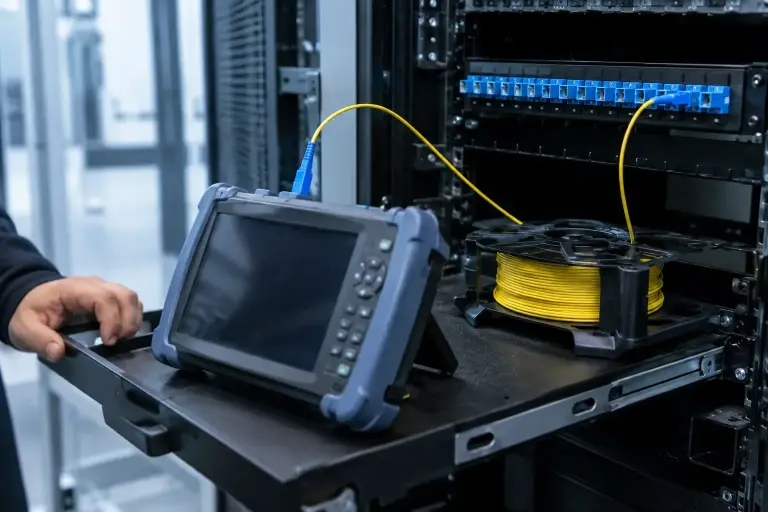
Mastering the Arc: Your Guide to Fiber Optic Fusion Splicing
Understanding Fiber Optic Fusion Splicing and Its Advantages
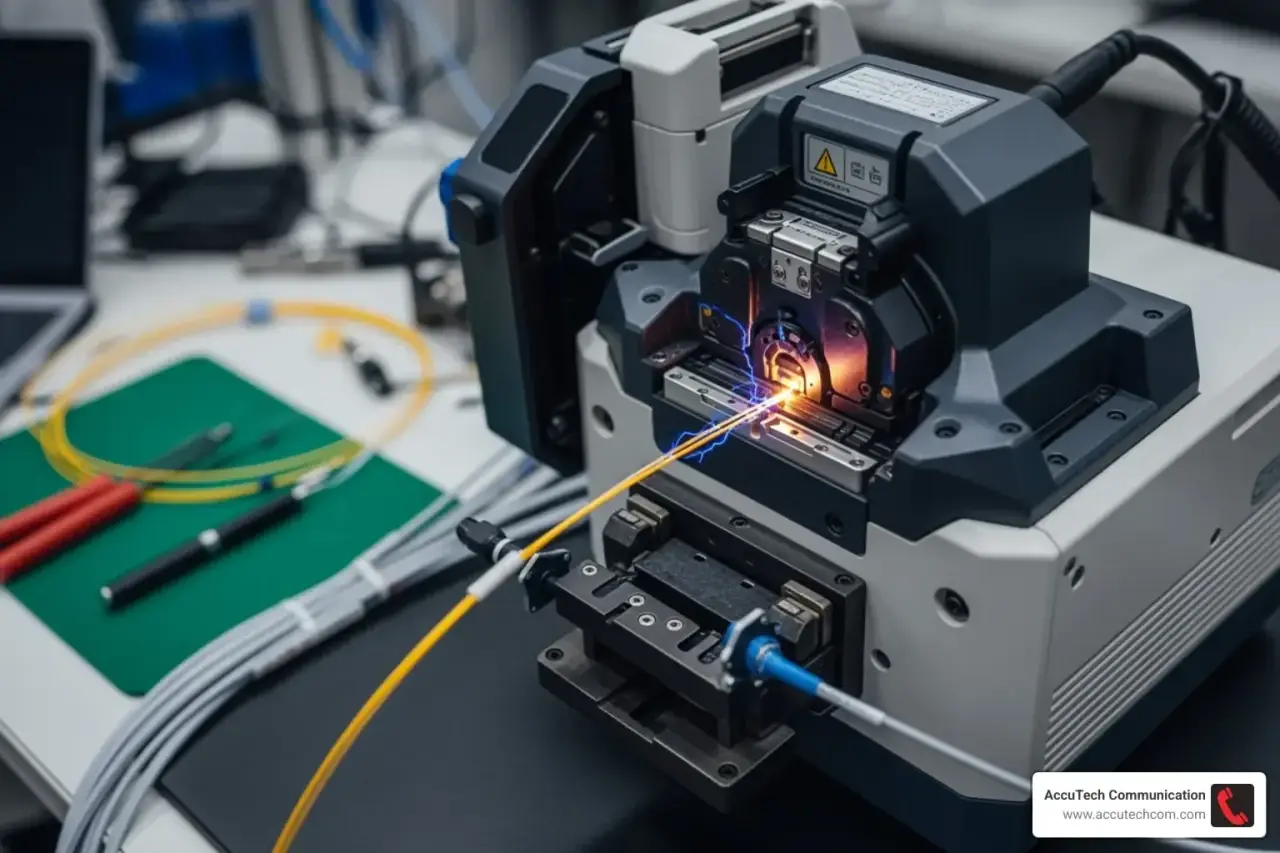
Fiber optic fusion splicing is the process of permanently joining two optical fibers end-to-end by melting them together using an electric arc, creating a connection so clean that light passes through with almost no loss or reflection.
Quick answer: Here’s what you need to know about fusion splicing:
| Factor | Detail |
|---|---|
| What it is | Permanently welding two fiber ends together using heat |
| How it works | Fibers are stripped, cleaned, cleaved, aligned, then fused with an electric arc |
| Typical loss | Less than 0.1 dB; as low as 0.02 dB under ideal conditions |
| Key advantage | Lowest loss and highest strength of any fiber joining method |
| Best used for | Permanent connections in commercial networks, long-haul fiber, and high-density cabling |
| Standard | Governed by ANSI/EIA/TIA-455 |
For businesses running mission-critical infrastructure, think healthcare networks, enterprise WANs, or data centers across Massachusetts, New Hampshire, and Rhode Island, the quality of every fiber connection matters. A poorly made splice can quietly degrade signal performance across an entire network.
That’s where fusion splicing stands apart. Unlike mechanical splices or plug-in connectors, fusion splicing welds the glass itself. The result is a joint that’s nearly as strong as the original fiber, with signal loss that’s often undetectable in real-world testing.
But the process demands precision. From cleaving fiber ends at angles under two degrees, to programming the splicer correctly, to protecting the finished splice, every step affects the final result. This guide walks you through all of it.
I’m Corin Dolan, owner of AccuTech Communications, with decades of hands-on experience designing and installing fiber optic infrastructure for commercial clients across New England, including projects where fiber optic fusion splicing was the only method that met the performance requirements. In the sections ahead, I’ll break down everything you need to understand this process, whether you’re evaluating it for your next project or overseeing a team that performs it.
At its simplest, fiber optic fusion splicing is the act of joining two optical fibers end-to-end using heat. The goal is to fuse the two fibers together so that light passing through is not scattered or reflected back by the splice. When done correctly, the splice and the region surrounding it are almost as strong as the intact fiber itself.
While there are other ways to connect fiber, such as mechanical splicing or using de-matable connectors, fusion splicing is the gold standard for permanent installations.
Why Fusion Splicing Wins
The primary benefits of fusion splicing revolve around signal integrity and physical durability. Because we are essentially creating a continuous piece of glass, the “joint” disappears from the perspective of the light beam.
| Method | Typical Insertion Loss | Reflectance (Return Loss) | Permanence |
|---|---|---|---|
| Fusion Splicing | < 0.1 dB | Extremely Low | Permanent |
| Mechanical Splicing | 0.2 dB, 0.5 dB | Moderate | Semi-Permanent |
| Fiber Connectors | 0.2 dB, 1.0 dB | Variable | De-matable |
As noted in Optical Fiber Fusion Splicing Research, the engineering behind these arcs has evolved to ensure that the tensile strength of the splice remains high, preventing the fiber from snapping under the thermal cycles or minor tensions found in commercial fiber optic technology.
Superior Performance Metrics
In high-speed data, every decibel counts. Fusion splicing is known for offering transmission at an insertion loss of less than 0.1dB. Under ideal conditions, these splices quite reliably exhibit very low transition losses on the order of 0.02 dB.
For a data center in Boston or a medical facility in Worcester, this means higher reliability and better efficiency. Low reflectance (high return loss) is also critical for high-bitrate systems, as it prevents light from bouncing back into the transmitter and causing errors.
Commercial Applications in New England
We see fiber optic fusion splicing utilized most heavily in:
- Telecommunications Backbones: Connecting long-haul cables where de-mating is never required.
- Enterprise WANs: Linking corporate offices across cities like Waltham and Marlborough.
- Metropolitan Area Networks (MAN): High-speed city-wide rings in hubs like Providence or Manchester.
- Data Centers: Where high-density ribbon fibers require professional fiber optic splicing contractors to manage thousands of connections efficiently.
Essential Equipment and Maintenance Requirements
You can’t perform a high-quality splice with a lighter and a pair of scissors. It requires a specialized toolkit designed for micron-level precision.
The core components of our fiber network equipment kits include:
- The Fusion Splicer: The “brain” of the operation that aligns and welds the fibers.
- Precision Cleaver: Perhaps the most important tool, it scribes and breaks the fiber to a perfect 90-degree angle.
- Fiber Strippers: Tools like the Miller stripper or No-Nik used to remove the protective buffer coatings.
- Cleaning Supplies: 99% pure isopropyl alcohol and lint-free wipes.
- Protection Sleeves: Heat-shrink tubes with a stainless steel strength member.
Precision Alignment Systems
Modern fusion splicers use one of two main methods to ensure the fiber cores (the tiny centers where light travels) are perfectly lined up:
- Profile Alignment Splicing (PAS): This uses dual-axis cameras to look at the fiber from the side. By analyzing the “profile” of the light passing through the glass, the machine can identify the core and align it automatically.
- Local Injection and Detection (LID): This system actually bends the fiber to “inject” light into the core and “detect” it on the other side. The machine moves the fibers until the light transmission is maximized, ensuring a perfect core-to-core match.
The Fujikura technology history shows that PAS technology, introduced in the 1980s, revolutionized the industry by making high-precision splicing faster and more field-rugged.
Splicer Maintenance and Care
A fusion splicer is a lab-grade instrument used in construction environments. It needs love!
- Electrode Cleaning: The electrodes create the arc. Over time, silica buildup can occur. We clean them regularly and replace them after a set number of arcs (usually around 1,000 to 5,000).
- Arc Calibration: Changes in altitude, humidity, and temperature affect the arc. We perform an “Arc Test” every morning to ensure the machine is delivering the right amount of heat.
- V-Groove Cleaning: The tiny grooves that hold the fiber must be spotless. A single speck of dust can throw off alignment. Following the Fiber Optic Association cleaning guide is mandatory for our techs.
The Step-by-Step Process of Fiber Optic Fusion Splicing
Splicing is 90% preparation and 10% actual welding. If the preparation is flawed, the splice will fail.
1. Cable Preparation
We start by stripping the outer cable jacket, usually exposing 2-3 meters of the buffer tubes. Inside the splice closure, we typically leave about 1 meter of buffer tube and 1 meter of bare fiber to allow for future repairs or re-splicing.
2. Stripping and Cleaning
Using a precision stripper, we remove the 250-micron or 900-micron buffer coating to reveal the 125-micron glass cladding. We then clean the bare glass with a lint-free wipe soaked in alcohol. You should hear a “squeak”, that’s the sound of clean glass! For more details, see our guide on how to splice fiber optic cable.
3. Precision Cleaving
This is the “make or break” step. We use a precision cleaver to scribe the glass and snap it. The goal is an end-face angle of less than 0.5 degrees. If the angle is over 2 degrees, the splicer will likely reject it because the fibers won’t fuse evenly.
4. Executing the Fusion Arc
Once the fibers are loaded into the V-grooves:
- Pre-fusion: The machine gives a tiny burst of heat to burn off any remaining microscopic dust.
- Alignment: The cameras or LID system align the cores.
- Fusion Arc: A sustained electric discharge melts the glass ends together.
- Inspection: The machine performs a visual check and a “tension test” to ensure the weld is solid. It then provides a loss estimate. While helpful, we always verify this later with how to test fiber optic cable protocols like OTDR testing.
5. Splice Protection and Housing
A bare splice is incredibly fragile. We slide a heat-shrink protector over the joint and place it in the splicer’s internal oven. Once shrunk, the splice is placed into a splice tray. These trays manage the bend radius to prevent “macro-bends” that leak light. Finally, the trays are stored in a underground fiber optic installation closure or a rack-mount patch panel.
Evaluating Quality and Troubleshooting Defects
Even with the best machines, “bad” splices happen. A professional technician knows how to read the splicer screen and the OTDR trace to spot trouble.
Common Splicing Problems
- Matchheads: These look like rounded tips. They usually happen if the arc current is too high or the electrodes are dirty.
- Constriction: The splice looks “pinched.” This is often caused by the feed rate being too slow or the heat being too high.
- Bubbles or Inclusions: These are usually caused by dirt on the fiber end-face or a poor cleave that trapped air during fusion.
- Offset Cores: Even if the outside of the fiber looks aligned, the cores inside might be mismatched. This results in high insertion loss.
Testing for Success
We don’t just take the splicer’s word for it. We use an Optical Time Domain Reflectometer (OTDR) to “see” the splice. By sending a pulse of light and measuring the backscatter, we can pinpoint the exact loss at that joint. For critical links, we perform bi-directional testing to account for differences in the fiber’s “Mode Field Diameter” (MFD), which can cause “gainers” or false high-loss readings in one direction. You can learn more about this in our fiber optic monitoring system overview.
Safety Precautions
Safety is paramount.
- Glass Shards: Cleaved fiber ends are invisible and like needles. We use dedicated “sharps” containers for every single scrap.
- Arc Flash: While small, the electric arc can be a hazard in explosive environments (like some industrial sites).
- Laser Safety: Never look into a fiber. Infrared light is invisible but can permanently scar your retina.
- Chemicals: Isopropyl alcohol is flammable and should be handled with care.
Our fiber optic technician standards ensure that every member of our team in places like Boston and Nashua follows these protocols to the letter.
Advancements in Ribbon Fiber Optic Fusion Splicing
As data demands explode, we are seeing more “Ribbon Fiber.” Instead of individual strands, 12 fibers are bonded together into a flat ribbon.
Mass fusion splicing allows us to splice all 12 fibers at once. This is a massive time-saver for high-fiber-count cables (like those with 864 or 1728 fibers) often found in types of fiber optic cable used for data center backbones.
Comparing Single-Fiber and Mass Fusion
While mass fusion is efficient, it requires even higher precision. If one fiber in the ribbon has a bad cleave, you have to cut and redo all 12. It requires specialized thermal strippers and ribbon cleavers. For large-scale projects, this is the only way to stay on schedule. Check out our commercial fiber optic installation guide for more on large-scale deployments.
Commercial Splicing Costs and Considerations
When budgeting for a commercial project in New England, it’s important to understand the variables.
Note: All prices mentioned are average costs sourced from publicly available internet data and are not the actual prices of AccuTech Communications.
Based on industry averages, the cost of commercial splicing typically ranges from $25 to $75+ per splice. This wide range exists because of several factors:
- Volume: Splicing 1,000 fibers in a controlled data center is much cheaper per-splice than driving to a remote site to fix a single broken 4-strand cable.
- Environment: Indoor, rack-height splicing is faster than working in a manhole or on an aerial lift in the middle of a New Hampshire winter.
- Testing Requirements: Basic loss estimation is standard, but bi-directional OTDR testing and formal documentation add to the project scope.
Frequently Asked Questions about Fusion Splicing
What is the typical loss for a professional fusion splice?
A professional splice should consistently show less than 0.1 dB of loss. In many cases, our technicians achieve 0.02 dB to 0.05 dB, which is essentially “invisible” to the network.
How does fusion splicing differ from mechanical splicing?
Fusion splicing uses an electric arc to weld the glass together into a single piece. Mechanical splicing holds the two ends together with a clamp and uses an “index-matching gel” to help light pass through the gap. Fusion is more permanent, has lower loss, and is the industry standard for commercial networks.
Why is cleaving the most critical step in the process?
If the glass isn’t cut at a perfect 90-degree angle, the ends won’t melt together evenly. This leads to air bubbles, gaps, or “necked-down” splices that look like an hourglass. A bad cleave is the #1 cause of failed splices.
Conclusion
Mastering the arc of fiber optic fusion splicing is what separates a standard cable installer from a true network infrastructure partner. Whether we are working in a high-tech lab in Cambridge, a corporate headquarters in Providence, or a data hub in Manchester, our focus is always on the long-term reliability of the connection.
AccuTech Communications has been providing these specialized services since 1993. We understand the unique challenges of the Massachusetts, New Hampshire, and Rhode Island landscapes, from the historic buildings of Boston to the modern data centers of the Metro-west. Our commitment to quality and expertise ensures that your fiber backbone is ready for the speeds of tomorrow.
If you’re planning a network expansion or need expert repair services, contact our fiber optic installation team serving Boston, MA today. We’ll bring the precision, the equipment, and the experience to ensure your project is a success.