
Why Proper Fiber Optic Repair is Critical for Your Business Network
Fiber optic repair is the process of restoring a damaged fiber optic cable to full functionality by locating the fault, preparing the cable ends, splicing the fibers back together, and testing the connection to ensure signal integrity. For commercial networks in Massachusetts, New Hampshire, and Rhode Island, a properly executed repair can restore your business operations in under an hour, while a poor repair can lead to chronic signal loss and repeated downtime.
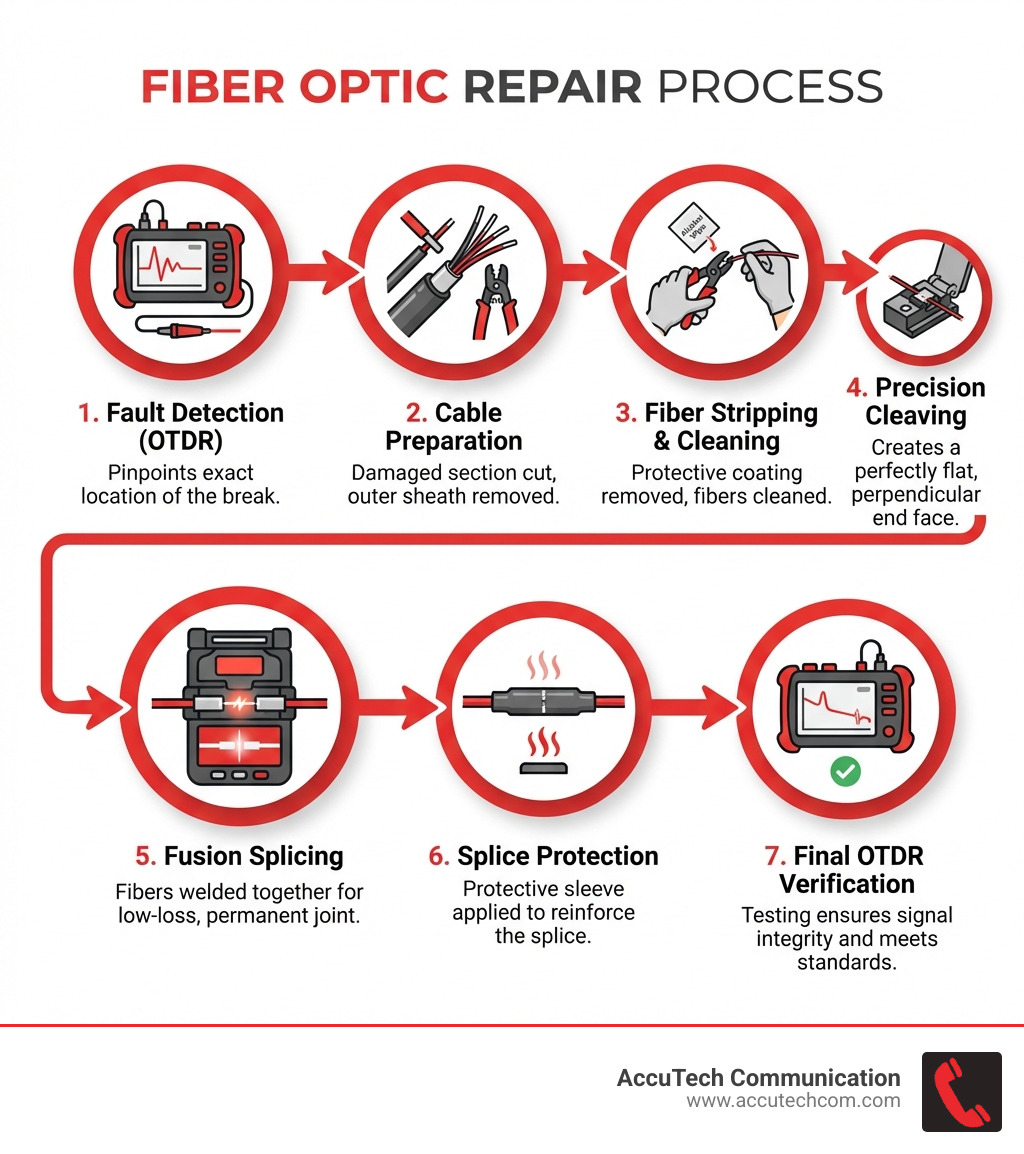
Here’s what a professional fiber optic repair involves:
- Fault Location – Using an OTDR (Optical Time Domain Reflectometer) to pinpoint the exact location of the break or damage
- Cable Preparation – Cutting out the damaged section and stripping the protective coatings to expose clean fiber ends
- Splicing – Joining the fiber ends using fusion splicing (permanent, <0.10dB loss) or mechanical splicing (faster, emergency repairs)
- Testing – Verifying signal quality with OTDR testing to ensure the repair meets industry standards
- Documentation – Recording the repair location, test results, and splice details for future maintenance
Why repair matters for your business: Approximately 70 percent of fiber optic network failures are due to bad connectors, and physical damage from construction, environmental factors, or improper installation accounts for most of the remaining issues. The difference between a quick recovery and extended downtime often comes down to having the right tools, trained technicians, and a clear repair process.
Your fiber network carries mission-critical data for your healthcare facility, manufacturing operation, or educational institution. When a backhoe severs your underground cable during construction, or when environmental factors degrade a connection, you need a repair solution that restores full bandwidth and reliability—not a temporary fix that fails under stress.
I’m Corin Dolan, owner of AccuTech Communications, and I’ve been helping businesses across Massachusetts, New Hampshire, and Rhode Island maintain reliable fiber optic networks since 1993. Through hundreds of commercial fiber optic repair projects, I’ve seen how proper diagnosis, precision splicing, and thorough testing make the difference between a network that supports your business growth and one that holds it back.
Similar topics to Fiber optic repair:
Diagnosing Failure: Common Causes and Symptoms of a Broken Fiber Cable
Fiber optic cables are the backbone of modern communication networks, renowned for their incredible speed and bandwidth. However, even these robust lines are susceptible to damage, leading to significant disruption in data transmission. Understanding the common causes and symptoms of a broken fiber cable is the first critical step in effective fiber optic repair.
Physical and Environmental Causes of Fiber Damage
When we talk about what can go wrong with fiber optic cables, the causes generally fall into a few key categories:
- Physical Damage: This is often the most dramatic and easily identifiable cause. We’ve all heard the term “backhoe fade”—a common industry phrase for when an optical fiber cable is cut or damaged during digging operations. This can happen during construction, landscaping, or even routine utility work. Other forms of physical damage include vandalism, accidental cuts during maintenance, or even damage from animals like rodents, which have been known to chew through cables. For businesses in Massachusetts, New Hampshire, and Rhode Island, protecting underground cables with proper burial depth (around 1 meter or 3 feet) and clear markings is essential.
- Environmental Factors: Our New England weather can be tough on infrastructure. Extreme temperatures can stress cables, and moisture ingress can be particularly problematic. Mold can grow inside poorly sealed cables in humid conditions, leading to signal loss. Cables can also be affected by flooding in manholes or splice closures.
- Installation Errors: Unfortunately, sometimes the damage starts at installation. Excessive bending beyond the cable’s minimum bend radius can cause micro-bends or even breaks, impeding the total internal reflection of light. Improper tension during pulls, poor splicing techniques, or inadequate protection of splice points can all lead to premature failure.
- Connector Failure: This is a big one. Statistics show that the majority of fiber optic network failures, around 70 percent, are due to bad connectors. This can be due to poor termination during installation, contamination (dirt, dust, oils), or simply wear and tear. A contaminated connector can cause significant signal loss and is a common culprit for network slowdowns. Manufacturing defects, though less common, can also contribute to a cable’s reduced lifespan.
Using Professional Tools to Pinpoint the Problem
Once we suspect a fiber optic cable is damaged, our next step is to diagnose the problem accurately. This involves using specialized tools to pinpoint the exact location and nature of the fault, saving valuable time and resources during the fiber optic repair process.
- Visual Inspection: For easily accessible cables, a visual inspection is always the first step. We look for obvious cuts, kinks, pinches, or splits along the cable’s length. We also check connectors for fraying or discoloration.
- Visual Fault Locator (VFL): A VFL is a simple yet effective tool for tracing and continuity testing on shorter cables, typically up to several kilometers. It injects a visible red laser light into the fiber. If there’s a break, a sharp bend, or a faulty connector, the red light will escape from the cable jacket at the fault location, making it visible. This is particularly useful for premises cabling or patch cords in your data center or server room.
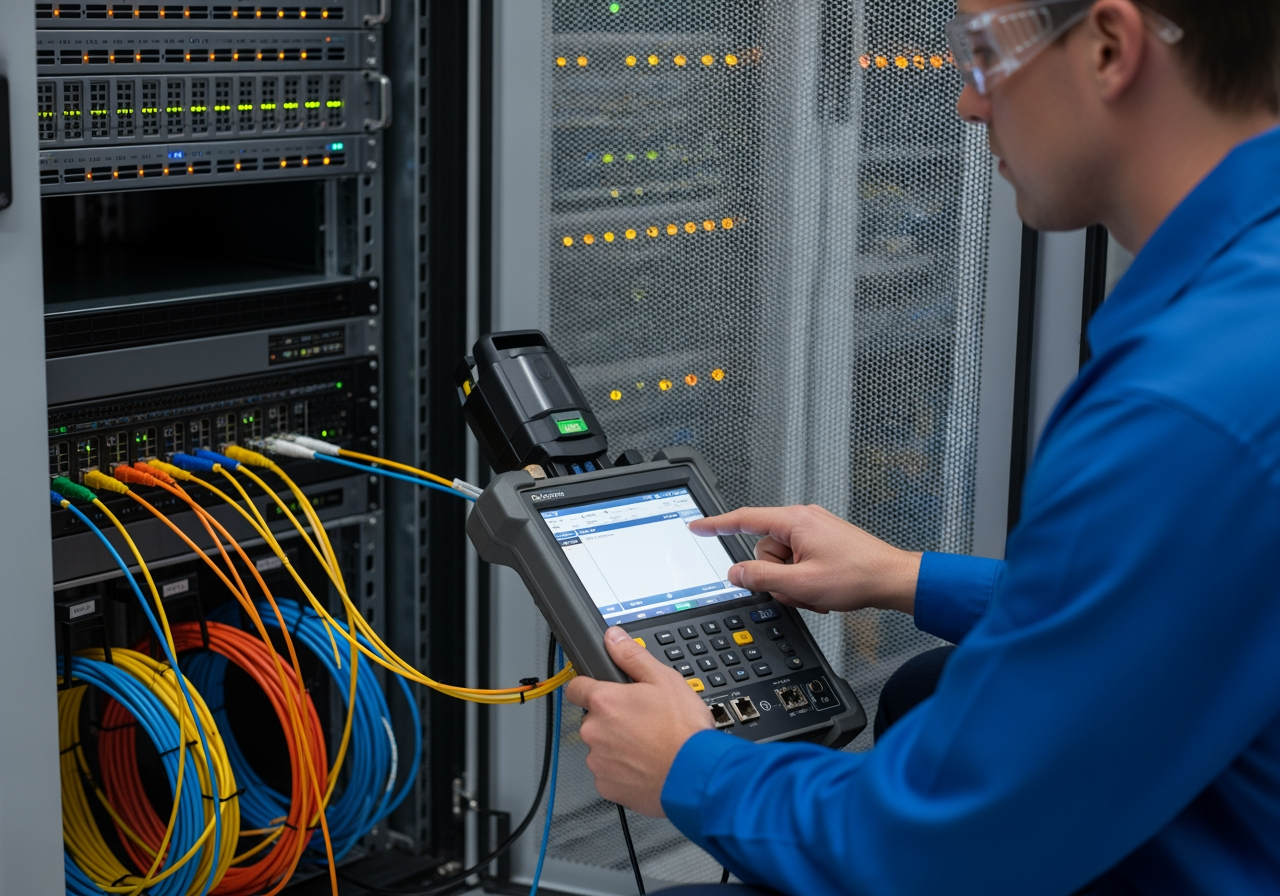
- Optical Time Domain Reflectometer (OTDR): This is the workhorse of fiber optic diagnostics. An OTDR sends pulses of light down the fiber and measures the reflected light (backscatter) over time. By analyzing these reflections, we can create a detailed graphical profile of the fiber’s condition. The OTDR can precisely locate breaks, bends, splices, and connectors, and quantify the signal loss at each point. For longer cables, especially those running between buildings or across your campus in Massachusetts, New Hampshire, or Rhode Island, an OTDR is indispensable for fault location. OTDRs generally do not have adequate resolution for very short cables (less than 30-50 meters), and they measure fiber length, which is usually 1-2% shorter than the cable’s physical length.
By combining these diagnostic methods, our expert technicians can efficiently and accurately pinpoint the problem, allowing us to proceed with the most effective fiber optic repair strategy.
The Professional Fiber Optic Repair Process
Once the fault is located, the real work of fiber optic repair begins. This is a delicate process that requires precision, specialized tools, and adherence to strict safety protocols to ensure a lasting and high-performing connection.
Essential Tools and Safety for a Clean Repair
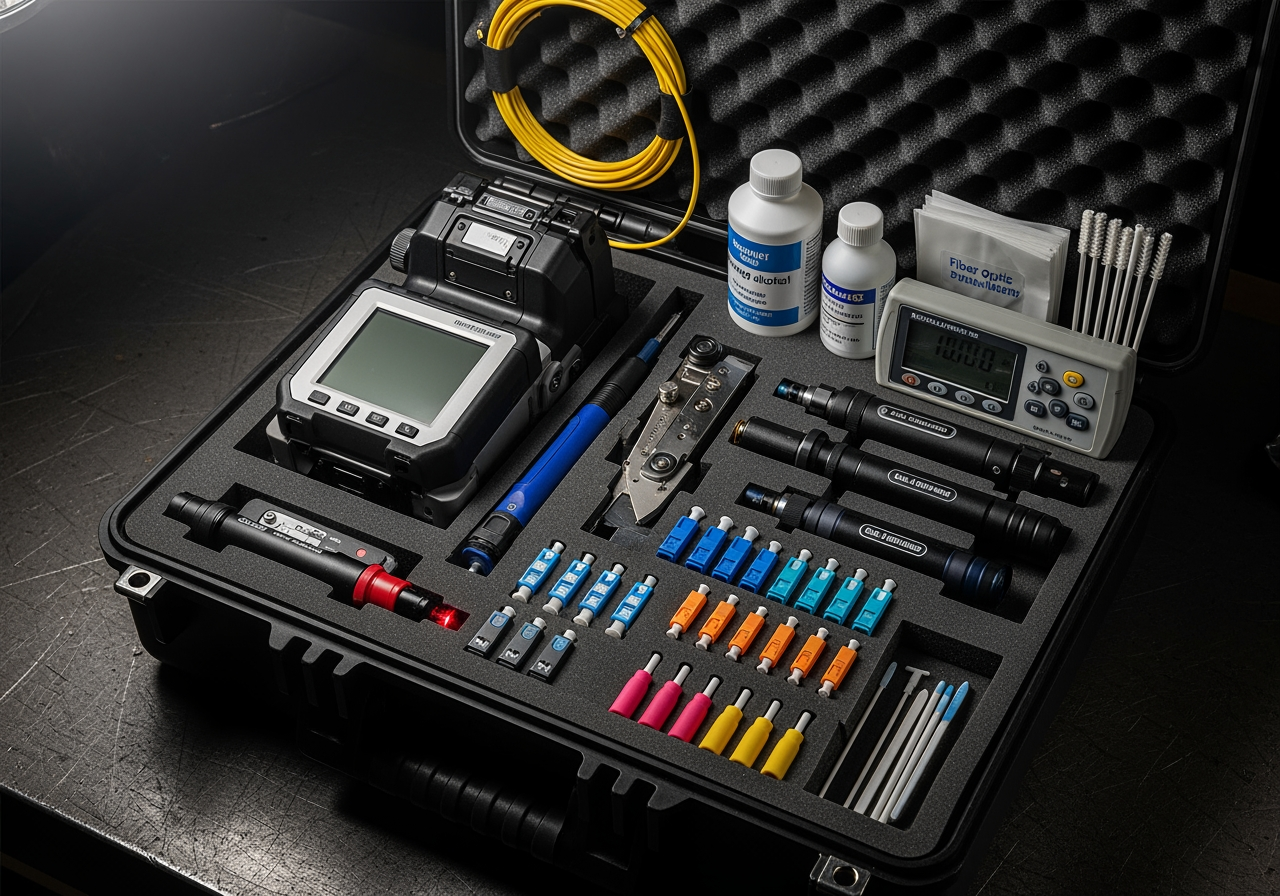
Before we even think about touching the damaged cable, we gather our essential tools and prioritize safety. Working with fiber optics involves handling glass, specialized chemicals, and high-precision equipment.
Essential Tools:
- Fiber Optic Cutter: A specialized tool designed to make clean, straight cuts through the cable jacket and strength members, ensuring the delicate fibers inside are protected.
- Fiber Optic Stripper: These tools precisely remove the protective buffer coatings from the fiber without damaging the glass core. We use various types for different coating layers.
- Precision Cleaver: Arguably one of the most critical tools, a cleaver creates a mirror-smooth, perpendicular end-face on the fiber. This perfect end-face is paramount for successful splicing, especially fusion splicing.
- Fusion Splicer: This advanced machine uses an electric arc to melt and fuse two fiber ends together, creating a seamless, low-loss connection.
- Cleaning Supplies: Lint-free wipes and medical-grade isopropyl alcohol are crucial for thoroughly cleaning exposed fibers before splicing. Any dust, oil, or debris can severely degrade splice quality.
- Splice Protection Sleeves: These heat-shrinkable sleeves protect the delicate splice point from physical stress and environmental factors.
- Fiber Splice Trays and Closures: These organize and protect multiple splices within an enclosure, ensuring long-term reliability.
Safety First:
- ANSI-rated Safety Glasses: Always worn to protect eyes from accidental fiber shards, which are tiny and virtually invisible.
- Cut-Resistant Gloves: Protect hands from sharp tools and fiber ends.
- Flame-Retardant Clothing: Recommended, especially when using a fusion splicer.
- Glass Shard Disposal: We use adhesive mats and designated containers for safely collecting and disposing of fiber optic glass fragments, preventing contamination and injury.
Step-by-Step: From Damaged Cable to Restored Connection
With our tools ready and safety measures in place, we follow a meticulous step-by-step process for every fiber optic repair:
- Fault Isolation and Cable Access: After locating the fault with an OTDR, we carefully expose the damaged section of the cable. For underground cables, this might involve excavation. We ensure sufficient cable slack (service loops) is available on both sides of the break; if ends are too short, a new section of cable will need to be spliced in, requiring two splices.
- Cut Out Damaged Section: Using a fiber optic cutter, we remove the compromised portion of the cable, ensuring clean, straight cuts on the remaining healthy fiber.
- Strip Protective Coatings: We carefully strip back the outer jacket, strength members, and buffer coatings from both cable ends, exposing the bare optical fibers. The stripping length is precise, often around 50cm from the end.
- Clean Fiber Ends: This step cannot be overstated. We thoroughly clean the exposed bare glass fibers with lint-free wipes and isopropyl alcohol. It’s critical not to touch the cleaned fiber ends, as oils or dust can ruin the splice.
- Cleave Fiber: The precision cleaver is used to create a perfect, mirror-smooth, 90-degree end-face on each fiber. This is essential for proper light transmission across the splice.
- Splice Fibers: This is where the magic happens, using either fusion or mechanical splicing (discussed in detail below). We carefully align the fibers and join them.
- Protect the Splice: Once the splice is complete, we immediately protect it. For fusion splices, this involves sliding a heat-shrink protection sleeve over the splice and heating it to secure the connection. For mechanical splices, the protective housing is closed. The protected splices are then neatly organized within a splice tray, and the entire assembly is housed in a weatherproof closure.
- Test the Connection: The final and crucial step is to test the repaired cable to verify signal integrity and ensure the repair meets industry standards.
Fusion vs. Mechanical Splicing: The Core of Fiber Optic Repair
The choice between fusion splicing and mechanical splicing is a key decision in fiber optic repair, depending on the specific application, required performance, and environmental conditions.
| Feature | Fusion Splicing | Mechanical Splicing |
|---|---|---|
| Method | Uses an electric arc to melt and fuse fiber ends. | Uses a mechanical alignment device to hold fiber ends in place. |
| Splice Loss | Very low (typically < 0.10 dB, often < 0.05 dB). | Higher (typically 0.3 dB). |
| Durability | Permanent, strong, and highly reliable bond. | Less permanent, relies on physical contact. |
| Performance | Best for high-bandwidth, long-haul, and critical links. | Suitable for temporary fixes or non-critical links. |
| Equipment | Requires an expensive fusion splicer. | Requires less expensive tools, often a simple kit. |
| Speed | Slower, more precise process. | Faster, especially for emergency repairs. |
| Application | Preferred for outside plant (OSP) and backbone connections. | Good for premises cabling, emergency restoration, or temporary connections. |
Fusion Splicing: This method creates a continuous optical path by welding two fiber ends together using heat. The fusion splicer precisely aligns the fiber cores and then applies a high-voltage electric arc to melt and fuse the glass. This results in an incredibly strong, durable, and low-loss connection—often less than 0.10 dB, and sometimes as low as 0.05 dB. Fusion splicing is our preferred method for permanent repairs on critical infrastructure, such as long-haul cables or backbone connections for businesses in Massachusetts, New Hampshire, and Rhode Island, ensuring optimal data transmission rates.
Mechanical Splicing: In contrast, mechanical splicing involves aligning the fiber ends within a small, precision-made housing or sleeve. A gel or index-matching fluid inside the splice minimizes reflections and signal loss. While quicker and requiring less expensive equipment than fusion splicing, mechanical splices typically have higher signal loss (around 0.3 dB) and are less durable. They are often used for emergency repairs, temporary connections, or in premises cabling where performance requirements are less stringent. If a repair tech has a fusion splicer, the easier to install and more reliable fusion splice is generally recommended. For singlemode cable, we ensure a sufficient length (10 to 100 meters) of cable is used to prevent modal problems with transmission.
Post-Repair: Verification, Prevention, and Documentation
A successful fiber optic repair isn’t just about joining two ends; it’s about restoring network integrity, preventing future issues, and carefully documenting the work. These final steps are crucial for ensuring the long-term reliability of your fiber optic infrastructure.
How to Test and Verify a Successful Fiber Optic Repair
After the physical repair is complete, rigorous testing is essential to verify the quality of the splice and the overall health of the cable.
- OTDR Testing: We use an OTDR to perform a comprehensive test of the repaired section. This allows us to measure the exact splice loss and compare it against industry standards. A typical splice loss for a professional repair is under 0.10 dB, with most field repairs achieving less than 0.15 dB. We look for a smooth OTDR trace without unexpected spikes, indicating a clean, low-loss connection. Testing from both ends of the cable can provide a more complete picture of the repair’s quality.
- Optical Loss Test Set (OLTS): An OLTS, consisting of a light source and a power meter, measures the total insertion loss of the cable span. This gives us an overall picture of how well the light is transmitting through the repaired section. We aim for a signal insertion loss variance within 1%, confirming that the repair has not introduced significant attenuation.
- Comparing to Standards: We always compare our test results to the original installation documentation and industry standards to ensure the repaired cable performs as expected, maintaining the high bandwidth and reliability your business relies on.
Preventing Future Damage to Your Fiber Network
While we’re experts in fiber optic repair, we’d much rather help you prevent damage in the first place! Proactive measures can significantly reduce the likelihood of costly downtime for your business in Massachusetts, New Hampshire, and Rhode Island.
- Proper Installation: This is fundamental. Ensuring cables are installed correctly, without sharp bends, excessive tension, or improper pulling forces, prevents common stress-related failures. We always adhere to the minimum bend radius specifications for each cable type.
- Using Innerduct and Conduit: For indoor fiber optic cables, using bright orange innerduct provides an extra layer of protection and makes the cable highly visible, preventing accidental damage during equipment moves or renovations. For outdoor installations, burying cables in conduit or direct burying armored cable provides robust protection against physical damage.
- Cable Management: Neat and organized cable runs, both inside and outside your facility, reduce the risk of accidental damage. This includes enclosing and locking patch panels where backbone cables terminate, preventing unqualified personnel from tampering with critical connections.
- Spare Fibers and Service Loops: Including spare fibers in all new cable installations is an inexpensive measure compared to future restoration costs. Additionally, leaving extra cable in service loops at strategic points allows for easier access and sufficient length for splicing during repairs, saving immense restoration time.
- Regular Visual Inspections: While fiber optic cable plants generally do not need maintenance (and unnecessary inspection can sometimes cause more damage than good), periodic visual checks of accessible cable routes and connectors can help identify potential issues before they become critical.
- Connector Care: Since bad connectors cause 70% of network failures, regular cleaning of connectors with isopropyl alcohol and lint-free wipes is a simple yet effective preventative measure. Always inspect connectors with a microscope before connecting them.
For comprehensive strategies on professional installation and structured cabling that minimizes future damage, you can learn more about our structured cabling services.
The Critical Role of Documentation in Maintenance
“The biggest single help in troubleshooting starts with producing good documentation during the installation and keeping it current.” This isn’t just a statistic; it’s a golden rule in fiber optic repair and maintenance.
- Network Diagrams and Cable Plant Maps: Detailed drawings showing the layout of your fiber optic network, including cable routes, splice locations, and termination points, are invaluable. For outdoor plant, this might include GPS locations; for indoor, detailed building drawings.
- Initial Test Results: Comprehensive records of initial OLTS loss measurements and OTDR traces for each fiber serve as a baseline. When a problem occurs, we can compare current test data to the original, quickly identifying new faults or degradation.
- Splice Locations and Fiber Identifiers: Knowing exactly where each splice is located and which specific fibers are involved simplifies troubleshooting immensely. Every fiber in every cable at every connection should be clearly marked and documented.
- Troubleshooting Aid: Good documentation allows us to rapidly identify the problem, know how it should be fixed, and have the right parts on hand. Without it, troubleshooting can become a frustrating and time-consuming guessing game.
- Post-Repair Updates: After every fiber optic repair, we carefully update the documentation to reflect any changes, including new splice locations, replacement components, or re-routed fibers. This ensures that the documentation remains an accurate and useful tool for future maintenance.
The Fiber Optic Association (FOA) provides excellent resources and guidelines on this topic. You can explore their extensive information at The Fiber Optic Association.
Frequently Asked Questions about Commercial Fiber Optic Repair
We understand that when your network goes down, you have questions. Here are some common inquiries we receive regarding fiber optic repair for businesses in Massachusetts, New Hampshire, and Rhode Island.
What’s the difference between field and lab repairs?
Field repairs are conducted on-site, directly where the damaged cable is located. Our technicians arrive with portable equipment, such as fusion splicers, cleavers, and OTDRs, ready to address issues like cable cuts or damaged connectors quickly. The primary goal of a field repair is immediate service restoration. These repairs can begin quickly, sometimes in less than thirty minutes if the broken component is accessible, and most achieve excellent splice loss results, often less than 0.15dB.
Lab repairs, on the other hand, typically involve sending a damaged component or pre-terminated assembly to a specialized facility. These labs have more sophisticated, non-portable equipment for detailed analysis, intricate repairs, or custom assembly. Lab repairs offer greater accuracy and dependability but are not suitable for urgent, on-site service restoration. For most commercial fiber optic repair needs, especially emergency outages, field repair is the faster and more practical solution.
Is it better to repair or replace a damaged fiber optic cable?
For most commercial scenarios, repairing a damaged fiber optic cable through splicing is almost always the preferred and most cost-effective solution. This is especially true for long-haul or backbone cables that are expensive and time-consuming to replace entirely. A professional repair can restore the cable to nearly its original performance with minimal signal loss.
Full cable replacement is typically only necessary for short, easily accessible patch cords, if the cable is damaged in multiple locations beyond feasible repair, or if the cable type is obsolete and incompatible with modern equipment. We always assess the extent of the damage to recommend the most efficient and economical approach for your business.
How long does a typical fiber optic repair take?
The duration of a fiber optic repair can vary significantly depending on several factors:
- Complexity of Damage: A simple, accessible single-fiber break is much faster to repair than a multi-fiber cable with extensive damage.
- Accessibility: Repairs in easily accessible locations like a data center rack are quicker than those requiring excavation for underground cables or the use of bucket trucks for aerial cables.
- Number of Fibers: Splicing a single fiber takes less time than splicing a 144-fiber cable, where each fiber must be individually prepared and spliced.
For a simple, accessible single-fiber repair, a trained technician can often complete the job in less than an hour. However, repairs on multi-fiber cables, or in difficult-to-access locations like underground conduits or aerial poles, can take several hours, sometimes an entire day, due to the time required for site preparation, accessing the cable, and individually testing each fiber. Our goal is always to minimize your restoration times, often reducing them by 30-50% through efficient processes and skilled technicians.
Conclusion: Partnering with Experts for Network Reliability
In today’s business environment, reliable network connectivity is not a luxury—it’s a necessity. When your fiber optic network experiences damage, you need a partner who can respond quickly, diagnose accurately, and execute a flawless fiber optic repair.
At AccuTech Communications, we bring decades of experience, specialized equipment, and a team of certified technicians to every commercial fiber optic repair project in Massachusetts, New Hampshire, and Rhode Island. We understand the critical nature of your business operations and are committed to restoring your network’s full functionality with minimal downtime and maximum reliability. From precision fusion splicing to thorough post-repair testing and meticulous documentation, we ensure your repaired fiber optic infrastructure supports your business growth for years to come.
Don’t let a damaged fiber optic cable disrupt your productivity. Partner with us for expert fiber optic repair and maintenance services that keep your business connected.
