Connecting the Future: A Guide to Fiber Optics Installation

Why Fiber Optics Installation Matters for Modern Business
A fiber optics installer is a specialized technician who installs, maintains, and repairs fiber optic cables that carry high-speed data and communications. Here’s what they do:
Primary Responsibilities:
, Install fiber optic cables in buildings, data centers, and telecommunications networks
, Splice and connect fiber optic cables using specialized equipment
, Test cable performance and troubleshoot connection issues
, Maintain existing fiber infrastructure and perform repairs
, Follow safety protocols when working with laser equipment and cables
Key Skills Required:
, Knowledge of fiber optic splicing and connectorization techniques
, Ability to use testing equipment like OTDRs and power meters
, Understanding of telecommunications standards and safety practices
, Physical ability to work in tight spaces and at heights
Modern businesses depend on fast, reliable data connections more than ever. Healthcare systems need instant access to patient records. Manufacturing facilities require real-time communication between automated systems. Educational institutions demand high-speed internet for digital learning.
Fiber optic cables deliver speeds up to 100 times faster than traditional copper wiring. They’re also more reliable and secure, making them essential for businesses that can’t afford network downtime. According to the Federal Communications Commission, fiber optic technology provides the most reliable and fastest internet connections available today.
The demand for skilled fiber optics installers continues to grow as more companies upgrade their infrastructure. Whether you’re looking to hire an installer or considering this career path, understanding the basics helps you make informed decisions.
I’m Corin Dolan, owner of AccuTech Communications, and I’ve been helping businesses across Massachusetts, New Hampshire, and Rhode Island with their communication infrastructure since 1993. My team and I work closely with fiber optics installer professionals to deliver scalable network solutions that grow with your business needs.
Fiber optics installer terms made easy:
, how to terminate fiber optic cable
, types of fiber optic cable
, fiber optic splicing technician
What is a Fiber Optics Installer?
When you flip a switch and your internet loads instantly, or when your business phone system connects crystal-clear calls across the country, there’s likely a fiber optics installer behind that seamless experience. These skilled professionals are the unsung heroes of our connected world.
A fiber optics installer does far more than just run cables through buildings. They’re part craftsperson, part technician, and part problem-solver all rolled into one. These specialists handle the installation, maintenance, and repair of the hair-thin glass cables that power our modern telecommunications networks.
Picture this: You’re tasked with threading something thinner than human hair through walls, around corners, and sometimes hundreds of feet underground, all while ensuring it can carry data at the speed of light without losing signal strength. That’s just a typical Tuesday for a fiber optics installer.
Reading blueprints and planning routes comes first. Every installation starts with understanding where cables need to go and how to get them there safely. Then comes the physical work, pulling cables through conduits, installing cable trays, and navigating tight spaces that would make a contortionist uncomfortable.
The real artistry happens during termination and splicing. Using equipment that costs tens of thousands of dollars, installers join cable segments with precision measured in microns. One tiny misalignment, and your high-speed connection becomes a frustrating crawl.
Testing and troubleshooting rounds out the daily routine. Installers use sophisticated tools like optical time-domain reflectometers to verify that signals travel cleanly from point A to point B. When something goes wrong, they become detectives, hunting down the source of signal loss or connection failures.
At AccuTech Communications, we’ve partnered with talented fiber optics installers for over 30 years. I’ve watched them transform businesses across Massachusetts, New Hampshire, and Rhode Island.
The job demands both technical expertise and physical stamina. You might spend morning hours in a climate-controlled data center, then afternoon hours on a rooftop in July heat. It’s challenging work, but it’s also incredibly rewarding when you see how reliable telecommunications infrastructure changes how people work and communicate.
Training and Certification for Fiber Optics Installers
Here’s the exciting part about becoming a fiber optics installer, you don’t need to spend four years in college to start a rewarding career. Most people can get certified and job-ready in just a few weeks to a few months.
The ETA Fiber Optic Installer Certification stands out as the gold standard in our industry. This comprehensive program walks you through everything from basic fiber theory to the intricate art of splicing. You’ll find how light travels through different types of fiber optic cable, master essential safety procedures, and learn testing methods that ensure perfect installations every time.
For installers looking to climb the career ladder, BICSI Continuing Education Credits (CECs) provide excellent ongoing professional development. These advanced courses explore network design, project management, and cutting-edge technologies that keep you ahead of the curve.
But here’s what really matters: hands-on practice makes all the difference. You can study fusion splicing theory until your eyes glaze over, but the real learning happens when you’re actually aligning two hair-thin glass fibers under a microscope and watching them fuse together at 2000°F. That’s when you truly appreciate the precision this work demands.
Quality training programs cover fiber optic theory and light transmission principles so you understand the science behind what you’re doing. You’ll master cable handling and installation techniques that prevent costly damage during installation. The programs also teach both mechanical and fusion splicing methods, connector installation and polishing, and testing procedures with professional equipment. Most importantly, they emphasize safety protocols for laser equipment because your eyesight depends on it.
Community colleges, technical schools, and industry organizations all offer these programs. Many employers also provide on-the-job training, especially if you’re just starting out and show genuine enthusiasm for learning.
At AccuTech Communications, we’ve seen how proper training transforms installation quality. When we work with certified installers across Massachusetts, New Hampshire, and Rhode Island, the difference is night and day. A trained professional creates networks that run smoothly for decades, while someone cutting corners often leaves behind installations that need constant troubleshooting.
Key Skills and Techniques in Fiber Optics Installation
Becoming a skilled fiber optics installer is like learning to be a surgeon for telecommunications networks. You’re working with glass fibers thinner than human hair, handling equipment worth tens of thousands of dollars, and one small mistake can affect hundreds of users.
The precision required might seem intimidating at first, but that’s exactly what makes this field so rewarding. When you master these techniques, you’re literally connecting the world.
Splicing: The Heart of Fiber Installation
Think of splicing as performing microsurgery on glass. You’re joining two fiber optic cables to create one continuous path for light to travel. There are two main approaches, and each has its place.
Fusion splicing is the gold standard. An electric arc heats the fiber ends to about 2000°F, melting them together into one seamless piece of glass. The result? Signal loss of less than 0.1 dB, which means almost no light is lost at the connection. It’s incredibly precise work that requires steady hands and expensive equipment.
Mechanical splicing offers a faster alternative. Instead of melting fibers together, you align them perfectly in a special connector filled with index-matching gel. While not quite as robust as fusion splices, mechanical splices work great for temporary repairs or situations where you need to work quickly.
Connectorization: Making the Final Connection
How to terminate fiber optic cable properly separates the professionals from the amateurs. This process requires incredible attention to detail.
First, you strip the cable jacket without nicking the delicate glass fiber inside. Then comes cleaving, creating a perfectly flat end face on the fiber. We’re talking mirror-smooth here. Finally, you polish the connector until it’s flawless, because even microscopic scratches will scatter light and degrade performance.
I’ve seen installers rush through this process, only to spend hours later troubleshooting connection problems that could have been avoided with proper technique.
Testing: Ensuring Everything Works
No fiber optics installer worth their salt walks away from a job without thorough testing. You need to prove that light travels cleanly through every connection.
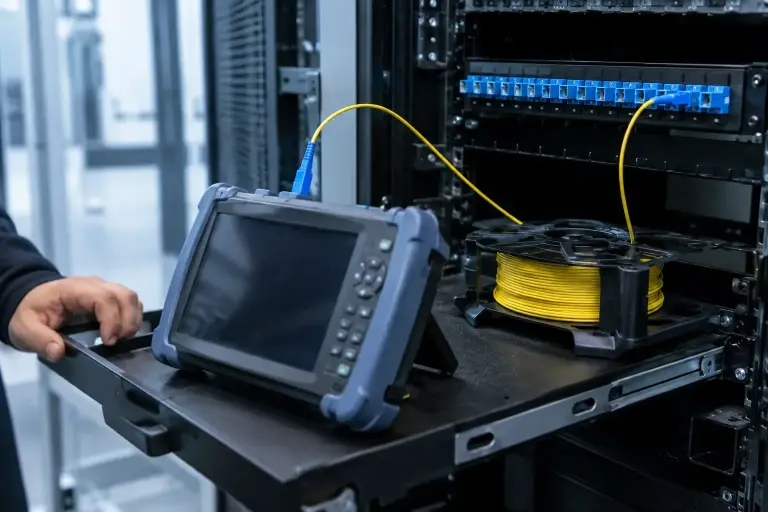
Optical power meters tell you how strong your signal is. OTDRs (Optical Time-Domain Reflectometers) are like X-ray machines for fiber, they can pinpoint exactly where problems exist along miles of cable. Visual fault locators help you trace cables and spot major breaks by sending visible red light through the fiber.
At AccuTech Communications, we’ve learned that spending extra time on testing upfront saves our clients from expensive service calls later.
Safety Practices: Protecting Eyes and Equipment
Here’s something that might surprise you: fiber optic cables carry invisible laser light that can permanently damage your eyesight. You can’t see it, you can’t feel it, but looking directly into an active fiber can cause instant, irreversible eye damage.
Professional installers always wear safety glasses designed for specific laser wavelengths. We never look directly into fiber ends or connectors, even when we think they’re disconnected. Those tiny glass fiber scraps from cleaving? They’re nearly invisible and incredibly sharp, proper disposal is essential.
Following lockout/tagout procedures when working on active systems isn’t just good practice; it’s what keeps you safe and prevents network outages.
The difference between a trained professional and someone trying to figure it out as they go becomes obvious quickly. Taking time to master each technique properly means installations that work flawlessly for decades, not systems that need constant troubleshooting.
Career Opportunities in Fiber Optics
If you’re considering a career as a fiber optics installer, you’ve picked an exciting time to enter the field. The demand for skilled technicians has never been higher, and it’s only growing as our world becomes more connected.
Telecommunications line installers make up the largest group of fiber professionals. These are the folks who bring high-speed internet to your neighborhood, running cables from street to building, connecting homes and businesses to the digital world. It’s satisfying work when you realize you’re literally connecting people to opportunities, education, and each other.
Data centers offer another fascinating career path. Working as a fiber optics installer in these facilities means handling some of the most demanding installations in the industry. When you’re working in a server room that handles millions of internet searches or streaming videos, there’s no room for error. Even a tiny speck of dust on a connector can bring down websites that thousands of people depend on.
Industrial settings provide unique challenges that many technicians find rewarding. Manufacturing plants, oil refineries, and power companies need fiber networks that can handle extreme conditions. These installations often pay well because they require specialized knowledge and the ability to work in demanding environments.
Government and military projects offer stable, well-paying positions for those who qualify. These roles often require security clearances, but they come with excellent benefits and the satisfaction of supporting national security and public safety communications.
The numbers tell an encouraging story. The Bureau of Labor Statistics expects fiber optics installer jobs to grow 7% through 2031, that’s faster than most other careers. This growth comes from several exciting developments: 5G networks need extensive fiber connections, smart cities are connecting everything from traffic lights to utility meters, and rural communities are finally getting access to high-speed internet.
Starting salaries typically range from the mid-thirties to mid-forties, but experienced technicians with solid certifications often earn much more. The Boston area, where we serve many clients, tends to pay particularly well due to high demand and cost of living.
Many successful fiber optics installer professionals eventually start their own businesses or move into network design and project management. The technical skills you develop as a fiber optic splicing technician create opportunities throughout the telecommunications industry.
At AccuTech Communications, we’ve worked with many talented installers over our 30 years in business. The best ones combine technical expertise with problem-solving skills and genuine pride in their craft. It’s a career that offers both immediate job security and long-term growth potential.
Frequently Asked Questions about Fiber Optics Installation
What experience is required to become a fiber optics installer?
Here’s some encouraging news if you’re thinking about changing careers: you don’t need any previous experience to become a fiber optics installer. I’ve personally worked with installers who started their careers in retail, construction, the military, and even food service. What they all had in common wasn’t their background, it was their willingness to learn something new.
The beauty of this field is that employers understand they’re hiring for potential, not just experience. When we partner with installation teams at AccuTech Communications, we look for people who have good hand-eye coordination and pay attention to details. Working with hair-thin glass fibers requires patience and precision, but these are skills you can develop with practice.
Physical fitness matters too. You might spend a day crawling through tight spaces in a data center or working on a ladder installing cables. But you don’t need to be a marathon runner, just reasonably comfortable moving around and working with your hands.
Most companies will train you on the job or hire you after you complete a short certification program. The key is showing that you’re serious about learning the trade and committed to doing quality work.
What certifications are available for fiber optics installers?
Several respected organizations offer certifications that can jumpstart your career as a fiber optics installer.
The ETA Fiber Optic Installer (FOI) certification is probably the most widely recognized credential in the industry. This program covers everything from basic fiber theory to hands-on splicing techniques. You’ll take both written exams and practical tests where you actually splice cables and install connectors.
BICSI certifications take a broader approach, covering fiber optics as part of comprehensive telecommunications infrastructure. These are excellent if you want to eventually move into network design or project management roles.
Manufacturer-specific certifications from companies like Corning and CommScope show you know how to work with particular products and installation methods. These can be valuable if you specialize in certain types of installations.
The field keeps evolving, so continuing education is important. New connector types, testing equipment, and installation techniques are constantly being developed. The best installers I work with are always learning something new.
What are the job prospects for fiber optics installers?
The job prospects for fiber optics installers are honestly some of the best I’ve seen in any technical field, especially here in Massachusetts, New Hampshire, and Rhode Island where AccuTech Communications operates.
5G network deployment is creating massive demand. Every new 5G cell tower needs fiber optic connections for backhaul, and there are thousands of these installations happening across New England. The telecommunications companies simply can’t find enough qualified installers to keep up.
Data centers are expanding rapidly to support cloud computing and streaming services. Each new facility requires extensive fiber infrastructure, from the building entrance all the way to individual server racks. We regularly work on these projects, and the demand consistently exceeds the supply of skilled technicians.
Smart building technology is another growth driver. Modern commercial buildings integrate fiber for security systems, HVAC controls, and high-speed internet. Even older buildings are being retrofitted with fiber networks.
Government infrastructure programs are funding fiber installations in rural and underserved areas. These federal and state broadband initiatives represent billions of dollars in installation work over the next decade.
The work can be physically demanding and technically challenging, but it offers excellent job security, good compensation, and the satisfaction of building the infrastructure that keeps our digital world connected. At AccuTech Communications, we see how this technology transforms businesses, and there’s plenty of work for everyone willing to learn the skills.
Conclusion
The role of a fiber optics installer has never been more important for keeping businesses connected and competitive. Every day, we see how proper fiber installation transforms operations, from healthcare facilities that need instant access to patient records to manufacturing plants running automated systems that depend on split-second timing.
At AccuTech Communications, we’ve been part of this change since 1993. Over three decades of working with businesses across Massachusetts, New Hampshire, and Rhode Island has taught us something important: the quality of your fiber installation determines everything that follows. A rushed job might work initially, but it’ll cause headaches for years. Professional installation done right the first time saves money and prevents downtime.
The precision required for this work is remarkable. We’re talking about splicing glass fibers thinner than human hair, achieving connection losses measured in fractions of decibels, and following safety protocols that protect both equipment and people. It’s technical work that requires real expertise, not something you want to trust to the lowest bidder.
If you’re a business owner planning a fiber upgrade, choose certified professionals who understand your industry’s specific needs. The fiber optics installer you select should have proper training, current certifications, and experience with installations similar to yours.
For those considering this as a career path, the opportunities are excellent. The telecommunications industry needs skilled technicians, and the work offers good pay, job security, and the satisfaction of building the infrastructure that keeps our digital world running.
The future definitely runs on fiber optics. Every new business, every expanding data center, every 5G cell tower needs skilled installers to make the connections that matter. At AccuTech Communications, we’re proud to be part of this essential work, delivering reliable network cabling solutions that help New England businesses thrive.
Ready to see what professional fiber installation can do for your business? Our team is here to discuss how the right infrastructure upgrade can position your company for whatever comes next.