
What Is Commercial Data Cabling — and Why Does It Matter for Your Business?
Commercial data cabling is the physical network infrastructure that connects your computers, phones, servers, security systems, and other devices — forming the foundation of every digital operation in your building.
Here’s a quick overview of what it involves:
- What it is: A structured system of cables, connectors, and hardware that carries voice, data, and video signals throughout a commercial building
- Main cable types: Cat6, Cat6a, and fiber optic — each suited to different speeds, distances, and environments
- Who installs it: Certified cabling contractors who design, install, test, and certify the system to industry standards
- Key standards: ANSI/TIA-568, BICSI, ISO/IEC 11801, and NEC Article 800
- Why it matters: Poor cabling causes slow speeds, dropped connections, and costly downtime — reliable infrastructure keeps your business running
If your building’s network feels slow, unreliable, or impossible to expand, the cabling infrastructure is usually the root cause — not your internet plan or hardware.
Modern businesses depend on fast, stable connectivity more than ever. Whether you’re running a healthcare facility, a manufacturing plant, or a multi-floor office in Massachusetts, your network is only as strong as the cables behind it.
I’m Corin Dolan, owner of AccuTech Communications, and I’ve spent decades designing and installing commercial data cabling systems for businesses across Massachusetts, New Hampshire, and Rhode Island. In this guide, I’ll walk you through everything you need to know — from cable types and standards to planning, installation, and long-term maintenance.
The Strategic Importance of Commercial Data Cabling
When we talk about Commercial data cabling, we are usually talking about a “structured” approach. In the old days, many offices used “point-to-point” cabling. This meant if you added a new server, you ran a long, messy cord directly from that server to a switch. It worked for two devices, but once you had twenty, it looked like a bowl of blue spaghetti.
Structured cabling is a standardized, engineered architecture. It provides a consistent framework for your entire building. This isn’t just about tidiness; it’s about business survival. Proper network data wiring reduces downtime significantly because it makes troubleshooting a breeze. If a port goes down, we know exactly where it leads, thanks to proper labeling and documentation.
Furthermore, a structured cabling system is built for scalability. As your business grows in Worcester or Nashua, you won’t need to rip out your walls to add more desks. You simply tap into the existing infrastructure. This “future-proofing” ensures that as technologies like Wi-Fi 6 or 10-Gigabit Ethernet become the norm, your physical wires can handle the load. Plus, organized cabling improves data security by preventing unauthorized “taps” and reducing the risk of accidental disconnections.
The Six Subsystems of a Structured Cabling Solution
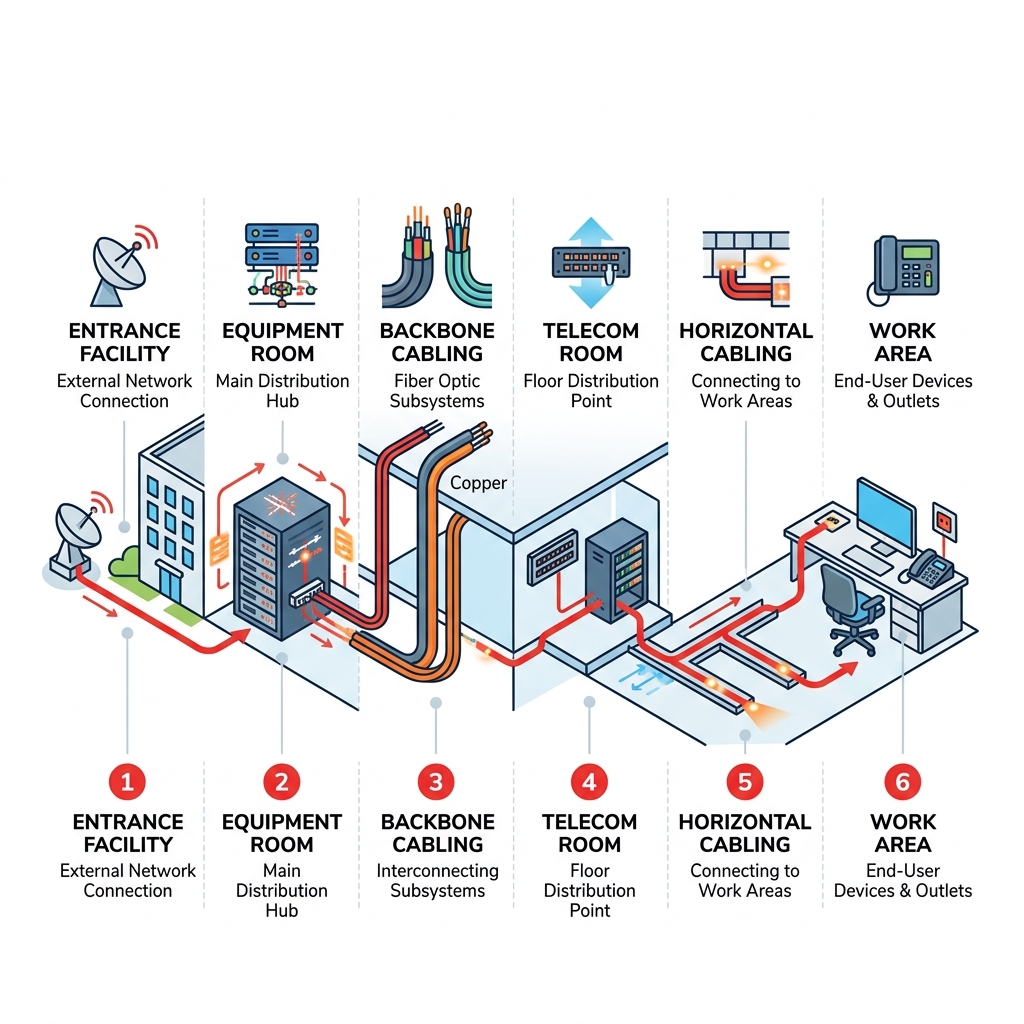
To understand how data moves through your office, we break a low voltage structured cabling project into six distinct subsystems:
- Entrance Facilities (EF): This is where the service provider’s wires (like Comcast or Verizon) enter your building. It contains the “demarcation point” between the utility and your private network.
- Equipment Rooms (ER): The “brain” of your network. This room houses your primary servers, routers, and large switches.
- Backbone Cabling: Also known as vertical cabling, this connects the equipment room to various telecommunications rooms throughout the building. We often use fiber optics for backbone cabling because it handles high speeds over long distances.
- Telecommunications Rooms (TR): These are smaller closets located on different floors or sections of a warehouse. They house the patch panels that distribute data to local workstations.
- Horizontal Cabling: These are the runs that go from the TR to the individual wall outlets. This is the most common type of Commercial data cabling found in an office environment.
- Work Areas: This is the “final mile”—the patch cords that connect a user’s computer, VoIP phone, or printer to the wall jack.
High-Performance Commercial Data Cabling Standards
We don’t just wing it when we install these systems. To ensure your network is reliable, we follow strict international and national standards. The ANSI/TIA-568-D.2 standard is the “bible” for copper cabling, ensuring that every connector and wire meets specific performance metrics.
Safety is just as important as speed. We adhere to NEC Article 800 fire codes, which dictate how cables must be rated for “plenum” spaces (the areas above drop ceilings where air circulates). Using the wrong cable type in these areas isn’t just a performance issue; it’s a fire hazard. Our team maintains BICSI certifications, which represent the highest level of education in the information technology systems industry. Following these ANSI/TIA-568-D.2 compliance rules ensures your system is recognized and warrantied globally.
Comparing Cable Types: Cat6, Cat6a, and Fiber Optics
Choosing the right cable is like choosing the right tires for a car—it depends on where you’re driving and how fast you want to go. For most data network cabling projects, we look at three main options:
| Cable Type | Max Speed | Max Distance for Max Speed | Best Use Case |
|---|---|---|---|
| Cat6 | 1 Gbps (up to 10G) | 100m (1G) / 55m (10G) | Small offices, basic data/voice |
| Cat6a | 10 Gbps | 100 meters | High-density offices, PoE++ devices |
| Fiber Optic | 100 Gbps+ | 10km+ (Single-mode) | Backbones, connecting buildings |
Cat6 is a reliable workhorse, but Cat6a is becoming the new standard for modern businesses. It features better shielding to prevent electromagnetic interference (EMI) and is “PoE++ ready,” meaning it can provide both high-speed data and significant power to devices like advanced security cameras or Wi-Fi access points.
For long distances or massive bandwidth, fiber optic cabling installation is the only way to go. Fiber uses light instead of electricity, making it immune to electrical noise and capable of speeds that copper simply can’t touch.
Step-by-Step Best Practices for Commercial Data Cabling
A successful installation starts long before we pull the first wire. As data cabling specialists, we follow a proven process:
- Site Assessment: We walk your facility in Boston or Providence to identify obstacles like power lines (which cause interference) or physical barriers.
- Pathway Design: We plan the most efficient route for the cables, using J-hooks, cable trays, or conduits to keep everything supported and organized.
- Cable Pulling: We carefully pull the cables to avoid kinks or excessive tension, which can damage the internal copper pairs.
- Termination & Labeling: Every wire is terminated at a high-quality patch panel and a wall jack. We label both ends clearly—nothing is more frustrating than a “mystery wire.”
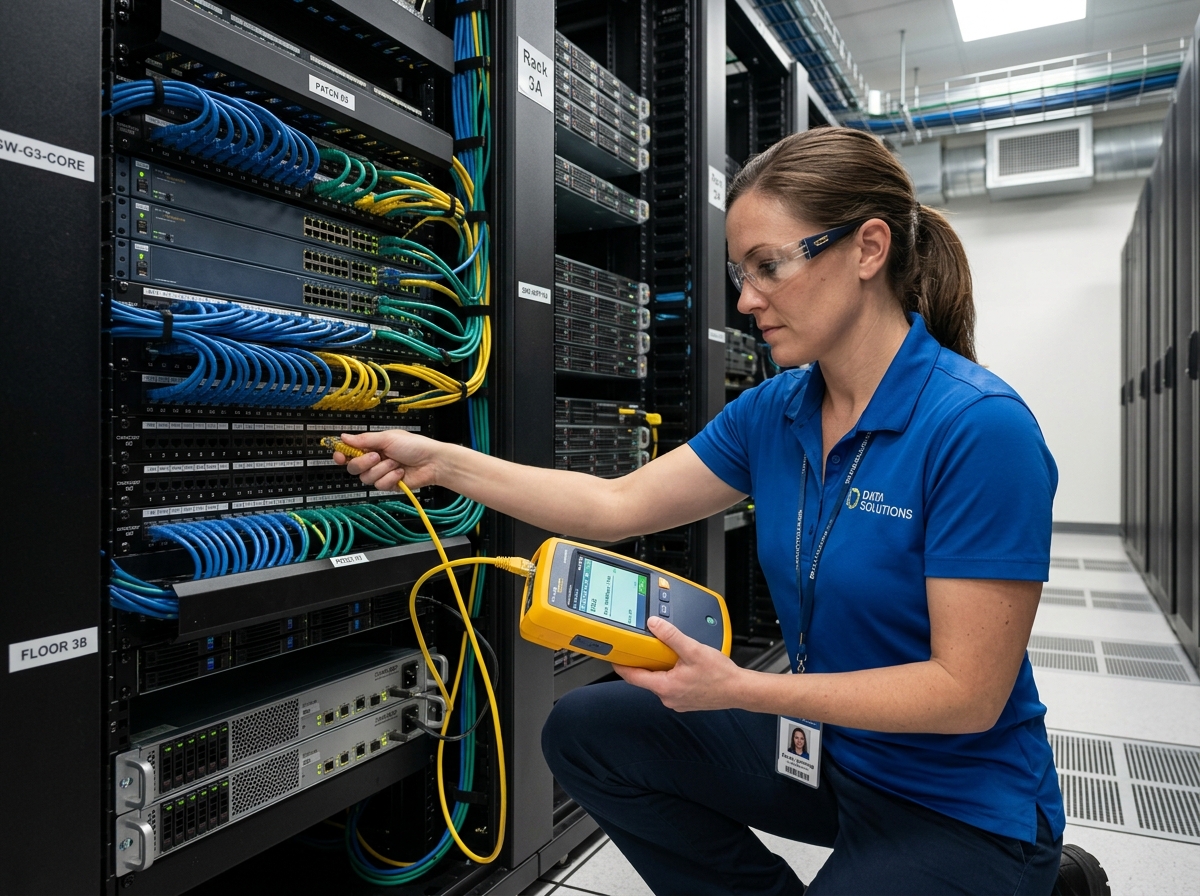
- Testing & Certification: We use specialized Fluke testers to verify that every single “drop” meets its rated speed (Cat6 or Cat6a). We provide these test results to you as proof of a job well done.
Planning, Maintenance, and Infrastructure Costs
When planning your commercial structured cabling, always think three to five years ahead. If you have 50 employees today, plan for 75. It is much cheaper to install extra “dark” (unused) cables now than to call us back in six months to add three more outlets.
Maintenance is also key. We recommend regular inspections to check for sagging cables or damaged jacks. If you experience a “slow” connection, our data cabling installation complete guide techniques involve systematic troubleshooting: checking the patch cord, then the wall jack, and finally the horizontal run to isolate the fault.
Understanding Industry Average Pricing
We know that budget is a major factor for any business in New England. While we provide custom quotes based on your specific layout, it helps to understand industry averages.
Note: All prices mentioned below are average costs sourced from publicly available internet data and are not the actual prices of AccuTech Communications.
Factors that influence your total investment include:
- Building Size: Larger footprints require longer cable runs.
- Cable Category: Cat6a materials are more expensive than Cat5e or Cat6.
- Environment: Installing in an open warehouse with high ceilings is different than a finished office with drop ceilings.
- Number of Drops: The more workstations you need to connect, the higher the cost.
Based on online data, average commercial installations can range from $2,000 to over $30,000 depending on complexity. A simple office refresh might be on the lower end, while a multi-floor data center build-out using fiber optics can easily exceed the higher range.
Frequently Asked Questions about Commercial Data Cabling
What is the maximum length for horizontal cabling?
The industry standard maximum length for horizontal cabling is 295 feet (90 meters). This limit ensures optimal signal quality and prevents data loss. If you need to go further than this, we typically install a new telecommunications room or use fiber optic extensions.
How does structured cabling support emerging technologies?
Modern Commercial data cabling is the backbone for Wi-Fi 6, which requires high-speed backhaul. It also supports the Internet of Things (IoT), where everything from your thermostat to your lighting is connected. VoIP phone systems and high-speed fiber internet also rely on the low latency provided by a structured system.
What is the difference between structured and general data cabling?
General data cabling is often an ad-hoc, “break-fix” approach where wires are added as needed without a master plan. Structured cabling is a professionally engineered infrastructure designed for long-term maintenance, easy expansion, and maximum uptime.
Conclusion
At AccuTech Communications, we’ve been the trusted partner for businesses across Massachusetts, New Hampshire, and Rhode Island since 1993. Whether you are in a high-rise in Boston or a warehouse in Manchester, we provide the expertise needed to keep you connected.
Our certified technicians specialize in everything from simple office drops to complex data center build-outs. We pride ourselves on offering competitive pricing without ever compromising on the quality of our components or our craftsmanship. If you’re ready to upgrade your business connectivity, we invite you to learn more info about our structured cabling services and see why thousands of local businesses trust us with their most critical infrastructure.
