Splicing Up Opportunities: A Look at the Fiber Optic Job Market

The Critical Role of Fiber Splicing in Modern Communications
Fiber splicing contractors needed to support the explosive growth of fiber optic networks. This demand is driven by several key factors:
- 5G Network Deployment: Building new 5G infrastructure requires massive fiber installations.
- Fiber-to-the-Home (FTTH) Expansion: High-speed internet is expanding to rural and underserved areas.
- Data Center Growth: Enterprise networks need higher bandwidth and lower latency.
- Network Maintenance: Aging infrastructure requires upgrades and 24/7 emergency restoration.
What is fiber splicing? It’s the process of permanently joining two fiber optic cables by fusing their glass strands. This creates a continuous path for light, enabling data to travel at incredible speeds, up to 100 Gbit/s, with minimal signal loss.
Without skilled technicians creating these ultra-low-loss connections, the high-speed networks we rely on for everything from streaming video to telehealth wouldn’t function properly. The job market reflects this, with constant openings for fiber splicers in FTTH, data center, and OPGW (Optical Ground Wire) projects.
As businesses and consumers demand faster internet, the need for qualified fiber splicing professionals grows. At AccuTech Communications, we’ve helped businesses across Massachusetts, New Hampshire, and Rhode Island with their network infrastructure since 1993. We know that quality fiber splicing directly impacts network performance, reliability, and your ability to leverage modern communication technology.
Fiber splicing contractors needed terminology:
Why Fiber Splicing Contractors Are Needed Now More Than Ever
The fiber optic market is experiencing explosive growth. The biggest driver is 5G network deployment, as every 5G tower requires a fiber optic backbone. At the same time, Fiber-to-the-Home (FTTH) initiatives are bringing high-speed internet to rural communities, meaning fiber splicing contractors needed in areas that may have never seen fiber before.
Data centers are another huge factor, constantly upgrading their infrastructure to handle increased bandwidth from cloud computing and AI. These facilities require precise, low-loss fiber connections to maintain speed and reliability. This constant evolution of technology means there is always work for skilled fiber splicing professionals. More info about How Fiber Optic Cabling Can Improve Your Business Performance.
The Networks Where Fiber Splicing Contractors Are Needed
The work is versatile, with projects varying in scope and environment.
- FTTH Networks: The most common projects, bringing fiber directly to homes and businesses.
- Enterprise and Commercial Networks: Working inside offices or hospitals with structured cabling and high uptime requirements.
- Long-Haul Telecommunication Lines: Spanning hundreds of miles to connect cities, requiring extreme precision.
- Data Centers: The most exacting work, where a single bad splice can affect thousands of users.
- OPGW (Optical Ground Wire): Niche work combining fiber optics with electrical utility infrastructure, requiring specialized safety knowledge.
Understanding the unique requirements of each network type makes a contractor more valuable. More info about Fiber Optic Network Design.
Geographic Hotspots and Market Trends
Here in New England, AccuTech Communications has seen consistent demand for fiber splicing contractors needed across Massachusetts, New Hampshire, and Rhode Island since 1993.
- Massachusetts: The Greater Boston area and towns like Marlborough and Woburn see constant activity from enterprise upgrades, FTTH buildouts, and data center expansions.
- New Hampshire and Rhode Island: A fiber boom is underway, especially in rural areas finally getting broadband access.
Job boards consistently show openings for both W2 employees and contract roles, offering arrangements that fit different lifestyles. Technicians willing to travel within the region can stay consistently busy.
The Role in Emergency Restoration and Maintenance
When a fiber line is cut, critical systems can go down. This is when fiber splicing contractors needed becomes an urgent call to restore vital communications. Network uptime is crucial, and skilled splicers are the first responders for damage from construction, weather, or equipment failure.
This work requires technical skill and the ability to work under pressure, often on live networks (“in-service hot cuts”) to minimize disruption. Beyond emergencies, scheduled maintenance, testing, cleaning, and re-splicing, is essential to prevent future outages and keep networks at peak performance. At AccuTech Communications, our ability to quickly diagnose and repair fiber issues is invaluable to our clients. More info about How to Repair Fiber Optic Cable.
Becoming a Fiber Splicing Technician: Skills, Tools, and Career Path
The field needs talented people willing to learn. Being a fiber splicing contractor needed by top companies requires precision, patience, and problem-solving. You’ll be working with glass strands thinner than a human hair, so a steady hand and sharp eye are essential.
The job is physically demanding, involving carrying heavy equipment, climbing ladders, and working in all weather conditions. However, career paths are varied, with strong earning potential. You can specialize in areas like OPGW or data centers, or move into project management. The industry rewards skill and dedication. For a deeper dive, check out our page on becoming a Fiber Optic Splicing Technician.
Essential Skills and Certifications
To excel as a splicer, you need a combination of skills:
- Technical Knowledge: Understanding how fiber optics work, network structures, and cable types.
- Dexterity and Hand-Eye Coordination: Working with small, fragile fibers requires precise movements.
- Problem-Solving: Using test equipment to diagnose and fix issues under pressure.
- Attention to Detail: Cleanliness is critical, as a single dust speck can ruin a connection.
- Ability to Read Prints: Following network schematics and work plans is essential.
- Physical Stamina: Lifting, climbing, and working in challenging conditions are part of the job.
Certifications from organizations like the Fiber Optic Association (FOA) provide credibility. Credentials like CFOT (Certified Fiber Optic Technician) and CFOS/S (Certified Fiber Optic Splicer) show employers you have proven expertise. On-the-job training is also invaluable for turning knowledge into real-world skill. A strong foundation in Fiber Optic Cable Installation will also set you apart.
The Splicer’s Toolkit: Essential Equipment
A splicer’s toolkit is their livelihood. Quality equipment ensures precision and reliability.
Key tools include:
- Fusion Splicer: The most critical tool, it aligns and melts fiber ends together to create a permanent, low-loss connection.
- High-Precision Cleaver: Makes a perfect, flat cut on the fiber end, which is essential for a good splice.
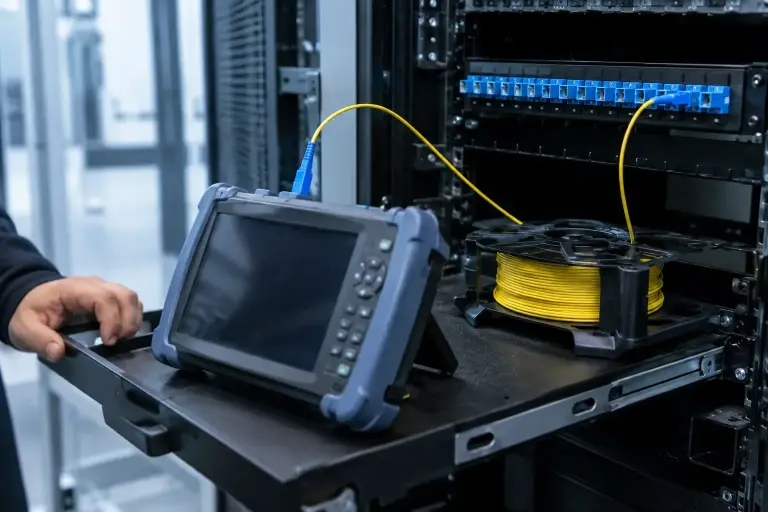
- OTDR (Optical Time-Domain Reflectometer): A diagnostic tool that sends light pulses to locate faults, breaks, or signal loss.
- Power Meter and Light Source: Used together to measure signal loss and verify splice quality.
- Supporting Tools: Fiber strippers, isopropyl alcohol, lint-free wipes, and a Visual Fault Locator (VFL) are also essential for preparation and basic troubleshooting.
In-House vs. Contract: Why Fiber Splicing Contractors Are Needed for Project Flexibility
Companies often debate hiring full-time splicers (W2 employees) versus bringing in contractors (1099). While in-house teams offer consistency, fiber splicing contractors needed on a project basis provide best flexibility.
Contractors allow companies to scale their workforce up or down with project demands, avoiding the overhead of permanent staff. They also bring diverse experience and specialized skills. At AccuTech Communications, we leverage skilled contractors to respond quickly to jobs across Massachusetts, New Hampshire, and Rhode Island, ensuring the right expertise for every project.
Here’s how the two approaches compare:
| Feature | In-House Splicing Roles | Contract Splicing Roles |
|---|---|---|
| Pros | Consistent team, deep company knowledge, stable employment | Flexibility, specialized expertise, rapid deployment, lower overhead for hiring company |
| Cons | Higher overhead (benefits, training), less project flexibility, limited specialized skills | Less company-specific knowledge, project-based income for technician, reliance on external resources |
| Typical Projects | Ongoing network maintenance, very large-scale, long-term infrastructure builds | Short-to-medium term projects, emergency repairs, specialized installations (e.g., OPGW, FTTH rollouts), geographical coverage for specific regions |
In today’s dynamic market, contractors provide the agility to keep projects moving. That’s why you’ll see opportunities for both W2 and 1099 positions.
Understanding the Splicing Process and Best Practices
When fiber splicing contractors needed arrive on site, their mission is to create connections so precise that light passes through with minimal signal loss. This microsurgery on glass ensures a network performs optimally. Rigorous testing with OTDRs and power meters is fundamental to verify that each connection meets industry standards and preserves signal integrity.
At AccuTech Communications, we also emphasize comprehensive documentation of each splice. These records become invaluable for future troubleshooting, saving time and effort. Understanding the full scope of Fiber Optic Cable Installation helps set realistic expectations for quality and longevity.
Fusion vs. Mechanical Splicing: What’s the Difference?
There are two primary splicing methods, and knowing when to use each is a key skill.
- Fusion Splicing: This is the gold standard. A fusion splicer aligns and then melts two fiber ends together with an electric arc, creating a permanent, seamless weld. The result is extremely low signal loss (0.02-0.05 dB), making it ideal for backbones, FTTH, and data centers where performance is critical.
- Mechanical Splicing: This method uses a small connector to hold two fiber ends in alignment, with an index-matching gel to reduce reflection. It’s faster and requires less expensive equipment, but results in higher signal loss (0.1-0.5 dB). It’s best for temporary connections or emergency repairs where speed is the priority.
For permanent infrastructure, fusion splicing ensures optimal performance for decades. For more context, see our guide on Types of Fiber Optic Cable.
Common Challenges and Safety Protocols
Fiber splicing involves real-world challenges and safety risks. Technicians must be prepared for varied working conditions, from climate-controlled data centers to outdoor work in harsh weather. Key safety protocols include:
- Confined Spaces: Always checking for hazardous gases and ensuring proper ventilation before entering manholes or vaults.
- Working at Heights: Using proper fall protection when on ladders or in bucket trucks, especially near power lines.
- Eye Safety: Never looking directly into a fiber without verifying it’s not live with a power meter, as the invisible laser light can cause permanent eye damage.
- Cleanliness: Maintaining a spotless work area and using isopropyl alcohol and lint-free wipes to prevent contamination that can degrade a signal.
- Tool Maintenance: Regularly calibrating and maintaining expensive equipment like fusion splicers and OTDRs to ensure accuracy and safety.
Mastering these challenges is why skilled professionals are so valued in this industry.
Frequently Asked Questions about the Fiber Splicing Field
If you’re curious about why fiber splicing contractors needed postings are everywhere, you’re not alone. Here are answers to the most common questions we receive at AccuTech Communications.
What’s the main difference between fusion and mechanical splicing?
Fusion splicing permanently welds two fibers together with an electric arc. This creates a seamless connection with the lowest possible signal loss, making it the best choice for permanent installations, long-haul networks, and data centers.
Mechanical splicing uses a precision clamp to align two fibers. It’s faster and requires less equipment, but has higher signal loss. This makes it ideal for temporary connections or emergency repairs where speed is the top priority.
How long does it take to become a certified fiber splicer?
While a basic training course takes only a few days, becoming a truly proficient and certified splicer requires several months to a year of on-the-job training. This real-world experience is crucial for mastering the equipment, handling different cable types, and troubleshooting issues effectively. Certifications from organizations like the FOA validate this expertise to employers.
Why are so many fiber splicing contractors needed right now?
The demand is driven by a massive global expansion of fiber networks. Key factors include:
- 5G Deployment: Requires a dense fiber backbone.
- High-Speed Internet Demand: FTTH initiatives are connecting homes and businesses, especially in rural areas.
- Data Center Growth: Cloud computing, AI, and streaming services require constant infrastructure upgrades.
This massive build-out requires a large, skilled workforce. Contractors provide the specialized, flexible labor that companies need to manage these project-based demands for building, maintaining, and repairing critical infrastructure.
Conclusion: Connecting Your Business to a High-Speed Future
The need for skilled fiber splicers is clear. They are the backbone of modern communication, making the precise connections that power our digital world. The demand for fiber splicing contractors needed for 5G, FTTH, and data center growth is not a temporary boom; it’s a long-term trend as our world becomes more connected.
Every business depends on reliable, high-speed network infrastructure. The quality of your fiber splicing directly impacts everything from cloud application performance to your ability to handle large data transfers. Partnering with certified professionals who deliver low-loss, reliable connections is invaluable.
Since 1993, AccuTech Communications has helped businesses across Massachusetts, New Hampshire, and Rhode Island build network infrastructure that is ready for the future. We understand that your network is the lifeline of your business. As bandwidth demands grow, the need for expertly installed and maintained fiber becomes even more critical. Your business deserves a partner with decades of experience and a commitment to quality.
Ready to ensure your business is connected at the speed of light? Learn more about our professional Fiber Optic Cabling Installation services and let’s talk about building a network that’s reliable, efficient, and ready for whatever the future holds.