
Gigabit Ethernet Solution: Top 5 Powerful Picks 2025
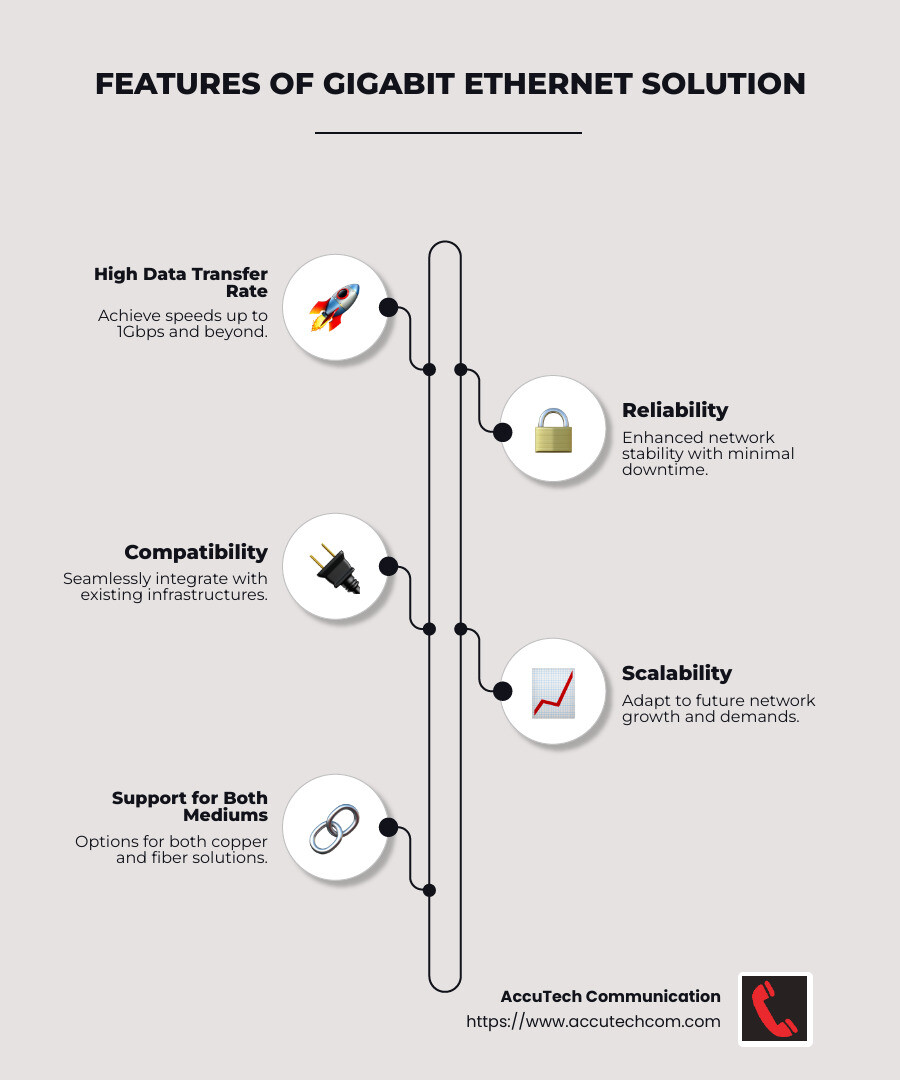
Gigabit ethernet solution is your key to faster, more reliable network performance. When you’re seeking a gigabit ethernet solution, look for these features:
- High data transfer rate and reliability
- Compatibility with existing infrastructure
- Scalability for future growth
- Support for both copper and fiber mediums
Where speed and connectivity are paramount, understanding the nuances of a gigabit ethernet solution can transform how your business functions. Whether it’s enhancing long-distance switch-to-switch transmissions or fortifying your data center’s backbone, a robust network strategy centered around gigabit ethernet holds the promise of improved efficiency and increased productivity.
I’m Corin Dolan, and I’m here to lead you through open uping the potential of a gigabit ethernet solution for your business. With years of experience at AccuTech Communications, I’ve seen how installing a reliable gigabit ethernet solution can make a significant difference for businesses aiming to improve their communication networks. Together, let’s explore how these solutions can provide a substantial boost in performance and reliability.
Understanding Gigabit Ethernet
Gigabit Ethernet is a game-changer in networking. It provides high-speed data transfer, which is crucial for both businesses and homes. Let’s break down some key terms and technologies that make this possible.
1000BASE-T: The Standard for Most Networks
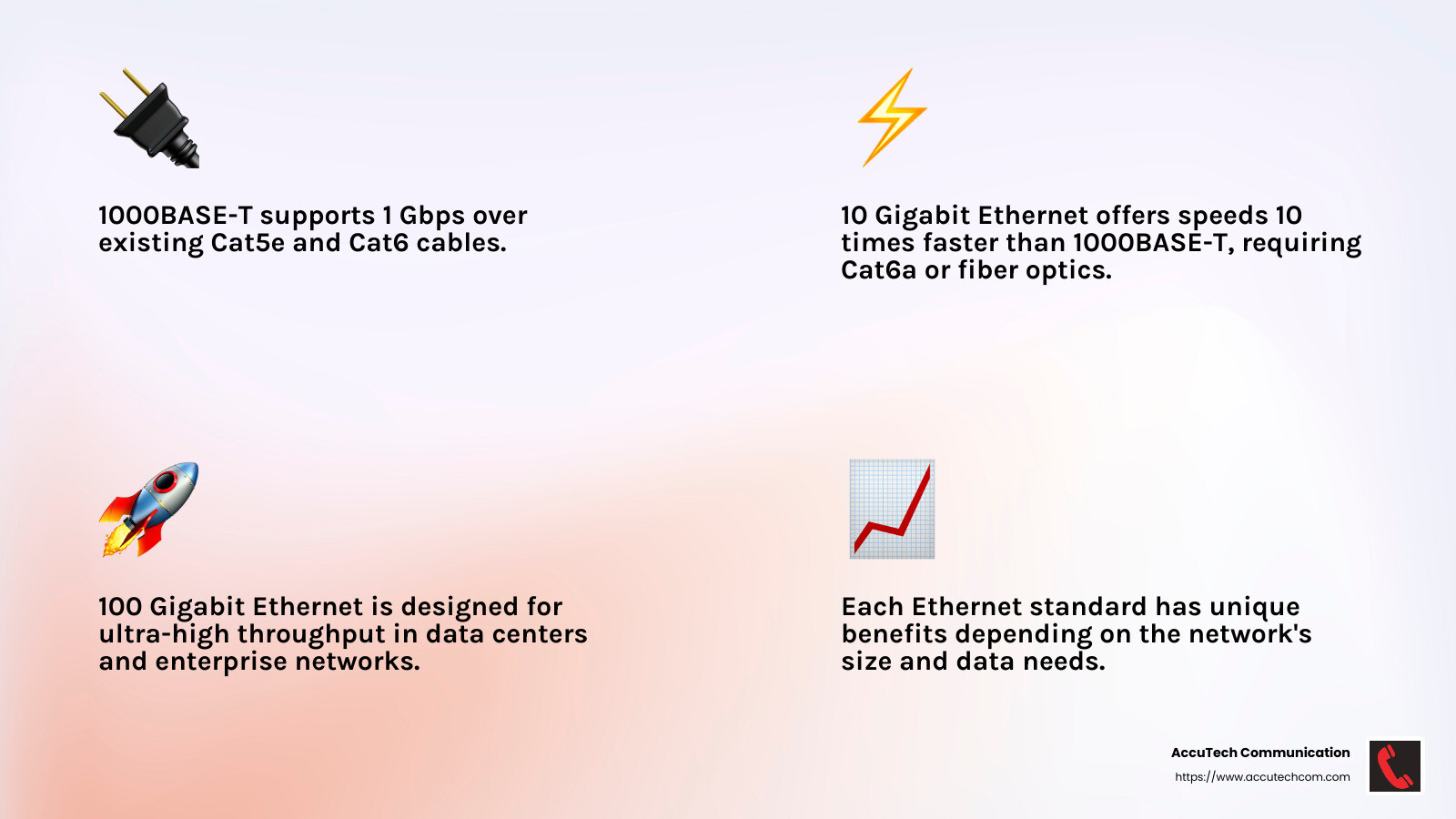
1000BASE-T, also known as Gigabit Ethernet, is the most common standard in use today. It allows for data transfer speeds of up to 1 gigabit per second (Gbps) over copper cables. This standard uses four pairs of twisted wires, making it compatible with existing Cat5e and Cat6 cables. The great thing about 1000BASE-T is that it uses the infrastructure you likely already have, making it a cost-effective way to boost your network speed without major rewiring.
10 Gigabit Ethernet: For When You Need More Speed
As the demand for faster networks grows, 10 Gigabit Ethernet is becoming more popular. It offers speeds up to 10 times faster than traditional Gigabit Ethernet. This is particularly useful in data centers and high-performance computing environments where large amounts of data need to be transferred quickly. However, 10 Gigabit Ethernet often requires newer cabling, like Cat6a or fiber optics, to handle the increased speed and data volume.
100 Gigabit Ethernet: The Future of Networking
For cutting-edge applications and future-proofing your network, 100 Gigabit Ethernet is the way to go. This technology is designed for environments that require extremely high data throughput, such as cloud data centers and large-scale enterprise networks. While it’s not yet common in most business settings due to its high cost and infrastructure requirements, it represents the pinnacle of current Ethernet technology.
Why It Matters
Understanding these standards is crucial when choosing a gigabit ethernet solution. Each offers different benefits depending on your needs:
- 1000BASE-T is ideal for most small to medium-sized businesses.
- 10 Gigabit Ethernet is perfect for environments needing higher speeds and data transfer.
- 100 Gigabit Ethernet is for those looking to future-proof and invest in top-tier performance.
By aligning your network needs with the right Ethernet standard, you can ensure that your business or home network is both efficient and ready for future demands.
In the next section, we’ll explore how to choose the right gigabit ethernet solution based on your specific needs, focusing on the types of cables and connectors that will best support your network infrastructure.
Choosing the Right Gigabit Ethernet Solution
When it comes to setting up a gigabit ethernet solution, choosing the right cables and connectors is crucial. Let’s explore some of the essential components you’ll need to consider.
Cat5e vs. Cat6: What’s the Difference?
Cat5e (Category 5e) and Cat6 (Category 6) cables are two of the most popular choices for Ethernet cabling. Here’s a quick comparison to help you decide which one suits your needs:
- Cat5e Cables: These are improved versions of the original Cat5 cables. They support data transfer speeds up to 1 Gbps and are suitable for most home and small business networks. Cat5e is a cost-effective choice if you’re setting up a standard Gigabit Ethernet network.
- Cat6 Cables: These offer higher performance than Cat5e, supporting speeds up to 10 Gbps over short distances (up to 55 meters). With better insulation and reduced crosstalk, Cat6 is ideal for environments with high data transfer needs, like small data centers or offices with heavy network traffic.
Both Cat5e and Cat6 use the same RJ-45 connectors, making them versatile and easy to integrate into existing setups.
RJ-45: The Standard Connector
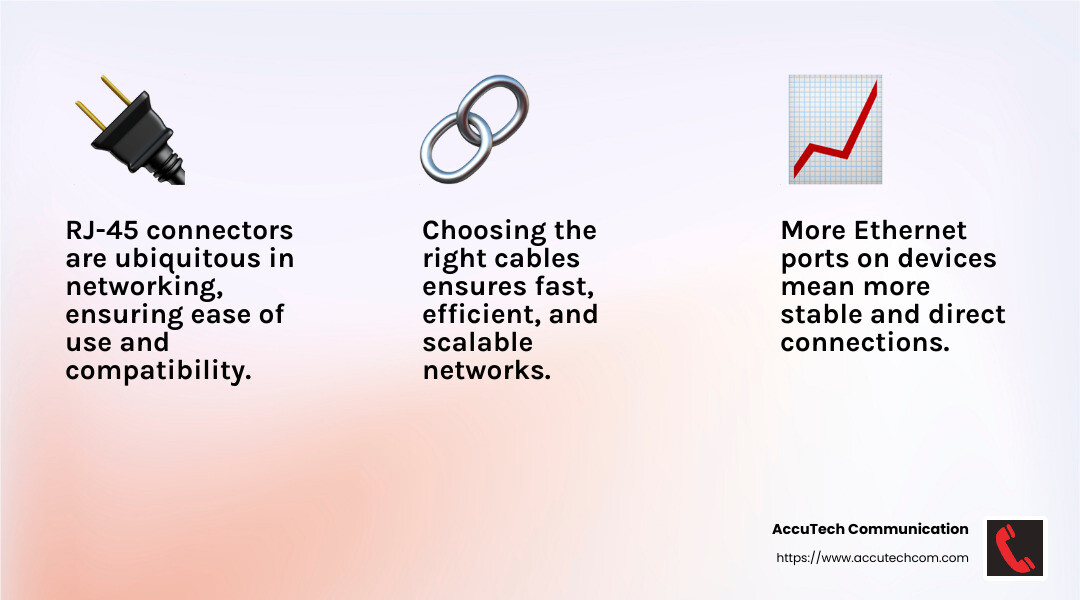
The RJ-45 connector is the standard interface used for Ethernet networks. It’s what you plug into the Ethernet port on your devices. RJ-45 connectors are compatible with both Cat5e and Cat6 cables, making them a staple in networking.
Why RJ-45 Matters:
- Compatibility: Since RJ-45 is widely used, it’s compatible with most network equipment, including routers, switches, and computers.
- Ease of Use: These connectors are easy to attach and detach, making them convenient for both permanent and temporary network setups.
Ethernet Ports: More is Better
When setting up a network, the number of Ethernet ports on your devices (like routers and switches) is crucial. More ports mean you can connect more devices directly, ensuring stable and fast connections.
Key Considerations:
- Port Count: Ensure your switch or router has enough ports to accommodate all your wired devices. For home use, a switch with 8 ports might suffice, while businesses may need 24 or more.
- PoE (Power over Ethernet): Some Ethernet ports can also provide power to devices like IP cameras and phones. This feature can reduce the need for additional power cables, simplifying your setup.
Making the Right Choice
Selecting the right components for your gigabit ethernet solution depends on your specific needs:
- For standard home use, Cat5e cables and a basic switch with enough RJ-45 ports should suffice.
- For businesses or environments with higher data demands, Cat6 cables and a switch with more ports and PoE capabilities might be necessary.
By choosing the right cables and connectors, you ensure that your network is not only fast and efficient but also scalable for future needs.
In the next section, we’ll explore some of the top gigabit ethernet solutions that can help optimize your network’s performance.
Top Gigabit Ethernet Solutions
When exploring gigabit ethernet solutions, one standout option is the GigaBlox Nano. Known for its compact and modular design, this solution offers flexibility and efficiency in various applications.
GigaBlox Nano: Small but Mighty
The GigaBlox Nano is a game-changer in Ethernet solutions. It’s the most compact gigabit ethernet switch available, measuring just 26mm x 26mm. Despite its small size, it packs a punch with four 10/100/1000M Ethernet ports.
Key Features:
- Modular and Stackable: The GigaBlox Nano’s modular design means it can be easily integrated into other systems. Its stackable feature, using the Samtec Razor Beam™ header, allows you to build custom setups with ease. You can create a network configuration that fits your unique needs without unnecessary bulk.
- Transformerless Ethernet: By removing transformers, the GigaBlox Nano achieves a significant reduction in size and weight. This is ideal for compact systems like drones and robots that share a common ground and don’t require Power over Ethernet (PoE).
- Flexible Integration: Customers can directly integrate the GigaBlox Nano with their own daughterboards, allowing for ultimate flexibility. Whether you need BotBlox pinout PicoBlade connectors or standard RJ-45 connectors, this solution can adapt to your needs.
Benefits of a Modular Design
A modular design, like that of the GigaBlox Nano, offers several advantages:
- Customizability: You can tailor the network setup to specific requirements, whether it’s for a small business or a larger enterprise.
- Space Efficiency: The compact nature saves valuable space, making it perfect for environments where room is limited.
- Scalability: Start small and expand as needed. The stackable nature allows for adding more modules without overhauling the entire system.
Why Choose GigaBlox Nano?
For those seeking a gigabit ethernet solution that is both powerful and adaptable, the GigaBlox Nano stands out. Its innovative design and flexibility make it suitable for a wide range of applications, from home networks to advanced tech systems.
By opting for a solution like the GigaBlox Nano, you ensure your network is not only efficient but also ready to grow with your needs.
In the next section, we’ll dig into the benefits of gigabit ethernet for both home and business environments, and how it can improve your network’s performance.
Benefits of Gigabit Ethernet for Home and Business
Gigabit Ethernet is a powerhouse for both homes and businesses, offering significant advantages in various settings. Let’s break down how it benefits data centers, server interconnects, and network switch uplinks.
Data Centers: The Heart of Connectivity
In data centers, speed and reliability are crucial. Gigabit Ethernet provides the backbone for data centers, enabling rapid data transfer and efficient management of large amounts of information. This means:
- Faster Data Processing: With speeds up to 1,000 Mbps, gigabit ethernet ensures that data moves quickly between servers, reducing lag and improving overall performance.
- Scalability: As data centers grow, gigabit ethernet can easily scale to meet increasing demands, ensuring that the network remains robust and efficient.
- Reduced Latency: By minimizing delays in data transmission, gigabit ethernet helps maintain smooth operations, which is vital for data-intensive applications.
Server Interconnects: Seamless Communication
Servers need to communicate efficiently to handle tasks like data storage, processing, and retrieval. Gigabit ethernet facilitates this by providing:
- High-Speed Links: Servers connected via gigabit ethernet can share data rapidly, ensuring that applications run smoothly and efficiently.
- Reliability: With gigabit ethernet, server interconnects are less prone to errors, ensuring consistent uptime and performance.
- Flexibility: Whether it’s connecting servers within a single rack or across different locations, gigabit ethernet offers the flexibility needed to create efficient server networks.
Network Switch Uplinks: Boosting Network Performance
Network switches are essential for directing data traffic efficiently. Gigabit ethernet improves these uplinks by:
- Increasing Bandwidth: With gigabit ethernet, network switches can handle more data, reducing congestion and improving network speed.
- Improving Connectivity: Multiple devices can be connected seamlessly, allowing for a more integrated network environment.
- Enhancing Security: Gigabit ethernet supports advanced security features, ensuring that data remains protected as it moves through the network.
Incorporating gigabit ethernet into your home or business network can lead to significant improvements in speed, reliability, and scalability. Whether you’re managing a data center, setting up server interconnects, or optimizing network switch uplinks, gigabit ethernet is a versatile and powerful solution that can meet your needs.
In the next section, we’ll address some frequently asked questions about gigabit ethernet solutions to help you make informed decisions for your network.
Frequently Asked Questions about Gigabit Ethernet Solutions
What Ethernet do I need for 1gbps?
To achieve speeds of 1 Gigabit per second (Gbps), you’ll need the right cabling. Cat5e and Cat6 cables are your best options.
- Cat5e: This is the minimum standard for gigabit ethernet. It supports speeds up to 1 Gbps over a distance of 100 meters. It’s a solid choice for most home networks and small businesses.
- Cat6: Offers improved performance, especially in environments with potential interference. It also supports 1 Gbps over 100 meters and can handle higher speeds over shorter distances, making it a great choice for future-proofing your network.
Do I really need Gigabit Ethernet?
Whether you need gigabit ethernet depends on your internet usage and the number of devices in your network.
- Average Household: If your household internet speed is between 100–500 Mbps, a gigabit ethernet solution might be more than you need right now. However, as more devices connect and data usage increases, upgrading to gigabit ethernet can ensure your network remains fast and efficient.
- Heavy Users: For homes or businesses with multiple users streaming, gaming, or working from home, gigabit ethernet can significantly improve performance by reducing lag and improving download and upload speeds.
Which is faster, USB 3.0 or Gigabit Ethernet?
When comparing USB 3.0 to gigabit ethernet, both have their strengths.
- USB 3.0: Offers a theoretical maximum speed of 5 Gbps, which is faster than gigabit ethernet. However, this speed is typically used for data transfer between devices, like moving files between a computer and an external hard drive.
- Gigabit Ethernet: Provides up to 1 Gbps for network connections. It excels in providing consistent, high-speed internet access across multiple devices, which is crucial for network performance in both home and business settings.
In summary, if your primary need is internet connectivity, gigabit ethernet is the way to go. For device-to-device data transfers, USB 3.0 offers higher speeds but won’t replace the role of ethernet in network setups.
Next, we’ll wrap up by discussing AccuTech Communications’ commitment to providing certified service and competitive pricing for your networking needs.
Conclusion
In today’s digital world, choosing the right gigabit ethernet solution is crucial for both homes and businesses. At AccuTech Communications, we understand this need and are committed to delivering top-notch service and reliable solutions.
Certified Service: Since 1993, we have been a trusted partner for businesses across Massachusetts, New Hampshire, and Rhode Island. Our team of certified technicians ensures that your network infrastructure is optimized for peak performance. Whether it’s network cabling, business phone systems, or data center technologies, our expertise guarantees that your network is in good hands.
Competitive Pricing: We believe that high-quality service shouldn’t come with a high price tag. Our competitive pricing model ensures that you get the best value for your investment. We work closely with you to design and implement a solution that meets your specific needs without breaking the bank.
When you choose AccuTech Communications, you’re not just getting a service provider; you’re gaining a partner committed to helping your network thrive. Our dedication to quality and customer satisfaction sets us apart in the industry.
For more information on our services and to see how we can help you open up the full potential of your network, visit our Network Cabling Services page. Let’s work together to build a robust and efficient network that supports your growth and connectivity needs.
