
Why Internet Optical Fiber Transforms Modern Business Connectivity
Internet optical fiber is a technology that transmits data using light pulses through ultra-thin glass or plastic strands, delivering speeds up to 100 times faster than traditional copper-based connections like DSL or cable internet.
Key differences from traditional internet:
- Technology: Fiber uses light signals; copper uses electrical signals
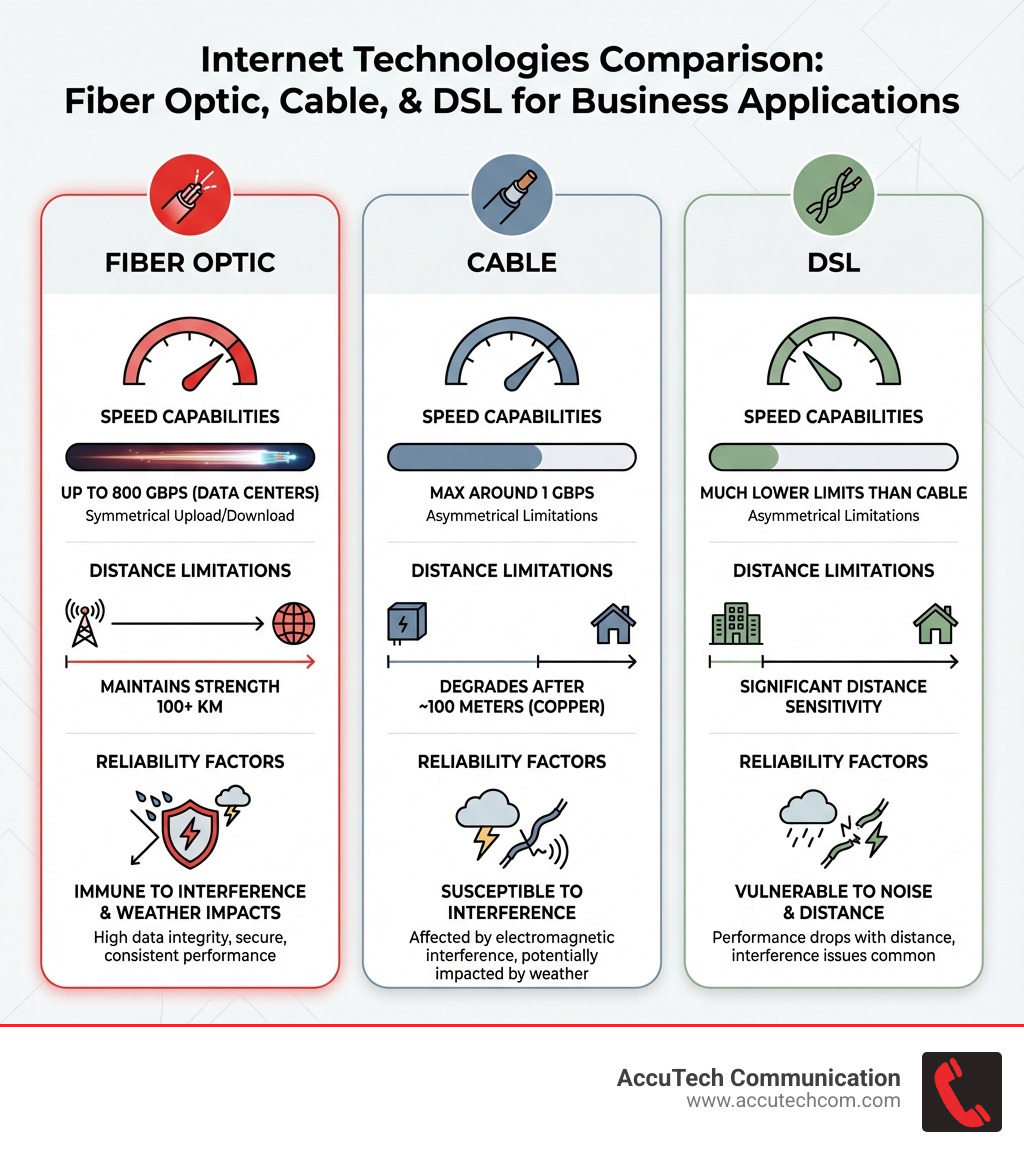
- Speed: Fiber delivers up to 800 Gbps in data centers; copper maxes out around 1 Gbps
- Distance: Fiber maintains signal strength for 100+ km; copper degrades after just 100 meters
- Reliability: Fiber is immune to electromagnetic interference and weather impacts
- Bandwidth: Symmetrical upload/download speeds vs. copper’s asymmetrical limitations
For businesses in Massachusetts, New Hampshire, and Rhode Island, fiber optic internet has become essential infrastructure. Healthcare facilities need it for telemedicine and large imaging file transfers. Manufacturing companies rely on it for real-time data analytics and IoT sensor networks. Educational institutions depend on it for distance learning and research collaboration.
The technology works through total internal reflection – light pulses bounce through a hair-thin glass core, carrying binary data at nearly the speed of light. Unlike copper cables that transmit electricity, fiber’s light-based system eliminates signal degradation, interference, and security vulnerabilities that plague traditional connections.
I’m Corin Dolan, owner of AccuTech Communications, and I’ve been designing and installing internet optical fiber networks for commercial clients across Massachusetts, New Hampshire, and Rhode Island since 1993. Our team specializes in future-proof internet optical fiber infrastructure that scales with your business demands, from small office LANs to complex multi-building campus networks.
Simple internet optical fiber glossary:
How Fiber Optic Technology Works: From Light Pulses to Data
At its heart, internet optical fiber technology is surprisingly neat. Imagine sending messages not with electricity through metal wires, but with flashes of light through ultra-thin glass. That’s precisely what fiber optics accomplish, and it’s why they are so incredibly fast and reliable. The magic lies in how these light pulses are guided and preserved over vast distances.
The fundamental principle governing how light travels within a fiber optic cable is known as total internal reflection. This means that when light enters the glass fiber, it continually bounces off the inner walls of the cable, much like a ball bouncing down a mirrored hallway. This constant reflection ensures the light stays within the fiber, preventing it from escaping and losing signal strength. Because the cladding (the outer layer of the fiber) does not absorb any light from the core, the light wave can travel great distances with minimal loss.
These light pulses aren’t just random flashes; they carry binary code, the language of computers. A “flash” can represent a “1,” and the absence of a flash a “0.” This digital signal is generated by a transmitter, which converts electrical data into light signals using either lasers or Light Emitting Diodes (LEDs). Once the light signal has traveled through the fiber, an optical receiver at the other end detects the light, decodes the binary information, and converts it back into an electrical signal that your business’s computers and devices can understand. You can dig deeper into the science behind fiber optics to understand this fascinating process.
The Core Components of an Internet Optical Fiber Cable
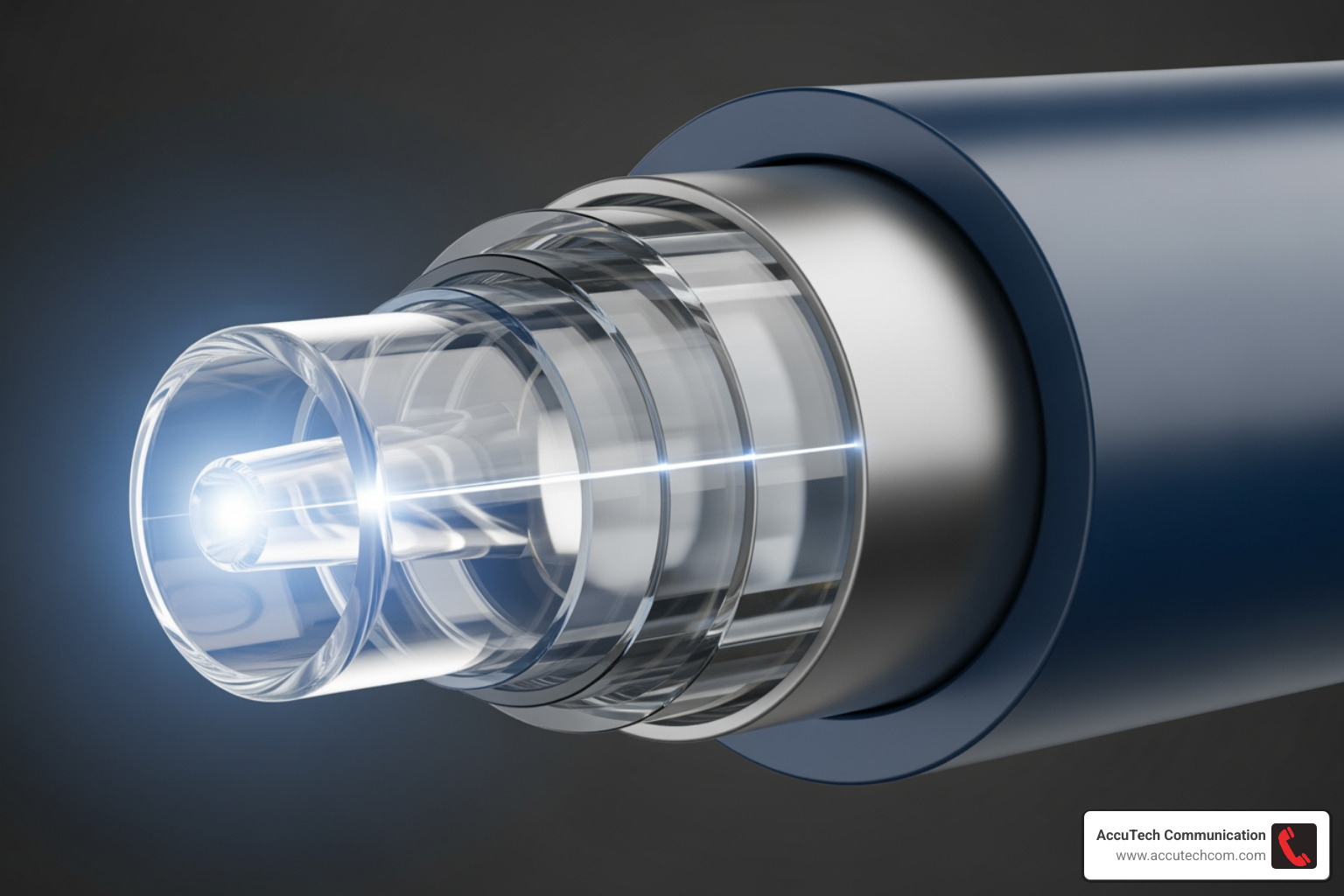
An internet optical fiber cable might look simple from the outside, but it’s a marvel of engineering. Each individual fiber, about the diameter of a human hair, is composed of several critical layers, each serving a specific purpose:
- Core: This is the very thin, central strand of glass (or sometimes plastic) through which the light signals actually travel. It’s made from optically pure glass, far purer than the glass in your windowpanes, to minimize signal loss.
- Cladding: Surrounding the core is a layer of glass called the cladding. The cladding has a different refractive index than the core, which is crucial for the total internal reflection process. It acts like a mirror, reflecting the light back into the core and keeping it contained within the fiber.
- Buffer Coating: This is a protective plastic coating applied directly over the cladding. It shields the delicate glass fiber from moisture and physical damage, providing the first layer of defense.
- Jacket: The outermost layer of the entire cable is the jacket. This robust protective sheath, often made of PVC or polyethylene, encases multiple buffered fibers, offering further protection against environmental factors, physical stress, and sometimes even pests.
These glass strands, though incredibly thin, are bundled together to form a complete internet optical fiber cable. The precision in their manufacturing ensures consistent performance and durability, essential for the demanding environments of modern business.
The Science of Light Transmission
The efficient and rapid transmission of data through internet optical fiber is a direct result of the physics of light. As mentioned, the Total Internal Reflection principle is the cornerstone. Light traveling through the high-density core hits the boundary with the lower-density cladding at a specific angle, causing it to reflect completely back into the core, rather than refracting out. This means the light effectively “bounces” its way along the fiber.
This ingenious method leads to minimal signal loss (attenuation), allowing data to travel over much longer distances than electrical signals before needing amplification. Modern fiber has remarkable attenuation, often around 0.3 dB/km, with the C band (1530–1565 nm) exhibiting the lowest losses and longest range. This efficiency is why fiber optic cables can carry signals for 100 kilometers without losing significant strength, whereas copper cables are typically limited to about 100 meters.
The light sources used, lasers and LEDs, are chosen for their ability to generate precise light pulses. Lasers are typically used for single-mode fiber due to their focused, coherent light, enabling longer distances and higher bandwidth. LEDs are often paired with multimode fiber for shorter-distance applications. The refractive index of both the core and cladding is precisely engineered during manufacturing to ensure optimal total internal reflection. For a more detailed understanding of how light behaves in these cables, explore more on light transmission principles.
Fiber vs. Copper: A New Standard for Business Connectivity
For decades, copper cabling was the backbone of communication, carrying everything from phone calls to early internet signals. However, the demands of modern business in Massachusetts, New Hampshire, and Rhode Island have far outstripped copper’s capabilities. Internet optical fiber has emerged as the superior choice, setting a new standard for business connectivity due to its inherent advantages.
Here’s a comparison of how fiber optic cables stack up against traditional copper cables:
Speed and Bandwidth
When it comes to speed, fiber optics operates in a league of its own. Unlike copper, which transmits electrical signals, internet optical fiber sends data as pulses of light, traveling at nearly the speed of light itself. This allows for incredibly fast data transfer rates. In data centers today, fiber optic cables can transmit data at rates up to 800 Gbps, far surpassing the typical maximums of copper.
This translates to significant real-world benefits for businesses. Imagine transferring an HD movie. A single fiber connection can complete this task in less than a tenth of a second, while a typical copper-wire office network might take about a minute. This speed is further improved by symmetrical speeds, meaning your upload and download speeds are often identical, a crucial advantage for cloud-based applications, large file transfers, and video conferencing.
Copper connections, particularly DSL and many cable internet services, are often asymmetrical, with much slower upload speeds that can bottleneck business operations. Fiber’s higher bandwidth ceiling means we can transmit a broader range of frequencies without signal degradation, allowing for massive amounts of data to be moved simultaneously.
Distance and Reliability
One of copper’s major limitations is signal degradation over distance. Electrical signals lose strength and clarity rapidly, requiring repeaters every 100 meters or so to boost the signal. This is simply not practical for vast networks or long-haul connections. Internet optical fiber, however, can carry signals for 100 kilometers or more without active processing or losing significant signal strength. This incredible reach allows us to design more expansive and efficient networks for businesses across New England.
Beyond distance, fiber offers unparalleled reliability. It is immune to electromagnetic interference (EMI), which can disrupt electrical signals in copper cables. This is a critical advantage in industrial environments, data centers, or even offices with numerous electronic devices, where EMI can cause data errors and network instability. Furthermore, fiber optic cables are generally more resilient to environmental factors and weather resistance than copper, offering a more stable connection even in challenging conditions. Power outages are also less likely to affect fiber connections directly, as they don’t rely on electrical signals for data transmission.
Security and Durability
For businesses, data security is paramount. Copper cables, by their nature, emit electromagnetic signals that can be intercepted or “tapped” relatively easily. Fiber optic cables, on the other hand, transmit light internally, making them incredibly difficult to tap into without physically breaking the fiber, which would immediately disrupt the signal and alert network administrators. This provides significantly improved data security, protecting sensitive business information.
In terms of physical resilience, fiber optic cables offer several advantages. They are made from glass or plastic and transmit light, so they are non-flammable, eliminating the fire risk associated with electrical currents in copper wires. They are also remarkably lightweight, weighing considerably less than comparable copper cables, which simplifies installation and reduces structural load. Despite their delicate appearance, fiber optic cables possess high tensile strength, meaning they can withstand considerable pulling force during installation. This combination of security and durability makes internet optical fiber a robust choice for protecting your business’s network infrastructure.
The Business Advantages of Internet Optical Fiber
In today’s digital landscape, a robust and reliable internet connection isn’t just a convenience; it’s a foundational element for success. For businesses in Massachusetts, New Hampshire, and Rhode Island, embracing internet optical fiber provides a significant competitive edge, fostering increased productivity, enhancing operational efficiency, and offering the scalability for growth that modern enterprises demand. We’ve seen how fiber transforms businesses, enabling them to innovate and thrive.
Powering High-Bandwidth Business Operations
Modern business operations are increasingly data-intensive. From international video calls to massive cloud storage, the need for speed and bandwidth is constant. Internet optical fiber is perfectly positioned to meet these demands:
- 4K/8K Video Conferencing: High-definition video calls with clients, partners, and remote teams demand substantial bandwidth, especially for multiple participants. Fiber ensures crystal-clear visuals and audio without frustrating lag or pixelation.
- Large File Transfers: Whether you’re uploading CAD drawings, sharing marketing videos, or backing up critical databases, fiber’s symmetrical speeds mean large files move quickly in both directions, saving valuable time.
- Cloud-based Software (SaaS): The reliance on Software-as-a-Service applications like CRM, ERP, and project management tools means your business lives in the cloud. Fiber provides the low latency and high bandwidth necessary for these applications to run smoothly and responsively.
- VoIP Phone Systems: Voice over Internet Protocol (VoIP) systems offer cost savings and flexibility, but they require a stable, high-quality internet connection. Fiber delivers the consistent performance needed for clear calls and reliable communication.
- Real-time Data Analytics: Businesses are increasingly leveraging big data for insights. Fiber enables the rapid collection, transfer, and processing of vast datasets, empowering real-time analytics for informed decision-making.
Supporting a Multi-Device Smart Office
The modern office is a connected ecosystem. Employees use multiple devices simultaneously – laptops, tablets, smartphones – often connected to a myriad of smart office tools. Internet optical fiber ensures that this complex web of devices operates seamlessly, without compromising performance.
- Simultaneous Users: With fiber, multiple employees can engage in high-bandwidth activities (streaming, large downloads, cloud access) concurrently without experiencing frustrating slowdowns. Our clients often report a dramatic improvement in overall network responsiveness.
- IoT Devices: Smart thermostats, lighting systems, security sensors, and other Internet of Things (IoT) devices are becoming common in commercial spaces. These devices require a stable network to communicate efficiently.
- Access Control Systems & Surveillance Cameras: Modern security systems, particularly high-resolution surveillance cameras, generate significant amounts of data. Fiber provides the reliable backbone needed to transmit and store this critical information, ensuring the safety and security of your premises.
Fiber delivers consistent performance across all these connected devices, ensuring every part of your smart office runs efficiently.
Future-Proofing Your Network Infrastructure
Investing in internet optical fiber is an investment in the future of your business. Technology evolves rapidly, and data demands are constantly growing. Our research indicates that data transmission rates have been doubling approximately every five years. Fiber optic infrastructure is designed to keep pace.
- Meeting Future Data Demands: As your business expands and adopts new technologies, fiber provides the headroom to accommodate increased data traffic without needing a complete overhaul of your cabling infrastructure.
- Emerging Technologies: Technologies like Augmented Reality (AR) and Virtual Reality (VR) for training, design, or customer engagement are emerging. These applications require immense bandwidth and ultra-low latency, which only fiber can reliably deliver.
- Long-term Investment: While initial installation might seem like a significant step, the longevity, reliability, and upgradeability of fiber make it a highly cost-effective long-term investment. It reduces maintenance needs and the frequency of costly infrastructure upgrades.
By choosing fiber today, you’re not just solving current connectivity challenges; you’re proactively building a network that will support your business’s innovation and growth for years to come. We encourage you to review charting the future of Ethernet to understand how these trends will impact your business.
Understanding Fiber Optic Cable Types
Just as there are different types of roads for different kinds of travel, there are different types of internet optical fiber cables, each optimized for specific applications and distances. Choosing the right fiber type is critical for ensuring your business gets the most efficient and cost-effective network. We help our clients in Massachusetts, New Hampshire, and Rhode Island steer these choices, matching cable to business needs for optimal performance.
Single-Mode Fiber (SMF)
Think of Single-Mode Fiber (SMF) as the superhighway of fiber optics. It features a very small core (typically around 9 microns in diameter), which allows only a single path or “mode” of light to travel through it. This tiny core, combined with a laser light source, minimizes light reflections and dispersion, enabling signals to travel long distances with virtually no degradation.
SMF is the go-to choice for applications requiring the highest bandwidth and longest reach. Its use cases include:
- Telecom Backbones: The core networks that connect cities and continents rely heavily on SMF.
- Campus Networks: For large campuses in New England with multiple buildings spread out, SMF is ideal for inter-building connections, carrying data across kilometers.
- Data Center Interconnects: Connecting geographically separated data centers or extending networks across a large facility.
SMF is designed for high-speed, long-distance data transmission, and a single-mode fiber cable can operate up to 50 times more distance than multi-mode fiber, making it incredibly powerful for large-scale operations.
Multimode Fiber (MMF)
If SMF is the superhighway, Multimode Fiber (MMF) is the multi-lane arterial road. It has a larger core (typically 50 or 62.5 microns in diameter), which allows multiple modes or paths of light to travel simultaneously. MMF commonly uses a less expensive LED light source. While it’s excellent for high-speed data over shorter distances, the multiple light paths can cause some signal dispersion over longer runs, limiting its maximum effective distance compared to SMF.
MMF is widely used for:
- Local Area Networks (LANs): Connecting devices within a single office building or floor.
- Data Centers: Ideal for connections between servers, switches, and storage arrays within the same data center.
- Building Backbones: Vertical runs connecting different floors in a multi-story building.
MMF comes in various classifications, known as OM ratings, each offering different performance levels:
- OM1: 62.5 µm core, suitable for 100 Mbps to 1 Gbps over shorter distances (e.g., 200-300m).
- OM2: 50 µm core, similar speeds to OM1 but can go slightly further.
- OM3: 50 µm laser-optimized core, supports 10 Gbps up to 300 meters, 40 Gbps up to 100 meters.
- OM4: 50 µm laser-optimized core, supports 10 Gbps up to 550 meters, 40 Gbps up to 150 meters, and 100 Gbps up to 100 meters.
- OM5: 50 µm wideband laser-optimized core, supports 40/100 Gbps and beyond over similar distances to OM4, but designed for wavelength division multiplexing to carry more data.
Both single-mode and multimode fibers share a common cladding diameter of 125 µm, but their core differences dictate their optimal applications. Our expertise lies in helping you select and install the appropriate fiber type to meet your business’s unique demands.
The Evolution and Future of Your Internet Optical Fiber Connection
The journey of internet optical fiber from a theoretical concept to the backbone of global communication is a testament to human ingenuity. Its history is rich with groundbreaking findies and continuous innovation, paving the way for the incredible speeds and capacities we experience today.
The idea of transmitting information via light isn’t new; Alexander Graham Bell himself experimented with a “Photophone” in 1880, transmitting sound on a beam of light. While ingenious, his invention was limited by atmospheric interference. The real breakthrough for modern fiber optics came in the 1960s with Charles Kao’s theoretical work suggesting that glass fibers could transmit light over long distances if they were pure enough.
This vision was realized by Corning Glass Works in the early 1970s, developing the first low-loss optical fiber. By 1977, the first live telephone traffic was being sent through fiber optics, and by 1988, the TAT-8 became the first transatlantic telephone cable to use optical fiber, marking a new era in global communication. Researchers at Bell Labs later achieved a record bandwidth–distance product of over 100 petabit × kilometers per second, pushing the boundaries of what was thought possible.
Future Trends in Fiber Optic Technology
The evolution of internet optical fiber is far from over. Researchers and engineers are continuously pushing the boundaries of speed and efficiency, ensuring that our networks can handle the ever-increasing flow of data.
- Hollow-core Fiber: One of the most exciting advancements is the development of hollow-core fiber. Unlike traditional fibers where light travels through glass, these new fibers allow light to travel through an air-filled core. This is significant because light travels faster in air than in glass, leading to lower latency (less delay) and even less attenuation. This technology promises to open up new levels of speed and responsiveness for critical applications.
- Petabit-per-Second Speeds: The pursuit of higher data rates continues unabated. Recent research has showcased astonishing achievements. In 2023, a speed of 301 Tbit/s was achieved over 50–150 km using 1097 WDM channels, and in 2024, a new record of 402 Tbit/s was set over 50 km using 1505 WDM channels. Even more impressively, in 2021, 319 terabits per second was transmitted over 3,000 kilometers with four-core fiber cables. These breakthroughs, while currently in research labs, indicate the immense potential for future commercial networks. You can explore more about these advancements in research on future fiber trends.
- Wavelength Division Multiplexing (WDM): A key technology enabling these incredible speeds is WDM. This technique allows multiple channels of information to be sent simultaneously over a single fiber strand by using different colors (wavelengths) of light. It’s like turning a single-lane road into a multi-lane highway, dramatically increasing the fiber’s capacity without laying new cables.
These innovations mean that your internet optical fiber connection today is not just fast, but it’s built on a foundation that will continue to evolve, supporting the next generation of digital services and applications for businesses in Massachusetts, New Hampshire, and Rhode Island.
Government Programs for Business Broadband
The importance of high-speed broadband, particularly internet optical fiber, for economic development and competitiveness is widely recognized. Governments at various levels are investing heavily in expanding access to this critical infrastructure.
One significant initiative is the federal Broadband Equity, Access, and Deployment (BEAD) Program. While primarily aimed at underserved and unserved areas, this program represents a massive investment in broadband infrastructure across the United States, including our service areas of Massachusetts, New Hampshire, and Rhode Island. For businesses, this means increased opportunities for upgraded connectivity as new fiber networks are deployed or existing ones are expanded. We actively monitor these infrastructure investments and can help businesses understand how these developments might create opportunities for businesses in Massachusetts, New Hampshire, and Rhode Island to upgrade connectivity and leverage the full potential of fiber optics.
The growing recognition of fiber’s importance has also made its deployment more cost-effective. While we don’t discuss specific pricing, the overall trend in the industry shows that the cost of rolling out fiber has become increasingly competitive, making it a viable and smart investment for businesses of all sizes.
Conclusion: Upgrade Your Business with a Future-Ready Network
In an era where digital presence is paramount, the quality of your internet connection directly impacts your business’s success. As we’ve explored, internet optical fiber offers unparalleled speed, unwavering reliability, and robust security that traditional copper connections simply cannot match. It’s the indispensable technology powering everything from high-bandwidth cloud applications and seamless video conferencing to sophisticated IoT deployments and critical data analytics.
For businesses in Massachusetts, New Hampshire, and Rhode Island, upgrading to fiber is more than just an expense; it’s a strategic crucial investment for modern businesses. It ensures your operations run smoothly, your teams stay productive, and your data remains secure. Moreover, with the continuous evolution of fiber technology and ongoing infrastructure investments, you’re not just buying into today’s best technology, but also future-proofing your network for years to come.
At AccuTech Communications, we pride ourselves on providing certified, reliable service. Since 1993, our team has been at the forefront of designing, installing, and maintaining robust fiber optic networks for commercial clients throughout New England. Our expertise ensures that your fiber optic installation is carefully planned and flawlessly executed, delivering the high-performance connectivity your business deserves.
Don’t let outdated infrastructure hold your business back. Accept the future of connectivity.
Contact AccuTech Communications for a professional fiber optic network cabling consultation today to discuss how we can lift your business with a future-ready network.
