Keeping Your Wires Straight: A Comprehensive Guide to Cabling Installation and Maintenance
Why Cabling Installation and Maintenance Determines Your Network’s Success
Cabling installation and maintenance is the process of designing, installing, testing, and managing the physical wiring infrastructure that carries data, voice, and video across a commercial network. Here’s a quick overview of what it involves:
| Stage | What Happens |
|---|---|
| Planning | Site assessment, cable type selection, pathway design |
| Installation | Running copper or fiber cables through conduits and raceways |
| Testing & Certification | Verifying signal quality, speed, and compliance with standards |
| Labeling & Documentation | Identifying every cable run for easier future maintenance |
| Ongoing Maintenance | Inspections, repairs, and updates as your network grows |
Most businesses don’t think about their cabling, until something breaks. Then it becomes the only thing that matters.
The numbers back this up. According to BICSI, roughly 30% of network downtime is caused by cabling-related issues. That’s a significant share of outages tied not to software, not to servers, but to the physical wires running behind your walls.
Yet cabling is almost always an afterthought. Companies invest heavily in routers, switches, and cloud platforms, and then run everything over infrastructure that was never properly planned or documented. The result is a tangled mess that slows troubleshooting, blocks upgrades, and quietly undermines performance every single day.
A well-designed, properly maintained cabling system changes all of that. It gives your network a solid foundation, one that’s organized, scalable, and built to handle what’s coming next.
I’m Corin Dolan, owner of AccuTech Communications, and I’ve spent decades helping businesses across Massachusetts, New Hampshire, and Rhode Island get their cabling installation and maintenance right from the ground up. In this guide, I’ll walk you through everything you need to know to make smart decisions about your network infrastructure.
Basic cabling installation and maintenance vocab:
The Foundation of Modern Networks: Understanding Structured Cabling
When we talk about “structured cabling,” we aren’t just talking about plugging in a few blue wires and hoping for the best. We are talking about a highly engineered system of cabling and associated hardware that provides a comprehensive telecommunications infrastructure. Think of it as the central nervous system of your business. Without a clear Structured Cabling Definition, it’s easy to fall into the trap of “point-to-point” wiring, where every new device gets its own messy, direct run to the server.
So, What is Network Cabling? In a structured environment, it is a series of six standardized subsystems that work together to ensure your data gets from Point A to Point B without taking a nap along the way.
- Entrance Facilities: This is where the outside world (your service provider) meets your building. It’s the “front door” for your data.
- Equipment Rooms: The central hub where main cross-connects and complex equipment live.
- Backbone Cabling: Also known as vertical cabling, this connects the equipment rooms and telecommunications closets, often spanning different floors.
- Telecommunications Closets: The smaller rooms on each floor where horizontal cabling terminates.
- Horizontal Cabling: The wires that run from the telecom closet to the individual work areas.
- Work Area Components: The final stretch, the wall plates, jacks, and patch cords that connect your computers and VoIP phones to the network.
Horizontal vs. Backbone Cabling: A Quick Comparison
Understanding the difference between these two is critical for any cabling installation and maintenance plan.
| Feature | Horizontal Cabling | Backbone (Vertical) Cabling |
|---|---|---|
| Primary Function | Connects users to the local floor closet | Connects closets, floors, or buildings |
| Typical Media | Cat6, Cat6A (Copper) | Fiber Optic (Single-mode or Multimode) |
| Distance Limits | Strictly 90 meters (plus 10m for patch cords) | Can span kilometers with fiber |
| Bandwidth | High, but limited by copper standards | Massive capacity for aggregated traffic |
Key Components of a Robust System
To build a system that doesn’t make your IT manager want to pull their hair out, you need the right Types of Cables. We typically look at:
- Cat6 and Cat6A: The workhorses of modern offices. Cat6 handles Gigabit speeds easily, while Cat6A is designed for 10-Gigabit performance over the full 100-meter run.
- Fiber Optic Cabling: When distances are long or bandwidth needs are extreme, we turn to fiber. Types of Fiber Optic Cable include OM4 multimode (great for high-speed data center links) and OS2 single-mode (perfect for long-distance building-to-building connectivity).
- Patch Panels and Modular Connectors: These allow us to terminate cables neatly and make changes easily. A well-organized patch panel is the difference between a 5-minute fix and a 5-hour headache.
Planning and Executing Professional Cabling Installation and Maintenance
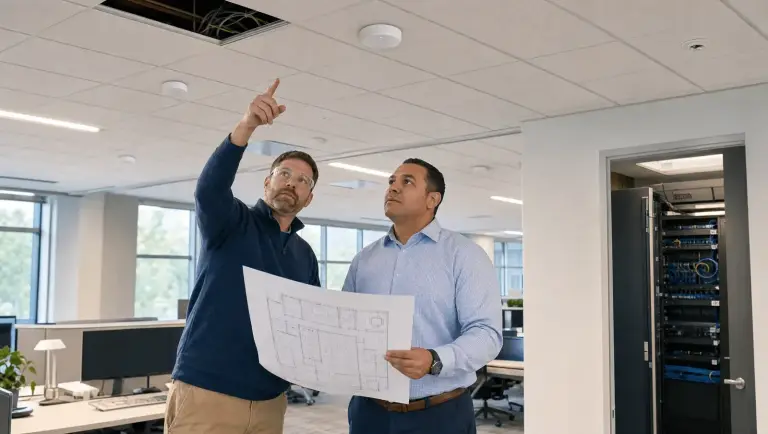
You wouldn’t build a house without a blueprint, and you shouldn’t install a network without a design. Our Network Cabling Installation Services always begin with a comprehensive site assessment. We look at the building structure, existing wiring, and, most importantly, where you plan to be in five years.
A Data Cabling Installation Complete Guide must account for the physical “pathways” cables will take. Are we going through the ceiling? Under a raised floor? We have to design conduit and raceway systems that protect the cable while allowing for proper airflow management. If you pack a cable tray too tight, the heat can actually degrade signal performance.
Regional Considerations for Cabling Installation and Maintenance
Operating in the Northeast means dealing with specific regional requirements. Whether we are doing a Network Cabling Installation in a historic brick building in Boston or a modern medical facility in Providence, we have to stay compliant with:
- Massachusetts Building Codes: Strict adherence to fire stopping and plenum ratings is non-negotiable.
- New Hampshire Commercial Standards: Ensuring that installations can handle environmental factors like humidity and temperature shifts in unconditioned warehouse spaces.
- Rhode Island Telecommunications Regulations: Following state-specific licensing for low-voltage contractors.
Selecting the Right Media for Business Needs
Choosing between copper and fiber isn’t just about speed; it’s about the environment. For Fiber Optic Installation, we often recommend it for backbone links because it is immune to electromagnetic interference (EMI). If your cables run near heavy machinery or fluorescent lighting ballasts, copper might struggle with “noise,” but fiber will hum right along.
We also have to consider the “jacket” of the cable. Plenum-rated cables are required in air-handling spaces (like above a drop ceiling used for HVAC). They are made of special plastics that don’t give off toxic smoke if there’s a fire. Riser-rated cables are used for vertical shafts but aren’t safe for plenum spaces. Getting this wrong isn’t just a technical error, it’s a massive fire code violation.
Industry Standards and Compliance for Reliable Connectivity
We live and breathe the ANSI/TIA-568 standards. These are the “rules of the road” for Structured Cabling. They dictate everything from how much you can untwist a pair of wires at the connector to the maximum bend radius of a fiber line.
Why do we care so much? Because 30% of network downtime is caused by cabling-related issues. When a cable is stretched too thin or terminated poorly, you get signal attenuation (the signal gets weaker) or crosstalk (signals from one wire bleed into another). To the end-user, this looks like a “slow internet day,” but to us, it’s a failure of physics.
Best Practices for Ongoing Cabling Installation and Maintenance
Once the Cable Installations are done, the maintenance begins. One of our most important Network Cabling Services is establishing a labeling protocol. We follow the TIA-606-C standard, which means every single wall plate has a unique identifier that matches the patch panel in the server room.
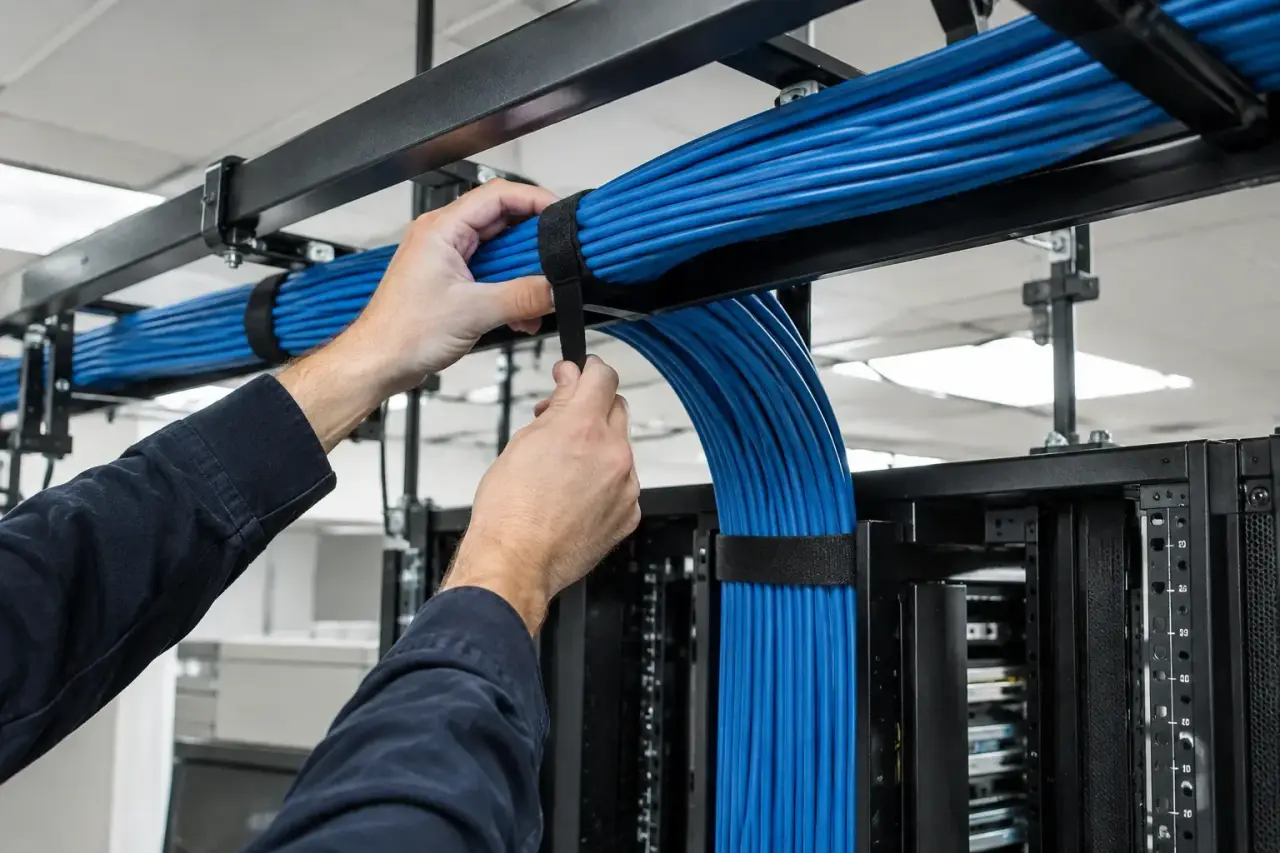
If a user at desk 402 loses connection, we don’t go hunting through a “spaghetti” mess of wires. We look at the label, find the corresponding port in the closet, and fix it. This “cable grooming” and documentation update process should be part of your annual preventive inspections. If you find a snagged fiber line early, you can perform a Fiber Optic Repair before it brings down your entire backbone.
Advanced Testing, Certification, and Future-Proofing
“It looks good” isn’t a test result. Every professional installation must be certified. We use high-end diagnostic tools like the Fluke DSX-8000 to verify that every run meets its rated speed.
When we learn How to Test Network Cable Quality, we aren’t just checking if the lights blink. We are measuring:
- Near-End Crosstalk (NEXT): Ensuring wires aren’t interfering with each other.
- Return Loss: Checking for impedance mismatches that reflect the signal back to the source.
- Attenuation: Measuring how much signal is lost over the distance of the run.
Whether you need a Cat 6 Cable Tester for your office or need to know How to Test Fiber Optic Cable for a Data Center Interconnect, certification is your insurance policy. It proves the work was done right and guarantees performance for years to come.
Adapting to Emerging Technologies
The world of cabling installation and maintenance is moving fast. We are already seeing the rise of 800G fiber and the massive cabling requirements of AI data centers, which require ultra-high-density patching and specialized cooling-aware layouts.
Additionally, the growth of Power over Ethernet (PoE), where your cables provide both data and electricity to cameras, lights, and access points, has changed the game. Cables now carry heat. Using a Network Cable Tester with POE Finder ensures your infrastructure can handle the wattage without melting the insulation. When we perform a Fiber Optic Cable Installation, we are always looking at how to future-proof for the next decade of hardware.
Frequently Asked Questions about Cabling
Why is structured cabling better than point-to-point wiring?
Standardization is the biggest win. With Network Cable Installations that follow a structured design, you get significantly reduced downtime and easier troubleshooting. It also improves airflow in your server rooms (because you don’t have a wall of “dead” cables blocking the fans) and saves money long-term by making moves, adds, and changes a breeze.
What is the difference between plenum and riser-rated cables?
It comes down to fire safety. Plenum-rated cables are designed for air-handling spaces; they use materials that resist burning and emit low smoke. Riser-rated cables are for vertical runs between floors. You can use plenum cable in a riser, but you cannot use riser cable in a plenum space without violating building codes in Massachusetts, New Hampshire, and Rhode Island.
How often should commercial cabling be tested?
You should always have an initial certification at the time of installation. After that, we recommend testing during any major “Move, Add, or Change” (MAC) and performing annual inspections to check for physical wear or performance degradation. If your network feels sluggish, a quick check with a Cat 5 Cable Tester or Cat6 certifier can often find a hidden physical fault.
Conclusion
At the end of the day, your network is only as strong as its weakest link, and that link is usually a cable. Proper cabling installation and maintenance isn’t just a “nice to have”; it’s a fundamental requirement for any business that relies on data.
Since 1993, AccuTech Communications has been the trusted partner for businesses throughout Massachusetts, New Hampshire, and Rhode Island. We don’t just pull wire; we build foundations. Our technicians provide full project documentation.
Whether you are fitting out a new office in Worcester, upgrading a data center in Manchester, or expanding a medical facility in Providence, we are here to help you keep your wires straight.
Ready to build a network you can rely on? Request a professional cabling estimate today and let’s get started.