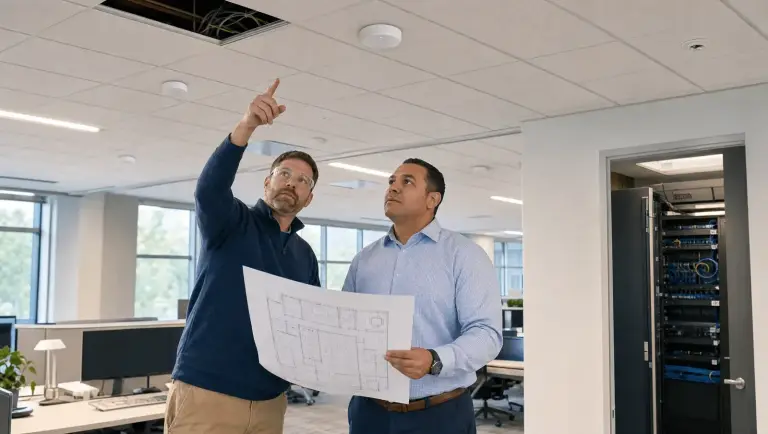
Your Guide to Expert Cable Repair: From Faults to Fixes
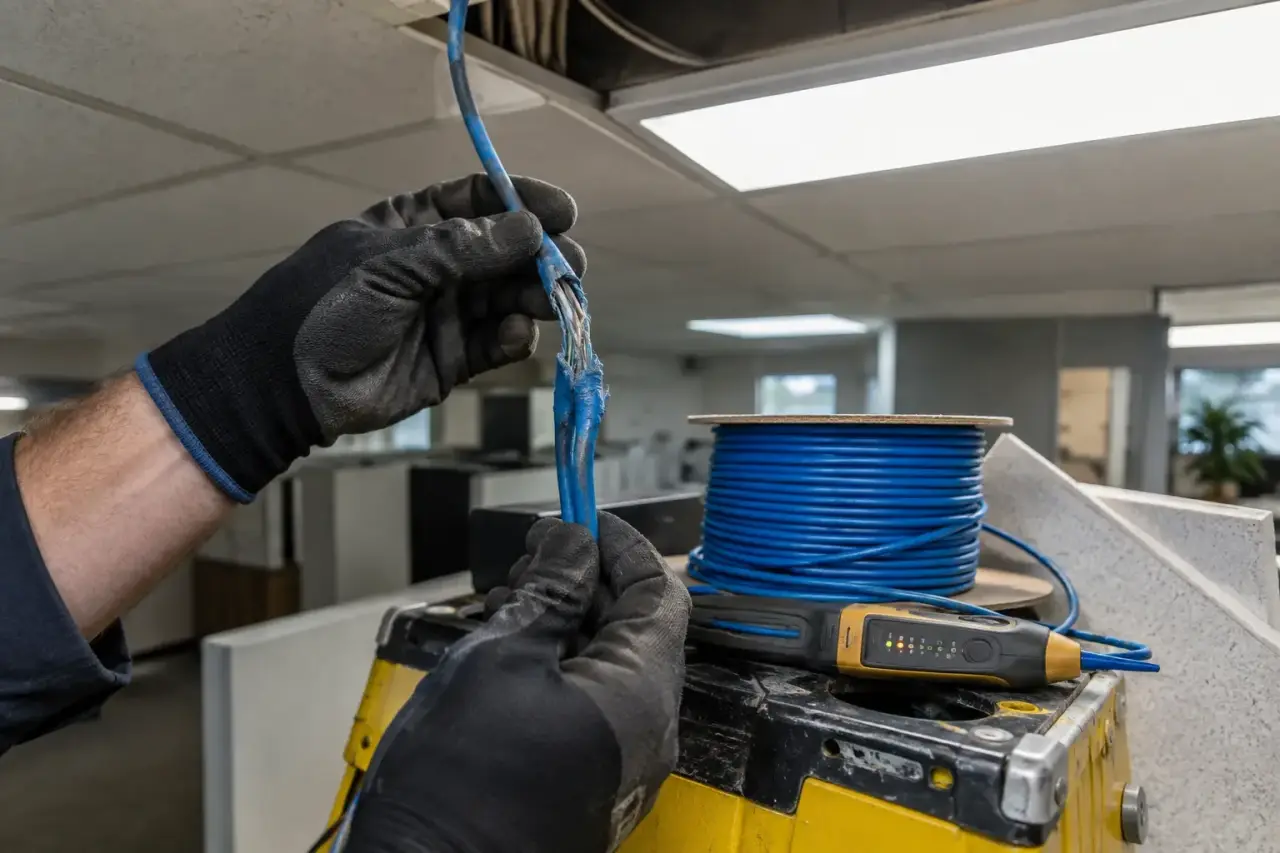
Is Your Business Losing Productivity to Cable Failures?
A cable repair service can get your commercial network back up and running fast, without the cost of full replacement. Here’s a quick look at what to expect:
What a professional cable repair service typically covers:
- Diagnosing faults (breaks, shorts, signal loss)
- Repairing or re-terminating damaged ends
- Splicing fiber optic or copper cables
- Testing repaired cables to manufacturer specs
- Emergency and on-site repair options
Whether you’re dealing with intermittent connectivity, physical damage, or signal degradation, a qualified technician can pinpoint the problem and fix it, often the same day.
Cable failures don’t just cause frustration. They disrupt operations, cost revenue, and put compliance at risk. For commercial businesses in Massachusetts, New Hampshire, and Rhode Island, even a few hours of downtime can have a serious impact on productivity and client relationships.
That’s why knowing your options before a fault strikes matters.
I’m Corin Dolan, owner of AccuTech Communications, with decades of hands-on experience delivering cable repair service and structured cabling solutions to commercial clients across New England. In this guide, I’ll walk you through everything you need to know, from identifying common faults to choosing the right repair provider.
Simple Cable repair service glossary:
Common Faults Requiring Professional Cable repair service
In commercial infrastructure, cables are the unsung heroes. But even the best-installed systems face challenges. Whether it’s a data center in Boston or a warehouse in Manchester, cables are susceptible to a variety of “injuries” that require expert intervention.
The most common issues we see involve physical damage. This can range from “rodent-induced” outages (yes, squirrels love fiber jackets) to accidental cuts during office renovations. Environmental wear is another silent killer; moisture, extreme temperature fluctuations, and even UV exposure can degrade the protective shielding of a cable, leading to signal attenuation, a fancy term for your data getting “tired” and failing to reach its destination.
If you are noticing sluggish speeds or dropped calls, it might be time to look into fiber-optic-repair-near-me.
Identifying Ethernet and Fiber Optic Issues
For most modern offices, the backbone of the network relies on Ethernet (CAT5e, CAT6, CAT6A) and fiber optic cabling. Ethernet issues often boil down to the connectors. We frequently see damaged RJ45 connectors where the plastic clip has snapped off, or the internal copper pins have become oxidized.
There are two primary wiring standards used for these connectors: T568A and T568B. While both work, consistency is key. If a “DIY” repair mixes these standards on opposite ends of a cable, you’ve essentially created a crossover cable where you didn’t want one, leading to total connectivity failure.
Fiber optics are even more sensitive. A microscopic scratch on the glass core or a slight bend beyond its “bend radius” can cause massive packet loss. If you suspect a break, understanding how-to-repair-fiber-optic-cable involves more than just a piece of electrical tape, it requires precision fusion splicing.
Specialized Industrial and Broadcast Cable Failures
Beyond standard office networking, many New England businesses rely on specialized cables that require a higher level of expertise.
- SMPTE Hybrid Fiber: Used extensively in broadcast and stadium environments, these cables carry both fiber for data and copper for power. A break in either can shut down a multi-million dollar production.
- Coaxial Splicing: While older, high-grade coaxial is still used in specific offshore and industrial applications. Splicing these requires maintaining the exact impedance to avoid signal reflections.
- Broken or Shorted Conductors: In heavy-duty industrial settings, cables are often moved or flexed constantly. This leads to internal fatigue where the copper strands literally snap inside the jacket, or the insulation fails, causing a short circuit.
Essential Services Offered by Cable Repair Professionals
When you hire a professional cable repair service, you aren’t just paying for a “fix.” You are paying for a restoration of your system’s integrity.
Advanced Testing and Diagnostic Tools
We don’t guess where the problem is; we use science.
- OTDR (Optical Time Domain Reflectometer): This is the gold standard for fiber repair. It sends a pulse of light down the fiber and measures the reflections to pinpoint the exact location of a break, down to the foot.
- TDR (Time Domain Reflectometer): The copper equivalent of an OTDR, this tool finds shorts and breaks in Ethernet and coaxial cables.
- Computerized Diagnostics: Modern testers provide detailed reports on insertion loss (how much signal is lost) and return loss (how much signal is bouncing back), ensuring the repair meets original manufacturer specifications.
If your office phones are acting up, specialized business-phone-system-repairs can diagnose whether the fault lies in the hardware or the cabling infrastructure.
Emergency and Mobile Cable repair service Options
In business, time is literally money. A severed backbone cable can stop a production line or take a call center offline. Reputable services offer 24/7 availability and a quick-response fleet.
For large-scale industrial sites or offshore applications, mobile repair units, essentially “shops on wheels”, can perform on-site splicing, termination, and testing. This significantly reduces downtime by eliminating the need to ship heavy cables back to a facility.
Repair vs. Replacement: Making the Economic Choice
One of the most frequent questions we get is: “Should I just buy a new one?” The answer depends on the cable’s length and complexity. For a 6-foot patch cord, replacement is the way to go. But for a 500-foot SMPTE hybrid cable or a multi-strand fiber backbone, a cable repair service can save you thousands of dollars.
Factors Influencing Cable repair service Pricing
While we don’t provide fixed pricing without an inspection, it’s helpful to understand the variables. Please note that all prices mentioned are average costs sourced from publicly available internet data and are not the actual prices of AccuTech Communications. Professional repairs generally fall into a wide range of $150 to $1,500+.
Why such a wide range?
- Labor Rates: Emergency after-hours service costs more than a scheduled repair.
- Material Costs: High-end connectors (like LEMO or specialized fiber ends) can be expensive.
- Complexity: Splicing a single fiber strand is faster than rebuilding a 48-strand armored backbone.
- Testing Requirements: Specialized certification reports for military or healthcare compliance add time to the process.
For those looking for a business-phone-system-repair-near-me, repairing existing wiring is almost always more cost-effective than a full “rip and replace” project.
How to Choose a Reliable Cable Repair Provider
Not all “cable guys” are created equal. When your business infrastructure is on the line, you need a partner who understands the high stakes of commercial operations.
Look for providers who employ technicians with industry-recognized certifications, such as RCDD (Registered Communications Distribution Designer). This ensures the repair isn’t just a “band-aid” but meets ANSI/TIA/EIA standards. Furthermore, ensure the company follows strict OSHA safety standards, especially if they are working in industrial environments or at heights.
Preparing for the RMA and Shipping Process
If you are sending a specialized cable to a shop for repair, the “Return Merchandise Authorization” (RMA) process is vital.
- Documentation: Clearly describe the symptoms. “It doesn’t work” is less helpful than “Intermittent signal loss when moved.”
- Mark the Fault: If you know where the physical damage is, mark it with tape.
- Protective Packaging: Fiber optic ends should always be capped. Coiled cables should be secured to prevent further internal strain during transit.
- Test Data: If you have previous test results for that cable, include them so the technician has a baseline for comparison.
Frequently Asked Questions about Cable Repair
What is the difference between T568A and T568B wiring?
These are the two standards for wiring the eight copper strands inside an Ethernet cable into an RJ45 plug. T568B is the most common in modern commercial installations in the US. The only difference is the position of the orange and green wire pairs. As long as both ends of the cable use the same standard, your network will work perfectly.
How does OTDR testing improve repair outcomes?
Without an OTDR, finding a break in a 1,000-foot fiber cable hidden behind walls or in underground conduits is like finding a needle in a haystack. The OTDR tells us exactly how many feet into the cable the break is, allowing us to pinpoint the repair site and avoid unnecessary demolition or cable pulling.
What industries rely most on specialized cable repair?
- Broadcast & Entertainment: For SMPTE and Triax camera cables.
- Healthcare: For high-speed data links and nurse call systems.
- Manufacturing: For industrial Ethernet and power cables that drive automation.
- Data Centers: Where fiber density is high and any loss of signal is catastrophic.
Conclusion
At AccuTech Communications, we believe that a robust network is the foundation of every successful business. Since 1993, we have been the trusted partner for commercial clients throughout Massachusetts, New Hampshire, and Rhode Island.
Our team of technicians is dedicated to providing reliable, high-quality cable repair service that keeps your operations moving. Whether you need a quick fix for a severed fiber line or a complete audit of your structured cabling, we have the expertise and the tools to get the job done right.
Don’t let a faulty cable slow you down. Contact us today for Expert Structured Cabling Services and let’s get your business back up to speed.