
Why Low Voltage Data Cabling is the Foundation of Modern Business Operations
Low voltage data cabling is the physical network infrastructure that transmits data, voice, and video signals throughout your commercial building at voltages below 50 volts. Here’s what you need to know:
What It Does:
- Carries data between computers, servers, phones, and other network devices
- Powers compatible devices through Power over Ethernet (PoE)
- Supports security cameras, access control systems, and Wi-Fi access points
- Forms the backbone of your structured cabling system
Key Types:
- Copper Cables (Cat5e, Cat6, Cat6a) – Cost-effective for most business applications
- Fiber Optic Cables – High-speed, long-distance backbone connections
Why It Matters:
- Network reliability directly impacts productivity
- Poor cabling causes downtime, which can cost businesses anywhere from $1,200 to over $4,000 per incident based on industry averages
- Proper installation ensures scalability for future growth
- Standards-compliant systems reduce troubleshooting time and maintenance costs
You want your network to run smoothly until it doesn’t. When downtime hits, it derails productivity, sparks frustration, and drives up costs. The difference between a network that supports your business and one that holds it back often comes down to the quality of the cabling infrastructure hidden in your walls and ceilings.
Low voltage cabling isn’t just about connecting devices. It’s about creating a reliable, organized system that can adapt as your business grows and technology evolves. Whether you’re running a healthcare facility that depends on real-time data access, a manufacturing operation with IoT sensors, or an office building with hundreds of employees, your structured cabling system is the foundation everything else is built on.
The good news? When designed and installed correctly, low voltage data cabling provides a stable platform that can support multiple generations of equipment upgrades without needing replacement. The key is understanding what makes a cabling system truly effective and ensuring your installation meets industry standards from day one.
I’m Corin Dolan, and I’ve been helping commercial clients across Massachusetts, New Hampshire, and Rhode Island design and implement reliable low voltage data cabling systems since founding AccuTech Communications. Over the years, I’ve seen how the right cabling infrastructure transforms business operations and how the wrong approach creates costly, ongoing problems.
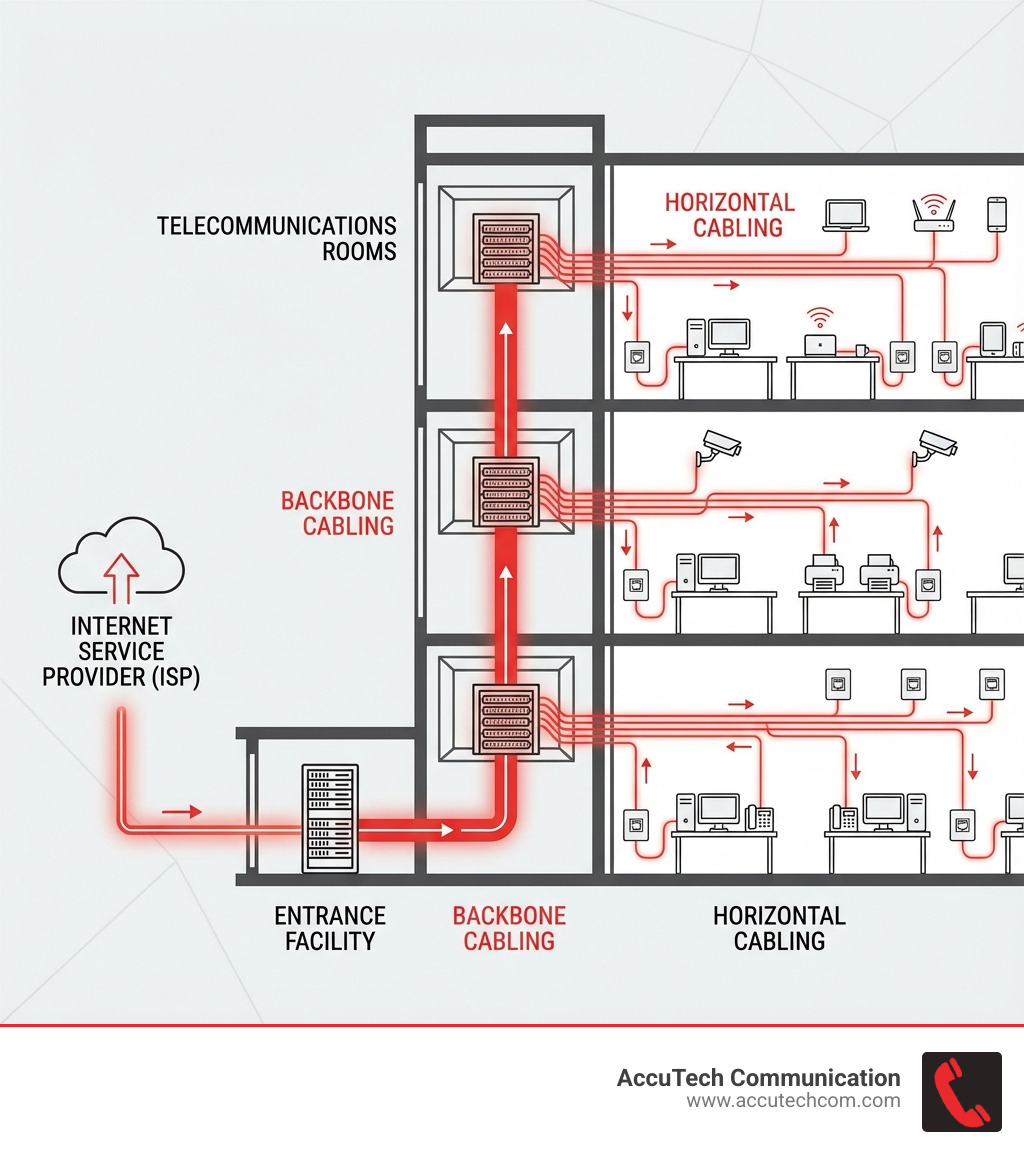
Basic low voltage data cabling vocab:
What is Low Voltage Cabling and Why is it Critical for Business?
At its core, low voltage data cabling refers to network cables that carry signals for data, voice, and video communication at voltages below 50 volts. This distinguishes it significantly from high voltage wiring, which typically carries 120 volts or more to power heavy equipment and infrastructure. While high voltage wiring delivers raw power, low voltage cabling is the nervous system, transmitting the delicate, critical data flows that keep modern businesses running.
The primary difference lies in their function and voltage. High voltage wiring is designed to supply electrical power to devices, operating at levels that pose significant electrical hazards if mishandled. Low voltage cabling, on the other hand, is engineered for signal transmission, carrying information rather than high power. This fundamental difference offers several advantages for your commercial environment:
- Safety advantages: Because it operates at lower voltages, low voltage cabling presents a significantly reduced risk of electrical shock or fire. This makes installation and maintenance safer for technicians and minimizes workplace injury risks for your employees.
- Energy efficiency: While not directly reducing power consumption in the same way as LED lighting, low voltage systems, particularly those utilizing Power over Ethernet (PoE), can contribute to overall energy efficiency by simplifying power delivery to devices and reducing the need for separate power outlets.
- Power over Ethernet (PoE): This remarkable technology allows compatible devices, such as VoIP phones, Wi-Fi access points, and security cameras, to receive both data and electrical power over a single Ethernet cable. This eliminates the need for separate power cords and outlets, simplifying installation, reducing clutter, and offering greater flexibility in device placement.
The applications of low voltage data cabling are vast and continually expanding, forming the backbone of almost every critical system in modern commercial settings across Massachusetts, New Hampshire, and Rhode Island. Here are some of the primary uses we implement for our clients:
- VoIP Phone Systems: For clear, uninterrupted voice communications, connecting your team and clients.
- Wi-Fi Access Points: Distributing wireless internet signals throughout your facility, ensuring seamless connectivity for all devices.
- Networked Computers and Printers: The essential connections that enable your workstations, servers, and printing solutions to communicate efficiently.
- Security and Surveillance Cameras: Providing reliable data transmission for real-time monitoring and recording, crucial for asset protection and employee safety.
- Access Control Systems: Managing entry and exit points, ensuring secure access to restricted areas within your building.
- Audio/Visual Equipment: Supporting conference room displays, digital signage, and multimedia systems for presentations and internal communications.
- IoT Devices and Smart Sensors: Connecting a growing array of intelligent devices that monitor environments, track assets, and automate building functions.
Low voltage cabling is the silent workhorse behind your business’s digital operations. Without a robust, well-designed system, even the most advanced hardware and software cannot perform optimally.
The Anatomy of a Structured Cabling System
Imagine the central nervous system of your business—that’s what a structured cabling system is. It’s a comprehensive, standardized approach to your organization’s physical network infrastructure, designed to support multiple hardware uses and be easily scalable for future growth. Unlike traditional point-to-point wiring, which can quickly become an inflexible mess, structured cabling brings order, reliability, and efficiency.
Structured cabling systems are built upon a hierarchical star topology, meaning all devices connect back to a central point, or a series of interconnected central points. This standardized architecture is critical for manageability, troubleshooting, and future expansion. It adheres to strict industry guidelines, primarily from organizations like TIA/EIA, ensuring interoperability and consistent performance.
We design and install structured cabling systems that divide your network into six distinct subsystems, each playing a vital role:
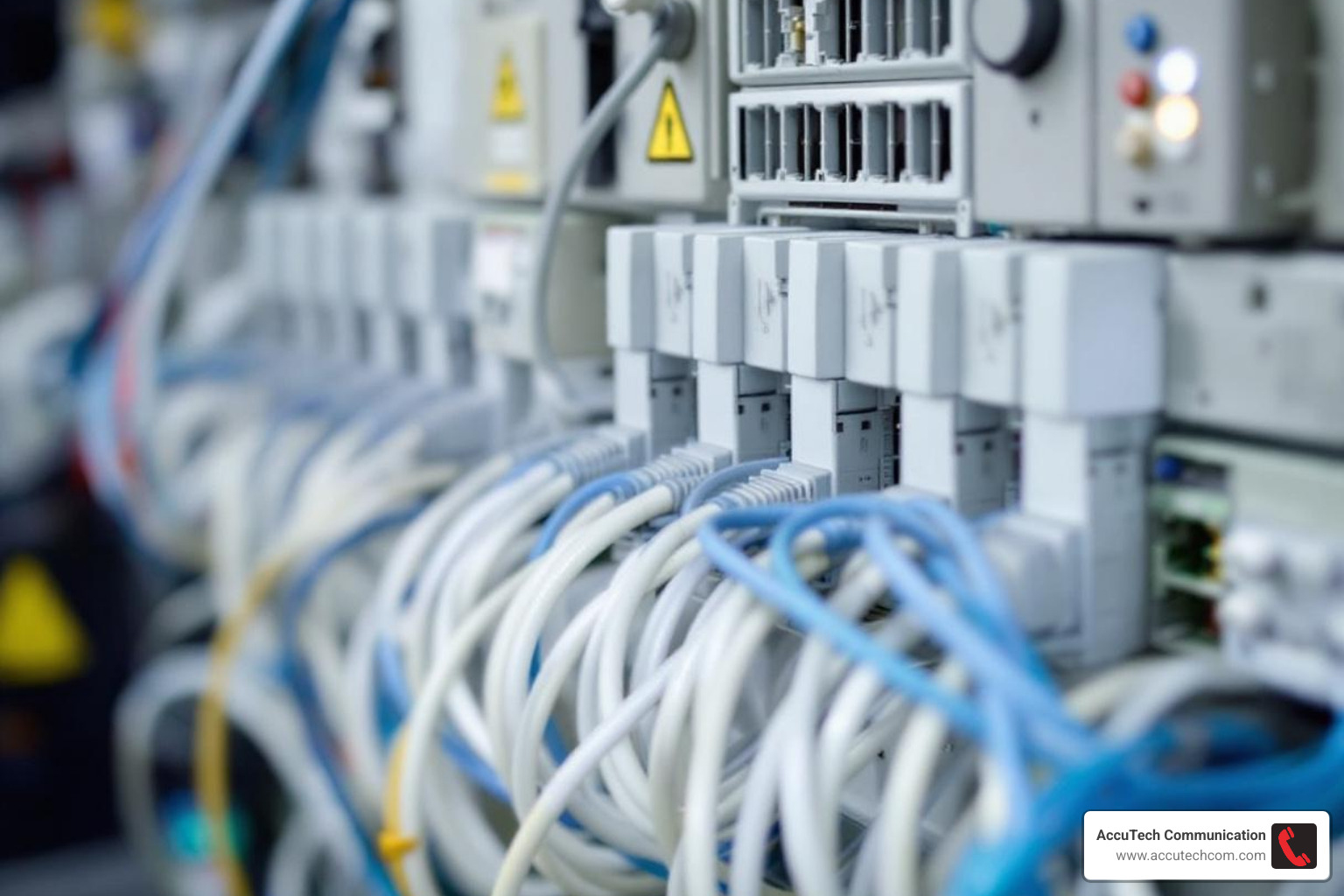
The 6 Subsystems:
- Entrance Facility (EF): This is where external telecommunications cables (from internet service providers, telephone companies, etc.) enter your commercial building. It houses the network demarcation point, protection devices, and connecting hardware. Proper design here is crucial for securing your incoming services and ensuring a clean transition to your internal network.
- Equipment Room (ER): The ER is a centralized space, often a data center, that houses the main telecommunications equipment, such as servers, switches, and patch panels. It’s the brain of your network, requiring careful planning for optimal temperature, humidity, power, and security to minimize network-related downtime, which can cost businesses anywhere from $1,200 to over $4,000 per incident based on industry averages.
- Backbone Cabling: These are the inter-building and intra-building cables that connect the Entrance Facility, Equipment Rooms, and Telecommunications Rooms. Backbone cabling carries high-bandwidth traffic over longer distances, typically using fiber optic cables for speed and reliability. This is the superhighway of your network.
- Telecommunications Room (TR): Also known as a Telecom Closet (TC), this room houses intermediate distribution frames (IDFs), patch panels, and active equipment (like network switches) that serve a specific floor or area of your building. For larger commercial buildings, multiple TRs might be necessary, especially since data cabling standards limit copper cable lengths to 90 meters for optimal performance. These rooms should be climate-controlled and organized for easy maintenance.
- Horizontal Cabling: This subsystem extends from the Telecommunications Room to individual work areas or outlets. It’s the most visible part of the system for end-users, providing connectivity to their devices. Horizontal cabling typically consists of twisted-pair copper cables (Cat5e, Cat6, Cat6a) or, in some cases, fiber optic cables for specialized needs.
- Work Area (WA): This is the end-user environment where telecommunications outlets connect to computers, VoIP phones, Wi-Fi access points, security cameras, and other devices. The design here focuses on accessibility, flexibility, and ensuring enough outlets for current and future needs.
By adhering to this structured approach, we ensure your network infrastructure is not only robust and efficient today but also adaptable to the technological demands of tomorrow.
Choosing the Right Types of Low Voltage Data Cabling
Selecting the appropriate type of low voltage data cabling is paramount for your business’s network performance and future growth. It’s not just about getting connected; it’s about optimizing speed, reliability, and scalability for your specific commercial needs. A well-chosen cabling infrastructure supports current demands and can easily accommodate future technologies without costly overhauls. For more detailed information on our data cable installation services, visit our data cable installation page.
Copper Cabling: Cat5e, Cat6, and Cat6a
Copper cabling, particularly twisted-pair Ethernet cables, remains the workhorse for many horizontal cabling applications in commercial buildings. The “Category” rating (Cat) indicates the cable’s performance capabilities, primarily its bandwidth and data transfer speeds. Twisted-pair technology helps reduce electromagnetic interference (EMI) and crosstalk—signal interference between neighboring cable pairs.
- Cat5e (Category 5e): An improved version of Cat5, Cat5e is capable of supporting Gigabit Ethernet (1,000 Mbps) over distances up to 100 meters, with a bandwidth of 350 Hz. It’s a cost-effective solution for many standard business applications and has been a staple for years.
- Cat6 (Category 6): Designed for higher performance, Cat6 supports up to 1 Gigabit Ethernet over 100 meters and can even handle 10 Gigabit Ethernet (10 Gbps) speeds, though only up to 55 meters. It offers better crosstalk reduction and higher bandwidth (250 MHz) compared to Cat5e, making it suitable for more demanding applications.
- Cat6a (Category 6 Augmented): For businesses requiring robust 10 Gigabit Ethernet speeds over longer distances, Cat6a is the answer. It can maintain 10 Gbps speeds over the full 100-meter length and significantly reduces alien crosstalk (interference from neighboring cables). With a bandwidth of 500 MHz, Cat6a provides superior performance for high-bandwidth applications and data centers.
Here’s a quick comparison of these common copper cable types:
| Cable Type | Speed (Max) | Max Distance (for 10 Gbps) | Bandwidth | Common Business Use Case |
|---|---|---|---|---|
| Cat5e | 1 Gbps | N/A (not recommended) | 350 Hz | Standard office networks, VoIP, printers |
| Cat6 | 1 Gbps | 55 meters | 250 MHz | Gigabit Ethernet backbone, security cameras |
| Cat6a | 10 Gbps | 100 meters | 500 MHz | Data centers, high-performance workstations, future-proofing |
Fiber Optic Cabling: The Speed and Distance Champion
When speed, distance, and immunity to interference are critical, fiber optic cabling is the undisputed champion. Instead of electrical signals, fiber optic cables transmit data using pulses of light through thin strands of glass or plastic. This technology offers several key advantages:
- EMI Immunity: Unlike copper, fiber optic cables are immune to electromagnetic interference, making them ideal for environments with heavy machinery or electrical noise.
- Superior Speed and Bandwidth: Fiber optic cables support significantly higher data rates and bandwidths, making them perfect for demanding applications.
- Long-Distance Capability: Light pulses can travel much farther than electrical signals without significant degradation, making fiber ideal for backbone cabling between floors, buildings, or within large data centers.
- Future-Proofing: Fiber optics offer unparalleled scalability for future speed increases, making them a strategic investment for businesses anticipating rapid technological advancements.
We commonly deploy fiber optic cabling for backbone connections, data center links, and high-speed external connections across Massachusetts, New Hampshire, and Rhode Island. To learn more about our specialized fiber optic installation services, please visit our fiber optic cabling installation page.
The Role of Standards and Best Practices in Low Voltage Data Cabling
The quality of your low voltage data cabling installation can make or break your network’s performance and your business’s productivity. It’s not just about running wires; it’s about ensuring every cable is installed to exacting standards, guaranteeing network reliability and delivering long-term value. A well-installed system minimizes downtime, simplifies troubleshooting, and reduces maintenance costs over its lifespan.
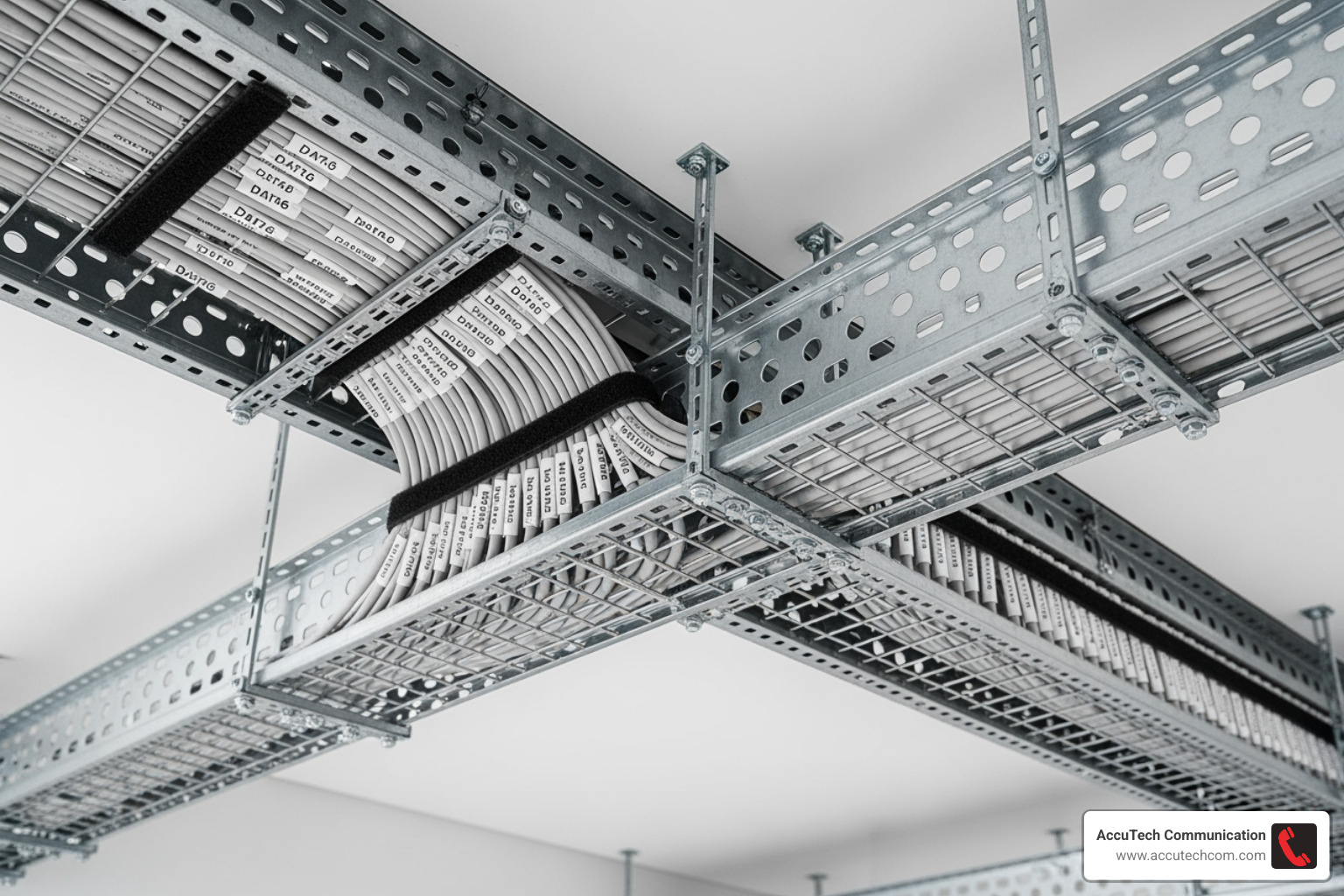
Why Industry Standards (TIA/EIA) Matter for your low voltage data cabling
In low voltage data cabling, industry standards are not just suggestions; they are the bedrock of performance, interoperability, and safety. The Telecommunications Industry Association (TIA) and Electronic Industries Alliance (EIA) standards, particularly the TIA/EIA-568 series, provide comprehensive guidelines for commercial building telecommunications cabling. These standards define:
- Performance Benchmarks: They specify the electrical and transmission characteristics required for different cable categories (Cat5e, Cat6, Cat6a) and fiber optic types, ensuring cables perform as expected.
- Interoperability: By adhering to these standards, manufacturers produce components that work seamlessly together, allowing for flexible system design and equipment upgrades.
- Safety Compliance: Standards often align with electrical codes, contributing to a safer working environment and reducing risks of electrical hazards or interference.
- Reliability Assurance: Following these guidelines leads to a robust, predictable network infrastructure, minimizing signal loss, crosstalk, and other issues that can degrade performance.
As NEMA (National Electrical Manufacturers Association) emphasizes, structured cabling is a standards-based system that can reduce moves, adds, and changes, installation time, and maintenance costs. We strictly adhere to these standards to deliver reliable, high-performance solutions for our commercial clients. You can read more about the importance of Structured Cabling for Data Communications from NEMA.
Key Design and Installation Considerations for your low voltage data cabling
Designing and installing low voltage data cabling systems, especially in commercial environments, requires meticulous planning and execution. We take pride in our certified, reliable service, ensuring every aspect of your installation is handled with expertise:
- Professional Planning: Before any cable is pulled, we conduct thorough site surveys and design a cabling plan that accounts for current needs, future scalability, and compliance with local codes in Massachusetts, New Hampshire, and Rhode Island.
- Scalability: A robust system anticipates growth. We design with future expansion in mind, ensuring your infrastructure can support new devices, higher bandwidths, and evolving technologies without major overhauls.
- Cable Pathways: Proper pathways (conduits, cable trays, raceways) are essential. Cable trays are often preferred for their accessibility and flexibility, but conduit systems are also used depending on the environment. Conduit fill should not exceed 40 percent, and cable tray fill should not exceed 50 percent, to allow for future growth and ease of maintenance.
- Bend Radius: Cables have minimum bend radius limitations to prevent damage and signal degradation. For solid copper cable, the bend radius should not exceed four times the cable diameter. For optical fiber, while legacy fiber required a 2-inch minimum bend radius, modern “bend insensitive” fibers can tolerate tighter bends, making them more versatile.
- Cable Management: Organization is key. This includes proper routing, bundling, and securing cables to prevent tangles and damage. J-hooks, for example, should be spaced no more than 5 feet apart to properly support cabling infrastructure.
- Labeling: Every cable should be clearly labeled at both ends, identifying its origin and destination. This is invaluable for troubleshooting, maintenance, and future moves, adds, and changes (MACs).
- Separation from EMI Sources: To prevent electromagnetic interference, low voltage data cables should be routed away from sources like fluorescent lighting fixtures, large motors, and power cabling. A minimum 5-inch distance is often required from power lines over 2 kVA.
- Testing and Certification: After installation, every cable run is rigorously tested and certified to meet industry standards. This ensures optimal performance and provides documented proof of compliance.
These considerations are not just about neatness; they directly impact your network’s efficiency and reliability. The U.S. Department of Energy’s Best Practices Guide for Energy-Efficient Data Center Design highlights that optimizing cable management and layout can directly improve energy performance and lower costs.
Business Benefits of a Professional Cabling Installation
Investing in a robust and professionally installed low voltage data cabling infrastructure is a strategic decision that yields significant returns for your commercial business. It’s not merely an expense; it’s an investment in your operational efficiency, reliability, and future growth.
- Improved Reliability: Well-installed cabling minimizes downtime caused by faulty connections or interference. With structured cabling, you reduce the risk of network outages, ensuring your critical business applications are always available.
- Increased Productivity: A reliable network means faster data transfer, clearer communications, and seamless operation of all networked devices. This directly translates to higher employee productivity and smoother workflows.
- Future-Readiness: Modern structured cabling systems are designed for longevity, typically supporting multiple generations of hardware upgrades. By choosing high-grade cables like Cat6a or fiber optics, you build an infrastructure that can handle future bandwidth demands and emerging technologies, such as IoT and AI-driven analytics, for years to come.
- Simplified Network Management: Proper labeling, organization, and adherence to standards make your network easier to manage. Troubleshooting is quicker, and moves, adds, and changes (MACs) to your network become far less complex and disruptive.
- Cost Efficiency: While the initial investment in a professional installation might seem higher than a haphazard approach, it pays dividends in the long run. Reduced downtime costs (which can range from $1,200 to over $4,000 per incident according to industry data), lower maintenance expenses, and simplified upgrades contribute to a strong return on investment.
A professional low voltage data cabling installation provides a stable, high-performance foundation that empowers your business to operate at its best. We understand that your network is critical, and we are committed to delivering certified, reliable service with a commitment to quality. To learn more about how we can improve your network, explore our network cabling installation services.
Frequently Asked Questions about Low Voltage Cabling
We often encounter common questions and misconceptions about low voltage data cabling. Let’s clear up some of the most frequent inquiries.
Can wireless technology completely replace wired low voltage cabling?
This is a common misconception! While wireless technology, particularly Wi-Fi, offers incredible flexibility and convenience, it cannot completely replace wired low voltage data cabling for critical business operations. Here’s why:
- Reliability: Wired connections are inherently more stable and less prone to interference, signal drops, or security vulnerabilities compared to wireless. For critical servers, data centers, and essential workstations, a wired connection provides best reliability.
- Speed and Bandwidth: Wired Ethernet connections consistently offer higher, more consistent speeds and greater bandwidth capacity than wireless. While Wi-Fi speeds are improving, they are shared among all connected devices, whereas a wired connection provides dedicated bandwidth.
- Security: Wired networks are generally more secure by their nature, as physical access is required to tap into the network. Wireless networks are more susceptible to unauthorized access if not properly secured.
- Power over Ethernet (PoE): Many devices, including Wi-Fi access points themselves, rely on PoE delivered over wired Ethernet cables for both data and power.
For most commercial environments, a hybrid approach is best. Wired low voltage data cabling forms the backbone for critical systems and high-bandwidth applications, while wireless provides mobility and convenience for non-critical devices.
What is the difference between a “Permanent Link” and a “Channel” test?
When we certify your low voltage data cabling installation, we perform rigorous tests, including “Permanent Link” and “Channel” tests. Understanding the difference is key to verifying performance:
- Permanent Link: This refers to the fixed infrastructure of your cabling system. It includes the horizontal cable run from the patch panel in the telecommunications room to the wall outlet in the work area, plus the connectors at both ends. It explicitly excludes any patch cords or equipment cords. Testing the permanent link verifies the performance of the installed cable infrastructure itself.
- Channel: The channel test includes the entire end-to-end connection that an end-user device would use. This means it includes the permanent link plus any patch cords used at the patch panel and at the work area outlet, as well as the equipment cord connecting to the device. Testing the channel verifies the performance of the complete signal path.
Both tests are crucial. The permanent link test ensures the installed cabling meets standards, while the channel test confirms that the entire connection, including all cords, delivers the expected performance.
How long does a structured cabling system last?
A professionally installed structured cabling system is designed for remarkable longevity. Unlike rapidly evolving hardware and software, which may have a lifespan of 1-5 years, a well-designed low voltage data cabling infrastructure can reliably serve your business for 10 to 20 years, or even longer.
This extended lifespan is a testament to:
- Material Quality: High-grade cables and components, specified by industry standards, are built to last.
- Standards Compliance: Adherence to TIA/EIA and other relevant standards ensures the system is robust and adaptable. Standards guide the design of current systems to ease future changes, aiming for a generic structured cabling plant capable of running foreseeable applications for 10-15 years.
- Future-Proofing: By selecting cabling categories that exceed current needs (e.g., installing Cat6a when Cat5e is sufficient for today), you build in headroom for future bandwidth requirements.
While the physical cabling itself has a long life, it’s advisable to assess your system’s performance periodically, especially when implementing new technologies or experiencing increased network demands. Regular inspections can help identify wear and tear or technological obsolescence, ensuring your infrastructure continues to meet organizational needs.
Conclusion
In today’s business world, your low voltage data cabling infrastructure is more than just wires in the walls—it’s a critical strategic asset that dictates your operational efficiency, reliability, and ability to innovate. From supporting vital communications to enabling advanced security systems and preparing for future technological shifts, a robust cabling system is truly the backbone of your success.
We believe that investing in a professional, standards-compliant installation is one of the smartest decisions your commercial business can make. It minimizes costly downtime, boosts productivity, and provides a scalable foundation that will serve you for years to come.
At AccuTech Communications, we bring decades of expertise to designing, installing, and maintaining superior low voltage data cabling solutions for commercial clients across Massachusetts, New Hampshire, and Rhode Island. Our commitment to certified, reliable service and competitive pricing ensures that your network infrastructure is not just functional, but brilliant.
Ready to lift your network infrastructure? Learn more about our structured cabling services and find how we can help your business thrive.
