
Network Communications: Top 5 Powerful Solutions for 2025
The Digital Backbone of Modern Business
Network communications is the process of connecting computers, servers, and devices to share resources and information across wired or wireless media. It forms the foundation of all digital business operations today.
“Communications networks have a critical role to play in sustainability initiatives.” – Fujitsu
What is Network Communications?
* Definition: The exchange of data between devices using standardized protocols
* Components: Sender, receiver, transmission medium, and protocols
* Types: Local Area Networks (LAN), Wide Area Networks (WAN), Metropolitan Area Networks (MAN)
* Technologies: Wired (Ethernet, fiber) and wireless (Wi-Fi, cellular)
* Protocols: TCP/IP, UDP, HTTP/HTTPS, FTP, SMTP
In today’s digital landscape, businesses can’t afford network downtime or communication bottlenecks. Whether you’re sharing files between departments, conducting video conferences, processing customer transactions, or managing remote teams, your network infrastructure determines how efficiently information flows throughout your organization.
Modern network communications has evolved far beyond simple data transfer. Today’s systems integrate voice, video, messaging, and data sharing on unified platforms. This convergence enables unprecedented collaboration while reducing costs and complexity.
The right network communication solution can:
- Increase operational efficiency through reliable resource sharing
- Improve collaboration with seamless connectivity between teams
- Support data-driven decisions through faster information access
- Enable cloud computing and distributed systems
- Future-proof your business for emerging technologies
I’m Corin Dolan, owner of AccuTech Communications with over 30 years of experience designing and implementing network communications solutions for businesses across Massachusetts, New Hampshire, and Rhode Island. My team specializes in creating robust, scalable network communications infrastructures that serve as the foundation for business growth and technological advancement.
Network Communications word list:
– business it network
– communication systems
– telecommunication network
Why This Round-Up Matters
The demand for enterprise-grade network communications has skyrocketed in recent years, driven by several factors:
- Hybrid work environments requiring seamless transitions between office and remote locations
- Latency-sensitive applications like video conferencing and real-time collaboration tools
- Increasing data volumes from IoT devices, analytics, and digital change initiatives
- Security concerns as network perimeters expand beyond traditional office boundaries
According to recent industry data, businesses are investing heavily in modernizing their network infrastructure to support these evolving needs. At AccuTech Communications, we’ve seen how companies that prioritize robust network communications gain competitive advantages through improved agility, reduced downtime, and improved collaboration capabilities.
Mastering Network Communications: Market Snapshot
The network communications landscape is changing faster than ever, and we’re seeing some fascinating shifts in how businesses approach their digital infrastructure.
In our conversations with clients across New England, we’re noticing a strong emphasis on building networks that can withstand just about anything. Companies aren’t just implementing backup systems anymore – they’re designing redundancy into every single layer of their network architecture. It’s like having not just a spare tire, but an entire backup car following you on every journey.
We’re also watching the walls come down between traditionally separate systems. Those operational technology networks that used to run in isolation? They’re now being integrated with information technology systems, creating unified digital environments that share data and insights across the entire organization.

The remote work revolution has permanently altered network design priorities. Remember when networks were built assuming most users would be in the office? Those days are gone. Today’s networks must deliver secure, high-performance access from literally anywhere – your home office, a coffee shop, or a cabin in the woods.
Interestingly, diversity, equity, and inclusion considerations are now influencing network planning too. Forward-thinking organizations are ensuring equitable access to network resources across diverse employee populations and locations, recognizing that technology access is a crucial component of workplace equity. Some fascinating scientific research on salary transparency shows how open communication about compensation can help address pay inequities – and the same principles apply to ensuring fair access to technological resources.
In the communications field, we’re seeing new roles emerge that reflect these changing priorities. The Communications Manager position at many organizations now requires deep expertise in digital network infrastructure, with competitive salaries reflecting just how critical these roles have become to business success.
Key Drivers Behind “Always-On” Network Communications
Several major technological shifts are fueling the demand for more robust network communications systems that simply never go down.
The IoT explosion has transformed our digital landscape. With billions of connected devices worldwide – from smart thermostats to industrial sensors – networks must handle unprecedented volumes of data flowing in all directions. Each of these devices needs bandwidth, management, and security considerations that didn’t exist a decade ago.
Cloud migration continues to reshape how businesses operate. As workloads shift to distributed cloud platforms, networks must evolve to support this fundamentally different computing model. This means optimizing paths to cloud resources and ensuring there’s enough bandwidth for data-hungry applications like video conferencing and collaborative design tools.
The 5G rollout is opening doors to applications that simply weren’t possible before. With its ultra-low latency and high reliability, 5G is enabling everything from remote surgical operations to augmented reality training programs – but only if your network infrastructure can support these demanding use cases.
Edge computing is changing where data processing happens. By handling computation closer to where data is generated, businesses reduce latency and bandwidth requirements while improving application performance. This distributed approach requires completely rethinking traditional hub-and-spoke network designs.
At AccuTech Communications, we help businesses throughout Massachusetts, New Hampshire, and Rhode Island adapt their network infrastructure to these emerging technologies, ensuring they remain competitive and nimble in rapidly changing markets.
Challenges Enterprises Face Today
Despite all the technological advances, businesses still face significant network communications problems that can impact their operations.
Bandwidth spikes remain a persistent headache for network administrators. When everyone jumps on a video call at 9 AM Monday morning, or when marketing uploads that massive product demonstration video, these unpredictable surges can degrade performance for all users. Without proper capacity planning and quality of service configurations, your most critical applications may crawl to a halt during peak usage times.

Security threats have grown more sophisticated as network perimeters have dissolved. The old “castle-and-moat” approach – where everything inside the network was trusted and everything outside was suspect – simply doesn’t work in today’s distributed environment. Security now needs to be woven throughout the entire infrastructure.
The skills gap in networking continues to widen. Finding and keeping qualified network professionals has become increasingly difficult for many organizations. The average salary for network professionals reflects this scarcity, with Data Communication Engineers earning upwards of $104,000 annually according to recent data. This talent shortage can leave businesses vulnerable when implementing new technologies.
Legacy integration challenges plague many established organizations. Those older systems that “still work fine” often need to connect with modern network infrastructure, requiring specialized knowledge and careful planning to maintain business continuity during transitions.
Scalability concerns keep IT leaders up at night. Networks must be able to grow alongside the business without requiring complete redesigns every few years. This demands forward-thinking architecture that anticipates future needs – something we pride ourselves on at AccuTech Communications when designing solutions for our clients in New England.
Top 5 Commercial Solutions for Seamless Connectivity
Building a rock-solid Network Communications infrastructure isn’t just about buying the latest equipment—it’s about creating a foundation that grows with your business. At AccuTech Communications, we’ve helped hundreds of Massachusetts businesses design systems that stand the test of time while delivering real value.
When we sit down with clients to plan their network infrastructure, we focus on four key principles that make all the difference:
- Future-proof architecture that won’t leave you scrambling when new technologies emerge
- Vendor-neutral standards so you’re never locked into a single manufacturer’s ecosystem
- Cost-efficiency that balances upfront investment with long-term operational savings
- Scalability that accommodates your business growth without requiring a complete overhaul
The financial aspect of network planning often comes down to capital expenditure versus operational expenditure considerations. Here’s how these different approaches impact your bottom line:
| Approach | Initial Investment | Ongoing Costs | Best For |
|---|---|---|---|
| Capital Expenditure (CapEx) | Higher upfront costs | Lower monthly expenses | Stable businesses with predictable growth |
| Operational Expenditure (OpEx) | Minimal upfront investment | Higher monthly subscription fees | Growing businesses needing flexibility |
| Hybrid Model | Moderate initial investment | Moderate monthly costs | Most modern businesses |
After three decades of building Network Communications systems across New England, we’ve identified five commercial solutions that consistently deliver exceptional results for our clients. These technologies form the backbone of today’s connected enterprise and deserve your careful consideration as you plan your network strategy.
Let’s explore each solution in detail to help you make informed decisions about your connectivity infrastructure.
1. Structured Cabling Infrastructure – The Physical Bedrock
In our increasingly wireless world, it’s easy to forget what keeps our digital lives humming along behind the scenes. The truth? Good old-fashioned cables. As the foundation of reliable Network Communications, structured cabling remains the unsung hero of connectivity.
Think of structured cabling as the circulatory system of your business – when properly designed and installed, it silently delivers everything your organization needs to thrive. When it’s compromised, everything slows down.
At AccuTech, we’ve seen how a thoughtfully designed cabling infrastructure transforms business operations. Modern structured cabling delivers three critical benefits:
Reliability that wireless simply can’t match. While Wi-Fi has its place (more on that later!), nothing beats a hardwired connection for consistent performance without the interference headaches.
Speed that keeps pace with your ambitions. Today’s standards support everything from 1 Gbps for basic operations all the way to blazing 400 Gbps for data-intensive applications – ensuring your team never waits on technology.
Future-readiness that protects your investment. A properly installed cable plant can support multiple generations of network equipment, giving you flexibility as technology evolves.

When we design modern cabling systems, we focus on three key components:
Category 6A Copper serves as the workhorse for most office environments. Supporting speeds up to 10 Gbps over distances up to 100 meters, it’s perfect for connecting workstations and powering devices through PoE technology.
Fiber Optic cabling becomes essential when distance or speed demands increase. Single-mode fiber can carry signals for kilometers without degradation, making it ideal for campus environments or connecting buildings. Plus, its immunity to electromagnetic interference makes it perfect for industrial settings.
Power over Ethernet (PoE) technology has revolutionized network design by allowing a single cable to deliver both data and electrical power. This neatly simple approach powers everything from IP phones to security cameras to wireless access points – reducing cable clutter and simplifying installations.
“Installation of modern high-speed data transfer cable requires highly trained personnel whose expertise, experience and knowledge is unquestionable.”
This is why our BICSI-certified technicians at AccuTech treat every installation with meticulous care. Each cable is properly installed, thoroughly tested, and comprehensively documented. This attention to detail isn’t just about preventing future problems – it’s about building the solid foundation upon which all your other network systems will depend.
When properly executed, structured cabling becomes virtually invisible – it just works. And that’s exactly how it should be.
2. Unified Communications Systems – Voice, Video & Messaging in One
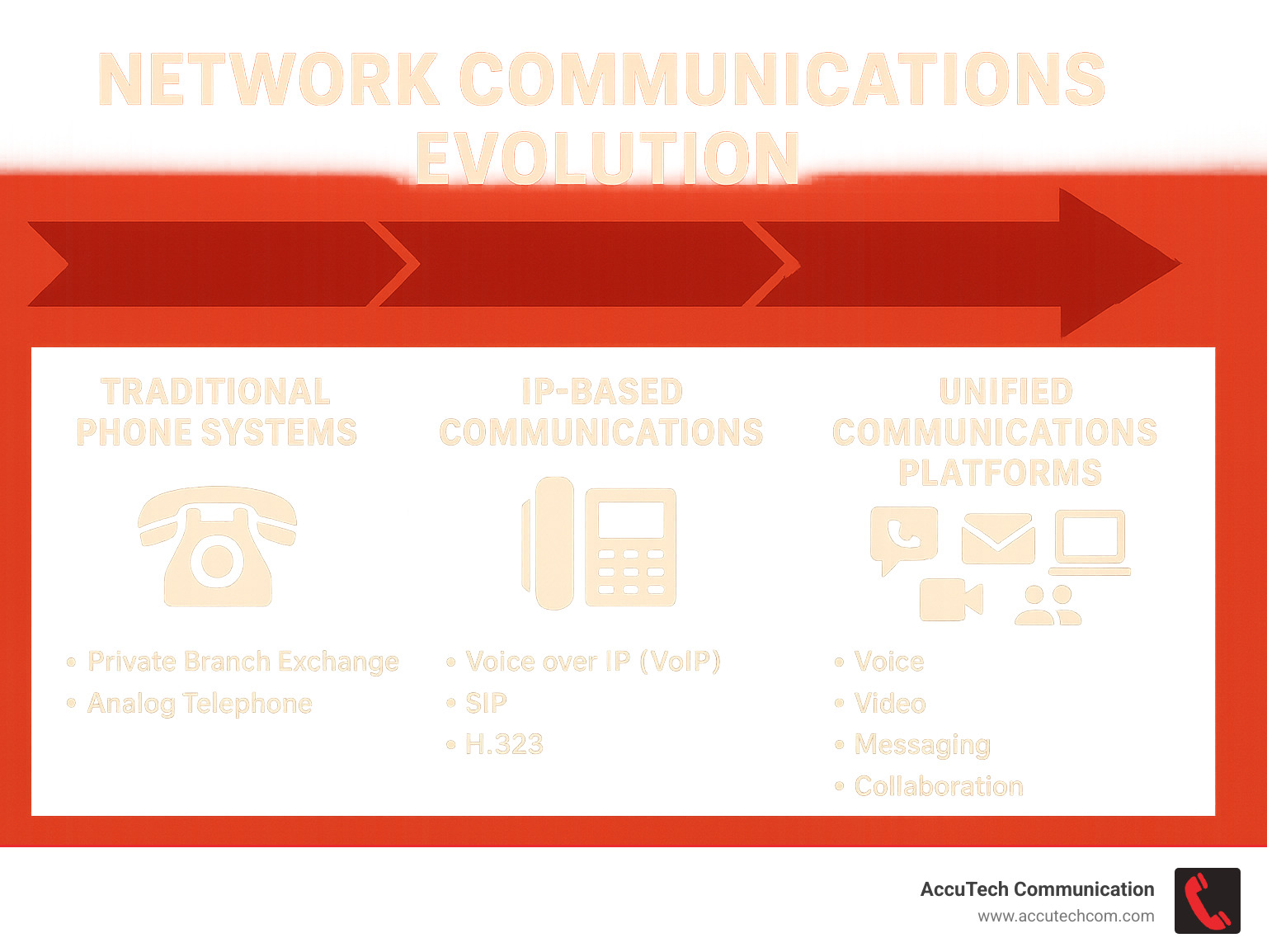
Modern businesses require communication tools that transcend traditional phone systems. Unified Communications (UC) platforms integrate multiple channels into a cohesive experience:
- Voice over IP (VoIP): Converting voice signals to data packets for transmission over IP networks
- Video Conferencing: Supporting face-to-face communication regardless of location
- Instant Messaging: Enabling quick text-based exchanges for immediate needs
- Presence Information: Showing availability status to optimize communication timing
- File and Screen Sharing: Facilitating collaboration on documents and presentations
Key technologies powering UC systems include:
- SIP Trunking: Replacing traditional phone lines with internet-based connections to the public telephone network
- Collaboration Applications: Software platforms that integrate multiple communication channels
- Mobile Integration: Extending UC capabilities to smartphones and tablets for on-the-go access
“With a focus on improving collaboration AND customer service, today’s telephone systems are built to handle increased call volumes and integrate seamlessly with your existing workflow and CRM tools.”
UC systems represent a significant evolution from legacy phone systems, shifting voice communications from dedicated telephone wires onto existing data networks. This consolidation reduces costs while enabling new capabilities that improve productivity.
3. Wi-Fi 6 & Private 5G – Wireless That Works Like Wired
Wireless connectivity has evolved dramatically, with current technologies approaching the reliability and performance of wired connections. Modern wireless solutions include:
- Wi-Fi 6 (802.11ax): The latest Wi-Fi standard offering dramatically improved performance in dense environments
- Private 5G Networks: Dedicated cellular networks that businesses can deploy on their premises for ultra-reliable connectivity
These technologies leverage several advanced capabilities:
- Orthogonal Frequency Division Multiple Access (OFDMA): Allowing multiple clients to share channels simultaneously
- Multi-User MIMO: Enabling access points to communicate with multiple devices at once
- Target Wake Time: Reducing power consumption by scheduling device communications
- Beamforming: Focusing wireless signals toward specific devices rather than broadcasting omnidirectionally
For businesses with large campuses or challenging RF environments, private 5G offers unique advantages:
- Dedicated Spectrum: Operating in licensed or shared spectrum bands with less interference
- Mobility Support: Seamless handoffs as users move throughout the facility
- Quality of Service: Guaranteed performance for critical applications
- Extended Range: Better coverage in large facilities or outdoor areas
At AccuTech Communications, we conduct thorough wireless site surveys to design optimal coverage patterns and ensure reliable performance throughout your facility.
4. Network Security & Zero Trust – Protecting Network Communications
In today’s interconnected world, network communications no longer stay neatly within your building’s walls. As your network extends beyond traditional boundaries, your security approach needs a complete rethink.
The old “castle and moat” security model—where everything inside your network was trusted and everything outside wasn’t—simply doesn’t work anymore. With remote work, cloud applications, and mobile devices, the concept of “inside” and “outside” has fundamentally changed.
That’s where Zero Trust comes in. This security model operates on a simple principle: trust nothing, verify everything.
“Network security measures include data encryption, firewalls, intrusion detection systems, and virtual private networks (VPNs).”
Zero Trust Architecture treats every access request as if it originates from an untrusted source—even if it comes from inside your network. This means verifying every user and every device, every single time. It sounds exhausting, but with the right tools, it happens seamlessly in the background.
Another powerful approach is micro-segmentation. Think of it as creating security checkpoints throughout your network, not just at the entry points. If a breach occurs in one segment, it stays contained rather than spreading throughout your entire system. It’s like having fireproof doors throughout your building instead of just at the entrance.
The most secure networks also employ continuous monitoring. Rather than periodic security checks, these systems constantly watch for unusual patterns that might indicate a breach. It’s like having a vigilant security guard who never takes a coffee break.
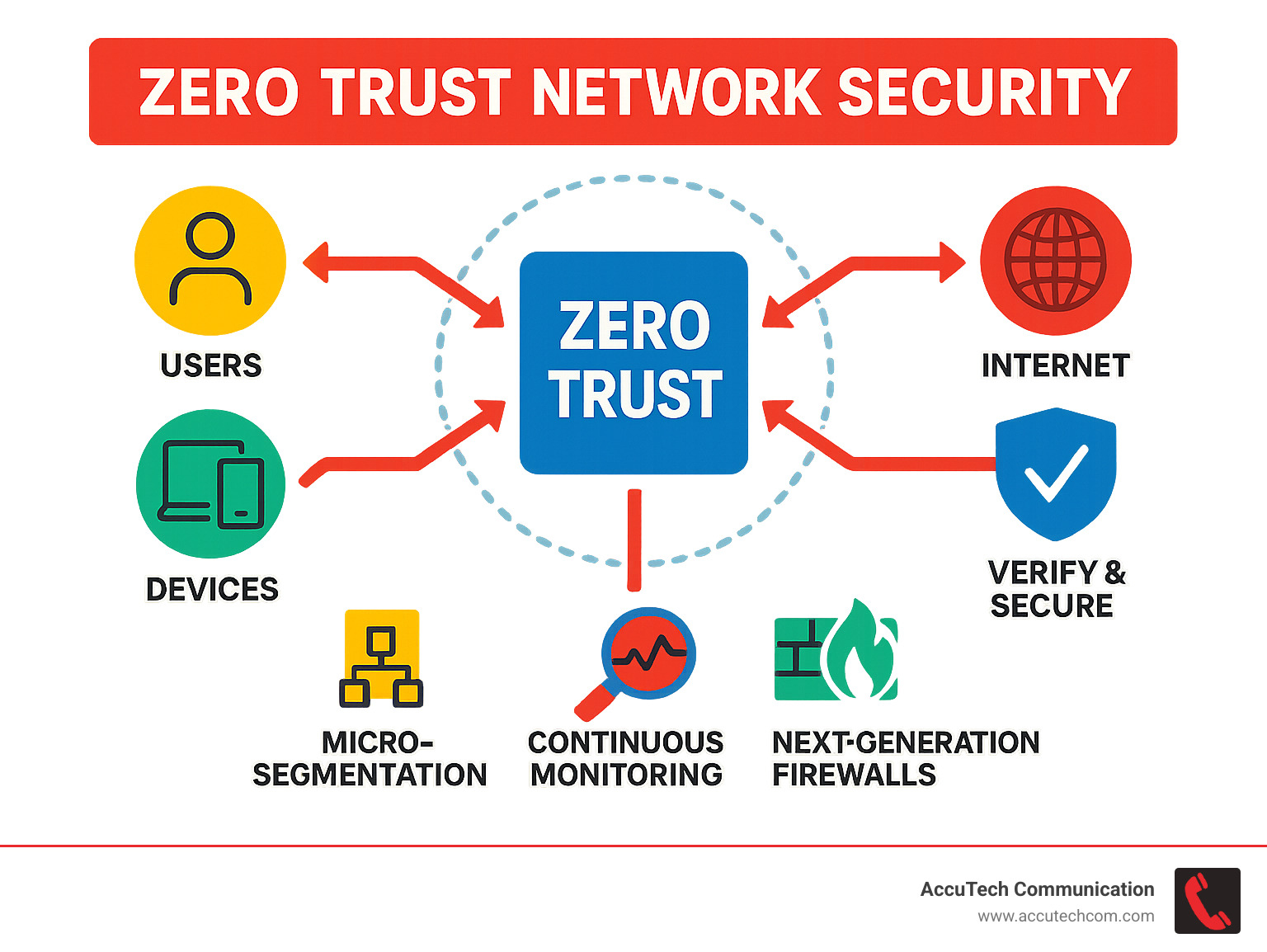
The backbone of modern network security includes several critical components:
Next-generation firewalls do much more than their predecessors. Beyond simply filtering traffic, they inspect data packets deeply, identify applications regardless of port or protocol, and stop threats in real-time.
Multi-factor authentication (MFA) adds crucial layers of protection by requiring users to verify their identity in multiple ways. Something you know (password), something you have (phone), something you are (fingerprint)—combining these makes unauthorized access exponentially more difficult.
Encryption protects your data whether it’s traveling across the network or sitting in storage. Even if someone intercepts your information, strong encryption renders it unreadable without the proper keys.
Intrusion detection and prevention systems act as your network’s immune system, constantly scanning for suspicious behavior and automatically responding to threats before they can cause damage.
The shift to remote work has dramatically accelerated the adoption of these Zero Trust models. At AccuTech Communications, we’ve helped numerous Massachusetts, New Hampshire, and Rhode Island businesses transition to this more robust security approach—maintaining productivity while significantly reducing their risk profile.
Network security isn’t just about keeping bad actors out—it’s about verifying that everyone inside is exactly who they claim to be.
5. Cloud-Managed Networking Platforms – Visibility From Anywhere
Modern network communications infrastructure increasingly relies on cloud-based management platforms that provide:
- Centralized Control: Managing all network devices from a single interface
- Real-time Visibility: Monitoring performance, security, and usage patterns
- Automated Optimization: Adjusting settings based on changing conditions
- Remote Troubleshooting: Diagnosing and resolving issues without on-site visits
Key technologies in this space include:
- Software-Defined Wide Area Networking (SD-WAN): Intelligently routing traffic across multiple connection types
- AI-Driven Analytics: Using artificial intelligence to identify patterns and predict issues before they impact users
- Auto-Provisioning: Configuring new devices automatically based on predefined templates
- API Integration: Connecting network management with other business systems
These platforms transform how networks are managed, reducing operational overhead while improving responsiveness to changing conditions. They’re particularly valuable for organizations with multiple locations or limited IT staff.
Implementation & Best Practices
Successfully implementing network communications solutions isn’t just about installing equipment—it’s about creating a foundation that supports your business both today and tomorrow. At AccuTech, we’ve refined our approach over decades of hands-on experience.
A thoughtful implementation begins with a comprehensive site survey. We walk your space, document what exists, identify your specific requirements, and plan for how your business might grow. This foundational step prevents costly surprises later.
Next comes the detailed design phase—the blueprint that guides everything that follows. We map out precise cabling paths, determine optimal equipment locations, and create logical configurations that align with your business processes.
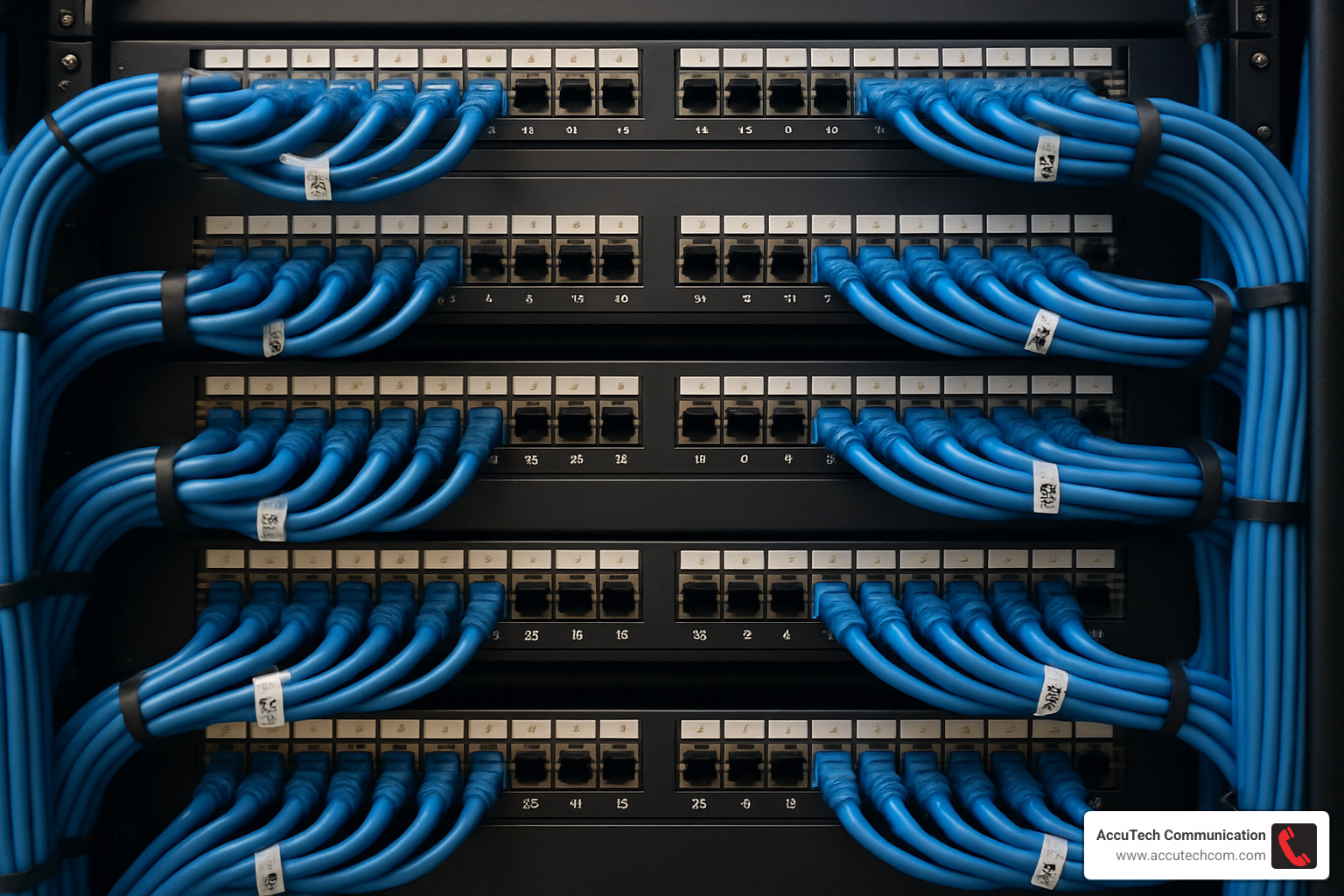
When it’s time for installation, we only use certified technicians who take pride in their craftsmanship. The quality of your installation directly impacts how your network performs for years to come—which is why we never cut corners. After installation, we conduct thorough testing against specifications, ensuring everything performs exactly as promised before you sign off.
Finally, we provide complete documentation of your new system. This isn’t just paperwork—it’s a valuable resource for your team and any future modifications.
“With your own unique infrastructure from AccuTech Communications, you can make a lasting impression on business operations and customer experience.”
Our approach to network communications includes building in redundancy to eliminate single points of failure. When one component has an issue, another seamlessly takes over. We also believe in standardizing components throughout your network—using consistent equipment and configurations makes ongoing management much simpler.
Proper change management procedures are essential too. We follow structured processes for any modifications to avoid disrupting your operations. And we recommend regular maintenance schedules to proactively inspect and update systems before small issues become major problems.
Our network cabling installation services throughout Massachusetts, New Hampshire, and Rhode Island follow these time-tested principles, consistently delivering reliable, high-performance results for businesses of all sizes.
Designing for Scalability in Network Communications
The network you build today shouldn’t become obsolete tomorrow. Scalable design gives your business room to grow without requiring complete rebuilds when your needs change.
We recommend modular equipment racks that allow for easy expansion. When you need to add capacity, you simply slot in new components rather than replacing entire systems.
Modern leaf-spine topology creates non-blocking network fabrics that scale horizontally as your business grows. This approach eliminates bottlenecks that can occur in traditional network designs.
Virtualization plays a crucial role too, using software to abstract network functions from hardware. This flexibility lets you adapt quickly to changing requirements without physical modifications.
We also believe in strategically overprovisioning key components—building in extra capacity for future expansion costs less than retrofitting later. At AccuTech Communications, every network we design considers not just your current needs, but where your business is heading.
Measuring Impact & ROI
How do you know if your network communications investment is delivering value? By measuring the right metrics.
Uptime Service Level Agreements (SLAs) track network availability, with modern businesses typically targeting 99.9% or higher. Every tenth of a percentage point matters—the difference between 99.9% and 99.99% uptime is nearly nine hours of additional productivity annually.
Mean Time to Repair (MTTR) measures how quickly issues are resolved when they occur. As this number decreases, your operational efficiency increases.
User Experience Metrics assess application performance from your team’s perspective. Technical measurements matter, but how your network feels to the people using it daily matters more.
The Net Promoter Score gauges overall satisfaction with network services. Would your team recommend your current network setup to other departments or businesses? This simple question often reveals deeper insights than technical metrics alone.
By establishing baselines and regularly measuring these metrics, you can demonstrate the value of your network investments and identify opportunities for improvement. At AccuTech, we help clients not just build great networks, but understand their true business impact.
Frequently Asked Questions about Network Communications
What makes “Network Communications” different from basic data transfer?
Think of basic data transfer as sending a package through the mail – it’s just about getting something from here to there. Network communications, on the other hand, is like having an entire logistics company at your disposal.
When we talk about true network communications, we’re referring to a comprehensive ecosystem that does far more than just move data. It’s about creating a digital nervous system for your business that handles everything from making sure different systems can talk to each other (protocol management) to ensuring your most important applications get priority treatment when the network gets busy (quality of service).
Modern network communications also builds in layers of security to keep your data safe, creates multiple pathways so a single failure doesn’t bring everything down, and seamlessly connects all your different systems – from your phone system to your security cameras to your cloud applications.
At AccuTech, we’ve seen how businesses transform when they move beyond thinking about simple data transfer to embracing comprehensive network communications solutions that support their entire operation.
How do I future-proof my network for emerging technologies?
Nobody wants to invest in technology that will be obsolete before you’ve finished paying for it. Future-proofing your network communications is something we take seriously at AccuTech.
The most important step is embracing open standards rather than proprietary technologies. Think of it like building with Lego blocks that can be reconfigured rather than a jigsaw puzzle with pieces that only fit one way.
Physical infrastructure is the hardest thing to change later, so we recommend installing more capacity than you immediately need. It’s much easier to upgrade the electronics that use the cables than to pull new cables through walls and ceilings.
Virtualization is another key strategy – using software to handle functions that previously required specialized hardware gives you flexibility to adapt without replacing equipment. It’s like having a smartphone that can become different tools through apps rather than carrying a separate device for each function.
We also build redundancy into every network we design. Having backup systems and alternative pathways means you stay operational even when something fails.
Finally, staying current with software updates keeps your network secure and compatible with new technologies. We’ve helped countless businesses across Massachusetts, New Hampshire, and Rhode Island implement these strategies to ensure their investments stand the test of time.
Which metrics should I track to judge network success?
Measuring the right things makes all the difference between a network that looks good on paper and one that actually delivers for your business. We recommend tracking both technical performance and business impact.
On the technical side, keep an eye on latency (how long data takes to travel), jitter (variations in that travel time that can make video calls choppy), and packet loss (data that never reaches its destination). Also monitor your bandwidth utilization so you can see trends and plan for growth before you hit capacity limits.
But the technical metrics only tell part of the story. What really matters is how well your network communications support your business. Track how quickly your critical applications respond to users, how often network issues are reported, and how quickly those issues get resolved. Gather feedback from the people who depend on the network every day.
The most valuable insight comes from connecting network performance to business outcomes. Does improved network performance correlate with higher productivity, better customer satisfaction, or increased sales? These connections help justify investments in your network communications infrastructure.
At AccuTech Communications, we help our clients establish monitoring systems that capture both technical excellence and business value, giving you a complete picture of your network’s contribution to your success.
Conclusion
The landscape of Network Communications continues to evolve rapidly, driven by changing work patterns, increasing data volumes, and emerging technologies. Organizations that build robust, scalable network foundations will be better positioned to adapt to these changes and leverage new opportunities.
When I look at the network evolution I’ve witnessed over my 30+ years in this industry, I’m still amazed at how far we’ve come. Yet the fundamental principles remain consistent: businesses need reliable, secure, and efficient ways to exchange information.
What’s become crystal clear in today’s digital environment is that your network isn’t just plumbing anymore—it’s the circulatory system of your entire operation. The choices you make today will impact your ability to compete tomorrow.
Let me share what I believe are the most important takeaways from our roundup:
First, despite all the wireless innovation, physical infrastructure remains critical. Those cables hidden in your walls and ceilings are the silent workhorses of your network. When properly installed, they provide the consistent performance that mission-critical applications demand.
Second, unified communications has transformed how teams collaborate by bringing together voice, video, and messaging on a single platform. This convergence eliminates the silos that once separated different communication methods, creating a seamless experience regardless of location.
Third, advanced wireless technologies have matured to the point where they now rival wired connections for many applications. Wi-Fi 6 and private 5G networks offer unprecedented reliability and performance for mobile users.
Fourth, security must be embedded throughout your network, not just at the perimeter. The zero-trust approach, while sometimes challenging to implement, provides the protection modern businesses need in an increasingly distributed world.
Finally, cloud management platforms have revolutionized how we monitor and maintain networks, providing unprecedented visibility and control without requiring on-site presence.
At AccuTech Communications, we’ve been helping businesses across Massachusetts, New Hampshire, and Rhode Island steer these changes since 1993. Our expertise in network cable services and communications infrastructure provides a solid foundation for businesses looking to improve their network capabilities.
I’ve found that companies benefit tremendously from partnering with a single vendor for their complete Network Communications needs. This approach simplifies management, ensures compatibility between components, and gives you a single point of accountability for performance. No more finger-pointing between vendors when issues arise!
As you consider your network modernization roadmap, the infrastructure decisions you make today will shape your organization’s capabilities for years to come. With proper planning and implementation, your network can become a competitive advantage rather than a limitation.
We’d love to help you build that advantage. After all, in today’s connected world, your business is only as strong as the network supporting it.
