Can You Reuse Existing Network Drops After an Office Layout Change?
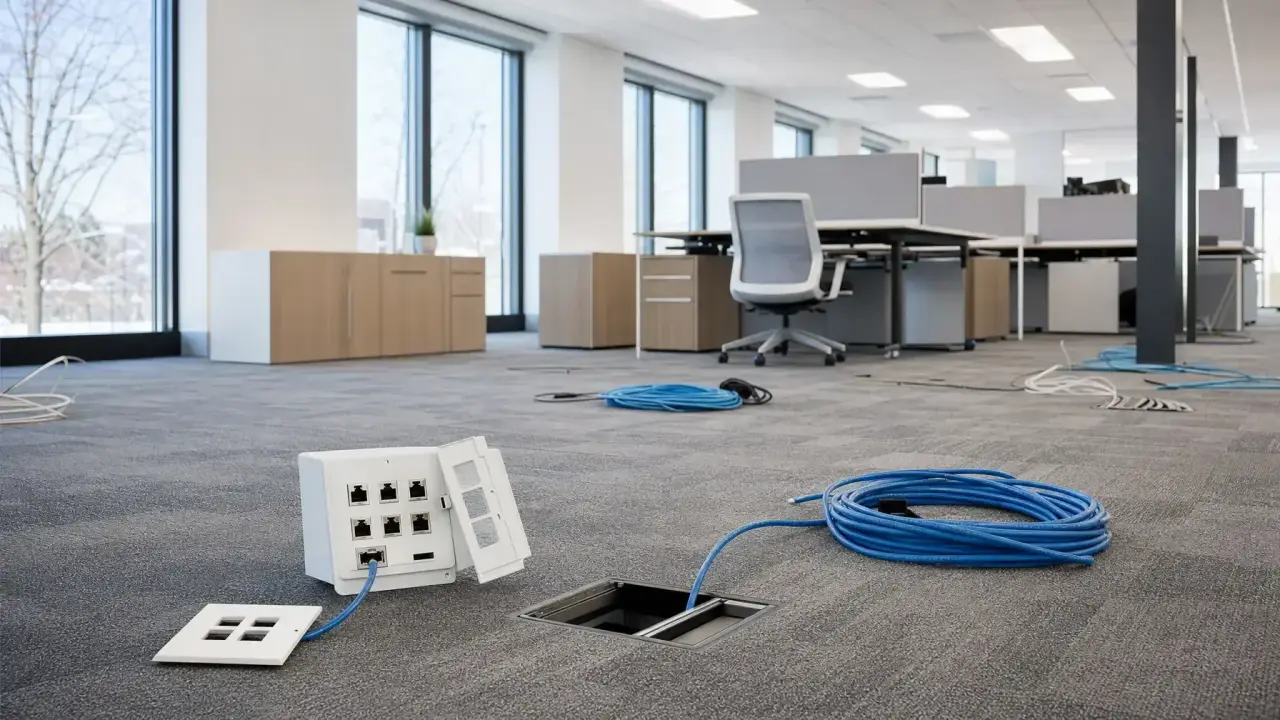
Yes—existing copper network drops may be reusable after an office layout change, provided their location, condition and suitability for the intended equipment are established. Moving desks does not automatically require replacing the cabling. Equally, an outlet that looks intact or currently provides a connection is not enough evidence to approve it for a different use.
Treat each drop as a separate decision. Map it to the revised layout, gather the records you have, and identify what remains unknown. That gives your IT team and cabling contractor a useful basis for deciding what to retain, investigate, repair or replace.
Start with the new workspace, not the nearest jack
Mark the proposed desks, shared work areas and wired devices on your revised floor plan. Include phones, printers, wireless access points and other equipment where applicable. Ask IT to identify the connection requirements for each intended use, including any equipment power requirements carried over the network connection.
Then mark the existing outlets that might serve those locations. Record whether each outlet will remain accessible once furniture and partitions are in place. Do not assume that a nearby outlet can serve a workspace just because a patch cord could reach it; have the proposed connection arrangement assessed rather than planning loose cords across circulation areas.
Keep location and cable condition separate. A sound existing run may be in the wrong place for the revised layout. An outlet in the ideal position may still have an unresolved fault or unknown capabilities.
Gather evidence that belongs to the specific drop
Collect available outlet labels, endpoint schedules, floor plans and previous test documentation. Ask IT whether records identify the corresponding patch-panel port and network closet. Preserve missing or conflicting information as an open question instead of filling the gap with a guess.
- Identity: Does the outlet label match the available records, and is the other end identified?
- History: Are there reports of dropped connections, inconsistent performance or previous repairs associated with this outlet?
- Documentation: Can a previous test record be tied to this particular run, and is any subsequent work known?
- Intended use: Is the proposed equipment different from what used the outlet before?
Previous test documentation is evidence to review, not an automatic approval for reuse. Ask the assessor whether it addresses the intended application and whether changes or reported problems call for further assessment. Likewise, a missing record creates uncertainty; it does not, by itself, prove that the cable needs replacement.
Note Document what is visible and already available. Do not open wall plates, lift ceiling tiles, modify terminations or unplug live connections to identify a run. Leave concealed-pathway inspection, tracing and technical assessment to qualified personnel working with your IT team.
Separate the reason for concern before choosing an action
Describe the issue without diagnosing it. “Outlet will be behind the new partition,” “label has no matching record” and “users report intermittent connection loss” are different findings. They should not all become a blanket instruction to replace cabling.
- Location problem: Ask whether the existing outlet can appropriately serve the planned device location. If not, plan a new drop rather than treating the problem as a cable fault.
- Unknown identity or condition: Request assessment to establish what the run is and whether it meets the intended requirement before deciding to retain or replace it.
- Reported connection problem: Record the symptoms, affected equipment and circumstances. Let IT and the cabling assessor determine whether the issue involves the installed run, patch cords, equipment or another part of the network.
- Visible damage: Record the affected outlet or accessible component without disturbing it, and refer it for professional assessment.
Use a conditional reuse, repair or replacement decision
Retain a drop when its identity is established, its location works for the revised layout, and the assessment supports its intended use. Keep it marked as a reuse candidate—not confirmed for reuse—while relevant questions remain unanswered.
Consider repair when an assessor identifies a localized issue that can appropriately be corrected and the remaining run is suitable. Ask what verification is needed after the repair before returning it to service. Repairing an identified fault and establishing suitability for new equipment are related but separate decisions.
Plan a replacement or new run when assessment shows that the existing drop cannot meet the requirement, its condition does not support retention, or its location no longer serves the layout. Replacement addresses an unsuitable existing run; an additional drop addresses a connection needed elsewhere. Your revised office may need a mixture of retained, repaired and new connections.
Build a drop-by-drop assessment worksheet
Create a worksheet entry for each proposed wired connection and its candidate outlet. Use the fields below, keeping observations separate from conclusions. Where information is unavailable, write “unknown” and identify who will resolve it.
| Worksheet field | What to record | Question to resolve |
|---|---|---|
| Proposed workspace | Room, floor-plan location and intended device | Has IT confirmed the connection requirement? |
| Candidate outlet | Visible label and current location | Will the outlet appropriately serve the new position? |
| Endpoint records | Recorded closet and patch-panel port, if known | Does the record match this outlet? |
| Previous evidence | Available test documents and known changes | What further assessment is needed for the proposed use? |
| Observed concerns | Visible damage or reported symptoms, without a diagnosis | Who will investigate the concern? |
| Decision and next action | Reuse candidate, assessment needed, repair proposed or new run proposed | What evidence and confirmation are still required? |
Bring the open questions to the assessment
Share the revised floor plan, worksheet and available records with IT and the cabling contractor. Ask them to distinguish confirmed reuse decisions from items still requiring investigation, and to explain why any repair or new run is proposed. The worksheet is a way to organize evidence—not a substitute for technical assessment.
Accutech Communications handles new drops, re-cables, office moves and repairs for Massachusetts businesses. Its network cabling installation and repair services cover those drop-level needs.
If the changes also involve closets, racks, patch panels or backbone connections, Accutech's structured cabling services address the system those drops connect to.
When you request a cabling estimate, describe the layout changes and identify which drops are candidates for reuse and which remain uncertain. You do not need to decide that every existing cable stays—or every cable goes—before asking for help.