
Security Camera for Business: Top 5 Essential Features
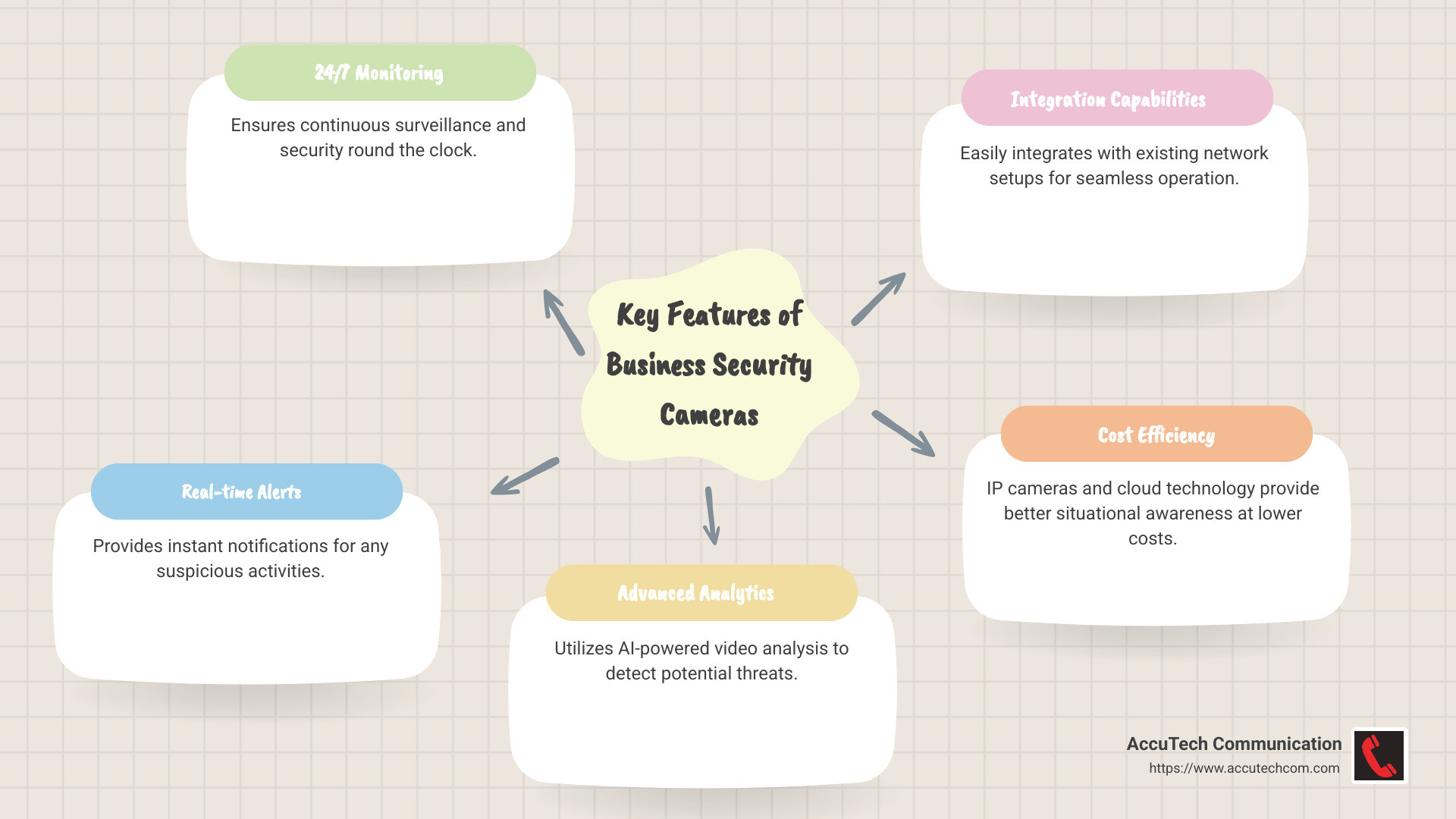
Security camera for business is more than just a precaution; it’s a necessity in today’s world. With threats ranging from theft and vandalism to employee misconduct, having a reliable business security system is crucial. But what exactly makes up a business surveillance system? Here’s a quick breakdown:
- 24/7 Monitoring: Continuous coverage day and night to ensure constant surveillance.
- Real-time Alerts: Instant notifications for any suspicious activity.
- Advanced Analytics: Detect potential threats automatically using AI-powered video analysis.
- Integration Capabilities: Easy connection with existing network setups.
Security cameras have evolved tremendously since their early days as “closed circuit” systems. Now, options like IP cameras and cloud technology provide improved features for better situational awareness and cost efficiency. Therefore, investing in a commercial CCTV system can significantly deter criminal activity, with studies indicating a 60% reduction in burglaries when cameras are visibly in place.
As Corin Dolan, with significant expertise in security camera for business infrastructure, I understand the importance of technologically advanced systems to safeguard your valuable assets. This introduction serves as a stepping stone into deeper topics about security camera systems you’ll find in the following sections!
Basic security camera for business glossary:
– commercial security
– business video surveillance
– camera monitoring
Understanding Business Security Cameras
When it comes to security camera for business, understanding the different systems is key to choosing the right one for your needs. Let’s break down the main types: NVR systems, DVR systems, IP cameras, and analog cameras.
NVR Systems
NVR (Network Video Recorder) systems are the modern choice for many businesses. They use digital IP cameras that process video and audio signals before sending them to the recorder. This means you get high-quality video with features like color night vision and face recognition. NVR systems can be wired, using Ethernet cables that also provide power (thanks to PoE technology), or wireless, connecting via WiFi. These systems are flexible and can be accessed remotely through apps, allowing business owners to monitor their premises from anywhere.
DVR Systems
On the other hand, DVR (Digital Video Recorder) systems use analog cameras. These cameras connect to the recorder using coaxial cables. While DVR systems are reliable, they are less flexible compared to NVR systems. The video quality is generally lower, and advanced features like face recognition are not typically available. However, DVR systems can be a cost-effective solution for businesses with simpler security needs.
IP Cameras
IP (Internet Protocol) cameras are the stars of NVR systems. They offer high-resolution video and can include advanced features like motion detection and video analytics. IP cameras are ideal for businesses that need detailed footage and smart surveillance capabilities. They can be integrated with existing network setups, making them a versatile choice for both new installations and system upgrades.
Analog Cameras
Analog cameras are the traditional choice found in DVR systems. They are straightforward and have been used for years in various security setups. While they don’t offer the same level of detail or features as IP cameras, they are reliable and can be a good fit for businesses that need basic surveillance without the need for high-tech features.
Choosing the Right System
When selecting a security camera for business, consider the size of your premises, the level of detail you need, and your budget. NVR systems with IP cameras are great for businesses that require high-quality footage and advanced features. If your needs are more basic, a DVR system with analog cameras might be sufficient.
Each system type has its own strengths and can be custom to meet the unique needs of your business. Understanding these differences will help you make an informed decision that ensures your business is well-protected.
In the next section, we’ll explore the various types of security camera systems available, including wired, wireless, and wire-free systems, and how they can be integrated into your business environment.
Types of Security Camera Systems for Business
When it comes to protecting your business, choosing the right security camera system is crucial. Let’s explore the different types: wired systems, wireless systems, wire-free systems, and PoE.
Wired Systems
Wired systems are the traditional choice for many businesses. They connect cameras to recorders using cables, which ensures a stable and reliable connection. These systems often use Ethernet cables that provide both power and data transfer through Power over Ethernet (PoE) technology. This means fewer cables and a cleaner setup.
Advantages:
– Reliability: Wired systems are less prone to interference.
– Consistent Power Supply: PoE eliminates the need for separate power sources.
– High-Quality Video: Stable connections ensure high-resolution footage.
Considerations:
– Installation Complexity: Requires professional installation due to cabling.
– Limited Flexibility: Harder to relocate cameras once installed.
Wireless Systems
Wireless systems use WiFi to transmit video data, offering more flexibility in camera placement. They still require a power source, but without the need for data cables, installation is simpler.
Advantages:
– Easy Installation: No extensive cabling required.
– Flexible Placement: Cameras can be positioned anywhere within WiFi range.
Considerations:
– Potential Interference: WiFi signals can be disrupted by other devices.
– Power Source Required: Cameras still need to be plugged in.
Wire-Free Systems
Wire-free systems take wireless a step further by using battery-powered cameras. This means no cables at all, offering the ultimate flexibility in camera placement.
Advantages:
– Ultimate Flexibility: Place cameras anywhere, even in remote locations.
– Easy to Relocate: Cameras can be moved as needed without hassle.
Considerations:
– Battery Life: Regular battery changes or recharging is necessary.
– Signal Range: Limited to the range of the base station or WiFi.
Power over Ethernet (PoE)
Power over Ethernet (PoE) is a technology used in wired systems that simplifies installation by allowing a single cable to provide both power and data. This is particularly useful for businesses looking to minimize cable clutter and installation complexity.
Advantages:
– Simplified Cabling: Reduces the number of cables needed.
– Centralized Power Management: Easier to manage and troubleshoot.
Considerations:
– Specialized Equipment: Requires PoE-compatible devices and switches.
Choosing the right type of security camera for business depends on your specific needs and environment. Wired systems offer reliability, wireless systems provide flexibility, and wire-free systems deliver maximum freedom in camera placement. PoE technology improves wired systems by simplifying power and data management. Understanding these options will help you select the best system to keep your business secure.
In the following section, we’ll discuss the key features to look for in a security camera system, such as night vision and AI analytics, to ensure you get the most out of your investment.
Key Features to Consider
When selecting a security camera for business, it’s crucial to focus on the features that will best meet your needs. Here are some key features to consider:
Night Vision
Night vision is essential for monitoring your business around the clock. Cameras with this feature use infrared (IR) technology to capture clear images in low-light or no-light conditions. This ensures your surveillance system is effective even when the lights go out.
Benefits:
– 24/7 Surveillance: Keep your business secure day and night.
– Improved Detail: Infrared capabilities provide clear images in darkness.
Face Recognition
Face recognition technology allows cameras to identify and verify individuals based on their facial features. This can improve security by alerting you when unauthorized persons are detected.
Benefits:
– Improved Security: Quickly identify potential intruders.
– Access Control: Monitor who enters and exits your premises.
AI Analytics
AI analytics bring smart technology to your surveillance system. With features like person detection, vehicle detection, and behavior analysis, AI can help reduce false alarms and provide valuable insights.
Benefits:
– Proactive Security: Receive alerts for suspicious activity.
– Operational Insights: Use data to improve business operations.
Cloud Storage
Cloud storage offers a convenient way to store and access video footage. Instead of relying solely on physical storage devices, cloud solutions provide flexibility and scalability.
Benefits:
– Remote Access: View footage from anywhere with an internet connection.
– Scalability: Easily expand storage as your needs grow.
These features can significantly improve the effectiveness of a security camera for business. Whether it’s ensuring visibility at night, leveraging AI for smarter monitoring, or using cloud storage for easy access, these capabilities can make a big difference in protecting your business.
In the next section, we’ll cover the installation process and costs associated with setting up a security camera system for your business.
Security Camera for Business: Installation and Costs
When it comes to setting up a security camera for business, understanding the installation process and associated costs is crucial. Let’s break it down so you know what to expect.
Installation Costs
The cost of installing a security camera system can vary widely depending on several factors. These include the type of cameras, the number of cameras, and whether you choose a wired or wireless system.
- Wired Systems: Generally more expensive to install due to the complexity of running cables throughout your facility. However, they often offer more reliable connections.
- Wireless Systems: Easier and cheaper to install since they don’t require extensive cabling. But, they may need more maintenance to ensure stable connectivity.
- Professional Installation: Hiring experts can ensure that your system is set up correctly and efficiently. This can save you time and potential headaches from DIY errors. Plus, professionals can provide valuable advice on camera placement and system optimization.
Cost Deduction
Did you know that installing security cameras might be tax-deductible? Many businesses can write off security systems as a business expense. It’s important to consult with a tax professional to understand the specific deductions available in your area.
Professional Installation
Opting for professional installation can be a wise investment. Professionals bring experience and expertise, ensuring that your cameras are positioned for optimal coverage. They also handle the technical aspects, like integrating with existing systems and configuring your network video recorders (NVRs) or digital video recorders (DVRs).
Benefits of Professional Installation:
– Expertise: Proper setup and troubleshooting.
– Time-Saving: Quick and efficient installation.
– Peace of Mind: Assurance that your system is working as intended.
While the upfront cost might be higher, the long-term benefits of a professionally installed system often outweigh the initial investment.
In the next section, we’ll address some frequently asked questions about business security cameras, including legal considerations and potential tax deductions.
Frequently Asked Questions about Business Security Cameras
How much do security cameras cost for a business?
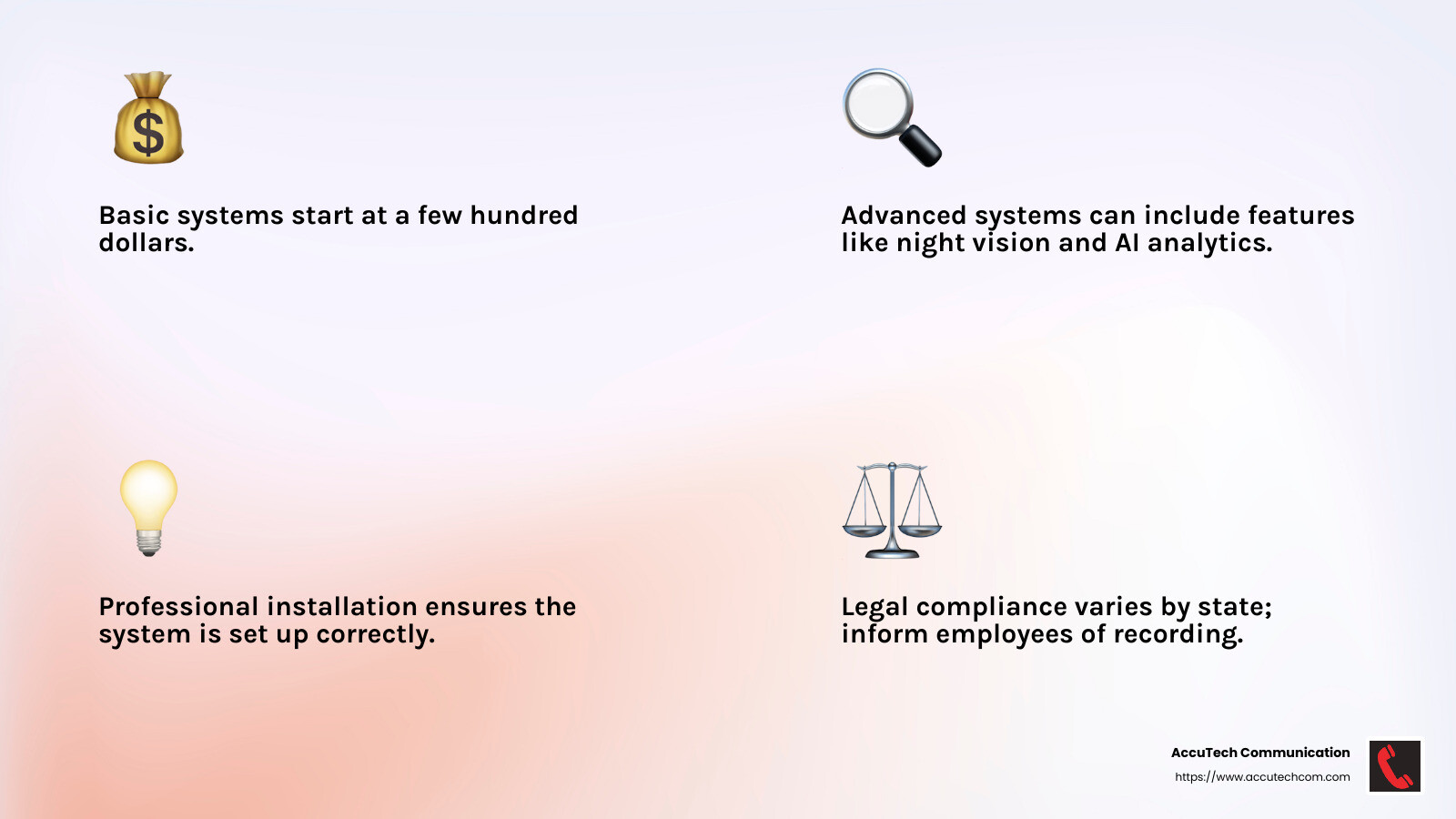
The cost of a security camera for business can vary based on several factors. On average, a basic system might start at a few hundred dollars, while more advanced setups can run into the thousands. Here’s a quick breakdown:
- Basic Systems: These often include a few cameras and a simple recording device. They are suitable for small businesses and usually cost less.
- Advanced Systems: These include features like night vision, AI analytics, and cloud storage. They are ideal for larger facilities and can be more expensive.
Installation Costs: As mentioned earlier, professional installation adds to the cost. However, it ensures that the system is set up correctly, saving you potential future expenses.
Is it legal for businesses to have hidden cameras?
Legal Considerations: Yes, businesses can have hidden cameras, but there are legal guidelines to follow. Privacy laws vary by state, so understand the regulations in your area.
- Notice: In many places, you must inform employees and customers that they are being recorded, even if the cameras are hidden.
- Areas of Privacy: Installing cameras in private areas like restrooms or locker rooms is generally illegal.
Always consult with a legal expert to ensure compliance with local laws.
Can you write off security cameras for business?
Yes, you can often write off security cameras as a business expense. This can help reduce the overall cost of your security system.
Tax Deductions: Security systems are considered a capital expense. They can be depreciated over time, or in some cases, fully deducted in the year they are purchased.
- Consult a Tax Professional: To understand the specific tax benefits available, it’s wise to consult with a tax advisor familiar with your local regulations.
In the next section, we’ll wrap up our guide with a look at why AccuTech Communications is a trusted choice for businesses in Massachusetts and beyond.
Conclusion
When it comes to securing your business, choosing the right partner is crucial. AccuTech Communications, serving Massachusetts, New Hampshire, and Rhode Island since 1993, stands out as a reliable choice for businesses seeking top-notch security solutions.
Why Choose AccuTech?
- Proven Track Record: With decades of experience, we’ve built a reputation for delivering quality service and competitive pricing. Our clients trust us to keep their businesses secure, and we take that responsibility seriously.
- Comprehensive Services: We offer more than just security cameras. Our services include network cabling, business phone systems, and data center technologies. This makes us a one-stop-shop for all your communication and security needs.
- Expert Installation: Our certified technicians ensure that your security camera for business is installed correctly and efficiently. Professional installation not only provides peace of mind but also optimizes the performance of your security system.
- Customer-Centric Approach: We prioritize customer satisfaction, offering personalized solutions custom to your specific needs. Our team is always ready to assist, ensuring that your business is protected around the clock.
- Local Expertise: Being based in Massachusetts, we understand the unique needs of businesses in the region. Our local presence means we’re always nearby to support you whenever needed.
For businesses looking to improve their security infrastructure, partnering with a reliable provider like AccuTech Communications can make all the difference. From initial consultation to ongoing support, we’re here to help you every step of the way.
Request a consultation to learn more about how we can secure your business with a customized solution. Let us help you safeguard your assets and ensure peace of mind.
