Step-by-Step Guide to Fiber Optic Connectivity Solutions
Why Fiber Optic Connectivity Solutions Are the Backbone of Modern Business Networks
Fiber optic connectivity solutions are the gold standard for fast, reliable, and scalable commercial networks, and for good reason.
Here’s a quick breakdown of what they are and why they matter:
| Feature | What It Means for Your Business |
|---|---|
| Speed | Supports 10 Gbps to 400 Gbps and beyond |
| Distance | Transmits data up to 70 km without signal loss |
| Bandwidth | Up to 1,000x the capacity of copper cabling |
| Reliability | Immune to electromagnetic interference (EMI) |
| Security | Extremely difficult to tap or intercept |
| Scalability | Ready for 5G, AI, IoT, and future tech demands |
Whether you’re running a corporate campus, a multi-floor office, or a data-intensive operation in Massachusetts, New Hampshire, or Rhode Island, your network infrastructure directly impacts how well your business runs.
Outdated copper wiring simply can’t keep up. High-definition video, cloud applications, real-time data, and connected devices are pushing traditional networks to their limits. Fiber removes those limits.
The global fiber optic cable market is projected to reach $11.7 billion by 2026, a clear signal that businesses everywhere are making the switch.
I’m Corin Dolan, owner of AccuTech Communications, and I’ve spent decades helping commercial clients across Massachusetts, New Hampshire, and Rhode Island design and deploy fiber optic connectivity solutions that keep their operations running at full speed. In this guide, I’ll walk you through everything you need to know, from core architecture and deployment strategies to emerging trends and how to choose the right solution for your business.
Fiber optic connectivity solutions terms to know:
Core Architecture of Fiber Optic Connectivity Solutions
To understand why fiber optics perform so incredibly well, we have to look at how they are built. At its most basic level, an optical fiber is a strand of extremely pure glass (or sometimes plastic) that is about the thickness of a human hair.
This tiny strand is made up of two primary layers:
- The Core: The inner glass channel through which light travels.
- The Cladding: An outer layer of glass that surrounds the core. The cladding has a different refractive index, which acts like a mirror, reflecting light back into the core and keeping it trapped as it zigs and zags down the line. This phenomenon is known as total internal reflection.
Because data is transmitted as pulses of light rather than electrical signals, fiber optic systems suffer from incredibly low signal attenuation (loss of signal strength over distance). While a standard Category 6 copper cable starts losing signal integrity after just 100 meters, single-mode fiber cables can carry data up to 70 kilometers without needing any signal regeneration.
Furthermore, because light does not generate or react to electrical currents, fiber optic cables are entirely immune to electromagnetic interference (EMI). Whether your cables run next to heavy machinery in a Worcester manufacturing plant, near fluorescent lighting in a Boston office building, or alongside high-voltage power lines, your data remains crystal clear and uninterrupted.
To help you decide which type of fiber is right for your facility, let’s look at how the two primary types compare:
| Parameter | Single-Mode Fiber (SMF) | Multimode Fiber (MMF) |
|---|---|---|
| Core Diameter | ~9 microns | 50 to 62.5 microns |
| Light Source | Laser (highly focused) | LED or VCSEL (broader light) |
| Transmission Distance | Up to 70 km (unregenerated) | Up to 300m, 550m (standard) |
| Bandwidth Capacity | Virtually unlimited | High (optimized for shorter runs) |
| Best Used For | Campus backbones, metro networks, long-haul | Local Area Networks (LANs), server rooms, short rises |
Understanding these structural differences is the first step in planning a network that will support your business for decades. For a deeper dive into how this transition impacts your bottom line, explore our guide on why fiber optics is your business’s future.
Key Components of an Optical Network
An optical network is much more than just the cable running through the walls. It requires a carefully integrated ecosystem of hardware components to route, manage, and translate optical signals.
- Optical Transceivers: These devices plug into your network switches and routers. They perform the critical job of converting electrical data from your copper-based hardware into light pulses for the fiber network, and vice versa.
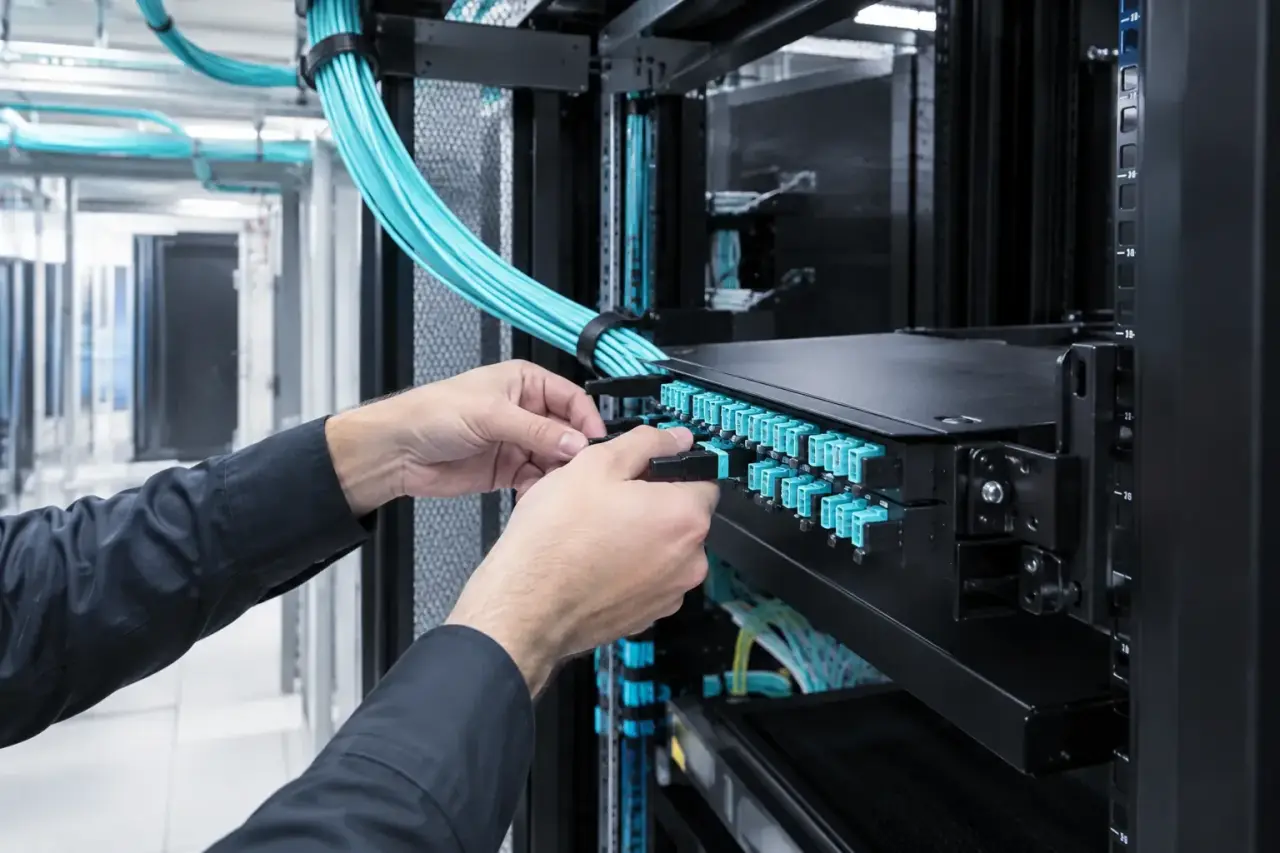
- Patch Panels & Enclosures: Serving as the central nervous system of your physical network, patch panels organize, route, and protect incoming and outgoing fiber runs. High-density rack-mount panels are crucial for keeping server rooms clean and manageable.
- Splice Trays: Located inside protective enclosures, splice trays safely hold and organize fused or mechanically joined optical fibers, preventing delicate connections from bending or snapping.
- Fiber Connectors: The physical plugs at the end of the cables. Common types include LC (small-form-factor connectors popular in high-density environments), SC (square connectors), and MTP/MPO (multi-fiber push-on connectors used for rapid, high-capacity trunk lines).
- Demarcation Boxes: These enclosures mark the transition point where the service provider’s external fiber line ends and your business’s private internal network begins.
Each of these components must be selected and installed with precision. Even a tiny speck of dust on a connector can disrupt light transmission and cause packet loss. That is why working with experienced professionals for your fiber optic cabling services is so critical to achieving a flawless installation.
Single-Mode vs. Multimode Fiber Performance
When planning your infrastructure, the choice between single-mode and multimode fiber will dictate your network’s physical reach and hardware requirements.
Single-Mode Fiber (SMF) features a microscopic core (typically 9 microns). Because the path is so narrow, light can only travel in a single, straight line down the center. This eliminates modal dispersion, a phenomenon where different rays of light arrive at the destination at slightly different times, distorting the signal. Consequently, SMF can transmit massive amounts of data over vast distances. It relies on highly focused laser sources, which are more sophisticated and costly than the light sources used for multimode fiber, but necessary for campus backbones or long-distance links.
Multimode Fiber (MMF) has a much larger core (usually 50 or 62.5 microns), which allows multiple light paths (or “modes”) to travel down the cable simultaneously. Because the light bounces around inside the wider core, modal dispersion occurs over longer distances, limiting MMF to shorter runs (typically under 1,000 feet). However, because MMF utilizes less expensive LED or VCSEL (Vertical-Cavity Surface-Emitting Laser) light sources, the active electronics required to run a multimode network are often more budget-friendly. This makes multimode fiber the go-to choice for localized local area networks (LANs) and server rooms.
Designing Commercial Fiber Networks: Key Environments
Every business has unique architectural and operational requirements. A historical office building in Quincy, MA, requires a very different structured cabling design than a sprawling warehouse in Manchester, NH, or a medical research facility in Providence, RI.
Properly designing your network environments ensures maximum scalability and network reliability as your business grows. When you build a solid foundation, you ensure that your business is prepared for whatever technological demands the future brings. To understand how this fits into your broader business strategy, check out our resources on fiber optics for business.
Selecting the Right Fiber Optic Connectivity Solutions for Enterprise Networks
Enterprise networks typically span multiple floors, buildings, or entire corporate campuses. To connect these disparate spaces, we design a hierarchical structured cabling system.
- Backbone Cabling: This is the primary data highway of your business. It connects your main distribution frame (MDF) to intermediate distribution frames (IDFs) located in telecommunications closets throughout your facilities. We almost always recommend single-mode fiber for inter-building campus backbones to guarantee speed over distance, while multimode fiber is highly efficient for vertical risers within a single building.
- Local Area Networks (LANs): Bringing fiber closer to the desk or work area ensures that high-bandwidth workstations, such as those used by creative agencies, engineering firms, or financial analysts, experience zero latency.
- Media Converters: In many enterprise environments, a complete copper-to-fiber overhaul isn’t necessary or practical all at once. Media converters allow you to integrate high-speed optical lines seamlessly with legacy copper-based switches and hardware, protecting your existing technology investments.
For organizations looking to deploy cutting-edge enterprise architectures, utilizing advanced Intelligent OptiX Network Solutions can provide passive all-optical LAN (POL) designs that simplify management, reduce power consumption, and eliminate the need for active switches in intermediate closets.
Data Center and FTTH Deployments
In environments where data density is exceptionally high, standard cabling methods quickly lead to a tangled, unmanageable mess.
- High-Density Patching: Modern data centers require specialized solutions to maximize space. Platforms like Leviton’s e2XHD and HDX global systems allow network administrators to patch up to 96 LC fibers in a single rack unit (1RU), or up to 144 fibers per RU using Ultra-High-Density (UHDX) enclosures. This level of density is achieved using pre-terminated MTP/MPO trunk lines that bundle multiple fibers into a single, compact connector.
- Fiber Distribution Frames (FDF): For massive operations, dedicated frames can manage over 3,168 LC fibers in a single footprint, ensuring that patch cords are organized, supported, and protected against exceeding their minimum bend radius.
- Passive Optical Networks (PON) & Optical Splitters: In campus-wide deployments or multi-tenant commercial buildings (often referred to under the broader umbrella of Fiber-to-the-Premise or FTTP), PON technology is highly effective. By using unpowered optical splitters, a single incoming optical fiber can be split to serve up to 32 or 64 separate endpoints. This passive design drastically reduces equipment costs, eliminates the need for power in intermediate distribution points, and simplifies maintenance.
Whether you are upgrading a server room or building out a multi-tenant facility, choosing local experts who understand the unique layout of regional business hubs is essential. If you are operating in the Greater Boston area, you can learn more about localized design considerations in our guide on fiber optic services in Boston.
Deployment Strategies: Pre-Terminated vs. Field-Terminated Assemblies
When it comes to the actual installation of your fiber optic network, one of the most critical decisions you will make is choosing between pre-terminated and field-terminated fiber assemblies.
- Pre-Terminated Fiber Assemblies: These cables are measured, cut, terminated, and polished in a controlled factory environment before they arrive at your job site.
- Pros: Installation is incredibly fast, often up to 70% faster than field termination. Because they are factory-tested, they offer guaranteed performance with certified insertion loss and return loss metrics. There is zero on-site termination waste, and the risk of craft-sensitive installation errors is virtually eliminated.
- Cons: Cable runs must be measured with absolute precision before ordering. If a cable is too short, it cannot be used; if it is too long, the installer must safely store the slack.
- Field-Terminated Assemblies: These cables are pulled raw and terminated on-site by a technician using fusion splicing or mechanical connectors.
- Pros: Offers ultimate flexibility. Installers can pull cable through tight conduits without bulky connectors attached and cut the cable to the exact length needed, eliminating slack storage issues.
- Cons: Requires highly skilled technicians and expensive tools (like fusion splicers). Installation takes significantly longer, and environmental factors on-site (like dust or humidity) can affect termination quality and increase insertion loss.
For most modern commercial projects, pre-terminated systems represent the most cost-effective and reliable path forward, though a hybrid approach is often used for complex pathways. To see how these strategies fit into a complete deployment workflow, read our complete fiber optic installation guide.
Dark Fiber vs. Lit Fiber Considerations
When expanding your network across multiple locations, you will need to choose between leasing dark fiber or lit fiber from telecommunications providers.
- Dark Fiber: This refers to optical fiber cables that have been installed but are “unlit”, meaning no active electronics or light signals are running through them. When you lease dark fiber, you purchase the physical pathway. You are responsible for buying, installing, and managing the transceivers, switches, and routers on both ends to “light” the fiber.
- Best For: Large enterprises, financial institutions, and school districts that require complete network control, bespoke security protocols, and virtually unlimited bandwidth without recurring monthly speed-tier costs.
- Lit Fiber: This is a fully active network service managed by a service provider. The carrier owns and maintains the electronics, and you pay a monthly fee for a guaranteed bandwidth tier (e.g., 1 Gbps or 10 Gbps).
- Best For: Businesses that want to minimize initial capital expenditure (CAPEX) and prefer to hand off network management, maintenance, and troubleshooting to a third-party service provider under a strict Service Level Agreement (SLA).
Metro Fiber vs. Long-Haul Infrastructure
The geographic scope of your network will dictate whether your infrastructure falls under metro or long-haul design criteria.
- Metro Fiber: These metropolitan networks connect offices, data centers, and campus locations within a specific city or regional hub. They are optimized for high-capacity, low-latency communication across distances typically ranging from 5 to 50 kilometers. In our region, high-speed regional transport is expanding rapidly, as seen in initiatives like the Boston Metro Network Expansion, which brings robust, redundant pathways to businesses throughout eastern Massachusetts.
- Long-Haul Infrastructure: These networks connect cities, states, or even continents. Because distances span hundreds or thousands of kilometers, signal degradation is inevitable. Long-haul networks require specialized optical amplifiers and signal regeneration stations placed at strategic intervals to boost the light signals without introducing latency or errors.
Emerging Trends and Technology Advancements
The world of fiber optics is evolving at a breakneck pace. As businesses adopt data-heavy applications, the demand for smarter, faster, and more efficient physical layers has never been higher.
Today, we are seeing the convergence of optical networks with artificial intelligence (AI), the Internet of Things (IoT), and 5G integration. AI data centers, for example, are deploying Co-Packaged Optics (CPO) to support massive 51.2 Tbps Ethernet switches, while advanced optical sensing technologies are turning standard fiber cables into sensory networks capable of detecting physical vibrations, temperature changes, and perimeter breaches.
Staying ahead of these trends is vital to maintaining a competitive edge. To learn how modern cabling can transform your daily operations, read about maximizing business efficiency with fiber optic cabling.
Future-Proofing with Advanced Fiber Optic Connectivity Solutions
When we install a structured cabling system, we aren’t just designing for today’s needs; we are building a foundation for the next 15 to 20 years.
With bandwidth demands growing exponentially, your physical layer must support seamless network migration without requiring you to rip out and replace existing cables. By installing high-quality single-mode and OM4/OM5 multimode fiber backbones today, you ensure your physical infrastructure can scale from 10G and 40G up to 100G, 400G, and even 800G speeds simply by upgrading the transceivers on either end. To learn more about selecting the right physical media for longevity, view our guide on fiber optic cable installation.
Ultra-Low-Loss Connectors and 400G/800G Migration
As networks migrate to 400G and 800G speeds, the “power budget” (the allowable amount of signal loss across a channel) becomes incredibly tight. Every connection point, every patch panel, cassette, and adapter, introduces a small amount of signal loss.
To combat this, manufacturers have developed ultra-low-loss (ULL) connectivity components. Systems like the OPT-X Unity Ultra Low Loss Fiber Optic System utilize precision-engineered MTP/MPO and LC connectors that drastically reduce insertion loss.
While standard connectors might introduce 0.5 dB to 0.75 dB of loss per connection, ULL components keep loss as low as 0.15 dB for MTP and 0.08 dB for LC. This allows network designers to include multiple patch points in a channel, giving them the flexibility to route cables through intermediate distribution frames, while still staying safely within the strict limits required for high-speed parallel optics.
Frequently Asked Questions about Fiber Networks
What is the difference between dark fiber and lit fiber?
Dark fiber refers to physical, unlit optical cables leased without any active electronics. The lessee must purchase and manage the optical transceivers and switches to transmit data. Lit fiber is an active, fully managed service provided by a carrier, where the speed, bandwidth, and active electronics are controlled and maintained by the service provider.
How does fiber optic cabling improve business security?
Because fiber optic cables transmit data using light pulses rather than electrical currents, they do not emit electromagnetic signals. This makes them virtually impossible to tap or intercept remotely. Additionally, physically splicing into an active fiber cable to steal data causes an immediate, detectable drop in signal strength (insertion loss), which alerts network administrators to the breach instantly.
Why should businesses choose pre-terminated fiber assemblies?
Pre-terminated fiber assemblies are factory-terminated and tested, ensuring certified performance and lower insertion loss. They reduce on-site installation time by up to 70%, eliminate the need for specialized termination tools on-site, and cut down on labor costs and waste, making them highly cost-effective for commercial installations.
Conclusion
Investing in high-performance fiber optic connectivity solutions is one of the most impactful decisions you can make to future-proof your business infrastructure. From supporting daily high-speed data transfers to enabling next-generation AI and cloud applications, a robust fiber network ensures your organization never skips a beat.
Since 1993, AccuTech Communications has been the trusted partner for commercial businesses across Massachusetts, New Hampshire, and Rhode Island. Our team of technicians is committed to delivering reliable, top-quality structured cabling, network design, and fiber installations tailored to your specific operational needs, all at highly competitive pricing.
Ready to upgrade your business network with a certified, high-performance fiber system? AccuTech Communications Fiber Optic Installation is here to help. Contact us today to discuss your project and request a custom consultation.