
Submarine Fiber Optic Cable: Top 10 Amazing Facts 2025
Connecting the World: Understanding Submarine Fiber Optic Cable Networks
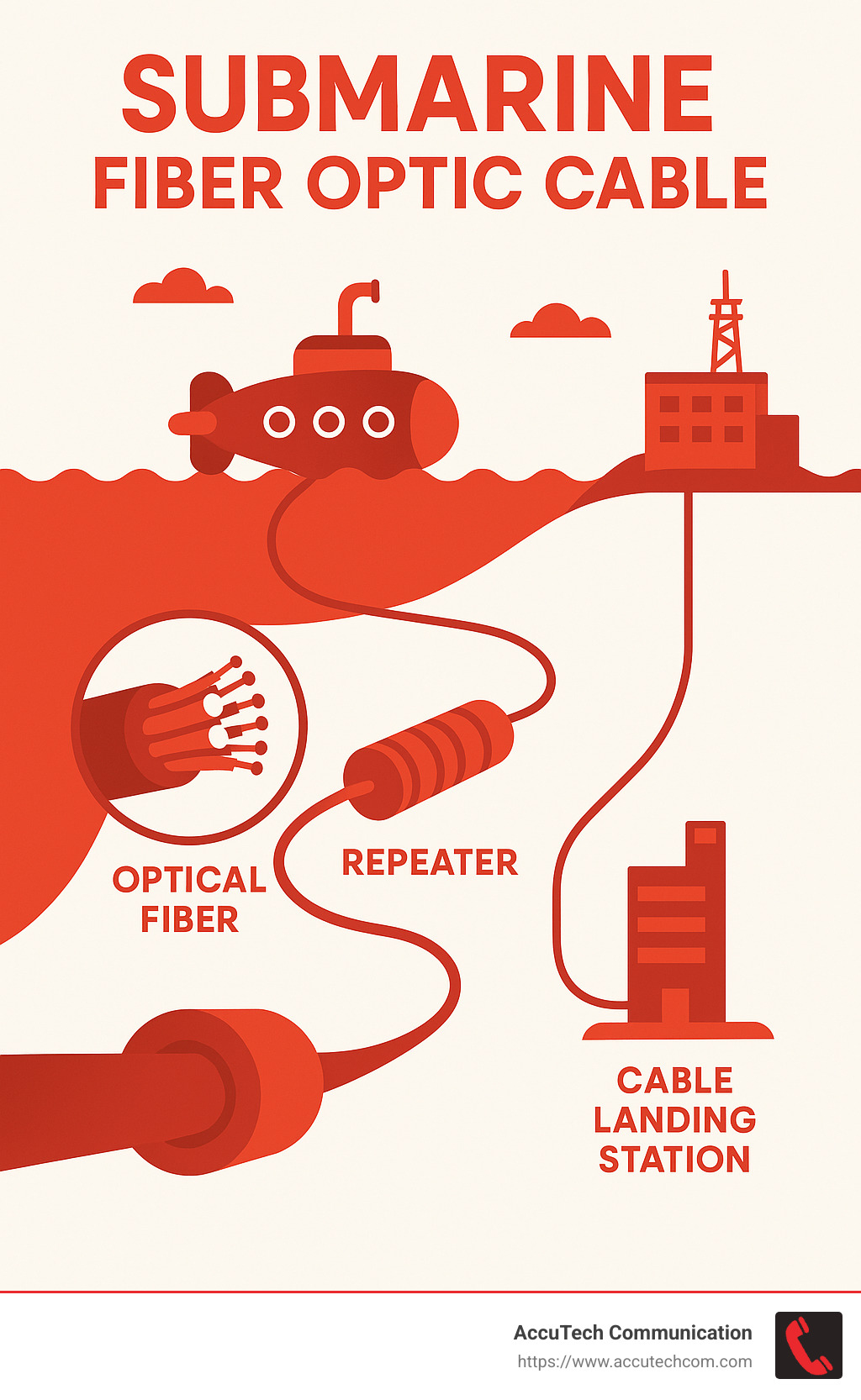
A submarine fiber optic cable is a high-capacity cable laid beneath the ocean that carries nearly all International internet and voice data between continents.
Here’s what you need to know at a glance:
- What it is: Undersea cables made of thin strands of glass (fiber optics) transmitting data as pulses of light.
- How it works: Lasers send rapid pulses of light through optical fibers; amplifiers (repeaters) boost signals across long distances.
- Why it matters: Submarine cables transmit 99% of all international data and voice communications.
Beneath the ocean’s surface, an invisible network of fiber optic cables connects continents, enabling seamless global communication. Although satellites get most of the attention, nearly all your international emails, video calls, and cloud services travel through these critical undersea highways. From their beginnings as simple telegraph cables to the highly advanced fiber-optic networks today, submarine fiber optic cables are the quiet backbone of our digitally connected world.
I’m Corin Dolan, owner at AccuTech Communications, with decades of experience designing and implementing communications infrastructure, including submarine fiber optic cable networks. In this guide, I’ll explain exactly how these cables function and their role in our global connectivity.
Basic submarine fiber optic cable glossary:
– how do fiber optic cables work
– types of fiber optic cable
– how far can fiber optic cable run
What Are Submarine Fiber Optic Cables and How Do They Work?
Submarine fiber optic cables might not get the spotlight often, but they’re truly the unsung heroes of global connectivity. If you’ve ever wondered how your emails, social media posts, or video calls travel halfway around the world in an instant, it’s thanks to these incredible underwater highways. You might assume satellites handle most of this work—but here’s a fun fact: more than 95% of international data travels through submarine cables, not satellites!
From Light Signals to Global Communication
At their core, submarine fiber optic cables work the same way as fiber optic cables used on land. They transmit data through pulses of light traveling down thin glass strands called optical fibers. Each fiber is incredibly thin—just about as wide as a strand of human hair—but able to carry huge amounts of information at blazing speeds.
How does this happen? The secret lies in a phenomenon called total internal reflection. Imagine shining a flashlight down a long, bendable pipe covered with mirrors inside. The light bounces around inside without escaping, traveling all the way to the other end. Optical fibers work similarly: they have a glass core surrounded by a “cladding” material. Because the core has a higher refractive index than the cladding, when light hits that boundary, it reflects inward, bouncing back and forth and staying inside the fiber.
But even lightspeed has limits—after traveling long distances underwater, the signal naturally weakens. To keep data clear and reliable across entire oceans, these cables use devices called repeaters. Placed about every 70 kilometers along a cable, repeaters amplify the weakening signals, boosting their strength so data stays crystal-clear. Modern repeaters use advanced technology called erbium-doped fiber amplifiers (EDFAs) to amplify signals directly as light, without converting them into electricity.
To squeeze even more data down these slim glass fibers, engineers use a clever technology called wavelength division multiplexing (WDM)—think of it as sending multiple streams of data, side-by-side, each riding a different color (or wavelength) of light. Dense WDM (DWDM) takes this idea further, packing dozens or even hundreds of data streams into a single fiber—dramatically boosting capacity.
The Anatomy of a Submarine Fiber Optic Cable
From the outside, a submarine fiber optic cable looks simple—just about as thick as your garden hose. But cut it open, and you’ll find a marvel of modern engineering specifically designed for the rough conditions deep beneath the ocean surface.
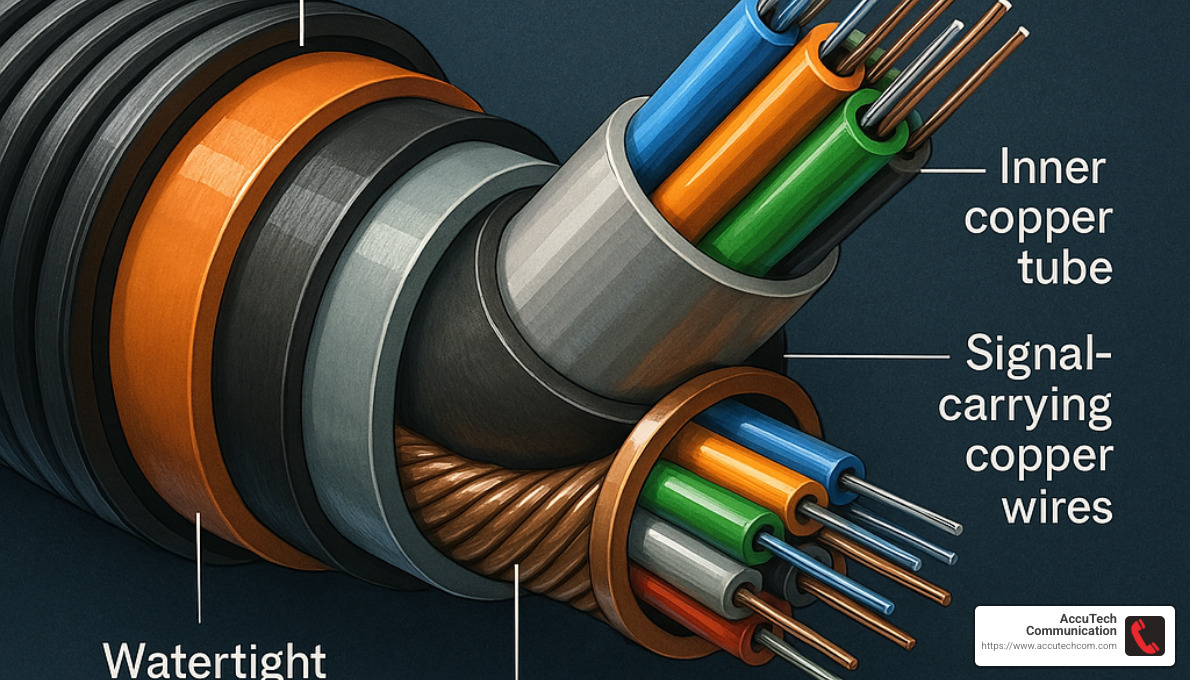
At the very center of the cable are those precious optical fibers themselves. Made from ultra-pure silica glass, modern submarine cables typically have anywhere from 4 to 48 fiber pairs. They often use a special type called G.654 fiber, designed specifically for long underwater journeys. These fibers experience very low signal loss (attenuation)—usually between 0.15 and 0.17 dB/km—far better than standard fibers used on land.
Surrounding these delicate glass fibers is a stainless steel tube filled with protective gel. This combination provides initial protection from crushing deep-sea pressures and prevents water damage that could disrupt the signals.
Adding to the cable’s strength and durability are multiple protective layers:
- Steel strength members: Wires that provide the necessary strength for installation and recovery from the seabed.
- Copper conductor: Often included to deliver electrical power to the repeaters along the route.
- Water-blocking materials: Special layers that keep water from seeping into the cable if the outer layers get damaged.
- Polyethylene sheath: A tough, insulating plastic covering that offers additional protection.
- Steel armor: Extra protection for cables placed in shallow waters, where they’re more vulnerable to fishing gear, anchors, and other hazards.
Cables designed for deeper ocean sections are generally thinner and lighter, while those closer to shore get more steel armor for extra protection. There’s a fascinating balance between strength, flexibility, and protection in every submarine fiber optic cable.
As the International Cable Protection Committee explains, “the cable’s physical design—from a thin core of optical fibers to multiple protective layers and external armor—ensures both functionality and resilience in harsh underwater environments.”
To explore different types of fiber optic cable used in various applications, including submarine systems, you can visit our dedicated page.
Turning Pulses of Light into Global Connectivity
So how does information turn into pulses of light—and then back into the websites and voice calls we rely on every day?
It starts with data encoding. First, digital data (like your email or a video call) gets translated into a series of ones and zeros. Lasers then convert these zeros and ones into flashes of light—”laser on” for a 1, “laser off” for a 0—sending billions of these pulses per second through the fiber optic cable.
Today’s undersea cables achieve incredible data speeds—often measured in terabits per second (Tbps). One terabit equals 1,000 gigabits, and modern cables can transmit hundreds of terabits simultaneously. For example, the impressive MAREA cable connecting Virginia Beach, USA, to Bilbao, Spain, carries up to 224 Tbps—that’s enough capacity to stream millions of HD movies simultaneously!
As mentioned earlier, repeaters placed every 70 kilometers along the route strengthen and regenerate signals, keeping them clean and clear. The use of Dense Wavelength Division Multiplexing (DWDM) technology further maximizes cable capacity by carrying multiple data streams at different wavelengths through a single fiber. It’s like adding more lanes to a highway without actually making the road wider.
One huge advantage of submarine fiber optic cables over satellite communication is their extremely low latency. Latency is the time it takes data to travel from sender to receiver. Fiber optic signals cross oceans in a matter of milliseconds. For example, a signal traveling across the Atlantic Ocean takes only around 60 milliseconds via submarine cable. By contrast, satellite signals—traveling all the way into orbit and back—typically experience latency of hundreds of milliseconds.
This low latency is especially important for applications where speed is essential—like financial trading, video conferencing, online gaming, and real-time streaming. Satellites might be the flashy, visible face of global communication, but submarine fiber optic cables quietly do the real heavy lifting beneath the waves.
For a deeper dive into the fascinating principles behind this technology, visit our detailed article explaining exactly how do fiber optic cables work.
The Global Network of Submarine Fiber Optic Cables
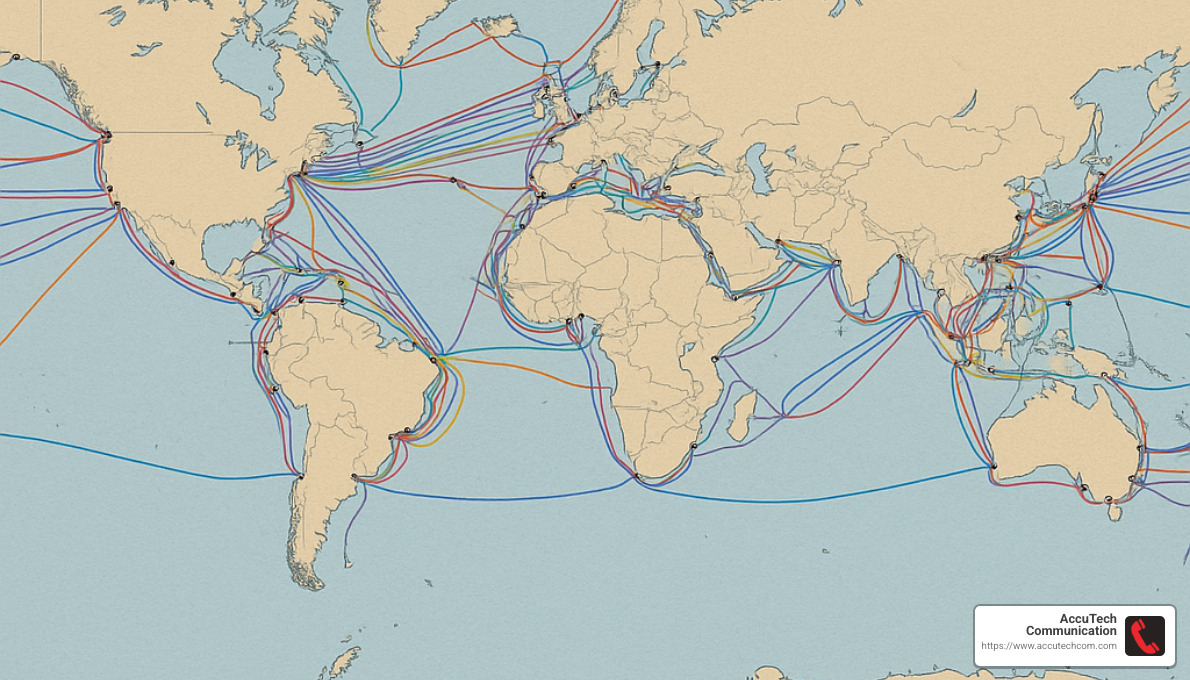
When most people think of the internet, they picture wireless signals and satellites floating far above the earth. But the real backbone of global connectivity is quietly hidden beneath the ocean waves: the vast network of submarine fiber optic cables.
Today, there are around 450 active submarine cable systems crisscrossing the oceans, totaling over 1.4 million kilometers (about 850,000 miles). If you can picture stretching fiber optic cables around Earth’s circumference 35 times—that’s basically what this impressive network achieves!
These undersea highways are the lifelines of the digital world, physically connecting continents, countries, and billions of people. Without them, your international emails, video calls, and streaming services would grind to a halt.
Of course, not all oceans have equal cable coverage. The busiest cable routes connect the major economies and digital hubs. Across the Atlantic Ocean, cables like MAREA (owned by Microsoft and Meta) and Dunant (owned by Google) connect North America and Europe with lightning-fast speeds of over 200 Tbps each. Likewise, across the Pacific Ocean, cables such as FASTER (linking the US to Japan and Taiwan) and PLCN (connecting the US with Hong Kong and the Philippines) bridge North America to Asia—spanning incredible distances of up to 13,000 kilometers.
Beyond these transoceanic giants, numerous regional systems provide essential connectivity within specific areas. Southeast Asia, for example, relies heavily on regional cables due to its numerous islands and coastal communities. One of the most exciting regional expansions underway is 2Africa, expected to be fully operational in 2024. When completed, it will stretch 45,000 kilometers—making it one of the longest submarine cable systems ever built—and will connect an incredible 34 countries across Africa, Europe, and Asia.
As global internet usage continues to skyrocket (international bandwidth demand grew at an annual rate of 45% between 2017 and 2021), cable operators are constantly expanding and upgrading the network. While brand-new cables are always being installed, operators frequently boost existing cable capacity by upgrading terminal equipment—allowing them to keep pace with demand without laying entirely new routes.
Because cable faults and breaks occasionally occur, network redundancy is crucial. Cable planners make sure each region has several cable connections—if one cable gets damaged, traffic reroutes through alternative paths, avoiding disruptions. Think of redundancy as having backup highways when your main commute route is blocked.
To see the incredible scale of this underwater web, explore TeleGeography’s interactive submarine cable map. It’s a fascinating glimpse at the invisible infrastructure beneath the waves.
Major Submarine Cable Routes and Systems
While hundreds of submarine fiber optic cables span the globe, certain routes act as major arteries, carrying the bulk of global internet traffic. Let’s take a closer look at some of these essential pathways.
The Transatlantic cables linking North America and Europe are historic and vital routes. Modern examples like MAREA and Dunant carry vast data loads with lightning-quick speeds. Today’s newest transatlantic cables often feature 16-24 fiber pairs—far more capacity than previous generations.
On the opposite side of the globe, the Transpacific cables connect North America and Asia, bridging some of the longest cable distances in existence. Systems like FASTER and PLCN highlight the incredible engineering behind these vast ocean crossings, carrying data swiftly across thousands of kilometers.
Beyond these major ocean crossings, extensive regional cable systems connect nearby countries and island nations. Southeast Asia, dotted with islands and coastlines, relies heavily on these shorter cables that function like neighborhood roads connecting local communities.
One particularly ambitious cable project nearing completion is 2Africa. Once fully operational, this massive system will be among the longest cables ever built, spanning 45,000 kilometers and linking 34 countries in Africa, Europe, and Asia. Projects like these highlight the continued growth and importance of submarine cable infrastructure in digitally underserved regions.
Cable upgrades also play a key role in maintaining the network. Rather than constantly laying new cables, operators frequently improve existing cables by installing upgraded equipment at each end. This cost-effective strategy boosts bandwidth and capacity, staying ahead of skyrocketing demand without expensive new deployments.
Cable Landing Stations: Where Sea Meets Land
You might wonder how these extraordinary underwater cables connect seamlessly to the land-based internet networks we use every day. That vital connection happens at specialized facilities called cable landing stations.
Cable landing stations are coastal buildings that house critical equipment allowing the transition from submarine to terrestrial fiber networks. Don’t let their modest exterior fool you—these are high-tech hubs performing several important functions.
Inside these secure facilities, you’ll find power feed equipment (PFE) supplying electricity to repeaters along the cable route, optical distribution frames organizing all the fiber connections, and submarine line terminal equipment (SLTE) converting optical signals into electrical signals for use in terrestrial networks.
Since landing stations represent such crucial infrastructure, security is tight. Expect perimeter fences, restricted access, surveillance cameras, and sometimes even guards. Despite their importance, most landing stations intentionally blend into their surroundings so as not to draw unwanted attention.
Environmental factors also shape landing station design. Facilities are typically positioned on liftd ground away from immediate shorelines to avoid flooding, erosion, and tsunami threats. Engineers consider additional factors like proximity to existing telecom networks, seabed suitability, accessibility for maintenance, and protection from fishing and shipping activities when choosing landing sites.
Once safely ashore, submarine fiber optic cables connect to terrestrial fiber networks. These land-based networks then route data to internet exchange points, data centers, and eventually to all our homes and businesses.
At AccuTech Communications, we appreciate the incredible engineering behind the submarine fiber optic network. Although we focus on terrestrial fiber installation here in Massachusetts, New Hampshire, and Rhode Island, we bring the same dedication to quality, reliability, and smart design principles that make the global cable network possible. Curious about fiber optic cabling for your business? Check out our guide: what is fiber optic cabling and why is it important.
The Installation and Maintenance of Submarine Fiber Optic Cables
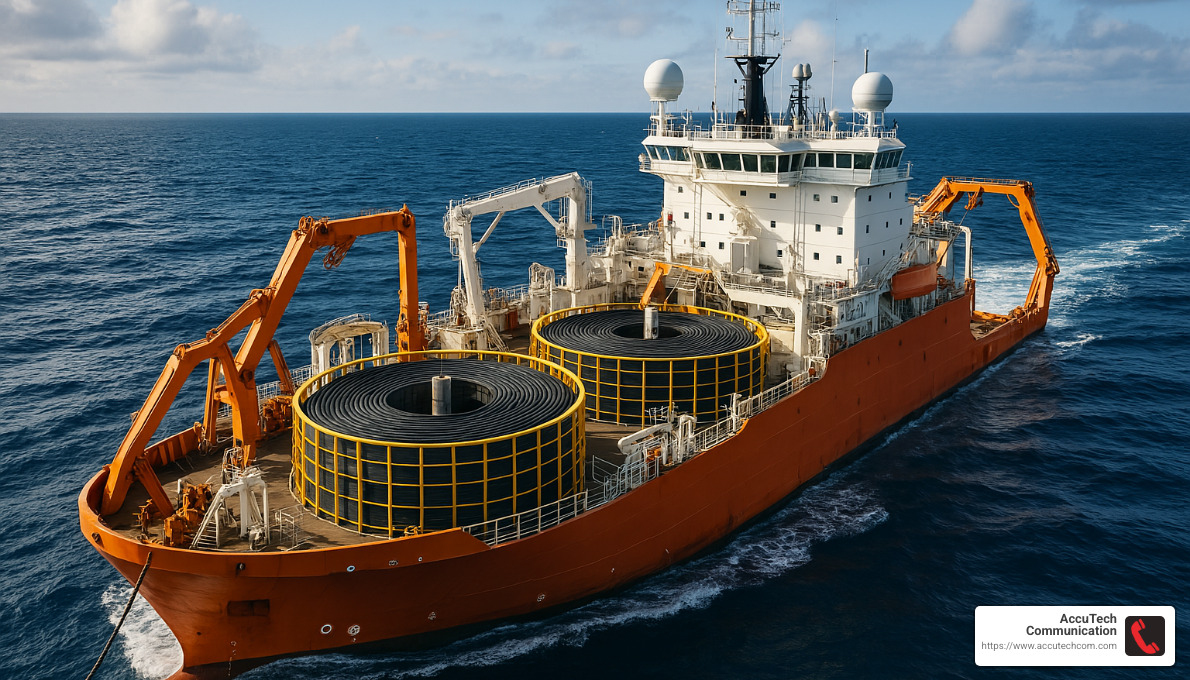
Installing a submarine fiber optic cable beneath the ocean isn’t as simple as tossing a wire overboard and hoping for the best. (If only!) Instead, it’s a highly specialized, carefully planned operation involving dedicated cable ships, advanced equipment, and meticulous attention to detail. From initial idea to final deployment, it usually takes about 18-24 months—meaning patience, thorough planning, and plenty of coffee are required.
Special-purpose cable-laying ships, costing hundreds of millions of dollars, play the starring role. These ships come equipped with sophisticated navigation and positioning systems that keep them precisely on track along the planned cable route. They house massive cable storage tanks or giant rotating carousels, holding thousands of kilometers of cable neatly coiled and ready to deploy.
As the ship moves slowly forward—typically laying cable at a rate of around 100-150 kilometers per day—it gently pays out the fiber optic cable. Tension control equipment ensures the cable doesn’t become too tight (risking breakage) or too loose (which might create loops or kinks). Think of it as the Goldilocks of deep-sea installations—”just right” is the only acceptable option.
In shallow waters closer to shore, submarine cables face greater risk from fishing boats, ship anchors, and curious marine life. To protect them, specialized plows or remotely operated vehicles (ROVs) bury the cable beneath the seabed. In deeper waters, cables typically lie directly on the ocean floor, where there’s much less risk of accidental damage.
Planning and Deploying Submarine Cables
The actual laying of a submarine fiber optic cable is just the visible tip of the iceberg. Before any cable can be installed, months of careful planning and preparation are needed.
First comes route planning. Engineers carefully plot the cable path to avoid underwater mountains, canyons, earthquake zones, and high-traffic shipping lanes. They also have to consider territorial boundaries, environmentally sensitive marine habitats, and existing cable locations to reduce hazards and conflicts.
Next up are detailed marine surveys of the proposed cable route. Equipped with tools like multibeam echo sounders, side-scan sonar, and sub-bottom profilers, survey vessels map out the ocean floor in remarkable detail. These surveys highlight potential hazards and help engineers determine precisely where cable burial is necessary and where the cable can safely rest on the seabed.
Alongside physical surveys, thorough environmental assessments are conducted to minimize any impact the cable might have on marine ecosystems. Fortunately, studies generally show that submarine cables have minimal impact. In some cases, cable protection zones even become accidental marine reserves, keeping away fishing boats and creating safe havens for marine life.
Once surveys are complete, engineers finalize cable design specifics. Shallow water segments typically use heavier armor for extra protection, while deep-water sections can be lighter, since they’re safer from human activities.
With all preparations complete, the real deployment begins at what’s called the shore-end installation. Here, the cable transitions from sea to land. Workers carefully float the cable ashore or, in sensitive environmental areas, use directional drilling to run the cable underground directly to the landing station, avoiding any disruption to beaches or fragile habitats.
From there, the cable ship heads out to sea, deploying cable along the ocean floor segment by segment. While deep-water areas typically go quickly, laying cable in shallow coastal waters is slower and more meticulous. The entire operation for a transoceanic cable can take several months—meaning no one gets seasick on these crews (or at least, they’d better not!).
If you’re curious about how fiber optic installations happen on land (without the risk of seasickness!), check out our guide on how to install fiber optic cable for practical tips and best practices.
Maintaining and Repairing Undersea Infrastructure
Even with such careful design and installation, accidents happen. Worldwide, submarine cables experience roughly 100-150 faults each year, usually in shallow waters due to fishing gear, ship anchors, or natural events like underwater earthquakes and landslides. Fortunately, there’s a detailed process in place to quickly identify and fix these issues.
The first step after a cable fault occurs is pinpointing its exact location. Crews use specialized equipment like Optical Time Domain Reflectometry (OTDR)—basically a high-tech method of sending pulses of light down the cable and measuring how long they take to bounce back from the fault. This helps accurately determine where the cable is damaged.
Next, a repair ship sets out to fix the issue. Cable repair vessels carry grapnels—essentially big hooks—that are carefully lowered down to grab the faulty cable and bring it safely to the surface. This can be challenging in deep water, with cables often lying several kilometers below the surface. (It’s like fishing, except instead of catching dinner, you’re bringing up critical digital infrastructure!)
Once the damaged section is recovered, a new portion of cable is carefully spliced into place. Fiber optic splicing is a highly precise task, with technicians using advanced fusion splicing techniques to ensure minimal signal loss—the goal is typically less than 0.1 dB per splice.
After repairs are complete, the cable is gently lowered back to the seabed, often with a loop or omega shape to allow flexibility for future seabed movement or easier future maintenance. Depending on water depth, weather conditions, and damage complexity, repairs might take anywhere from just a few days to several weeks.
Submarine fiber optic cables are built to last, typically having a 25-year operational lifespan. With proper monitoring and regular maintenance, many cables exceed that timeframe, keeping our global digital connections humming smoothly far into the future.
At AccuTech Communications, we install terrestrial fiber optic infrastructure serving businesses across Massachusetts, New Hampshire, and Rhode Island. While our ground-based installations thankfully don’t require grapnels or deep-sea fishing techniques, we practice the same principles of careful planning, quality craftsmanship, and attentive maintenance to keep your network reliable and secure.
Challenges and Vulnerabilities of Submarine Cable Networks
Submarine fiber optic cables quietly connect our modern world, forming the backbone that carries virtually all of our international communications. Yet, despite their essential role, these remarkable cables face numerous challenges and vulnerabilities. Understanding these risks is crucial in ensuring this hidden network remains protected and reliable.
Today, submarine fiber optic cables are recognized as critical infrastructure—much like power grids, highways, and water systems. An interruption or damage to a key submarine cable could severely disrupt global commerce, government operations, and our everyday lives. In fact, a major cable outage can easily cost billions of dollars per day in lost business and productivity.
While the global submarine cable network is designed with built-in redundancy (meaning multiple cable routes exist to handle traffic if one is damaged), individual cables remain exposed to numerous threats. This is especially true for regions relying on just a few cable connections—where even a small amount of damage can cause significant disruption.
Physical Threats to Submarine Fiber Optic Cables
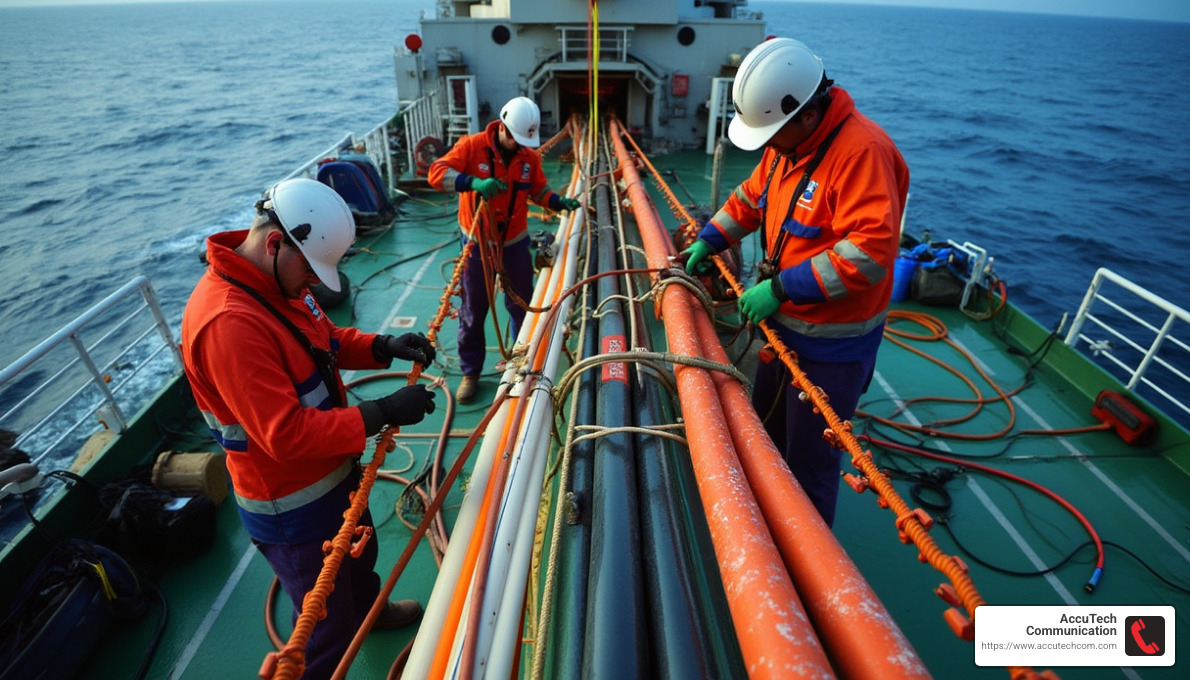
Despite their rugged design, submarine fiber optic cables aren’t indestructible. A variety of physical threats—both human-made and natural—pose ongoing challenges.
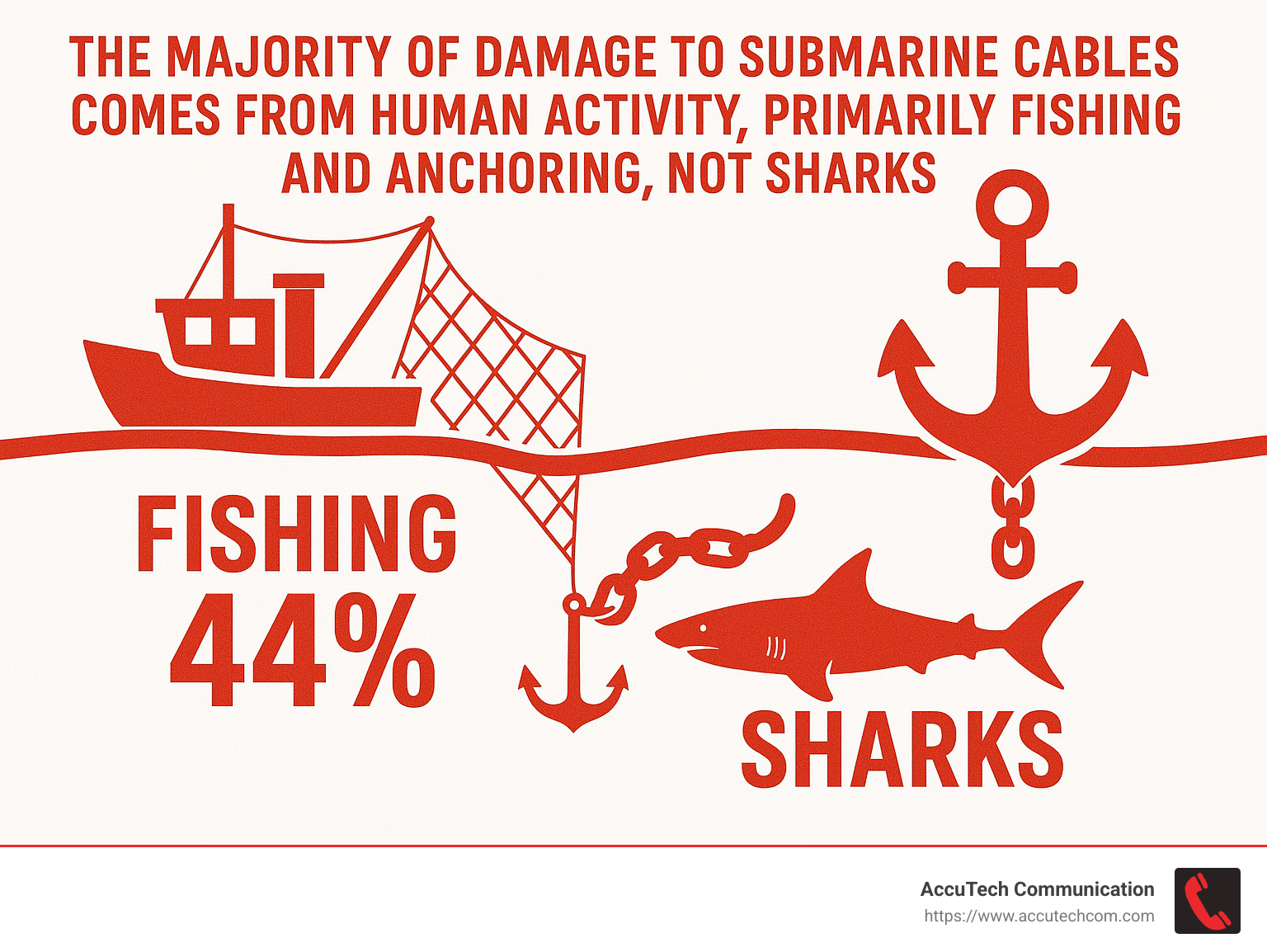
One of the biggest threats comes from human activities, especially commercial fishing. Bottom trawling nets and fishing gear can snag cables, inadvertently pulling them from the seabed or breaking them altogether. Cable locations are marked on navigational charts, but these incidents still regularly occur.
Another common culprit is ship anchors, particularly around busy ports and shipping lanes. Just one large anchor dragged along the seafloor can slice through a submarine fiber optic cable in seconds. With global shipping traffic continuing to grow, this risk remains a significant concern.
Natural events also pose serious risks. Seabed movements, such as underwater earthquakes, landslides, or turbidity currents (which are essentially underwater avalanches of sediment), can damage cables or sever them completely. For instance, back in 2006, an underwater earthquake off Taiwan damaged nine cables simultaneously, causing widespread internet disruptions across Asia.
In areas with strong ocean currents, cables can suffer from continuous abrasion, wearing them down as they rub against rocks or coral reefs. During installation planning, thorough seabed surveys help minimize this risk by carefully selecting safer cable routes.
And what about sharks biting cables? It makes for an entertaining myth, but shark attacks on submarine cables are extremely rare. Early cables occasionally showed bite marks, likely due to curious fish attracted by bright cable coatings. However, modern cables don’t attract sharks—and data from the International Cable Protection Committee confirms sharks aren’t causing cable failures.
Finally, submarine cables must withstand tremendous water pressures at depth. While modern cables are engineered to easily handle pressures exceeding 8,000 psi at the deepest ocean trenches, older or damaged cable sections can become vulnerable to water intrusion, potentially causing electrical shorts and equipment failures.
Security and Geopolitical Considerations
Beyond the physical challenges, submarine fiber optic cables have become increasingly important in geopolitical strategy and national security.
Because these cables pass through international waters as well as multiple national territories, they fall under a complex web of legal frameworks. The United Nations Convention on the Law of the Sea (UNCLOS) provides some protection for cables outside territorial waters, yet enforcement can be challenging—particularly since not all nations adhere fully to international law.
Within territorial waters (12 nautical miles offshore), coastal countries hold complete authority over cable activities. In Exclusive Economic Zones (EEZs), extending up to 200 nautical miles offshore, coastal nations must allow cable installations by other countries but retain certain regulatory rights. Beyond the EEZ, cables generally benefit from international legal protections—though practically enforcing these protections at sea can still be tricky.
Given how crucial submarine fiber optic cables have become, governments increasingly worry about deliberate sabotage or espionage. Intelligence agencies historically have shown interest in these cables for surveillance purposes. Today, safeguarding cables against state-sponsored threats has become a priority for national security agencies worldwide.
Several nations have introduced special regulatory frameworks to protect submarine infrastructure. For example, Australia has enacted a dedicated submarine cable protection regime, while the United States classifies submarine cables as critical national infrastructure. In the U.S., cable projects require licenses from the Federal Communications Commission (FCC), which closely regulates cable operations landing on American shores.
Here at AccuTech Communications, we specialize in reliable, secure communication infrastructure for businesses throughout Massachusetts, New Hampshire, and Rhode Island. While we don’t work directly with submarine cables (we’d rather stay dry, thank you very much!), we follow the same fundamental principles of quality, resilience, and security in every fiber optic network we install.
The Future of Submarine Fiber Optic Cable Technology
The technology behind submarine fiber optic cables is constantly improving, driven by our seemingly endless appetite for bandwidth. Everything from Netflix binges to cloud storage relies on these hidden undersea networks, so keeping them fast, reliable, and efficient is crucial. Thankfully, ongoing innovations ensure we’ll stay connected for decades to come.
Today’s global internet traffic is growing rapidly—fueled by more streaming services, remote work, social media, and digital business. This constant growth pushes engineers to find creative ways to squeeze more data into each cable without skyrocketing costs. After all, nobody wants to pay more just to binge-watch their favorite series!
Technological Innovations Driving Capacity Growth
One of the most exciting developments in submarine fiber optic cable design is something called Space Division Multiplexing (SDM). Traditional cables transmit data using separate wavelengths (colors) of light within a single core fiber. SDM takes things a step further by introducing multi-core fibers, which contain several separate cores within one fiber. Think of it as turning a one-lane road into a multi-lane highway—without widening the road itself.
In lab tests, these multi-core fibers have already smashed records, reaching incredibly low losses of just 0.155 dB/km. Basically, this allows cables to handle far more data over longer distances without signal degradation. Pretty impressive stuff!
Another way we’re ramping up capacity is by using more wavelengths of light. Historically, cables operated mostly in what’s known as the C-band, but we’re now tapping into extra parts of the spectrum—like the L-band and even the S-band—to carry greater amounts of information simultaneously.
Advanced amplifiers are another big leap forward. These clever devices boost the optical signals along the cable, helping data travel further without losing quality. New amplifier designs and hybrid amplification methods mean signals can cross even longer ocean routes reliably, cutting down on repair and maintenance costs.
Efficiency is also a hot topic. As cables carry more data, their repeaters (signal boosters) need more power. To avoid rising power demands, engineers are incorporating power-efficient electronics and optical components, ensuring cables stay sustainable and cost-effective over their lifespan.
And speaking of flexibility, the industry is moving toward open cable systems. In the past, cable operators had to rely on equipment from a single manufacturer. Now, open cable designs let operators mix and match terminal equipment from different vendors. This makes upgrades easier, cheaper, and more future-proof.
Want to see some cutting-edge examples? Check out how OFS is developing fiber technologies—it’s fascinating stuff.
Environmental Considerations and Sustainability
There’s another important side to the future of submarine fiber optic cables—sustainability. While undersea cables already have minimal environmental effects, the industry is actively looking for ways to reduce impacts even further.
Interestingly, cable protection zones—areas around cables where activities like fishing or anchoring are banned—can actually become accidental marine reserves. These zones create safe habitats where marine life can thrive, turning cables into unexpected ocean allies.
There’s also growing interest in integrating submarine cables with renewable energy projects. For example, cables that carry data could simultaneously transport electricity from offshore wind farms to land-based grids. Talk about multi-tasking!
When cables reach the end of their life, recycling becomes key. There’s an increasing emphasis on recovering valuable metals like copper and steel, reducing waste and minimizing the environmental footprint.
Cable designers are continually improving efficiency to lower energy use and carbon footprints. They also strive to extend cable life beyond the standard 25 years, meaning fewer replacements and less disturbance to the ocean floor.
Here at AccuTech Communications, we fully accept these sustainability principles. Although we focus on terrestrial fiber optic networks here in Massachusetts, New Hampshire, and Rhode Island, the same commitment to innovation, efficiency, and environmental responsibility guides our work every day.
Frequently Asked Questions about Submarine Fiber Optic Cables
How Much Do Submarine Fiber Optic Cables Cost?
If you’re thinking about investing in your very own submarine fiber optic cable (and frankly, who isn’t?), you’ll want to be prepared—these cables don’t come cheap. Prices vary significantly based on several factors like cable length, capacity, water depth, and route complexity.
On average, expect costs to start around $40,000 per mile (roughly $25,000 per kilometer) for manufacturing and installation alone. A full-scale transoceanic cable, stretching thousands of kilometers across the seabed, can quickly tally up to between $250 million and $400 million. Ouch.
But where does all that money go? It covers much more than just the cable itself. The total price includes optical repeaters, branching units, cable landing station equipment, marine environmental surveys, permitting, and the substantial costs of specialized installation vessels.
So who foots the bill for these massive projects? Traditionally, telecom companies have teamed up in a consortium to share the costs and benefits. These consortiums still exist, but there’s a new trend: private investors—particularly tech giants like Google, Microsoft, Meta, and Amazon—are now investing directly in submarine cables to strengthen their global networks.
Hybrid models are increasingly common, too, where consortiums, private companies, and even governments pool resources to improve connectivity, especially for regions that need an economic boost.
Speaking of economic boosts—investing in submarine cables isn’t just about spending money. Studies have found these cables significantly improve local and regional economies by encouraging digital business growth, improving global market access, and facilitating knowledge sharing worldwide.
Who Owns and Operates Submarine Fiber Optic Cables?
Good question—just who owns all these underwater data highways crisscrossing our oceans? Historically, submarine cables were primarily owned by major telecommunications carriers like AT&T, British Telecom, Orange, and NTT. They built these cables in partnerships, sharing ownership, costs, and capacity.
These days, however, the landscape has shifted dramatically. The rise of cloud computing, streaming video, social media, and massive data centers has put tech giants like Google, Meta (Facebook), Amazon, and Microsoft in the driver’s seat. In fact, as of 2022, more than half of all new submarine cable capacity has been funded directly by these content providers. Talk about staying connected!
Of course, specialized submarine cable operators like SubCom (formerly TE SubCom) and ASN (Alcatel Submarine Networks) still play a critical role. These companies have built a business around manufacturing, deploying, and maintaining cables for others.
Finally, governments occasionally get directly involved—especially when cables are built to connect remote or strategically important regions. These projects might not always be commercially viable, but they are crucial for national development and security.
How Are Submarine Fiber Optic Cables Protected from Damage?
Considering these cables transmit 99% of international internet traffic, protecting our underwater lifelines is pretty important. Thankfully, industry experts have developed multiple strategies to keep them safe from all sorts of threats.
First, the cables themselves are built tough. Submarine cables feature armored designs, with multiple protective layers. Heavier armor goes on shallow-water sections to protect them from anchors, fishing nets, and other ocean floor hazards.
In busy coastal areas, cables are often buried beneath the seabed using specialized equipment like plows or remotely operated vehicles (ROVs). Typical burial depths range from half a meter up to three meters, depending on local conditions. Deeper waters usually don’t require burial, as there’s less risk of human-caused damage.
To further protect these vital cables, many countries have established Cable Protection Zones. These areas restrict or prohibit activities like fishing, dredging, and anchoring, with clearly marked nautical charts to warn mariners of cable locations.
On the legal front, international treaties like the United Nations Convention on the Law of the Sea (UNCLOS) and the 1884 Convention for the Protection of Submarine Cables make it illegal under international law to intentionally damage submarine cables. While enforcement can be challenging, these laws provide important protection frameworks.
If a cable does get cut or damaged, repair plans come swiftly into action. Companies typically maintain shared repair agreements, ensuring rapid access to repair ships and specialized equipment. Pieces of damaged cable are retrieved, replaced, and carefully spliced—restoring connectivity as quickly as possible.
Cables are also constantly monitored via advanced diagnostic systems. These technologies help operators detect potential issues and pinpoint faults rapidly, minimizing downtime if problems occur.
Perhaps the best protection strategy of all is redundancy planning. The global cable network relies on multiple diverse routes, so if one cable fails, data can be swiftly rerouted, keeping your cat videos streaming uninterrupted.
At AccuTech Communications, we know a thing or two about protecting critical network infrastructure. While we focus on terrestrial fiber optic installations across Massachusetts, New Hampshire, and Rhode Island, the fundamental principles of quality, security, and reliability remain the same, whether your cables run under the ocean or beneath your business floor.
Conclusion
The silent titans of our digital age lie hidden beneath the waves, unseen yet indispensable. Submarine fiber optic cables are truly the unsung heroes of our connected world, quietly carrying the lifeblood of global communication while we scroll, stream, and video chat without a second thought to the incredible infrastructure making it all possible.
When I think about the evolution of these remarkable systems, I’m always struck by their journey. From the first telegraph cables laid across the Atlantic in the 1800s to today’s cutting-edge fiber optic networks capable of transmitting terabits of data per second, these cables represent one of humanity’s most impressive engineering achievements. They’ve continuously evolved to meet our insatiable appetite for faster, more reliable connectivity, all while operating in one of Earth’s most hostile environments.
Despite all the buzz about satellite internet and 5G networks, the reality remains clear: submarine fiber optic cables carry 99% of all international data traffic and will continue to be the backbone of global communications for decades to come. Their best capacity, reliability, and cost-effectiveness simply can’t be replicated by other technologies. Every international video call, overseas financial transaction, and cross-continental streaming session depends on light pulses racing through glass fibers beneath the ocean.
The future looks even brighter for these underwater highways. Engineers are developing exciting innovations like space division multiplexing and multi-core fibers that promise to multiply capacity without needing proportionally larger cables. Meanwhile, the industry is embracing more sustainable approaches to deployment and maintenance, with some cable protection zones inadvertently creating marine sanctuaries where sea life can flourish undisturbed by trawling and anchoring.
At AccuTech Communications, we’re proud to be part of the broader fiber optic industry that includes these remarkable submarine systems. Though our daily work involves installing and maintaining terrestrial fiber networks across Massachusetts, New Hampshire, and Rhode Island, we share the same commitment to reliability and excellence that drives the submarine cable industry. Our fiber optic cabling installation services bring this same technology to businesses throughout New England, connecting them to the global network that submarine cables make possible.
Next time you’re on a video call with someone overseas or downloading files from a server halfway around the world, take a moment to appreciate the incredible journey that data is making. Those bits and bytes are traveling as pulses of light through glass threads thinner than human hair, crossing entire oceans in milliseconds thanks to submarine fiber optic cables. It’s a modern miracle that happens billions of times each day – invisible, reliable, and absolutely essential to our connected world.
In a very real sense, these cables don’t just connect our computers and phones; they connect our cultures, economies, and lives. They’ve shrunk our world in ways that would have seemed impossible just a generation ago, enabling global collaboration and communication on an unprecedented scale. As we look to the future, these remarkable underwater networks will continue to evolve, expand, and enable the next chapter of our digital world.
