
Why Fiber Optic Cables Matter for Modern Business Infrastructure
Fiber optic cables are flexible glass or plastic strands that transmit data as pulses of light, enabling high-speed communication over long distances with minimal signal loss. In the commercial landscapes of Massachusetts, New Hampshire, and Rhode Island, these cables have become the gold standard for networking. Whether you are operating a data center in Boston, a medical facility in Worcester, or a corporate office in Waltham, understanding this technology is vital for maintaining a competitive edge.
For many organizations, fiber is no longer a “nice to have.” It is foundational infrastructure for:
- Cloud-first operations: reliable uplinks for SaaS applications, hosted VoIP, and off-site backups.
- Business continuity: consistent performance during peak usage and reduced risk of interference-related outages.
- High-demand workloads: video conferencing, large file transfers, security camera backhaul, and multi-building networks.
- Facility growth: expansions, new floors, and additions that require longer cable runs than copper supports.
Key Facts About Fiber Optic Cables:
- Speed: Transmit data at rates up to 800 Gbps and beyond.
- Distance: Carry signals for 100 kilometers without signal loss (compared to just 100 meters for copper).
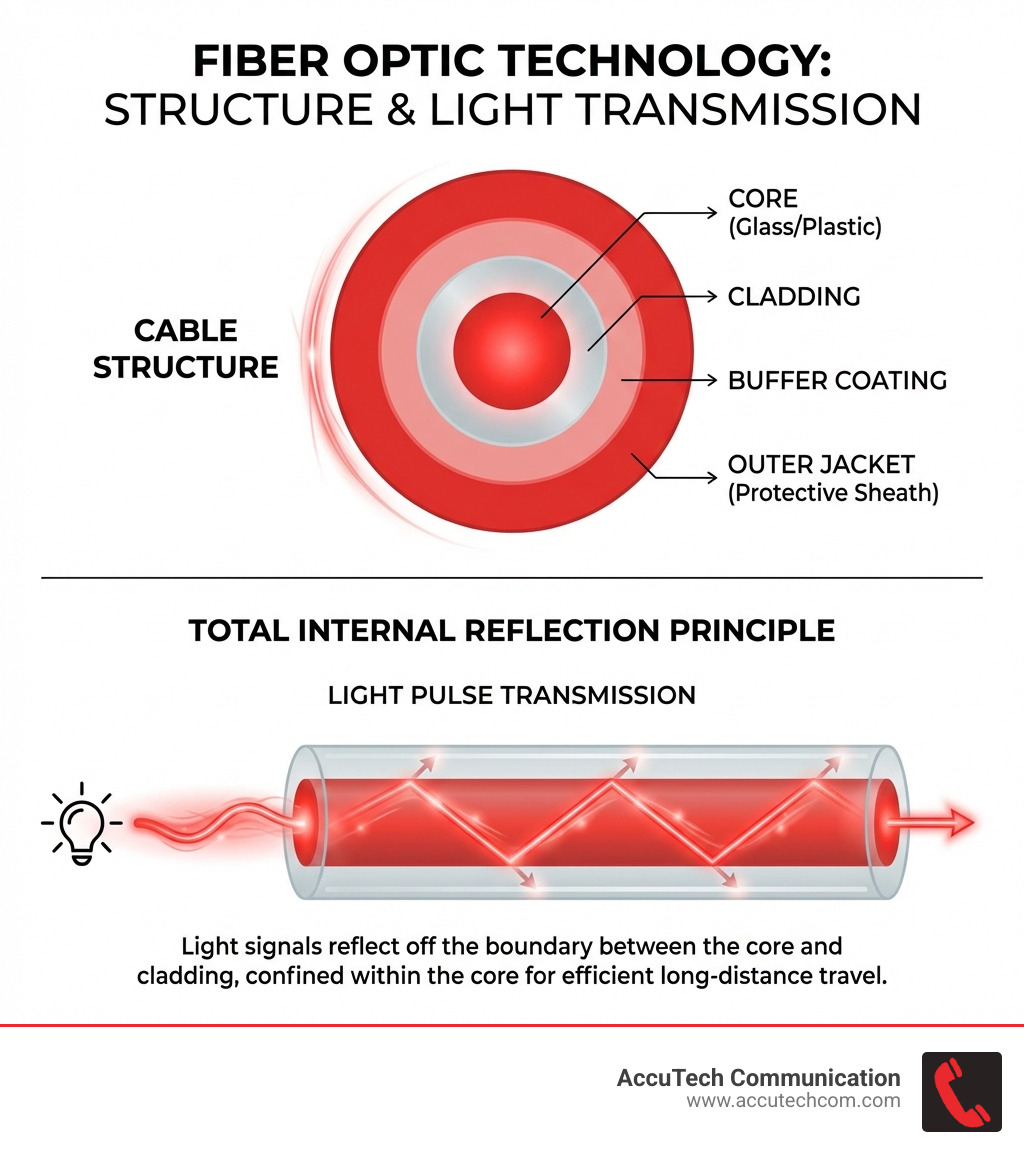
- Construction: Composed of a core (glass/plastic), cladding, protective buffer coating, and a rugged outer jacket.
- Signal Loss: Only 3% over 100 meters, whereas copper can lose up to 94% of its signal over the same distance.
- Types: Available as single-mode (for long-distance backbones) and multimode (for shorter, high-bandwidth local connections).
- Global Deployment: Over 5 billion kilometers of fiber are currently installed worldwide, powering the modern internet.
How They Work (In Practical Business Terms)
Light pulses travel through the fiber’s core using a principle called total internal reflection. This occurs when light bounces off the boundary between the core and the cladding, staying confined within the cable even as it bends and turns. This allows for incredibly efficient data transfer without the interference issues common in electrical systems.
In commercial networks, those light pulses are created and read by network optics (transceivers) connected to switches, routers, firewalls, and storage systems. In other words, the fiber itself is the physical pathway, and the electronics at each end convert electrical data into light and back again. This is a key reason fiber is so scalable: in many cases, you can increase throughput later by upgrading the optics and switching equipment without needing to replace the entire cabling pathway.
Why New England Commercial Sites Rely on Fiber
Understanding fiber optic cables has become critical for any business that depends on reliable, high-speed data transmission. From healthcare facilities in Providence requiring uninterrupted access to patient records to manufacturing operations in Woburn coordinating real-time production data, the backbone of modern commercial communication runs on optical fiber technology.
Unlike traditional copper cabling, fiber optic cables offer immunity to electromagnetic interference (EMI), superior bandwidth capacity, and the ability to support growing data demands without frequent infrastructure overhauls. These advantages make them the preferred choice for:
- Data center backbones and cross-connects in and around Boston
- IDF-to-MDF building backbones in multi-floor offices in Waltham
- Warehouse and manufacturing links where electrical noise can disrupt copper
- Multi-building campus connectivity across parking lots or between facilities
What This Guide Covers
I’m Corin Dolan, owner of AccuTech Communications. We have been designing and installing fiber optic cables for commercial clients across Massachusetts, New Hampshire, and Rhode Island since 1993. Our team provides certified, reliable service with a commitment to quality and competitive pricing. This guide will help you understand how these systems work, their advantages over copper, and how to choose the right solution for your business infrastructure.
Quick fiber optic cables terms:
Understanding the Fundamentals of Fiber Optic Cables
At its heart, a fiber optic cable is an ingenious solution for transmitting information using light. Imagine sending messages down a garden hose, but instead of water, it’s light, and instead of a hose, it’s a hair-thin strand of ultra-pure glass. This is the fundamental magic of fiber optics that allows businesses in Metro-west Boston and beyond to communicate at the speed of light.
The basic principle relies on total internal reflection. Inside each optical fiber, light travels through a central glass strand called the core. Surrounding this core is the cladding, which has a slightly lower refractive index. This difference causes light signals to bounce off the cladding and stay trapped within the core, allowing them to travel vast distances with minimal signal loss. This ensures that the light pulses carrying your crucial business data reach their destination intact. You can learn more about this principle from Light collection and propagation.
Key Components of Optical Fiber
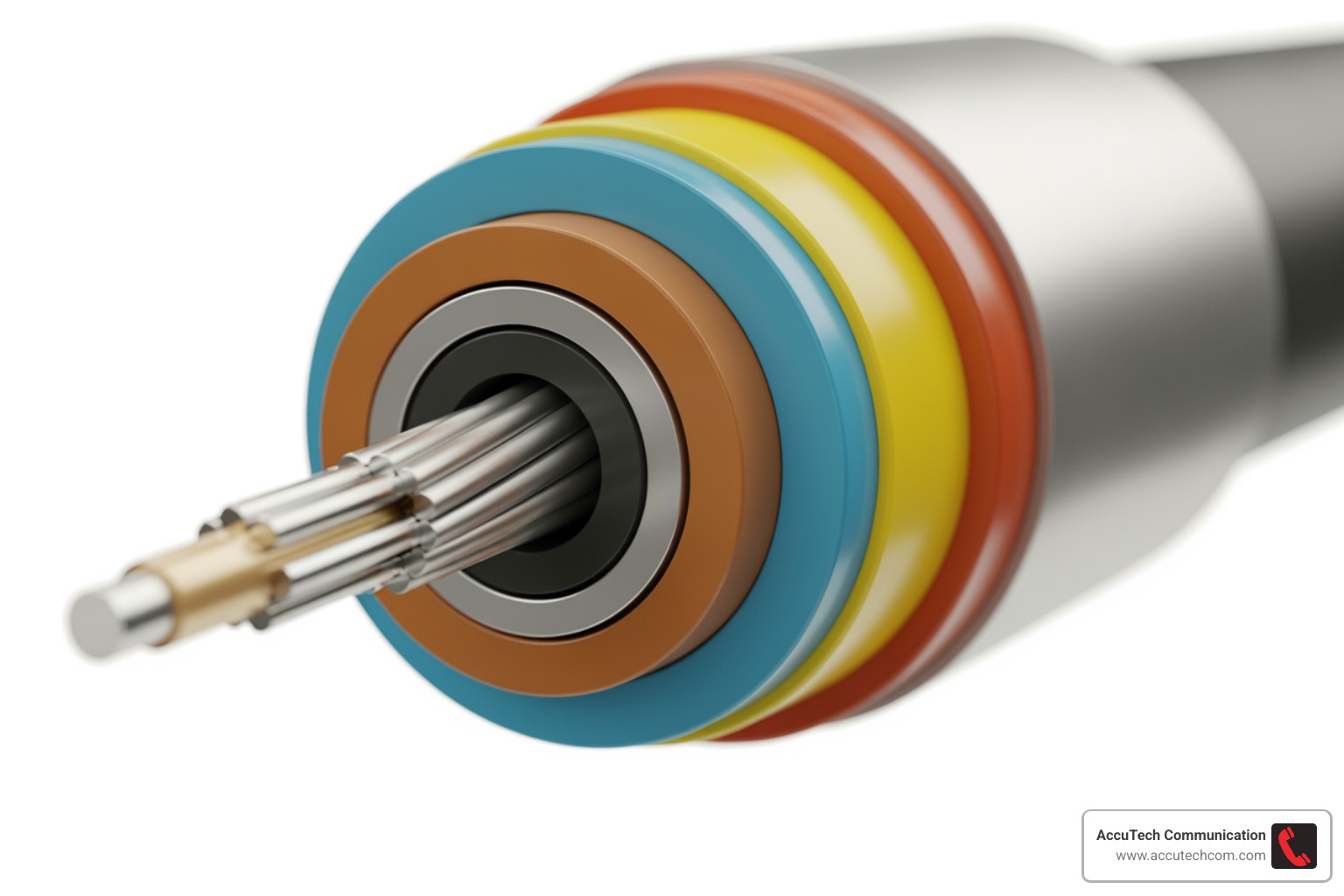
While the core and cladding are the heroes of light transmission, a fiber optic cable is a sophisticated assembly designed for protection and performance in demanding commercial environments:
- Buffer Coating: A plastic layer immediately surrounding the cladding that protects the delicate glass fiber from physical damage and moisture.
- Strength Members: Often made from aramid yarn (Kevlar), these provide tensile strength, allowing the cable to be pulled through conduits in buildings in Marlborough or Sudbury without stretching the glass fibers.
- Outer Jacket: The outermost layer, typically made of plastic, which protects the assembly from environmental factors, abrasions, and crushing. The material varies depending on whether the cable is for indoor, outdoor, or plenum use.
- Rip Cord: A strong string used to easily strip back the outer jacket during preparation. For a clearer understanding, see this Definition: rip cord.
Performance Metrics and Signal Loss
When evaluating fiber optic cables, several key metrics dictate network effectiveness:
- Speed and Bandwidth: Fiber can transmit data at rates up to 800 Gbps, vital for large data centers and enterprise networks. Breakthroughs have even demonstrated single cables transferring 1 petabit per second over 50 kilometers.
- Distance: Fiber can carry signals for 100 kilometers without a repeater, whereas copper is limited to 100 meters.
- Attenuation (Signal Loss): Measured in decibels (dB) per kilometer. Modern single-mode fiber loses as little as 0.25 dB/km at 1550 nm. Managing these losses is crucial for reliable networks, as detailed in Optical power loss (attenuation) in fiber.
- Wavelengths: Fiber typically uses infrared light (850 nm, 1300 nm, 1310 nm, and 1550 nm) because these experience the lowest attenuation in glass. More on this can be found in Understanding Wavelengths In Fiber Optics.
Key Advantages Over Traditional Copper Cabling
For businesses in our service areas of Massachusetts, New Hampshire, and Rhode Island, choosing fiber optic cables over traditional copper cabling is a strategic decision that pays dividends in performance and reliability. Copper has served us well for decades, but it faces physical limitations that fiber simply does not have.
That said, fiber and copper are often deployed together in well-designed commercial networks. A common approach is to use fiber for building backbones, data center interconnects, or long horizontal runs, while using copper for shorter endpoint drops where it makes sense. The right mix depends on your facility layout, bandwidth targets, and the long-term growth plan.
| Feature | Fiber Optic Cables | Traditional Copper (Cat6a) |
|---|---|---|
| Bandwidth Capacity | Extremely High (Up to 800 Gbps+) | Limited (Up to 10 Gbps) |
| Maximum Distance | Up to 100 km without repeaters | 100 meters (328 feet) |
| EMI/RFI Immunity | Fully Immune (Glass/Plastic) | Susceptible to Interference |
| Physical Size/Weight | Thin and Lightweight | Thick and Heavy |
| Data Security | High (No signal radiation) | Lower (Can be tapped via induction) |
| Future-Proofing | Excellent (Scalable with electronics) | Limited by physical properties |
Bandwidth and Scalability
One of the most significant advantages of fiber optic cables is the sheer volume of data they can carry. While copper cables like Cat6a are limited to 10 Gbps over 100 meters, fiber can handle hundreds of gigabits per second. This scalability is essential for growing businesses in Boston and Worcester that need to support cloud computing, video conferencing, and large-scale data backups without bottlenecking.
In practical commercial planning, bandwidth growth is rarely linear. A company might be “fine” today and then quickly outgrow copper backbones when adding:
- New virtual servers or storage replication
- Higher-resolution security video retention
- More Wi-Fi access points per floor
- New applications that require low latency and predictable throughput
Because fiber’s capacity is so high, it can accommodate these jumps more gracefully than copper, especially on backbone links between network closets, server rooms, and data center rows.
Maximum Distance Without Compromising Performance
Copper Ethernet’s 100-meter limit is a real design constraint in larger facilities. In commercial buildings with long corridors, high ceilings, or remote IDFs, you can run into distance issues quickly. Fiber supports far longer runs, which is particularly useful for:
- Connecting MDF-to-IDF across multiple floors
- Linking separate suites or departments on large floor plates
- Campus-style connections between buildings (where permitted and properly engineered)
Longer allowable distances can mean fewer intermediate closets, fewer active devices to maintain, and more predictable performance when your layout doesn’t fit neatly into copper’s limitations.
Immunity to Interference
In industrial areas like Woburn or manufacturing hubs in Rhode Island, electromagnetic interference (EMI) from heavy machinery or power lines can degrade copper signals. Because fiber optic cables use light rather than electricity, they are completely immune to EMI and radio frequency interference (RFI). This ensures a clean, stable connection regardless of the surrounding environment.
This immunity is also valuable in commercial spaces with dense electrical infrastructure, such as:
- Electrical rooms and risers
- Elevator equipment areas n- Generator/UPS environments
When uptime matters, removing interference as a variable can simplify troubleshooting and reduce intermittent issues that are time-consuming to diagnose.
Improved Security
Data security is a top priority for commercial entities. Copper cables radiate electromagnetic signals that can be intercepted or “tapped” without physically cutting the wire. Fiber optics do not radiate signals and are extremely difficult to tap without being detected, making them the most secure choice for financial and healthcare institutions in New England.
Operational Benefits for Commercial Facilities
Beyond speed and distance, fiber optic cables can reduce practical headaches during deployment and ongoing maintenance:
- Cable pathway efficiency: fiber’s smaller size can ease congestion in trays and conduits.
- Reduced grounding concerns: because fiber is non-conductive, it can be advantageous in certain building pathways (while still following applicable codes and standards).
- Clear upgrade paths: when fiber plant is installed, tested, labeled, and documented properly, future electronics refreshes are often simpler.
For commercial clients across Massachusetts, New Hampshire, and Rhode Island, these benefits translate into networks that are easier to scale, easier to manage, and better aligned with long-term technology roadmaps.
