
What are Two Characteristics of Fiber Optic Cable: Top Insights
What are two characteristics of fiber optic cable? Fiber optic cables are renowned for their high bandwidth capabilities and immunity to electromagnetic interference (EMI). These attributes make them an ideal choice for robust communication systems, ensuring data is transmitted efficiently and securely over long distances. Their application in structured and network cabling is pivotal for industries like healthcare, where reliable connectivity is paramount.
Fiber optic cables are a cornerstone of modern network infrastructure, and understanding their importance helps businesses make informed decisions about their communication systems. By integrating fiber optic technology, organizations are better equipped to handle increased data demands and future-proof their operations.
I am Corin Dolan, committed to providing businesses with insights into effective communication solutions. With experience in the telecommunications industry, particularly focusing on what are two characteristics of fiber optic cable, I’m dedicated to helping companies achieve seamless connectivity.
What are two characteristics of fiber optic cable terms you need:
– how do fiber optic cables work
– what is fiber optic cable made of
– types of fiber optic cable
What are Two Characteristics of Fiber Optic Cable?
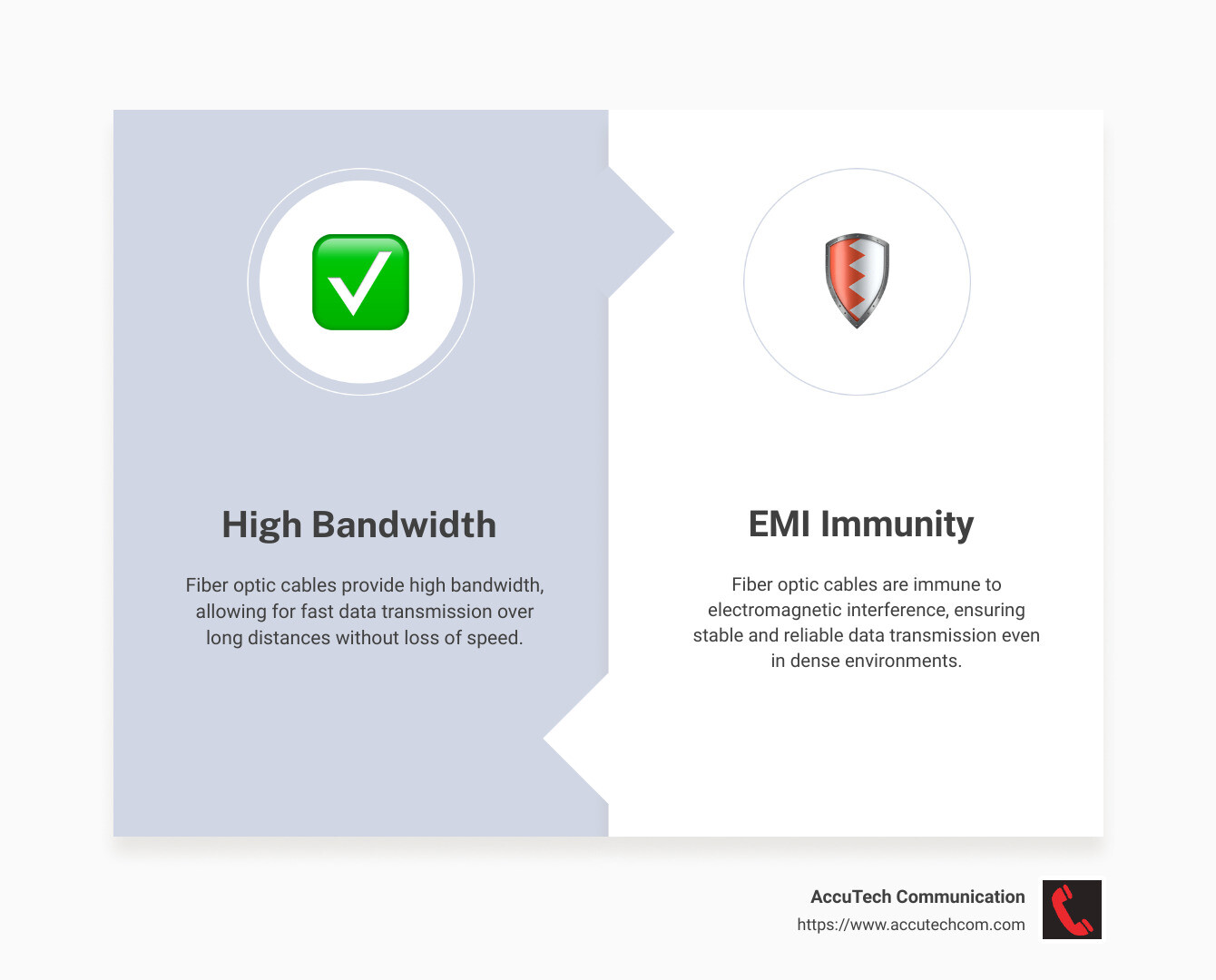
Fiber optic cables are essential for modern communication systems. Two key characteristics make them stand out: high bandwidth and immunity to electromagnetic interference (EMI).
High Bandwidth
Fiber optic cables can carry vast amounts of data at incredible speeds. This high bandwidth capability means they can support the growing demands for data transmission in today’s digital world. Unlike traditional copper cables, fiber optics can handle multiple data streams, making them ideal for high-performance networks.
- Fast Data Transfer: Fiber optics provide speeds that are best by copper cables, ensuring quick and efficient data transfer.
- Future-Proof: As data needs grow, fiber optics can easily accommodate increased bandwidth demands without needing a complete overhaul.
Immunity to Electromagnetic Interference
One of the standout features of fiber optic cables is their immunity to electromagnetic interference. This means they can transmit data without being affected by external electromagnetic fields, which can be a problem for copper cables.
- Reliable Connectivity: With no interference from EMI, fiber optics ensure a stable and consistent connection, crucial for industries like healthcare and finance.
- Secure Data Transmission: The lack of EMI makes fiber optic cables less prone to data breaches, providing a secure way to transmit sensitive information.
These two characteristics—high bandwidth and EMI immunity—make fiber optic cables a preferred choice for businesses looking to improve their network infrastructure. By investing in fiber optic technology, companies can ensure they have a reliable and efficient communication system that meets both current and future needs.
Types of Fiber Optic Cables
Fiber optic cables come in two main types: single-mode and multimode. Each type has its own specific applications and benefits, depending on the needs of the network.
Single-Mode Fiber
Single-mode fiber is designed for long-distance communication. It uses a single light path to transmit data, which minimizes signal loss and allows for high-speed data transfer over long distances. This makes it ideal for telecommunications and internet backbones, where data needs to travel across cities or even continents.
- Long-Distance Capability: Single-mode fiber can transmit data over distances of up to 100 kilometers without the need for signal boosters.
- Narrow Core: The core of single-mode fiber is very narrow, usually around 9 micrometers, which helps in maintaining signal integrity over long distances.
Multimode Fiber
Multimode fiber is best suited for shorter distances, such as within a building or campus. It has a larger core that allows multiple light paths or modes, which can carry more data but over shorter distances compared to single-mode fiber.
- Cost-Effective for Short Distances: Multimode fiber is generally more affordable than single-mode for short-range applications.
- Larger Core: With a core size of about 50 to 62.5 micrometers, multimode fiber can handle more data, but it’s more prone to signal degradation over longer distances.
Wavelength Range
The wavelength range used in fiber optic cables affects their performance. Single-mode fibers typically use a wavelength of 1310 nm or 1550 nm, which is ideal for long-distance communication. Multimode fibers, on the other hand, often operate at wavelengths of 850 nm or 1300 nm, suitable for shorter distances.
- Single-Mode Wavelengths: 1310 nm and 1550 nm are optimal for minimizing signal loss over long distances.
- Multimode Wavelengths: 850 nm and 1300 nm are used for efficient data transmission over shorter distances.
Understanding these types and their characteristics helps in selecting the right fiber optic cable for specific network needs, ensuring optimal performance and cost-effectiveness.
Advantages of Fiber Optic Cables
Fiber optic cables offer several advantages that make them a preferred choice for many applications. Let’s explore some key benefits: low attenuation, improved security, and durability.
Low Attenuation
One of the standout features of fiber optic cables is their ability to transmit data over long distances with minimal signal loss, known as low attenuation. This means that signals can travel farther without the need for frequent boosting, which is crucial for maintaining data integrity in large networks.
- Long-Distance Efficiency: Fiber optics can carry signals over distances that copper cables can’t match without repeaters.
- High Data Integrity: The low attenuation ensures that data arrives with minimal loss, maintaining quality and speed.
Improved Security
Fiber optic cables offer improved security over traditional cabling. Since they transmit data as light rather than electrical signals, they are much harder to tap into without detection. This makes them an excellent choice for sensitive data transmission.
- Difficult to Tap: Any attempt to tap into a fiber optic cable would likely result in a noticeable drop in signal quality, alerting to potential breaches.
- Secure Data Transmission: Ideal for environments where data security is a top priority, such as financial institutions and government facilities.
Durability
Fiber optic cables are known for their durability. They are less susceptible to environmental factors that often affect copper cables, such as electromagnetic interference (EMI) and radio frequency interference (RFI).
- Resistant to Interference: Fiber optics are immune to EMI and RFI, ensuring stable performance even in challenging environments.
- Long Lifespan: With proper installation and maintenance, fiber optic cables can last for many years, reducing the need for frequent replacements.
These advantages make fiber optic cables a smart investment for businesses looking to future-proof their network infrastructure. Up next, we’ll explore the various applications of fiber optic cables across different sectors.
Applications of Fiber Optic Cables
Fiber optic cables are changing industries with their advanced capabilities. Let’s explore how they are used in telecommunications, data centers, and the medical sector.
Telecommunications
In telecommunications, fiber optic cables are a game-changer. They enable high-speed internet, clear voice calls, and robust data services.
- High-Speed Internet: Fiber optics provide faster internet speeds compared to traditional copper lines, supporting streaming, gaming, and large data transfers without lag.
- Reliable Connections: Their immunity to electromagnetic interference ensures clear and stable communication, even in densely populated areas.
Data Centers
Data centers depend heavily on fiber optic technology to manage vast amounts of data efficiently.
- Scalability: Fiber optics support the rapid scaling of data centers, accommodating growing data demands.
- Efficient Data Transfer: They enable quick data transfer between servers, reducing latency and improving overall performance.
Medical Sector
In the medical field, fiber optic cables play a crucial role in diagnostics and treatment.
- High-Resolution Imaging: Used in endoscopy and imaging, fiber optics provide clear, detailed visuals, aiding in accurate diagnosis.
- Telemedicine: High-speed data transmission allows for remote consultations and real-time data sharing, enhancing patient care.
These applications highlight the versatility and importance of fiber optic cables across different sectors. As technology evolves, the role of fiber optics will only continue to expand, driving innovation and efficiency.
Frequently Asked Questions about Fiber Optic Cables
What are the two major classifications of fiber optic cable?
Fiber optic cables are primarily classified into two types: single-mode and multimode.
- Single-Mode Fiber: This type is designed for long-distance communication. It has a small core diameter, allowing only one light mode to propagate. This minimizes signal loss and maintains high bandwidth over long distances, making it ideal for telecommunications and large-scale data transfers.
- Multimode Fiber: Multimode fibers have a larger core, allowing multiple light modes to travel simultaneously. This makes them suitable for shorter distances, such as within data centers or buildings. They are often used for applications that require high bandwidth over shorter ranges.
What makes fiber preferable to copper cabling for interconnecting buildings?
Fiber optic cables offer several advantages over traditional copper cabling, especially for interconnecting buildings.
- High Bandwidth: Fiber optic cables can carry significantly more data at higher speeds than copper cables. This makes them perfect for supporting high-speed internet and large data transfers.
- EMI Immunity: Fiber optics are immune to electromagnetic interference (EMI), which can be a significant issue with copper cables. This ensures stable and reliable connections, even in environments with high electrical noise.
How does fiber optic cabling support future needs?
Fiber optic cabling is designed to meet both current and future demands, thanks to its unique characteristics.
- Wide Bandwidth: The wide bandwidth of fiber optics allows for the transmission of vast amounts of data, making it adaptable to future technological advancements and increasing data requirements.
- Low Attenuation: Fiber cables exhibit low signal loss over long distances. This means data can travel further without degradation, reducing the need for signal boosters and ensuring efficient communication.
These features make fiber optic cables a forward-thinking solution, capable of supporting technological growth and evolving connectivity needs.
Conclusion
At AccuTech Communications, we understand that fiber optic cabling is not just about high-speed data transfer; it’s about building a reliable and future-ready network infrastructure. Located in Massachusetts and serving the surrounding regions, we’ve been providing certified service since 1993. Our commitment to quality ensures that your network cabling is installed to the highest standards, ensuring long-term performance and reliability.
Competitive pricing is a cornerstone of our service philosophy. We believe that top-notch fiber optic solutions should be accessible to businesses of all sizes. By offering cost-effective solutions without compromising on quality, we help our clients stay ahead in the world of technology.
Whether you’re looking to improve your telecommunications, upgrade your data center, or simply need a dependable network for daily operations, AccuTech Communications is your trusted partner. Our expertise in fiber optic cabling ensures that your business is equipped to handle current demands and future growth.
For more information on how we can assist with your network cabling needs, visit our Fiber Optic Cabling Installation page. Let us help you build a stronger, more efficient network today.
