
Wireless Network Solutions for Business: Top 5 Effective Choices
Wireless network solutions for business have become essential for educational institutions aiming to foster a seamless digital learning environment. In schools and universities, reliable Wi-Fi connectivity supports interactive learning tools, facilitates research, and improves communication between students and staff.
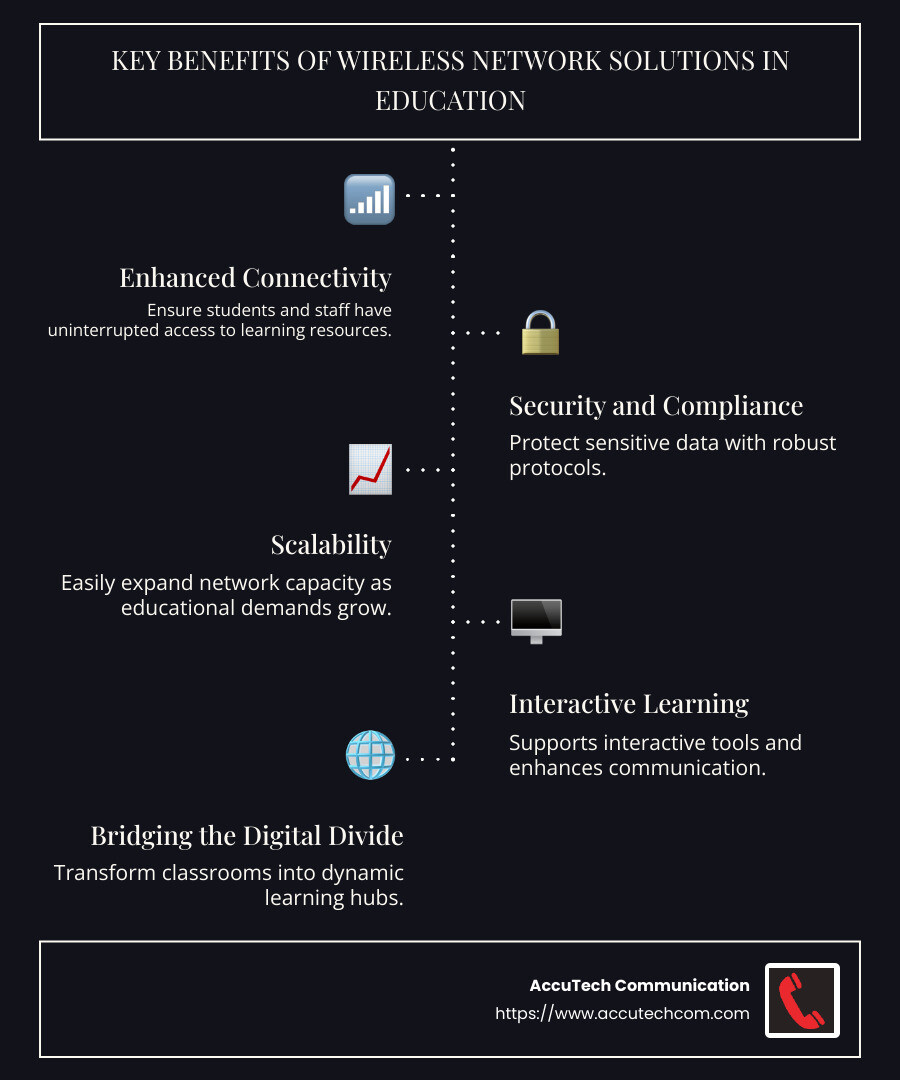
- Improved Connectivity: Ensure students and staff have uninterrupted access to learning resources.
- Security and Compliance: Protect sensitive data with robust protocols.
- Scalability: Easily expand network capacity as educational demands grow.
In educational institutions, these solutions transform classrooms into dynamic learning hubs, close the digital divide, and improve the overall academic experience. As wireless technologies evolve, schools must adopt custom solutions to meet these increasing digital demands.
I’m Corin Dolan, a seasoned expert in wireless network solutions for business, with years of experience at AccuTech Communications in Sudbury, Massachusetts. With a deep understanding of communication networks, I guide businesses in changing their infrastructure with reliable and scalable solutions.
Understanding Wireless Network Solutions for Business
Wi-Fi networks are the backbone of any modern educational environment. They allow students and staff to connect their devices—like laptops, tablets, and smartphones—to essential online resources. But setting up a reliable Wi-Fi network isn’t just about installing a few routers. It’s a comprehensive solution that addresses connectivity issues and supports a wide range of client devices.
Wi-Fi Networks: The Basics
Wi-Fi networks use radio waves to provide wireless high-speed Internet and network connections. In schools, these networks need to be robust enough to handle numerous connections simultaneously without a hitch. This ensures that whether students are researching for a project or teachers are streaming educational videos, the connection remains stable and fast.
Tackling Connectivity Issues
One of the common challenges in wireless network solutions for business is connectivity issues. These can occur due to interference, outdated hardware, or poor network design. Schools can overcome these problems by:
- Upgrading to Wi-Fi 6 technology, which offers faster speeds and better performance in crowded environments.
- Conducting regular network assessments to identify and resolve weak spots.
- Installing cloud-managed access points that allow for easy monitoring and troubleshooting.
Supporting Client Devices
Educational institutions often have a wide variety of client devices connecting to their network. From the latest tablets to older laptops, each device has different connectivity needs. A well-designed wireless network solution should:
- Support a mix of device types and operating systems.
- Provide seamless roaming to ensure uninterrupted connectivity as users move around the campus.
- Implement quality of service (QoS) settings to prioritize critical educational applications over non-essential traffic.
By understanding these key aspects of wireless network solutions, schools can create a reliable and efficient digital learning environment. This not only improves the educational experience but also prepares students for a tech-driven world.

Next, we’ll explore the various types of wireless networks and how they can be custom to meet the specific needs of educational institutions.
Types of Wireless Networks
When it comes to wireless network solutions for business, especially in educational institutions, understanding the different types of networks is crucial. Each type serves specific needs and environments, ensuring that students and staff have reliable access to digital resources.
Local Area Networks (LANs)
Local Area Networks (LANs) are the most common type of network found in schools and universities. They cover a small geographic area, like a single building or a campus, providing high-speed connectivity for a concentrated number of devices. LANs are ideal for educational environments because they enable quick data transfer and easy access to shared resources like printers and file servers.
- Benefits of LANs:
- High-speed data transfer
- Secure and controlled access
- Easy to manage and expand
Metropolitan Area Networks (MANs)
Metropolitan Area Networks (MANs) span a larger area than LANs, typically covering a city or a large campus with multiple buildings. They connect several LANs, allowing for efficient data communication over longer distances. For universities with multiple campuses or buildings spread across a city, MANs provide a seamless connection, ensuring that resources can be shared effortlessly.
- Benefits of MANs:
- Efficient connectivity across multiple locations
- Cost-effective for large campuses
- Supports a high volume of data traffic
Personal Area Networks (PANs)
Personal Area Networks (PANs) are smaller networks designed for individual users. They typically connect devices like smartphones, tablets, and laptops within a short range, often using technologies like Bluetooth. In an educational setting, PANs can be useful for connecting personal devices to the school’s network without interfering with larger networks.
- Benefits of PANs:
- Convenient for personal device connectivity
- Low cost and easy setup
- Minimal interference with larger networks
Wide Area Networks (WANs)
Wide Area Networks (WANs) cover the largest geographic area, often connecting multiple LANs and MANs across cities, countries, or even continents. They are essential for institutions with campuses in different locations, providing a unified network that supports communication and resource sharing on a global scale.
- Benefits of WANs:
- Extensive geographic coverage
- Enables communication between distant campuses
- Scalable to accommodate growth
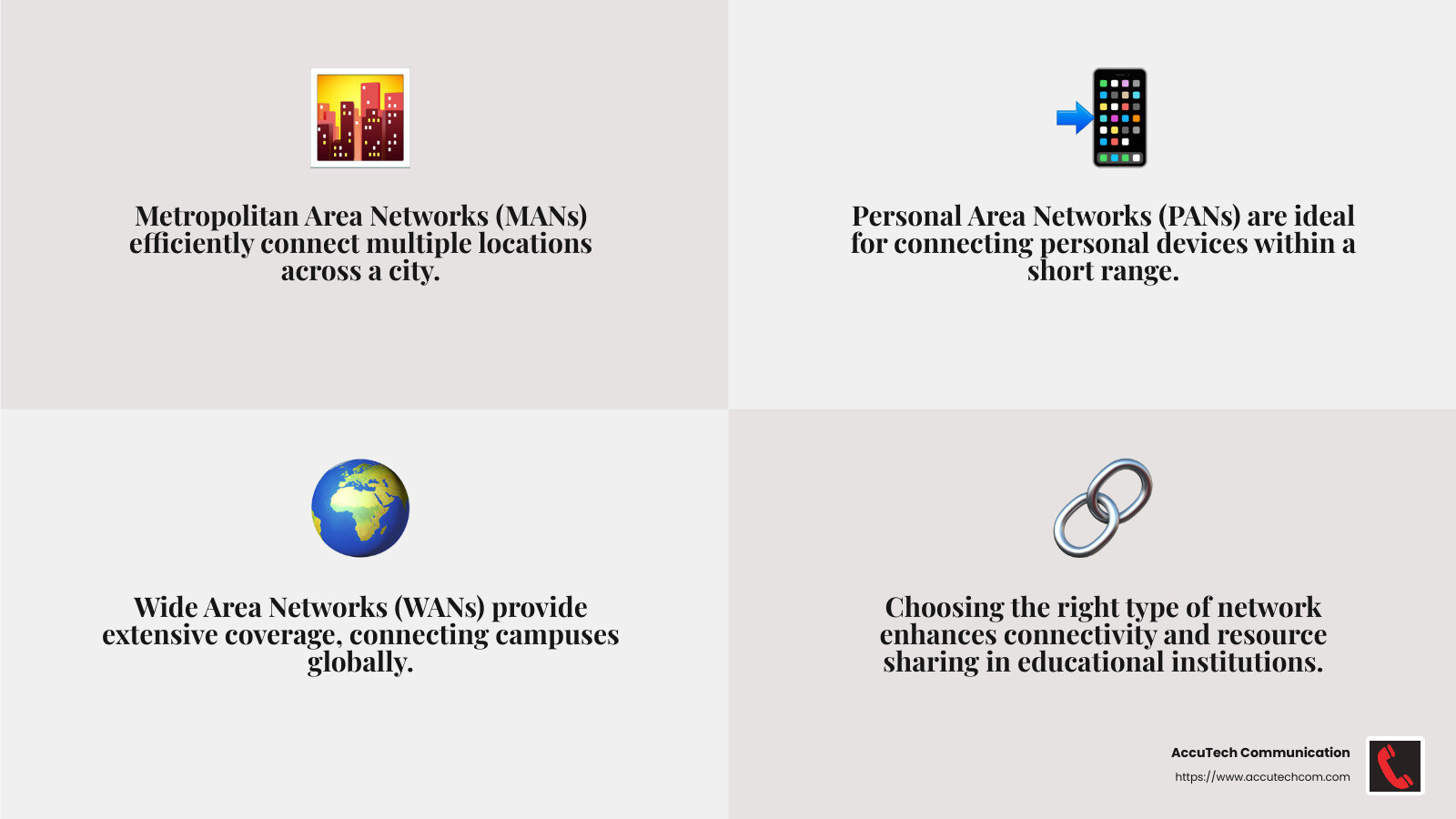
Each type of network plays a vital role in creating a comprehensive wireless network solution for business. By choosing the right network type, schools and universities can improve connectivity, improve resource sharing, and support a tech-driven educational environment.
Up next, we’ll dig into the top wireless solutions for educational institutions, focusing on the latest technologies like Wi-Fi 6 and cloud-managed access points.
Top Wireless Solutions for Educational Institutions
When it comes to wireless network solutions for business, especially in schools and universities, embracing the latest technology can make a huge difference. Let’s explore some of the top solutions that can transform educational environments.
Wi-Fi 6
Wi-Fi 6 is the latest standard in wireless technology, offering faster speeds and better performance in crowded areas. For schools and universities, this means more reliable connections even during peak usage times, like between classes or during large events.
- Benefits of Wi-Fi 6:
- Higher speeds: Perfect for streaming and accessing large files.
- Improved capacity: Handles more devices without slowing down.
- Improved efficiency: Reduces battery drain on connected devices.
Imagine a lecture hall filled with students all accessing online resources simultaneously. Wi-Fi 6 can handle this high-density environment, ensuring everyone stays connected without hiccups.
Cloud-Managed Access Points
Cloud-managed access points bring a new level of simplicity and control to network management. These devices allow IT teams to manage networks remotely, making it easier to troubleshoot issues and update settings without being on-site.
- Benefits of Cloud-Managed Access Points:
- Remote management: Adjust settings and monitor performance from anywhere.
- Scalability: Easily add more access points as the institution grows.
- Real-time updates: Keep the network secure with automatic updates.
For a university with multiple campuses, cloud-managed access points mean seamless control over the entire network, no matter where the IT team is located.
High-Density Environments
Educational institutions often face the challenge of high-density environments where many devices connect to the network at once. Solutions designed for these environments ensure that performance remains strong and reliable.
- Key Features for High-Density Environments:
- Advanced load balancing: Distributes network traffic evenly.
- Multiple access points: Provides extensive coverage without dead zones.
- Interference management: Minimizes signal interference for clearer connections.
Consider a busy student union where hundreds of devices connect to the Wi-Fi. High-density solutions make sure that every student can access the internet smoothly, whether they’re studying or relaxing between classes.
By implementing these top wireless solutions, educational institutions can create a robust and efficient network that supports both learning and administration. In the next section, we’ll explore the benefits of these solutions in more detail, including how they improve communication and provide secure access.
Benefits of Implementing Wireless Solutions in Schools
Implementing wireless network solutions for business in schools and universities offers a multitude of benefits, enhancing both educational and administrative functions. Here’s how these solutions can transform educational institutions:
Seamless Communication
Wireless solutions ensure that students, teachers, and staff can communicate effortlessly. Whether it’s sharing resources during a class or coordinating events, a strong wireless network keeps everyone connected.
- Instant Collaboration: Teachers can share assignments and resources with students in real-time.
- Efficient Administration: Staff can coordinate seamlessly across departments using digital tools.
- Improved Learning Experiences: Students can engage in interactive learning activities without connectivity issues.
Secure Access
Security is paramount in educational settings, where sensitive data and personal information are frequently accessed. Wireless solutions offer robust security features to protect these networks.
- Advanced Encryption: Ensures that data transmitted over the network is secure from unauthorized access.
- Role-Based Access: Provides different levels of network access to students, faculty, and guests.
- Regular Security Updates: Keeps the network protected against the latest threats.
By maintaining secure access, schools can safeguard student and staff information while ensuring that only authorized users can access sensitive resources.
Scalable Connectivity
As schools grow, so do their connectivity needs. Wireless solutions offer scalability, allowing institutions to expand their networks without starting from scratch.
- Easy Expansion: Additional access points can be added as more buildings or classrooms are introduced.
- Flexible Infrastructure: Adaptable to changing technological needs and student populations.
- Cost-Effective Growth: Avoids the high costs associated with overhauling existing network infrastructure.
For example, a university planning to expand its campus can easily scale its wireless network to accommodate new buildings and increased student enrollment.
By leveraging these benefits, schools and universities can create an environment that supports effective learning and efficient operations. This leads us to the next section, where we’ll address some frequently asked questions about wireless network solutions for business.
Frequently Asked Questions about Wireless Network Solutions for Business
What are the 4 types of wireless networks?
Wireless networks come in various forms, each suited to different needs and environments. The four main types are:
- Local Area Networks (LANs): These networks cover a small geographical area, like a school campus or office building. They are ideal for connecting computers, smartphones, and other devices within a close proximity.
- Metropolitan Area Networks (MANs): Spanning a larger area than LANs, MANs connect multiple locations within a city or large campus. They are often used by universities or businesses with several buildings in a metropolitan area.
- Personal Area Networks (PANs): These are very small networks, typically covering a few meters. PANs connect personal devices like smartphones, tablets, and laptops, often using Bluetooth technology.
- Wide Area Networks (WANs): Covering vast geographical areas, WANs connect devices over long distances. They are used by large organizations with offices scattered across different cities or even countries.
How to set up a Wi-Fi network for your business?
Setting up a Wi-Fi network for your business involves several key steps:
- Choose a Service Provider: Select a reliable internet service provider (ISP) that offers the speed and bandwidth necessary for your business operations.
- Select the Right Equipment: Invest in quality routers and access points that can handle the number of devices and the type of network traffic your business generates. Consider options like the Zyxel SCR 50AXE or the Cisco Meraki Go GX50 for robust performance.
- Configuration: Properly configure your network to ensure optimal performance. This includes setting up secure passwords, configuring SSIDs, and ensuring that your network is encrypted.
- Placement of Access Points: Strategically place access points to ensure full coverage and avoid dead zones. This is especially important in high-density environments like schools or large offices.
- Regular Maintenance: Keep your network updated with the latest firmware and security patches to protect against vulnerabilities and ensure smooth operation.
What is the best wireless router for business use?
Choosing the right router is crucial for maintaining a reliable business network. Two top contenders are:
- Zyxel SCR 50AXE: Known for its strong performance and advanced security features, making it suitable for small to medium-sized businesses.
- Cisco Meraki Go GX50: Offers cloud management capabilities, making it easy to monitor and manage your network from anywhere. It’s a great choice for businesses looking for simplicity and reliability.
Both options provide excellent connectivity, robust security, and user-friendly management features, ensuring your business network runs smoothly and efficiently.
By understanding these key aspects of wireless networks, you can make informed decisions when implementing wireless network solutions for business. This knowledge will help ensure your network is both effective and secure, supporting your business’s needs as it grows and evolves.
Conclusion
As we wrap up our exploration of wireless network solutions for business, it’s clear that having a reliable and efficient network is crucial for any educational institution or business. At AccuTech Communications, we pride ourselves on being a trusted partner in building these robust networks.
Based in Massachusetts, we offer a certified service that ensures your network infrastructure is optimized for peak performance. Our skilled technicians and engineers are equipped to handle all your network cabling and wireless needs, providing solutions custom to your specific requirements. Whether you’re a small business or a large corporate campus, our expertise covers it all.
One of our key strengths is our competitive pricing. We understand that budget is a significant consideration for many organizations, and we strive to offer cost-effective solutions without compromising on quality. Our commitment to delivering value has helped us build lasting relationships with clients across Massachusetts, New Hampshire, and Rhode Island.
We believe in not just meeting but exceeding our clients’ expectations. Our comprehensive services, from consultation and design to installation and maintenance, ensure that your network is always running smoothly. This dedication to quality and service has been our hallmark since 1993.
For more information on how we can help strengthen your network infrastructure, visit our Network Cabling Services page. Let us help you create a seamless and secure wireless environment that supports your institution’s growth and connectivity needs.
In conclusion, choosing the right partner for your wireless network solutions is crucial. With AccuTech Communications, you can be confident in receiving top-notch service and support, allowing you to focus on what truly matters—your business or educational mission.
