
Voice and Data Installation: Ultimate 2025 Guide
Why Voice and Data Installation is Critical for Modern Business Operations
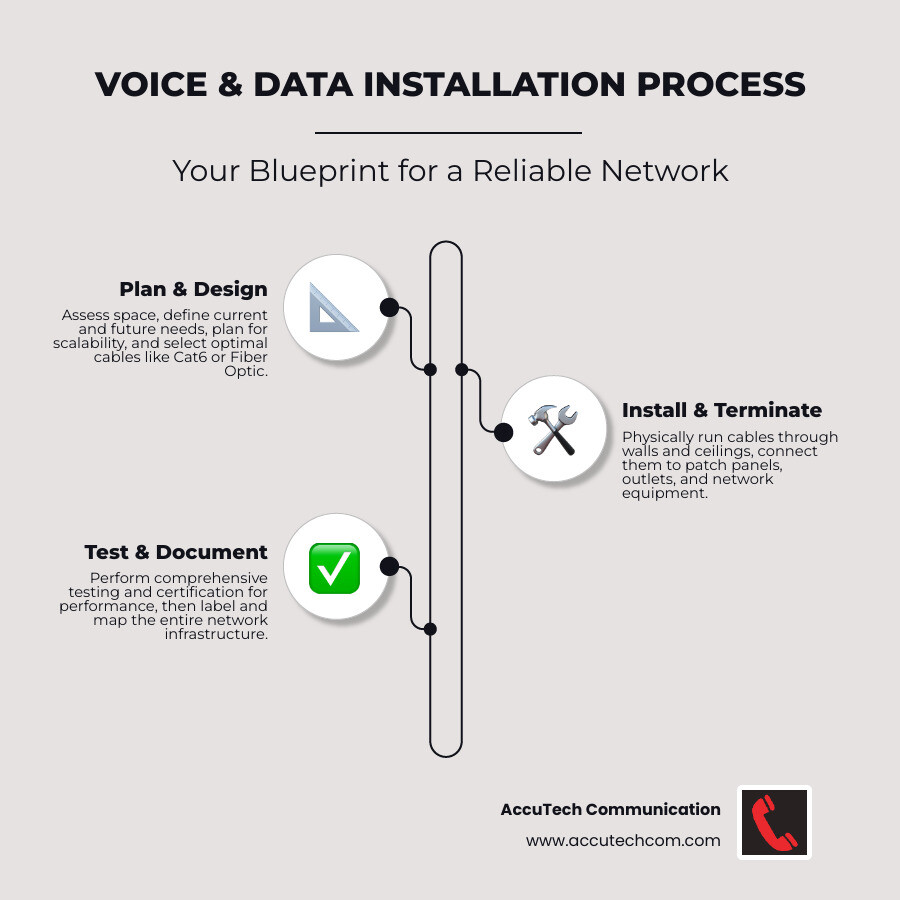
Voice and data installation is the foundation of every successful modern business, connecting your phones, computers, and critical systems through a structured network of cables and equipment. Here’s what a professional installation involves:
Key Components of Voice and Data Installation:
- Planning & Assessment – Evaluating your space, current needs, and future growth
- Cable Selection – Choosing between Cat5e, Cat6, Cat6a, or fiber optic based on performance requirements
- Physical Installation – Running cables through walls, ceilings, and floors to connect workstations
- Termination & Testing – Connecting cables to patch panels, outlets, and network equipment
- Documentation – Labeling and mapping your entire network infrastructure
The voice and data cabling market is expected to reach $15 billion globally by 2025, reflecting the critical importance of reliable network infrastructure. As one industry expert noted, “Most personnel can’t live without structured cabling” – it’s become as essential as electricity for business operations.
A proper installation reduces downtime, boosts performance, and ensures scalability for future tech. From small offices to large healthcare facilities requiring HIPAA compliance, the quality of your installation directly impacts productivity.
I’m Corin Dolan, Owner of AccuTech Communications, and I’ve been helping businesses across Massachusetts, New Hampshire, and Rhode Island with voice and data installation projects since 1993. My team specializes in designing scalable communication solutions that grow with your business, from initial planning through ongoing support.
Important voice and data installation terms:
Step 1: Planning Your Voice and Data Cabling Infrastructure
Planning your voice and data installation is like creating a blueprint for a house—get it right before you start. Proper planning is the key to a successful network infrastructure.

We always start with a thorough site assessment of your space. This means walking through your office, understanding how your team works, and getting a clear picture of your current communication needs. But here’s the key – we don’t just focus on today. We spend time understanding your business goals and anticipating where you’ll be in five or ten years.
During this planning phase, we’re asking important questions about your bandwidth needs and future growth. Will you be adding more employees? Planning to use video conferencing more heavily? Thinking about expanding to new applications that demand high-speed data transfer? These conversations help us design a system that grows with you instead of holding you back.
The beauty of good planning shows up in our device inventory and outlet location mapping. We carefully consider where each workstation needs to be, how your team moves through the space, and what makes sense for your workflow. Our server room design takes into account not just your current equipment, but the space and power requirements for future upgrades.
This upfront investment in planning pays dividends later. A well-designed structured cabling system means you won’t need a complete overhaul every time your business evolves. For a deeper look at how we approach this comprehensive planning process, check out our structured cabling services.
Factors to Consider When Choosing an Installation Provider
Choosing the right partner for your voice and data installation can make or break your project. After three decades in this business, I’ve seen what separates the professionals from the rest.
Certified technicians are non-negotiable. Improper termination or poor installation can cripple your network. Our team holds industry certifications because technical details matter.
Industry standards compliance is your insurance policy. We follow TIA/EIA standards religiously to ensure your system performs reliably for years. Compliance means every cable, connection, and label follows the rules.
Strong project management keeps everything on track. Large installations are complex, and you don’t want chaos disrupting your business. Our project managers coordinate every detail to keep your installation on schedule and budget.
Experience in your industry makes a real difference. A healthcare facility has different needs than a manufacturing plant. We’ve worked across many sectors and understand these nuances, as our client testimonials reflect.
Finally, post-installation support is crucial. Your network needs ongoing care, and we provide maintenance, upgrades, and troubleshooting long after the initial installation.
Understanding Your Environment: Plenum vs. Non-Plenum
Not all cables are created equal; your building’s design dictates the type you need. Understanding plenum spaces versus non-plenum environments isn’t just technical trivia—it affects safety, compliance, and your budget.
Plenum spaces are air circulation pathways, like the area above a drop ceiling. Fire safety codes mandate special plenum-rated cables here. These cables have fire-resistant jackets that don’t release toxic fumes or spread flames in a fire.
In a non-plenum environment, air returns to the HVAC system through enclosed ducts. Here, you can use standard, less expensive cables.
The cost difference can be significant, but safety is paramount. We assess your building during our site visit to determine the required cable rating. Getting this right ensures your installation passes inspection and keeps your team safe.
Step 2: Selecting the Right Cables for Your Network
Choosing the right cable is like picking the right highway for your data. Some are for light traffic, others are superhighways for high volume. Your cable selection is the foundation for your network’s current and future performance.
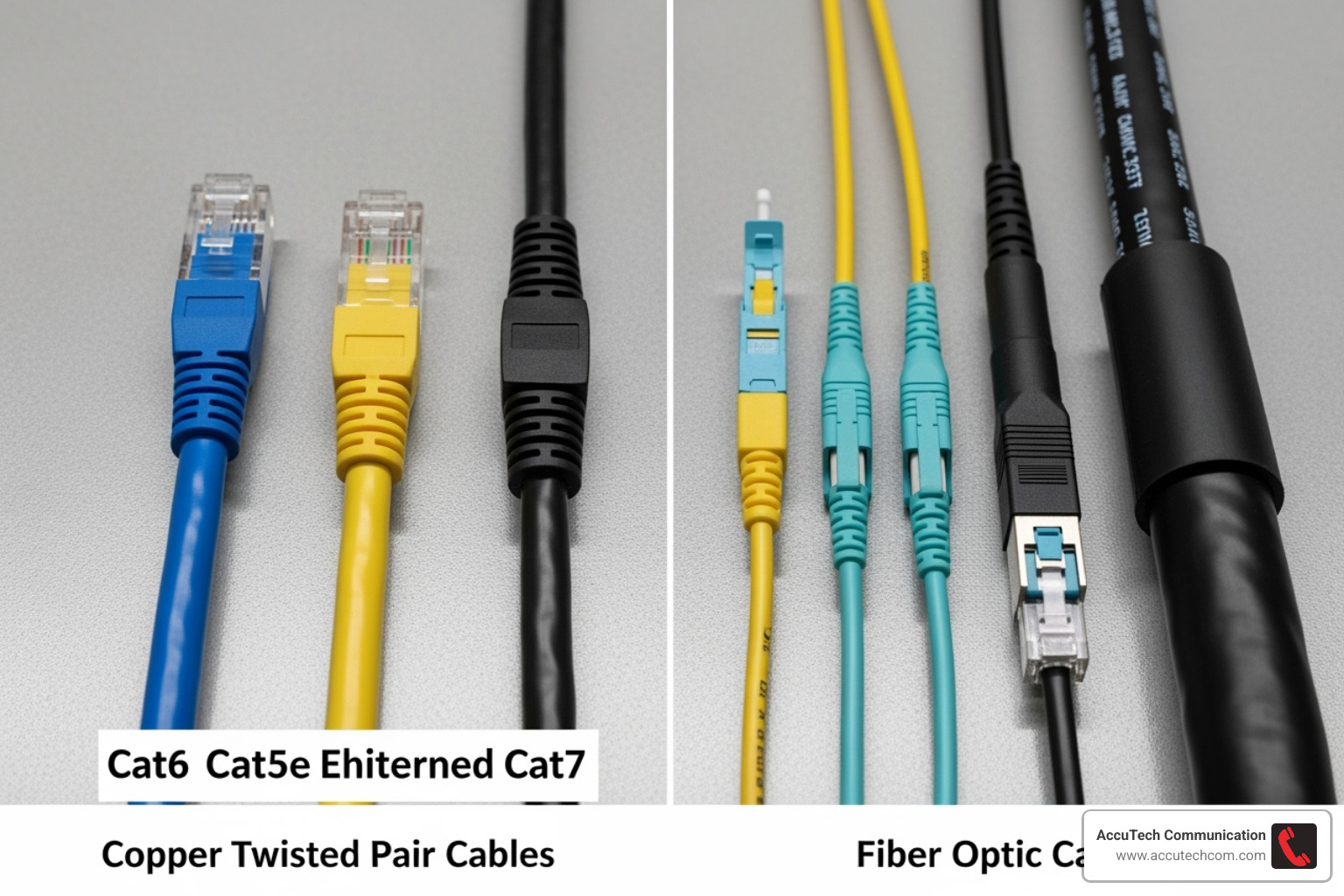
For your voice and data installation, we use two main cable families. Copper cabling (Cat5e, Cat6, Cat6a) sends data via electrical signals. It’s great for most business networks but has distance limitations and is susceptible to electromagnetic interference.
Fiber optic cabling uses light pulses through glass strands. It’s like a crystal-clear phone call versus shouting across a noisy room. Fiber offers much higher speeds, greater distances, and immunity to the electromagnetic interference that affects copper.
The choice between copper and fiber isn’t always obvious, and that’s where our experience comes in. We look at your bandwidth needs, the distances we need to cover, your budget considerations, and most importantly, where you see your business heading in the next five to ten years.
A Guide to Common Voice and Data Installation Cables
Let’s break down the cable options you’ll encounter during your voice and data installation without getting lost in technical jargon:
| Cable Type | Speed Capability | Bandwidth Capacity | Cost | Ideal Use Case |
|---|---|---|---|---|
| Cat5e | Up to 1 Gbps (180 ft) | 100 MHz | Low | Small offices, basic internet, legacy systems |
| Cat6 | 1 Gbps (180 ft), 10 Gbps (short distances) | 250 MHz | Moderate | Modern offices, general business, VoIP, streaming |
| Cat6a | 10 Gbps (328 ft) | 500 MHz | Higher | High-performance networks, data centers, industrial |
| Fiber Optic | 1+ Tbps | Vast | High | Network backbones, long distances, future-proofing |
Cat5e is an older but capable standard, handling 1 Gbps up to 180 feet. It’s a budget-friendly choice for small offices with basic internet and file-sharing needs.
Cat6 is our standard recommendation for modern businesses. It supports 1 Gbps (and 10 Gbps over short runs), making it ideal for VoIP, video streaming, and busy offices. Cat6 offers the perfect balance of performance and value.
For serious horsepower, Cat6a delivers 10 Gbps over the full 328-foot distance. Its thicker, shielded design is perfect for industrial settings or high-density applications where performance is critical.
Fiber optic cabling is in a league of its own, with speeds over 1 Tbps and vast distance capabilities. It’s our top choice for connecting buildings, creating network backbones, and future-proofing. Explore our fiber optic cabling installation services to learn more.
Voice-Specific Cabling Considerations
Modern voice and data installation has been simplified by a game-changing technology shift.
Voice over Internet Protocol (VoIP) has largely replaced traditional phone systems. Your calls travel over your data network, allowing us to run phone and computer connections through a single cable to each workstation.
Power over Ethernet (PoE) simplifies this further. A single cable delivers both data and power to devices like VoIP phones, eliminating the need for extra power outlets and adapters.
The cost savings are substantial, nearly halving your cabling requirements compared to separate voice and data systems. Plus, digital VoIP calls are often clearer and more reliable than analog phone lines.
For businesses still using traditional landlines, we’ll work with your existing setup and plan for a smooth transition when you’re ready. Our goal is ensuring every conversation is crystal clear and every connection is rock solid, whether you’re talking to the office next door or a client across the country.
Step 3: The Professional Voice and Data Installation Process
This is where your planned network comes to life. The actual voice and data installation transforms plans into a working system that will serve your business for years.
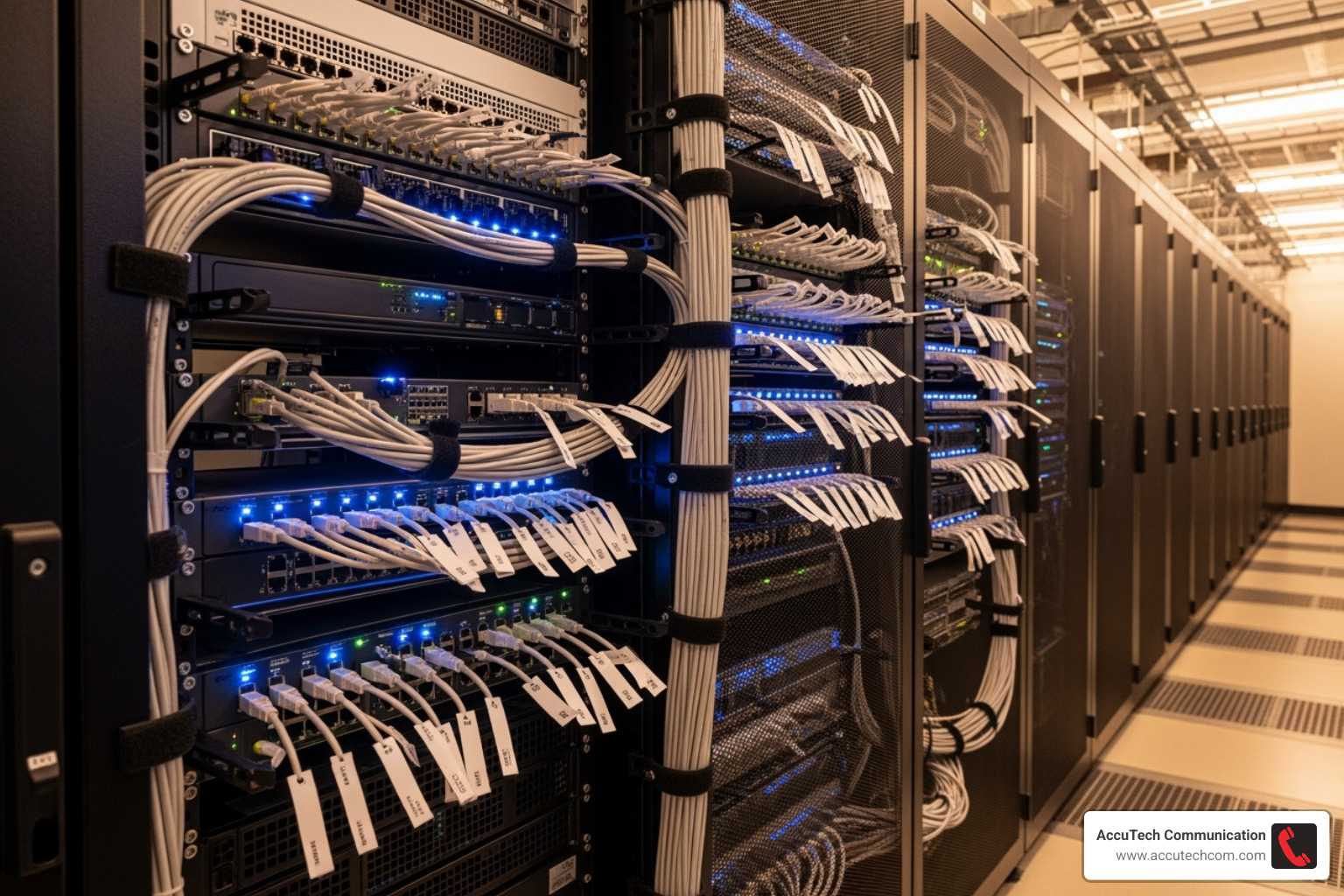
This phase is like building your office’s circulatory system. Network cables must connect every workstation, phone, and device.
We start by preparing cable pathways—the hidden routes for your data. This involves working above ceilings, behind walls, or under floors to keep cables protected and out of sight for a clean, professional look.
Pulling cables requires experience. Each cable must be handled carefully to avoid damage. We use specialized tools and techniques to guide cables through tight spaces without stressing them.
Termination is a critical step. We attach connectors to the cable ends with precision. Poor termination can kill network speed, so we take extra care with every connection.
Patch panels and wall plates give your network its organized structure. Think of patch panels as the central hub in your server room where all cables meet, while wall plates are the clean, professional outlets where employees plug in their devices. This setup makes future changes and troubleshooting much easier.
Every cable gets thoroughly tested and certified using specialized equipment. We don’t just check if it works – we verify it meets exact performance standards for speed and signal quality. This testing ensures your network will perform reliably for years.
Finally, we handle labeling and documentation with the same care as everything else. Every cable, port, and connection gets clearly labeled. We provide you with detailed as-built drawings showing exactly where everything is located. Trust me, you’ll appreciate this attention to detail when you need to make changes later!
From Server Room to Workstation: Key Installation Stages
A professional voice and data installation follows a logical flow from the central equipment to each workstation, helping you see how all the pieces fit together.
Backbone cabling forms the superhighway of your network. These high-capacity cables connect your main equipment room to telecommunications rooms throughout your building. We often use fiber optic cables for backbone runs because they can handle enormous amounts of data over long distances without any signal loss.
Horizontal cabling branches out from telecom rooms to work areas, typically using Cat6 or Cat6a. We keep these runs under 300 feet to maintain peak performance, much like a short hose maintains water pressure.
Your telecommunications rooms serve as the nerve centers of your network. These dedicated spaces house patch panels, network switches, and other active equipment. In smaller offices, a wall-mounted enclosure can do the job, but larger facilities need dedicated rooms with proper cooling and power.
Work area outlets are where the magic happens for your employees. These wall plates provide the connection points for computers, phones, and other devices. We typically install at least two outlets per work area, giving you flexibility for future changes.
Cable management keeps everything neat and organized. Using proper racks, cabinets, and cable trays prevents the dreaded “spaghetti mess” that makes troubleshooting a nightmare. Good cable management also improves airflow around equipment, helping everything run cooler and last longer.
Grounding and bonding provides essential protection for your equipment and people. We ensure all conductive parts are properly connected to a common ground, protecting against electrical surges and reducing interference that could slow down your network.
Throughout every stage, we strictly follow EIA/TIA 568 specifications. These industry standards ensure your installation is safe, reliable, and built to last. It’s like following a proven recipe – when you stick to the standards, you get consistent, professional results every time.
Step 4: Ensuring Long-Term Performance, Security, and ROI
A professional voice and data installation is a strategic investment in your business’s future. Like a reliable car, you want it to serve you well for years without breaking down.

When your cabling infrastructure is done right, the benefits become clear almost immediately. Your network performs faster, with data zipping between computers and crystal-clear phone calls. Those frustrating moments when the internet crawls or calls drop become rare occurrences rather than daily headaches.
Over time, the benefits multiply. Reduced downtime keeps your team productive. You’ll spend less on maintenance and repairs because the system is reliable. When it’s time to grow, your infrastructure can handle new employees, software, or locations without expensive overhauls.
Data security gets a boost too. A well-organized network is much easier to monitor and protect. When cables are properly managed and access points are secure, unauthorized users have a much harder time getting into your systems. Plus, everything runs more reliably, which means your business operations stay consistent and dependable.
Perhaps most importantly, you’re future-proofing your business. Technology changes fast, but a quality cabling system adapts with it, supporting new applications and growing demands without missing a beat.
Securing and Maintaining Your Cabling Infrastructure
Your cabling infrastructure needs regular care to perform at its best, preventing bigger problems down the line.
Physical security forms your first line of defense. We recommend keeping your telecommunications rooms locked and monitored. These spaces house critical equipment that keeps your business running, so restricting access makes sense. Protecting cables from accidental damage is equally important – a forklift accidentally hitting a cable run can take down half your network.
Cable management might sound boring, but it’s actually fascinating how much difference organization makes. When cables stay neat and properly labeled, they perform better and last longer. Heat buildup decreases, signal quality improves, and troubleshooting becomes a breeze instead of a nightmare. We’ve seen too many businesses struggle with tangled, unlabeled cables that turn simple fixes into expensive projects.
Regular testing catches small issues before they become big headaches. While we certify everything during installation, periodic check-ups help maintain peak performance. This is especially valuable when you’re upgrading systems or notice performance dips.
The industry keeps evolving, and your infrastructure should keep pace. Wi-Fi 6 support requires robust backbone cabling, and emerging technologies like AI-driven analytics can help predict network issues before they impact your business. A well-designed system provides the foundation for these advances.
The Financial and Operational Benefits of Quality Cabling
The financial benefits are clear. The voice and data installation market is booming, expected to reach $15 billion globally by 2025, because businesses recognize that quality cabling delivers real value.
Increased productivity might be the biggest win. When your team can work without network frustrations, they accomplish more and feel better about their day. Video calls connect clearly, files transfer quickly, and applications respond instantly. It’s amazing how much smoother everything flows when the foundation is solid.
Lower maintenance costs add up significantly over time. Quality installations require fewer service calls and repairs. Instead of budgeting for constant fixes, you can invest in growing your business. The simplified moves, adds, and changes alone save substantial money – adding a new workstation becomes a quick plug-and-play operation rather than a major project.
Modern businesses depend on high-demand applications that need serious network muscle. Cloud computing, video conferencing, large file transfers, and specialized software all perform better with quality cabling. When your infrastructure can handle these demands effortlessly, you’re free to focus on what matters most – serving your customers and growing your business.
The improved business agility is a key benefit. A flexible, scalable network lets you adapt quickly to new opportunities, like supporting remote work or implementing new tech. This flexibility provides a real competitive advantage.
Frequently Asked Questions about Voice and Data Cabling
Over the years, I’ve noticed that business owners often have similar concerns when it comes to voice and data installation. Let me address the questions that come up most frequently in our consultations.
What is the difference between structured cabling and point-to-point cabling?
Structured cabling is like a well-planned city. Everything connects to a centralized hub (your telecommunications room) via patch panels. From there, cables branch out to workstations in an organized, scalable pattern.
Structured cabling makes your network incredibly easier to troubleshoot. When someone calls saying their internet is down, we can quickly trace the connection from their desk back to the central hub. It’s also highly scalable – adding new workstations or upgrading equipment becomes a simple matter of connecting to existing infrastructure.
Point-to-point cabling is like a maze. Each device connects directly to another, creating “cable spaghetti.” It quickly becomes a nightmare to manage and troubleshoot, as you have to trace individual cables through walls and ceilings.
The cable clutter alone makes point-to-point installations difficult to maintain, and they’re nearly impossible to expand efficiently. That’s why we always recommend structured cabling for any business planning to grow or simply wanting a reliable network.
Which industries benefit most from a professional installation?
Every business with computers benefits, but some industries have demanding requirements that make professional voice and data installation critical.
Healthcare facilities need robust networks for patient management systems, electronic health records, and telemedicine capabilities. They also face strict HIPAA compliance requirements that demand secure, reliable data transmission. Education institutions require high-density Wi-Fi support for classrooms full of tablets and laptops, plus administrative networks that keep the school running smoothly.
Manufacturing environments present unique challenges with harsh conditions that require durable cabling solutions resistant to electromagnetic interference from heavy machinery. Corporate offices rely on their network infrastructure for everything – VoIP phone systems, video conferencing, file sharing, and cloud applications that keep business moving.
Retail businesses depend on reliable connections for point-of-sale systems, inventory management, and customer Wi-Fi that improves the shopping experience. Government agencies need secure, high-performance networks for sensitive data and inter-agency communication. Even the hospitality industry has evolved to require sophisticated networks for guest services, property management systems, and entertainment offerings.
Each of these industries has learned that network downtime directly impacts their bottom line, making professional installation a smart investment rather than an optional expense.
Can I install voice and data cabling myself?
While the DIY spirit is admirable, voice and data installation is one area where saving money upfront often costs more in the long run.
The biggest risk is performance degradation from improper pulling or termination, leading to signal loss and failures. Professionals use specialized, expensive testing tools to certify performance, which DIY installers lack.
Non-compliance with standards is a serious concern. Building and fire safety codes are legal requirements. Using the wrong cable or method can create safety hazards and fail inspections.
Perhaps most importantly, professional installers provide warranties and certification for their work. When we complete an installation, you get documentation proving that every cable meets performance specifications. A DIY job offers no such guarantees, and if problems arise, you’re on your own.
Our certified technicians have spent years learning the nuances of proper cable installation. We have the specialized tools, knowledge of current standards, and experience to do the job right the first time. The peace of mind and long-term reliability make professional installation a wise investment in your business’s future.
Conclusion
Reliable communication is at the heart of every successful business. Your voice and data installation is the invisible foundation that keeps your team connected, your customers happy, and your operations running smoothly.
This guide covered the essential steps: careful planning, smart cable selection, expert installation, and ongoing maintenance. Together, these create a network that meets today’s needs and grows with your business.
The right infrastructure transforms companies. Teams collaborate effectively, productivity soars without technical frustrations, and owners gain peace of mind from knowing their systems are reliable and secure.
The numbers don’t lie – the voice and data cabling market is booming because businesses recognize this foundational investment pays dividends for years. But more than statistics, it’s about giving your team the tools they need to do their best work.
Don’t let outdated or poorly installed cabling hold your business back. Whether you’re planning a new office, upgrading your current system, or dealing with frustrating network issues, professional installation makes all the difference.
For certified and reliable voice and data installation in Massachusetts, New Hampshire, or Rhode Island, AccuTech Communications has been helping businesses like yours since 1993. We understand that every business is unique, and we’re committed to designing solutions that fit your specific needs and budget.
Ready to build a network that truly connects your business? Get a quote for your network cabling installation and let’s start the conversation about your communication goals.
