
Why Your Business Needs Reliable, High-Speed Connectivity
Business fiber optic internet delivers symmetrical upload and download speeds up to 100 Gbps over dedicated fiber-optic cables, providing the reliable, low-latency connectivity that modern companies need for cloud applications, video conferencing, and data-intensive operations.
Quick Comparison: Top Business Fiber Internet Features
| Feature | What to Look For | Why It Matters |
|---|---|---|
| Speed | 1 Gbps to 100 Gbps symmetrical | Supports multiple users and applications simultaneously |
| Uptime SLA | 99.9% to 100% guarantee | Minimizes costly downtime for critical operations |
| Installation | Professional site survey and setup | Ensures proper implementation and performance |
| Support | 24/7/365 monitoring and local technicians | Fast resolution when issues arise |
| Scalability | Easy speed upgrades | Grows with your business needs |
In a business world where connectivity directly impacts productivity, the right solution is critical. As one CEO noted after switching providers, their business “no longer experiences slowdowns or outages.”
Unlike traditional cable or DSL, which use copper wiring, fiber optic technology transmits data as pulses of light through glass strands. This enables faster speeds, greater reliability, and improved security. The technology is crucial for healthcare, manufacturing, and other businesses that rely on uninterrupted network access.
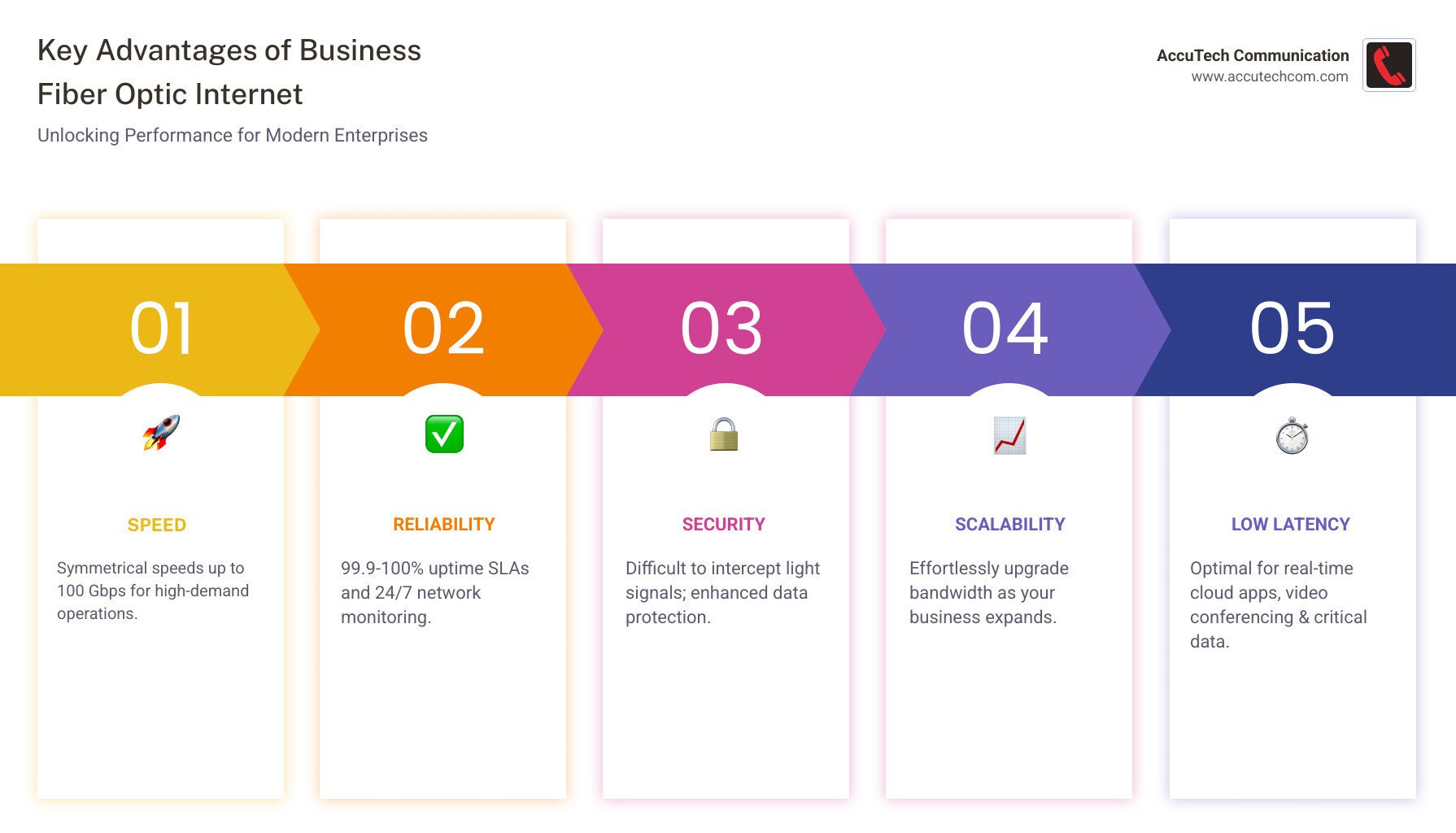
Most business fiber providers offer symmetrical speeds, meaning your upload speeds match your download speeds—essential for video conferencing, cloud backups, and transferring large files. Many also back their services with Service Level Agreements (SLAs) guaranteeing 99.9% to 100% uptime. Beyond raw speed, fiber provides low latency for real-time applications and built-in security advantages, since fiber signals are extremely difficult to intercept.
I’m Corin Dolan, owner of AccuTech Communications, and I’ve spent over three decades helping businesses across Massachusetts, New Hampshire, and Rhode Island implement reliable business fiber optic internet and structured cabling solutions. My team and I have seen how the right fiber infrastructure transforms business operations, from healthcare facilities requiring 24/7 uptime to manufacturers managing complex IoT networks.
Common business fiber optic internet vocab:
What is Business Fiber Optic Internet and Why Does It Matter?
Business fiber optic internet uses a different approach than traditional connections. Instead of sending electrical signals through copper wires, it transmits data as pulses of light through thin glass strands—literally at the speed of light. This technical difference is why fiber delivers dramatically better performance for transferring large files, hosting clear video conferences, or running essential cloud applications.
One of the most practical advantages is symmetrical speeds. With traditional internet, your upload speed is usually much slower than your download speed, creating a bottleneck for cloud backups or sharing your screen in a video meeting. With fiber, your upload speed matches your download speed, so everything moves at the same fast pace.
Low latency is another game-changer. Latency is the delay between when you click something and when it happens. For real-time applications like video conferencing and VoIP phone systems, low latency means your interactions feel instant and natural rather than laggy. Fiber is also more stable, as it’s immune to the electromagnetic interference that can disrupt copper cables.
The Core Benefits for Modern Companies
When businesses switch to business fiber optic internet, they’re investing in a foundation that supports everything they do. Here are the core benefits we’ve seen play out for our clients.
Improved productivity is the first thing people notice. Your team stops waiting for files to upload or download, and cloud applications respond instantly. Multiple employees can use bandwidth-intensive tools simultaneously without slowing each other down.
Superior reliability means fewer headaches. Fiber connections offer 99.9% reliability and aren’t vulnerable to the electromagnetic interference that plagues copper lines. When your business depends on staying connected, that reliability is invaluable.
Future-proof scalability gives you room to grow. Fiber supports speeds up to 100 Gbps, so you can easily scale your bandwidth as your needs change without needing to rip out cables and start over.
Improved data security is built into the technology. The pulses of light in fiber are extremely difficult to intercept compared to electrical signals in copper. Many business fiber services also include DDoS protection and DNS security features.
Support for data-intensive applications ensures your business can adopt the latest technologies, whether you’re running complex cloud software, implementing IoT devices, or supporting remote workers.
Dedicated Fiber Solutions: Ensuring Consistent Performance
For businesses that can’t afford any slowdowns, it’s important to understand the difference between shared and dedicated fiber. Shared connections mean you share bandwidth with other users, which can lead to slower speeds during peak hours.
Dedicated Internet Access (DIA) provides a private fiber line exclusively for your business. This guarantees your bandwidth at all times, eliminating congestion and ensuring consistent performance for critical applications like VoIP, video conferencing, and cloud software. For mission-critical operations, dedicated fiber is essential infrastructure.
Many providers also build custom business solutions on dedicated fiber, such as managed Wi-Fi or Metro Ethernet to connect multiple locations. At AccuTech Communications, we help design these custom networks to ensure the infrastructure meets specific business goals.
Key Features to Evaluate in a Business Fiber Internet Service
When choosing business fiber optic internet, speed is just the start. The difference between a good and a great connection lies in features that truly matter for your operations. Just as you’d consider more than horsepower in a truck, you need to evaluate the reliability, scalability, and security of your internet service. Let’s walk through the key features.
Speed, Bandwidth, and Scalability
Business fiber optic internet speeds range from 1 Gbps to 100 Gbps. While 1 Gbps is often sufficient for small to mid-sized businesses, larger operations may need 10 Gbps or more. The key is having enough bandwidth for all simultaneous activities—video conferences, cloud uploads, and VoIP calls—to run smoothly. To determine your needs, consider the number of employees, their online activities, and the number of connected devices. Some providers offer a bandwidth calculator to help estimate requirements.
A major benefit of fiber is its scalability. As your business expands, you can easily “add locations or increase speeds to support your requirements.” This ability to “scale optic fiber internet technology as business needs grow” makes it a long-term investment.
Reliability, Uptime, and Service Level Agreements (SLAs)
In business, downtime is expensive. This is where a Service Level Agreement (SLA) becomes your safety net. An SLA is a provider’s contractual promise for service availability, typically a “99.9% reliability” or “100% uptime guarantee.” These are binding agreements, often with financial remedies if the provider falls short.
Good providers back this with proactive 24/7/365 monitoring to fix issues before you notice them, and local technicians for fast response times. For added protection, look for redundancy options. Some plans include “built-in 5G internet backup at no extra cost,” providing automatic failover if the primary fiber connection fails. These “redundancy options are available for network performance,” ensuring critical business functions continue uninterrupted.
Security Considerations for Your Business Fiber Optic Internet
Security should be built into your internet service. Business fiber optic internet offers inherent physical security, as data traveling as light pulses is “harder to intercept than the electrical signals used by copper cables.” Beyond this, many providers integrate cybersecurity features.
DDoS protection mitigates attacks that could shut down your network, while DNS security blocks malicious sites to protect against malware and phishing. Some services also include secure Wi-Fi gateways. For more comprehensive protection, providers may offer managed network security solutions, which is valuable for businesses without dedicated IT security staff. Understanding What an Internet Protocol (IP) address is provides helpful context for network security.
The Implementation Process: From Planning to Installation
Getting business fiber optic internet set up involves more than a quick router installation, but the process is straightforward when you know what to expect. Understanding each step helps ensure everything goes smoothly with minimal disruption.
Understanding the Costs of Business Fiber Optic Internet
Let’s talk about the investment for business fiber optic internet. While we can’t quote specific numbers, it’s helpful to understand the typical cost structure.
Installation fees are often waived for new customers or certain speed tiers. You might see “FREE Installation” advertised, which can be a significant saving. However, if fiber isn’t already at your building, there may be construction charges to bring the line to your premises. It’s worth having an upfront conversation about any potential costs.
Monthly service costs are your ongoing investment. These fees cover your chosen bandwidth, SLA guarantees, and any additional features like static IP addresses or managed Wi-Fi. The speed tier, reliability level, and whether you choose a dedicated connection all influence your pricing.
Regarding contract terms, many providers now offer flexible “no annual contract” options. This allows you to pay month-to-month without long-term commitments. That said, some promotions might require longer agreements, so always read the fine print.
Installation Timelines and Potential Challenges
Once you’ve selected a provider, implementation begins. Typical timelines for business fiber optic internet installation vary. If fiber is already nearby, the process is faster. If not, it can take roughly three weeks to bring the line to your location and get you connected.
The process starts with a critical site survey. After an access agreement is signed, technicians assess the best route for the fiber, identify obstacles, and create a detailed installation plan. Proper planning here prevents future headaches.
Building access and permitting can cause delays, particularly in multi-tenant buildings. Your provider will need to coordinate with property managers and secure local permits if construction is needed. An experienced local provider can steer these processes efficiently.
The actual installation method depends on your location. Underground fiber optic installation is common and includes options like conduit pulling or direct burial, which often involves trenching. This approach offers excellent protection from weather and damage.
Alternatively, aerial installation leverages existing utility poles to run fiber cables overhead. This method is often faster and more cost-effective when trenching isn’t practical. A good provider will assess your situation and recommend the best approach.
For businesses wanting to dive deeper into the technical aspects and best practices for fiber optic infrastructure, we’ve put together comprehensive information. You can find more info about professional fiber optic installation on our website, covering everything from planning through ongoing maintenance.
Frequently Asked Questions about Business Fiber
We’ve been helping businesses across Massachusetts, New Hampshire, and Rhode Island steer business fiber optic internet for over three decades now. Along the way, certain questions come up again and again. Let’s tackle the most common ones.
Is a wired connection faster than wireless with fiber internet?
Even with fiber’s incredible speed, a wired Ethernet connection will almost always outperform Wi-Fi. A wired connection provides a dedicated, interference-free path for data, ensuring maximum speed. Wi-Fi signals, in contrast, can be slowed by walls, distance from the router, and other wireless devices.
While modern Wi-Fi 6 technology offers faster speeds and better device handling, a wired connection remains the best choice for transferring massive files or running mission-critical applications that require absolute consistency. For everyday tasks, modern Wi-Fi is more than adequate, but for maximum performance, wired has the edge.
What is a static IP address and does my business need one?
An IP address is your business’s address on the internet. Most are dynamic, meaning they change periodically. A static IP address stays the same, like a permanent office address.
You’ll need a static IP if you host your own web or email server, or need reliable external access for services like a VPN, security cameras, or remote monitoring systems. Some specialized business applications also require one. If you’re unsure, consult your IT team, but for consistent external access to your network, a static IP is the standard solution.
Can I use my own router with a business fiber connection?
Yes, you can typically use your own router with business fiber optic internet. Most providers supply an optimized router, often with Wi-Fi 6 and integrated security. However, to use advanced features like multiple static IPs, you will need your own router.
If you bring your own device, ensure it can handle fiber speeds to avoid creating a bottleneck. Also, be aware of the support trade-off: the provider’s technical support will not cover third-party routers. They will only troubleshoot their own equipment and the fiber line itself. The choice comes down to whether you prefer the flexibility of your own equipment or the convenience of guaranteed provider support.
Conclusion: Future-Proofing Your Business with the Right Partner
Your internet connection is the lifeline of your business. As we’ve explored, business fiber optic internet provides the speed, reliability, and scalability that modern companies need—from symmetrical speeds for cloud applications to low latency for video conferencing. With features like guaranteed uptime through SLAs and dedicated connections, fiber is a comprehensive solution.
However, even the best internet service is only as good as the physical infrastructure supporting it. Poorly installed fiber optic cabling can bottleneck your connection and create future problems. This is where the quality of the installation matters most.
At AccuTech Communications, we’ve specialized in designing and installing this critical physical infrastructure since 1993. Our certified technicians ensure that the cabling for your high-speed internet is properly installed, terminated, and planned for future growth. We’ve helped businesses throughout Massachusetts, New Hampshire, and Rhode Island build reliable network foundations.
Don’t let subpar cabling limit the potential of your business fiber optic internet. The quality of your installation directly impacts your network’s performance today and for years to come.
Ready to build a network infrastructure that’s truly future-proof? Get a quote for your fiber optic cabling installation and let’s talk about what your business needs.
