
The Role of a Certified Fiber Optic Technician in Modern Business Connectivity
What does a certified fiber optic technician do? In short, they install, maintain, test, and troubleshoot fiber optic cable systems that carry high-speed data for businesses, schools, hospitals, and other commercial facilities.
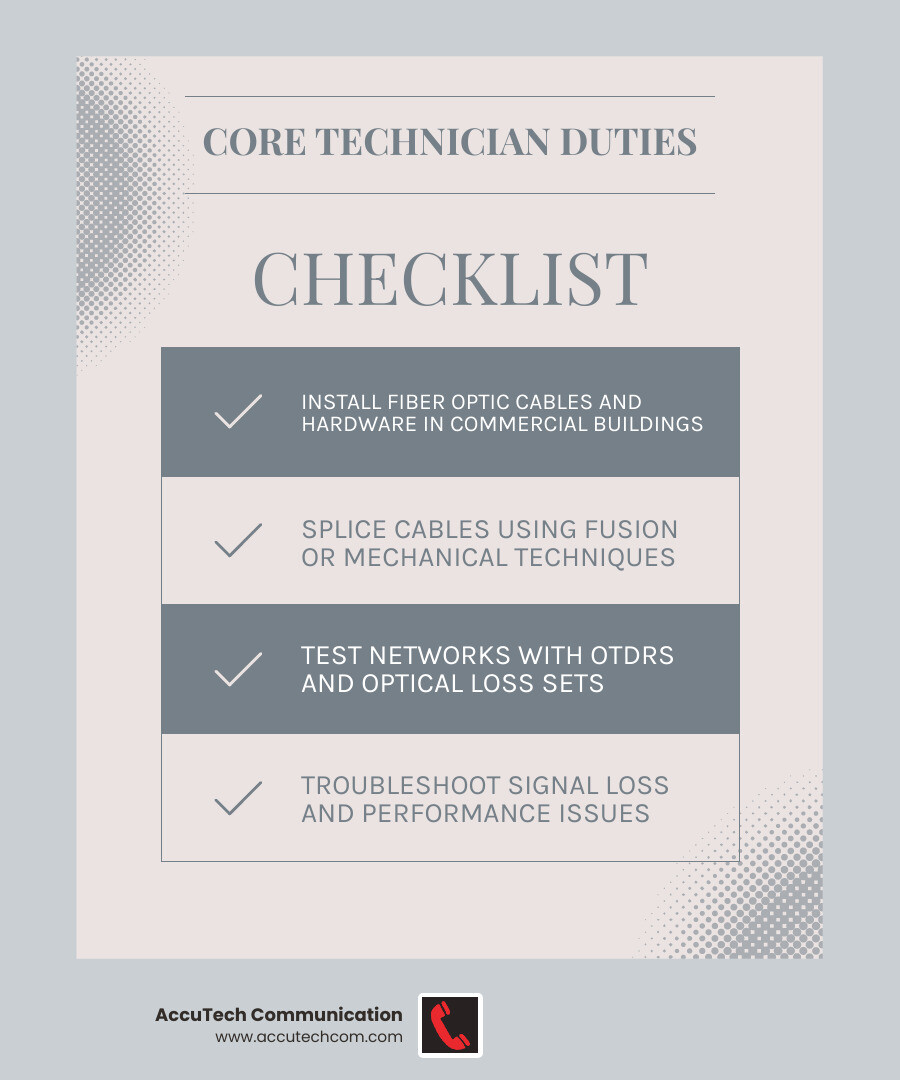
Here’s a quick breakdown of their core responsibilities:
- Install fiber optic cables and related hardware in commercial buildings and outdoor environments
- Splice fiber cables using fusion or mechanical splicing techniques
- Terminate connectors and verify low-loss connections
- Test networks using tools like OTDRs, optical loss test sets, and visual fault locators
- Troubleshoot signal loss, faults, and performance issues
- Maintain records of network designs, splice cases, and system diagrams
- Follow safety standards including proper handling of laser sources and fragile glass fiber strands
These professionals are recognized by the U.S. Department of Labor and certified through organizations like the Fiber Optic Association (FOA) and ETA International.
Fiber optic cables carry far more data than traditional copper wiring — and they do it faster, over longer distances, with less interference. That makes certified technicians essential to any business that depends on reliable, high-performance connectivity.
I’m Corin Dolan, owner of AccuTech Communications, with decades of hands-on experience in commercial network infrastructure across Massachusetts, New Hampshire, and Rhode Island — including working alongside certified fiber optic technicians every day. Understanding what does a certified fiber optic technician do is something I’ve seen firsthand, and I’ll walk you through everything you need to know.
What does a certified fiber optic technician do terms to know:
What Does a Certified Fiber Optic Technician Do?
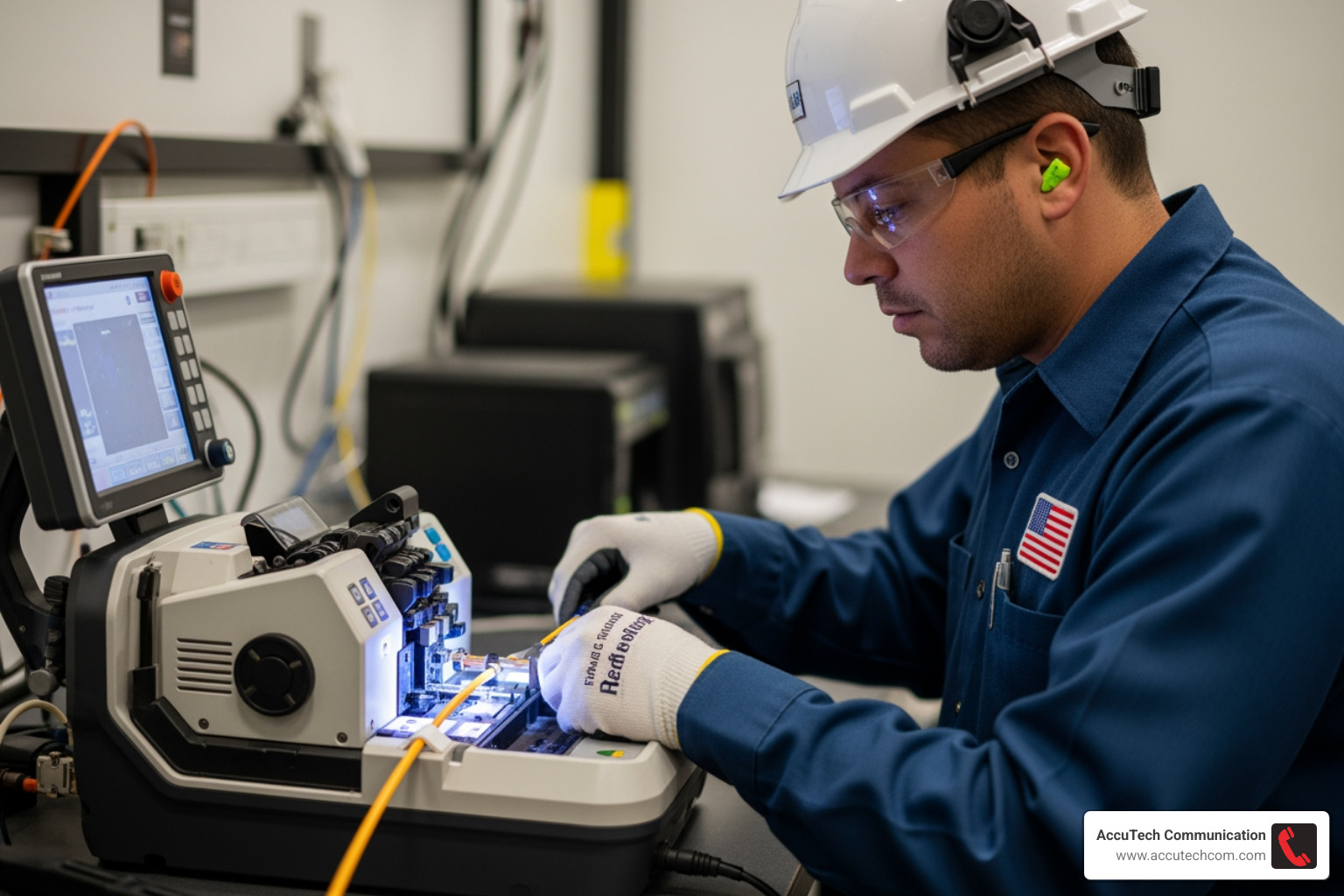
A certified-fiber-optic-technician (CFOT) is a specialist who has mastered the Knowledge, Skills, and Abilities (KSAs) required to build and maintain the light-based networks that power our modern world. While a general cable installer might pull wire through a wall, a CFOT deals with glass strands as thin as a human hair, requiring a level of precision that borders on the surgical.
Their primary responsibilities revolve around the “life cycle” of a fiber network. This starts with the physical installation of the cable—whether it is being pulled through indoor conduits or laid in outdoor trenches. Once the cable is in place, the technician performs fiber-optic-splicing-technician duties, which involve joining two fiber ends so perfectly that light can pass through the joint without scattering.
A typical workday is rarely repetitive. One morning, a technician might be in a climate-controlled server room terminating connectors; by the afternoon, they could be in a bucket truck performing an emergency fiber-optic-repair after a storm has damaged an aerial line. Throughout these tasks, they are constantly documenting their work, creating “as-built” diagrams that show exactly where every splice and connection is located.
What does a certified fiber optic technician do in commercial environments?
In the commercial sector—where we at AccuTech Communications focus our expertise across Massachusetts and New Hampshire—the role becomes even more specialized. Technicians work within fiber-optic-data-centers to manage high-density patch panels and ensure that the backbone of a company’s IT infrastructure is flawless.
In large fiber-optic-commercial office buildings or hospital campuses, they design and install Local Area Network (LAN) backbones. This involves connecting different floors or buildings to a central hub, ensuring that thousands of users have simultaneous access to high-speed internet and VOIP phone systems. Because businesses cannot afford downtime, a CFOT in these environments must work with extreme efficiency, often performing upgrades or repairs during off-hours to minimize disruption.
What does a certified fiber optic technician do to ensure network safety?
Safety is a massive part of the job. Working with fiber optics isn’t just about data; it’s about managing hazards that are often invisible. According to Certification: Fiber Optics Technician (FOT) standards, technicians must be well-versed in TIA-568C performance characteristics to prevent system destabilization.
Key safety protocols include:
- Eye Safety: Never looking directly into the end of a fiber cable, as the infrared laser light used for data can cause permanent retinal damage.
- Glass Shard Management: When stripping and cleaving fiber, tiny “cleaves” (glass shards) are produced. These are incredibly sharp and can easily penetrate the skin or be inhaled, so technicians use dedicated disposal containers.
- Chemical Safety: Fiber work requires specialized cleaning solvents and epoxies that must be handled according to OSHA standards.
- Electrical Hazards: Even though fiber itself doesn’t carry electricity, it is often installed near power lines or in metallic armored casings that can become energized.
Essential Skills, Tools, and Industry Standards
To succeed, a technician must master a suite of sophisticated fiber-optic-network-components. The most critical skill is understanding fiber-optic-cable-technology, specifically the difference between Single-mode and Multi-mode fibers.
| Feature | Multi-mode Fiber (MMF) | Single-mode Fiber (SMF) |
|---|---|---|
| Core Diameter | Larger (50-62.5 microns) | Smaller (8-10 microns) |
| Light Source | LED or VCSEL | Laser |
| Distance | Short (up to 2km) | Long (up to 40km+) |
| Common Use | Intra-building/LANs | WANs/Campus Backbones |
| Bandwidth | High | Virtually Unlimited |
Mastering the Tools of the Trade
You can’t do this job with a standard toolbox. fiber-optic-cable-installation-services require precision instruments.
- Fusion Splicers: These machines use an electric arc to melt two fiber ends together. A certified technician must know how to align the cores perfectly to achieve a “near-zero” loss splice.
- OTDR (Optical Time Domain Reflectometer): This is the “MRI machine” of the fiber world. It sends a pulse of light down the fiber and measures the reflection to pinpoint exactly where a break or a high-loss connector is located.
- Cleavers and Strippers: These tools remove the protective buffers and cut the glass at a perfect 90-degree angle. Even a microscopic jagged edge can ruin a connection.
- Inspection Microscopes: Technicians use these to check connector end-faces for dust or scratches. In the fiber world, a single speck of dust is like a giant boulder blocking a tunnel.
The Path to Certification: Training and Education
Becoming a technician isn’t just about being good with your hands; it requires a structured educational foundation. Most technicians begin with a high school diploma and then move into specialized post-secondary programs in telecommunications or electronics.
There are two primary paths to certified-fiber-optics-technician status:
- The Training Path: Attending an FOA-approved school or a community college program. These courses usually last from a few days for basic certification to a year for comprehensive diplomas.
- The Experience Path: If you already have documented field experience (usually at least two years), you can apply for the “Work to Cert” program.
For those looking to start their journey, the Fiber U Basic Fiber Optics course is an excellent free resource that provides the theoretical knowledge needed to pass the certification exams. Many professionals also look into cfot-certification-online options to supplement their hands-on training.
Steps to Achieve CFOT Status
According to Fiber U training requirements, the process generally follows these steps:
- Gain Knowledge: Study fiber optic jargon, communications systems, and components.
- Hands-on Practice: Master cable preparation, fusion splicing, and termination in a lab or field setting.
- Testing Mastery: Learn to use an OLTS (Optical Loss Test Set) and OTDR to verify network integrity.
- Pass the Exam: The CFOT exam consists of 100 questions (multiple choice, matching, and true/false). You must score at least 70% to pass.
Career Outlook: Salary and Advancement Potential
The career outlook for fiber technicians in our region is exceptionally bright. As businesses in Massachusetts and Rhode Island shift toward cloud computing and 5G infrastructure, the demand for high-speed connectivity continues to surge.
The U.S. Bureau of Labor Statistics expects a healthy increase by 8% in demand for telecommunications equipment installers between 2021 and 2031. This growth is driven by massive investments in rural broadband and the constant need for data center expansion.
Understanding Industry Compensation
Based on national average salary data from ZipRecruiter and the BLS, here is what the compensation landscape looks like (please note these are industry averages and not specific to AccuTech Communications):
- Median Annual Salary: Approximately $58,870 to $60,000.
- Salary Range: Entry-level technicians may start around $33,500, while top-tier experts and specialists can earn upwards of $100,000 depending on the complexity of the projects and geographic location.
- Training Costs: To get started, a technician might spend anywhere from $1,100 for a basic CFOT course to over $3,500 for a full series of specialist certifications (like splicing and testing).
Advancement often involves moving from a field technician role into network design, project management, or obtaining a fiber-optic-cable-contractor-license to lead large-scale infrastructure projects.
Frequently Asked Questions
What is the difference between a fiber technician and a cable installer?
A cable installer typically handles a variety of media, including copper (Cat5e/Cat6) and coaxial cables, often focusing on the physical “pulling” and routing of wires. A fiber technician is a specialist who focuses on the high-precision world of glass optics, requiring advanced knowledge of light physics, fusion splicing, and specialized testing equipment that a general installer wouldn’t typically use.
How long does it take to become a certified fiber optic technician?
If you attend an intensive FOA-approved program, you can gain your basic CFOT certification in as little as three to five days of classroom and lab work. However, achieving true mastery and being ready for complex commercial projects usually requires one to two years of on-the-job experience.
Are fiber optic technicians in high demand in the Northeast?
Absolutely. With the high concentration of biotech, financial services, and educational institutions in the Metro-west Boston area and throughout Massachusetts, New Hampshire, and Rhode Island, the need for certified professionals to maintain these high-bandwidth networks is at an all-time high.
Conclusion
Understanding what does a certified fiber optic technician do reveals a career that is part scientist, part construction worker, and part detective. These professionals are the unsung heroes who ensure that our emails send instantly, our video calls don’t lag, and our businesses stay competitive in a digital-first economy.
At AccuTech Communications, we’ve been providing these critical services since 1993. Whether you are in Boston, Worcester, or Manchester, our team of experts understands the nuances of commercial network cabling. If your business needs reliable, certified service for your next project, we are here to help.
From fiber-optic-technician services to full data center build-outs, we bring a commitment to quality and competitive pricing to every job across Massachusetts, New Hampshire, and Rhode Island. Reach out to us today to see how we can strengthen your business’s connectivity.
