
What Is Fiber Optic Fusion Splicing? (And Why It Matters for Your Network)
Fiber optic fusion splicing is the process of permanently joining two optical fiber ends together using an electric arc — producing a connection so clean that light passes through with almost no loss or reflection.
Here’s a quick snapshot of what you need to know:
| Topic | Key Fact |
|---|---|
| What it is | Joining two fiber ends using heat (usually an electric arc) |
| Why it’s used | Lowest signal loss, least reflection, strongest joint of any fiber joining method |
| Typical splice loss | As low as 0.01 dB — over 20x better than the 0.30 dB allowed by ISO/TIA standards |
| Main types | Core alignment (precision) and cladding alignment (speed) |
| Key steps | Strip → Clean → Cleave → Fuse → Protect → Test |
| Who uses it | Telecom providers, enterprise networks, data centers, FTTH deployments |
For businesses in Massachusetts, New Hampshire, and Rhode Island running on fiber — or planning to — the quality of every splice directly affects how reliably data moves across your network. A poorly made joint creates signal loss, reflection, and long-term network instability. A well-made fusion splice, on the other hand, is nearly invisible to light traveling through the fiber.
This guide walks you through exactly how fusion splicing works, what tools and equipment are involved, and how to achieve consistent, high-quality results.
I’m Corin Dolan, owner of AccuTech Communications, and I’ve spent decades helping commercial clients across Massachusetts, New Hampshire, and Rhode Island design and install fiber optic networks where fiber optic fusion splicing is a cornerstone of every high-performance build. I’ll share what we’ve learned in the field so you can make smarter decisions about your network infrastructure.
Understanding Fiber Optic Fusion Splicing and Its Benefits
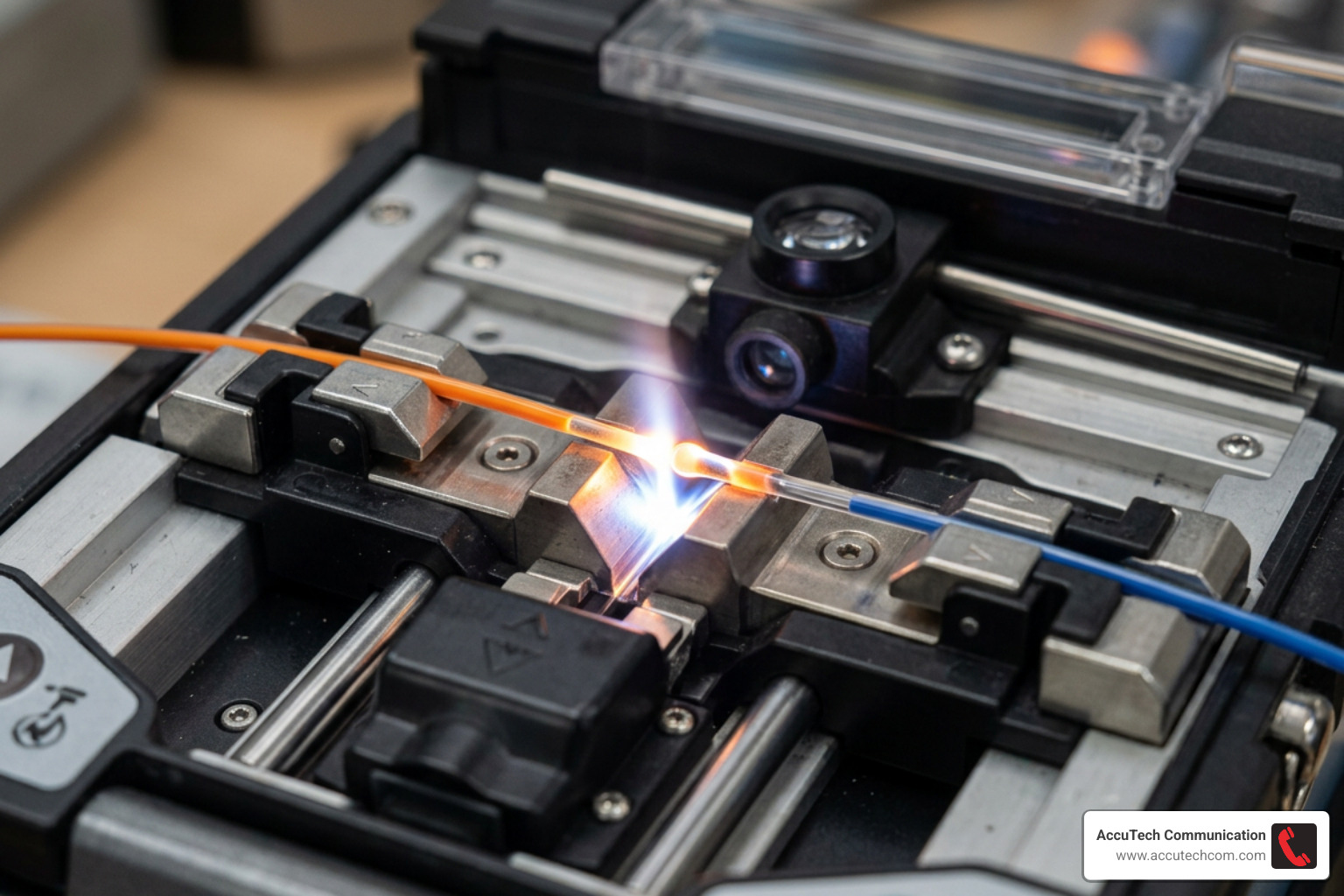
At its core, fiber optic fusion splicing is a form of glass welding. We aren’t just pushing two wires together; we are using a high-voltage electric arc to melt the ends of two glass fibers and fuse them into a single, continuous strand. This creates a molecular bond that is remarkably strong—often as strong as the original fiber itself.
When we perform a fusion splice, our primary goal is to ensure that light passing through the glass isn’t scattered or reflected back toward the source. This is critical for maintaining signal integrity over long distances. According to Optical Network Design and Implementation research, the precision required is immense, especially when you consider that a single-mode fiber core is only about 8 to 10 microns in diameter—roughly one-tenth the thickness of a human hair.
The benefits of this method are numerous. For one, it offers the lowest reflectance of any joining method, which is vital for high-speed data transmission. It also provides a permanent, stable joint that isn’t susceptible to the dust or humidity that can plague other types of connections. If you’re looking for more details on the basics of fiber endings, you can check out our guide on how to terminate fiber optic cable. For a broader encyclopedic look, you can also see this Fusion splicing technical overview.
Fusion Splicing vs. Mechanical Splicing
We often get asked why we prefer fusion over mechanical splicing. While mechanical splicing uses a small plastic sleeve and an index-matching gel to align fibers, it is generally considered a temporary or “emergency” fix.
- Splice Loss: Fusion splicing is the gold standard for performance. While the maximum allowed splice loss by TIA standards is 0.30dB, a high-quality fusion splice often reaches 0.01dB. Mechanical splices rarely get close to that level of precision.
- Reliability: Because the fibers are physically fused together, there is no risk of them shifting or the gel drying out over time.
- Long-term Stability: In the variable climates of New England—from the humid summers in Boston to the freezing winters in Manchester, NH—fusion splices hold up much better against thermal expansion and contraction.
- Reflection Loss: Fusion splicing minimizes back-reflection (ORL), which is essential for modern high-speed networks that can’t tolerate “noise” on the line.
Choosing the Right Equipment for Your Business Network
Choosing a fusion splicer is a significant investment for any commercial network infrastructure. In our work across Massachusetts and Rhode Island, we’ve found that the right machine depends entirely on the application. Modern machines use either 4-motor or 6-motor systems to align the glass.
- 4-Motor Systems: Often used for “Active Clad Alignment.” These are great for FTTH (Fiber to the Home) or enterprise networks where the fibers being joined are from the same manufacturer and have very consistent geometry.
- 6-Motor Systems: These are the “Core Alignment” powerhouses. They use two additional motors to move the fibers in three dimensions (X, Y, and Z) to align the actual cores, not just the outer cladding.
Battery capacity is another huge factor. When we are out in the field in Billerica or Worcester, we need a machine that can last through a full day of splicing. Some top-tier models can handle 280 splice and heat cycles on a single charge. If you’re curious about how these tools fit into a broader project, see our fiber optic cabling services page.
Core Alignment for High-Performance Trunk Lines
For high-performance trunk lines and long-haul connections, core alignment is non-negotiable. This technology uses a Profile Alignment System (PAS) to look through the cladding and see the actual core of the fiber.
This is particularly important when we are splicing “dissimilar” fibers—fibers made by different manufacturers or at different times. Sometimes the core isn’t perfectly centered within the cladding (a problem called core-cladding eccentricity). A core alignment splicer detects this and adjusts the fibers so the cores line up perfectly, even if the outer edges are slightly off. This level of precision is a key part of our fiber optic installation guide.
Mass Fusion Splicing for High-Density Data Centers
In high-density environments like modern data centers in the Metro-west Boston area, we often deal with ribbon fiber. Instead of splicing one fiber at a time, mass fusion splicers can join 12 fibers simultaneously.
With some modern cables containing up to 6,912 fibers, splicing them one by one would take weeks. Mass fusion splicing allows us to complete these massive data center build-out projects with incredible efficiency. While the loss might be slightly higher than a single-fiber core alignment splice, the time savings are astronomical—often reducing installation time by 40% or more when paired with pigtailed splice cassettes.
The Step-by-Step Process of Fiber Optic Fusion Splicing
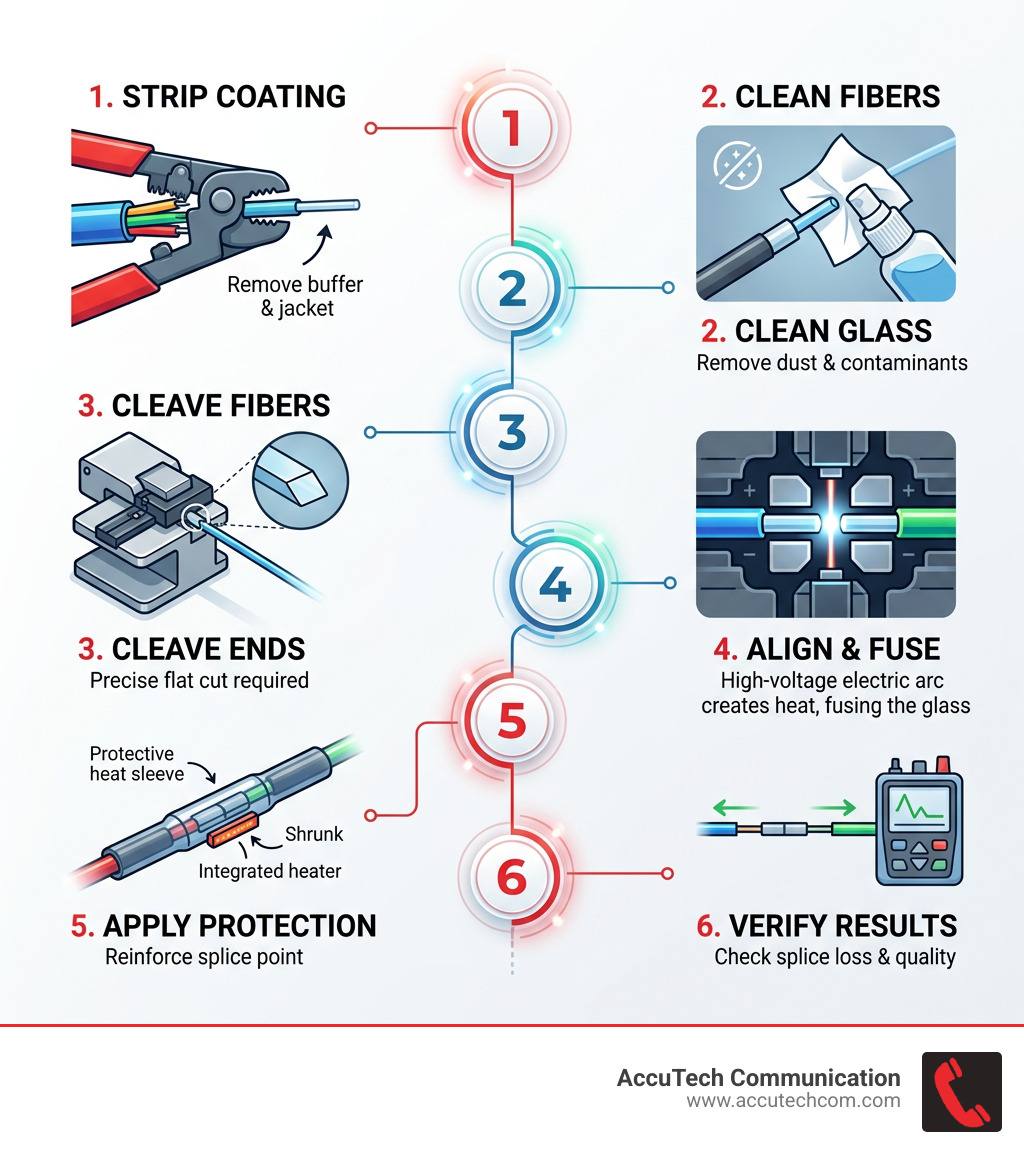
Success in fiber optic fusion splicing is 90% preparation and 10% actual fusing. If you skip a step or get lazy with cleaning, the machine will let you know with a “Bad Cleave” or “High Loss” error. We follow a strict protocol for all our fiber optic installation services. For a more granular look, you can also read our detailed guide on splicing fiber optic cable.
Preparation: Strip, Clean, and Cleave
- Strip: We use high-quality Miller strippers to remove the outer jacket and the 250-micron buffer coating. The goal is to expose about 30-40mm of bare glass without nicking it. A nicked fiber is a ticking time bomb that will eventually break.
- Clean: Once stripped, the bare glass must be cleaned. We use lint-free wipes and 99% pure Isopropyl alcohol. You should hear a “squeak” as you pull the wipe across the glass—that’s the sound of a clean fiber.
- Cleave: This is the most critical step. A precision cleaver doesn’t “cut” the fiber; it scores the glass and then applies pressure to cause a clean break. The endface must be perfectly flat (usually within 1 degree of perpendicular). If the cleave is angled or has a “lip,” the splice will fail.
The Fusion and Protection Phase
Once the fibers are prepared, they are placed into the splicer’s v-grooves.
- Alignment: The machine uses cameras to inspect the endfaces for dust or bad cleaves. It then automatically aligns the fibers.
- The Prefuse Spark: Most modern splicers emit a tiny, low-voltage spark just before the main arc. This burns off any microscopic dust or moisture that might have settled on the fiber in the seconds since you cleaned it.
- The Arc: The main electric arc fires, melting the glass and pushing the two ends together.
- Protection: Glass is fragile once the coating is removed. Before we even start the splice, we slide a heat-shrink protective sleeve onto one of the fibers. After the splice is done, we slide that sleeve over the joint and place it in the splicer’s built-in oven. This sleeve usually contains a stainless steel strength member to prevent the splice from bending or breaking.
- Storage: Finally, the protected splice is carefully coiled into a splice tray within a closure or patch panel. We always ensure there is plenty of “slack” (about 1 meter) so that if a repair is needed in the future, there is enough fiber to work with.
Testing and Maintaining Splice Quality
You can’t just assume a splice is good because the machine says “0.00dB.” The machine’s estimate is based on the visual alignment of the cores, but it doesn’t actually measure light passing through the joint.
To truly verify a splice, we use an Optical Time Domain Reflectometer (OTDR). This tool sends a pulse of light down the fiber and measures the “backscatter.” A good splice will show up as a tiny drop in the trace, while a bad splice will look like a large cliff. According to scientific research on hot splices, testing from both directions and averaging the results is the only way to get a truly accurate measurement. You can learn more about this in our article on how to test fiber optic cable.
Troubleshooting Common Splice Defects
Even with the best equipment, things can go wrong. Here are the “usual suspects” we look for:
- Matchheads: If the fusion current is too high or the electrodes are dirty, the ends of the fiber can round off like a matchhead before they fuse, leading to a huge bubble in the middle.
- Constriction: This looks like the splice has “waisted” or gotten thinner. It’s usually caused by the arc being too hot or the fibers not being pushed together (fed) fast enough.
- Bubbles: Usually caused by contamination. If there is a speck of dust on the endface, it gets trapped inside the molten glass and creates an air pocket.
- Black Lines: Sometimes these are just optical illusions caused by the way light hits different types of glass, but often they indicate a “cold splice” where the glass didn’t melt all the way through.
Maintaining your equipment is the best way to avoid these. Electrodes generally need to be replaced every 5,000 splices to ensure the arc remains stable. We adhere to the highest fiber optic construction standards to ensure our clients get the best possible results.
Frequently Asked Questions about Fiber Optic Fusion Splicing
What is the average cost of a fusion splicer?
The cost of a fusion splicer varies significantly based on its capabilities. Based on industry averages and public internet data, you can expect the following ranges:
- Entry-level / Handheld Splicers: $1,500 – $4,500. These are often used for quick repairs or FTTH work.
- Core-Alignment Splicers: $6,000 – $12,000. These are the standard for high-performance commercial networks.
- Mass Fusion / Ribbon Splicers: $10,000 – $15,000+. These are specialized tools for high-density data center work.
Note: These prices are average costs sourced from publicly available internet data and do not reflect the actual rates or equipment costs of AccuTech Communications.
How often should electrodes be replaced?
Most manufacturers recommend replacing electrodes after about 5,000 “arcs.” Over time, the tips of the electrodes wear down or get coated in silica “soot,” which makes the electric arc unstable. Most modern machines will track this for you and give you a warning when it’s time for a change. Regular cleaning of the V-grooves and lenses is also essential for keeping the machine’s “eyes” sharp.
Why is core alignment preferred over clad alignment?
While clad alignment is faster and the machines are cheaper, core alignment is superior for accuracy. Clad alignment assumes that the core is perfectly in the center of the fiber. If you are splicing a new fiber to an older one (common in network upgrades in cities like Boston or Cambridge), the cores might not be perfectly centered. Core alignment “sees” this and adjusts the fibers so the light path is perfectly straight, resulting in much lower loss.
Conclusion
At AccuTech Communications, we believe that a network is only as strong as its weakest splice. Whether we are working in a high-rise in Boston, a data center in Marlborough, or a campus in Nashua, NH, we bring the same level of precision and care to every fiber optic fusion splicing job we perform.
Since 1993, we have provided certified, reliable service to businesses across Massachusetts, New Hampshire, and Rhode Island. We understand the local landscape and the unique demands of New England’s commercial infrastructure. If you’re looking to build a network that is future-proof, high-speed, and incredibly reliable, we’re here to help.
Ready to take the next step in your network evolution? Request an estimate today and let us show you the bright side of professional fiber optic installation.
