What Does a Data Center Build Out Project Manager Actually Do?
A data center build out project manager is the person responsible for planning, coordinating, and delivering one of the most complex types of construction projects in commercial infrastructure today.
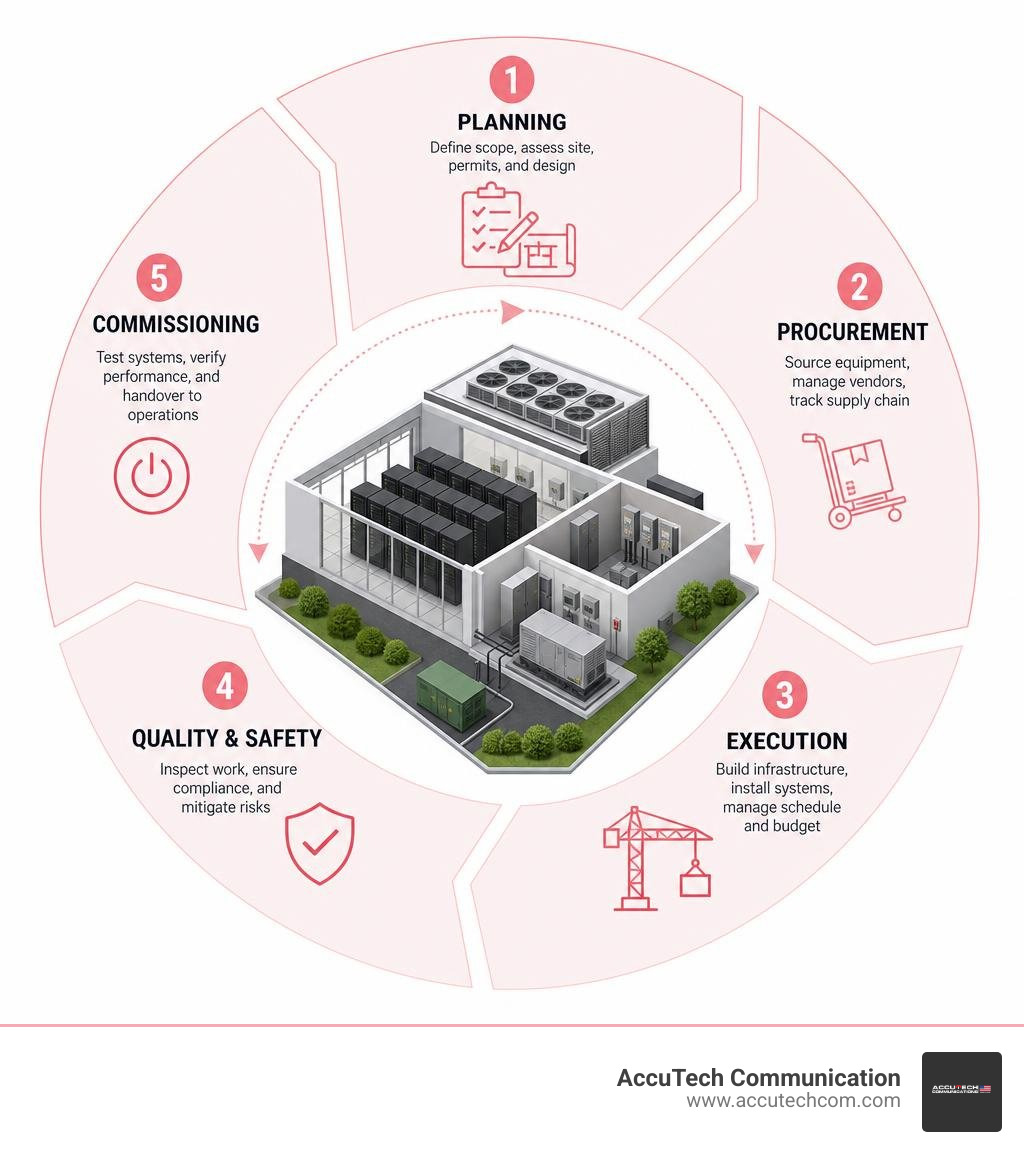
Here’s a quick breakdown of what the role involves:
| Area | What the PM Manages |
|---|---|
| Planning | Site selection, permitting, utility coordination, scope definition |
| Procurement | Long-lead equipment, vendor contracts, supply chain tracking |
| Execution | Budget control, schedule management, subcontractor coordination |
| Quality & Safety | Inspections, compliance, risk mitigation |
| Commissioning | System testing, operational readiness, handover to operations |
Data centers rank among the most energy-intensive and technically demanding facilities ever built. And demand is only growing — driven by AI, cloud computing, and the need to bring data processing closer to end users.
The stakes are high. According to the Project Management Institute, poor project delivery wastes US$1 million every 20 seconds globally. On a mission-critical facility where uptime is everything, a poorly managed build doesn’t just cost money — it can delay operations for months.
That’s why the role of a dedicated project manager is so critical on these builds. It takes someone who understands both the business and the technical complexity — from MEP systems and structured cabling to commissioning protocols and stakeholder alignment.
I’m Corin Dolan, owner of AccuTech Communications, and with over 30 years serving commercial clients across Massachusetts, New Hampshire, and Rhode Island, I’ve worked closely with the infrastructure that makes data center build out project management a discipline all its own. In the sections below, I’ll walk you through everything you need to know about this role — from core responsibilities to certifications and career paths.
Data center build out project manager terms simplified:
The Role of a Data Center Build Out Project Manager
Managing a Data Center Build Out is fundamentally different from overseeing a standard commercial office renovation. A data center is a living, breathing machine wrapped in a physical building. Every square foot of space must be optimized for power distribution, heat dissipation, structural load-bearing capacity, and absolute physical security.
The project manager serves as the central hub of this massive machine. They translate high-level business goals and IT capacity requirements into actionable construction plans. This means they must speak the language of corporate executives, electrical engineers, HVAC technicians, network engineers, and local code inspectors. Because these facilities operate 24/7/365, the PM must design and build with red-hot focus on redundancy and “mission-critical” infrastructure—where a single second of downtime can result in millions of dollars in lost revenue for the end users.

Why Hire a Dedicated Data Center Build Out Project Manager?
When companies look to expand their digital footprint, they sometimes make the mistake of assigning the build-out to a general construction PM or an internal IT director. However, data center builds demand a highly specialized set of skills.
Hiring a dedicated data center build out project manager provides three primary benefits:
- Strict Cost Control: Modern data center construction costs have skyrocketed due to specialized cooling requirements and massive power equipment. An experienced PM keeps a tight grip on the budget, preventing scope creep and managing complex contract structures like Guaranteed Maximum Price (GMP).
- Proactive Risk Mitigation: PMs use specialized risk-management frameworks to identify potential bottlenecks—such as utility power delays or environmental permitting issues—before they impact the schedule.
- Uptime and Reliability Protection: A seasoned PM knows how to design and execute a build that meets strict Tier classification standards (such as Uptime Institute’s Tier III or IV), ensuring that the facility has the redundant power and cooling systems required for continuous operations.
The value of professional project management in this space is clear. For example, JLL project management professionals have delivered more than 35,000 projects worldwide and saved clients more than US$300M on energy costs through optimized, highly efficient facility designs. To learn more about the macro trends driving this demand, check out our guide on The Data Center Building Boom Are You Ready?.
Key Stakeholder Coordination and Alignment
On any given day, a data center PM might coordinate with dozens of distinct groups. Aligning these stakeholders is one of the most challenging aspects of the job.
The primary players include:
- The Owner/Client: Corporate executives, real estate directors, or colocation providers who set the high-level budget, timeline, and capacity requirements.
- The General Contractor (GC) & Subcontractors: The teams physically pouring the concrete, pulling the heavy electrical conduit, and installing the cooling towers.
- Engineering Teams: Mechanical, electrical, and structural engineers who design the complex power distribution paths and cooling systems.
- Network Engineers: The specialists responsible for the fiber optic backbones, structured cabling, and carrier meet-me rooms.
- Commissioning Agents (CxA): Independent third-party testers who verify that every system operates exactly as designed under full-load conditions.
To keep everyone aligned, successful PMs establish strict communication matrices and meeting cadences. As highlighted in standard industry job descriptions, such as the Senior Project Manager, Data Centers in Herndon, Virginia | Careers at Mission Critical, Herndon, VA posting, a great PM must establish a “firm but fair” approach to subcontractor management while maintaining transparent, real-time reporting for owner representatives.
Core Responsibilities Across the Project Lifecycle
A data center project progresses through highly structured phases. The project manager’s responsibilities shift dramatically as the build moves from a conceptual design to an active construction site, and finally to a fully operational, commissioned facility. For a comprehensive look at these phases, you can read our Data Center Installation Complete Guide.
Preconstruction and Planning
The success of a data center build is often decided before a single shovel touches the dirt. During preconstruction, the project manager focuses on feasibility, risk assessment, and design coordination.
Key tasks during this phase include:
- Site Evaluation: Analyzing local utility capacity to ensure the site can secure tens of megawatts of reliable power.
- Permitting & Zoning: Navigating local municipal regulations, noise ordinances (critical for large backup generators), and environmental impact reports.
- Constructability Reviews: Reviewing design drawings alongside engineers to identify physical clashes or installation bottlenecks before materials are ordered.
As detailed in job listings like the Hyperscale Project Manager @ QTS | Simplify Jobs posting, PMs must carefully analyze leases, work letters, and utility agreements during this phase to establish a bulletproof project baseline that aligns with tenant commitments.
Execution, Procurement, and Cost Management
Once construction begins, the PM’s focus shifts to daily schedule tracking, cost management, and supply chain logistics. In the data center world, procurement is a massive hurdle. Equipment like high-voltage transformers, uninterruptible power supplies (UPS), and large chillers can have lead times stretching past 12 to 18 months.
To keep the project on track, the PM must:
- Manage Long-Lead Procurement: Secure manufacturing slots early and track shipments down to the day.
- Track Project Costs: Manage the cash flow, review subcontractor requisitions, and process change orders transparently.
- Control Scope Creep: Ensure that any requested design modifications are thoroughly vetted for budget and schedule impacts before approval.
Understanding these financial dynamics is critical for anyone planning a build. You can explore these factors in detail in our breakdown of Data Center Build Out Cost.
Commissioning and Handover
Commissioning is the ultimate test of a data center build. It is the process of proving that the facility’s redundant systems actually work when the main utility power goes dark.
The PM coordinates the commissioning process across five distinct levels:
- Level 1 (Factory Acceptance Testing): Testing equipment at the manufacturer’s facility before it is shipped.
- Level 2 (Component Delivery & Installation Verification): Ensuring equipment arrived undamaged and was installed correctly.
- Level 3 (Pre-functional Testing): Energizing individual components and checking basic operations.
- Level 4 (Functional Performance Testing): Testing complete systems (e.g., verifying that a generator starts and accepts load).
- Level 5 (Integrated Systems Testing / IST): The “pull-the-plug” test, where utility power is cut to the entire building to prove the UPS systems and generators seamlessly take over without dropping the simulated IT load.
According to technical standards found in executive postings like Project Executive – Hyperscale Data Center New Construction – Owen Electric – Career Page , a successful handover requires meticulous documentation of all Level 1-5 testing, lock-out/tag-out (LOTO) procedures, and comprehensive training for the operations team who will run the facility day-to-day.
Greenfield vs. Retrofit: Key Differences in Project Management
Data center project managers generally work on two types of builds: greenfield projects (building from the ground up on vacant land) or retrofits/expansions (modifying or expanding an existing, often active, facility).

Greenfield Construction Challenges
Greenfield projects offer a blank slate, allowing the design team to optimize the building’s layout, structural pathways, and utility connections without working around existing obstacles. However, they come with significant external challenges:
- Massive Utility Coordination: Bringing high-voltage transmission lines and high-count fiber backbones to a previously undeveloped site requires extensive negotiation with local utility providers.
- Civil Engineering & Environmental Compliance: Managing stormwater runoff, soil compaction, and environmental impact assessments.
- Longer Timelines: Greenfield builds typically take longer to reach operational status due to the extensive site prep and structural work required.
PMs on these projects must have strong experience in heavy civil construction and large-scale utility coordination, as highlighted by postings like Traveling Senior Project Manager – Mission Critical | Jobflarely .
Retrofit and Expansion Constraints
Retrofitting an existing commercial building or expanding an active data center is a completely different beast. The primary challenge here is simple: do not drop the active IT load.
Key constraints for retrofit PMs include:
- Working in Live Environments: Pulling new fiber optic cables, upgrading electrical switchgear, or replacing cooling units right next to active, production server racks.
- Dust and Vibration Mitigation: Construction dust can destroy sensitive IT equipment, and structural vibrations can damage spinning hard drives. PMs must design temporary containment zones and schedule high-vibration work during off-peak windows.
- Space and Structural Limitations: Retrofit designs must fit within the existing building’s structural footprint and column spacing, which requires creative engineering.
For a deeper dive into the logistics of relocating or modifying active environments, refer to our guide on Moving a Data Center and our comprehensive Data Center Installation Companies Ultimate Guide.
Technical Skills, Certifications, and Tools for Success
To successfully lead these high-value builds, a data center build out project manager must possess a unique blend of construction knowledge, IT infrastructure expertise, and formal project management training.
Essential Technical Knowledge
A great data center PM doesn’t need to be a licensed electrical engineer, but they must thoroughly understand the core systems that keep a data center running:
- Electrical Systems: Medium-voltage switchgear, Uninterruptible Power Supply (UPS) topologies, Emergency Power Generators, Automatic Transfer Switches (ATS), and Power Distribution Units (PDUs).
- Mechanical & Cooling Systems: Computer Room Air Conditioners (CRAC), Computer Room Air Handlers (CRAH), chilled water loops, cooling towers, and direct-to-chip liquid cooling systems.
- Structured Cabling: High-density fiber optic installations, copper patch panels, pathway design (underfloor vs. overhead cable trays), and meet-me-room configurations.
As emphasized in international job specifications like the (Senior) Technical Project Manager (m/f/d) – Data Centres at Turner & Townsend • Frankfurt am Main, Hesse, Germany posting, a deep familiarity with Building Management Systems (BMS) and Data Center Infrastructure Management (DCIM) tools is highly valued for tracking real-time power and cooling metrics.
For professionals looking to validate their expertise, several industry-recognized certifications are highly sought after by employers:
| Certification | Focus | Key Benefit |
|---|---|---|
| PMP (Project Management Professional) | General PM Methodologies | Establishes baseline competency in budget, schedule, and risk management. |
| CDCPM (Certified Data Center PM) | Data Center-Specific Builds | A 5-day intensive program (BTEC Level 5 Award) focusing on specialized data center constraints. |
| BICSI RCDD (Registered Communications Distribution Designer) | Structured Cabling & IT Design | Validates deep expertise in telecommunications and low-voltage cabling pathways. |
To see how these qualifications play out in local markets, you can explore the Best Senior Project Manager Jobs in Boston, MA 2026 listings, which frequently highlight the need for a combination of PMP and technical low-voltage certifications.
Career Paths for a Data Center Build Out Project Manager
The career path for a data center PM is highly lucrative, driven by the massive global demand for digital infrastructure. Professionals often enter the field from backgrounds in electrical contracting, mechanical engineering, network engineering, or general commercial construction.
Advancement opportunities typically progress from:
- Assistant Project Manager / Project Coordinator
- Project Manager (Data Center Build Out)
- Senior Technical Project Manager
- Project Executive / Program Director (managing multi-building hyperscale campuses)
In regional markets, the demand for these roles is incredibly strong. For instance, in a recent market snapshot of metropolitan tech hubs, out of 22 active Data Center PM listings, 18 roles required mid-to-senior level experience, and 20 of those 22 roles required consistent, on-site presence rather than hybrid work. This highlights the hands-on, highly collaborative nature of the role. For those interested in exploring active career opportunities in this field, you can review listings on the Data Center Project Manager – Construction – Fluidstack Career page.
Frequently Asked Questions
What is the average salary for a data center PM?
Salaries for a data center build out project manager are among the highest in the construction industry, reflecting the high technical complexity and financial risk associated with these builds.
Based on publicly available online data from 2026:
- Average Base Salary Range: $120,000 to $175,000 annually.
- Senior / Executive Roles: Can range from $180,000 to $250,000+ annually, depending on the scale of the projects managed.
- Note: These figures represent broad industry averages compiled from national job boards and recruitment agencies like Data Center Jobs – Engineering & Operations – LVI Associates . They do not represent actual salary scales or employment offers from AccuTech Communications.
What are the biggest challenges faced during a data center build-out?
The three most common bottlenecks on modern builds are:
- Supply Chain Delays: Long-lead electrical equipment (transformers, switchgear) can easily stall a project if not procured early in the design phase.
- Labor Shortages: Finding certified low-voltage technicians, specialized MEP engineers, and experienced commissioning agents can be difficult in highly competitive markets.
- Scope Creep: Mid-construction changes to server rack layouts or cooling specifications to accommodate changing IT requirements can derail both the budget and the timeline if not tightly controlled.
How do sustainability and energy efficiency impact data center builds?
Data centers are massive energy consumers. Consequently, modern project managers must integrate green building standards and energy-efficient designs into every phase of the build. This includes targeting LEED certification, optimizing Power Usage Effectiveness (PUE) metrics, and planning for the integration of liquid cooling systems and renewable energy sources to reduce the facility’s carbon footprint.
Conclusion
Building out a modern data center is a massive undertaking that requires a delicate balance of construction logistics, mechanical and electrical engineering, and complex IT infrastructure. A skilled data center build out project manager is the single most important asset in ensuring that these high-value, mission-critical projects are delivered on time, within budget, and to the exact quality standards required for continuous operations.
For businesses across New England looking to expand, upgrade, or build out their commercial network infrastructure, having a trusted, local partner makes all the difference. At AccuTech Communications, we specialize in delivering the high-quality structured cabling, fiber optics, and low-voltage infrastructure that serve as the backbone of successful data center installations. You can explore our regional capabilities by visiting our Data Center Services New England page.
Partner with New England’s Data Center Experts
Since 1993, AccuTech Communications has provided reliable, certified commercial services across Massachusetts, New Hampshire, and Rhode Island. We pride ourselves on offering competitive pricing, exceptional quality control, and a commitment to getting the job done right the first time.
Whether you are planning a greenfield build-out, a complex retrofit in a live environment, or a comprehensive structured cabling upgrade, our team of certified professionals is ready to support your project from concept to completion.
Ready to take the next step in your infrastructure journey? Learn more about our specialized solutions and how we can support your project manager by visiting our Data Center Build Outs page, or contact us today to schedule a consultation.