
Cat6a Ethernet Cable 1000 ft: Top 5 Superior Picks 2025
Future-Proofing Your Network Infrastructure
Cat6a ethernet cable 1000 ft bulk spools are the professional choice for high-performance network installations requiring consistent 10 Gigabit speeds across extended distances. If you’re looking to purchase bulk Cat6a cable, here’s what you need to know:
| Feature | Cat6a Specification |
|---|---|
| Data Rate | 10 Gbps up to 328 ft (100m) |
| Bandwidth | 500-750 MHz |
| Conductor | 23 AWG solid bare copper (recommended) |
| PoE Support | PoE++ (up to 100W) |
| Common Ratings | Riser (CMR), Plenum (CMP) |
| Shielding Options | Unshielded (UTP), Foil (F/UTP), Fully Shielded (S/FTP) |
When investing in a 1000 ft spool of Cat6a ethernet cable, you’re not just buying network cable – you’re investing in your organization’s digital foundation. The augmented Category 6 standard delivers superior performance for bandwidth-intensive applications like HD video streaming, large file transfers, VoIP systems, and data center connections. With its improved specifications, Cat6a provides significantly better protection against crosstalk and electromagnetic interference compared to previous generations, making it ideal for dense networking environments.
Modern businesses rely on robust network infrastructure to support an ever-growing array of connected devices and high-bandwidth applications. Cat6a ethernet cable 1000 ft bulk packages offer the perfect solution for complete network installations or upgrades, providing enough cable to wire multiple floors while maintaining consistent performance throughout your facility.
I’m Corin Dolan, owner of AccuTech Communications with over 30 years of experience designing and installing network infrastructure including cat6a ethernet cable 1000 ft deployments for businesses across Massachusetts, New Hampshire, and Rhode Island.
Why Upgrade to Cat6a Bulk Cable?
The decision to invest in Cat6a ethernet cable 1000 ft spools isn’t just about buying cable—it’s about building a foundation for your organization’s digital future. At AccuTech Communications, we’ve seen countless New England businesses transform their operations after making this smart investment.
Superior Performance Specifications
Think of Cat6a (Augmented Category 6) as the highway upgrade your data has been waiting for:
Your network deserves the breathing room that comes with 500-750 MHz bandwidth capacity—that’s double what Cat6 offers at 250 MHz. This extra capacity means more data flows through your network in the same amount of time, like widening a two-lane road to four lanes.
Unlike Cat6, which can only maintain 10 Gigabit speeds for about 55 meters, Cat6a delivers full 10 Gbps performance for the entire standard channel length of 328 feet (100 meters). For businesses with larger facilities, this consistent performance across longer distances eliminates frustrating dead zones and slowdowns.
The 23 AWG solid bare copper conductors in quality Cat6a cables provide optimal signal integrity. We’ve seen too many businesses try to save money with copper-clad aluminum (CCA) alternatives, only to face reliability issues down the road.
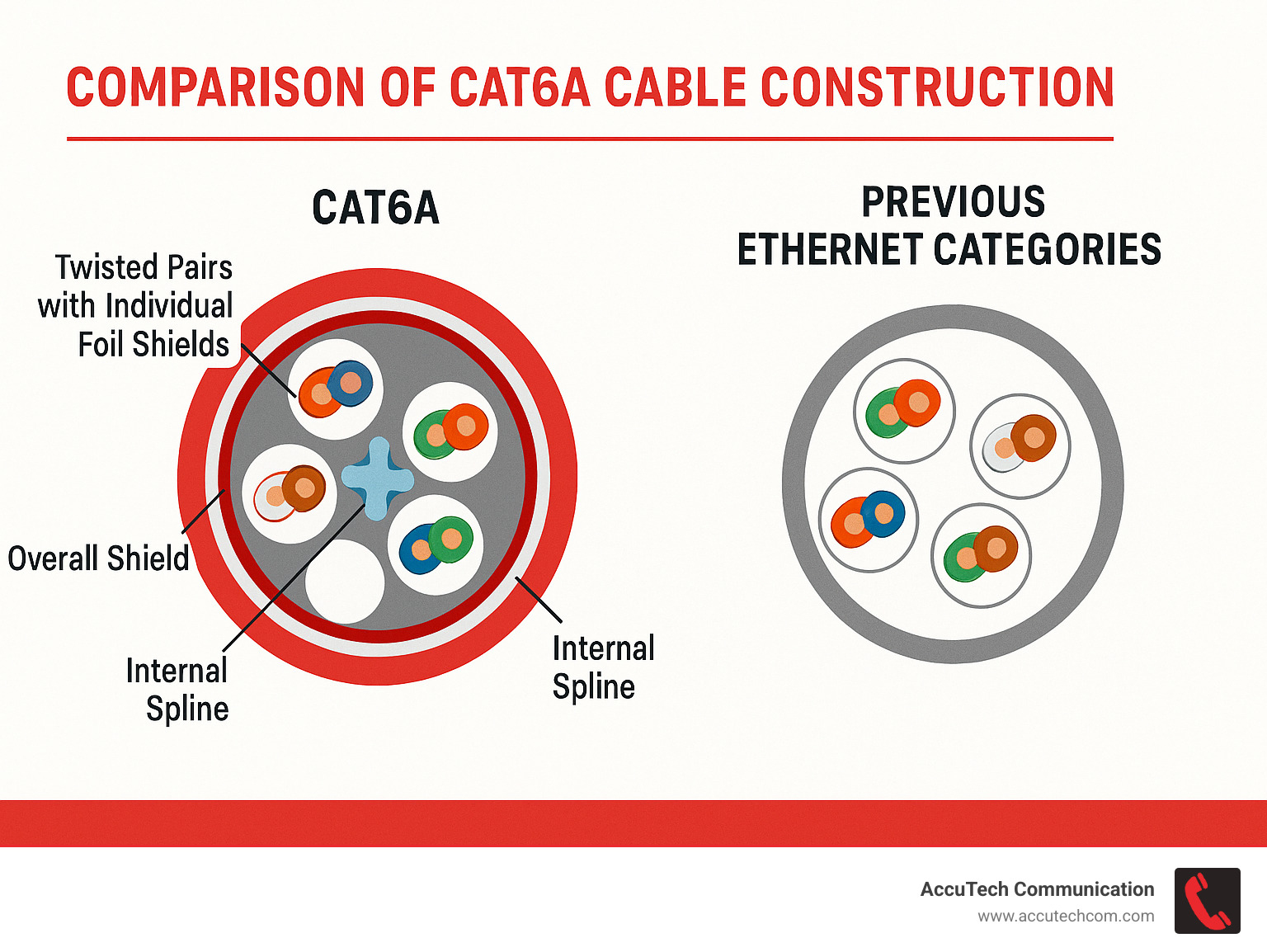
I love showing clients the internal spline design in Cat6a cables—this physical separator between the twisted pairs dramatically reduces crosstalk, which is crucial when you’re pushing 10 Gbps of data through your walls.
Improved Immunity to Interference
Modern offices are electromagnetic battlefields. Between wireless devices, fluorescent lighting, and electrical equipment, your network faces constant interference threats:
Superior alien crosstalk protection means your Cat6a cables won’t “eavesdrop” on each other. The improved twisting and insulation keep signals where they belong—in their own cable pairs.
For environments with heavy interference, the shielding options available with Cat6a make a world of difference. Whether you choose unshielded (UTP) for standard offices or shielded variants (F/UTP, S/FTP) for industrial settings or data centers, Cat6a handles interference like a pro.
Future-Ready Features
When I walk clients through their networking options, I always emphasize how Cat6a prepares them for both today’s and tomorrow’s technologies:
Power over Ethernet (PoE++) support is a game-changer. Cat6a cables can handle up to 100W of power delivery, which means you can power advanced security cameras, video conferencing systems, and next-gen wireless access points without running separate electrical lines. The savings in installation costs alone can be substantial.
Cat6a offers seamless backwards compatibility with your existing Cat6 and Cat5e infrastructure, allowing for phased upgrades that won’t break your budget all at once.
The extended lifespan of a properly installed Cat6a network—typically 10-15 years or more—makes it a sound investment. I’ve had clients calculate their cost-per-year based on this lifespan, and the value becomes immediately apparent.
Cat6a vs. Cat6 vs. Cat5e – The Quick Specs
When helping clients understand their options, this comparison table often clarifies why Cat6a makes sense for forward-thinking businesses:
| Specification | Cat5e | Cat6 | Cat6a |
|---|---|---|---|
| Maximum Data Rate | 1 Gbps (up to 100m) | 10 Gbps (up to 55m), 1 Gbps (up to 100m) | 10 Gbps (up to 100m) |
| Bandwidth | 100 MHz | 250 MHz | 500-750 MHz |
| Crosstalk Protection | Basic | Improved | Superior (includes alien crosstalk protection) |
| Typical Jacket Diameter | 5.0 mm | 5.8 mm | 6.2-7.4 mm (depending on shielding) |
| PoE Support | Limited (PoE/PoE+) | Good (PoE+) | Excellent (PoE++) |
| Typical Application | Basic networking | High-speed networking | Data centers, future-proof installations |
While the initial investment in Cat6a ethernet cable 1000 ft spools is higher than Cat6 or Cat5e, the long-term benefits make it the economical choice. I’ve seen businesses avoid costly re-cabling projects by making the right choice the first time.
At AccuTech Communications, we’re committed to helping you build infrastructure that grows with your business, not holds it back.
Best Cat6a Ethernet Cable 1000 ft Picks
When selecting the optimal Cat6a ethernet cable 1000 ft solution for your project, several factors come into play including environment, building codes, and specific application requirements. Based on our extensive installation experience across Massachusetts, New Hampshire, and Rhode Island, we’ve identified the best options for various scenarios:
Shielded cat6a ethernet cable 1000 ft for High-EMI Environments
If you’ve ever tried to have a conversation next to a jackhammer, you understand the challenge of communication amid interference. That’s essentially what your network faces in high-EMI environments.
Shielded Cat6a cable acts like noise-canceling headphones for your data, making it perfect for environments where electromagnetic interference would otherwise wreak havoc on your network performance. The dual-layer foil shielding with integrated drain wire creates a protective cocoon around your data transmission.
We recently installed shielded Cat6a ethernet cable 1000 ft spools throughout a manufacturing facility in Worcester where massive CNC machines were causing network dropouts with standard cabling. The difference was immediate – rock-solid connections even when all equipment was running at full capacity.
These cables excel in server rooms, industrial plants, healthcare environments, and anywhere with significant electrical equipment. The 23 AWG solid copper conductors ensure both optimal signal integrity and excellent power delivery for PoE devices. If you’re dealing with critical data in challenging environments, don’t compromise – detailed specifications show why shielded Cat6a is worth the investment.
Plenum-rated cat6a ethernet cable 1000 ft for Air-Handling Spaces
Building codes aren’t just bureaucratic red tape – they’re there to save lives. Plenum-rated Cat6a ethernet cable 1000 ft spools feature special FEP jacketing that produces minimal smoke and toxic fumes during a fire, which is crucial in air circulation spaces.
I’ll never forget installing network infrastructure in a Boston medical center where patient safety was paramount. The building inspector specifically checked that we used CMP-rated cabling in all ceiling spaces. Plenum-rated Cat6a wasn’t just a specification requirement – it was a moral obligation to protect the facility’s vulnerable patients.
This cable type comes in both shielded and unshielded configurations, giving you flexibility to match your interference protection needs while maintaining code compliance. The low-smoke properties make this the mandatory choice for hospitals, schools, and any building where cables run through HVAC air return spaces.
The investment in plenum-rated cable pays dividends in both safety and compliance. Learn more about proper installation techniques for these specialized cables in our guide to Network Cabling Installation.
Riser-rated cat6a ethernet cable 1000 ft for Vertical Shafts
When you’re running cable between floors but not through air-handling spaces, riser-rated (CMR) Cat6a ethernet cable 1000 ft spools offer the perfect balance of fire safety and cost-effectiveness. The PVC jacket includes flame-retardant properties specifically designed to prevent vertical fire spread – crucial in multi-story buildings.
One feature our technicians particularly appreciate is the sequential footage markings printed every foot or two. This seemingly small detail saves tremendous time when planning and executing multi-floor installations. When we’re pulling cable through a six-story office building in downtown Boston, knowing exactly how much cable remains on the spool prevents mid-installation shortages.
The 23 AWG solid copper conductors make riser-rated Cat6a ideal for permanent installations in commercial offices and multi-floor buildings. While not suitable for plenum spaces, this cable type meets all necessary fire codes for vertical shafts and most in-wall applications.
Outdoor/Direct-Burial Option – When Weather Strikes
New England weather can be brutal – from scorching summer sun to freezing winter storms. Standard indoor cables would quickly deteriorate in these conditions, which is why outdoor-rated Cat6a ethernet cable 1000 ft spools are essential for exterior applications.
The UV-resistant polyethylene jacket prevents sun damage, while internal water-blocking gel keeps moisture at bay even during heavy rain. These rugged cables maintain data integrity whether they’re running underground between buildings or supporting outdoor PoE surveillance cameras.
I recall an installation connecting two detached buildings at a manufacturing campus in Sudbury. The facilities manager initially balked at the cost difference between indoor and outdoor cable – until I showed him a sample of indoor cable that had been exposed to the elements for just one season. The deteriorated, cracked jacket made the decision easy.
For any installation exposed to weather, connecting outbuildings, or running surveillance to remote areas of your property, outdoor-rated Cat6a is the only sensible choice. The additional protection these cables offer prevents costly repairs and downtime that would inevitably result from using indoor cable in outdoor applications.
For all your Cat6a ethernet cable 1000 ft needs – whether shielded, plenum, riser, or outdoor – AccuTech Communications provides expert guidance to ensure you select the right product for your specific environment. We’ve seen how proper cable selection prevents headaches down the road.
Key Buying Factors & Cost Breakdown
Choosing the right Cat6a ethernet cable 1000 ft spool involves more than just finding the lowest price. As someone who’s helped countless businesses across New England with their network infrastructure, I’ve learned that understanding these key factors helps you make a smarter investment that pays off for years to come.
Conductor Material: Pure Copper vs. CCA
The heart of your cable makes all the difference in performance and longevity:
Pure Copper (Bare Copper) is what we always recommend to our clients in Boston’s financial district and beyond. Yes, it costs more upfront, but the superior conductivity means better signal integrity and much better heat dissipation for Power over Ethernet applications. When you’re powering security cameras or access points, this matters tremendously.
Copper-Clad Aluminum (CCA) might tempt you with its lower price tag, but I’ve seen too many network failures from these cables to recommend them. They have higher resistance, poorer PoE performance, and tend to break more easily during installation. For temporary setups they might work, but for permanent infrastructure? Pure copper is the only way to go.
Certification and Compliance
When I’m selecting cable for a hospital in Worcester or a school in Providence, these certifications aren’t just nice-to-haves—they’re essential:
ANSI/TIA-568.2-D certification ensures your cable truly meets Cat6a performance specifications. Without this, you might be getting something that falls short of true Cat6a capabilities.
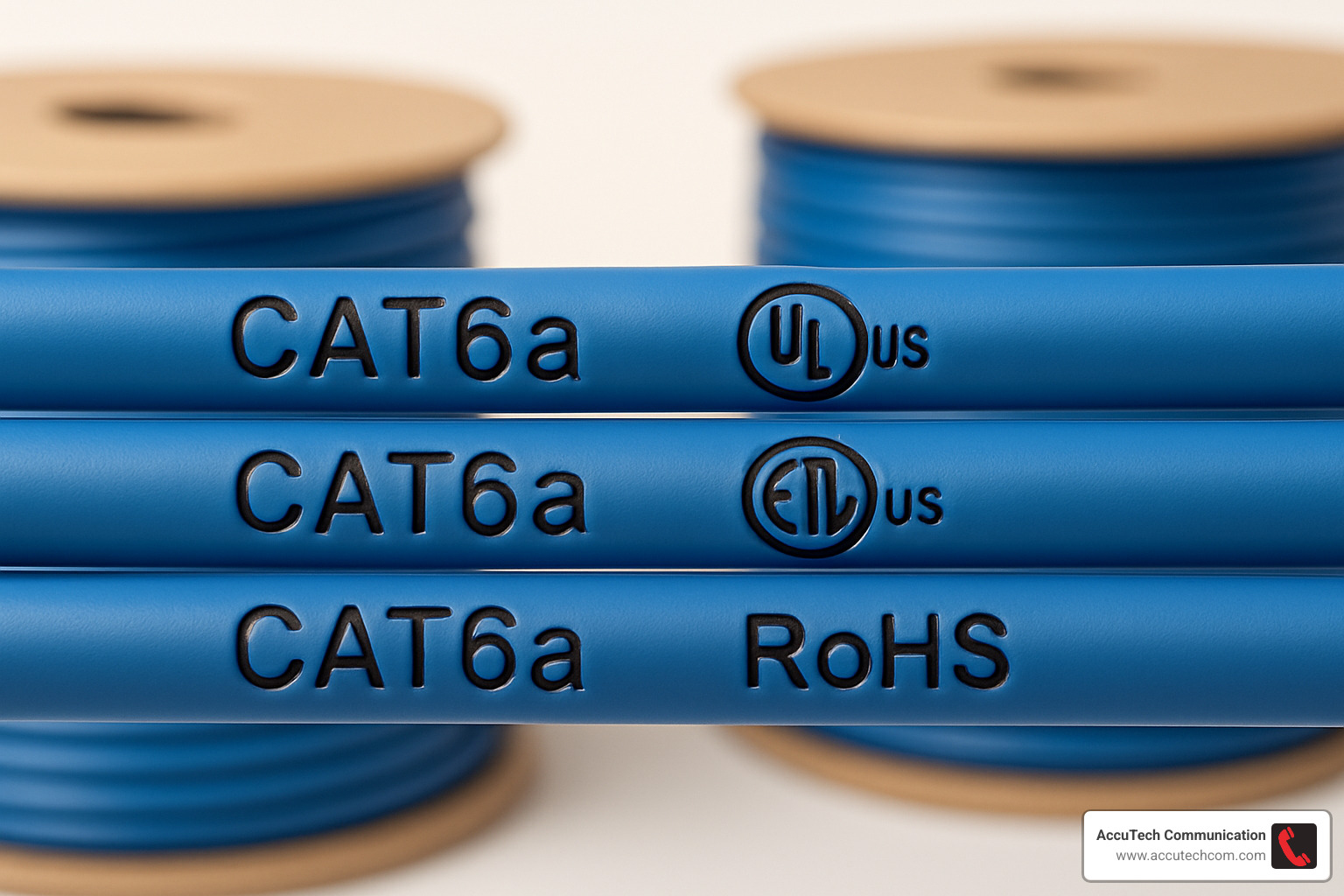
UL or ETL Listed markings mean the cable has been independently tested for safety. This is especially important for plenum and riser installations where fire safety is critical.
RoHS Compliance indicates the cable meets environmental standards limiting hazardous substances—something many of our environmentally-conscious clients in New Hampshire specifically request.
NEC Compliance for appropriate fire ratings (CMP, CMR) isn’t optional—it’s required by building codes and inspectors will check for this.
Physical Considerations
The practical aspects of Cat6a ethernet cable 1000 ft spools often get overlooked until installation day:
Weight matters more than you might think. A typical spool weighs between 25-46.5 pounds depending on shielding, which affects how easily your team can transport and handle it during installation.
Spool Dimensions (typically 14.5 × 14.5 × 7.75 inches for wooden spools) determine storage requirements and how easily the cable dispenses during installation.
Bend Radius for Cat6a is generally 4× the outer diameter—about 1-1.2 inches. Exceed this during installation and you risk damaging the internal structure, leading to performance issues that can be maddening to troubleshoot later.
Connector Compatibility is something we always verify before ordering. Cat6a’s larger diameter often requires specific compatible connectors, especially for shielded variants. Nothing’s worse than having 1000 feet of cable and realizing your connectors don’t fit properly!
Cost Factors and Value Analysis
When I’m advising clients in Massachusetts or Rhode Island about their network infrastructure, I always encourage thinking beyond the initial price tag:
Bulk Discounts can significantly reduce your per-foot cost. Most suppliers offer tiered pricing at 10+, 25+, and 50+ spool quantities. For larger projects across multiple sites, this adds up quickly.
Labor Savings features are worth their weight in gold. Sequential foot markings, easy-pull designs, and sturdy wooden spools can cut installation time by 15-20% in our experience—often saving more money than you’d save by choosing cheaper cable.
Warranty Period tells you a lot about a manufacturer’s confidence in their product. Quality Cat6a ethernet cable 1000 ft spools typically come with limited lifetime warranties, while inferior products might offer just 1-5 years.
Testing Certification included with your purchase can save valuable time during installation. Some premium manufacturers provide actual test results with each spool, reducing the need for extensive field testing.
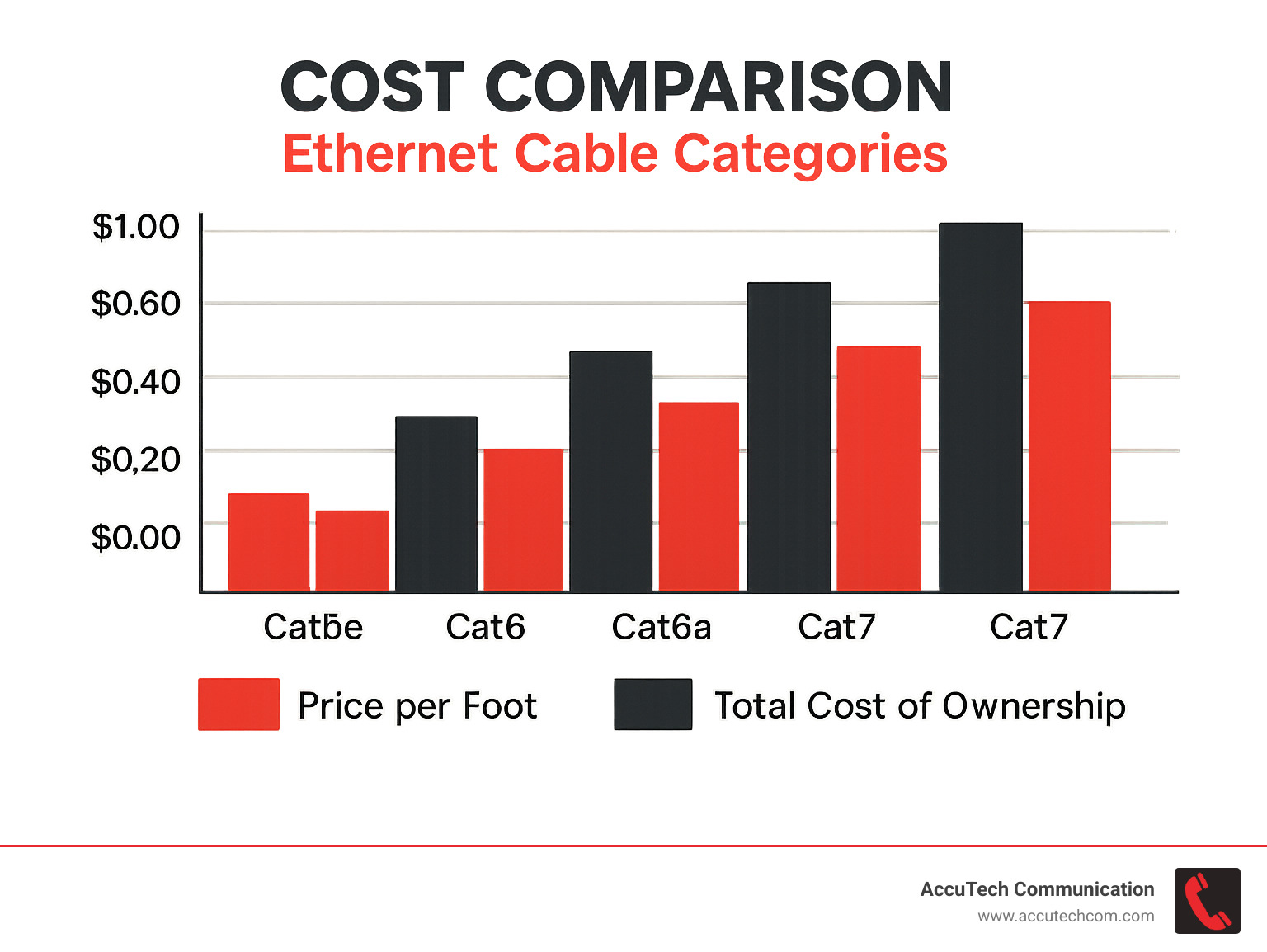
After 30+ years in this industry, I’ve found that premium Cat6a ethernet cable 1000 ft spools consistently deliver better value over the network’s lifetime. The initial investment pays for itself through faster installation, fewer troubleshooting headaches, and longer service life. For businesses that can’t afford downtime—like our clients in healthcare, education, and financial services—this reliability is invaluable.
Want to learn more about choosing the right network cabling for your specific needs? Check out our detailed guide on Types of Network Wiring for additional insights.
Installation Tips, Tools & Best Practices
Installing Cat6a ethernet cable 1000 ft spools isn’t just about running cable from point A to point B. It’s about creating a network foundation that will serve your business reliably for years to come. At AccuTech Communications, we’ve learned a thing or two about proper installation techniques through our decades of experience serving businesses across New England.
Critical Installation Parameters
When we’re installing Cat6a in office buildings around Boston, we always remind our team about the physical limits of these advanced cables. Never bend Cat6a tighter than 4× the cable’s outer diameter—that’s typically about 1-1.2 inches. Think of it like trying not to kink a garden hose; sharp bends damage the internal structure and degrade performance.
Pull tension is another critical factor. We keep it under 25 pounds of force (110 N) to prevent stretching those delicate copper conductors. I’ve seen many DIY installations where cables were yanked too hard through walls, resulting in mysterious performance issues that are nearly impossible to diagnose later.
Proper cable management isn’t just about aesthetics (though a tidy installation is definitely satisfying). We maintain at least 6 inches of separation from power cables to prevent electromagnetic interference. Your Cat6a has excellent shielding, but why test its limits? Also, be consistent with termination standards—whether you choose T568A or T568B wiring patterns, use the same one throughout your entire building.
One often overlooked detail: proper support methods. We use J-hooks or cable trays spaced every 4-5 feet to prevent sagging, which puts stress on the cable over time. Think of it like good posture for your network—a little support goes a long way.
Temperature and Environmental Considerations
Even the best Cat6a ethernet cable 1000 ft spool has its limits when it comes to environmental conditions. Standard Cat6a works optimally between -20°C to 60°C (-4°F to 140°F), which is plenty for most indoor installations, but worth considering for unheated warehouses or hot equipment rooms.
When we’re installing for Power over Ethernet applications (especially PoE++), we’re careful about how we bundle cables. Tight bundles can trap heat, potentially damaging the cable core or reducing its lifespan. This is especially important in schools and hospitals across Massachusetts where security cameras and wireless access points rely on PoE.
For conduit installations, we never exceed 40% fill capacity. This isn’t just about making future additions easier—it’s about allowing proper airflow for cooling and preventing cable damage during pulls. I like to tell clients it’s like packing for a vacation: if you stuff your suitcase to bursting, something’s bound to get wrinkled or damaged.
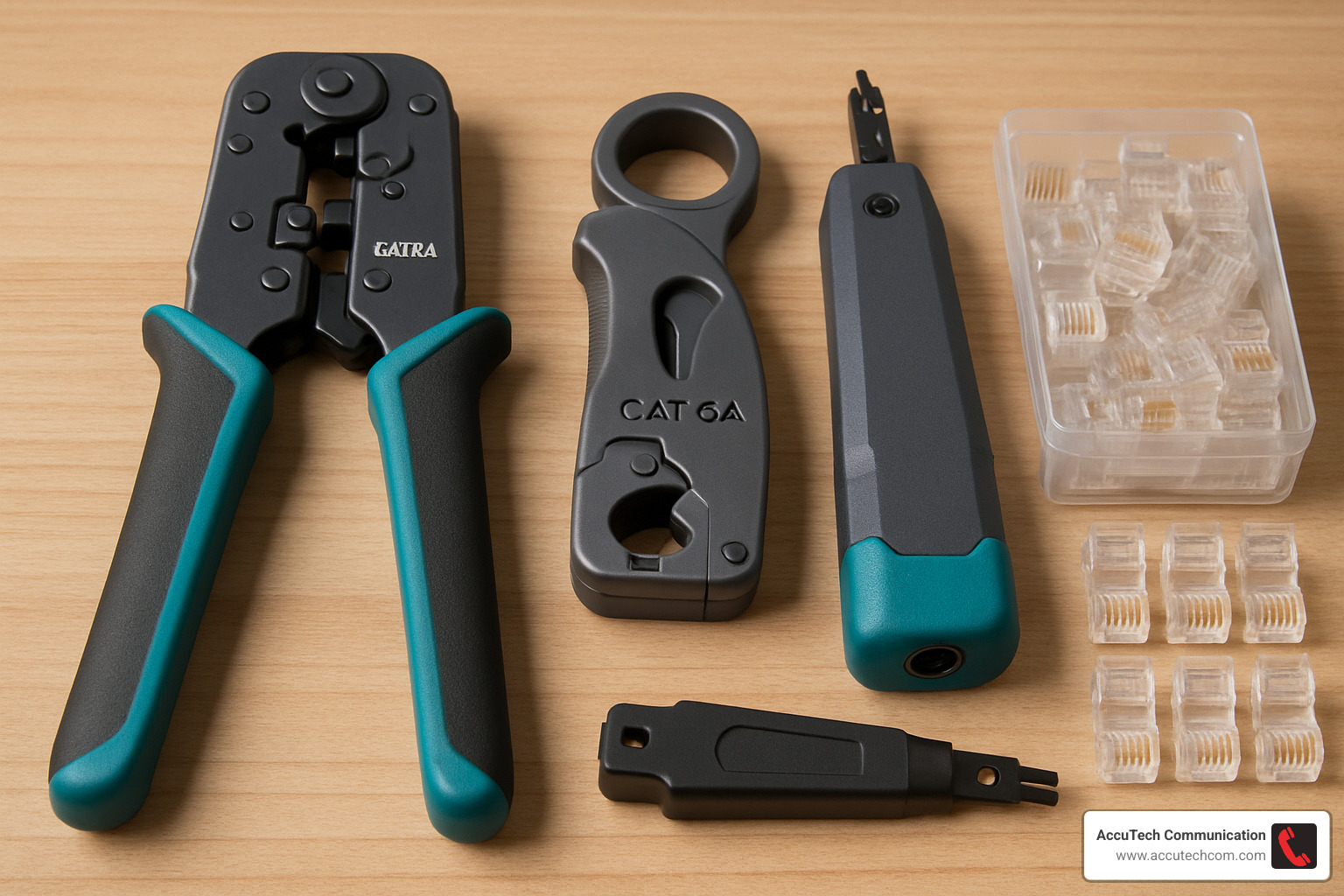
Essential Toolkit Checklist
Every AccuTech technician arrives on-site with a complete toolkit specifically designed for Cat6a installations. We’ve found these tools to be absolutely essential:
- Cable Cutters for clean, sharp cuts that don’t damage conductors
- Wire Strippers calibrated for 23 AWG conductors
- Punchdown Tool for clean terminations to patch panels and keystone jacks
- Crimping Tool rated specifically for Cat6a connectors
- Cable Tester (we prefer Fluke certification testers for verifying full performance)
- Fish Tape/Rods for navigating through walls and ceilings
- Cable Lubricant to reduce friction on long or challenging pulls
- Label Maker because a properly documented network saves hours of troubleshooting later
- Tone Generator/Probe for tracing cables in finished installations
- Shielding Continuity Tester for verifying proper grounding in shielded installations
I’ve personally rescued many troubled installations where the original installer skimped on proper tools. That $20 bargain crimper might seem like a deal until you’re troubleshooting intermittent network issues at 2 AM!
Termination Best Practices
The termination is where the magic happens—or where problems begin. When connecting those Cat6a ethernet cable 1000 ft runs to patch panels and jacks, we follow these critical techniques:
Keep pair untwisting to an absolute minimum—less than 0.5 inches is our rule. Those twists aren’t just for show; they’re mathematically calculated to cancel out interference. Every millimeter of unnecessary untwisting introduces potential signal problems.
Maintain jacket integrity by leaving as much of the outer jacket material as possible at termination points. The jacket provides essential structure and protection for those delicate twisted pairs.
Always use connectors specifically rated for Cat6a. Standard Cat6 connectors often can’t properly accommodate the larger diameter of Cat6a cable, leading to crimped or damaged conductors. This is especially important for shielded installations.
For our clients with shielded installations in high-interference environments like manufacturing facilities in Worcester, proper shield termination is non-negotiable. We ensure 360-degree shield contact and proper grounding of the drain wire to create an effective path for interference to dissipate.
After installation, we perform certification testing on every run. This isn’t just checking for basic connectivity—we’re verifying that each cable meets or exceeds the full Cat6a performance specifications. Our clients deserve to know they’re getting exactly what they paid for.
Video Walk-Through: Terminating Shielded Cat6a
For those who prefer seeing techniques in action, this professional demonstration covers proper shielded Cat6a termination:
Watch Cat6a Shielded Termination Guide
Terminating shielded Cat6a requires extra attention to detail. You must carefully remove the outer jacket without damaging the delicate foil shield, properly fold back the shield and drain wire, and ensure they make solid contact with the connector’s metal housing. The connector must be specifically designed for shielded Cat6a—it needs to accommodate both the larger diameter and provide proper shield connection points.
At AccuTech Communications, we’ve learned through years of experience that proper termination is the single most critical factor in achieving full Cat6a performance. That’s why our technicians undergo regular training to stay current with industry best practices, ensuring every installation we complete across Greater Boston meets or exceeds expectations. When you’re investing in premium Cat6a ethernet cable 1000 ft spools, you deserve an installation that helps you realize their full potential.
Frequently Asked Questions about Cat6a Bulk Cable (1000 ft)
What speed and bandwidth can I realistically expect?
When clients ask me about real-world performance of Cat6a ethernet cable 1000 ft spools, I tell them what we’ve consistently seen in the field: properly installed Cat6a delivers on its promise of 10 Gigabit speeds over the full 328-foot channel length. The actual bandwidth typically ranges between 500-750 MHz, depending on manufacturer specifications.
In our installations across Greater Boston, we’ve found that Cat6a consistently achieves these impressive speeds when quality components are used throughout. That said, a few factors can affect your real-world performance:
Your network is only as strong as its weakest link – poor terminations are the number one culprit behind performance issues. How you route cables (avoiding tight bends and interference sources) makes a significant difference too. And of course, proper testing confirms everything meets spec.
For most of our business clients in Massachusetts, Cat6a provides substantial bandwidth headroom for current applications while offering plenty of growth capacity for future needs. It’s why we confidently recommend it for forward-thinking organizations.
How far can I run Cat6a before performance drops?
One of the biggest advantages of Cat6a over its predecessors is distance capability. According to TIA/EIA standards, Cat6a ethernet cable 1000 ft maintains full 10 Gigabit performance up to 100 meters (328 feet), including patch cables at both ends. This gives you nearly twice the 10G distance compared to standard Cat6, which tops out at just 55 meters.
After hundreds of installations throughout New England, we’ve observed some interesting patterns:
Shielded Cat6a typically performs slightly better at distances approaching the limit thanks to superior noise rejection. The quality of your terminations becomes increasingly important as you approach maximum distances. And environmental factors like temperature and nearby equipment can influence effective range.
For clients needing to go beyond 100 meters, we typically recommend fiber optic solutions, though in certain scenarios, a well-designed Cat6a installation with repeaters can be a cost-effective alternative. We’re always happy to evaluate your specific needs and recommend the most practical solution.
Do I really need shielding for my installation?
This is perhaps the most common question we hear when discussing Cat6a ethernet cable 1000 ft options with clients. The honest answer? It depends on your specific environment and requirements.
Based on our decades of experience throughout New England, here’s my practical guidance:
Shielded Cat6a makes sense when your installation involves industrial environments with motors and machinery, cables running parallel to power lines, healthcare facilities with sensitive medical equipment, applications where data security is paramount, or high-density environments with many parallel cable runs.
Unshielded Cat6a usually works fine for standard office environments, projects with tight budget constraints, installations with minimal electromagnetic interference, situations where ease of termination is important (shielded requires more expertise), or where cable management space is limited (shielded has a larger diameter).
Interestingly, about 60% of our Cat6a installations around Waltham and Metro-west Boston use shielded cable, particularly in commercial buildings with dense electrical infrastructure or sensitive equipment. For specific recommendations for your environment, we’re always available for a consultation.
What’s the difference between Plenum (CMP) and Riser (CMR) ratings?
This distinction isn’t just technical jargon – it’s about safety, code compliance, and avoiding costly reinstallations. Let me break it down in practical terms:
Plenum (CMP) rated cable is specifically designed for air-handling spaces like the area above drop ceilings or under raised floors. It features a special fire-retardant jacket (typically FEP) that produces minimal smoke and toxic fumes if burned – critical in spaces that circulate air throughout a building. While it costs about 20-30% more than equivalent CMR cable, it’s mandatory in most commercial buildings for horizontal runs above drop ceilings.
Riser (CMR) rated cable is engineered for vertical runs between floors in non-plenum spaces. Its PVC jacket includes flame-retardant properties that prevent fire from spreading vertically through a building. It’s more economical than plenum cable and perfectly suitable for most wall and conduit installations, but cannot legally be installed in plenum spaces.
I’ve seen building inspectors require complete reinstallation when the wrong cable type was used, so we always verify building requirements before making recommendations. This attention to detail has saved our clients throughout Massachusetts and Rhode Island significant headaches and expense over the years.
For more detailed information about network cabling options, check out our guide on Types of Network Wiring.
Conclusion
Investing in Cat6a ethernet cable 1000 ft bulk spools is about more than just buying cable – it’s about building a foundation for your organization’s digital future. Throughout my years at AccuTech Communications, I’ve seen how this forward-thinking approach pays dividends for businesses across New England.
When you choose Cat6a for your network infrastructure, you’re getting a solution that grows with you. With full 10 Gbps speeds over the entire 100-meter channel length and bandwidth up to 750 MHz, your network will have plenty of headroom as your needs evolve. This isn’t just about today’s applications – it’s about being ready for whatever technology brings next.
The versatility of Cat6a is truly impressive. From powering high-definition security cameras with PoE++ to supporting lightning-fast data transfers in your server room, these cables handle it all with ease. I’ve installed Cat6a in everything from historic buildings in downtown Boston to cutting-edge manufacturing facilities in Worcester, and it delivers consistent performance in every environment.
Code compliance is another area where choosing the right Cat6a ethernet cable 1000 ft solution makes all the difference. Whether you need plenum-rated cable for those above-ceiling runs or outdoor-rated cable to connect your detached warehouse, proper selection ensures your installation meets all relevant building and safety codes. This attention to detail prevents expensive rework and potential safety issues down the road.
There’s also something satisfying about working with 1000 ft spools. They provide just the right quantity for most commercial installations – enough cable to handle comprehensive deployments without excessive waste. And when you’re pulling cable through a challenging pathway, knowing you have plenty of length to work with brings welcome peace of mind.
Since we founded AccuTech Communications back in 1993, we’ve been helping businesses throughout Massachusetts, New Hampshire, and Rhode Island build networks they can rely on. Our team understands the unique challenges of New England installations – from dealing with old brick buildings in Boston to planning for the temperature extremes we face throughout the year.
When you’re ready to upgrade your network infrastructure with Cat6a ethernet cable 1000 ft solutions, we’re here to help with honest advice, fair pricing, and installation services performed by technicians who truly care about getting it right. We’re not just installing cable – we’re helping build your business’s future.
For organizations in Metro-west Boston, Marlborough, Sudbury, Boston, Woburn, Waltham, or Worcester looking to future-proof their network infrastructure, reach out to our team at AccuTech Communications. We’d be happy to discuss the best Cat6a solution for your specific requirements and help you build a network that stands the test of time.
More info about Ethernet Cable Wiring
