
Companies in Comm Services: Top Growth 2025
Understanding the Communication Services Sector and Its Major Players
What companies are in the communication services sector spans a diverse range of businesses that keep us connected, informed, and entertained. This sector includes:
- Interactive Media & Services: Alphabet (Google), Meta (Facebook), Pinterest, Spotify, Roblox
- Entertainment: Disney, Netflix, Warner Bros. Findy, Electronic Arts, Live Nation
- Telecommunication Services: AT&T, Verizon, T-Mobile, Comcast, Charter Communications
The Communication Services sector, created in 2018 by the Global Industry Classification Standard (GICS), was formed to reflect the convergence of telecommunications, media, and internet businesses. This sector now includes over 265 stocks with a combined market cap of $8.06 trillion, making it a vital part of the modern economy.
It covers four main industries: Telecommunications, Media, Entertainment, and Interactive Media and Services. These companies generate nearly $1.98 trillion in annual revenue with an average profit margin of 14.90%.
For any business, understanding this sector is essential, as its technologies form the backbone of modern operations, from video conferencing to cloud-based phone systems.
I’m Corin Dolan, and through my work at AccuTech Communications, I’ve spent decades helping businesses across Massachusetts, New Hampshire, and Rhode Island implement the physical infrastructure that connects them to the companies and platforms within the communication services sector. Understanding these major players helps businesses make informed decisions about their own communication systems and technology partnerships.
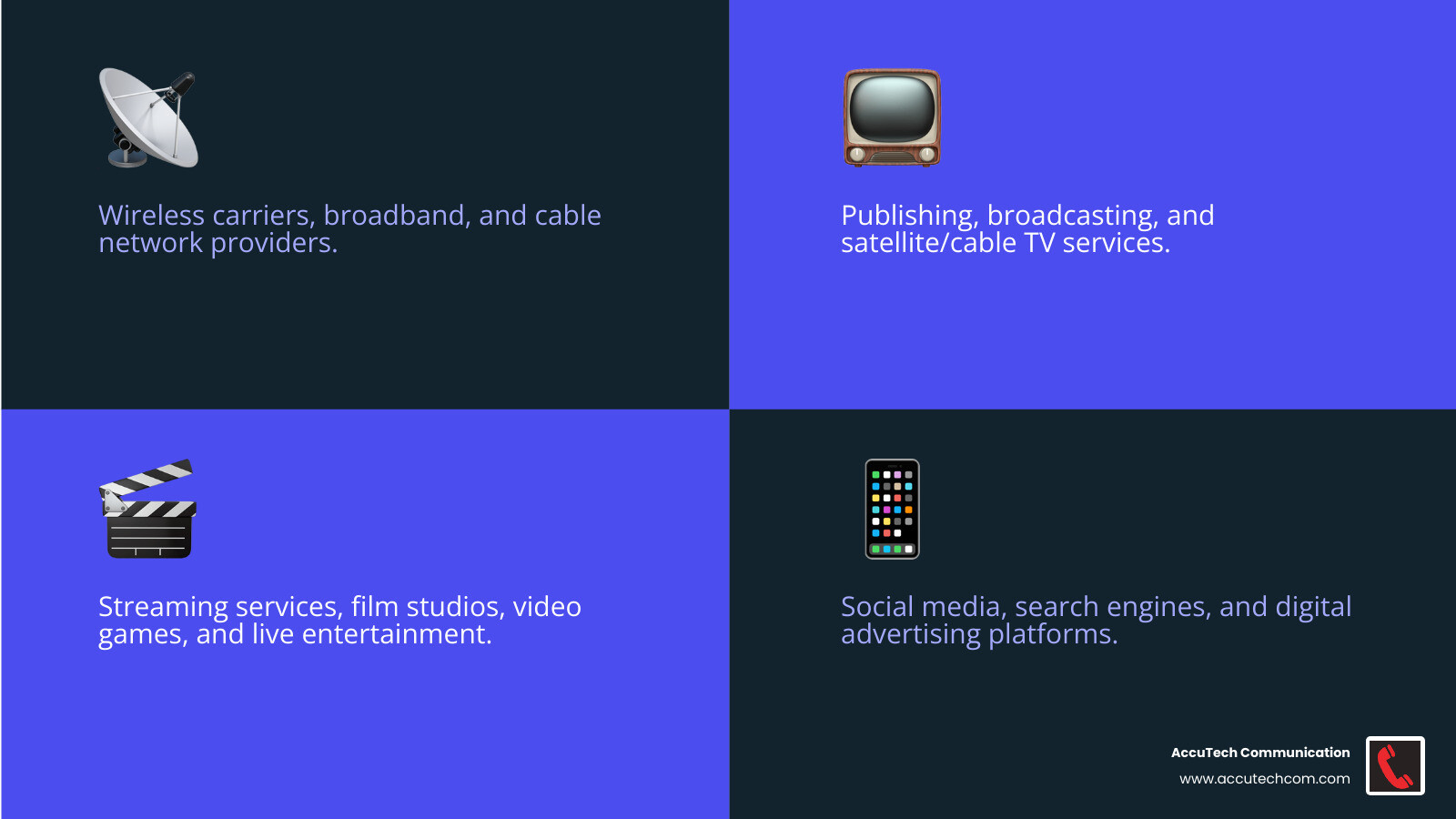
What Companies Are in the Communication Services Sector by Industry?
The communication services sector reflects how we live today, blurring the lines between entertainment, information, and connection. The same company might produce your favorite show and provide your video chat service, while your phone carrier bundles streaming with your data plan.
Before 2018, what companies are in the communication services sector was a harder question to answer, as these businesses were scattered across different classifications. Tech, media, and telecommunications companies each had their own category. But as internet giants began producing shows and phone companies acquired media empires, the old classifications no longer fit.
That’s when the Global Industry Classification Standard (GICS) created this new sector, bringing telecommunications, media, and internet companies together. It was a recognition that these industries had converged into something new.
This sector is known for its high growth potential, driven by constant innovation, but that growth comes with volatility. Companies can soar on a hit show or new technology but can also stumble when consumer tastes shift. With a combined market cap exceeding $8 trillion and revenues approaching $2 trillion, these are economic powerhouses shaping the world.
Let’s explore the three main industries that define this dynamic sector.
Interactive Media & Services

This industry is the digital heartbeat of modern life, built on connection and engagement. These companies build the platforms where we search, share, and connect. Most earn revenue through digital advertising or subscription models.
Alphabet Inc. (GOOGL) is a dominant force with a market cap near $3 trillion. Its Google search engine and YouTube platform are central to how we access information online.
Meta Platforms, Inc. (META), with a market cap over $1.8 trillion, built its empire on social networking. Its platforms, including Facebook, Instagram, and WhatsApp, connect billions and are key hubs for user-generated content.
Pinterest, Inc. (PINS), with a market cap around $26 billion, is a visual findy engine for finding inspiration. Some analysts believe the stock may be trading at a discount.
Spotify Technology S.A. (SPOT), with a market cap of approximately $144 billion, has transformed the music and podcast industry by putting millions of songs in users’ pockets.
Roblox Corporation (RBLX), valued at about $43 billion, is a platform where users create and share entire worlds and games. It’s highly popular with younger audiences, blurring the line between content creation and consumption.
Entertainment

The Entertainment industry is where storytelling meets technology, encompassing blockbuster movies, binge-worthy series, video games, and concerts. The biggest shift has been the rise of streaming services and “cord-cutting,” forcing companies to invest billions in original content to compete for subscribers.
The Walt Disney Company (DIS) is an entertainment icon with a market cap over $203 billion. Its empire spans theme parks, classic characters, and streaming platforms like Disney+, Hulu, and ESPN+, expertly leveraging its intellectual property.
Netflix, Inc. (NFLX), with a market cap near $500 billion, pioneered the streaming revolution. It has become a global powerhouse producing award-winning original content worldwide.
Warner Bros. Findy, Inc. (WBD), with a market cap of around $25 billion, holds a vast portfolio including HBO, Warner Bros. studios, and the Findy Channel, boasting deep content libraries.
Electronic Arts Inc. (EA), with a market cap of roughly $34 billion, is a leader in the massive video game industry. Franchises like FIFA and Madden highlight the significance of interactive entertainment.
Live Nation Entertainment, Inc. (LYV) focuses on the irreplaceable experience of live entertainment. With a market cap around $35 billion, it connects artists with fans through global concerts and festivals.
Telecommunication Services

Telecommunication Services is the foundation that makes everything else possible. These companies build and maintain the cell towers, fiber optic cables, and networks that keep us connected. This industry requires enormous capital to constantly upgrade infrastructure. From wireless carriers to broadband providers, these businesses maintain the importance of telecom infrastructure that modern life depends on.
AT&T Inc. (T), a telecom veteran with a market cap near $197 billion, provides wireless, broadband, and video services across the U.S. It remains a cornerstone of the nation’s telecommunications infrastructure.
Verizon Communications Inc. (VZ), with a market cap of approximately $185 billion, operates a vast wireless network and is expanding its fiber-optic services. Known for reliability, some analysts consider it potentially undervalued.
T-Mobile US, Inc. (TMUS) is a fierce competitor with a market cap around $263 billion. It has challenged the telecom hierarchy with aggressive pricing and network expansion.
Comcast Corporation (CMCSA), with a market cap of about $114 billion, provides cable, internet, and voice services while also owning NBCUniversal. Some analysts believe the stock trades at a significant discount.
Charter Communications, Inc. (CHTR) operates as Spectrum, providing broadband, cable, and voice services. With a market cap of roughly $51 billion, analysts suggest it may be trading below its fair value.
For businesses, these telecommunications services are essential. Whether running cloud applications or hosting video conferences, reliable network infrastructure is critical. That’s why we provide comprehensive business communication services to ensure your connectivity is never a weak link.
Key Market Trends and Future Outlook
The communication services sector is in a state of constant change, driven by new technologies and shifting consumer habits. What’s cutting-edge today can be old news tomorrow.
The 5G rollout is a transformative wireless technology upgrade, not just a minor speed bump. It promises dramatically faster speeds, near-zero lag, and the ability to connect countless devices. While it requires billions in infrastructure investment from telecom companies, the potential payoff includes new revenue from improved mobile broadband, real-time gaming, and advanced Internet of Things (IoT) applications.
Artificial Intelligence (AI) is fundamentally changing operations. Telecom providers use AI to optimize networks and predict maintenance. Streaming platforms use it for content recommendations, while advertisers use it for hyper-targeted campaigns. For companies like Baidu, AI is becoming a key factor in their valuation and expected revenue growth.
The regulatory environment is increasingly complex. Data privacy concerns have led to strict regulations like GDPR and CCPA. Antitrust scrutiny is growing for the largest tech and media giants. Content moderation on social media remains a tightrope walk between protecting free speech and combating harmful content.
The “shift to streaming” and “cord-cutting” trend continues, forcing traditional cable companies to adapt by launching their own services and bundles. It’s an intense battle for subscribers that drives innovation. The S&P 500 Communication Services Index provides detailed performance insights on leading companies.
Looking ahead, future growth drivers include the continued expansion of digital advertising, interactive gaming, the metaverse, and the world’s insatiable demand for high-speed connectivity. However, the sector faces challenges like brutal competition and the need for continuous, massive capital expenditures.
What companies are in the communication services sector for investors to watch?
Investing in this sector can be a roller coaster, with high growth potential often accompanied by volatility. The sector has a split personality: high-octane growth stocks in media and entertainment, and steady, dividend-paying telecom providers.
Understanding this duality is key. High-growth stocks can deliver impressive returns but are more sensitive to market sentiment. Dividend-paying stocks in telecommunications offer steady income, which is attractive for long-term or income-focused portfolios.
The sector’s weighted average P/E ratio is 27.30, with a 1.25% dividend yield, but these averages hide key differences. Stable, income-generating giants like Verizon (P/E 17.79, yield ~6.5%) and AT&T (P/E 18.17, yield ~6.0%) contrast with growth powerhouses like Meta (P/E 27.39, no dividend) and Netflix (P/E 47.04, no dividend). Comcast (P/E 11.86, yield 2.8%) straddles the middle ground. These differences directly impact how these stocks should fit into your investment strategy.
How can you invest in the sector?
If you’re interested in this sector, you have several options.
Individual stocks are the most direct approach but require serious homework and carry higher risk.
Exchange-Traded Funds (ETFs) offer instant diversification. XLC (The Communication Services Select Sector SPDR Fund) is a large, liquid option. VOX (Vanguard Communication Services Index Fund ETF Shares) and FCOM (Fidelity MSCI Communication Services Index ETF) are other popular, low-cost choices. Other options like IXP and IYZ cater to different objectives.
Mutual Funds are similar to ETFs but often actively managed. Options include VTCAX, FGJMX, FGHMX, FGEMX, and FGKMX.
One strategy is to look for undervalued stocks. Morningstar analysts regularly identify these opportunities within what companies are in the communication services sector. For example, recent analysis highlighted several companies as trading significantly below fair value estimates, including Charter Communications, Baidu, Comcast, Verizon Communications, and Pinterest. These insights can serve as excellent starting points for deeper research, but always do your own due diligence before investing.
No matter your approach, diversification is crucial. Just as investors diversify portfolios, businesses must ensure their communication infrastructure is robust. Planning for scalability often means investing in proper infrastructure, where structured cabling services become essential for future-proofing your network.
Frequently Asked Questions about the Communication Services Sector
When I talk to business owners about what companies are in the communication services sector, I hear the same questions again and again. Let’s explore the most common ones.
Why was the Communication Services sector created?
The sector was formally established in 2018 by S&P and MSCI to address the convergence of media, technology, and telecommunications. Before 2018, companies that were increasingly competing were scattered across different sectors: Alphabet (Information Technology), Disney (Consumer Discretionary), and AT&T (Telecommunication Services). As internet giants became entertainment producers and telecoms acquired media companies, the old classifications became obsolete. The new sector groups these converged businesses, providing a more accurate reflection of the modern market where the lines between connectivity, content, and digital platforms have blurred.
Is the Communication Services sector high-growth?
Yes, the sector is generally considered high-growth, but it’s diverse. The growth is primarily driven by the Interactive Media & Services and Entertainment industries, where companies like Meta and Netflix innovate rapidly. This is where you find high-growth potential, often accompanied by market volatility. However, the sector also includes more mature, stable businesses in the telecommunications industry. Companies like AT&T and Verizon offer slower growth but provide reliability and steady income through dividends. This diversity allows investors to choose between high-growth opportunities and stable, income-generating investments, depending on their risk tolerance.
What are the biggest risks for companies in this sector?
Companies in this sector face several significant risks:
- Intense Competition: The battle for subscribers, customers, and advertising dollars is relentless across all sub-industries, from streaming to wireless services.
- Rapid Technological Change: Staying current requires massive, continuous capital investment. The 5G rollout is a prime example for telecoms, while tech companies face constant pressure to innovate.
- Evolving Consumer Habits: Trends like “cord-cutting” can completely upend business models. Companies must adapt quickly to shifting preferences in how people consume content and communicate.
- Regulatory Scrutiny: This is a major and growing challenge. Companies face intense oversight regarding data privacy (GDPR, CCPA), antitrust concerns about market dominance, and the political complexities of content moderation.
Understanding these risks is crucial for businesses that rely on these services. It highlights the need for a robust and adaptable communication infrastructure, which is why we at AccuTech focus on building rock-solid foundational systems.
Conclusion
This overview of what companies are in the communication services sector shows why the sector matters to our economy and daily lives. Created in 2018, the sector has become the backbone of how we work, play, and connect. From telecom giants like Verizon and AT&T providing essential networks, to entertainment leaders like Disney and Netflix, to platforms like Meta and Alphabet that shape our interactions—these companies are woven into modern life. Representing over $8 trillion in market value and nearly $2 trillion in revenue, they form the infrastructure of our connected world.
What’s most striking is the sector’s duality: cutting-edge innovation like AI and 5G on one side, and the foundational work of building the physical infrastructure that makes it possible on the other. The fiber optic cables, cell towers, and structured cabling in office buildings are the unsung heroes of the digital age.
At AccuTech Communications, we live and breathe this foundational layer. While the big players roll out 5G, we’re on the ground in Massachusetts, New Hampshire, and Rhode Island, ensuring businesses have the rock-solid connectivity they need. Because here’s the truth: no matter how innovative the technology or how compelling the content, it all depends on reliable physical network infrastructure.
That’s why we’re passionate about services like fiber optic cabling installation—it’s about future-proofing your business. A proper infrastructure supports high-bandwidth video, cloud applications, and the next wave of communication technologies.
The communication services sector will continue to evolve, but the need for robust connectivity will remain constant. If your business needs to strengthen its communication infrastructure or plan for growth, we’re here to help. Contact us for your business communication needs, and let’s make sure you’re connected to the opportunities this dynamic sector offers.
