From Conduit to Connectivity: Mastering Fiber Optic Installation

Why Fiber Optic Installations Are Essential for Modern Business
Fiber optic installations provide the fastest, most reliable internet available by transmitting data as light pulses through glass strands. Unlike copper cables that use electrical signals, this technology delivers superior speed, bandwidth, and reliability over longer distances.
Key Benefits:
- High-speed data transfer up to 100 Gbit/s
- Low latency and minimal signal loss
- Long-distance capability without signal boosters
- Immunity to electromagnetic interference
- Superior security compared to copper
Main Installation Types:
- FTTH (Fiber to the Home): Direct fiber for maximum speed.
- FTTC (Fiber to the Curb): Fiber to a nearby pole, then coaxial cable.
- FTTN (Fiber to the Neighborhood): Fiber to a central node, then coaxial cable.
A typical installation takes 2-3 hours and involves running the fiber cable into your building, installing an Optical Network Terminal (ONT) and router, and testing the signal.
I’m Corin Dolan, owner of AccuTech Communications. Since 1993, my team has specialized in designing and installing scalable fiber infrastructure for businesses across Massachusetts, New Hampshire, and Rhode Island that depend on high-performance connectivity.
Similar topics to fiber optic installations:
Understanding the Fundamentals of Fiber Optics
The internet connection that powers your business isn’t electricity in a wire, it’s pulses of light traveling through glass strands thinner than a human hair. That’s the core of fiber optic installations. While copper cables send electrical signals that degrade and suffer from interference, fiber uses light to transmit data. This allows for speeds up to 100 times faster with virtually no signal loss over long distances. For a deeper dive, The FOA Reference For Fiber Optics is an excellent resource.
Not all fiber connections are the same. The method of delivery determines your speed and reliability:
- FTTH (Fiber to the Home): The gold standard. Fiber runs directly into your building, delivering the fastest speeds and lowest latency.
- FTTC (Fiber to the Curb): Fiber runs to a nearby distribution point (like a utility pole), with traditional coaxial cables completing the connection. This offers great speeds, but less than a full FTTH connection.
- FTTN (Fiber to the Neighborhood): Fiber runs to a central node serving a larger area, with existing copper lines connecting to individual premises. This is an upgrade from older systems but offers the lowest speeds of the three fiber options.
Understanding these types helps us design the right solution for your needs. For more on how we build complete network solutions, see our data center technologies.
Single-Mode vs. Multi-Mode Fiber Cables
Choosing between single-mode and multi-mode fiber is a key decision in any fiber optic installation.
| Feature | Single-Mode Fiber (SMF) | Multi-Mode Fiber (MMF) |
|---|---|---|
| Core Diameter | Around 9 microns (extremely thin) | 50 or 62.5 microns (much thicker) |
| Light Source | Laser (precise, focused beam) | LED or VCSEL (broader, less focused) |
| Distance | Long distances (tens to hundreds of kilometers) | Shorter distances (up to a few kilometers) |
| Bandwidth | Extremely high, virtually unlimited for future needs | High, but limited over distance due to modal dispersion |
| Applications | Long-haul networks, FTTH, CATV, WAN, MAN, inter-building | LANs, data centers, campus backbones, security systems |
| Jacket Color | Typically yellow | Typically orange (OM1/OM2) or aqua (OM3/OM4/OM5) |
| Cost | Higher equipment cost, lower fiber cost | Lower equipment cost, higher fiber cost over distance |
Single-mode fiber (SMF) has a tiny core that guides light in a single path, making it ideal for long distances like connecting buildings across a city (FTTH, WANs). You’ll recognize it by its yellow jacket.
Multi-mode fiber (MMF) has a larger core that allows multiple light paths. It’s perfect for shorter runs within a building or campus (LANs, data centers) and typically has an orange or aqua jacket. Premises fiber optic cable is usually tight buffer cable. Simplex or zipcord cable is used for some applications where only one or two fibers are needed. Backbone cables, which may contain 24-96 fibers, are usually distribution style cables.
Essential Equipment for a Fiber Connection
A complete fiber system requires several key components:
- Optical Fiber Cables: The physical medium (SMF or MMF) that carries data as light.
- Optical Network Terminal (ONT): This device, similar to a modem, converts light signals into electrical signals your devices can use.
- Gateway or Fiber-Compatible Router: This distributes the internet connection via Ethernet and Wi-Fi. It’s crucial that the router can handle fiber speeds to avoid a bottleneck.
- Other Hardware: This includes protective enclosures for exterior connections, high-quality Ethernet cables for wired devices, and optional WiFi extenders to eliminate dead zones.
The Pre-Installation Blueprint: Planning for Success
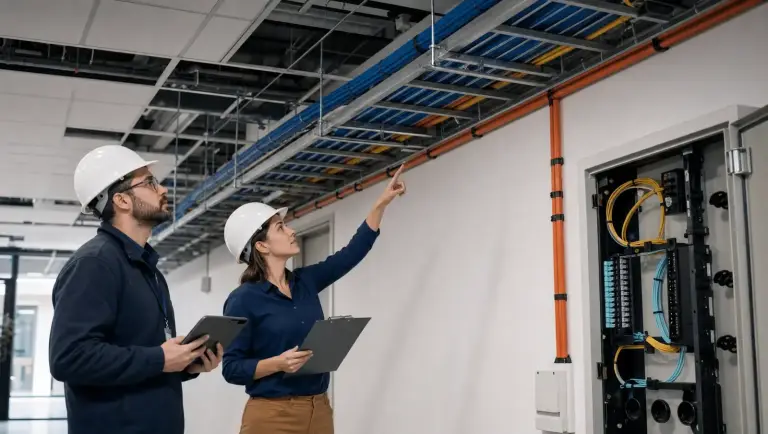
A successful fiber optic installation begins with a detailed plan. A comprehensive site survey is the first step, where we walk your property to map the optimal cable route and identify potential challenges like bedrock or existing utilities. This allows us to plan a path that is short, secure, and minimally disruptive.
For larger projects, permit acquisition from local and state agencies can add weeks or months to a timeline. We handle this paperwork early to keep your project on schedule.
Preparing for Your Installation
If you’re a homeowner preparing for installation, your part is simple:
- Clear a small area (about 2×2 feet) near a power outlet for the ONT and router. A central location is best for Wi-Fi coverage.
- Ensure power outlets are accessible and functional.
- An adult over 18 must be home for the entire appointment, which typically lasts two to three hours.
Estimating the Costs of Fiber Optic Installation
The total investment for fiber optic installations depends on several factors. The final cost is a combination of an initial installation fee, equipment costs (ONT, router), and labor charges for the technicians.
Material costs vary based on the type and length of fiber cable. Underground burial can be a significant expense, reflecting the use of specialized equipment, permit fees, and site restoration. The cost is influenced by terrain and the specific method used, such as trenching or directional boring to go under obstacles like driveways.
A Step-by-Step Guide to Professional Fiber Optic Installations
A professional fiber optic installation is a methodical process that typically takes two to three hours.
- Final Site Assessment: The technician walks through the plan with you, confirming the cable path, building entry point, and equipment locations.
- Bringing Fiber Indoors: We run the fiber cable into your building, using existing entry points when possible. If a new entry is needed, we drill a small, sealed hole to protect your building’s integrity.
- Equipment Installation: The technician installs the Optical Network Terminal (ONT), which converts light signals to electrical ones. Then, your gateway (router) is connected to the ONT to provide Wi-Fi and wired connections.
- Final Signal Test: We conduct thorough tests to verify signal strength and speed, ensuring your network is performing at its peak. We’ll also help with your initial Wi-Fi setup.
Key Methods for Fiber Optic Installations
The best path for your fiber depends on your location and budget.
Underground installation is preferred for its protection against weather and damage. Methods include:
- Trenching: Digging an open trench to lay conduit, suitable for new construction.
- Micro-trenching: Cutting a narrow, shallow groove in pavement, which is faster and less disruptive, especially in urban areas.
- Directional Boring (HDD): An advanced technique to drill under roads, landscaping, or other obstacles without surface disruption.
Underground conduits are typically buried 1 to 1.2 meters deep for protection. Learn more about protecting your investment with our innerduct installation services.
Aerial installation is a cost-effective alternative that uses existing utility poles. This method is often quicker than digging and allows for easier access for future maintenance. Our technicians ensure all aerial cables are installed safely and securely.
Connecting Fibers: Splicing vs. Connectors
Joining fibers requires precision to minimize signal loss.
Fusion splicing is the best method for permanent connections. It uses an electric arc to “weld” two fiber ends together, creating a seamless, low-loss joint that is strong and durable. A protective sleeve is heat-shrunk over the splice to shield it from moisture and stress, making it ideal for outdoor and long-haul runs.
Mechanical connectors (like LC connectors) provide flexibility. They allow for quick connections and disconnections without permanent fusing, which is useful for network testing, reconfigurations, or connecting to equipment. While they have slightly higher signal loss than a fusion splice, they are essential for creating a practical, adaptable network.
Best Practices for Handling, Safety, and Maintenance
Working with fiber optics requires a gentle touch and meticulous attention to detail. Throughout our decades of experience with fiber optic installations, we’ve learned that following proper handling practices isn’t just about protecting equipment; it’s about ensuring your network performs flawlessly for years to come.
Cable Handling:
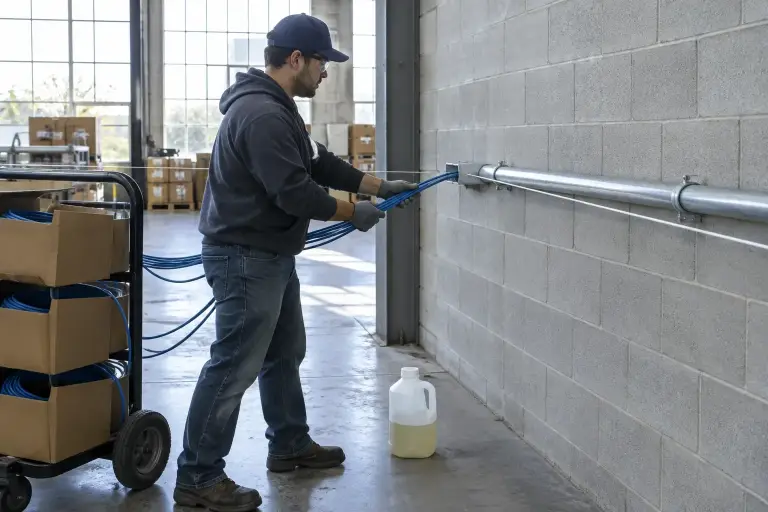
- Never pull the fiber itself. Always pull on the cable’s integrated strength members (Kevlar yarn or fiberglass rod). Pull on the strength members only, never the fiber.
- Avoid twists. Always roll the cable off the spool instead of spinning it off the end to prevent stress on the fibers.
- Respect the minimum bend radius. Bending a cable too sharply creates micro-fractures that degrade the signal over time. Adhering to the manufacturer’s specified bend radius prevents this hidden damage.
Safety Precautions for Fiber Optic Installations
Safety is our top priority. Fiber optics present unique hazards that require specific precautions.
- Eye Safety: The laser light in fiber cables is invisible but can cause permanent eye damage. Never look directly into a fiber end. Additionally, tiny glass shards from cutting fiber can penetrate skin or eyes. We use sealed containers for all scraps and maintain spotless work areas.
- Chemical Handling: We use isopropyl alcohol and other chemicals for cleaning and splicing. Proper ventilation and personal protective equipment are always used.
- Code Compliance: Indoor cables must meet National Electrical Code (NEC) flammability ratings. We also follow strict protocols for grounding metallic components and restricting work area access to prevent accidents.
Testing, Optimizing, and Maintaining Your Network
After installation, we conduct comprehensive testing and provide guidance on maintenance to ensure peak performance.
Performance testing is done with an Optical Time-Domain Reflectometer (OTDR), which acts like an X-ray for the fiber, pinpointing any signal loss from splices or connectors. We ensure every installation meets strict attenuation (signal loss) limits.
Connector cleaning is critical, as a single speck of dust can degrade the signal. We use a meticulous process with lint-free wipes and isopropyl alcohol. The technique matters as much as the materials.
Troubleshooting common issues often comes down to the basics. Signal degradation can be caused by dirty connectors, sharp bends, or damaged cables. Our technicians can quickly diagnose and resolve these problems to minimize downtime. For comprehensive support, explore our fiber optic cabling installation services or structured cabling services.
The Long-Term Value of Fiber Connectivity
When you choose fiber optic installations for your business, you’re not just upgrading your internet connection, you’re making a strategic investment that pays dividends for years to come.
Fiber delivers rapid data transfer and expansive bandwidth, allowing your team to operate seamlessly without buffering or slow cloud uploads. This creates a significant competitive advantage. Unlike copper, fiber is immune to electromagnetic interference, ensuring a rock-solid connection even in challenging industrial environments.
Security is another key advantage. Tapping into a fiber optic cable without detection is extraordinarily difficult, providing an inherent layer of physical security for your sensitive data.
Perhaps the most compelling argument for fiber is future-proofing. Its bandwidth capacity is so vast it can handle emerging technologies like advanced AI and IoT without requiring costly upgrades. Over the long term, fiber saves money through its durability and low maintenance needs. For commercial property owners, a building with existing fiber infrastructure has a higher property value and is more attractive to potential tenants. Fiber optics deliver the steadfast reliability and superior performance that modern businesses depend on, compounding in value year after year.
Frequently Asked Questions about Fiber Optic Installation
Over my years at AccuTech Communications, I’ve fielded countless questions about fiber optic installations. Here are the most common ones we hear from clients across Massachusetts, New Hampshire, and Rhode Island.
What is the difference between FTTH, FTTC, and FTTN?
These acronyms describe how close the fiber optic cable gets to your building, which directly impacts your internet performance.
- FTTH (Fiber to the Home) is a pure fiber connection directly to your premises, offering the absolute fastest speeds.
- FTTC (Fiber to the Curb) brings fiber to a nearby pole or cabinet, using coaxial cable for the final short distance, resulting in very good but not maximum speeds.
- FTTN (Fiber to the Neighborhood) runs fiber to a central point serving a larger area, with longer copper cable runs to each building, offering the slowest speeds of the three.
How should I prepare my home for a fiber installation appointment?
A little preparation ensures a smooth installation. First, clear a small space (about 2×2 feet) near a working power outlet in a central location for the new equipment (ONT and router). Also, ensure there is a clear path for the technician to work from the outside wall to this location. Finally, an adult over 18 must be present for the entire appointment, which usually takes two to three hours.
What are the most critical safety rules during a fiber installation?
Safety is paramount. The two biggest fiber-specific hazards are invisible laser light and microscopic glass shards.
- Eye Protection: Never look directly into a fiber optic cable or port, as the invisible laser light can cause permanent eye damage.
- Glass Shards: Tiny glass fragments from cutting fiber are incredibly sharp and can easily get into your skin or eyes. Our technicians follow strict protocols to contain and dispose of all fiber scraps safely.
Beyond these, we adhere to all standard safety rules for chemical handling and electrical work, and we restrict access to the work area to keep everyone safe.
Conclusion
We’ve covered a lot of ground together, but it all comes down to this: fiber optic installations represent the most reliable, fastest, and future-ready connectivity solution available today. Fiber delivers real advantages: rapid data transfer, expansive bandwidth, immunity to interference, and improved security. These benefits translate into smoother operations and a real competitive edge.
The best part? Once properly installed, a fiber optic network is remarkably durable and low-maintenance. However, achieving that reliability requires expertise. Professional planning, precise splicing, and thorough testing are non-negotiable for a network built to last.
Since 1993, we at AccuTech Communications have been helping businesses across Massachusetts, New Hampshire, and Rhode Island build robust fiber infrastructure. Our technicians deliver installations that not only meet industry standards but exceed your expectations. We combine quality service, competitive pricing, and expertise to build a fiber network that will serve you for years to come.
Ready to experience the difference that professional fiber optic installations can make? Contact us for professional fiber optic cabling installation services and let’s build the foundation for your connected future together.