
Category 6 Cable: 7 Best Powerful Picks for 2025
Understanding Category 6 Cable: The Networking Backbone
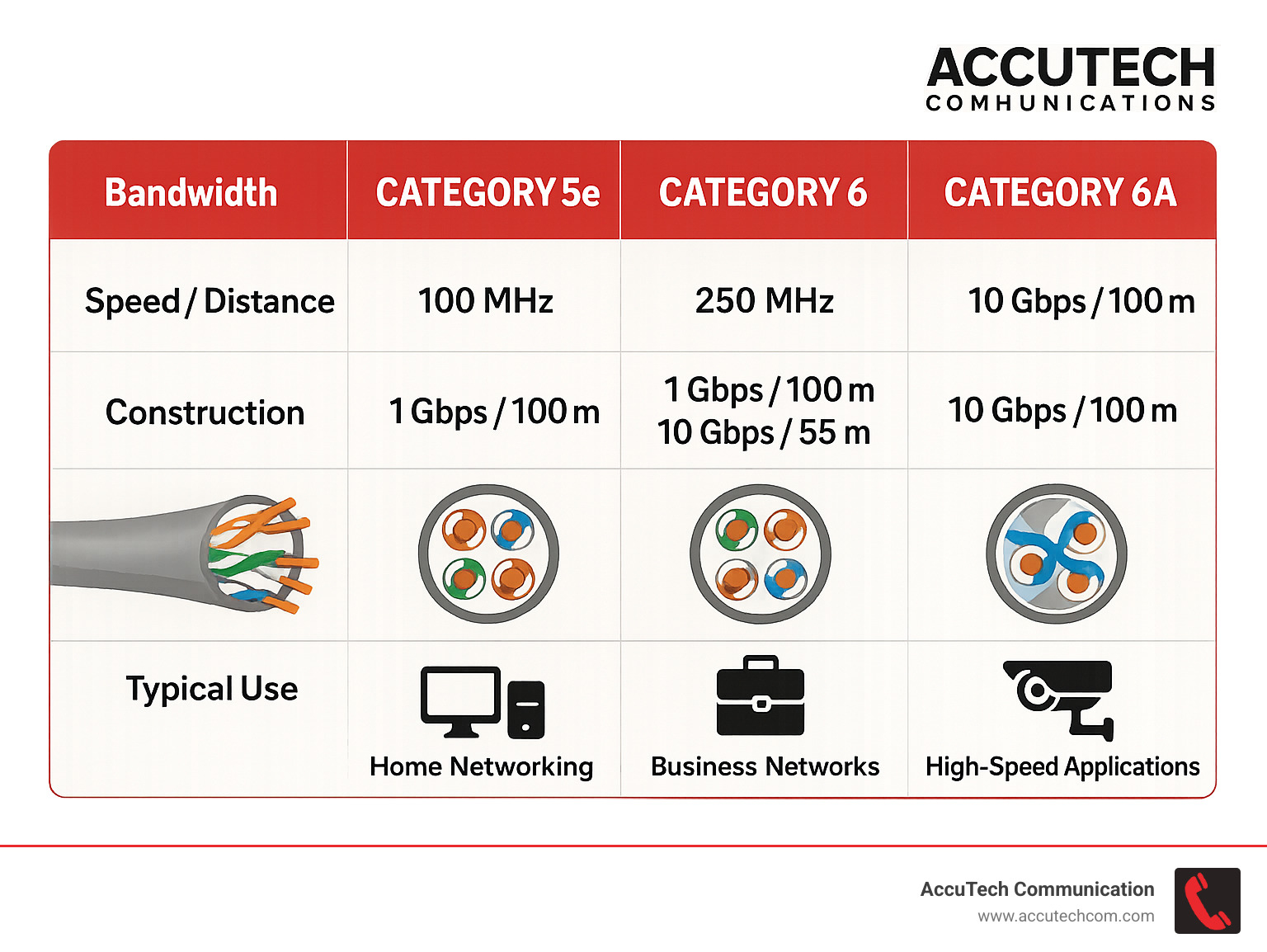
Category 6 cable is a standardized twisted pair cable for Ethernet networks that supports frequencies up to 250 MHz and provides reliable data transmission for modern networking needs. If you’re looking to buy Category 6 cable, here’s what you need to know:
| Feature | Category 6 Specification |
|---|---|
| Bandwidth | 250 MHz (vs 100 MHz for Cat5e) |
| Speed | 1 Gbps at 100 meters, 10 Gbps at 55 meters |
| Construction | 4 twisted pairs, often with internal spline |
| Conductor Size | Typically 23 AWG solid copper |
| Shielding Options | Unshielded (UTP), Shielded (STP, F/UTP, S/FTP) |
| Common Jackets | CM (general), CMR (riser), CMP (plenum), OSP (outdoor) |
In 1973, Bob Metcalfe invented Ethernet at Xerox PARC, laying the groundwork for today’s network cabling standards. Since then, Ethernet cables have evolved dramatically, with Category 6 emerging in 2002 as a significant upgrade over its predecessors. With more stringent specifications for crosstalk and system noise, Cat6 cables have become the backbone of reliable business networks worldwide.
Why has Category 6 cable remained so popular? Simple: it strikes the perfect balance between performance and cost. While newer standards exist, Cat6 delivers the gigabit speeds most businesses need today while providing a pathway to 10 Gbps for shorter runs. It’s also fully backward compatible with all previous Ethernet standards.
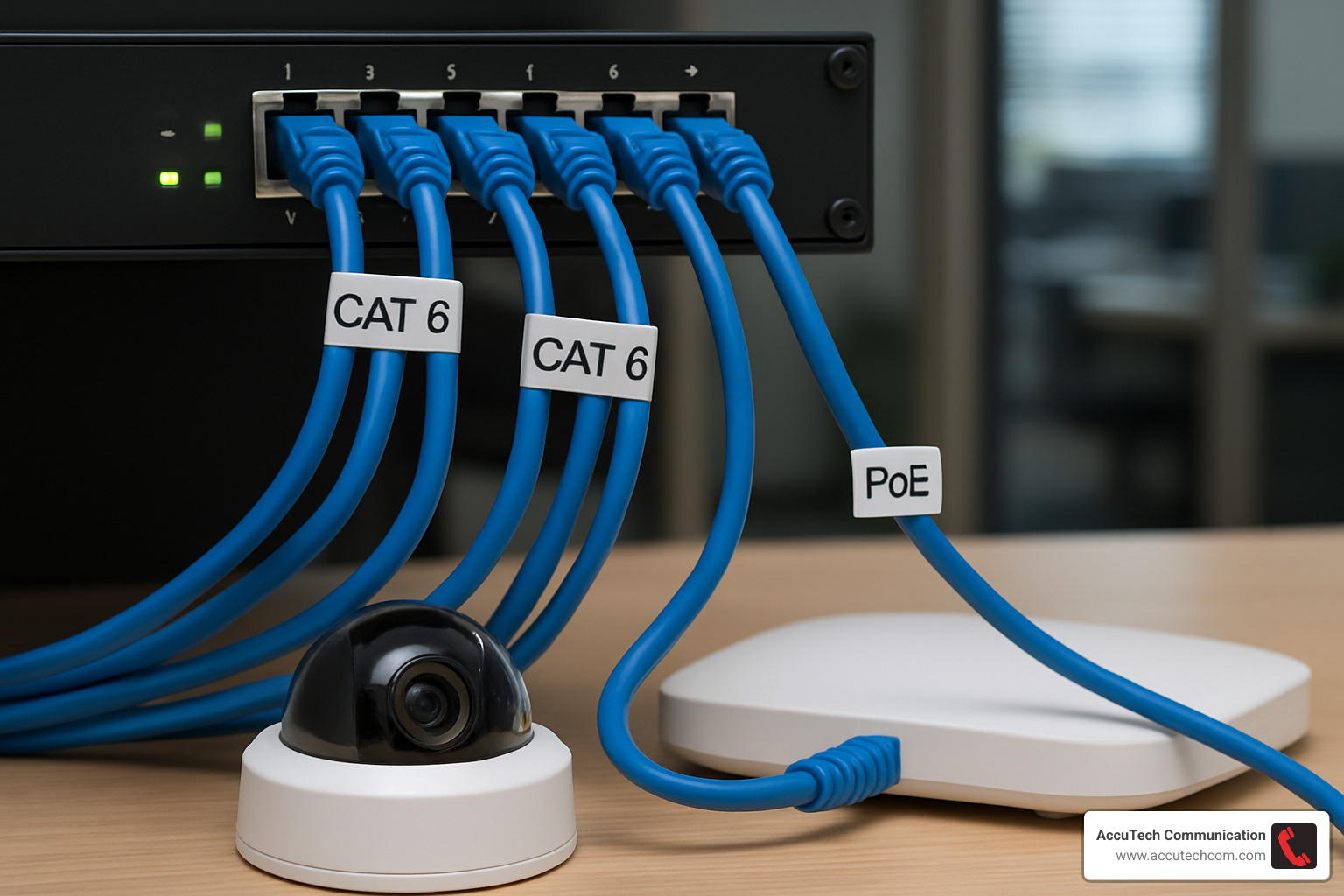
The boom in Power over Ethernet (PoE) devices has made Cat6 even more valuable. Its thicker 23 AWG conductors handle power delivery better than Cat5e, supporting advanced applications like high-resolution security cameras, wireless access points, and VoIP phone systems.
I’m Corin Dolan, owner of AccuTech Communications with over 30 years of experience designing and installing category 6 cable systems throughout Massachusetts, New Hampshire, and Rhode Island. My team has deployed thousands of miles of category 6 cable in environments ranging from healthcare facilities to educational institutions, ensuring businesses maintain reliable, high-performance networks.
Category 6 cable further reading:
– network cable categories
– ethernet cable wiring
– patch cables
Quick Specs: Why Category 6 Cable Still Rules in 2024
It’s 2024, and despite newer cable standards hitting the shelves, Category 6 cable remains the undisputed champion of network installations throughout Massachusetts and beyond. But why has this particular standard maintained its reign? The answer lies in its sweet-spot combination of performance, reliability, and value that perfectly meets the needs of today’s businesses.
When we install networks at AccuTech, clients often ask what makes Category 6 cable special. It all comes down to the specifications defined by ANSI/TIA-568.2-D and ISO/IEC 11801 standards. These aren’t just technical jargon—they translate directly into the smooth, reliable network performance that keeps your business running.
The 250 MHz frequency rating of Category 6 cable offers two and a half times the bandwidth of Cat5e. This extra headroom isn’t just about bragging rights—it provides real stability when your network gets busy with multiple high-bandwidth applications running simultaneously. Think of it as having a wider highway instead of a narrow road—traffic simply flows better.
For most office environments, Category 6 cable‘s ability to deliver guaranteed 1 Gbps performance across full 100-meter runs is perfect. And for those server rooms or data centers where devices are closer together? You’ll enjoy 10 Gbps speeds at distances up to 55 meters—plenty for most business setups.
The construction quality makes a difference too. With thicker 23 AWG solid copper conductors (compared to Cat5e’s typical 24 AWG), Category 6 cable handles Power over Ethernet applications with less heat buildup. Many versions also include a clever central plastic spline that keeps the twisted pairs properly separated, reducing crosstalk that can degrade your signal.
Here’s how Category 6 cable stacks up against its cousins:
| Specification | Category 5e | Category 6 | Category 6A |
|---|---|---|---|
| Frequency | 100 MHz | 250 MHz | 500 MHz |
| 1 Gbps Distance | 100 m | 100 m | 100 m |
| 10 Gbps Distance | Not specified | 55 m | 100 m |
| Typical AWG | 24 AWG | 23 AWG | 23 AWG |
| Alien Crosstalk | Not specified | Basic protection | Improved protection |
| Internal Spline | No | Often included | Always included |
| Typical Diameter | 5.0 mm | 6.0-6.5 mm | 7.5-9.0 mm |
A word of caution from our three decades of experience: always insist on pure copper conductors in your Category 6 cable. We’ve seen too many network problems traced back to counterfeit or substandard cables using copper-clad aluminum (CCA). These not only deliver poor performance but can generate excessive heat with PoE applications—potentially creating fire hazards. Quality matters!
In the past year alone, our AccuTech teams have installed over 500,000 feet of Category 6 cable across Boston, Worcester, and surrounding areas. This real-world experience confirms what the specs suggest: properly installed Cat6 systems deliver exceptional reliability for businesses of all sizes, making it the standard that still rules in 2024.
How We Picked the Best Category 6 Cable Types
After installing millions of feet of network cabling throughout New England since 1993, we’ve learned a thing or two about what makes Category 6 cable work in the real world. At AccuTech, we don’t just install cable – we solve connectivity problems for businesses across Massachusetts, New Hampshire, and Rhode Island.
When I’m helping clients choose the right Category 6 cable, I focus on practical factors that impact day-to-day performance. It’s not just about the specs on paper – it’s about how that cable will perform in your specific environment for years to come.
Shielding Options
The electromagnetic environment in your building makes a huge difference in which Category 6 cable will work best. In quiet office settings, unshielded (U/UTP) cable often provides excellent performance without unnecessary cost. But step into a manufacturing facility with motors and machinery generating electromagnetic interference, and suddenly that F/UTP (foiled) or S/FTP (screened and foiled) cable becomes worth every penny by maintaining clean signal integrity.
I recently walked through a hospital where they’d installed unshielded cable near MRI equipment – they were experiencing mysterious network issues until we identified the interference problem and upgraded to properly shielded Category 6 cable.
Fire Ratings
Building safety isn’t something to compromise on. The right fire rating could literally save lives in an emergency:
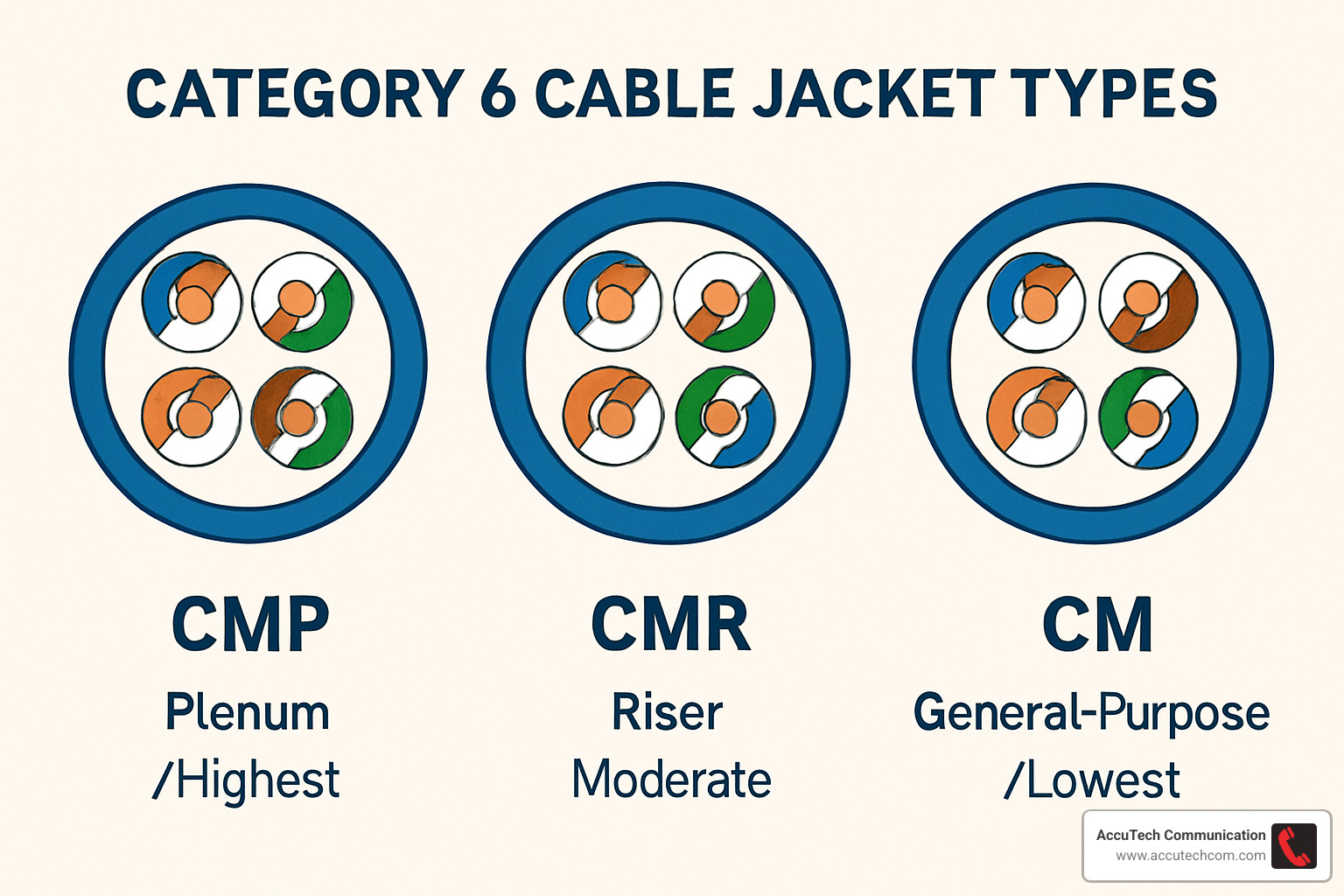
CM (Communications) jackets work for standard installations, but when running between floors, building codes typically require CMR (Riser) rated Category 6 cable. For ceiling spaces that handle air circulation (plenums), CMP-rated cable is mandatory – its special low-smoke jacket prevents toxic fumes from spreading through air ducts during a fire. For outdoor runs between buildings, OSP (Outside Plant) cable resists UV damage and moisture.
Power over Ethernet (PoE) Capability
The explosion of PoE devices has changed how we think about network cabling. Today’s Category 6 cable needs to carry both data AND power efficiently. With 23 AWG conductors, quality Cat6 can handle up to 90W of power using four-pair PoE (IEEE 802.3bt) without overheating.
This matters tremendously when you’re powering bandwidth-hungry devices like advanced security cameras, Wi-Fi 6 access points, or video-enabled VoIP phones. I’ve seen too many installations where cheaper, undersized cable created bottlenecks and even failed completely under PoE loads.
Third-Party Verification
Trust but verify – that’s our approach to Category 6 cable selection. The marketplace unfortunately contains products that claim to meet specifications but fall short in actual performance. We only use cables with ETL or UL verification to ensure they truly deliver what they promise.
This third-party testing confirms compliance with TIA-568.2-D and ISO/IEC 11801 standards – critical assurance when you’re building infrastructure meant to last 15+ years.
Physical Characteristics
The physical properties of Category 6 cable directly impact both installation quality and long-term performance. Quality cable maintains signal integrity even when bent (minimum four times the outer diameter), has consistent, precise twist rates to minimize crosstalk, and uses pure copper conductors – never copper-clad aluminum (CCA).
These details might seem minor, but they’re exactly what separates a rock-solid network installation from one plagued with mysterious performance issues and failures.
By carefully evaluating these factors for each client’s unique environment, we ensure you get the most appropriate Category 6 cable solution for your specific needs. This attention to detail is why businesses throughout Metro-west Boston, Marlborough, Sudbury and beyond have trusted AccuTech Communications with their critical network infrastructure for nearly three decades.
For more detailed information about different network cable categories and how they compare, visit our Network Cable Categories page.
Best Category 6 Cable for Everyday Gigabit Networks
When it comes to standard office setups and small-to-medium businesses, unshielded twisted pair (U/UTP) Category 6 cable is the sweet spot where performance meets value. This is the reliable workhorse that powers thousands of networks across Massachusetts and beyond.
Why U/UTP Category 6 is Ideal for Standard Environments
Think of U/UTP Category 6 cable as the comfortable family sedan of networking – not flashy, but incredibly dependable. With four twisted pairs of 23 AWG solid copper conductors wrapped in a standard CM (Communications) jacket, this configuration delivers exactly what most businesses need.
The beauty of U/UTP lies in its practicality. It’s cost-efficient compared to its shielded cousins while still delivering excellent performance for typical applications. Our technicians appreciate how easy it is to terminate – with no shield to ground, installation goes more smoothly and takes less time. It’s also lighter and more flexible, making it much easier to pull through conduits and steer around those tricky corners in older buildings.
I remember an installation we did in a historic Guide Hill office last year – those tight spaces would have been a nightmare with bulkier cable, but the U/UTP Category 6 cable handled those 19th-century architectural quirks beautifully.
Ideal Applications for U/UTP Category 6
Over nearly three decades of installations throughout Boston, Waltham, and Woburn, we’ve found this cable type excels in everyday business environments. It’s perfect for connecting your workstations, printers, and VoIP phones in general office settings. For small-to-medium businesses, it handles typical data and voice applications with room to spare.
Many of our residential clients choose it for home networks too, especially with more people working remotely. It provides rock-solid connections for video conferences, streaming, and even serious gaming. And for standard PoE applications like basic wireless access points and IP cameras, it delivers power and data reliably day after day.
Performance Characteristics
A quality U/UTP Category 6 cable isn’t just adequate – it’s impressive. You’ll get full 1 Gbps throughput at distances up to 100 meters, with 10 Gbps capability at distances up to 55 meters. The 250 MHz bandwidth provides comfortable headroom above minimum standards, ensuring your network has breathing room even during peak usage.
The excellent near-end crosstalk (NEXT) performance means cleaner signal transmission, while the solid copper conductors provide reliable PoE delivery for your powered devices.
We recently completed a project for a growing marketing firm in Marlborough, installing over 300 drops of U/UTP Category 6 cable. Their network supports dozens of workstations, VoIP phones throughout the office, and wireless access points covering every square foot. Even with heavy creative work transferring large files across the network, the system delivers rock-solid gigabit performance with minimal issues.
For most businesses looking to balance performance with budget considerations, U/UTP Category 6 cable continues to be the smart choice. It provides all the performance you need today while giving you room to grow tomorrow.
For more information about our Category 6 cable installations and services, visit our Cat6 page.
Best Shielded Category 6 Cable for High-EMI Spaces
When normal office environments meet Category 6 cable, everything works just fine. But what happens when you’re installing network cabling near MRI machines or on a factory floor filled with heavy machinery? That’s when standard unshielded cable starts to wave the white flag of surrender.
Understanding Shielded Category 6 Options
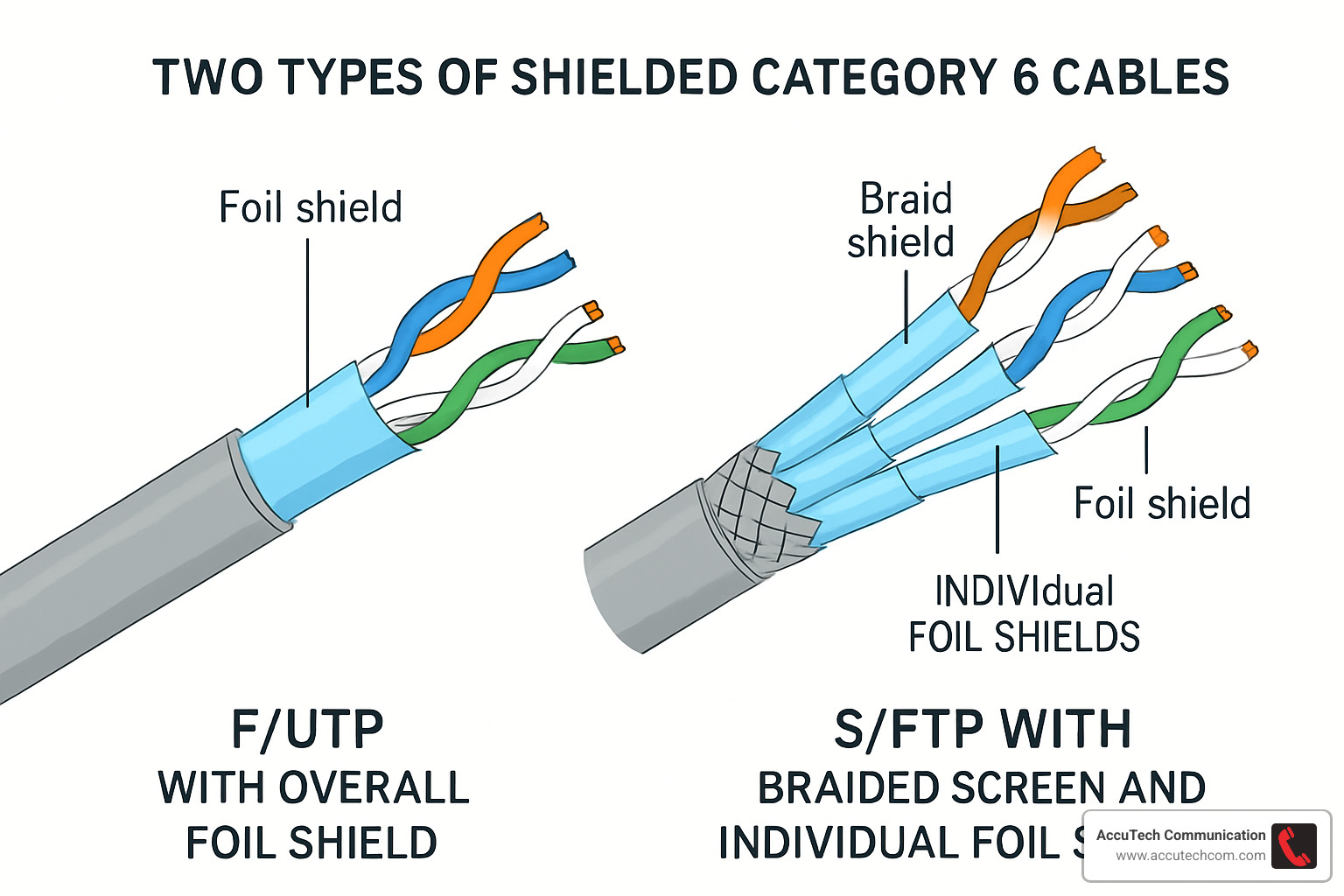
At AccuTech Communications, we’ve tackled some seriously challenging environments across Massachusetts. For these high-EMI battlegrounds, we typically recommend two shield warriors:
- F/UTP (Foiled Unshielded Twisted Pair): Think of this as your practical protector – an aluminum foil shield wrapped around all four pairs with a drain wire for grounding. It’s like a good raincoat – effective protection without breaking the bank.
- S/FTP (Screened Foiled Twisted Pair): This is the premium defender – combining an overall braided screen with individual foil shields around each twisted pair. When electromagnetic chaos reigns supreme, this is your champion.
Where Shielded Category 6 Cable Shines
Over our three decades in business, we’ve installed shielded Category 6 cable in some of New England’s most challenging environments:
Hospitals and medical facilities are electromagnetic battlegrounds. When we installed networks at a Boston hospital, their MRI suite was creating havoc with standard cabling. Shielded Category 6 cable solved their problems immediately.
Manufacturing floors in places like Worcester and Lowell need serious protection. Those motors and industrial equipment generate enough interference to make unshielded cable cry for mercy.
Electrical rooms housing transformers and power distribution panels create electromagnetic storms that only shielded cable can weather properly.
Research laboratories throughout Cambridge and Boston’s innovation districts often combine sensitive equipment with potential interference sources – a perfect application for shielded solutions.
Data centers supporting critical infrastructure simply can’t afford connection problems – that’s why many of our Massachusetts clients choose shielded Category 6 cable for their most critical links.
Critical Installation Tips for Shielded Cable
Here’s where I need to get a bit serious. Shielded cable isn’t just about buying the right product – it’s about installing it correctly:
Proper grounding is non-negotiable. I’ve seen too many installations where beautiful shielded cable was installed but never properly grounded. That’s like buying an umbrella and never opening it in the rain.
Use compatible components throughout your network. Mixing shielded cable with unshielded components is a recipe for disappointment.
Maintain shield continuity from end to end. One break in that protective shield creates a vulnerability in your network’s armor.
Avoid ground loops by properly bonding to your building’s grounding system. Different ground potentials can actually create more problems than they solve.
Real-World Performance Benefits
Let me share a quick story. We recently replaced problematic unshielded cabling with F/UTP Category 6 cable for a Worcester medical facility’s diagnostic imaging department. The change was remarkable – packet errors virtually disappeared, network throughput jumped by 27%, and those frustrating intermittent connection issues vanished completely.
Their diagnostic image transfer times dropped by 35%, which meant doctors could make faster decisions and see more patients. The slightly higher investment in shielded cabling paid for itself within months through improved operational efficiency.
When electromagnetic interference threatens your network’s performance, shielded Category 6 cable isn’t just nice to have – it’s essential. The modest additional cost is a small price to pay for the performance benefits and long-term reliability it delivers in challenging environments.
Best Plenum-Rated Category 6 Cable for Commercial Buildings
If you’ve ever peeked above a dropped ceiling in an office building, you’ve seen what we in the industry call “plenum space” – and it requires special cabling. For commercial buildings, plenum-rated Category 6 cable isn’t just a good idea – it’s often required by law.
Understanding Plenum-Rated Category 6 Cable
When I explain plenum cable to clients around Boston and Worcester, I like to start with what makes it special. CMP (Communications Plenum) rated Category 6 cable uses specialized Low Smoke Zero Halogen (LSZH) jacket materials that do three critical things:
First, they resist flame spread, which prevents fires from using your ceiling as a highway. Second, they produce minimal smoke, which can be a lifesaver during evacuations. And third – perhaps most importantly – they don’t release toxic halogen gases when heated, which can be deadly in a fire situation.
The National Fire Protection Association doesn’t mess around with this stuff. Their NFPA-70 National Electrical Code mandates plenum-rated cable in air handling spaces, and I’ve seen many installations delayed when inspectors catch non-compliant cable. This isn’t just red tape – it’s about saving lives.
When Plenum-Rated Category 6 Cable is Required
After installing networks throughout Massachusetts for nearly three decades, I can tell you plenum-rated cable belongs in several key areas:
Those suspended ceiling spaces that return air to your HVAC system need plenum cable. The same goes for raised floor environments common in data centers. Vertical risers between floors in office buildings typically require it too. And naturally, any cable running through actual HVAC ducts must be plenum-rated.
I remember a project in Framingham where the building owner tried to save money with riser-rated cable. The inspector caught it immediately and the entire installation had to be redone – costing far more than doing it right the first time.
Performance Characteristics
The good news? The special fire-resistant jacket doesn’t compromise performance. Plenum-rated Category 6 cable delivers everything standard Cat6 does:
You still get that full 250 MHz bandwidth, 1 Gbps performance at 100 meters, and 10 Gbps capability at distances up to 55 meters. It fully complies with TIA-568.2-D specifications just like standard Cat6.
There are some physical differences though. The plenum jacket makes the cable slightly stiffer than standard CM-rated cable. It handles higher temperatures better, which is handy in hot ceiling spaces. And it tends to resist environmental degradation better over time – a nice bonus for infrastructure that might stay in place for a decade or more.
Installation Considerations
When my team installs plenum-rated Category 6 cable, we follow some specific best practices:
We always use proper support systems – either J-hooks or cable trays designed specifically for plenum spaces. We maintain careful separation from power lines and fluorescent lighting to prevent interference. We’re religious about avoiding tight bends, maintaining at least a 4x outer diameter bend radius. And we properly firestop all penetrations through firewalls with approved materials.
Just last month, we completed a project in a Waltham office building where we installed over 25,000 feet of plenum-rated Category 6 cable throughout three stories. The building featured an open ceiling design with the ceiling space serving as a return air plenum, making CMP-rated cable non-negotiable. The installation sailed through inspection and now provides a clean, safe, high-performance network backbone.
For more information about different types of network wiring and their applications, visit our Types of Network Wiring page.
Best Outdoor & Direct-Burial Category 6 Cable for Harsh Weather
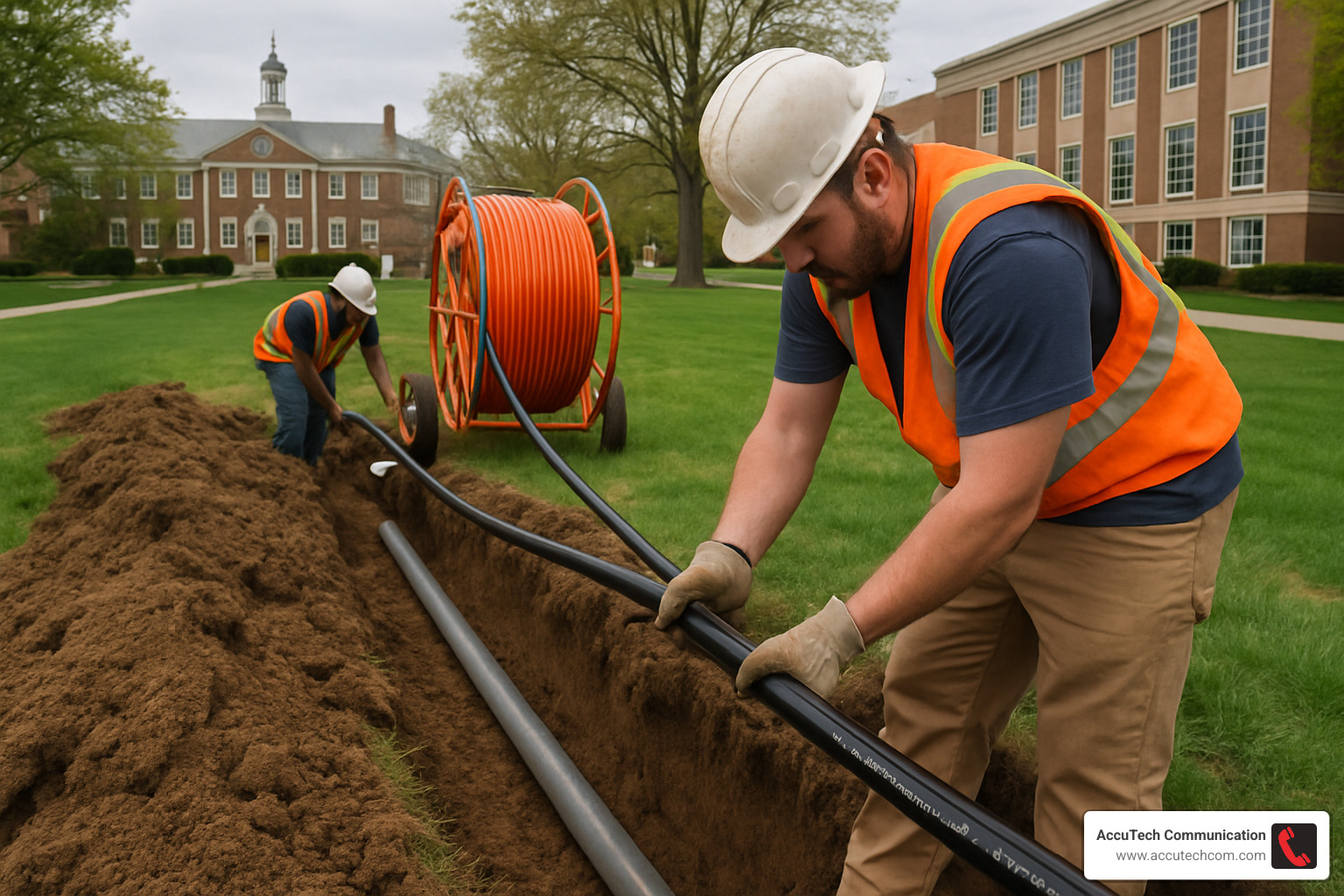
When your network needs to extend beyond the comfort of climate-controlled buildings, standard indoor Category 6 cable simply won’t cut it. Whether you’re connecting separate buildings across a campus, powering outdoor access points, or installing networking in harsh environments, you need something tougher.
Understanding Outdoor Category 6 Cable
Mother Nature can be brutal on network cabling. That’s why outdoor-rated Category 6 cable features special construction designed to laugh in the face of environmental challenges:
UV-resistant PVC jacket prevents the sun from degrading your cable over time. I’ve seen standard indoor cables turn brittle and crack after just a few months of sunlight exposure – not a problem with properly rated outdoor cable.
Water-blocking technology keeps moisture at bay. Whether you choose traditional gel-filled or modern dry-core designs, this protection is essential for maintaining signal integrity when the skies open up.
Extreme temperature tolerance from a bone-chilling −40°C to a sweltering +75°C means your network keeps humming regardless of what New England weather throws at it. And we all know how unpredictable that can be!
Improved durability gives you protection against crushing, abrasion, and even those persistent rodents that seem determined to chew through anything in their path.
The Revolution of Gel-Free Dry-Core Technology
I remember the days when terminating outdoor cable meant dealing with messy gel that got everywhere. Thankfully, modern outdoor Category 6 cable often uses innovative dry-core technology:
Instead of goopy gel, these cables use superabsorbent polymer tapes that instantly expand when they contact moisture, creating an impenetrable water barrier. This makes termination dramatically cleaner while maintaining complete water protection.
We recently completed a campus project in Worcester connecting three separate buildings using direct-burial Category 6 cable with this dry-core technology. Our technicians finished the job in record time without having to constantly clean their hands and tools – and the network has remained rock-solid through multiple rain and snow events.
Real-World Installation Best Practices
When we install outdoor Category 6 cable for our clients across Massachusetts, we follow these crucial guidelines to ensure decades of reliable performance:
Even direct-burial cable benefits from conduit protection – it’s cheap insurance against future excavation accidents. We typically bury cables at least 18-24 inches deep, depending on local codes and frost line considerations.
Lightning protection is non-negotiable in our installations. We always install surge protectors at building entry points to prevent lightning-induced damage that can fry your equipment and potentially create fire hazards.
Proper grounding of shields and metallic components is essential, as is creating weatherproof transition points where outdoor cable connects to indoor systems. We also include service loops (extra cable) at termination points to accommodate ground settling and make future repairs easier.
Real Success Stories
A particularly memorable installation took place at a coastal New Hampshire property where we needed to connect a main building to a dock facility 275 meters away. This exceeded the 100-meter distance limitation of Category 6 cable, so we engineered a hybrid solution.
We ran outdoor Category 6 cable to an intermediate junction box, then used fiber optic cabling for the remainder of the run. The system has weathered three years of harsh coastal conditions – salt spray, freezing temperatures, summer heat – without a single failure.
For businesses with outdoor networking needs, specialized outdoor Category 6 cable isn’t just a preference—it’s an absolute necessity for reliable long-term performance. When properly installed by experienced professionals, these systems can provide decades of trouble-free service, regardless of what weather comes your way.
Best Patch Category 6 Cable for Flexible Connections
While solid-conductor Category 6 cable works perfectly for permanent installations in walls and ceilings, you need something different for those flexible connections between devices. That’s where patch cables come in – these unsung heroes connect your equipment to wall outlets and link patch panels to switches. Choosing the right patch cables might seem like a small detail, but it can make or break your network’s performance.
Stranded vs. Solid Conductor Construction
Take a look at any quality patch Category 6 cable and you’ll notice it uses 24 AWG stranded copper conductors instead of the 23 AWG solid copper found in permanent installations. This isn’t just a manufacturing choice – it serves several crucial purposes:
Improved flexibility is the most obvious benefit. These stranded conductors can handle being bent, twisted, and moved repeatedly without breaking. If you’ve ever had a solid-core cable snap after one too many bends, you’ll appreciate this feature.
Better vibration resistance might not seem important until you’ve dealt with equipment racks in busy data centers. The constant hum and vibration that would eventually fatigue and break solid conductors is no match for a properly made stranded cable.
Easier handling becomes immediately apparent when you’re trying to steer the maze behind your equipment. Stranded patch cables move more smoothly around tight corners and through cable management systems.
Key Features of Quality Patch Cables
When we select patch Category 6 cables for our clients in Boston, Sudbury, and throughout Massachusetts, we don’t just grab whatever’s cheapest. We look for specific features that ensure reliability and performance:
Snagless boots protect those little plastic tabs that keep your cables securely connected. Without them, one accidental snag and that tab breaks off, leaving you with a cable that won’t stay connected.
Color-coding options might seem purely aesthetic, but they’re actually powerful organizational tools. In one Framingham office, we used different colors for voice, data, security, and guest networks – making troubleshooting infinitely easier for their IT team.
Factory termination ensures consistent, reliable connections. Machine-terminated ends deliver precision that’s difficult to match with field terminations, especially for the more demanding Category 6 cable specifications.
Molded strain relief at the connector-cable junction prevents damage at this vulnerable point. This is particularly important for cables that get moved or adjusted frequently.
Full Category 6 compliance maintains your network’s performance end-to-end. Even one substandard connection can create a bottleneck in your entire system.
Ideal Applications for Category 6 Patch Cables
Quality patch cables earn their keep in various network environments:
At workstations, they connect computers, VoIP phones, and other devices to wall outlets. In telecommunications rooms, they create the vital links between patch panels and network switches. For switch stacking, they enable multiple switches to function as a single logical unit. They also serve as console connections for managing network equipment and as cross-connects for organizing telecommunications rooms.
Length Considerations
One mistake we often see is the “just grab a longer one to be safe” approach to patch cables. This creates messy cable management nightmares and can actually impact performance. Here’s what we recommend:
For workstation connections, 3-15 feet depending on how your furniture is arranged. For patch panel to switch connections, 1-7 feet based on your rack configuration. And for equipment racks, custom-length cables minimize excess cable loops.
In a recent data center project in Marlborough, we deployed over 400 custom-length Category 6 patch cables using specific colors to identify different network segments. The client’s IT director told us this approach dramatically improved their visual organization and made troubleshooting so much easier – no more tracing cables through a tangled mess!
Performance Impact of Patch Cables
It’s easy to focus on the permanent infrastructure and forget that patch cables can be the weakest link in your network. While we rigorously test and certify permanent links during installation, patch cables sometimes get overlooked. Using substandard patch cables is like putting economy tires on a high-performance car – you’ll never experience the full capabilities of your system.
All Category 6 patch cables we provide at AccuTech Communications are factory-tested to ensure they meet or exceed TIA-568.2-D specifications. This attention to detail maintains the integrity of your network from end to end.
For more information about our selection of high-quality patch cables, visit our Patch Cables page.
Best Category 6 Cable for Power over Ethernet (PoE++) Deployments
The explosive growth of Power over Ethernet (PoE) devices has transformed how we design and implement network infrastructure. Modern PoE++ (IEEE 802.3bt) can deliver up to 90 watts of power over Category 6 cable, enabling a wide range of applications beyond traditional data networking.
Why Category 6 Cable Excels for PoE Applications
When it comes to powering devices through your network cabling, Category 6 cable is simply built better for the job. Those larger 23 AWG conductors might not seem significantly different from Cat5e’s 24 AWG, but that small difference adds up to substantially better power handling. Think of it like using a slightly thicker garden hose – more water flows with less resistance.
The improved heat dissipation characteristics of Cat6 are crucial when you’re bundling cables together in ceiling spaces or cable trays. I’ve seen installations where lower-quality cables in tight bundles literally became warm to the touch when running high-power PoE devices – not something you want in your infrastructure!
The higher quality insulation in proper Category 6 cable also withstands the electrical stress that comes from sending both data and power down the same wires. And those tighter twist rates that help with data transmission? They also maintain signal integrity even when you’re pushing power through the same conductors.
Understanding PoE Heat Concerns
Heat is the silent enemy of PoE installations. When electrical current flows through copper conductors, it generates heat through resistance – basic physics that can’t be avoided. In a properly designed system, this heat isn’t a problem. But when cables are bundled tightly together, especially in enclosed spaces, that heat can build up.
I remember a healthcare facility in Worcester where they had packed dozens of non-PoE-rated cables into a tight conduit to power their security cameras. Within months, they were experiencing mysterious network dropouts and performance issues. When we investigated, the cable bundle temperature was nearly 20 degrees higher than the surrounding air! This heat was increasing signal attenuation and slowly degrading the cable insulation.
Limited Power (LP) Rating
For any substantial PoE deployment, I strongly recommend using Category 6 cable with a Limited Power (LP) rating. This isn’t just another certification – it represents specific testing for PoE applications under worst-case bundling scenarios.
LP-rated cables maintain their performance despite temperature increases and comply with TIA TSB-184-A guidelines specifically developed for PoE deployments. They’re particularly important in installations where you’ll have many powered devices or tight cable pathways.
Best Practices for PoE Category 6 Installation
When our AccuTech technicians install Category 6 cable for PoE applications, we follow some essential guidelines to ensure long-term reliability:
We limit bundle sizes to allow better airflow around cables – smaller bundles dissipate heat much more effectively than large ones. We prefer cable trays where possible instead of conduit, as they allow air circulation around the cables.
Our teams are trained to avoid overtightening cable ties, which can deform cables and create “hot spots” where conductors are pressed too close together. We also carefully consider ambient temperature – an installation in a hot attic space requires different bundling approaches than one in an air-conditioned office.
And of course, for mission-critical installations or high-density deployments, we always recommend LP-rated cables that are specifically designed for PoE applications.
Real-World PoE Applications
Throughout Massachusetts, we’ve deployed PoE-optimized Category 6 cable for an impressive variety of applications. Advanced security systems with high-definition PTZ cameras often require up to 60W of power. Wi-Fi 6 access points with multiple radios and antennas are perfect candidates for PoE deployment. We’ve also installed digital signage systems in retail environments, building automation controllers, and even LED lighting systems with networked controls.
I’m particularly proud of a recent project for a Boston financial institution where we installed over 120 PoE-powered devices throughout their office using LP-rated Category 6 cable. Their system neatly supports advanced security cameras, wireless network, and VoIP phone system on a single unified infrastructure. Not only did this approach significantly reduce their deployment costs, but it also simplified their ongoing maintenance and management.
For those interested in the science behind PoE cabling best practices, CommScope’s Enterprise Source provides excellent research on PoE cabling that dives into the technical details.
Category 6 vs Category 6A: Should You Pay More?
One of the most common questions I hear from clients across Framingham, Natick, and throughout Metro-west Boston is whether the jump to Category 6A is worth the extra investment. It’s a great question that deserves a thoughtful answer based on your specific situation.
Understanding the Differences
When you place Category 6 cable side-by-side with its beefier cousin Category 6A, several key differences emerge. Category 6A doubles the available bandwidth to a robust 500 MHz (compared to Cat6’s 250 MHz) and can handle full 10 Gbps transmission across the entire 100-meter channel. That’s a significant improvement over Category 6 cable, which taps out at 55 meters for 10 Gbps applications.
Perhaps most importantly, 6A includes substantially improved alien crosstalk protection. This might sound like sci-fi jargon, but it’s actually a critical factor when running multiple high-speed cables bundled together. The improved shielding and insulation simply handle external noise better.
But these improvements don’t come without trade-offs. Category 6A cables are noticeably thicker—typically 7.5-9.0 mm compared to the slimmer 6.0-6.5 mm diameter of Category 6 cable. This makes them less flexible and more challenging to route through tight spaces or existing pathways. They’re also typically 20-40% more expensive, and terminating them requires more precise technique.
When Category 6A Makes Sense
After installing thousands of network drops throughout New England, I’ve found that Category 6A delivers clear value in several specific scenarios. If you need 10 Gbps connections beyond 55 meters, the choice is simple—Category 6A is your only twisted-pair option. This commonly applies in larger data centers, server rooms, and backbone connections.
Category 6A also makes sense when you’re future-proofing an installation with a 5+ year horizon, especially in technology-forward industries where bandwidth demands grow rapidly. The same goes for high-density environments where many 10 Gbps connections run parallel to each other, as alien crosstalk becomes increasingly problematic in these settings.
New construction projects with long cable runs are another sweet spot for 6A. When you’re building from scratch and know you’ll have distances approaching the 100-meter limit, the extra capability provides valuable peace of mind. And for truly mission-critical applications where performance and reliability are non-negotiable, the additional headroom of 6A can be well worth the investment.
When Standard Category 6 Is Sufficient
That said, Category 6 cable remains an excellent choice for most standard business environments. If you’re running a typical office where 1 Gbps meets current needs (and will likely continue to do so for several years), Category 6 cable delivers fantastic performance at a better price point.
For 10 Gbps connections under 55 meters—which covers most server room connections in small to medium businesses—Category 6 cable is perfectly capable. Budget-conscious deployments naturally gravitate toward Cat6, getting tremendous value without breaking the bank.
Retrofit installations in older buildings often benefit from Category 6 cable‘s smaller diameter, especially when threading through existing conduits or crowded pathways. And for the vast majority of small to medium businesses where gigabit speeds satisfy current and near-future requirements, Category 6 cable hits the sweet spot of performance and cost.
Cost-Benefit Analysis
When helping clients make this decision, I always consider the bigger picture. A properly installed cabling infrastructure should last 10-15 years, so the long-term value matters more than the initial cost difference. We look at projected bandwidth requirements based on business growth patterns and application needs. While the installation labor costs are similar for both cable types, the material cost difference can add up in larger deployments.
Recently, we worked with a growing software development firm in Waltham that took a smart hybrid approach. We installed standard Category 6 cable throughout their general office areas where gigabit speeds were perfect for everyday work. But for their development team and server connections, where they regularly moved large code repositories and virtual machine images, we used Category 6A to support their higher bandwidth needs. This balanced approach gave them performance where it mattered most while optimizing their overall budget.
The bottom line? Category 6 cable remains an excellent choice for most business applications, while Category 6A offers meaningful benefits for specific use cases where its advantages align with your particular needs.
For more detailed information about different Ethernet cable types and their applications, visit our Ethernet Cable Types page.
Installation Tips to Get Full Category 6 Cable Performance
Even the highest quality Category 6 cable won’t deliver its promised performance without proper installation. Over our decades installing networks throughout Massachusetts, New Hampshire, and Rhode Island, we’ve learned that the difference between a good network and a great one often comes down to installation details.
Maintain Proper Bend Radius
Your Category 6 cable is a bit like your back – bend it too sharply and you’ll have problems! We always ensure a minimum bend radius of at least 4 times the cable’s outer diameter. This isn’t just a suggestion – it’s essential for maintaining signal integrity. I’ve seen perfectly good cable installations fail testing simply because someone created a tight 90-degree bend during installation. Once a cable is kinked, that damage is permanent, and often means replacing the entire run.
When we install Category 6 cable in Boston office buildings, we use proper J-hooks, cable trays, and appropriate fasteners to support the cable properly throughout its path. This attention to detail ensures your network performs at its best for years to come.
Preserve Twist Integrity
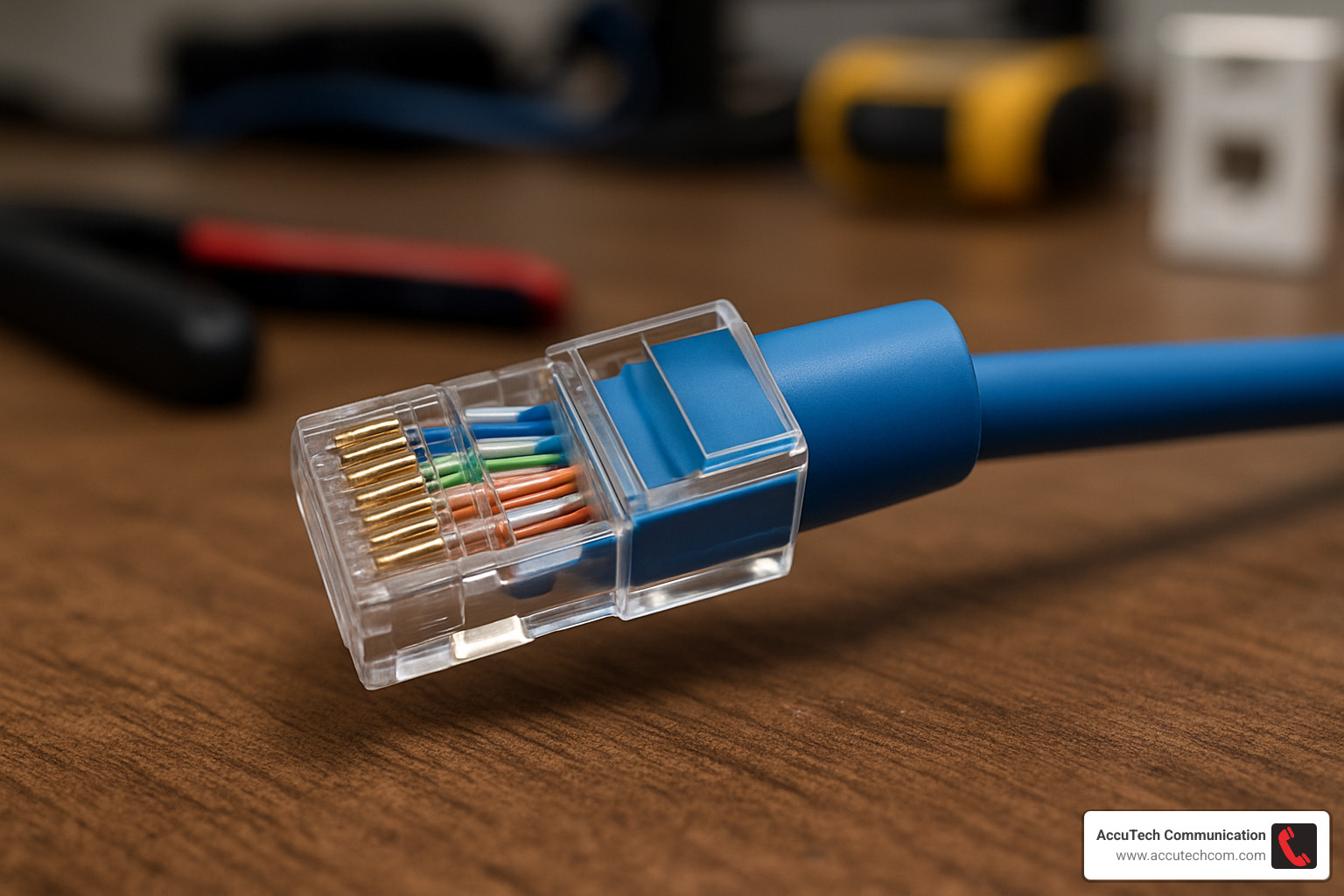
The magic of Category 6 cable is in those precisely twisted pairs. Each pair is twisted at a specific rate to cancel out interference, and maintaining this twisting is crucial for performance.
When terminating cables, we limit untwisting to less than 13 mm (0.5 inches). I’ve trained many technicians over the years, and I always emphasize this point – what happens in those last few centimeters can make or break a cable’s performance. We keep pairs together during installation and never unwind more cable than needed. Using termination tools specifically designed for Cat6 makes a big difference too – they help maintain the precise geometry that makes Category 6 cable work so well.
Choose Consistent Wiring Standards
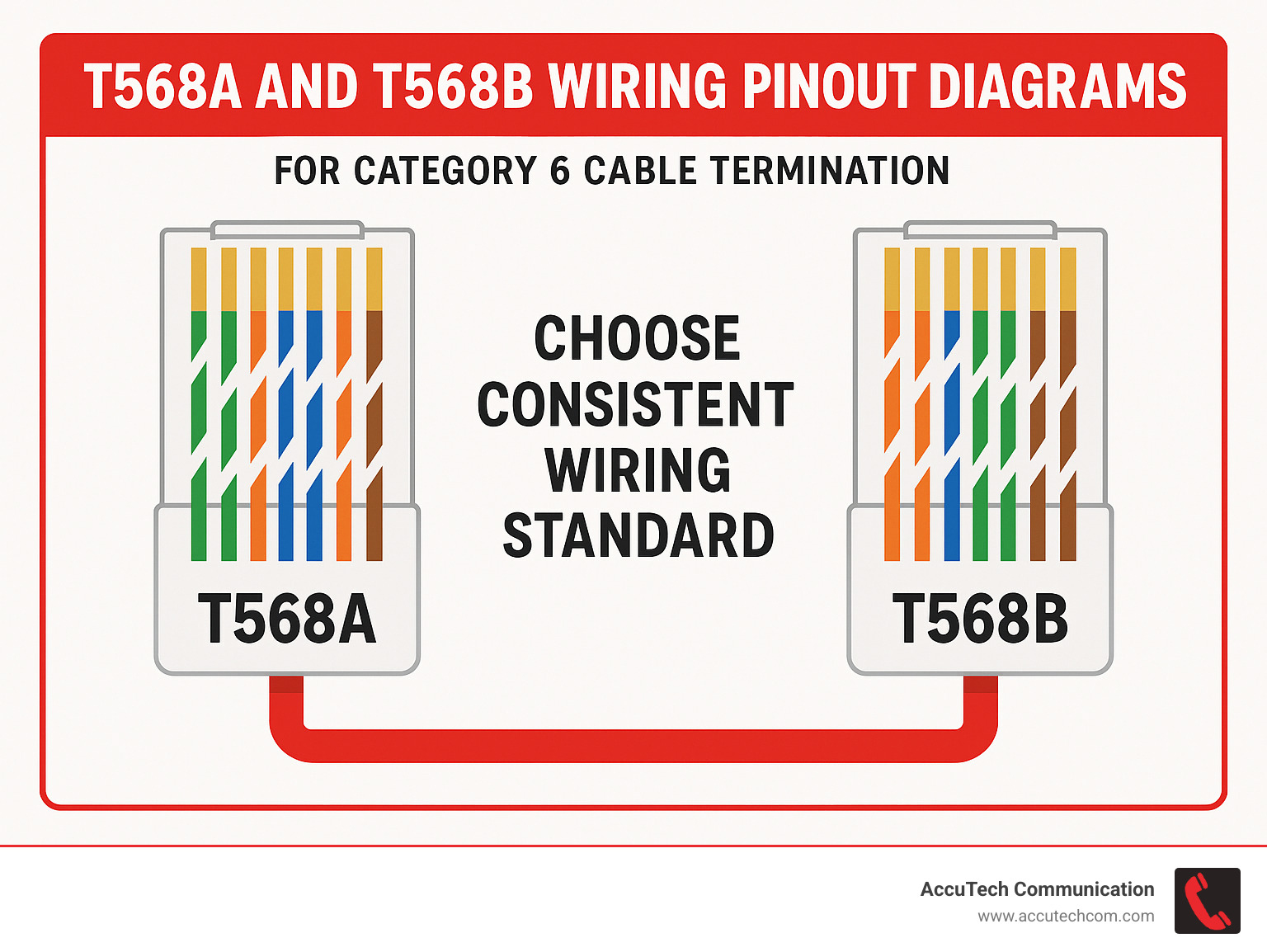
Consistency matters tremendously when working with Category 6 cable. We select either T568A or T568B wiring pattern and use it consistently throughout a building. This might seem like a small detail, but mixing standards can create headaches when troubleshooting or expanding networks later.
We carefully document the standard used, ensure all technicians follow the same pattern, and clearly label everything. This attention to detail has saved our clients countless hours of troubleshooting over the years.
Avoid Common Installation Pitfalls
Over the years, I’ve seen many Category 6 cable installations fail because of simple mistakes. Excessive pulling force is a common culprit – we never exceed 25 lbs of pulling tension. Another frequent issue is overtightening cable ties, which can deform the cable and create performance problems.
Maintaining proper separation from electrical cables is also crucial. In a recent Marlborough office installation, we had to completely redesign a cable pathway that a previous installer had run parallel to fluorescent lighting ballasts – the interference was causing significant network problems.
We’re also careful about proper stripping techniques to avoid damaging conductors, and we never mix cable categories within a channel. Category 6 cable performs best when every component in the path meets the same specifications.
Testing and Certification
Every Category 6 cable installation we complete gets thoroughly tested and certified. We use professional-grade cable analyzers like the Fluke DSX CableAnalyzer to verify performance against TIA-568.2-D standards.
This isn’t just about checking that the cable works – we test for all performance parameters and document everything. This documentation becomes invaluable if troubleshooting is ever needed, and it’s part of our warranty process. We verify full channel performance, not just individual segments, ensuring your network works as a complete system.
Real-World Installation Success
I remember a particularly challenging project for a Worcester healthcare facility where we installed over 400 Category 6 cable drops throughout their new wing. The building had unusual architectural features that made cable routing tricky, but by following these installation best practices, we achieved a 100% pass rate on first testing, with performance margins well above the minimum requirements.
The facility manager later told me their network was the most reliable system in the building – music to any installer’s ears! This attention to detail is why healthcare facilities throughout Massachusetts trust AccuTech Communications with their critical network infrastructure.
At AccuTech, we pride ourselves on these meticulous installation practices. Our technicians are fully trained and certified in proper Category 6 cable installation techniques, ensuring your network infrastructure performs at its best from day one.
Compliance & Certifications Checklist
Let’s talk about something that might seem boring but is actually super important – making sure your Category 6 cable is the real deal. After installing thousands of cable runs throughout New England, I’ve seen what happens when businesses cut corners on cable quality.
Essential Standards for Category 6 Cable
Think of these standards as your protection against poor performance and potential headaches down the road. When we source Category 6 cable for our clients in Boston, Worcester, or anywhere else we serve, we insist on these certifications:
ANSI/TIA-568.2-D is the North American telecommunications standard that defines exactly what makes a cable truly “Cat6.” This isn’t just some technical mumbo-jumbo – it’s your guarantee that the cable will perform as expected in real-world conditions.
Similarly, ISO/IEC 11801 Class E is the international equivalent that ensures global consistency. If your cable vendor can’t confirm compliance with these standards, that’s a major red flag.
Safety matters too, which is why we verify UL Listing on all our cables. This means the cable has been tested for safety by Underwriters Laboratories. For additional peace of mind, look for ETL Verification – this independent testing confirms the manufacturer isn’t just making empty performance claims.
And in today’s environmentally-conscious world, RoHS Compliance ensures your cable doesn’t contain harmful substances like lead or mercury.
Fire Safety Ratings
Fire ratings aren’t optional – they’re essential for both safety and code compliance. The rating you need depends on where the cable will be installed:
CM rated cable works fine for general office environments, while CMR (riser-rated) is required for cables running vertically between floors. If your cable will run through air handling spaces (like above drop ceilings used as air returns), you absolutely need CMP (plenum-rated) cable.
For hospitals, schools, and other sensitive environments, LSZH (Low Smoke Zero Halogen) cable provides extra protection by minimizing toxic smoke in case of fire.
The CCA Warning: Beware of Counterfeit Cable
Here’s something that really gets me fired up after 30 years in this business – Copper Clad Aluminum (CCA) cables being passed off as genuine Category 6 cable. This isn’t just about getting less than you paid for; it’s potentially dangerous.
True Category 6 cable must use solid copper conductors – that’s non-negotiable according to TIA standards. CCA alternatives use aluminum cores with thin copper plating, creating all sorts of problems: higher electrical resistance, excessive heat (especially with PoE devices), greater fragility during installation, and consistently poor performance.
I recently visited a client who couldn’t figure out why their security cameras kept dropping offline. The culprit? CCA cable that was generating so much heat under PoE load that it was literally degrading the connection. Not only did they have to replace all the cabling, but they also faced potential liability issues since the installation didn’t meet code requirements.
How to Verify Authentic Category 6 Cable
Protecting yourself from counterfeit cable isn’t difficult if you know what to look for:
The cable jacket should have proper UL or ETL markings printed directly on it. Genuine copper cable is noticeably heavier than CCA versions – if it feels lightweight, be suspicious. Don’t hesitate to request test reports from your supplier – legitimate manufacturers provide these readily.
Perhaps most importantly, purchase from reputable sources like AccuTech Communications. We’ve built relationships with trusted manufacturers and distributors since 1993. And remember, if the price seems too good to be true, it probably is – extremely low prices almost always indicate CCA construction.
Our Commitment to Quality
For every Category 6 cable installation we complete – whether it’s a small office in Sudbury or a massive data center in Boston – we provide comprehensive documentation proving compliance with all relevant standards. This includes manufacturer’s test reports, field testing results for each installed link, and full warranty documentation.
This approach recently paid off for a financial client in Boston who needed to demonstrate network compliance for an audit. Our detailed certification package satisfied their requirements without additional testing or remediation.
For more information about the serious risks associated with copper-clad aluminum cables, the Communications Cable & Connectivity Association provides excellent research on CCA risks.
When it comes to network infrastructure, cutting corners on cable quality is never worth the risk. At AccuTech, we’ve built our reputation on doing things right the first time – and that starts with using only genuine, fully compliant Category 6 cable.
Frequently Asked Questions about Category 6 Cable
What’s the maximum length for Category 6 cable at 10 Gbps?
One question we hear constantly from our Boston-area clients is about distance limitations. When using Category 6 cable for 10 Gigabit Ethernet, you’re looking at a maximum recommended length of 55 meters (about 180 feet). This is considerably shorter than the standard 100-meter limit you get with 1 Gigabit networks.
Why the difference? At 10 Gbps, signals become much more susceptible to alien crosstalk and interference. It’s like trying to have a quiet conversation in a crowded restaurant versus an empty room – the more data you’re pushing, the harder it is to maintain clarity over distance.
For installations requiring 10 Gbps beyond 55 meters, we typically recommend upgrading to Category 6A (which supports 10 Gbps for the full 100 meters), switching to fiber optic cable, or adding network equipment to break up the distance. Honestly, though, in most of the office environments we service throughout Metro-west Boston, this 55-meter limitation rarely causes problems since most horizontal runs fall comfortably within this range.
Can I mix Category 6 cable with older Cat 5e patch cords?
Yes, you technically can mix Category 6 cable with Cat 5e patch cords – but should you? That’s another question entirely.
Think of it like putting regular gas in a sports car. It’ll run, but you won’t get the performance you paid for. When you mix cable categories, your entire network will only perform to the level of the lowest category in the chain. Those high-performance Category 6 cable runs you invested in? They’ll essentially function as Cat 5e.
We’ve seen this scenario play out countless times in offices throughout Woburn and Waltham. Companies upgrade their infrastructure with beautiful new Category 6 cable runs, then try to save a few dollars by reusing old patch cords. The result is usually a network that works most of the time but suffers from mysterious intermittent issues that drive IT staff crazy.
For reliable performance – especially if you’re pushing gigabit speeds or using PoE devices – we strongly recommend maintaining Category 6 cable consistency from end to end.
Is “Cat 6e” a real standard or just marketing?
Here’s a straightforward truth: “Cat 6e” doesn’t exist as an official standard. It’s not recognized by TIA/EIA, ISO/IEC, or any other standards organization that matters. It’s purely a marketing term some manufacturers use to suggest their cable performs better than standard Category 6 cable but isn’t quite Category 6A.
When you see “Cat 6e” on packaging, approach with caution. There’s no agreed-upon specification for this designation, meaning different manufacturers can claim whatever performance levels they want. There’s no independent testing or certification standard to verify these claims.
In our three decades of network installations throughout Massachusetts, we’ve learned to stick with properly standardized and certified cable categories. That means genuine Category 6 cable (250 MHz) for standard installations or Category 6A (500 MHz) when you need that extra performance headroom. This ensures you’re getting products that meet recognized industry standards with verified performance characteristics.
What’s the difference between solid and stranded Category 6 cable?
Think of the difference between solid and stranded Category 6 cable like the difference between a highway and a city street. Each is designed for specific traffic patterns and needs.
Solid conductor Cat6 uses single 23 AWG copper wires for each conductor. It’s ideal for those “highway” permanent installations in walls, ceilings, and cable pathways. It provides better electrical performance over longer distances and handles Power over Ethernet applications beautifully due to its lower resistance. However, it’s more rigid and less tolerant of repeated bending.
Stranded conductor Cat6 uses multiple smaller copper strands twisted together. This creates those flexible “city street” connections needed for patch cables and equipment connections. Typically using 24 AWG conductors, stranded cable can handle the twists, turns, and repeated movements that would eventually break solid cable. It’s perfect for connecting equipment or anywhere cables might need to move occasionally.
In most of our installations across Massachusetts, New Hampshire, and Rhode Island, we use solid Category 6 cable for all horizontal runs and stranded for patch cords and equipment connections. This combination provides the best performance and reliability for both fixed and flexible applications.
How do I know if my existing cabling is Category 6?
Determining whether you truly have Category 6 cable installed can be tricky without the right tools. Here are some ways to investigate:
First, check the cable jacket markings. Genuine Cat6 cables should be clearly printed with “CAT 6” or “Category 6” along with manufacturer information and fire ratings. Look for this printing every few feet along the cable.
Physical characteristics can also provide clues. Category 6 cable is typically thicker than Cat5e (about 0.25″ vs 0.2″ diameter) and often has a distinctive central plastic spline separating the wire pairs inside. If you can see the end of a cable, this spline is a good indicator of Cat6 construction.
The termination hardware also matters. Cat6 jacks and patch panels are specifically designed for Category 6 cable and are usually labeled as such. If your cable is connected to Cat5e hardware, you’re not getting Cat6 performance regardless of the cable type.
The only definitive way to verify Category 6 performance is through proper testing with a cable analyzer. At AccuTech Communications, we regularly perform network infrastructure assessments throughout Massachusetts to help businesses verify their existing cabling performance and identify upgrade opportunities. Many clients are surprised to find that what they thought was Category 6 cable doesn’t actually meet the performance specifications when properly tested.
Conclusion
Throughout this comprehensive review of Category 6 cable, we’ve explored the various types, applications, and best practices for selecting and installing this versatile networking infrastructure. As we’ve demonstrated, Category 6 cable continues to be the backbone of reliable business networks throughout Massachusetts and beyond, offering an optimal balance of performance, cost, and future-readiness.
The key takeaways for anyone looking to purchase Category 6 cable include:
When selecting cable, remember to choose the right type for your environment. Whether you need standard U/UTP for typical office spaces, shielded variants for areas with high electromagnetic interference, plenum-rated cable for commercial buildings, or outdoor-rated options for campus installations – the specific environment dictates your best choice.
Always insist on quality and compliance. The market unfortunately has many counterfeit options, so verify proper certifications and avoid copper-clad aluminum (CCA) cables that compromise both performance and safety. The small savings upfront can lead to major headaches and expenses down the road.
Take time to consider your future needs. While Category 6 cable supports 10 Gbps up to 55 meters, it’s worth evaluating whether Category 6A might be warranted for longer high-speed runs. The structured cabling you install today will likely serve your business for the next 10-15 years.
Perhaps most importantly, don’t overlook installation quality. I’ve seen countless examples where even the best cable fails to perform to specifications simply because it was improperly installed. Proper termination, bend radius maintenance, and testing are absolutely critical.
At AccuTech Communications, we’ve been installing Category 6 cable systems throughout Massachusetts, New Hampshire, and Rhode Island since 1993. Our certified technicians bring decades of experience to every project, ensuring your network infrastructure is built to the highest standards with meticulous attention to detail.
Whether you’re upgrading an existing network, building out a new facility, or expanding your current infrastructure, we provide comprehensive structured cabling services custom to your specific needs. From initial design and cable selection through professional installation, testing, and certification, we handle every aspect of your project with the expertise that comes from nearly three decades of industry experience.
For businesses throughout Metro-west Boston, Marlborough, Sudbury, Boston, Woburn, Waltham, Worcester, and beyond, AccuTech Communications delivers the reliable, high-performance network infrastructure you need to support your critical operations today and into the future.
To learn more about our network cabling services and how we can help with your Category 6 cable installation needs, visit our network cable services page or contact us today for a consultation.
