
Commercial Structured Cabling: 10 Powerful Reasons to Choose
Why Commercial Structured Cabling is the Foundation of Modern Business
Commercial structured cabling is a standardized system of cables, connectors, and hardware that creates an organized network infrastructure to support voice, data, video, and security systems in business environments. Unlike traditional point-to-point wiring, structured cabling uses a modular approach with centralized distribution points that makes networks easier to manage, troubleshoot, and expand.
Key components of commercial structured cabling:
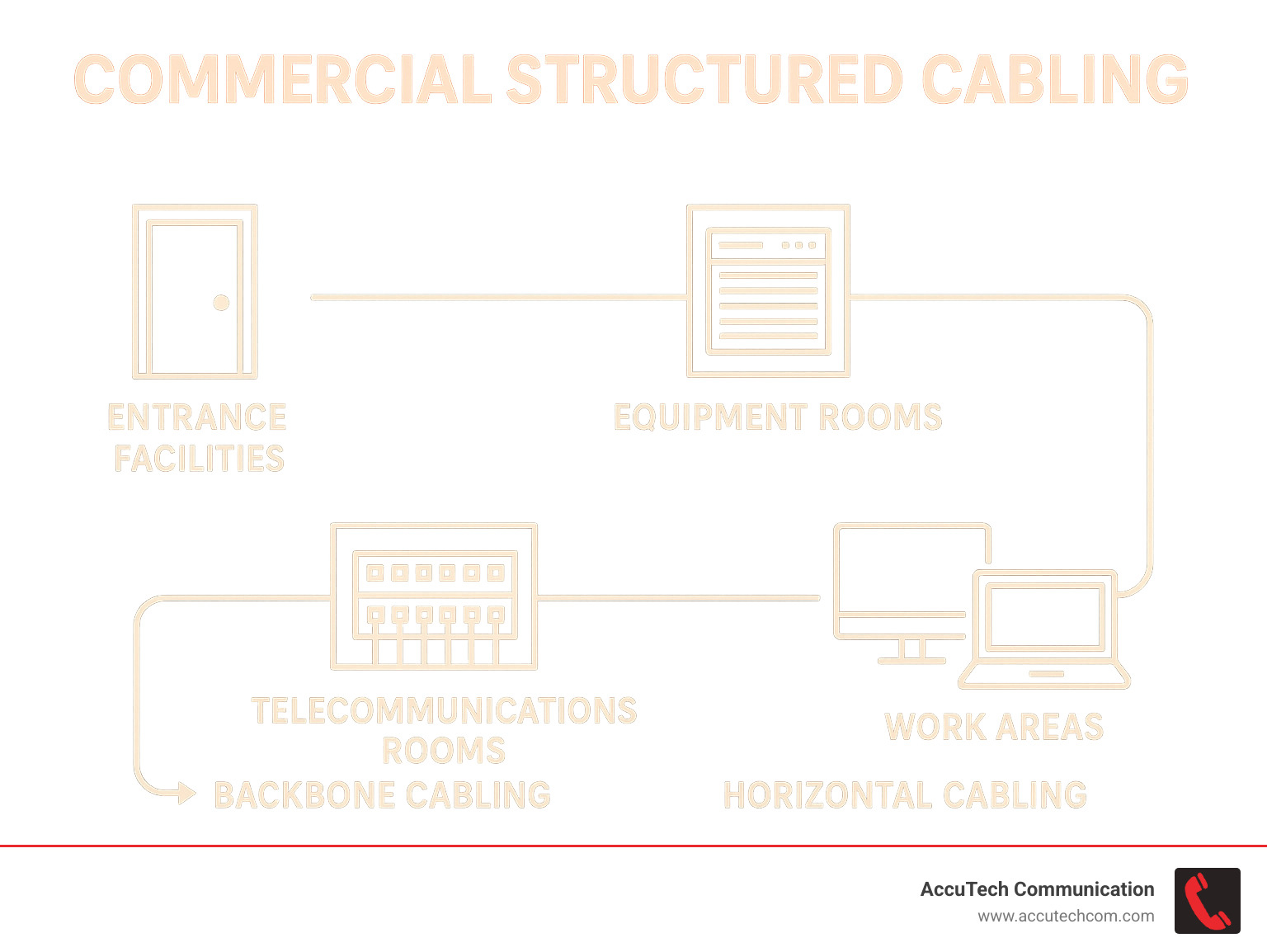
– Six standardized subsystems: entrance facilities, equipment rooms, backbone cabling, horizontal cabling, telecommunications rooms, and work areas
– Cable types: Cat5e, Cat6, Cat6A (copper) and fiber optic cables
– Standards compliance: ANSI/TIA-568, ISO/IEC 11801, and local building codes
– Maximum distances: 90 meters for permanent copper links, plus 10 meters for patch cords
– Benefits: Up to 50% reduction in network downtime, faster troubleshooting, and simplified moves/adds/changes
The difference between chaos and control often comes down to one thing: proper cable infrastructure. Many businesses struggle with tangled networks that slow down operations and make simple changes expensive. A well-designed structured cabling system eliminates this chaos by creating a clean, organized foundation that grows with your business.
I’m Corin Dolan, owner of AccuTech Communications, and I’ve been designing and installing commercial structured cabling systems across Massachusetts, New Hampshire, and Rhode Island since 1993. My team has seen how the right cabling infrastructure transforms business operations—from reducing costly downtime to enabling seamless technology upgrades.
Terms related to commercial structured cabling:
– horizontal cabling structure
– low voltage structured cabling
– network data wiring
Commercial Structured Cabling 101: From Definition to Business Value
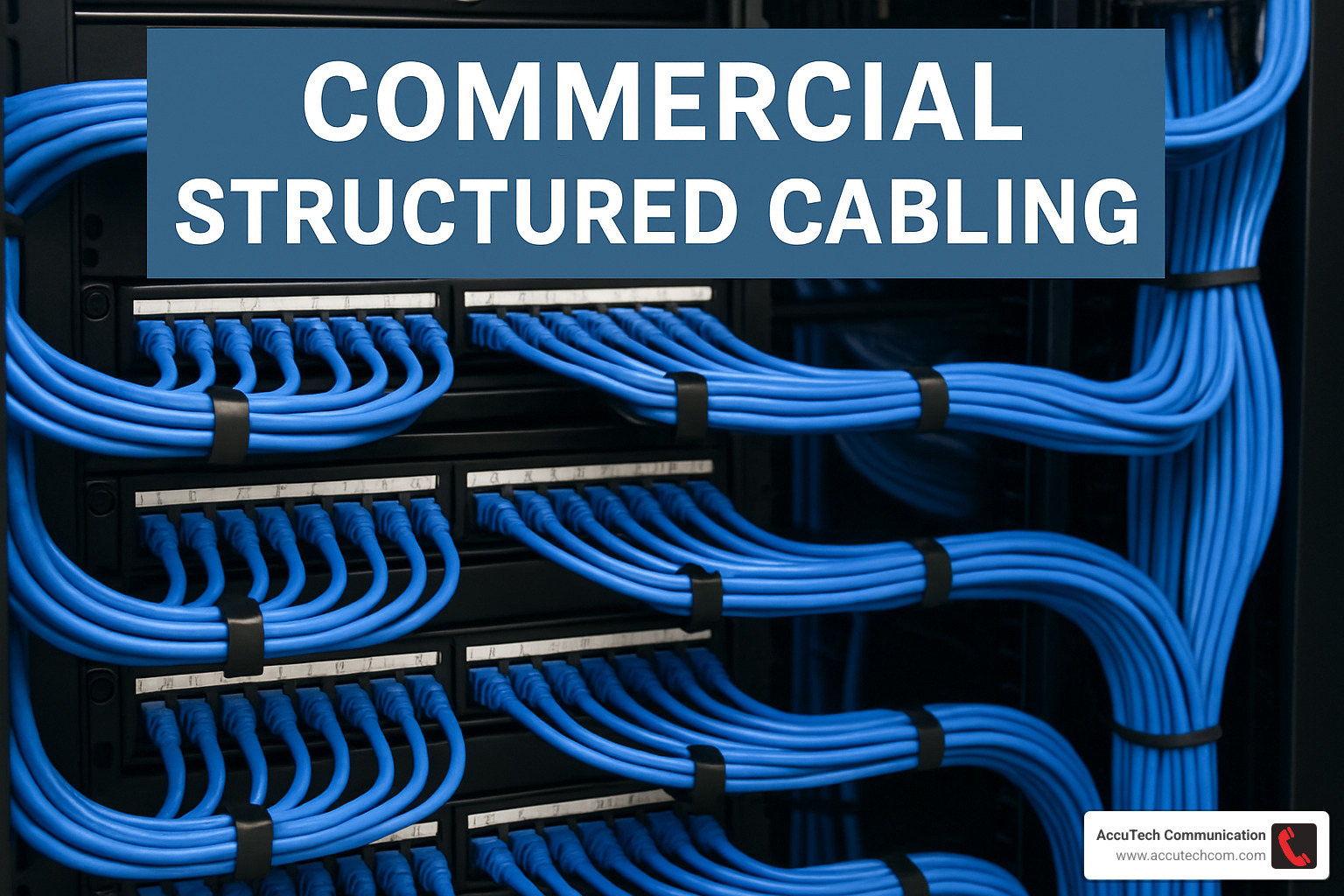
Picture walking into two different server rooms. The first looks like someone dropped a plate of spaghetti—cables everywhere, no rhyme or reason, and good luck finding anything when something breaks. The second is clean, organized, with neat rows of labeled cables that actually make sense. That’s the difference between old-school point-to-point wiring and modern commercial structured cabling.
Commercial structured cabling is essentially the nervous system of your building, but done right. Instead of running individual cables directly from device to device (which creates that spaghetti mess), structured cabling uses a modular design with centralized patch panels and organized distribution points. Think of it as creating highways for your data instead of random dirt roads.
The system follows the 90-meter rule—permanent cable links can’t exceed 90 meters, with an additional 10 meters allowed for patch cords. This ensures signal quality stays strong throughout your network. Everything converges through patch panels, making voice-data-video convergence seamless and supporting Power over Ethernet (PoE) for devices like IP phones and wireless access points.
Here’s what really matters: businesses with commercial structured cabling see up to 50% less network downtime compared to those with chaotic wiring. When problems happen (and they will), technicians can actually find and fix them quickly instead of playing detective with mystery cables hidden in walls.
The scalability factor is huge too. Need to add new workstations? Move departments around? With structured cabling, these changes become simple plug-and-play operations instead of major construction projects. Your IT team will thank you, and your budget will too.
How Commercial Structured Cabling Beats Point-to-Point
Let me paint you a picture of why commercial structured cabling leaves point-to-point wiring in the dust. With point-to-point, every single device needs its own dedicated cable run. Got 50 computers? That’s potentially 50 separate cables snaking through your building. Add phones, printers, security cameras, and wireless access points, and you’ve got a recipe for chaos.
Reduced clutter is the most obvious win. Instead of hundreds of individual cables creating a tangled mess, structured cabling organizes everything into neat, labeled bundles following designated pathways. Your server room actually looks professional, airflow improves (which keeps equipment cooler), and you reduce fire hazards from cable clutter.
Faster troubleshooting becomes a reality when everything is organized and documented. With point-to-point wiring, a network problem can send technicians on a treasure hunt through walls and ceiling tiles. I’ve seen techs spend entire days tracing a single cable. With structured cabling, problems get isolated quickly because every connection follows a logical pattern and proper documentation.
The growth-ready advantage really shines when your business expands. Adding new devices to point-to-point systems often means disruptive construction—drilling holes, running new cables, and hoping you don’t hit existing wiring. Structured cabling includes built-in capacity and standardized connection points, so growth becomes a simple matter of plugging into existing infrastructure.
Why It Matters for Commercial Buildings
For any commercial construction project, commercial structured cabling isn’t just a nice upgrade—it’s essential infrastructure that determines how well your building adapts to future technology needs. Today’s low-voltage systems handle everything from basic internet connectivity to sophisticated building automation, and the trend is only accelerating.
The timing matters enormously. Installing structured cabling during initial construction is incredibly cost-effective compared to retrofitting later. Once walls are up and tenants are in place, adding proper cabling becomes a major headache involving disruption, higher labor costs, and potential damage to finished spaces.
Future-proofing your investment means thinking beyond today’s needs. That fiber optic backbone that seems expensive now? It’ll support technologies we haven’t even invented yet. The extra capacity in your cable trays? It’ll accommodate growth without requiring you to tear open walls.
Low-voltage systems operating at 50 volts or less now power an amazing array of building functions. Your structured cabling infrastructure supports VoIP phone systems, wireless networks, security cameras, access control systems, and smart building technologies—all running on the same organized, manageable network foundation.
The cost-effectiveness extends far beyond installation day. When your cabling can support multiple applications on shared infrastructure, every technology upgrade becomes easier and more affordable. You’re not starting from scratch each time—you’re building on a solid foundation that grows with your business.
Anatomy & Standards: Subsystems, Cable Types & Compliance
When I explain commercial structured cabling to business owners, I like to compare it to the human body. Just like your body has different systems—circulatory, nervous, respiratory—that all work together, structured cabling has six distinct subsystems that create a complete network foundation.
These subsystems follow strict industry standards, especially the ANSI/TIA-568 standard, which might sound boring but actually saves you money and headaches. Think of standards as the universal language that lets equipment from different manufacturers work together seamlessly. Without them, you’d be stuck with one vendor forever.
In our 30 years of Structured Cabling Installation work across New England, we’ve learned that following these standards isn’t just about checking boxes—it’s about building systems that actually last and perform reliably for decades.
The Six Subsystems Explained
Let me walk you through each subsystem and explain why they matter for your business.
Entrance facilities are where the outside world connects to your building. This is your digital front door—where internet providers, phone companies, and other services plug into your internal network. Getting this right from the start prevents expensive retrofitting later.
Equipment rooms house the brains of your operation. These climate-controlled spaces contain servers, switches, and other critical hardware that keep everything running. Poor planning here creates bottlenecks that slow down your entire network.
Backbone cabling acts like the interstate highway system, moving data between floors and buildings at high speeds. We typically use fiber optic cables here because they can handle massive amounts of data over long distances without signal loss.
Horizontal cabling is the local road network that connects individual workstations to the backbone system. This copper cabling follows the famous 90-meter rule—permanent links can’t exceed 90 meters to maintain signal quality, with an additional 10 meters allowed for patch cords.
Telecommunications rooms serve as distribution hubs on each floor, kind of like local post offices that sort and route data to the right destinations. These rooms house the patch panels and switches that connect your backbone to individual work areas.
Work areas include everything users touch daily—wall outlets, patch cords, and device connections. While they seem simple, proper design here makes the difference between smooth operations and constant IT headaches.
Cable Category Cheat-Sheet
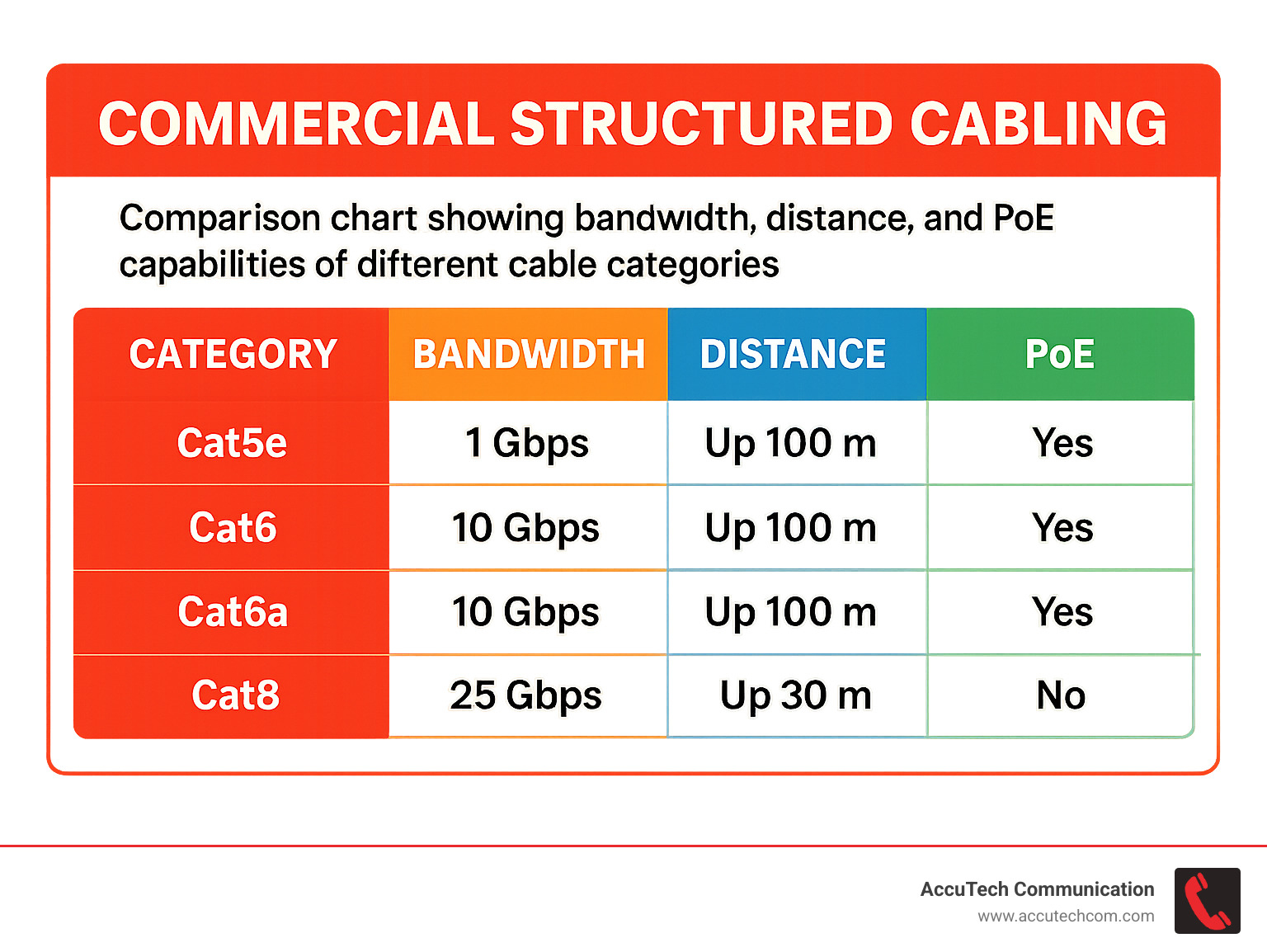
Choosing cable types for your commercial structured cabling system feels overwhelming when you’re staring at technical specifications. Let me break it down in practical terms.
Cat5e cables handle basic needs well—up to 1 Gbps speeds over 100 meters. They’re the budget option that works fine for voice and standard data applications. However, they might limit your options as technology advances.
Cat6 cables step up the game with support for 10 Gbps speeds, though only over shorter distances (about 55 meters). They offer better performance and less interference than Cat5e, making them suitable for most current business needs.
Cat6A cables are the sweet spot for many businesses. They maintain full 10 Gbps performance over the complete 90-meter distance and handle Power over Ethernet (PoE) applications more efficiently. The “A” stands for “Augmented,” which basically means they’re built to handle more power and generate less heat.
Fiber optic cables represent the premium option with virtually unlimited bandwidth and complete immunity to electrical interference. While more expensive upfront, fiber makes sense for backbone connections and future-proofing critical applications.
The choice often comes down to balancing today’s budget with tomorrow’s needs. We usually recommend Cat6A for new installations because it provides excellent future-proofing without breaking the bank.
Staying Compliant with Industry Standards
Industry standards like ANSI/TIA-568, ISO/IEC 11801, and CENELEC EN 50173 might sound like alphabet soup, but they’re actually your best friends when it comes to reliable commercial structured cabling.
The T568A and T568B wiring schemes specify exactly how individual wires connect inside plugs and jacks. Following these patterns ensures your system works with equipment from any manufacturer and can be serviced by any qualified technician—not just the original installer.
Fire codes require specific cable types in different building areas. Plenum-rated cables must be used in air handling spaces because they produce less toxic smoke if they burn. Riser-rated cables are required in vertical shafts between floors. These aren’t suggestions—they’re legal requirements that affect your insurance coverage and building occupancy permits.
BICSI certification represents the gold standard for cabling professionals. Working with BICSI-certified installers means your project follows industry best practices and includes the detailed documentation you’ll need for future maintenance and expansion.
Proper documentation isn’t just paperwork—it’s your system’s instruction manual. This includes as-built drawings showing exactly where cables run, detailed cable schedules, and test results proving everything works correctly. Without good documentation, even simple changes become expensive detective work.
For more details about our approach to standards compliance, check out our Structured Cabling Standards resource.
Implementation Roadmap: Design, Installation, Testing & Maintenance
Getting your commercial structured cabling system right requires more than just running cables through walls. After three decades of installations across Massachusetts, New Hampshire, and Rhode Island, I’ve learned that successful projects follow a careful roadmap from initial planning through ongoing maintenance.
The journey starts with a thorough site survey that goes beyond measuring distances. We examine your current setup, discuss your growth plans, and identify potential challenges before they become expensive problems. This upfront planning saves countless headaches later.
Smart planning includes building in future growth capacity from day one. Adding 25-50% spare capacity in your telecommunications rooms and cable pathways costs pennies during initial construction but saves thousands when you need to expand. I’ve seen too many businesses forced into expensive retrofits because they didn’t plan ahead.
Cable pathways need careful attention to avoid interference from power lines, fluorescent lights, and other electromagnetic sources. Proper separation from power lines and strategic use of shielded cables ensures your network performs reliably for years to come.
Our Network Cabling Installation Services follow a proven approach that minimizes disruption while delivering quality results:
- Site Survey and Design – Understanding your facility and technology needs
- Pathway Installation – Setting up conduits and cable management infrastructure
- Cable Installation – Running cables using proper techniques and Velcro ties
- Termination – Connecting cables to outlets and patch panels with precise color coding
- Testing and Certification – Fluke testing to verify performance standards
- Documentation – Creating detailed records with proper labeling for future reference
- System Handover – Final walkthrough and staff training
Professional RCDD installers bring expertise that shows in the final results. These certified professionals understand not just how to install cables, but how to design systems that perform reliably and support efficient moves-adds-changes. The result? Up to 50% reduced downtime compared to poorly planned installations.
Planning for Tomorrow’s Tech: IoT, Wi-Fi 6 & 5G
Planning your commercial structured cabling system means thinking about technologies that haven’t been invented yet. The Internet of Things is already putting network connections in places we never imagined—from smart light switches to occupancy sensors and environmental monitors.
Bandwidth headroom isn’t luxury; it’s necessity. Wi-Fi 6 and emerging wireless technologies promise amazing speeds, but they need robust wired connections to deliver on those promises. Each wireless access point requires a high-quality cable connection to function effectively.
Power over Ethernet keeps evolving, with PoE++ standards now delivering up to 100 watts per port. This powers everything from LED lighting to digital signage directly through network cables. Planning your power budget and choosing appropriate cable categories during design prevents costly upgrades later.
Smart buildings integrate HVAC, lighting, security, and other systems through your network infrastructure. Building this capability into your structured cabling design costs much less than retrofitting when you decide to upgrade to intelligent building systems.
DAS (Distributed Antenna Systems) for cellular coverage increasingly rely on structured cabling for wireless backhaul. Planning for these systems during initial design ensures strong cellular coverage without expensive building modifications.
Best Practices for Cable Management & Labeling
Good cable management makes the difference between a system that’s easy to maintain and one that gives technicians nightmares. Our Structured Cabling System installations always prioritize organization that pays dividends for years.
Rack layout planning ensures proper ventilation and easy equipment access. Vertical and horizontal cable managers keep connections organized while preventing cables from blocking airflow or creating service obstacles.
Strategic IDF/MDF placement affects both current performance and future expansion. We position these distribution points to minimize cable lengths while providing room for growth and maintaining easy maintenance access.
Consolidation points simplify cable management in open offices where workstations move frequently. These intermediate connection points reduce patch cord lengths and make workspace changes more efficient.
Labeling systems must be consistent, durable, and informative. We use standardized schemes that identify cable purpose, destination, and installation date. This information proves invaluable when troubleshooting problems or planning changes years later.
Color coding helps technicians quickly identify different cable types and purposes. While not required by standards, consistent color schemes significantly reduce maintenance time and prevent costly mistakes.
Testing, Certification & Ongoing Maintenance
Every commercial structured cabling installation must pass rigorous testing to ensure it meets performance standards. This isn’t just paperwork—it’s your guarantee that the system will perform as promised.
Acceptance testing uses specialized equipment to verify each cable link meets or exceeds performance requirements. This includes checking termination quality, signal integrity, and adherence to distance limitations.
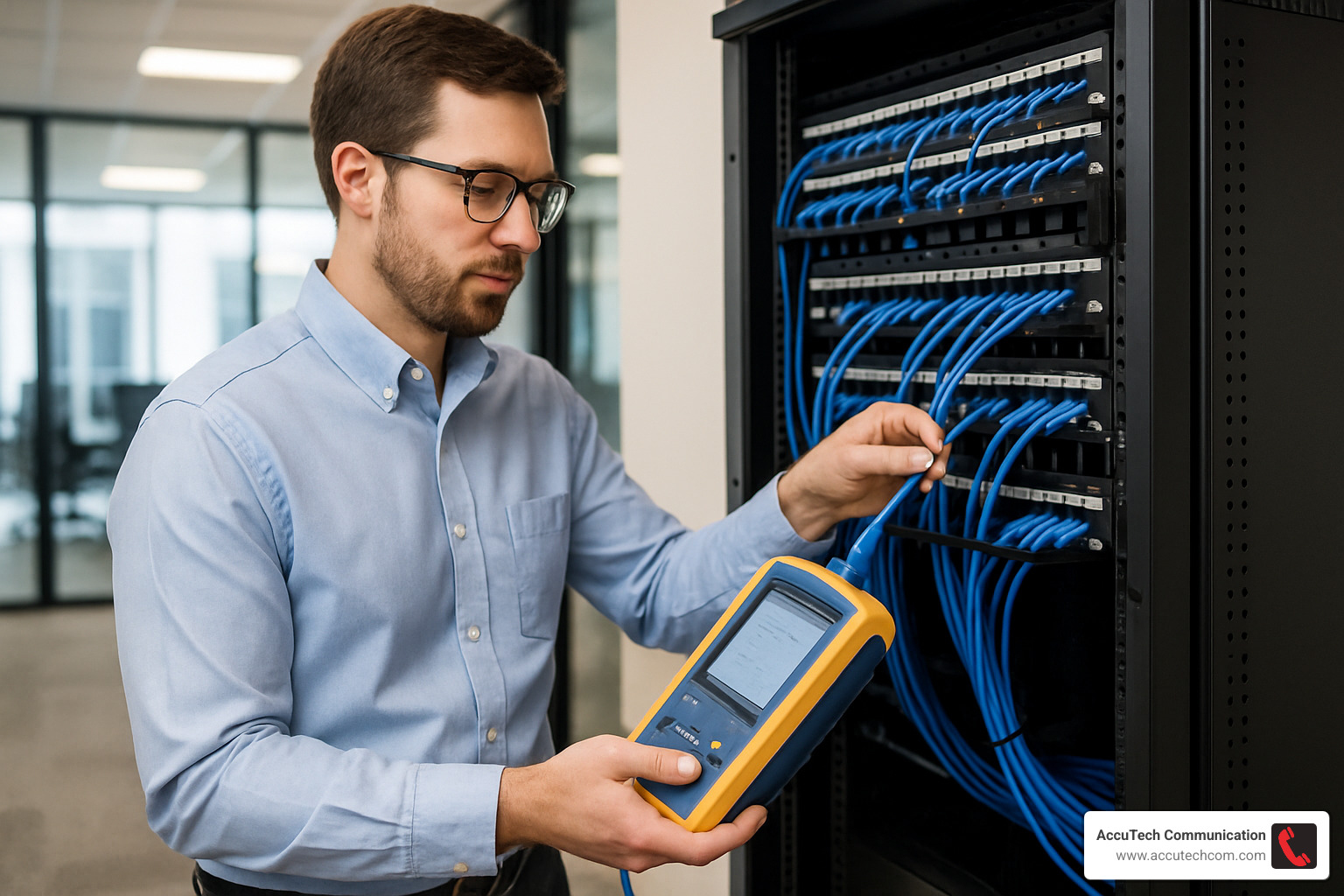
Fluke testing equipment provides detailed cable performance analysis, identifying potential problems before they cause network failures. These tests generate certification documents that prove your system’s performance and establish baseline measurements for future comparisons.
Periodic audits help catch problems before they cause downtime. We recommend annual inspections of critical infrastructure and testing representative cable samples to ensure continued performance.
Warranty requirements typically mandate specific testing procedures and documentation. Following these requirements protects your investment and ensures manufacturer support if problems develop.
A proper maintenance schedule includes regular cleaning of fiber connections, inspection of cable pathways for damage, and updating documentation as system changes occur. This proactive approach prevents small issues from becoming major problems.
Frequently Asked Questions about Commercial Structured Cabling
What types of businesses need commercial structured cabling?
The short answer? Pretty much every business that uses more than a few computers and phones. Commercial structured cabling has become the backbone of modern business operations, whether you’re running a small dental practice or managing a multi-story corporate headquarters.
Office buildings are the obvious candidates—any space where people need reliable internet, phone service, and network access benefits from organized cabling infrastructure. But we’ve installed structured cabling systems in some surprising places over our 30 years in business.
Educational facilities rely heavily on structured cabling to support everything from classroom computers to security cameras and PA systems. Healthcare organizations need rock-solid network performance for patient records, medical devices, and communication systems where downtime isn’t just inconvenient—it can be dangerous.
Manufacturing plants use structured cabling to connect production equipment, inventory systems, and office areas. Even retail locations benefit from organized cabling that supports point-of-sale systems, security cameras, and wireless networks for both staff and customers.
Here’s what surprises many business owners: even small operations see real benefits from commercial structured cabling. That 10-person accounting firm might think they can get by with cables running everywhere, but structured cabling pays for itself quickly when you need to add new employees or upgrade equipment.
Government facilities have particularly strict requirements for security and reliability, making structured cabling essential for meeting compliance standards while maintaining operational flexibility.
How often should my cabling be tested?
Think of cabling testing like getting a physical checkup—you need it when you first install the system, and then regular check-ins to catch problems before they become emergencies.
Every new commercial structured cabling installation requires complete certification testing. This isn’t just a good idea—it’s required for warranty coverage and ensures your system actually meets the performance standards you paid for. We use specialized Fluke testing equipment that generates detailed reports showing exactly how each cable link performs.
After your initial installation, annual inspections help catch potential problems early. These don’t require the full certification process, but should include checking cable pathways for damage, cleaning fiber optic connections, and spot-testing representative cable links throughout your system.
The real testing trigger comes when you make changes to your system. Moving equipment, adding new devices, or renovating office space can affect cable performance in unexpected ways. Any time we modify existing cabling, we retest the affected links to ensure they still meet performance requirements.
Don’t skip this step—we’ve seen businesses experience mysterious network problems that traced back to cable damage that happened months earlier during seemingly unrelated work. Testing after changes protects your investment and prevents future headaches.
Can structured cabling support wireless networks and emerging tech?
This might be the most important question we get, and the answer is absolutely yes—but with a twist that surprises many people. Commercial structured cabling doesn’t compete with wireless technology; it makes wireless technology possible.
Every wireless access point in your building needs a wired connection to function. The quality of that wired connection directly determines how well your Wi-Fi performs. Poor cabling means poor wireless performance, no matter how expensive your wireless equipment.
Wi-Fi 6 and upcoming wireless standards actually increase the importance of quality structured cabling because they require higher bandwidth connections to deliver their promised speed improvements. It’s like having a sports car—you need good roads to take advantage of the performance.
IoT devices are revolutionizing how buildings operate, from smart thermostats to occupancy sensors and automated lighting systems. These devices need network connections, and commercial structured cabling provides the organized infrastructure to support them without creating a tangled mess.
Smart building technologies integrate HVAC, lighting, security, and other systems through your network infrastructure. A well-designed structured cabling system gives you the flexibility to add these technologies as they become available, rather than facing expensive retrofits later.
Even 5G technology relies on structured cabling for backhaul connections. Those small cells that improve cellular coverage in buildings need wired connections to function effectively.
The key is designing your system with tomorrow’s technologies in mind. We typically include extra capacity and flexibility in our designs because we know your technology needs will grow over time. This forward-thinking approach protects your investment and ensures your infrastructure can adapt to whatever comes next.
Conclusion
Picture this: you walk into your server room and instead of seeing a tangled mess of cables, you see clean, organized pathways where every connection has a purpose and a place. That’s the power of commercial structured cabling—changing network chaos into a foundation that actually works for your business instead of against it.
The investment in quality cabling isn’t just about today’s needs. It’s about creating infrastructure that adapts as your business grows and technology evolves. When you need to add new devices, upgrade systems, or relocate equipment, structured cabling makes these changes simple instead of expensive headaches.
Think of commercial structured cabling as the Swiss Army knife of business infrastructure. One well-designed system handles your phones, internet, security cameras, Wi-Fi access points, and whatever new technology comes next. This unified approach streamlines operations and eliminates the complexity that comes from managing multiple separate systems.
At AccuTech Communications, we’ve watched businesses transform their operations with the right cabling foundation. Since 1993, we’ve helped companies across Massachusetts, New Hampshire, and Rhode Island move from cable chaos to organized efficiency. Our certified technicians understand that every business is different, and we design systems that fit your specific needs and budget.
The difference between a network that constantly causes problems and one that just works comes down to planning and quality installation. When cabling is done right the first time, it becomes invisible—supporting your operations reliably for decades without constant attention and maintenance costs.
Future-ready infrastructure isn’t about predicting every technology that’s coming. It’s about building flexibility and capacity that can handle whatever your business needs next. Learn more about our structured cabling services and find how we can help create the reliable foundation your business deserves.
Your network infrastructure should be the least of your worries, not a constant source of stress. Quality commercial structured cabling makes that possible, giving you the freedom to focus on growing your business instead of managing cable problems.
