
Datacenter Cable Management: Top 5 Proven Strategies 2024
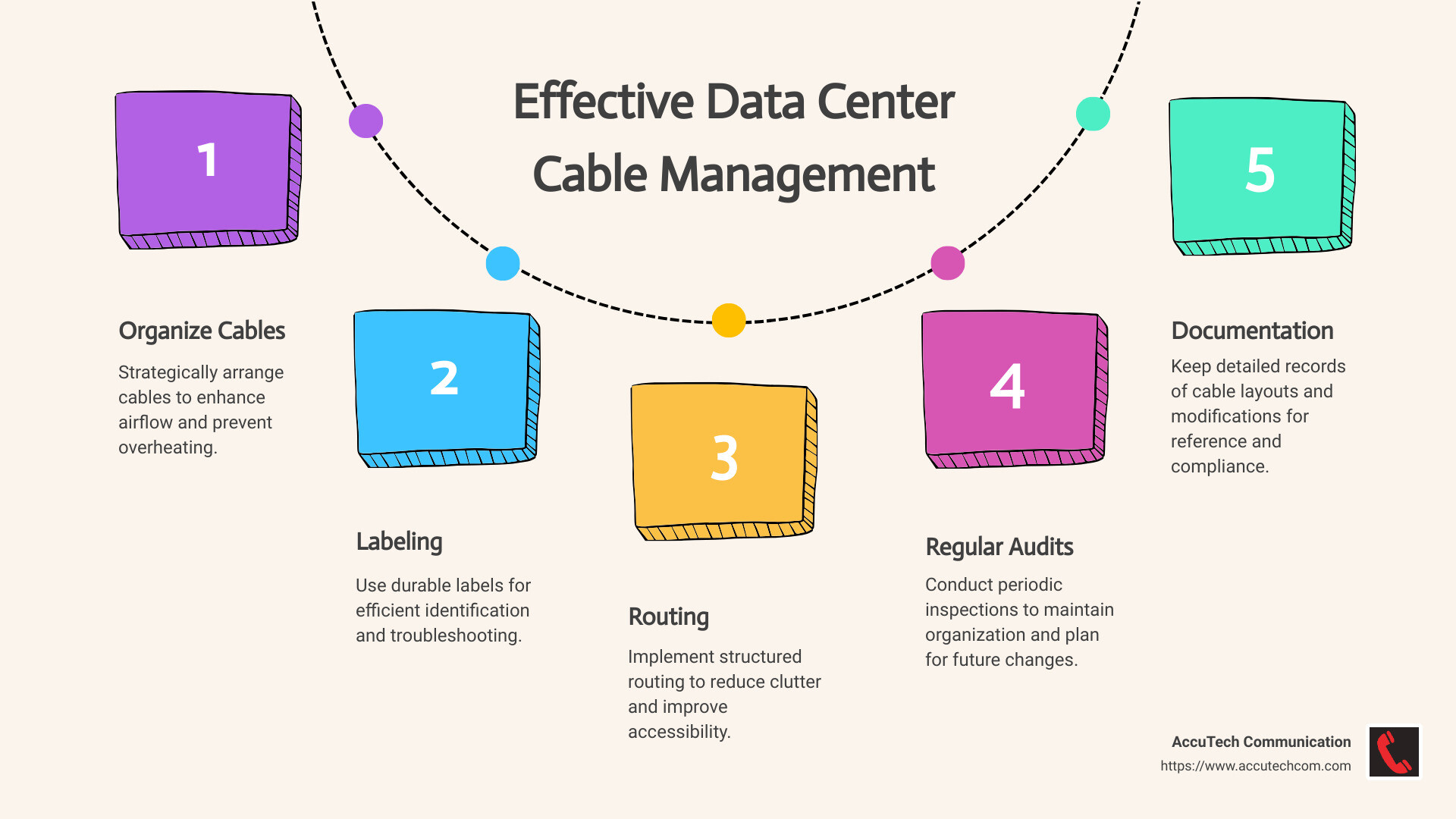
Data center cable management is crucial for any business that relies on a robust communication system, especially those in sectors like healthcare. Managing cables in a data center involves a structured approach to organizing, labeling, and routing cables to ensure efficient operations and prevent chaos. A successful strategy includes:
- Organizing cables to optimize airflow and prevent overheating.
- Using labels for easy identification and troubleshooting.
- Regular audits to maintain order and adapt to future needs.
An efficiently managed cable system improves uptime, maximizes capacity, and boosts productivity.
In today’s digital landscape, data centers are the heartbeat of IT infrastructure, ensuring seamless data flow and operational efficiency. However, poorly managed cables can transform a data center into a tangled web of confusion, risking downtime and hampering performance. That’s why effective cable management is not just a practice; it’s a cornerstone of operational success.
As Corin Dolan, owner of AccuTech Communications, I bring over two decades of experience in datacenter cable management, assisting various businesses in maintaining top-notch network infrastructure to meet their unique needs. We’ll explore practical strategies for taming the chaos of cable jungles.
Key datacenter cable management vocabulary:
– Data Center Build Outs
– data center build out consultant
– data center build out cost
Understanding Data Center Cabling
Navigating the maze of data center cabling can be daunting, but understanding its fundamentals can transform chaos into order. At the heart of this change are two main approaches: structured cabling and unstructured cabling.
Structured vs. Unstructured Cabling
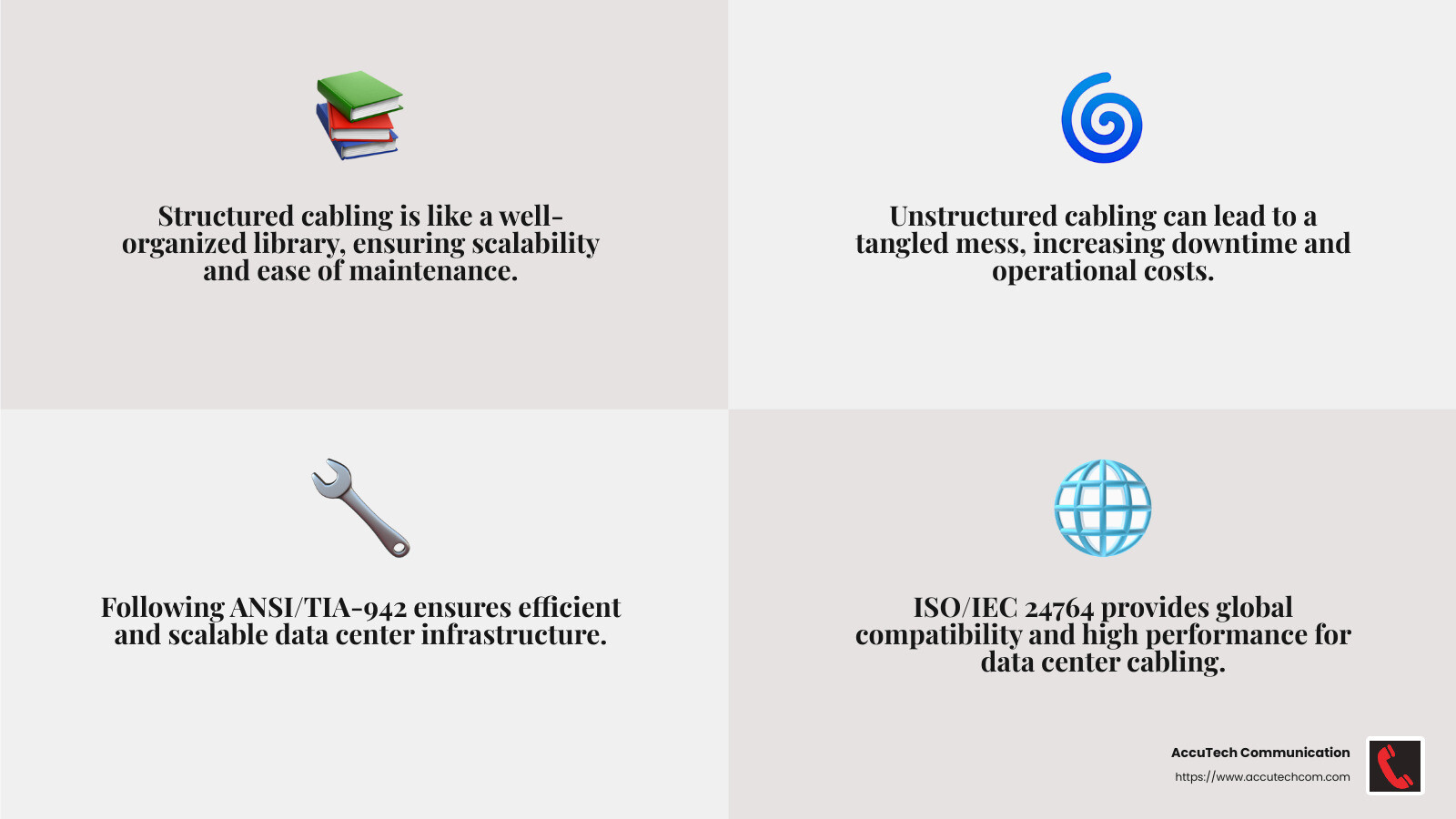
Structured Cabling is like a well-organized library. It follows a set of predefined standards and layouts, ensuring consistency and scalability. This approach uses components like twisted pair copper, fiber optic cables, and patch panels to create a reliable network infrastructure. The main advantage? It makes troubleshooting and upgrading a breeze, saving time and reducing costs in the long run.
Unstructured Cabling, on the other hand, is akin to a messy desk. It’s a more haphazard setup where cables are connected point-to-point without a standardized plan. While it might seem quicker to set up initially, it can lead to a tangled mess that complicates maintenance and scalability. This can result in higher operational costs and increased downtime.
Cabling Standards
Adhering to industry standards is crucial for any data center. These standards ensure safety, performance, and compatibility across various systems. Here are some key standards to know:
- ANSI/TIA-942: This standard provides guidelines for data center design, covering everything from cabling layouts to environmental considerations. It’s essential for ensuring efficient and scalable infrastructure.
- ISO/IEC 24764: An international standard that complements ANSI/TIA-942, providing specifications for cabling in data centers. It ensures global compatibility and high performance.
- ANSI/BICSI 002-2014: This standard offers comprehensive guidelines for data center design and operation, including modular data centers and energy efficiency.
Following these standards helps minimize risks and ensures that your data center is equipped to handle current and future demands.
By embracing structured cabling and adhering to established standards, businesses can create a robust and efficient network infrastructure. This foundation not only supports current operational needs but also prepares for future growth and technological advancements.
Benefits of Effective Data Center Cable Management
When it comes to data center cable management, the benefits are clear: improved uptime, better capacity utilization, and increased productivity. Let’s explore why these elements are crucial for a well-functioning data center.
Uptime
Effective cable management plays a pivotal role in minimizing downtime. Imagine trying to find a single book in a library where all the books are scattered randomly. Now picture the same scenario with cables in a data center. Properly organized cables, much like a well-ordered library, allow technicians to quickly identify and resolve issues. This means fewer disruptions to business operations, leading to higher uptime and improved reliability. As one expert notes, “Proper cable management directly contributes to reduced downtime and lower maintenance costs.”
Capacity Utilization
Knowing what cables and ports are available lets you maximize your existing resources. With well-documented and organized cabling, you can easily identify stranded capacity and forecast future needs. This efficient use of resources ensures you’re getting the most out of your data center’s infrastructure, ultimately saving time and money.
Productivity
A tidy and well-documented cabling system accelerates decision-making and troubleshooting. When everyone has access to a clear view of all physical assets and connections, it simplifies moves, adds, and changes. This streamlined process improves overall productivity. As a result, businesses can maintain seamless operations and deliver consistent services to customers.
In summary, effective data center cable management is not just about keeping things neat. It’s a strategic move that boosts uptime, optimizes capacity, and improves productivity. These benefits create a stable foundation for any data center, ensuring it operates at peak performance.
Types of Cables Used in Data Centers
In data centers, cables are like the unsung heroes, quietly connecting everything and ensuring smooth data flow. Let’s explore the main types of cables used: copper, fiber optic, and Ethernet.
Copper Cables
Copper cables are a popular choice in data centers due to their cost-effectiveness and versatility. These cables come in various forms, such as twisted pair cables (like CAT5e, CAT6, and CAT6a) and coaxial cables. They are ideal for short to medium distances, making them perfect for connecting devices within the same rack or nearby racks.
- Advantages: Copper cables are affordable and work well with existing infrastructure. They are reliable, with a mean time between failures of fifty million hours, providing maximum uptime.
- Considerations: While copper cables are budget-friendly, they have limitations in terms of speed and distance compared to fiber optics.
Fiber Optic Cables
Fiber optic cables are the go-to choice for high-speed data transmission across longer distances. They use light to transmit data, offering faster speeds and greater bandwidth than copper cables.
- Single-Mode Fiber (SMF): Ideal for long-distance and high-speed data transmission. It has a smaller core, allowing data to travel farther with minimal signal loss.
- Multi-Mode Fiber (MMF): Used for shorter distances within data centers. It has a larger core and is suitable for connections between servers and switches. Variants like OM3, OM4, and OM5 offer improved performance for high-speed applications.
- Advantages: Fiber optics provide faster speeds, longer reach, and more bandwidth, making them perfect for backbone cabling.
Ethernet Cables
Ethernet cables, such as Cat5e, Cat6, and Cat7, are essential for network connectivity in data centers. They are used to connect various devices, ensuring seamless communication.
- 10Gig and 40/100Gig Ethernet: These cables support high-speed data transfer, crucial for modern data centers that handle massive data loads.
- Connectors: Ethernet cables use connectors like RJ45, GG45, and TERA to establish secure connections between devices.
Choosing the right type of cable for your data center is crucial for optimal performance. While copper cables are cost-effective for short distances, fiber optic cables offer unparalleled speed and distance capabilities. Ethernet cables, on the other hand, ensure reliable network connectivity. By understanding the strengths and limitations of each type, you can design a cabling system that meets your data center’s specific needs.
Best Practices for Data Center Cable Management
Effective datacenter cable management is key to maintaining a smooth and efficient operation. Here are some best practices to keep your cables organized and your data center running optimally.
Labeling
Proper labeling is the simplest yet most effective way to manage cables. Use a commercial-grade label maker to create clear, legible labels for each cable. Import lists and use color-coded labels to make identification quick and easy. Adopting a labeling standard, like ANSI/TIA 606-B, ensures consistency and helps with future maintenance. Labels simplify troubleshooting, reduce downtime, and improve productivity by allowing technicians to trace cables quickly.
Airflow
Cables can obstruct airflow if not managed properly. Ensure that cables are neatly arranged and do not block ventilation paths. Remove any unused or abandoned cables from under raised floors or within cabinets. This prevents overheating and maintains optimal temperatures, which can extend equipment life and reduce energy costs. Well-organized cables mean better airflow and more efficient cooling.
Documentation
Maintain accurate and up-to-date documentation of your cabling infrastructure. Documenting data and power circuits in real-time helps in planning capacity, performing failover analysis, and responding swiftly to outages. Good documentation reduces the need for physical cable tracing, saving time and minimizing errors. It also assists in future upgrades or expansions, ensuring that the network’s layout is clear and understandable.
DCIM Software
Deploy Data Center Infrastructure Management (DCIM) software to streamline cable management. DCIM tools help visualize cabling infrastructure, document installations, and measure cable lengths before purchasing. They offer a comprehensive view of your data center’s connectivity, making it easier to manage complex networks. According to research, DCIM software is essential for modern data centers, where managing thousands of cables and ports can quickly become overwhelming.
By implementing these best practices, you can transform chaotic cabling into a well-organized system, enhancing your data center’s efficiency and reliability. Next, let’s address some frequently asked questions about data center cable management.
Frequently Asked Questions about Data Center Cable Management
What is data center cable management?
Data center cable management involves labeling, organizing, and documenting the cabling infrastructure within a data center. This process ensures that cables are easy to trace, reducing the time it takes to troubleshoot and repair issues. Proper cable management prevents the dreaded “cable spaghetti,” a tangled mess that can lead to downtime and inefficiencies. By keeping cables neat and organized, data centers can maintain optimal performance and ensure quick access to equipment.
What types of cables are used in data centers?
Data centers use a variety of cables to support different functions:
- Copper Cables: These are cost-effective and suitable for shorter distances. They are commonly used for local data center connections and have standards like TIA/EIA-568. Copper cables require more management but are effective for moderate-speed networks.
- Fiber Optic Cables: Known for faster speeds and longer distances, fiber optic cables are ideal for high-speed data center interconnects. They support high-speed data transmission and are easier to manage compared to copper cables. Fiber optics are excellent for large-scale operations requiring high bandwidth.
- Ethernet Cables: These include Cat 5e, Cat 6, Cat 6a, and others, each supporting different speeds and distances. Ethernet cables are versatile and widely used for various data center applications.
Why is cable management important in a data center?
Effective data center cable management is crucial for several reasons:
- Uptime: Well-managed cables ensure quick access and easy troubleshooting, reducing downtime. This is vital for maintaining business operations and customer satisfaction.
- Capacity Utilization: By knowing which cables and ports are available, data centers can maximize their existing resources. This helps in identifying stranded capacity and planning for future needs.
- Productivity: Organized cabling allows technicians to work more efficiently. It simplifies the process of moves, adds, and changes, enabling faster decision-making and execution.
In summary, cable management is not just about keeping things tidy. It’s about enhancing the overall performance, reliability, and efficiency of a data center’s operations. Next, we’ll wrap up our discussion with a look at how AccuTech Communications can assist in achieving these goals.
Conclusion
At AccuTech Communications, we pride ourselves on delivering top-notch data center cable management services to businesses across Massachusetts, New Hampshire, and Rhode Island. Since 1993, our commitment to quality and reliability has made us a trusted partner for companies looking to improve their IT infrastructure.
Our team of certified experts understands the complexities involved in data center build-outs and the critical role that effective cable management plays. We offer comprehensive solutions custom to meet the unique needs of each client, ensuring that their data centers run smoothly and efficiently.
By partnering with AccuTech Communications, you gain access to our wealth of experience and dedication to excellence. Whether it’s structured cabling, network optimization, or implementing best practices, we are here to support your data center’s success.
Ready to optimize your data center’s cable management? Learn more about our data center build-out services and how we can help you achieve seamless operations and improved productivity.
Thank you for choosing AccuTech Communications as your trusted provider for all your data center needs. We look forward to helping you transform chaos into order.
