
Fiber optic cable installation services: 2025 Ultimate Guide
Why Fiber Optic Networks Are Essential for Modern Business
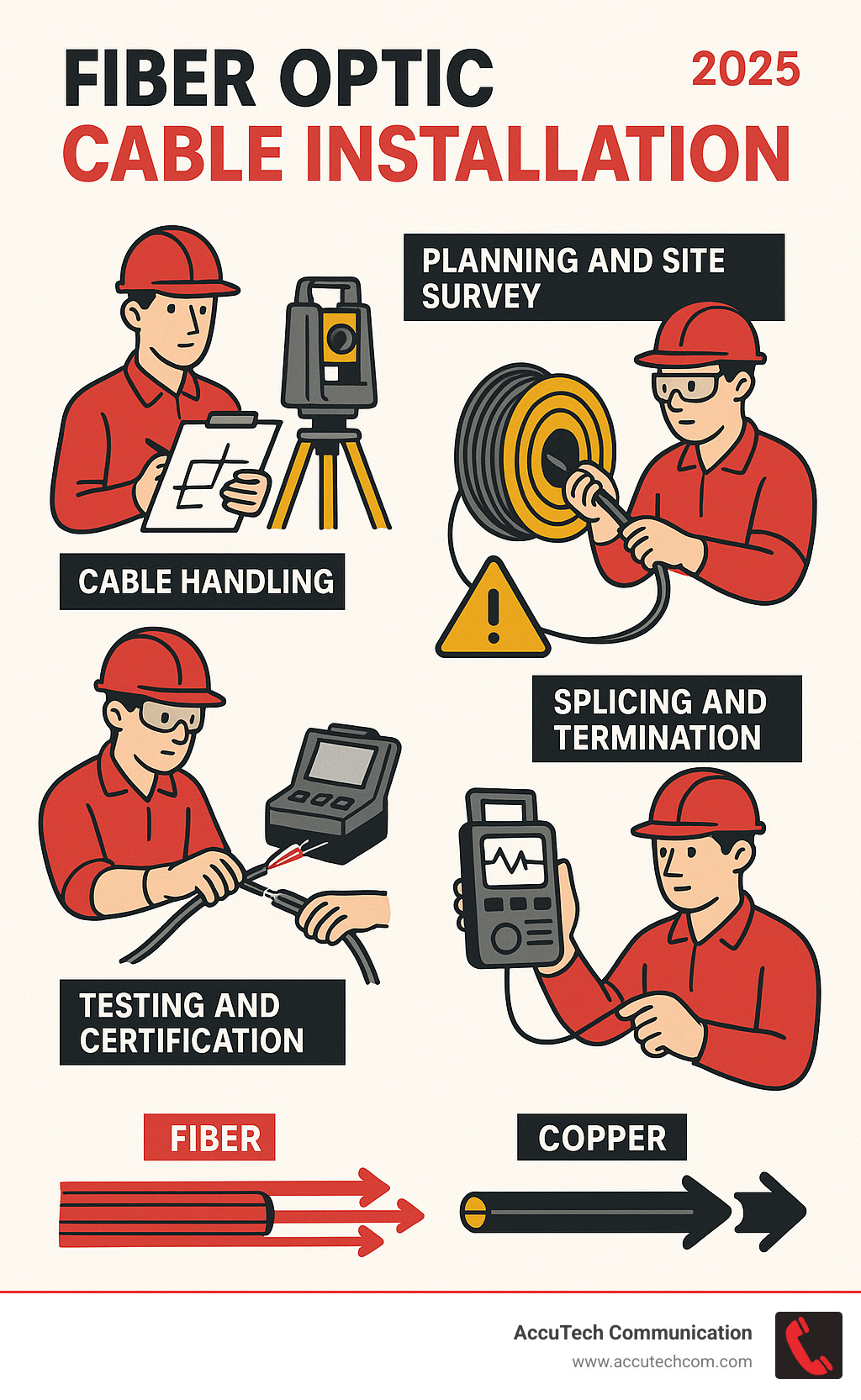
Fiber optic cable installation services deploy high-speed glass or plastic cables that transmit data as light, offering superior speed, bandwidth, and reliability over traditional copper wiring. A professional installation involves several key steps:
- Planning and Site Survey: Assessing route requirements and obtaining permits.
- Cable Handling: Using proper pulling techniques with strength members.
- Splicing and Termination: Connecting fibers using fusion or mechanical splicing.
- Testing and Certification: Verifying performance with OTDR and power meters.
- Documentation: Recording installation details for future maintenance.
Fiber optics can transmit data up to 100 times faster than copper cables and carry signals over 25 miles without degradation. For mission-critical environments like healthcare or manufacturing, fiber provides essential electromagnetic interference immunity and security. These durable glass strands can last up to 50 years with proper installation.
I’m Corin Dolan, owner of AccuTech Communications. Since 1993, my team has delivered expert fiber optic cable installation solutions across Massachusetts, New Hampshire, and Rhode Island, helping businesses upgrade their infrastructure for today’s demanding requirements.
Relevant articles related to Fiber optic cable installation:
Why Choose Fiber Optics? The Best Benefits Over Copper
Fiber optic cables transmit data using light pulses through glass strands, achieving speeds up to 100 times faster than copper while maintaining signal quality over much longer distances. This translates to significant business advantages:
- Higher bandwidth means your network can handle more users, devices, and demanding applications simultaneously without lag.
- Faster speeds directly improve productivity, allowing instant access to cloud applications and real-time collaboration.
- Greater reliability comes from fiber’s immunity to electromagnetic interference, ensuring stable connections in any environment.
- Superior signal integrity is clear: fiber loses only 3% of its signal strength over 100 meters, while copper loses over 90%.
- Longer transmission distances of up to 25 miles eliminate the need for signal boosters required by copper.
- Durability is a major win, with a lifespan of 50+ years and resistance to temperature, weather, and chemicals.
- Improved security is inherent, as fiber optic signals are nearly impossible to tap without detection.
Here’s how fiber stacks up against traditional copper wiring:
| Feature | Fiber Optic Cable | Traditional Copper Cable |
|---|---|---|
| Speed | Up to 100 times faster (10 Gbps and beyond) | Limited (1 Gbps maximum for Cat6) |
| Distance | Up to 25 miles without signal loss | 100 meters before degradation |
| Bandwidth | Massive capacity for multiple users | Bottlenecks with heavy traffic |
| Interference | Immune to electromagnetic interference | Susceptible to electrical noise |
| Durability | 50+ year lifespan | 5-15 years before replacement needed |
| Security | Nearly impossible to tap undetected | Easy to intercept signals |
The business impact is clear: companies investing in fiber optic cable installation see immediate performance improvements and long-term savings. For more details, see How Fiber Optic Cabling Can Improve Your Business Performance.
Understanding Fiber Optic Cable Types
Choosing the right cable is critical for performance. There are two main types:
Single-mode fiber has a small 9-micrometer core, allowing light to travel in a single path. This minimizes signal dispersion, making it ideal for long-distance applications like telecommunications backbones, connecting buildings across a campus, or Fiber to the Home (FTTH) over distances of 25 miles or more.
Multi-mode fiber has a larger core (50 or 62.5 micrometers) that allows multiple light paths. This enables high data rates over shorter distances, making it perfect for short-range connections within buildings, data centers, and campus backbones. OM3, OM4, and the newer OM5 are standards for high-speed LANs. For most business premises, we use durable tight buffer cable designs, as noted by experts like the FOA.
To learn more about cable options, visit our Fiber Optic Cable page.
Key Applications Across Industries
Fiber optic cable installation transforms operations across many sectors:
- Telecommunications: Forms the backbone of global communication, from submarine cables to local internet delivery.
- Data Centers: Provides the high-bandwidth, low-latency connections needed to power cloud services and online applications.
- Residential (FTTH): Delivers gigabit speeds to homes for streaming, gaming, and remote work, guided by standards like TIA 570-E.
- Industrial Automation: Offers interference-immune connectivity for robotics and control systems in noisy factory environments.
- Security Systems: Transmits high-definition CCTV video over long distances without signal loss.
- Medical Imaging: Enables the precision and clarity required for advanced diagnostic equipment and procedures.
Explore the full range of uses at What are Fiber Optic Cables Used For?.
Planning Your Installation: Strategy, Tools, and Preparation
Proper preparation is what separates a smooth, professional fiber optic cable installation from a costly failure. Our process begins with meticulous planning.
We start with a thorough site survey, walking the entire proposed cable route to identify potential challenges like sharp corners or existing utilities. Our route planning then calculates exact cable lengths, including service loops for future maintenance, and identifies entry points and splice locations. We also handle all permit requirements, coordinating with local authorities to keep your project on schedule. Finally, we create detailed project documentation, including as-built drawings and test results, which serves as your network’s permanent record for future troubleshooting and expansion.
Our expertise in Fiber Construction ensures we follow all industry standards, including the National Electrical Code (NEC) and TIA 570-E, for a reliable, long-lasting network.
Essential Tools for Fiber Optic Cable Installation
Working with glass fibers thinner than human hair requires specialized tools; there’s no room for improvisation.
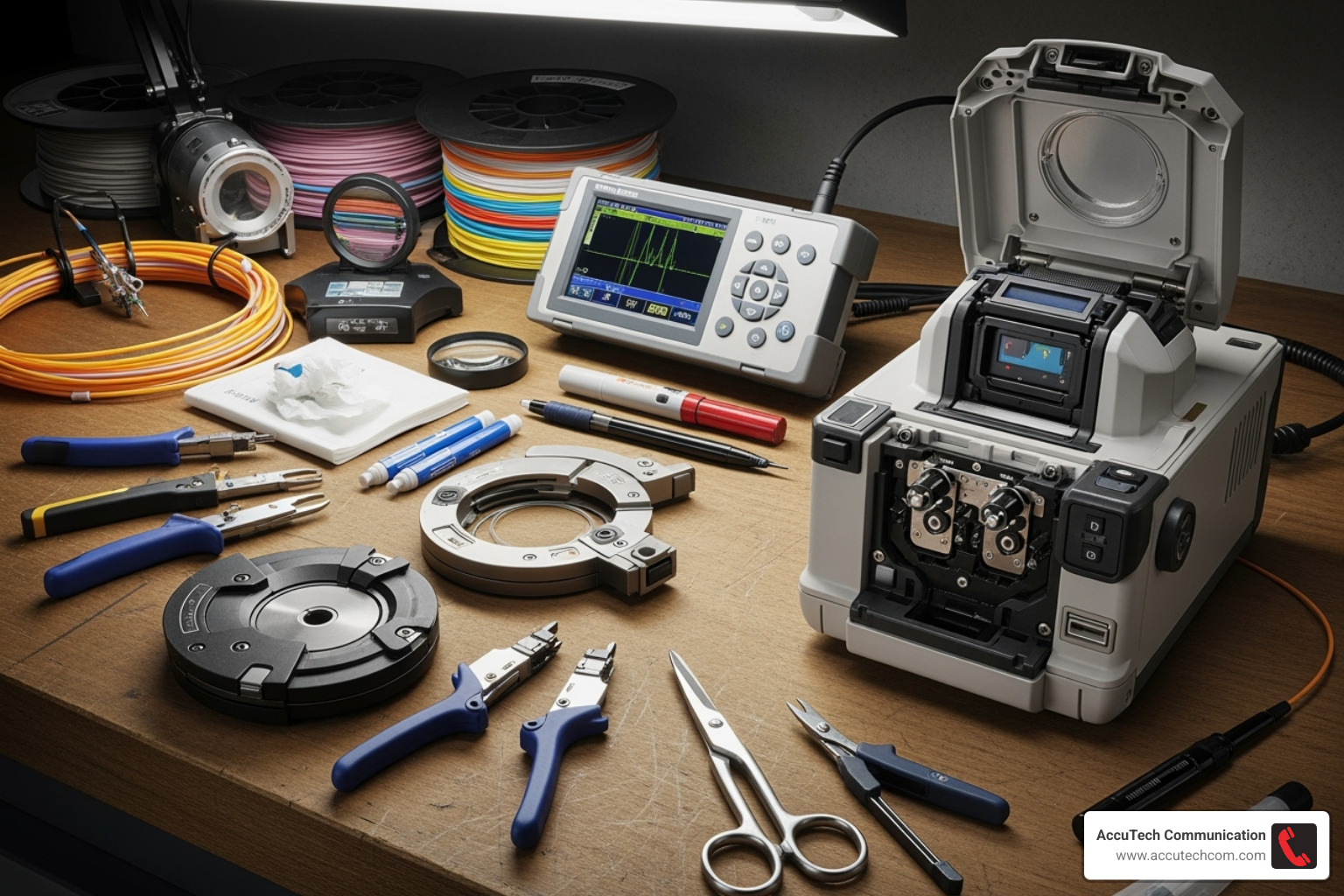
- Fiber Optic Stripper: Precisely removes cable jackets and buffer layers without scratching the glass core.
- Fiber Cleaver: Creates a perfectly clean, flat end face on the fiber, which is critical for low-loss connections.
- Fusion Splicer: Uses an electric arc to melt two fibers together, creating a seamless and permanent connection.
- OTDR (Optical Time-Domain Reflectometer): Acts like radar, sending light pulses to pinpoint the exact location of splices, connectors, and faults.
- Visual Fault Locator (VFL): Shoots a visible red laser through the fiber to make breaks and sharp bends glow, simplifying troubleshooting.
- Power Meter: Measures signal strength to verify the network will perform as designed.
Our certified Fiber Optic Technician team uses these tools to ensure every connection meets professional standards.
Common Challenges and How to Avoid Them
With three decades of experience, we know how to prevent common mistakes in fiber optic cable installation.
- Exceeding Bend Radius: Bending a cable too sharply creates micro-cracks that weaken the signal over time. We strictly follow the rule to never exceed the cable bend radius, maintaining at least 10-20 times the cable diameter.
- Exceeding Pulling Tension: Pulling too hard can stretch or snap the cable’s internal strength members. We always pull on these members, never the fibers, and use breakaway swivels to prevent exceeding pulling load ratings.
- Contamination: A single dust particle on a fiber end can block the signal. We use meticulous cleaning procedures and keep protective caps on until the last moment.
- Splicing Errors: We use real-time monitoring during fusion splicing and test every connection immediately to ensure verified performance.
- Insufficient Planning: This is the root cause of most problems. We spend the time upfront to get every detail right, avoiding costly do-overs.
By anticipating these challenges, we ensure your installation delivers reliable performance for decades.
The Step-by-Step Fiber Optic Cable Installation Process
A successful fiber optic cable installation follows a proven, multi-phase process. Skipping steps or rushing almost always leads to problems later.
Step 1: Cable Handling and Pulling
While the glass core is delicate, the cable is tough when handled correctly. The golden rule is to never directly pull on the fiber itself. Instead, we pull on the strength members—the built-in Kevlar or fiberglass rods designed to handle the stress.
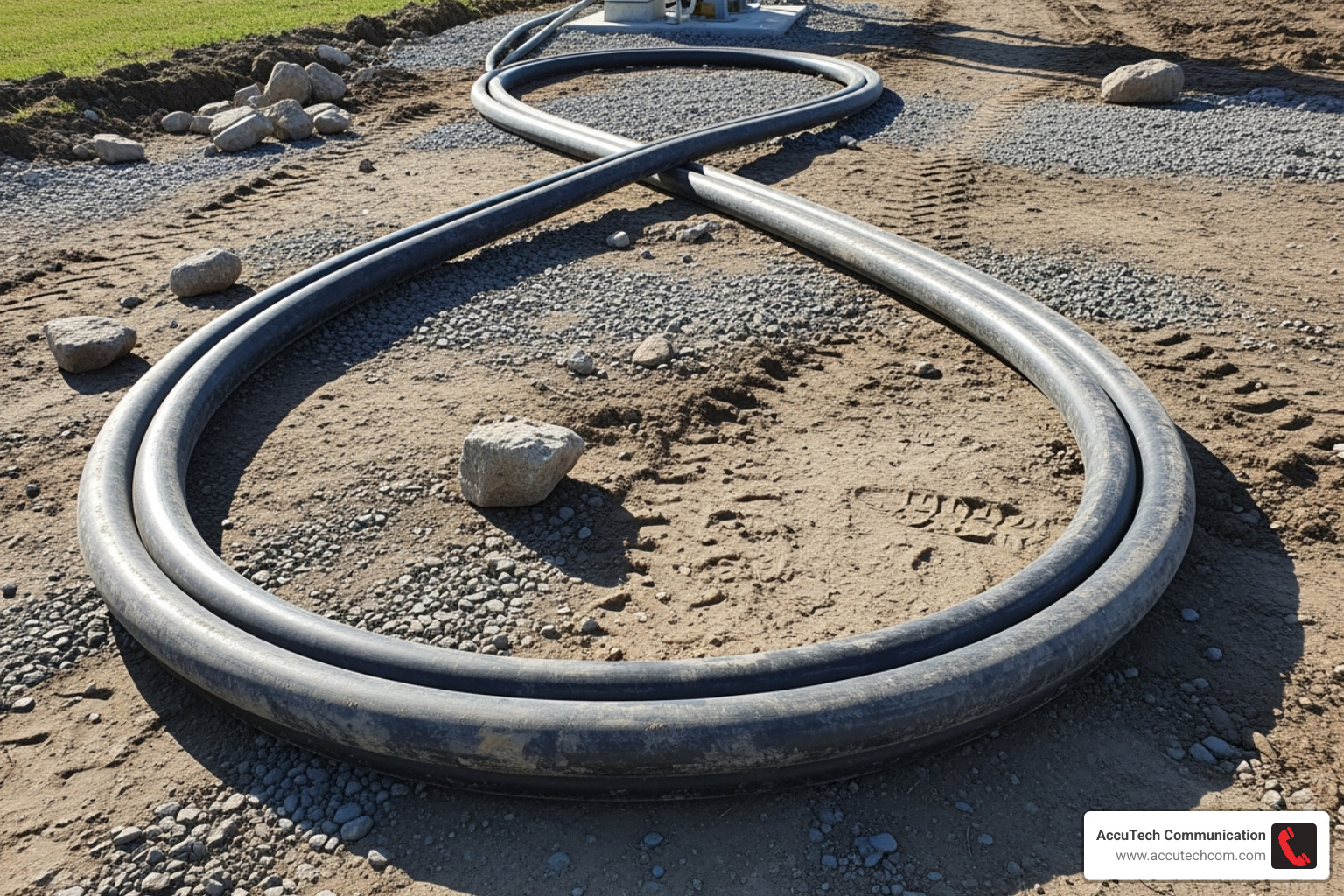
For pulls through conduit, we use specialized lubricants to reduce friction. When dealing with long runs, we lay cable in a figure-8 technique to prevent twists and kinks. It’s also crucial to always roll the cable off the spool instead of spinning it off the spool end to avoid twisting. Constant communication between team members ensures a smooth, safe pull.
Step 2: Splicing and Termination
This is where precision engineering creates the connections. Fusion splicing is our preferred method for permanent links. It uses an electric arc to melt two fiber ends into one continuous piece of glass, resulting in ultra-low signal loss and a connection that will last for decades. Our Fiber Optic Splicing Contractors have perfected this technique.
Mechanical splicing is a faster alternative for temporary repairs, using connectors and gel to align fibers. For termination, we connect the fiber to equipment using connectors like the compact LC or robust SC. We often use pigtails—short, factory-polished cables that we fusion splice to the main cable for maximum reliability. Our Fiber Optic Termination Contractors Near Me ensure every connection meets specifications. Learn more about Fiber Optic Cable Connectors.
Step 3: Housing and Management
Proper protection and organization are essential for long-term service.
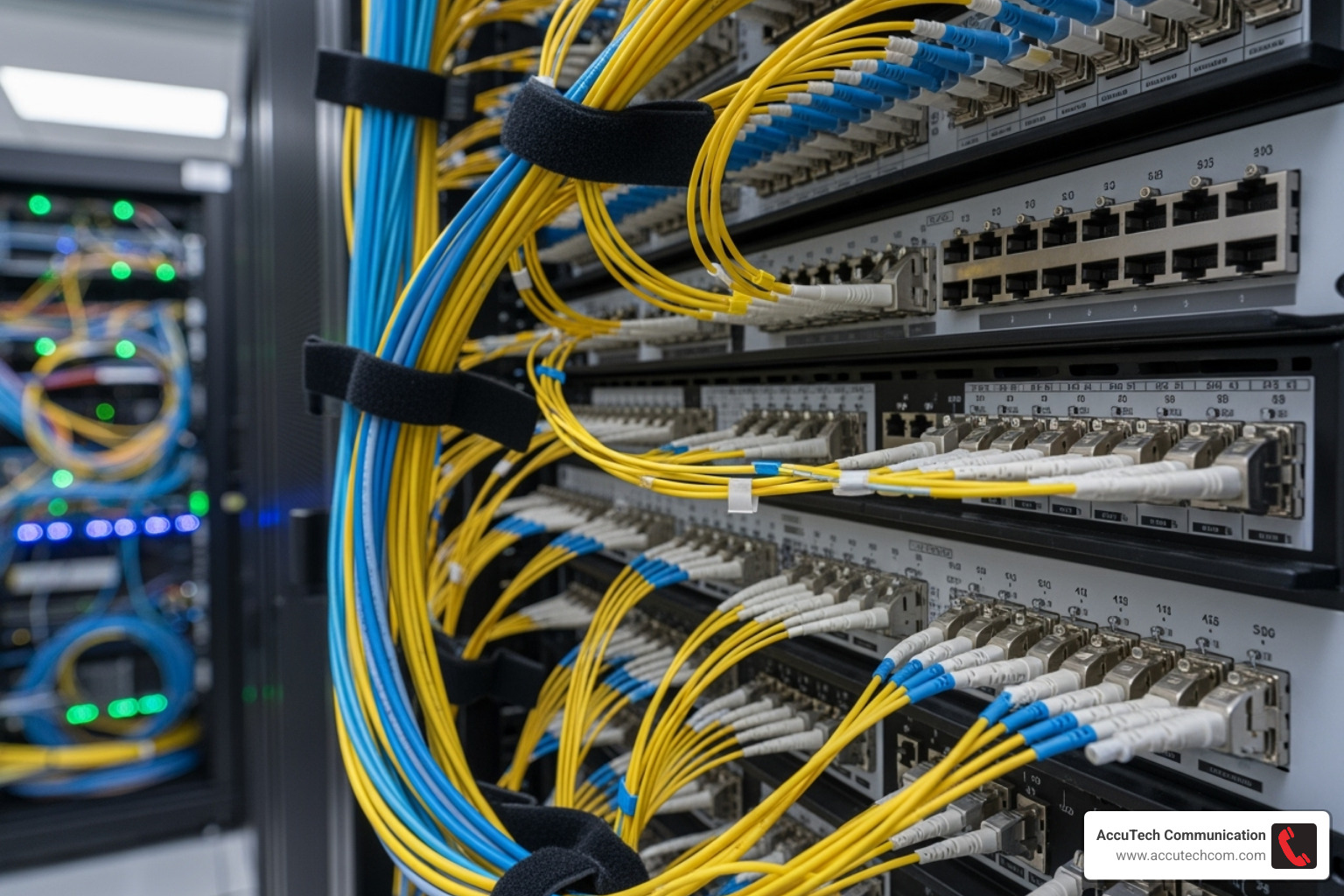
Patch panels act as the nerve center, providing an organized, labeled port for every connection. This simplifies future moves, adds, and changes. Inside, splice trays protect individual splices from damage. Throughout the installation, we use proper cable management like raceways and guides to maintain bend radius and prevent kinks. We also leave service loops—coiled sections of extra cable—at key locations. These provide the slack needed for future repairs or equipment moves without having to pull new cable. This professional finishing touch ensures your network performs better and lasts longer. See our Fiber Optic Patch Panel solutions.
Installation Environments and Safety Protocols
Adhering to best practices and safety standards is critical for the longevity and performance of your network infrastructure. The installation approach varies significantly depending on the environment.
Key Considerations for Your Fiber Optic Cable Installation Environment
- Indoor (Premises): In controlled environments like offices, we use flexible tight buffer cables with specific flammability ratings (plenum or riser) for safety. Cables are routed through conduits or trays, keeping them protected and separate from heavy copper cables.
- Outdoor (OSP): For Outside Plant (OSP) projects, we use robust loose-tube cables with polyethylene jackets to withstand UV radiation, moisture, and temperature extremes. As noted by the FOA, OSP cables are generally loose tube, ribbon or slotted core design.
- Underground: Cables can be placed in a trench via direct burial or run through conduits for superior protection and easier future upgrades. We adhere to a conduit fill ratio of no more than 40% to prevent damage during pulling and allow for expansion.
- Aerial: A fast and cost-effective option, aerial installation involves lashing self-supporting cables to messenger wires between utility poles. We always maintain proper clearance from power lines and account for cable sag.
Choosing the right cable and installation method for the environment ensures your Fiber Infrastructure will perform reliably for decades.
Critical Safety Precautions
Fiber optic cable installation involves unique safety challenges that require strict protocols.
- Eye Safety: This is non-negotiable. We mandate safety glasses at all times, as tiny, sharp glass shards are nearly invisible and can cause serious eye injury. We never look directly into a fiber unless we are certain no laser light is present.
- Fiber Shard Disposal: All scrap fiber is treated like hazardous waste and disposed of in clearly labeled, sealed containers to prevent injury.
- Chemical Handling: We use cleaning solutions and adhesives, always following manufacturer guidelines and using proper ventilation and protective equipment.
- Laser Light Exposure: Our team is trained to assume a fiber is active until tested with proper equipment to prevent eye damage from high-power lasers.
- Electrical Grounding: All metallic components of the cable system are properly grounded and bonded to protect our crew and your equipment from electrical hazards.
- Work Area Safety: We follow all OSHA guidelines, from trenching safety to fall protection, and segregate work areas to prevent unauthorized access and ensure a safe site.
Testing, Certification, and Future-Proofing
The installation isn’t complete until we conduct rigorous testing and certification. This final quality check ensures your network performs to its full potential and is ready for the future.
The Role of Testing and Certification
Comprehensive testing separates a professional installation from a problematic one.
- Insertion Loss Testing: Using a light source and power meter, we measure the total signal loss across each link to ensure it’s within acceptable limits. High loss can indicate bad splices or dirty connectors.
- OTDR Testing: An Optical Time-Domain Reflectometer (OTDR) creates a “fingerprint” of the fiber link, showing the exact location and quality of every splice, connector, and fault. This baseline data is invaluable for future troubleshooting.
- End-to-End Verification: We test at multiple stages—before, during, and after installation—to catch issues early and ensure the entire link meets performance specifications.
- Connector Cleaning: Before making any connection, we carefully clean every connector end-face. A simple step like using a wet wipe to loosen particles can prevent significant signal loss.
All results are carefully documented and provided to you, proving the installation meets or exceeds industry standards. Our Fiber Optic Monitoring System can also ensure optimal performance long after installation.
Future-Proofing Your Network
Fiber optic installation is an investment that grows with your business.
- Scalability: Fiber’s greatest strength is its ability to handle vastly increased data rates by simply upgrading the electronics at each end. The glass itself doesn’t need to be replaced, saving you from expensive re-cabling projects.
- Supporting Emerging Technologies: The infrastructure installed today is ready for tomorrow’s bandwidth-hungry applications, from AI and VR to advanced IoT networks.
- Increasing Property Value: A robust fiber infrastructure improves operational efficiency and makes commercial and residential properties more attractive and valuable.
By choosing fiber now, you’re building a resilient foundation for decades to come. Learn more about Maximizing Business Agility with Fiber Optic Cabling: The AccuTech Communications Solution.
Frequently Asked Questions about Fiber Optic Installation
Here are answers to the most common questions we receive about fiber optic cable installation.
How long does a fiber optic cable installation take?
The timeline depends entirely on the project’s scope and complexity. A simple indoor connection might take a few hours, while wiring an entire campus or performing underground installation can take weeks. Key factors influencing the duration include:
- Project Scope: The number of connections and length of the cable runs.
- Environment Complexity: Working in new construction is faster than retrofitting an older building.
- Team Size: Larger crews can complete work more quickly.
- Pre-installation Planning: Thorough planning prevents unexpected delays.
- Testing Duration: We allocate time for comprehensive testing and certification to ensure quality.
Can I install fiber optic cable myself?
While technically possible for a simple run, we strongly advise against DIY fiber optic cable installation. Professional installation is recommended for several reasons:
- Required Specialized Tools: Equipment like fusion splicers and OTDR testers is extremely expensive and requires training to operate correctly.
- Technical Skill: Working with delicate glass fibers and ensuring clean, precise connections is a highly skilled task.
- Risks of Improper Installation: A poor connection can lead to unreliable performance or complete network failure, resulting in costly professional repairs. There are also safety risks from glass shards and laser light.
- Professional Certification: Our technicians are certified and experienced, ensuring the job is done right and meets all industry standards.
How much does fiber optic installation cost?
The cost of fiber optic cable installation varies widely based on the specifics of the job. The fiber cable itself is often a small fraction of the total cost. The primary cost drivers include:
- Installation Complexity: Underground trenching is more expensive than running cable through existing indoor conduits.
- Length of Run: Longer distances require more materials and labor.
- Accessibility: Difficult-to-reach areas may require specialized equipment like bucket trucks or boring machines.
- Labor Costs: This is the largest component, covering skilled technicians and project management.
- Permits and Regulations: Outdoor and underground work often requires permits and coordination with local authorities.
While the upfront cost may be higher than copper, fiber’s superior performance, lower maintenance, and longevity provide a strong long-term return on investment. For more pricing details, see How Much is Fiber Optic Cable?. We recommend a site survey for an accurate estimate.
Conclusion
We’ve covered the essentials of fiber optic cable installation, from its clear advantages over copper to the meticulous process required for a successful deployment. Fiber optics is more than just faster internet; it’s the digital foundation your business needs to thrive, offering best speed, reliability, and security.
The importance of professional installation cannot be overstated. The process is unforgiving, and success depends on specialized tools, deep expertise, and strict adherence to industry standards. This ensures your network infrastructure will perform reliably for its 25 to 50-year lifespan.
This is where AccuTech Communications’ expertise makes the difference. Since 1993, our certified technicians have helped businesses across Massachusetts, New Hampshire, and Rhode Island build future-proof networks. We manage the entire process, from planning and permits to testing and certification, ensuring a smooth, professional result.
By investing in fiber optic cable installation now, you are positioning your business for the demands of tomorrow’s technology. Remote work, cloud computing, and AI all require the robust, high-speed connectivity that only fiber can provide.
Ready to build the network infrastructure that will power your success for years to come? For expert fiber optic cabling installation services, contact us today!
