Unraveling the Role: What Does a Fiber Optic Network Technician Do?
Why Fiber Optic Network Technicians Are Essential to Modern Business Infrastructure
A fiber optic network technician is a skilled professional who installs, maintains, tests, and repairs fiber optic cable systems that transmit data at ultra-high speeds across business networks, data centers, and telecommunications infrastructure. These technicians are the backbone of modern digital connectivity, ensuring that organizations can rely on fast, secure, and uninterrupted data transmission.
Quick overview of becoming a fiber optic network technician:
- Education: High school diploma or equivalent; vocational training or associate degree preferred
- Training: Hands-on experience through apprenticeships or on-the-job training programs
- Certification: Industry certifications like CFOT (Certified Fiber Optic Technician) from the Fiber Optic Association
- Key Skills: Cable splicing, termination, testing with specialized equipment (OTDRs, power meters), blueprint reading
- Career Outlook: 6% job growth projected from 2022 to 2032; median salary around $60,000 annually
- Work Environment: Data centers, commercial buildings, construction sites; indoor and outdoor settings
- Physical Demands: Lifting equipment, working at heights, climbing ladders, confined spaces
The demand for fiber optic network technicians has never been stronger. As businesses across Massachusetts, New Hampshire, and Rhode Island upgrade their network infrastructure to support cloud computing, video conferencing, and data-intensive operations, skilled technicians who can design, install, and maintain fiber optic systems are increasingly valuable. Unlike traditional copper cabling, fiber optics use light pulses to transmit massive amounts of data over long distances with minimal signal loss, making them essential for modern commercial communications.
This career offers job security, competitive pay, and opportunities for advancement. Whether you’re starting your journey or exploring career options in telecommunications, understanding what a fiber optic network technician does is the first step toward entering this in-demand field.
I’m Corin Dolan, owner of AccuTech Communications, and I’ve been working with fiber optic network technicians and commercial network infrastructure across Massachusetts, New Hampshire, and Rhode Island since 1993. Throughout my career, I’ve seen how critical skilled fiber optic network technicians are to ensuring businesses maintain reliable, high-performance communication systems.
Fiber optic network technician vocab to learn:
What Does a Fiber Optic Network Technician Do Day-to-Day?
A fiber optic network technician is a hands-on professional, deeply involved in the physical infrastructure that powers our digital world. Their daily tasks are varied, encompassing everything from initial setup and installation to ongoing maintenance and intricate troubleshooting. For businesses in Massachusetts, New Hampshire, and Rhode Island, these technicians are crucial for ensuring the robust and reliable network performance necessary for modern operations.
What are the core responsibilities of a fiber optic network technician?
At its heart, the job of a fiber optic network technician involves ensuring the seamless flow of data through fiber optic cables. This means they are responsible for the entire lifecycle of a fiber optic network, from its inception to its ongoing operation.
Their core responsibilities typically include:
- Installation: This is often where a project begins. Technicians pull fiber optic cables through conduits, trays, and existing infrastructure within commercial buildings, data centers, and telecommunications closets. They carefully follow blueprints and network diagrams to ensure cables are routed correctly and efficiently. For more detailed information on this process, you can explore our page on fiber optic installation.
- Splicing: Fiber optic cables are made of delicate glass strands. When cables need to be joined, either due to length requirements or damage, technicians perform precision splicing. This can involve fusion splicing, where two fiber ends are melted together using an electric arc, or mechanical splicing, which uses a mechanical connector to align and join the fibers. Fusion splicing is preferred for commercial applications due to its minimal signal loss and highest data transfer rates.
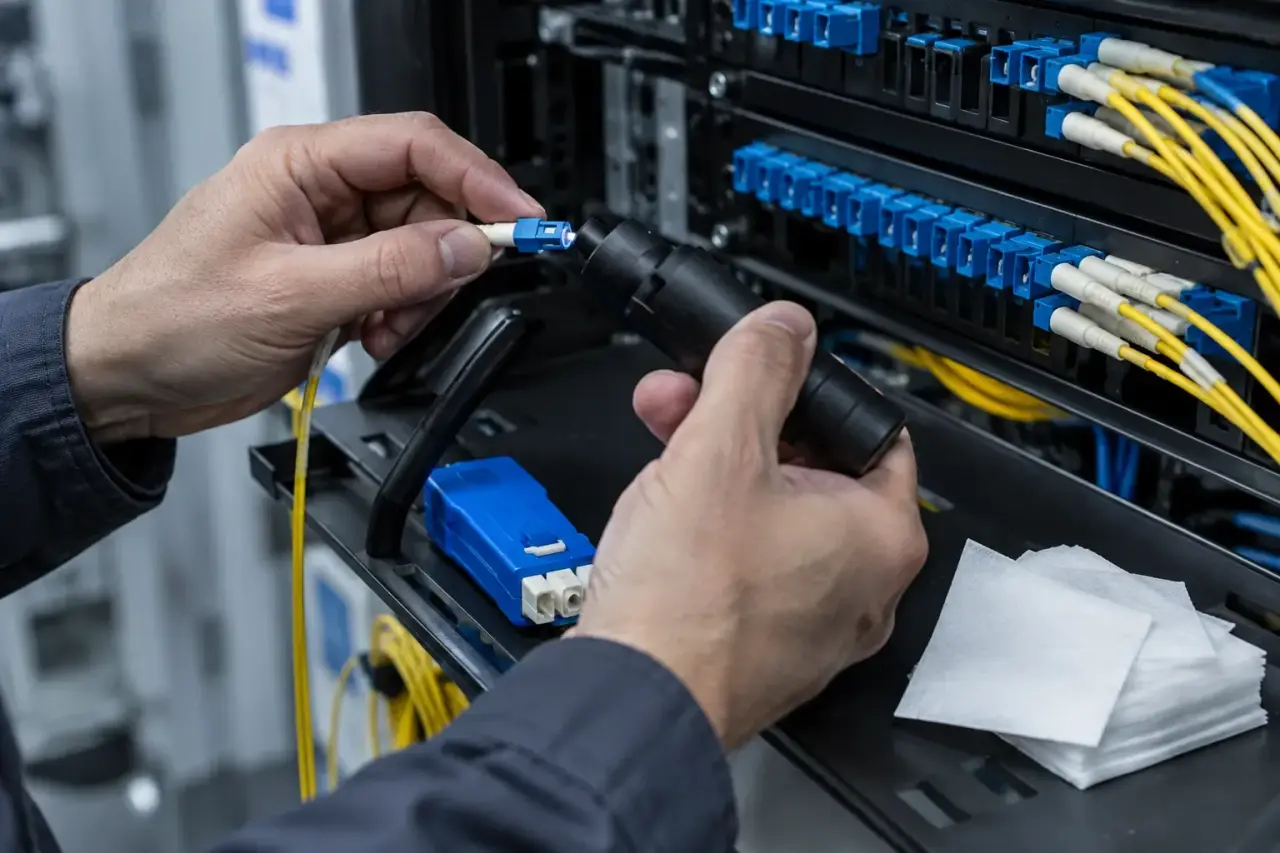
- Termination and Connectorization: Once cables are run, they need to be terminated with connectors that allow them to plug into network equipment. This process, known as connectorization, requires careful preparation of the fiber ends and precise attachment of connectors to ensure optimal signal transmission.
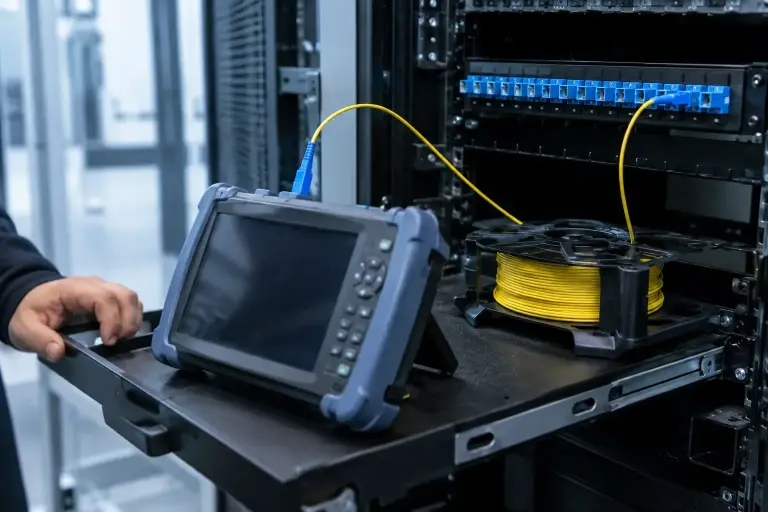
- Testing: After installation, splicing, and termination, extensive testing is performed to verify the network’s integrity and performance. Technicians use specialized tools like Optical Time Domain Reflectometers (OTDRs) to detect flaws, measure signal loss, and ensure the cable meets industry standards. Power meters and light sources are also used to measure signal strength and ensure proper functionality.
- Maintenance and Repair: Fiber optic networks, while robust, can experience issues. Technicians are on call to diagnose problems, which could range from a damaged cable to a faulty connector. They use their testing equipment to pinpoint the issue quickly and then perform necessary repairs, often involving re-splicing or replacing components.
- Documentation: A critical, but often overlooked, responsibility is maintaining accurate documentation of network layouts, test results, and repairs. This ensures that future maintenance or upgrades can be performed efficiently.
- Adherence to Industry Standards: Throughout all these tasks, fiber optic network technicians must strictly adhere to local building codes, OSHA safety requirements, and industry best practices to ensure compliant and safe installations.
Typical Work Environments and Conditions
The work environment for a fiber optic network technician is rarely monotonous. They often find themselves in a variety of settings, both indoors and outdoors, requiring adaptability and physical endurance.
- Indoor Work: A significant portion of their time might be spent within commercial data centers, server rooms, and telecommunications closets. These environments often require meticulous organization, attention to detail, and working in potentially confined spaces. They may also work within office buildings, schools, and healthcare facilities, installing and maintaining fiber connections that serve the internal networks.
- Outdoor Work: When it comes to external plant fiber, technicians might work at construction sites, pulling cable for new builds or trenching for underground installations. They may also be involved in aerial installations, which can mean working at significant heights, such as on utility poles (though this is more common for line installers, some fiber optic work can overlap). This outdoor work exposes them to various weather conditions, from heat and humidity to cold and rain.
- Physical Demands: This is a physically demanding job. Technicians frequently lift and carry equipment weighing around 30 lbs, and sometimes heavier. They often need to climb ladders, steer confined spaces, and spend time bending, kneeling, or stooping. The ability to use their hands to handle, control, or feel objects, tools, or controls continually is paramount.
- Team Collaboration: Most projects involve working as part of a team, coordinating efforts with other technicians, project managers, and sometimes even clients. Strong communication skills are essential for effective teamwork and problem-solving on the job.
Data on telecommunications line installers and repairers (a broader category that includes fiber optic network technicians) indicates that these professionals spend a significant amount of their time: 85% on average, working outdoors and exposed to all weather conditions. Furthermore, the role is highly collaborative, with 81% of their time spent in contact with others. This highlights the blend of independent work and team interaction, as well as the resilience required for the role.
How to Become a Fiber Optic Network Technician
Starting on a career as a fiber optic network technician is a journey that combines formal education with hands-on training and specialized certifications. It’s a field where practical skills are highly valued, making it accessible to individuals from diverse educational backgrounds.
Educational and Training Pathways
While a four-year degree isn’t typically required, a solid foundation of knowledge and skills is essential.
- High School Diploma or Equivalent: This is generally the minimum educational requirement. A strong aptitude in math and science can be beneficial.
- Vocational Schools and Community Colleges: Many aspiring technicians pursue programs at vocational schools or community colleges. These programs often lead to certificates or associate degrees in telecommunications technology, fiber optics, or electronics. They provide foundational theory and hands-on practice, preparing students for entry-level roles.
- On-the-Job Training (OJT): Many employers, including AccuTech Communications, understand the value of practical experience. Entry-level positions, such as Fiber Optic Technician Assistant or Technician Trainee, often involve significant on-the-job training, where new hires learn directly from experienced professionals. This can range from a few months to over a year to gain full competency.
- Apprenticeships: Apprenticeship programs offer a structured path that combines paid on-the-job training with classroom instruction. These programs are an excellent way to gain comprehensive skills and experience while earning a living. You can explore various apprenticeship opportunities to find programs relevant to telecommunications and fiber optics.
The Importance of Industry Certifications
In the competitive world of commercial network infrastructure, certifications are a game-changer. They validate a technician’s knowledge and skills, demonstrate a commitment to professional development, and often lead to better job prospects and higher earning potential.
- CFOT (Certified Fiber Optic Technician): This is arguably the most recognized and foundational certification for a fiber optic network technician. Offered by the Fiber Optic Association (FOA), the CFOT certification signifies a broad knowledge of fiber optics, covering design, installation, operation, and testing. It’s often required or highly preferred by employers. Many professionals obtain this certification by attending an FOA-Approved school, but it can also be achieved through documented industry experience and self-study using resources provided by the FOA.
- ETA (Electronics Technicians Association) Certifications: The ETA offers a range of certifications relevant to telecommunications and fiber optics, including Fiber Optic Installer (FOI) and various specialist certifications. These can complement a CFOT certification, demonstrating expertise in specific areas. The ETA is another highly respected organization in the industry; details can be found on the Association‘s website.
- Specialized Certifications: Beyond foundational certifications, technicians can pursue specialized credentials in areas like fusion splicing, outside plant (OSP) installation, or fiber optic network design (e.g., CFOS/S for Splicing, CFOS/T for Testing, CFOS/D for Design from the FOA). These specializations allow technicians to deepen their expertise and take on more complex projects.
- Preparation for Certification Exams: For those preparing for the CFOT exam, the Fiber U Basic Fiber Optics course is highly recommended. It provides a comprehensive overview of fiber optic theory and practical applications, making it an excellent resource for exam preparation.
For businesses like ours in Massachusetts, New Hampshire, and Rhode Island, hiring certified technicians ensures that our clients receive the highest quality of service and that their network infrastructure is installed and maintained to the most rigorous industry standards.
Essential Skills and Knowledge for Success
Being a successful fiber optic network technician requires a blend of technical prowess and crucial soft skills. It’s not just about knowing how to connect wires; it’s about understanding complex systems, solving problems creatively, and communicating effectively with commercial clients and team members.
Technical Skills
The technical demands of the role are extensive and constantly evolving. A fiber optic network technician must be proficient in a variety of specialized tasks:
- Fiber Optic Cable Preparation: This involves stripping the protective layers of fiber optic cables without damaging the delicate glass fibers within. Precision is key here, as improper preparation can lead to signal loss.
- Splicing Techniques: Mastery of both fusion and mechanical splicing is vital. Fusion splicing, in particular, requires a steady hand and an understanding of specialized equipment to create near-perfect connections between fiber strands.
- Termination Processes: Accurately attaching connectors to fiber optic cables is a critical skill. This includes polishing the fiber ends to ensure optimal light transmission and minimal reflection.
- Testing with OTDRs and Power Meters: Technicians must be adept at using sophisticated testing equipment. Optical Time Domain Reflectometers (OTDRs) are used to analyze the integrity of the fiber, identify faults, and measure distances. Optical power meters and light sources are used to measure the power of the light signal, ensuring it falls within acceptable parameters.
- Understanding Signal Loss: A core concept for any fiber technician is understanding why and where signal loss (attenuation) occurs in a network. This knowledge is crucial for troubleshooting and optimizing network performance.
- Reading Network Diagrams and Blueprints: Just like a builder needs blueprints, a fiber optic network technician needs to interpret detailed network diagrams to understand cable routes, connection points, and equipment locations. This ensures installations are efficient and meet design specifications.
- Working with Different Cable Types: While the focus is on fiber, technicians may also work with copper cables (e.g., Cat5e, Cat6) for certain network segments or as part of a hybrid infrastructure. A comprehensive understanding of various cabling systems is beneficial. You can find more info about network cabling and its different types.
Soft Skills
Beyond technical expertise, certain interpersonal and cognitive skills are indispensable for a fiber optic network technician:
- Critical Thinking and Problem-Solving: Networks are complex, and issues are rarely straightforward. Technicians must be able to analyze problems, identify root causes, and devise effective solutions, often under pressure.
- Attention to Detail: Given the delicate nature of fiber optics and the precision required for splicing and termination, meticulous attention to detail is paramount. A tiny speck of dust or a microscopic scratch can significantly impact network performance.
- Physical Dexterity and Hand-Eye Coordination: The work involves handling small, delicate components and operating precise equipment, requiring excellent dexterity.
- Color Vision: Fiber optic cables are often color-coded to identify individual strands within a bundle. Accurate color vision is essential for proper identification and connection.
- Client Communication (Commercial Focus): For commercial clients in Massachusetts, New Hampshire, and Rhode Island, clear and professional communication is vital. Technicians often need to explain technical issues in understandable terms, discuss solutions, and provide updates on project progress.
- Teamwork and Collaboration: Many fiber optic projects are large-scale endeavors that require coordinated effort. Working effectively within a team, sharing knowledge, and supporting colleagues are crucial for project success.
- Adaptability: The work environment can change rapidly, and technicians must be able to adapt to new technologies, unexpected challenges, and varying work conditions.
Career Outlook: Salary, Demand, and Advancement
A career as a fiber optic network technician offers a promising future, characterized by strong demand, competitive salaries, and clear paths for professional growth. The ongoing expansion of digital infrastructure ensures that these skilled professionals will remain vital to businesses across Massachusetts, New Hampshire, and Rhode Island.
Job Market and Salary Expectations
The job market for fiber optic network technicians is robust and growing. Overall employment of telecommunications technicians, which includes fiber optic roles, is projected to increase by 6 percent from 2022 to 2032. This growth is faster than the average for all occupations, driven by several factors:
- 5G Rollout: The deployment of 5G wireless networks heavily relies on fiber optic infrastructure as its backbone, creating a massive demand for technicians to install and maintain these critical connections.
- Cloud Computing and Data Centers: Businesses increasingly rely on cloud services and data centers, all of which require high-capacity fiber optic networks for fast and reliable data transfer.
- Business Network Upgrades: Commercial entities are continuously upgrading their internal networks to fiber optics to support higher bandwidth demands, enhancing productivity and enabling advanced applications.
When it comes to earning potential, fiber optic network technicians can anticipate competitive salaries. According to the U.S. Bureau of Labor Statistics (BLS), the median annual salary for telecommunications equipment installers and repairers, including fiber technicians, is around $60,000. However, salaries can vary significantly based on experience, location, and specific skills. For instance, Payscale reports that the average hourly pay for Fiber Optic Technicians stands at approximately $24.23, with salaries typically ranging from $17 to $36 per hour, or an annual range from $30,845 to $73,803. In 2024, other sources indicate an average annual pay of around $60,669.
Disclaimer: These salary figures represent national averages and can vary based on specific geographic locations, employer, and individual experience and certifications. While we strive to provide competitive compensation, these figures are not indicative of AccuTech Communications’ specific rates.
What is the career path for a fiber optic network technician?
The journey as a fiber optic network technician doesn’t end after initial training and certification; it’s a career with significant potential for progression and specialization.
- Entry-Level Roles: Many start as Fiber Optic Technician Assistants or Technician Trainees, learning the ropes and assisting senior technicians with installations, diagnostics, and troubleshooting.
- Senior Technician: With experience and additional certifications, technicians advance to senior roles, taking on more complex projects, leading smaller teams, and mentoring junior staff.
- Lead Technician or Team Leader: These roles involve overseeing projects, managing teams of technicians, ensuring quality control, and acting as a primary point of contact for clients.
- Project Manager: Experienced technicians with strong organizational and leadership skills can transition into project management, planning and executing large-scale network deployments for commercial clients.
- Network Engineer or Designer: For those interested in the theoretical and design aspects, a path towards network engineering or design is possible. This involves designing fiber optic infrastructure, optimizing network performance, and integrating new technologies.
- Specialization: Technicians can specialize in areas like data center fiber optics, outside plant (OSP) fiber, emergency repair, or advanced testing and fault location.
- Self-Employment: Some highly experienced technicians choose to become independent contractors, offering their specialized skills directly to businesses.
The foundation laid in understanding structured cabling and fiber optics opens doors to a wide array of opportunities within the telecommunications industry, making it a truly rewarding career choice.
Frequently Asked Questions about a Fiber Optic Technician Career
We often hear common questions from individuals considering this dynamic field. Let’s address some of them:
Is being a fiber optic technician a good career choice?
Absolutely! We believe it’s an excellent career choice, particularly for those who enjoy hands-on work, problem-solving, and being at the forefront of technology.
- High Demand: With the continuous expansion of fiber optic networks driven by 5G, cloud computing, and the need for faster business connectivity, the demand for skilled technicians is consistently strong across Massachusetts, New Hampshire, and Rhode Island.
- Job Security: Fiber optics is a stable and indispensable technology. As long as businesses need high-speed data, fiber optic network technicians will be essential.
- Competitive Salary: As outlined above, the earning potential is competitive, with opportunities for increased income as experience and certifications grow.
- Hands-On Work: If you prefer practical, field-based work over a desk job, this career offers plenty of opportunities to work with state-of-the-art equipment.
- Opportunities for Advancement: The career path is clear, with many avenues for progression into leadership, specialized, or engineering roles.
- Essential Role: You play a vital role in keeping businesses connected and productive, contributing directly to the digital economy.
How long does it take to become a certified technician?
The time it takes to become a certified fiber optic network technician can vary:
- Certification Courses: Many foundational certification courses, like the FOA CFOT, can be completed in a matter of days or a few weeks, providing intensive training and preparing you for the exam.
- Associate Degrees: If you opt for an associate degree program at a community college, this typically takes about two years.
- On-the-Job Training: While certifications can be quick, gaining true competency and experience often takes longer. Many technicians spend 1-3 months on post-employment, on-the-job training to become proficient. The learning process is continuous, as technology evolves.
What is the most challenging part of the job?
Like any skilled trade, being a fiber optic network technician comes with its unique challenges:
- Physical Demands: The job can be physically strenuous, involving lifting heavy equipment, climbing ladders, and working in various postures.
- Working in Diverse Weather Conditions: Outdoor installations mean exposure to all types of weather, which can be demanding.
- Meticulous Attention to Detail: The precision required for splicing and termination means there’s little room for error. A tiny mistake can cause significant network issues, requiring painstaking troubleshooting.
- Troubleshooting Complex Network Issues: Diagnosing and resolving intricate network problems can be mentally challenging, requiring strong analytical and problem-solving skills.
- Varied Work Environments: Technicians often note that you never know what you are walking into when arriving at different commercial client sites. This requires adaptability and resourcefulness to steer unique building layouts and existing infrastructure.
Conclusion
The fiber optic network technician is an unsung hero of our digital age, the architect and caretaker of the high-speed connections that power modern businesses. Their work is vital, ensuring that commercial entities in Massachusetts, New Hampshire, and Rhode Island can leverage the full potential of fiber optic technology for their operations.
This career offers a rewarding blend of technical skill, hands-on work, and continuous learning, with a clear path for professional growth and competitive compensation. As the world becomes increasingly connected, the demand for these skilled professionals will only continue to rise.
For businesses in Massachusetts, New Hampshire, or Rhode Island seeking expert network infrastructure support, partnering with certified professionals is key to ensuring reliable, high-performance communication systems.