
fiber optic technology companies: 10 Powerful Top Picks 2025
The Backbone of Digital Change: Fiber Optic Technology
When you think about what powers our digital world, fiber optic technology companies are the unsung heroes working behind the scenes. These innovative organizations design, manufacture, and deploy those amazing hair-thin glass strands that transmit data at the speed of light. Without them, we wouldn’t have the high-speed internet, 5G networks, data centers, and smart cities we increasingly rely on.
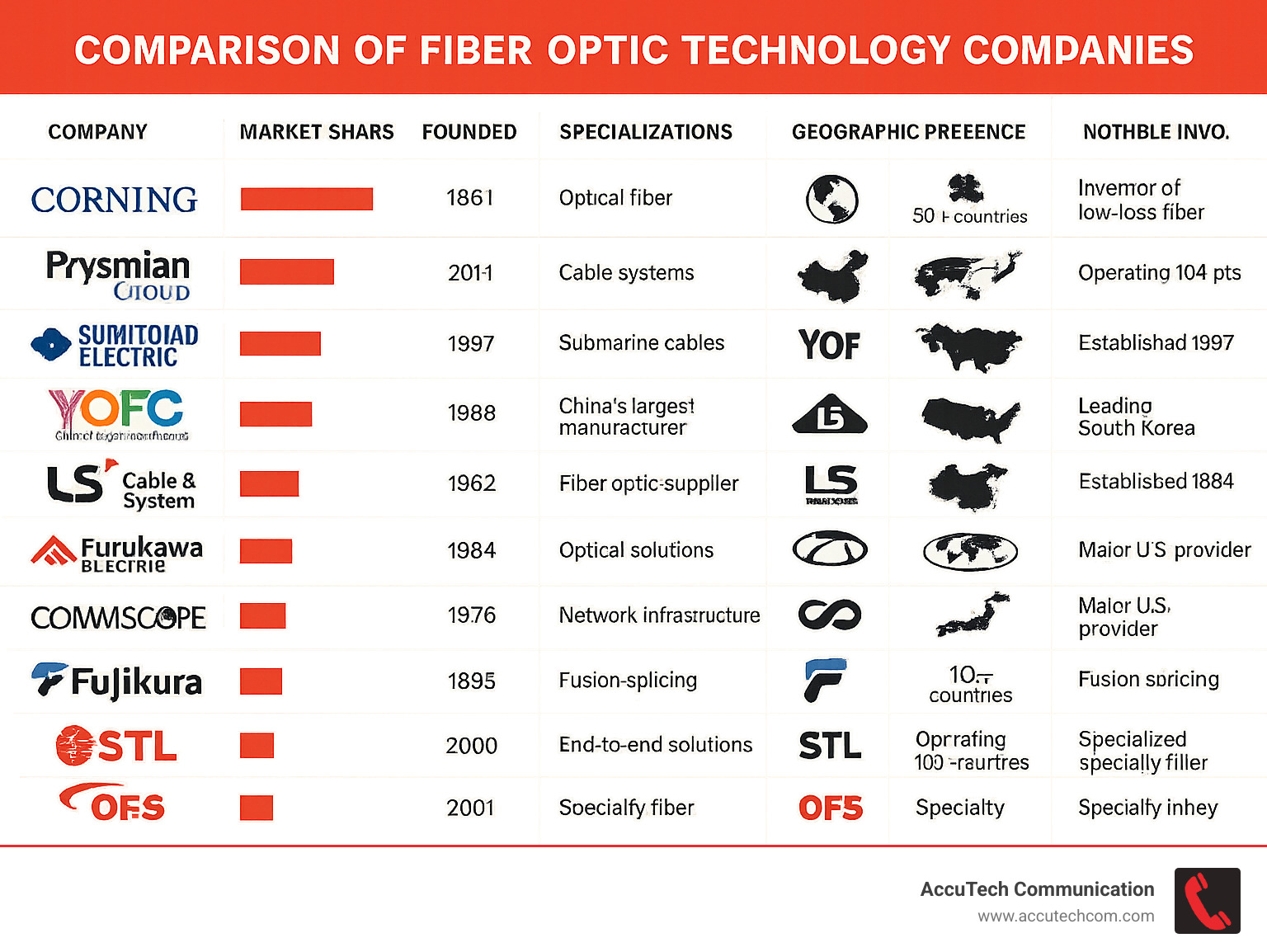
The landscape of leading fiber optic technology companies in 2024 includes global pioneers like the inventor of the first low-loss optical fiber with over 170 years of experience. There are major manufacturers operating in more than 50 countries with numerous manufacturing plants, while others have become renowned for their submarine cable systems.
Other major players include large fiber manufacturers from China, South Korea, and Japan, some established as far back as 1884. In the US, several companies provide comprehensive network infrastructure solutions, while others have pioneered fusion splicing technology. The industry also includes companies with operations in over 100 countries and specialists in optical fiber and connectivity solutions.
The market for these glass-based information highways is booming. We’re seeing explosive growth in the fiber optics sector, which is expected to expand from $3.2 billion in 2024 to a whopping $6.8 billion by 2029. That’s a compound annual growth rate of 16.4%! This remarkable surge reflects just how critical these companies have become in building the infrastructure needed for digital change across all industries.
What truly sets leading fiber optic technology companies apart is their relentless innovation. The best in the business continually push the boundaries of what’s possible in data transmission speed, distance, and reliability. They don’t just make fiber cables – they offer comprehensive solutions spanning the entire ecosystem, from raw glass manufacturing to specialized cable designs that can withstand the harshest environments.
I’m Corin Dolan, owner of AccuTech Communications. Since 1993, we’ve been partnering with leading fiber optic technology companies to design and implement high-performance network infrastructure solutions for businesses throughout Massachusetts, New Hampshire, and Rhode Island. Our decades of experience have taught us which manufacturers deliver the quality and reliability our clients deserve.
If you’re exploring solutions in this space, you might encounter terms like fiber optic cable technology, which refers to the fundamental transmission methods, or fiber optic monitoring systems that help maintain network integrity. Many industries are also adopting fiber optic sensing technology for applications beyond simple data transmission.
As the digital landscape continues to evolve, these fiber optic technology companies will remain at the forefront of innovation, enabling the connections that power our increasingly digital lives. Whether you’re upgrading your business network or building new infrastructure, partnering with the right fiber optic provider makes all the difference in your project’s success.
How Fiber Optic Technology Works
At its core, fiber optic technology is beautifully simple yet in its impact. Unlike traditional copper cables that transmit data via electrical signals, fiber optic technology companies create systems that send information through pulses of light.
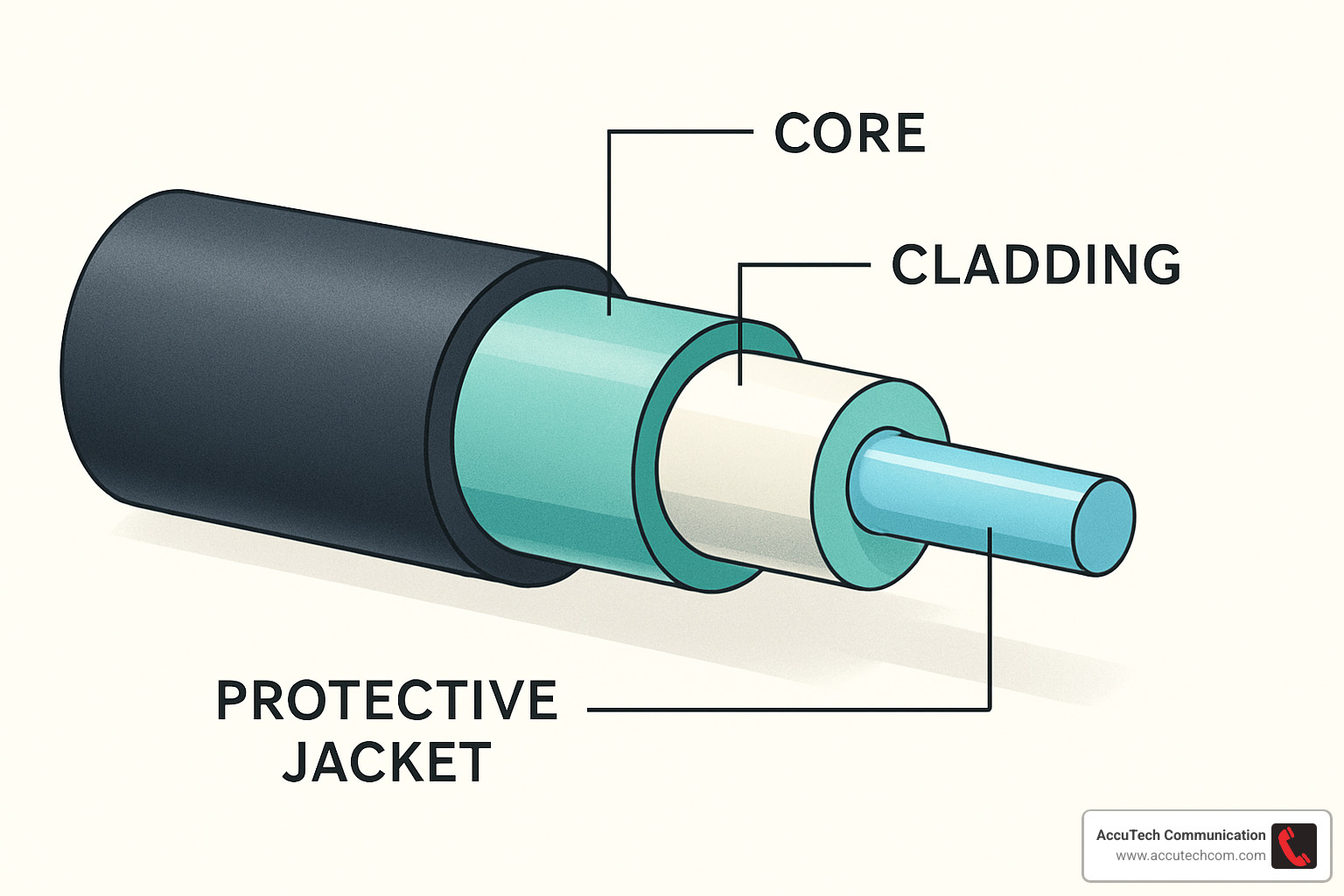
The magic happens through a principle called total internal reflection. Each fiber optic strand consists of an ultra-pure glass core surrounded by a cladding layer with a lower refractive index. When light enters the fiber at one end, it bounces off the cladding boundary at such an angle that it reflects back into the core rather than passing through—creating a light-based highway that can travel for miles with minimal signal loss.
As one engineer from a leading manufacturer (the company that invented low-loss optical fiber in 1970) once told me, “We’re essentially trapping light in a hair-thin glass tube and bouncing it along the walls thousands of times per second to transmit data.” I’ve always found that explanation helps people visualize what’s happening inside these remarkable cables.
This approach offers tremendous advantages over copper. Fiber delivers vastly more bandwidth—up to several terabits per second on a single fiber. Signals can travel much farther before requiring amplification, often reaching distances of many miles. Since light isn’t affected by electromagnetic interference that plagues copper cables, fiber performs flawlessly even in electrically noisy environments. It’s also incredibly secure and difficult to tap without detection, plus the glass doesn’t corrode, allowing properly installed fiber to last decades.
Want to learn more about the fundamentals? Check out our guide on What is Fiber Optic Cabling and Why is it Important?
Single-mode vs Multi-mode Cables
Fiber optic technology companies typically offer two main types of fiber cables, each with specific applications and capabilities:
Single-mode Fiber (SMF) features an ultra-thin glass core (just 9 microns—about a tenth the width of a human hair!) that transmits one light path or “mode.” It uses laser light sources at 1310nm or 1550nm wavelengths and supports transmission over extremely long distances—anywhere from 10 to 200km depending on the specific type. Common standards include OS1 and OS2. With its higher bandwidth capacity, single-mode is typically used for long-haul telecommunications, submarine cables, and carrier networks.
On the other hand, Multi-mode Fiber (MMF) has a larger core diameter (50 or 62.5 microns) that allows multiple light paths to travel simultaneously. It uses LED or VCSEL light sources at 850nm wavelength but is limited to shorter distances—up to 550m for the highest grades. Common standards include OM1, OM2, OM3, OM4, and OM5. While more economical for shorter distances, multi-mode is typically used for data centers, campus networks, and enterprise buildings.
As networks demand ever-higher speeds, we’ve seen a steady progression in fiber standards. OM1 (the original multi-mode standard) is increasingly obsolete for modern applications, while newer standards like OM4 and OM5 support 40/100 Gbps applications.
One industry expert I recently spoke with noted, “Single-mode fiber is the most widely used type due to its ability to transmit data over long distances with minimal loss, making it prevalent in telecommunications and data center applications.”
Key Advantages Delivered by Fiber Optic Technology
The benefits that fiber optic technology companies bring to modern networks go far beyond just speed. When we install fiber for our clients, they’re always amazed by the immediate performance improvements and long-term reliability.
Fiber supports internet speeds up to several terabits per second, enabling real-time applications like telemedicine, cloud computing, and 4K/8K video streaming that would choke traditional copper networks. It’s completely immune to electromagnetic interference (EMI), radio frequency interference (RFI), and electrical surges—making it ideal for industrial environments, healthcare facilities, and areas with electrical equipment.
The distance capability is truly incredible. Single-mode fiber can transmit signals over distances of 40-100km without amplification, compared to copper’s limit of about 100 meters for high-speed applications. This makes fiber perfect for connecting buildings across a campus or linking offices in different parts of town.
Security-conscious organizations appreciate that fiber doesn’t emit signals that can be intercepted, and any attempt to tap the cable typically causes detectable signal loss. This makes fiber the preferred choice for secure communications in financial, healthcare, and government settings.
Perhaps most importantly, fiber infrastructure installed today can support decades of bandwidth growth through equipment upgrades rather than cable replacement—a significant advantage as data demands continue to surge. It’s also more reliable in harsh environments, less susceptible to temperature fluctuations and moisture, resulting in fewer outages and maintenance issues.
At AccuTech Communications, we’ve seen how fiber’s space efficiency—significantly thinner and lighter than copper equivalents—makes installation easier and requires less space in conduits and cable trays. This often translates to simpler, more cost-effective deployments for our clients throughout Massachusetts, New Hampshire, and Rhode Island.
The Role of Fiber Optic Technology Companies in the Digital Age
Fiber optic technology companies are the unsung heroes powering our increasingly connected world. From the sprawling undersea cables linking continents to the fiber lines bringing blazing-fast internet to your doorstep, these companies build the invisible highways that make our digital lives possible.

The importance of these companies has skyrocketed in recent years, thanks to several transformative digital trends reshaping how we live and work.
The cloud computing revolution has fundamentally changed how businesses operate. As more companies shift their operations to the cloud, data centers need massive bandwidth connections that only fiber can deliver. Think about it – every time you access your company’s shared files or use a web-based application, you’re relying on fiber networks to make that happen smoothly and quickly.
Have you noticed how much faster your cell phone connection has become? That’s largely thanks to 5G network deployment, which depends heavily on fiber for backhaul – connecting those cell towers to the core network. A single 5G cell site often needs multiple fiber connections to handle all that data. Without fiber optic technology companies laying this groundwork, your lightning-fast mobile experience simply wouldn’t be possible.
The Internet of Things (IoT) expansion continues to accelerate, with billions of smart devices – from thermostats to industrial sensors – all generating data that needs to be transmitted and processed. Fiber networks provide the robust backbone necessary to handle this tsunami of information.
When the pandemic hit, the remote work change created unprecedented demand for reliable high-speed internet at home. This drove a massive expansion in fiber-to-the-home (FTTH) deployments worldwide. Many families suddenly needed enough bandwidth for simultaneous video conferences, online learning, and streaming – something only fiber could reliably deliver.
Governments around the world have recognized internet access as essential infrastructure through digital equity initiatives. They’re investing heavily in fiber networks to bridge the digital divide, understanding that broadband access is now fundamental for education, healthcare, and economic opportunity.
As a representative from a leading global fiber manufacturer put it: “The hunger for faster, more reliable internet connections keeps growing. Our fiber technologies play a crucial role in 5G infrastructure by connecting antennas and base stations to enable low-latency, high-speed data transfer.”
The market for fiber optic technology companies continues to expand rapidly, with growth projections showing no signs of slowing down. Industry analysts predict the global fiber optics market will grow at a compound annual rate of over 8% through 2030, driven by insatiable demand for bandwidth.
This growth isn’t just about business opportunity – it’s about enabling human connection and innovation. The International Telecommunication Union has highlighted the essential role of fiber infrastructure in achieving global connectivity goals, especially in underserved communities. Scientific research on global connectivity consistently shows that regions with robust fiber deployments enjoy measurable advantages in digital economy development and quality of life.
At AccuTech Communications, we’ve witnessed how fiber optic technology companies have transformed connectivity for our Massachusetts, New Hampshire, and Rhode Island clients. The innovations these companies develop become the building blocks we use to create reliable, future-proof networks for businesses of all sizes.
How Fiber Optic Technology Companies Drive Progress
The leading fiber optic technology companies aren’t just manufacturing cables—they’re powering our digital future through relentless innovation. These companies combine cutting-edge research with practical solutions that transform how we connect.
Research & Development Leadership
Behind every fiber breakthrough is a team of dedicated scientists and engineers pushing the boundaries of what’s possible. Industry leaders invest hundreds of millions in R&D annually, with remarkable results that benefit us all.
Today’s ultra-low-loss fiber designs have cut signal loss to less than 0.17 dB/km—a dramatic improvement from early fibers with losses of 20 dB/km. This means clearer signals traveling much further without needing amplification, connecting communities that were previously out of reach.
“When we developed bend-insensitive fiber, it completely changed installation possibilities,” explains one industry veteran. These newer fibers can turn tight corners without significant signal loss, making installations in homes and office buildings much simpler and more cost-effective.
For specialized environments, fiber optic technology companies have created radiation-hardened fiber that withstands extreme conditions—crucial for aerospace applications, nuclear facilities, and other demanding settings where regular fiber would quickly degrade.
Sustainability Initiatives
The fiber industry is increasingly embracing its environmental responsibility. Leading manufacturers have committed to ambitious carbon reduction targets while developing more recyclable cable designs. Their approach proves that connectivity and sustainability can go hand-in-hand.
Many companies have become known for energy-efficient manufacturing processes that reduce their carbon footprint while maintaining product quality. Meanwhile, others have pioneered eco-friendly coating materials that not only reduce environmental impact but actually improve fiber performance—showing that doing good can also mean creating better products.
These green initiatives are particularly important as global fiber deployments accelerate, ensuring that our digital infrastructure grows responsibly.
Network Densification Solutions
As networks become increasingly dense to support 5G and IoT devices, fiber optic technology companies have responded with clever innovations to maximize space efficiency.
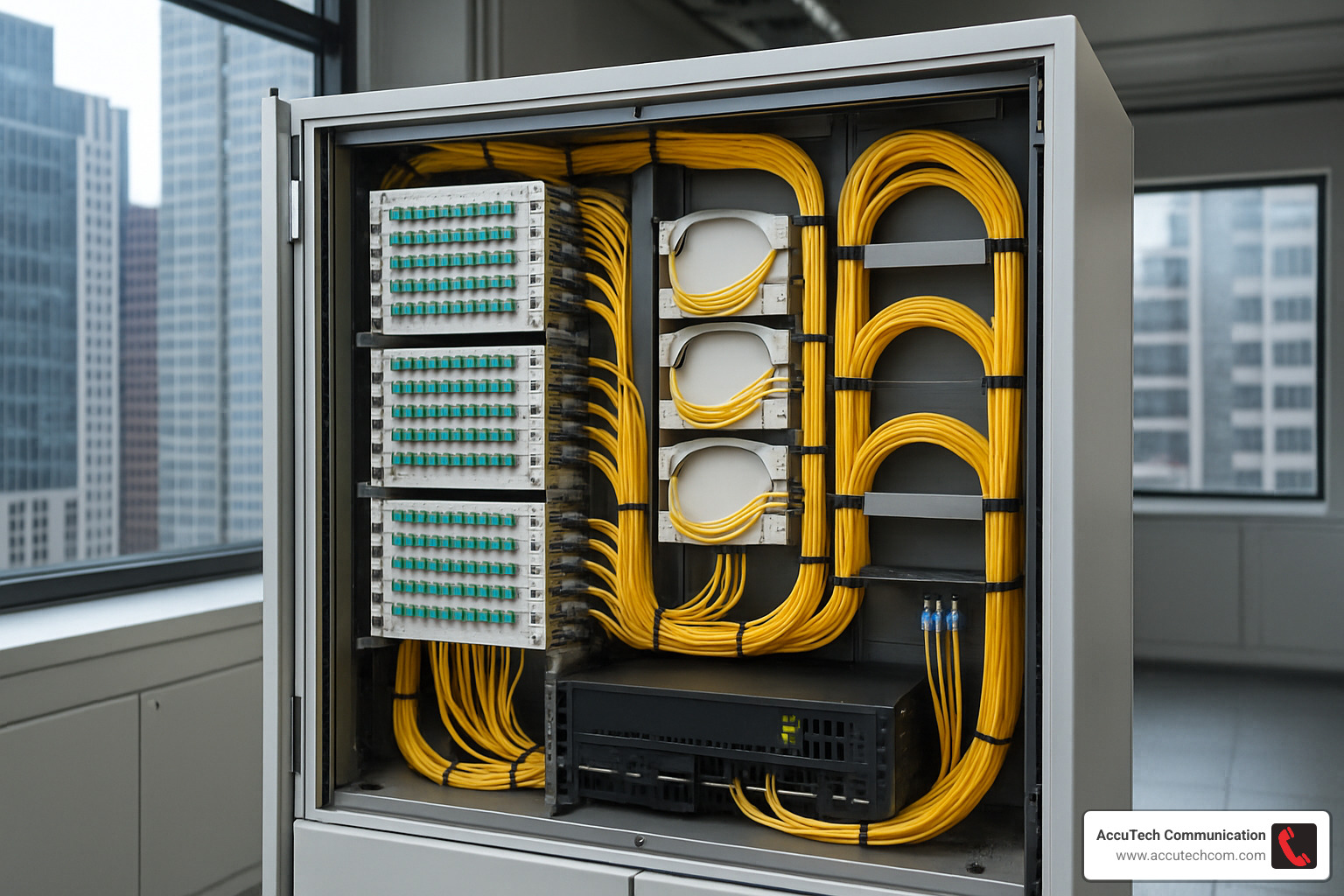
High-density fiber panels now support dramatically more connections in smaller spaces—a critical advancement for data centers where every square inch counts. Modern panels can house hundreds of fiber connections in the same footprint that once held dozens.
The development of microcables and microducts has been equally transformative. These ultra-compact designs allow network operators to maximize capacity in existing conduits, avoiding costly and disruptive construction projects to expand infrastructure.
For indoor applications where appearance matters, solutions like InvisiLight provide nearly invisible fiber installations. These innovative products allow fiber to be installed in historical buildings, luxury apartments, and retail spaces without compromising aesthetics.
Specialized Applications
Beyond standard connectivity, fiber optic technology companies have developed specialized solutions for unique challenges across industries.
Submarine systems represent some of the most impressive engineering achievements, with cables designed to withstand crushing ocean pressures and corrosive saltwater for decades. These undersea highways connect continents with multi-terabit capacity, forming the hidden backbone of our global internet.
In healthcare, ultra-thin fiber bundles enable minimally invasive procedures through endoscopy and precise surgical illumination. These medical applications quite literally save lives while reducing patient recovery time.
Industrial sensing has emerged as another growth area, with distributed fiber systems that detect temperature changes, strain, and vibrations along the entire cable length. These systems monitor pipelines for leaks, assess structural health in bridges and buildings, and provide early warning of potential failures in critical infrastructure.
At AccuTech Communications, we partner with these innovative fiber optic technology companies to bring their cutting-edge solutions to businesses throughout Massachusetts, New Hampshire, and Rhode Island. Our certified technicians stay current with the latest fiber developments, ensuring your installation leverages the most appropriate technology for your specific needs.
Innovations Shaping Fiber Optic Technology
The world of fiber optics isn’t standing still – it’s racing forward with innovations that continually redefine what’s possible in our connected world. Let’s explore the exciting developments fiber optic technology companies are pioneering today.
Hollow-Core Fiber
Remember how traditional fiber uses solid glass cores? Leading manufacturers are turning this concept inside-out with hollow-core fiber where light travels through air instead of glass. This isn’t just a minor tweak – it’s a fundamental rethinking of fiber design with remarkable benefits:
Light travels about 30-40% faster through air than glass, dramatically reducing signal latency – a game-changer for applications where every microsecond counts, like high-frequency trading or quantum computing. The air pathway also minimizes those pesky nonlinear effects that have long limited performance in conventional fiber.
As industry pioneers proudly state, they are “world pioneers in the implementation of hollow core fiber,” collaborating with industry partners on groundbreaking first-of-kind deployments that are opening new possibilities in advanced sensing and ultra-low latency communications.
Coherent Optical Technology
The wizards at various technology companies have developed sophisticated coherent optical systems that are nothing short of magical in their capabilities. These systems use advanced digital signal processing to compensate for fiber impairments while enabling single wavelengths to carry a mind-boggling 1.2 Terabits per second.
To put this in perspective, major telecommunications providers have recently demonstrated transporting 1.2 Terabits of data across a single wavelength using advanced coherent interconnect modules – enough capacity to download the entire Library of Congress in seconds. These technologies are essentially squeezing more data into existing fiber infrastructure through higher spectral efficiency, maximizing the return on installed fiber investments.
Multi-Band Transmission
Traditional fiber systems have typically used only the C-band of the optical spectrum – like only playing the middle octave on a piano. Now, fiber optic technology companies are expanding their range:
They’re utilizing Super C-band and Super L-band technologies to increase fiber capacity by 25% or more without laying new cable. Multi-band systems tap into more of the available spectrum, while advanced wavelength division multiplexing (WDM) technologies can combine over 100 channels on a single fiber strand – like turning a one-lane road into a 100-lane superhighway.
Photonic Integrated Circuits
Just as electronic integrated circuits revolutionized computing, photonic integrated circuits (PICs) are changing optical communications. These remarkable devices integrate multiple optical functions onto a single chip, drastically reducing size, power consumption, and cost while enabling mass production of advanced optical components.
As one photonics researcher put it, “PICs are doing for light what microchips did for electricity.” According to industry research, photonic integration represents a critical pathway for scaling fiber networks to meet future bandwidth demands. Scientific research on photonics impact highlights how these technologies are reshaping telecommunications, sensing, and computing.
How Fiber Optic Technology Companies Enable 5G and Terabit Internet
The 5G revolution wouldn’t be possible without fiber optic technology companies working behind the scenes. These advanced wireless networks fundamentally depend on fiber infrastructure in several crucial ways:
The connection between 5G cell sites and the core network (fronthaul and backhaul) demands massive data capacity – industry experts estimate a single 5G site needs 10 times the backhaul capacity of a 4G site. Meanwhile, 5G networks require many more small cells deployed closer together than previous generations, each needing its own fiber connection.
For applications where every millisecond matters – autonomous vehicles, remote surgery, and immersive augmented reality – the combination of 5G wireless and fiber backhaul creates the ultra-low latency (under 10ms) that makes these services possible. As 5G architectures push computing resources closer to users through edge data centers, high-capacity fiber networks provide the essential connections between these distributed resources.
As one network architect colorfully explained, “Fiber is the oxygen that allows 5G to breathe. Without dense fiber deployment, 5G simply cannot deliver on its promises.”
Sustainability and Green Manufacturing
Today’s leading fiber optic technology companies aren’t just focused on performance – they’re equally committed to sustainability in their operations:
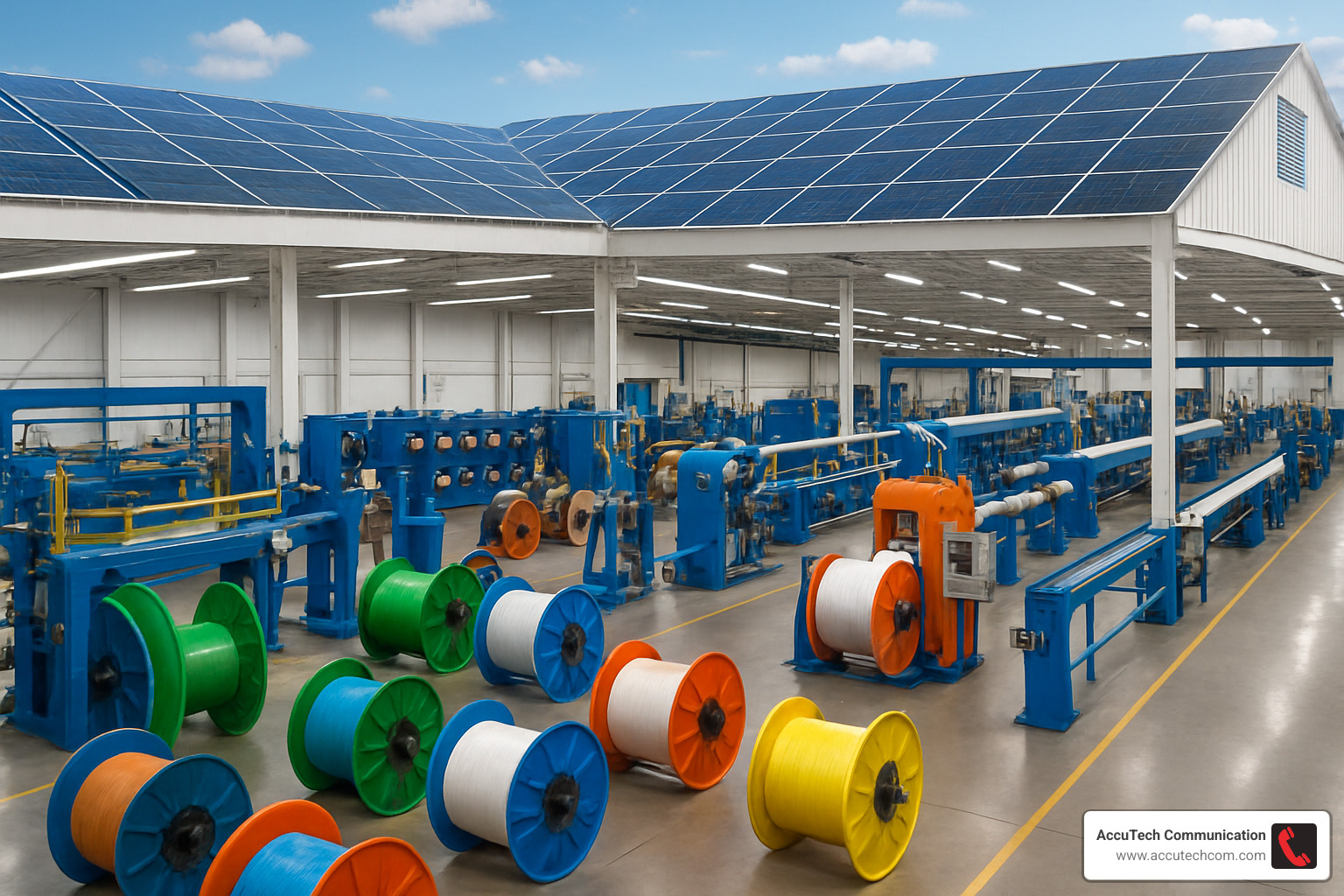
Many major manufacturers have accepted ambitious carbon reduction goals, with industry leaders pledging to reduce Scope 1 and 2 emissions by 30% by 2030. This commitment extends to energy-efficient production processes that consume significantly less energy and water per kilometer of fiber produced.
Innovation in recyclable materials for cable jacketing and packaging has improved end-of-life recyclability, while the inherent power savings of fiber networks compared to copper equivalents becomes increasingly important as global data traffic continues its exponential growth.
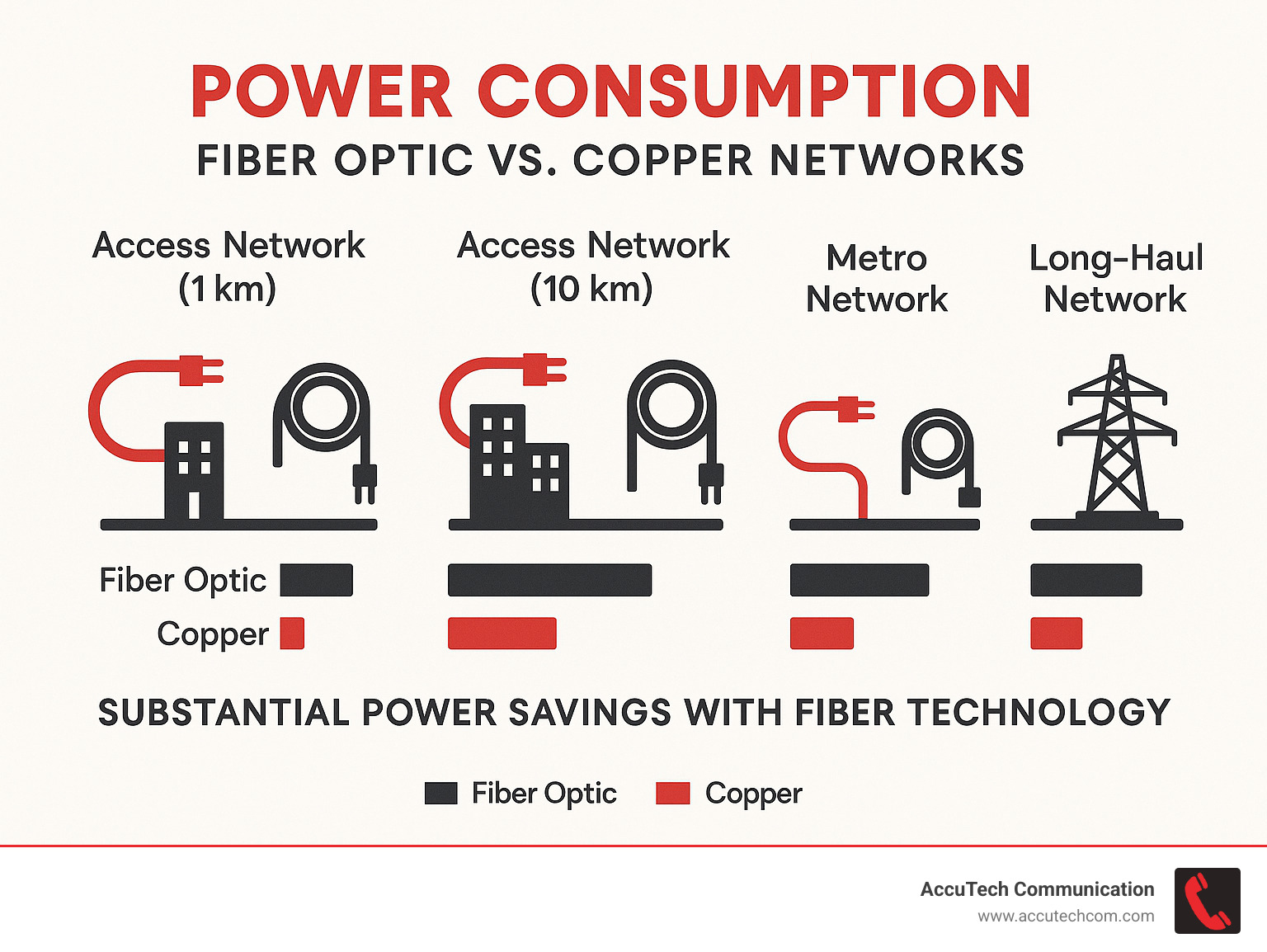
As we see in this comparison, the energy savings from fiber are substantial – not just a minor improvement but a fundamental advantage that compounds as networks grow larger. When you multiply these savings across thousands of network miles, the environmental impact becomes significant.
Choosing the Right Partner in the Fiber Era
Finding the perfect partner to help with your fiber infrastructure isn’t just about technology—it’s about relationship and trust. As you evaluate fiber optic technology companies and installation providers, here’s what truly matters for a successful partnership:
Quality Certifications and Standards
Behind every great fiber installation stands a team with proper credentials. When I meet with clients, I always encourage them to look for providers with recognized industry certifications that signal quality and reliability:
ISO 9001 certification shows a company follows consistent quality management practices—something that translates directly to fewer problems down the road. For telecommunications-specific work, TL 9000 certification adds another layer of confidence.
Safety matters too, which is why UL/ETL listings for components should be non-negotiable. Many of our clients also prefer working with installers who hold manufacturer certifications from industry leaders like Corning, CommScope, or Panduit—this means they’ve been specifically trained on those products.
Testing and Verification Capabilities
The true test of a fiber installation happens after everything’s connected. Professional installers should offer comprehensive testing that leaves no doubt about your network’s performance.
OTDR testing is particularly valuable—it’s like an X-ray for your fiber, showing precisely where any issues might exist along the entire path. Complementing this with power meter testing gives you real-world measurements of actual light loss across connections.
Don’t overlook the importance of detailed certification reports. These documents serve as your proof that every strand meets specifications and become invaluable documentation for future troubleshooting or expansions.
Customization and Flexibility
Your business isn’t cookie-cutter, and your fiber solution shouldn’t be either. The best partners bring industry-specific experience to the table—they understand that a hospital network has different priorities than a manufacturing facility or school campus.
Look for providers with genuine custom design capabilities who ask thoughtful questions about your current needs and future plans. The ability to create scalability planning into your initial design can save tremendous headaches and expense down the road when your needs inevitably grow.
Support and Warranties
The relationship with your fiber partner shouldn’t end at installation. After-deployment support often separates truly excellent providers from the merely adequate ones.
Comprehensive warranty coverage protects your investment, with leading installers offering extended workmanship guarantees beyond manufacturer warranties. When issues arise (and eventually, something always does), having emergency response capability from your provider can mean the difference between minor inconvenience and major disruption.
Don’t underestimate the value of thorough documentation—detailed as-built drawings and fiber maps become essential resources for your IT team and any future work on your infrastructure.
More info about Fiber Optic Cable Installation Companies
Questions to Ask Fiber Optic Technology Companies
When sitting down with potential partners, cut through the sales pitch with these revealing questions:
“What is your typical lead time for projects of our size and scope?” This helps set realistic expectations and allows proper planning.
“How do you handle post-installation support?” The answer reveals whether they view your project as a one-time transaction or ongoing relationship.
“What’s your approach to compliance with local codes and regulations?” Different regions have specific requirements—your partner should steer these complexities confidently.
“How do you build for scalability and future expansion?” Your network needs will grow—make sure your infrastructure can grow with you without requiring complete overhauls.
“Can you provide references from similar projects in our industry?” Nothing speaks louder than the experiences of others in your position.
“What testing protocols do you follow, and what documentation will we receive?” The depth of their answer often reflects the thoroughness of their work.
How AccuTech Communications Can Help
Since 1993, we’ve been designing and installing fiber optic networks throughout Massachusetts, New Hampshire, and Rhode Island with a simple philosophy: do exceptional work that stands the test of time.
Our approach starts with expert network design—our certified designers create custom fiber solutions custom to your specific environment, whether you’re connecting buildings across a campus or deploying high-density cabling within a data center.
Our certified installation team holds credentials from leading fiber optic technology companies and follows meticulous quality protocols. We’re a bit obsessive about details because we know they matter in the long run.
We perform comprehensive testing on every fiber strand—not just the bare minimum—and provide detailed documentation that certifies your network’s performance. This documentation becomes a valuable resource for your team.
Our regional expertise across MA, NH, and RI means we understand local building codes and requirements, ensuring smooth project execution without surprising regulatory problems.
We deliver competitive value by combining enterprise-grade fiber solutions with fair pricing and exceptional service. We’re not the cheapest option, but our clients tell us we provide the best overall value through quality that lasts.
Whether you’re upgrading an existing network or deploying new infrastructure, we’ll guide you through the entire process—from initial design to final certification, with a friendly, no-pressure approach.
Fiber Optic Contractor Near Me
Frequently Asked Questions about Fiber Optic Technology Companies
What industries rely most on these companies?
The digital revolution has made fiber optic technology companies essential partners across virtually every sector of our economy. While fiber’s reach is nearly universal today, certain industries have become particularly dependent on these lightning-fast glass highways.
Telecommunications remains the foundation of the fiber world, with providers relying on these critical connections for everything from undersea cables spanning oceans to the final link reaching your home. The relationship between telecom and fiber is so fundamental that you can’t have one without the other in today’s high-speed world.
Modern data centers have become veritable fiber forests, with massive cable counts often reaching into the thousands. These digital warehouses depend on fiber’s best capacity to move staggering amounts of data between servers and out to the wider world. As one data center manager told me, “Fiber isn’t just part of our infrastructure—it is our infrastructure.”
The healthcare sector has acceptd fiber with particular enthusiasm. Hospitals and clinics rely on these ultra-secure, high-capacity networks to support everything from instant access to patient records to the transmission of detailed medical images and the growing field of telemedicine. When milliseconds can literally save lives, fiber’s speed becomes a critical asset.
Financial services firms were early adopters of fiber technology, particularly for applications where speed translates directly to competitive advantage. High-frequency trading operations, where transactions happen in microseconds, simply couldn’t function without fiber’s minimal latency. Similarly, banks depend on fiber’s inherent security features to protect sensitive transactions.
Education, manufacturing, and defense round out the sectors where fiber optic technology companies have become indispensable partners. From campus-wide networks supporting digital learning to factory floors using fiber for automation and IoT connectivity, these specialized applications demand fiber’s unique combination of speed, security, and reliability.
How do single-mode and multi-mode offerings differ?
The fiber optic world is divided into two main families: single-mode and multi-mode. While both transmit data using light, they do so in fundamentally different ways that make each better suited for particular applications.
The most visible difference between them is physical—single-mode fiber has a tiny core (just 9 microns) that forces light to travel in essentially one path, while multi-mode has a more generous core (50 or 62.5 microns) that allows light to bounce along multiple paths simultaneously.
I like to explain it this way: single-mode is like a single-lane highway where cars must travel in a straight line, while multi-mode is more like a multi-lane highway where cars can change lanes. The single lane allows faster travel over longer distances, but the multi-lane approach can be more cost-effective for shorter trips.
This physical difference creates significant implications for how far your data can travel. Single-mode excels at long distances—up to 200km with the right equipment—making it the backbone of telecommunications networks and connections between cities or buildings. Multi-mode, while more limited in range (typically 550m or less for high-speed applications), remains popular for connections within buildings or across campuses.
Historically, multi-mode systems were less expensive for short distances because they used cheaper light sources (LEDs or VCSELs instead of lasers). However, as fiber optic technology companies have refined their manufacturing processes, this cost gap has narrowed significantly in recent years, making single-mode increasingly attractive even for shorter runs.
When helping our clients choose between these options, we consider not just their current needs but where their network might grow in the future. While multi-mode remains common in enterprise buildings and legacy installations, single-mode has become our go-to recommendation for most new deployments due to its future-proof capacity and increasingly competitive pricing.
Which trends will shape the market by 2030?
The fiber landscape never stands still, and the coming years promise even more dramatic evolution as fiber optic technology companies push the boundaries of what’s possible. Looking toward 2030, several transformative trends are already taking shape.
While we’re still in the midst of 5G deployment, forward-thinking companies are already developing solutions to support future 6G networks. These next-generation wireless systems will demand even denser fiber deployments and higher capacities, creating opportunities for innovations in both fiber design and deployment methods.
The explosive growth of artificial intelligence is creating unprecedented demands on our digital infrastructure. AI and machine learning applications generate massive data flows that require specialized ultra-high-capacity fiber connections between compute clusters. As one network architect explained, “Today’s AI training runs generate more data in a day than some entire networks handled in a year just a decade ago.”
Our cities are becoming increasingly intelligent, with urban infrastructure—from traffic systems to public safety networks—relying on fiber connectivity as its nervous system. This integration creates exciting opportunities for specialized outdoor fiber solutions designed to withstand harsh urban environments while delivering reliable connectivity.
The emerging field of quantum communications represents a particularly fascinating frontier. Quantum key distribution and other quantum technologies rely on specialized fiber infrastructure, creating an entirely new market segment for advanced fiber manufacturers focused on these cutting-edge applications.
Installation methods are also evolving rapidly, with robotics and automation changing how fiber is deployed. These technologies are particularly valuable in challenging environments like sewers, aerial deployments, and inside walls, making fiber installation faster and less disruptive.
Even space isn’t beyond fiber’s reach, as satellite constellations and space stations incorporate more fiber optic systems for internal communications. These applications demand specialized radiation-hardened fibers that can withstand the unique challenges of the space environment.
Throughout all these innovations runs a common thread of sustainability, with fiber optic technology companies increasingly focused on environmentally responsible manufacturing and deployment methods. From less disruptive installation techniques to more recyclable materials, the industry is working to ensure that our digital future doesn’t come at the expense of our planet’s health.
At AccuTech Communications, we stay on top of these emerging trends to ensure our clients’ networks are built not just for today’s needs but for tomorrow’s opportunities.
Conclusion
The digital revolution isn’t slowing down. From streaming services to smart homes, cloud computing to 5G networks – our connected world keeps demanding more from its invisible backbone. And that’s where fiber optic technology companies truly shine, creating not just cables, but the very foundation of our digital future.
Throughout this journey, we’ve seen how the industry leaders set themselves apart. They’re not content with today’s technology – they’re already building tomorrow’s solutions. Whether it’s Corning’s pioneering work in low-loss optical fiber or the cutting-edge developers pushing boundaries with hollow-core technology, these companies constantly redefine what’s possible.
For businesses across Massachusetts, New Hampshire, and Rhode Island, this rapidly evolving landscape can feel overwhelming. How do you choose the right fiber solution when technology keeps advancing? That’s where local expertise becomes invaluable. At AccuTech Communications, we’ve built strong relationships with leading fiber optic technology companies over our three decades in business. We translate their innovations into practical, custom-designed networks that solve your specific challenges.
Think of your fiber infrastructure as the foundation of a house – it needs to be rock-solid because everything else depends on it. When you partner with experts who understand both the technology and your business needs, you’re investing in a network that will grow with you through years of digital change.
Whether you’re connecting multiple buildings on a campus, upgrading your data center, or linking offices across the region, making informed choices about your fiber infrastructure today will pay dividends for years to come. The right fiber network doesn’t just solve today’s connectivity challenges – it prepares you for tomorrow’s opportunities.
AccuTech Communication can guide your fiber deployment
The fiber optic revolution is just getting started. With the right partners by your side, you’ll be ready for whatever comes next.
