Underground & Beyond: Mastering Low Voltage Cable Installation
Why LV Cable Installation is Critical for Your Business
LV cable installation involves setting up wiring that carries 50 volts or less. This cabling is the backbone for most modern business and home systems, transmitting data and signals for internet, security cameras, phone systems, and AV setups.
Because they handle low voltage, these cables are inherently safer and pose a much lower electrocution risk than high-voltage power lines. Proper installation is critical for reliability, ensuring your essential systems operate efficiently and minimize downtime.
This guide covers everything from planning and methods to safety and best practices, helping you build a dependable, future-proof network.
At AccuTech Communications, my team and I have years of hands-on experience specializing in expert LV cable installation and communication solutions across Massachusetts, New Hampshire, and Rhode Island.
Lv cable installation terms made easy:
- how to install low voltage deck lighting
- how to install low voltage deck post lighting
- how to install low voltage lighting
Foundations of Low-Voltage Wiring
Low-voltage cabling is the nervous system of your building, carrying 50 volts or less to keep your devices communicating. Proper LV cable installation is crucial for system efficiency, preventing issues like voltage drops and overheating. It ensures reliability, keeping your operations running without interruption. Most importantly, quality installation is about future-proofing your infrastructure, allowing it to grow with your business as you add advanced security, smart controls, or high-speed fiber.
For more insights, check out our pages on Low Voltage Cabling and The Importance of Professional Cabling Installation for Your Business.
Key Differences: Low-Voltage vs. High-Voltage
It’s easy to confuse low-voltage with standard electrical wiring. Here are the key differences:
- Voltage and Risk: Low-voltage systems operate at 50V or less, making them much safer than high-voltage systems (120V+), which carry a significant electrocution risk.
- Function: High-voltage delivers power to run equipment. Low-voltage transmits data and signals to connect devices.
- Regulation: High-voltage work is strictly regulated by the National Electrical Code (NEC) due to its danger. Low-voltage installation has its own codes but generally faces less scrutiny.
- Installation: High-voltage requires heavy-duty protection like conduits. Low-voltage focuses on signal integrity, organization, and avoiding interference.
Primary Applications in Businesses and Homes
Low-voltage wiring is essential for both businesses and homes, powering the systems that keep you connected and secure.
In business settings, it’s the foundation for:
- Security Systems: Connecting alarms, surveillance cameras, and access controls.
- Business Phone Systems: Supporting both traditional and VoIP setups. Our Business Phone Systems services help businesses stay connected.
- Wi-Fi and Internet: Providing the wired backbone (Cat5e, Cat6) for strong wireless performance.
- Commercial Network Cabling: Creating the structured infrastructure for all your data traffic. Our Commercial Network Cabling services ensure smooth data flow.
- Audio/Video Systems: Ensuring clear presentations and conference calls.
- Smart Building Automation: Connecting lighting, HVAC, and environmental sensors for optimized performance.
Home applications mirror these uses, including security, entertainment, and smart home devices. Since 1993, we’ve delivered certified LV cable installation to meet the unique needs of businesses across Massachusetts, New Hampshire, and Rhode Island.
Planning Your LV Cable Installation Project
Proper planning is the key to a successful LV cable installation, preventing costly fixes and performance issues. The process begins with pre-installation checks and a detailed site survey to identify cable paths and potential interference. We test all materials beforehand to ensure quality, checking everything from cable models to specifications.
A clear project roadmap is essential to avoid pitfalls like interference from high-voltage lines, ensuring an efficient and minimally disruptive installation. For basic checks, a Cat 5 Cable Tester can be a useful tool.
Selecting the Right Cables and Accessories
Choosing the right cable is critical for system performance and longevity. Common options include:
- Cat5e Cables: A standard for Ethernet, supporting speeds up to 100/1000 Mbps.
- Cat6 Cables: An upgrade for faster, more reliable networks, supporting 1000 Mbps at a higher bandwidth.
- Fiber Optic Cables: The best choice for long distances or high-interference areas, transmitting data via light. Our Fiber Optic Cable Installation services can help you implement this technology.
- Other Cables: We also use Coaxial Cables for TV/internet and Speaker Wire for audio systems.
The right accessories, including connectors, patch panels, and cable management hardware, are just as important as the cables themselves. You can learn more about your options by exploring Ethernet Cable Types.
Essential Preparation and Layout Strategy
A smart layout strategy ensures a smooth installation. Key steps include:
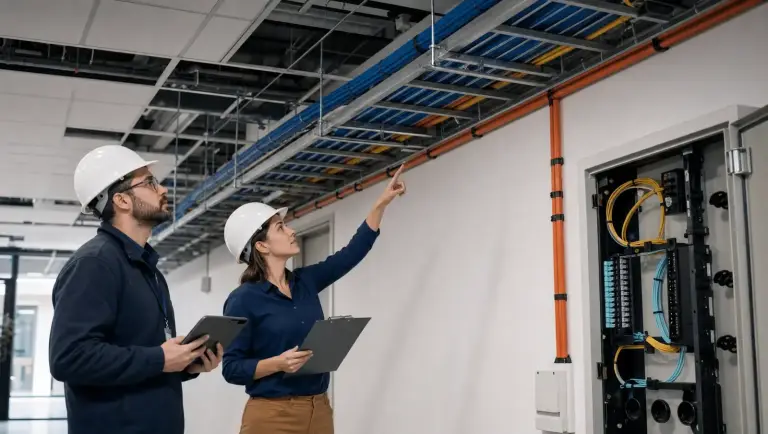
- Mapping Cable Paths: We identify the exact routes cables will take through walls, ceilings, and floors, pinpointing all termination points.
- Avoiding Interference: To prevent signal disruption, we keep low-voltage wiring at least 12 inches away from parallel high-voltage lines and cross them at a 90-degree angle if necessary. We also avoid sources like fluorescent lights and heavy machinery.
- Calculating Cable Lengths: We precisely measure cable runs to avoid waste or shortages, keeping in mind the 100-meter limit for standard Ethernet.
- Labeling Strategy: Proper labeling at both ends of a cable is essential for future maintenance and troubleshooting.
- Designing for Scalability: We plan for future growth by running extra data ports to key locations. This approach saves time and money on future expansions and is central to our Office Cabling services.
Core LV Cable Installation Methods: From Trenches to Conduits
Choosing the right method for your LV cable installation is critical for cost, performance, and future maintenance. The best approach depends on your location, project scope, and specific needs. Here’s a comparison of the main techniques:
| Method | Advantages | Disadvantages | Best-Use Scenarios |
|---|---|---|---|
| Direct Burial | Good heat dissipation, lower cost, large transmission capacity, easy construction. | Prone to external damage, soil corrosion, difficult to add/remove cables. | Urban public areas (parks, sidewalks), residential yards, where excavation is straightforward and future changes are unlikely. |
| Conduit | Excellent protection, easy to add/remove/replace cables, low mutual influence. | Higher cost, poor heat dissipation, requires more space, potential for heat fatigue. | Areas with high traffic, where excavation is difficult, cable crossing areas, future expansion is anticipated, or improved protection is needed. Often used for building entries and within walls/ceilings. |
| Cable Trench | Cost-effective for multiple cables, small laying area, flexible routing, good for maintenance. | Requires cover plate lifting for maintenance, potential for water accumulation. | Urban main roads, substation outgoing lines, parallel sections of voltage levels, areas with multiple cables, cable crossings, or large venues where direct burial isn’t feasible and conduit is too restrictive. |
Method 1: Direct Burial
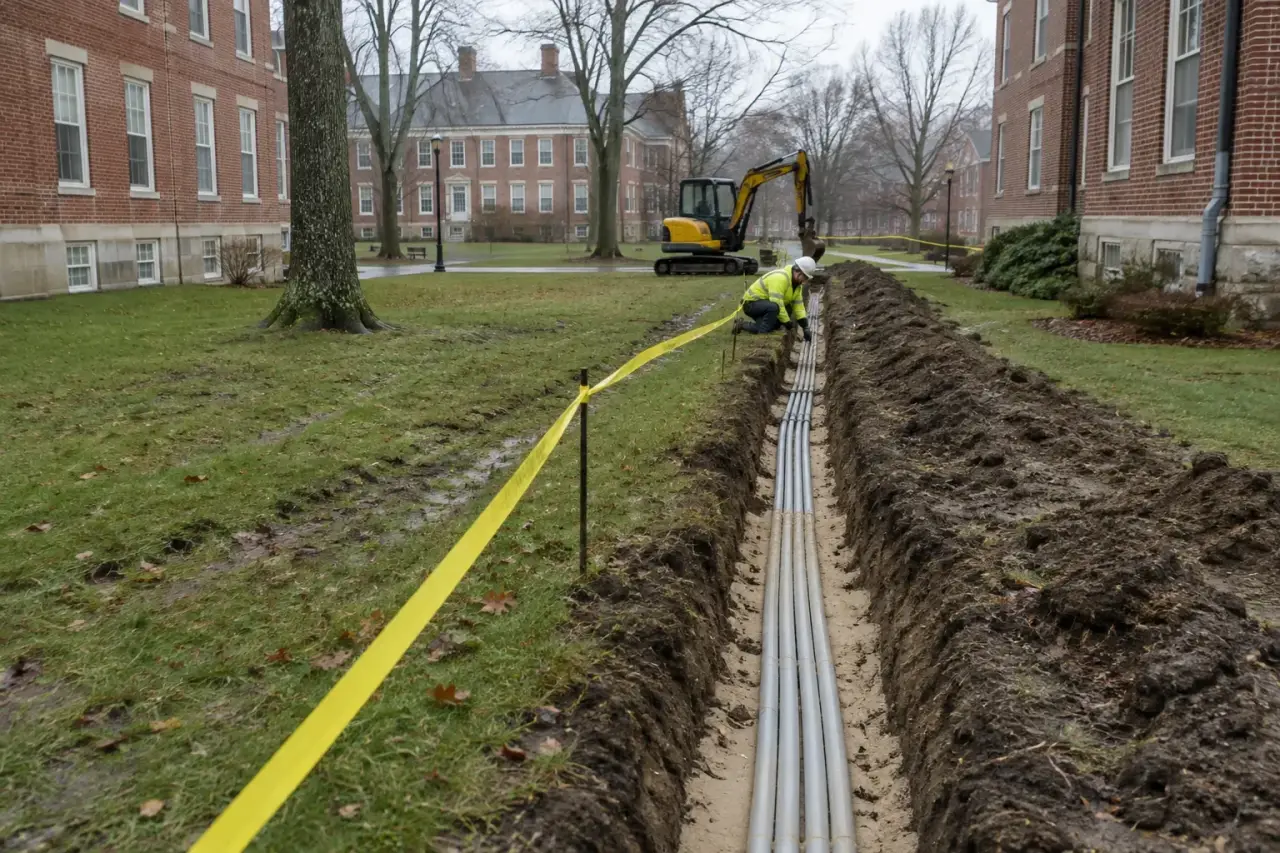
Direct burial is a cost-effective method where cables are placed directly in the ground. The soil provides good heat dissipation, but this method leaves cables vulnerable to physical damage and soil corrosion. It is best for areas where future changes are unlikely.
Proper installation depths are crucial for safety. Typical depths are 450mm (17.7 in) for footways, 600mm (23.6 in) for carriageways, and up to 1200mm (47.2 in) for agricultural land. We use cable protection tape or plastic covers like Stokbord® as a physical warning barrier against future digging.
Method 2: Conduit Installation
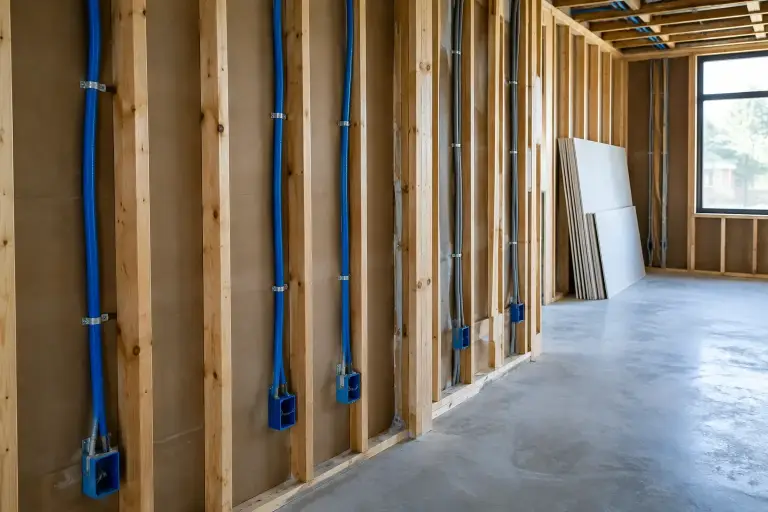
Conduit installation provides superior mechanical protection by running cables inside pipes like EMT, PVC, or flexible Innerduct. This method makes it easy to add, remove, or replace cables later, but it is more expensive and can trap heat.
Key considerations include the conduit fill ratio; we never fill conduits more than 50% to allow for future expansion and prevent overheating. Proper drainage and sealing at entry points are also essential to protect against water and pests. For more details, see our Conduit Installation Guide or our specialized Innerduct Installation Services.
Method 3: Cable Trench
The cable trench method provides a structured, protected pathway for laying multiple cables together. It’s a cost-effective middle ground between direct burial and conduit, ideal for urban main roads, substations, and large venues. While maintenance is accessible, it requires lifting heavy cover plates.
Key technical control points include installing cables on cable brackets (spaced ~80 cm apart) for organization and support. Proper drainage is paramount, with inspection holes and a slight slope to prevent waterlogging. We also implement anticorrosion measures and ensure proper grounding throughout the trench.
Safety, Standards, and Best Practices
Safety is a core principle in every LV cable installation we perform at AccuTech Communications. We adhere strictly to regulatory requirements and industry best practices to ensure the safety of our team and the long-term reliability of your system. Proper installation, following standards like the National Electrical Code (NEC), prevents issues like voltage drops and overheating, leading to fewer breakdowns and lower maintenance costs. For businesses, this commitment to quality is reflected in our Structured Cabling solutions.
We prevent common problems by performing thorough pre-installation checks on all materials and rigorous post-installation testing to certify system performance.
Key Technical Points for LV Cable Installation
Our teams are fully trained and equipped with the right Personal Protective Equipment (PPE) for every job.
Mandatory PPE includes:
- Safety Helmet
- Safety Boots
- Gloves
- Eye Shields/Safety Glasses
- Hi-Vis Clothing
We also follow critical safety procedures, such as only installing cables when the ambient temperature is above 0°C to prevent damage. For in-depth technical guidance, we often consult resources like the 7 Guidelines for Cable Installation.
Best Practices for Cable Handling and Pulling
Proper cable handling is essential for performance and longevity. We follow strict guidelines:
- Pulling Tension: We never exceed the maximum pulling tension (e.g., 25 pounds of force for Ethernet cables) to avoid damaging the internal wires.
- Bending Radius: We adhere to the manufacturer’s minimum bending radius and never bend cables at sharp 90-degree angles, which can cause signal loss.
- Unspooling: Cables are always unspooled from a rolling reel to prevent twists and stress.
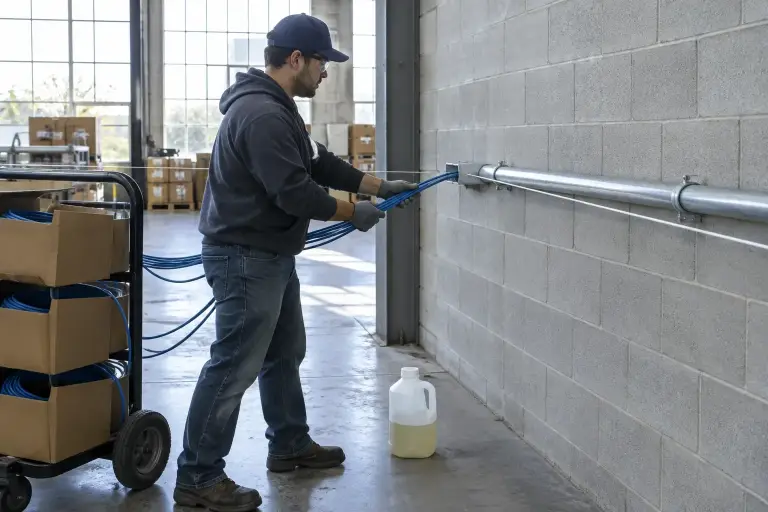
- Strain Relief: We ensure connections are secure and free from tension that could cause damage over time. For long pulls, we use lubricants and rollers to reduce friction.
We also avoid common pitfalls like kinks, over-pulling, sharp bends, running cables parallel to high-voltage lines, and poor labeling. This meticulous approach is key to our high-performance Datacenter Cable Management solutions.
Post-Installation Checks and Cable Management
The job isn’t finished until we’ve completed post-installation checks and management. This guarantees system integrity and simplifies future maintenance.
- Testing: We perform continuity testing with tools like a Network Cable Tester to check for breaks. For data cables, we conduct full performance certification to verify they meet industry standards for bandwidth and signal integrity, ensuring you get the speed you pay for.
- Cable Organization: A well-organized system is efficient and easy to maintain. We use best practices for bundling, labeling every cable at both ends, and using cable trays and raceways to support and protect wiring.
This structured approach minimizes future downtime and makes troubleshooting and upgrades hassle-free.
Frequently Asked Questions about Low Voltage Installation
Here are the most common questions we receive about LV cable installation, with straight answers to help you plan your project.
Does low-voltage wiring need to be in a conduit?
Whether conduit is required depends on local building codes. While the National Electrical Code (NEC) is often relaxed for low-voltage wiring, local rules may be stricter, and permits are often necessary for new construction or major renovations.
Even when not required, we recommend conduit as it provides crucial protection against physical damage. For example, while 12V landscape lighting can often be buried directly at least 6 inches deep, running it through PVC piping prevents accidental damage from lawnmowers or shovels.
Regardless of the method, always keep low-voltage lines at least 12 inches from parallel high-voltage wiring and cross them at a 90-degree angle to minimize interference.
What is the maximum length for a low-voltage cable run?
For copper data cables like Cat5e or Cat6 Ethernet, the maximum effective length is 100 meters (about 295 feet). Beyond this distance, the signal degrades, leading to slow and unreliable network performance.
To extend this distance, network switches or repeaters can be used to regenerate the signal for another 100-meter segment. For very long runs, such as connecting different buildings, fiber optic cables are the ideal solution. They transmit data using light and can cover vast distances with no signal loss.
Can I install low-voltage wiring myself?
While the DIY spirit is great, the answer depends on the project’s complexity.
Simple tasks, like installing a doorbell or basic landscape lighting, can often be handled by a handy homeowner.
However, complex systems for businesses, including networks, security systems, and smart building controls, require professional expertise. Subtle mistakes in pulling, bending, or routing cables can lead to poor performance and system failures. Our professional Data Cable Installation service uses cable testing and certification equipment to verify performance.
Furthermore, many manufacturers’ warranties are only valid if the system is installed by a certified professional. For business-critical systems, professional installation is a wise investment in reliability and peace of mind.
Conclusion
As we’ve seen, proper LV cable installation is about building a reliable foundation for your technology. It’s the unseen hero that powers everything from your internet to your security systems.
We’ve covered the importance of smart planning, from choosing the right cables and installation method to avoiding interference. Above all, safety and adherence to best practices are non-negotiable to ensure a system that performs perfectly for years. While simple tasks can be a DIY project, the complex needs of a business demand a professional touch.
At AccuTech Communications, we understand that your network is the heartbeat of your operations. Since 1993, our team has provided reliable service across Massachusetts, New Hampshire, and Rhode Island, ensuring your infrastructure is built to last.
Ready to build a future-proof network?