Beyond the Wires: Ensuring Reliable Network Cabling for Your Enterprise
Why Data Cabling for Businesses Is the Foundation of Modern Enterprise Networks
Data cabling for businesses is the physical infrastructure that connects every device, system, and application in your organization, from computers and phones to security cameras and cloud services.
If your network feels slow, unreliable, or hard to scale, your cabling infrastructure is likely the root cause.
Here’s what you need to know at a glance:
| Question | Quick Answer |
|---|---|
| What is business data cabling? | A structured system of cables and hardware that carries voice, data, and video across your organization |
| Why does it matter? | Poor cabling causes downtime, slow speeds, and expensive fixes |
| Best cable for most businesses? | Cat6a for new installs; fiber for long runs and high-bandwidth needs |
| How long does it last? | 10-15 years with proper installation and maintenance |
| Who should install it? | BICSI-certified professionals following ANSI/TIA-568 standards |
Most businesses don’t think about their cabling until something breaks. By then, the disruption, dropped calls, failed video conferences, sluggish file transfers, is already costing them time and money.
A well-designed cabling system isn’t just about keeping the lights on today. It’s the backbone that supports every technology upgrade you’ll make for the next decade, from VoIP and IoT devices to AI-driven applications and beyond.
I’m Corin Dolan, owner of AccuTech Communications, and I’ve spent decades helping businesses across Massachusetts, New Hampshire, and Rhode Island design and install reliable data cabling for businesses of all sizes and industries. In this guide, I’ll walk you through everything you need to make smart, future-proof decisions for your enterprise network.
Data cabling for businesses terms made easy:
The Fundamentals of Data Cabling for Businesses
When we talk about data cabling for businesses, we aren’t just talking about plugging a laptop into a wall. We are talking about the “nervous system” of your office. This infrastructure supports your high-speed internet, cloud-based applications, VoIP phone systems, security cameras, and even your smart building controls.
Modern network infrastructure relies on a concept called “structured cabling.” According to our Structured Cabling Definition, this is a standardized architecture for your telecommunications cabling. Instead of a tangled mess of wires running directly from one device to another, a structured system uses a series of patch panels and trunks to create a centralized, organized, and easily managed network.
For businesses in the Metro-west Boston area or up in Manchester, NH, having this foundation is no longer optional. As we integrate more IoT (Internet of Things) devices and AI-driven tools into our daily workflows, the sheer volume of data moving through our walls is skyrocketing. Without a professional install, your hardware, no matter how expensive, will be throttled by poor connectivity.
Structured vs. Point-to-Point Systems
In the early days of networking, many businesses used “point-to-point” cabling. This meant if you added a new server, you ran a cable directly from that server to a switch. While simple at first, this quickly leads to “spaghetti cabling”, a nightmare of tangled wires that makes troubleshooting impossible and blocks airflow in your server room.
By contrast, Structured Cabling provides a standardized layout. It’s like having a well-organized electrical grid for your building rather than running extension cords everywhere. The benefits are clear:
- Reduced Downtime: When a connection fails, a structured system allows us to identify and fix the issue in minutes, not hours.
- Easier Upgrades: Adding ten new employees in a Braintree or Worcester office is as simple as patching them into the existing panel.
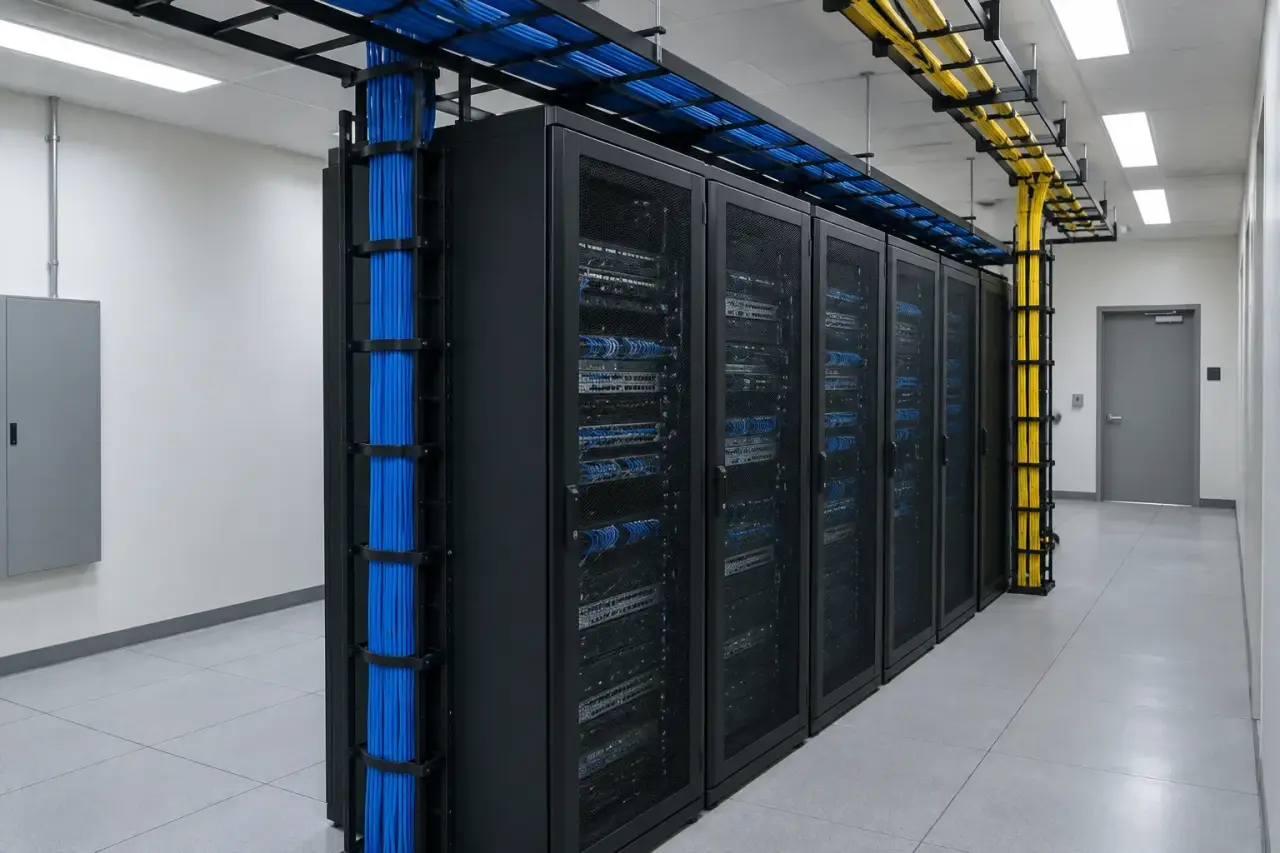
- Better Airflow: Organized cables don’t block the fans in your server racks, extending the life of your hardware.
Key Components of a Professional Install
A complete Cable Infrastructure consists of several critical subsystems. Understanding these helps you plan for growth:
- Horizontal Cabling: This is the wiring that runs from the telecommunications room to the individual outlets at workstations. To maintain signal quality, the maximum length for horizontal cabling is typically 295 feet (90 meters).
- Backbone Cabling: Also known as vertical cabling, this connects entrance facilities, equipment rooms, and telecommunications rooms across different floors or sections of a building.
- Patch Panels: These act as a central hub where all your horizontal cables terminate. They allow for easy “patching” of connections to your switches and routers.
- Work Area Components: These are the final links, the wall plates and patch cords that connect your computers and phones to the network.
Comparing Cable Categories: Cat6 vs. Fiber Optics
Choosing the right cable type is one of the most important decisions you’ll make. It’s a balance between your current speed needs and your desire to avoid re-wiring in three years.
Choosing the Right Data Cabling for Businesses
When assessing What are Ethernet Cables?, you’ll likely encounter these three common copper standards:
- Cat5e: This was the standard for years, supporting speeds up to 1,000 Mbps (1 Gbps). While it’s cost-effective, we generally recommend it only for basic voice applications or very small offices today.
- Cat6: A step up, Cat6 Network Cable supports 10 Gbps speeds at shorter distances (up to 55 meters). It features a higher twist rate and often a physical separator (spline) to reduce crosstalk.
- Cat6a: This is our “gold standard” for new office installations. It supports 10 Gbps at the full 100-meter distance and has a bandwidth of up to 500 MHz. If you plan for your system to last longer than five years, Cat6a is the way to go.
High-Performance Fiber Optic Solutions
For businesses with massive data demands, like medical facilities in Boston or data centers in Rhode Island, fiber optic cabling is essential. Unlike copper, which uses electrical signals, fiber uses light. This offers several game-changing advantages:
- Immense Bandwidth: Fiber can easily handle 10, 40, or 100 Gbps.
- Distance: Fiber can carry signals for miles without needing a signal booster.
- EMI Immunity: Since it doesn’t use electricity, it isn’t affected by electromagnetic interference from fluorescent lights or heavy machinery.
We often utilize Corning Data Center Solutions for backbone connections, ensuring that the link between your server rooms is never a bottleneck.
Industry Standards and Regulatory Compliance
A reliable network isn’t just about the cables; it’s about how they are installed. At AccuTech Communications, we strictly adhere to industry standards to ensure your business stays compliant and safe.
Key standards include:
- ANSI/TIA-568: The primary standard for commercial building cabling, covering everything from cable types to distances and connector pinouts.
- ANSI/TIA-942 Standard: This defines the requirements for data center infrastructure, including spaces like the Main Distribution Area (MDA) and Horizontal Distribution Area (HDA).
- BICSI (Building Industry Consulting Service International): This organization sets the benchmark for professional cabling design and installation.
Ensuring Quality with Certified Technicians
Why does certification matter? Because Low Voltage Structured Cabling is a precision task. If a cable is pulled too hard, the internal twists are ruined, leading to packet loss. If it’s bent too sharply (violating the “bend radius”), you lose signal integrity.
Furthermore, we must follow NEC Article 800 and local fire codes. For instance, in many Massachusetts office buildings, we are required to use “Plenum-rated” cable. This cable has a special fire-resistant jacket that emits less toxic smoke if it catches fire, which is crucial for cables running through air-handling spaces. Following IEEE 802.3 Ethernet Standards ensures that your physical layer is ready to support the latest high-speed networking hardware.
The Strategic Benefits of Professional Installation
Investing in professional data cabling for businesses provides a massive return on investment by preventing the “hidden costs” of a poor network.
Scalability and Data Cabling for Businesses
Your business today won’t be the same as your business in 2030. A professional Network Cabling Installation is designed with “headroom”, extra capacity to handle future tech.
- 5G and Wi-Fi 6/7: Modern wireless access points require high-speed “backhaul” cables (usually two Cat6a lines) to deliver their promised speeds.
- AI and Big Data: As more companies adopt AI-driven analytics, the demand for low-latency, high-bandwidth connections increases.
- Smart Buildings: From smart lighting to HVAC controls, everything is moving onto the IP network.
By using a modular Structured Data Cabling design, we make it easy for you to add new devices or workstations without having to rip open your walls or ceilings every time you hire a new team member.
Planning and Assessing Your Enterprise Infrastructure
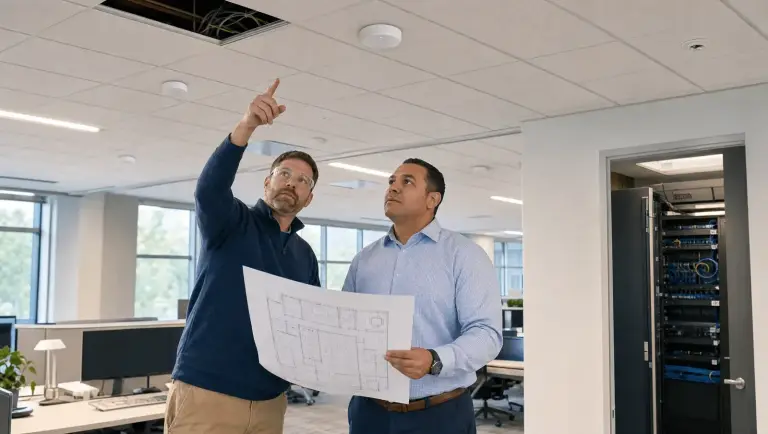
Before we pull a single wire, we perform a comprehensive assessment. This includes site surveys to identify potential interference sources and capacity forecasting to see where your business is headed.
A typical Data Cable Installation process with us looks like this:
- Design: We map out your floor plan, identifying every outlet and the best path for the backbone.
- Installation: Our technicians install the racks, patch panels, and cable runs with meticulous attention to detail and labeling.
- Testing and Certification: We use advanced tools (like Fluke DSX testers) to verify that every single “drop” meets the required performance standards. You receive a full report for your records.
Estimating Costs for Commercial Projects
While we don’t provide fixed quotes without seeing a site, we can look at industry averages to help you budget. Based on publicly available internet data, the average cost for a professional data cabling drop in a commercial setting typically ranges from $100 to $500 per drop.
However, it is important to note that industry variability is high. Complex projects involving high-end fiber optics, difficult wall penetrations, or specific plenum requirements can easily reach $1,500 or more per drop. These figures are sourced from general industry data and do not reflect the specific rates of AccuTech Communications. Every Cabling and Networking project is unique, and we recommend a personalized walk-through for an accurate estimate.
Frequently Asked Questions about Business Cabling
What is the difference between Cat6 and Cat6a?
The primary difference is bandwidth and distance. While Cat6 can handle 10 Gbps up to 55 meters, Cat6a can handle it for the full 100 meters. Cat6a also has better shielding to prevent “alien crosstalk,” making it much more reliable for high-density office environments.
How often should a business upgrade its data cabling?
Generally, a high-quality structured cabling system should last 10 to 15 years. However, we recommend an infrastructure checkup every 2-3 years. If you notice frequent disconnects, slow file transfers, or if you are upgrading to a new 10-Gigabit switch, it might be time for an upgrade.
Why is structured cabling better than wireless for enterprises?
While Wi-Fi is great for mobility, it can’t match the security, reliability, and speed of a wired connection. Wired cabling isn’t susceptible to interference from other devices or physical barriers like walls. For mission-critical tasks, like server access, VoIP calls, and security, wired is always the superior choice.
Conclusion
Your network is only as strong as its weakest link. In many cases, that link is the cabling hidden behind your walls. Since 1993, AccuTech Communications has been the trusted partner for businesses in Massachusetts, New Hampshire, and Rhode Island, ensuring their infrastructure is built to last.
From our headquarters in Massachusetts to our service areas in Boston, Worcester, Nashua, and Providence, we pride ourselves on delivering reliable service. We don’t just “run wires”; we build the foundation for your business’s future success.
Whether you are moving into a new office in Cambridge, expanding your warehouse in Manchester, or upgrading your data center in Warwick, we have the expertise to get the job done right, on time and on budget.
Ready to build a network you can rely on? Request a Quote for Business Network Cabling Services today and let’s discuss how we can future-proof your enterprise.