America’s Digital Backbone: Who Powers It and Why It Matters
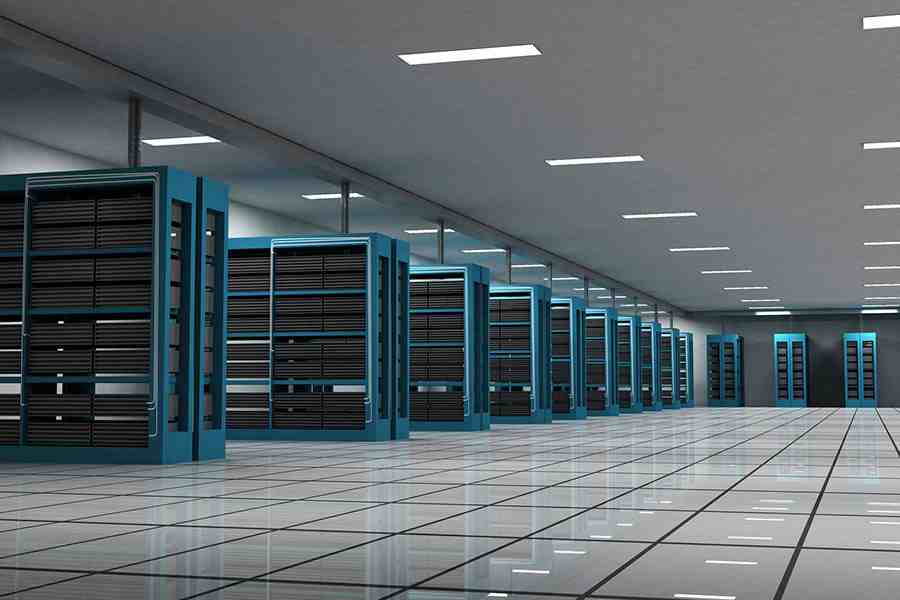
Data center infrastructure companies form the foundation of every cloud app, AI model, and enterprise system running today. And the scale is staggering — as of 2025, there are 2,396 operational data centers in the United States alone, carrying a collective active IT load of 17.2 gigawatts.
If you need a quick snapshot of the leading players, here they are:
| Company | Type | Active U.S. IT Capacity |
|---|---|---|
| Amazon Web Services (AWS) | Hyperscaler | 2.3 GW |
| Meta | Hyperscaler | 1.5 GW |
| Microsoft Azure | Hyperscaler | 1.2 GW |
| Equinix | Colocation | 995 MW |
| QTS | Colocation | 811 MW |
| Digital Realty | Colocation/Wholesale | 686 MW |
| CyrusOne | Colocation | 674 MW |
| Aligned Data Centers | Colocation/Wholesale | 6.4 GW (planned + operational) |
| Vantage Data Centers | Wholesale | ~2.6 GW (global) |
| CoreWeave | Neocloud (AI compute) | Rapidly scaling |
The industry is no longer just about square footage or server racks. AI and high-performance computing (HPC) are pushing power demands to extremes — rack densities are now racing toward 1 megawatt per rack, and entire campuses are scaling from megawatts to gigawatts almost overnight. Amazon alone plans to spend around $200 billion on capital expenditures in 2026, with the bulk going toward AI infrastructure.
For businesses in Massachusetts, New Hampshire, and Rhode Island, understanding this landscape matters — because the physical cabling and connectivity decisions you make today determine how well your infrastructure keeps pace with these shifts.
I’m Corin Dolan, owner of AccuTech Communications, and with over 30 years of hands-on experience designing and deploying commercial network infrastructure across New England, I’ve watched data center infrastructure companies evolve from simple server rooms to AI-ready gigawatt campuses. In this guide, I’ll break down who the key players are, what technologies are reshaping the industry, and what it all means for your local infrastructure decisions.
Discover more about data center infrastructure companies:
Understanding the Landscape of Digital Infrastructure

To evaluate the top data center infrastructure companies, we first have to understand how the digital ecosystem is segmented. The market is no longer a monolithic block of gray concrete buildings filled with generic servers. Today, it is a highly specialized landscape designed to balance massive scale, extreme power densities, and rapid deployment.
The industry measures scale by active IT load (power capacity in megawatts or gigawatts) rather than physical footprint or facility count. This shift reflects the reality of modern computing: a single high-density room can draw more power and deliver more compute than an entire multi-story facility did a decade ago. To learn how this hardware consolidation works at a structural level, you can read Beyond The Hype Understanding Hyperconverged Infrastructure.
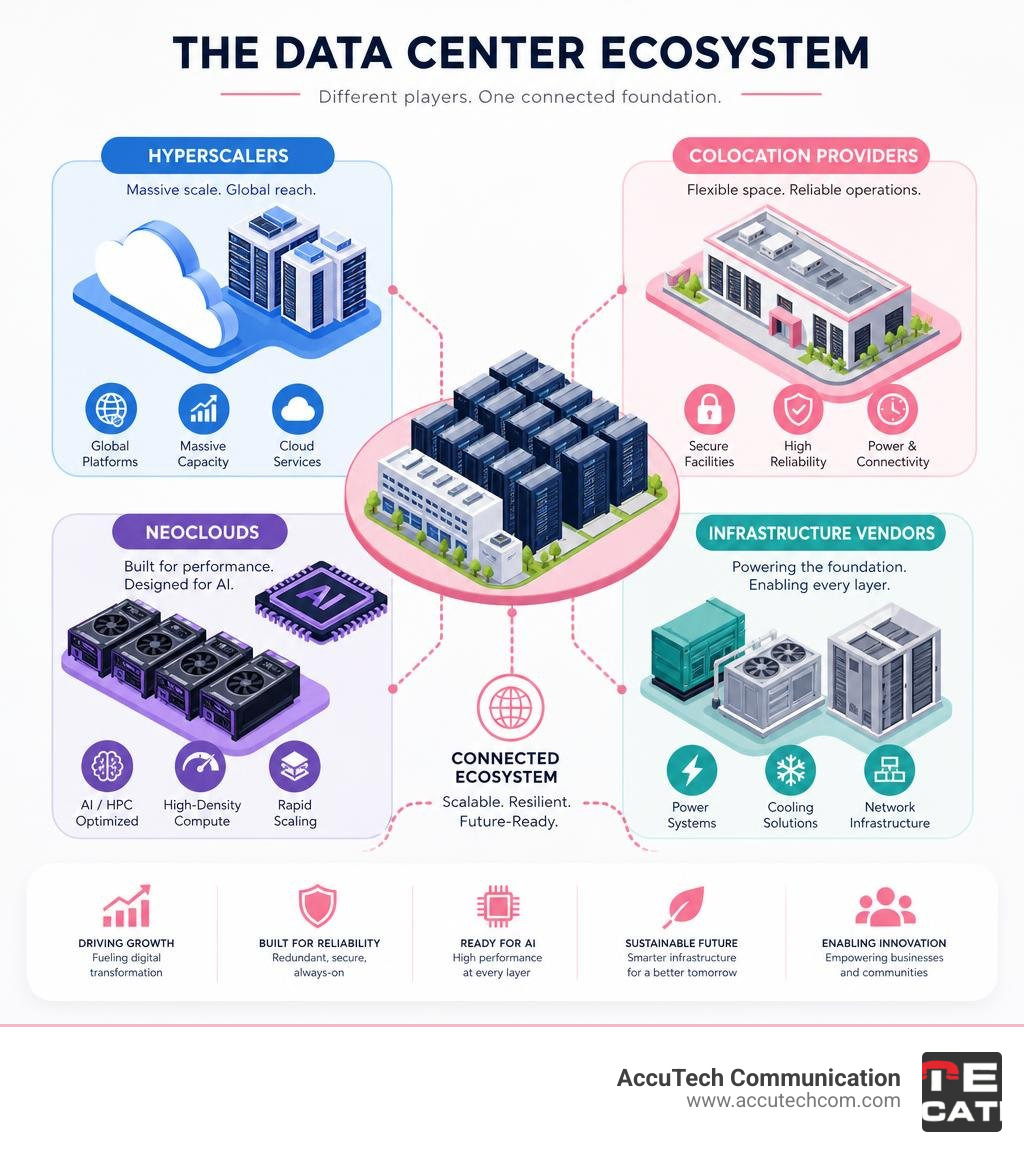
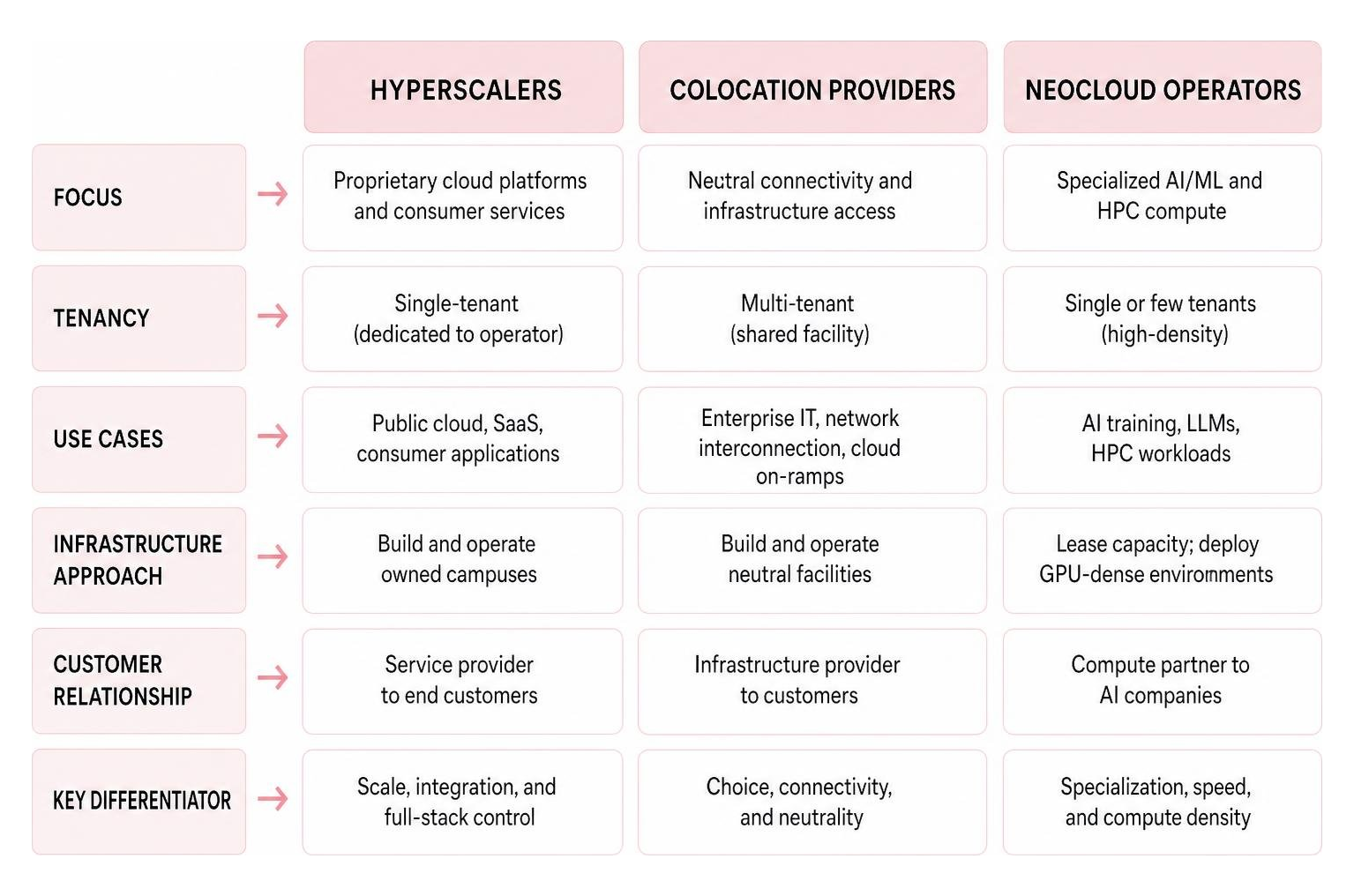
Hyperscalers vs. Colocation Providers vs. Neocloud Operators
The players building and leasing this infrastructure generally fall into three distinct categories, each serving a unique role in how data is processed, stored, and routed:
- Hyperscalers: Giants like Amazon Web Services (AWS), Meta, and Microsoft Azure own and operate massive, dedicated cloud infrastructures. They build gargantuan, single-tenant campuses optimized exclusively for their proprietary cloud services and consumer platforms. Because they control the software stack and the hardware design, they can optimize every variable from the chip to the substation.
- Colocation Providers: Companies like Equinix, Digital Realty, and Aligned Data Centers build multi-tenant facilities where enterprises, cloud providers, and networks lease “white space” (secure data center floor space). Colocation allows businesses to place their physical hardware close to major network hubs and cloud entrance points without the astronomical cost of building a proprietary facility.
- Neocloud Operators: A newer class of specialized AI compute partners, such as CoreWeave, has emerged. These operators do not focus on general-purpose cloud storage. Instead, they build highly specialized, GPU-dense environments tailored specifically for machine learning, large language models (LLMs), and high-performance computing (HPC). To scale rapidly, they often partner with colocation providers rather than building campuses from scratch.
The Shift Toward Gigawatt-Scale AI Factories
The explosion of artificial intelligence has pushed the industry past traditional limits. We are witnessing a transition from standard data centers to gigawatt-scale “AI Factories.” These campuses are built specifically to house GPU superclusters, which require an unprecedented amount of power and specialized cooling.
Consider the scale: major initiatives like the Stargate AI Initiative are treating data centers as critical energy assets, planning sites that scale from 5 GW to 10 GW of capacity. To deploy these systems without years of construction delays, operators are moving away from reactive, component-by-component project builds. Instead, they rely on modular pod architectures — prefabricated, standardized infrastructure units that can be manufactured off-site and assembled rapidly.
This rapid growth is fueling what we call The Data Center Building Boom Are You Ready. For businesses in New England, this boom means that securing reliable physical layer deployment and local connectivity is more critical than ever to avoid being left behind.
Key Players Among Data Center Infrastructure Companies
The market for digital infrastructure is undergoing rapid consolidation. Wholesale data centers — facilities leased to a single large tenant or a small group of high-capacity users — are expanding at breakneck speed. To understand how these wholesale platforms operate, you can explore the services of a premier Data Center & Colocation Provider.
Let’s look closely at the two primary types of companies powering this ecosystem: the operators who run the facilities and the hardware manufacturers who build the critical components.
Leading Colocation and Wholesale Data Center Infrastructure Companies
Several key operators dominate the wholesale and colocation landscape, each bringing distinct competitive advantages:
- Equinix: Operating more than 280 data centers across 77 global markets, Equinix is the gold standard for global interconnection. Their platform hosts over 10,000 customers, including 400+ cloud and network providers. Their primary advantage is their neutral ecosystem; they allow businesses to connect privately and securely to multiple clouds without vendor lock-in. Learn more about their platform at Data Center Company & Enterprise Network Technologies | Equinix.
- Digital Realty: With a massive global footprint of wholesale and colocation campuses, Digital Realty provides the physical scale that hyperscalers and large enterprises need to expand their core IT footprints across major metropolitan hubs.
- Aligned Data Centers: Known for rapid delivery and adaptive design, Aligned manages 87 data centers under management and future development, representing 6.4 GW of planned and operational capacity across 51 campuses. Their competitive edge is their ability to scale infrastructure dynamically while matching 100% of their North American energy load with renewable sources.
- Vantage Data Centers: Backed by strong investment consortiums, Vantage has built a global platform exceeding 2.6 GW of capacity. They specialize in large-scale, standardized wholesale campuses that can deliver operational white space to hyperscalers in six months or less.
Hardware and Component Data Center Infrastructure Companies
Behind the operators are the specialist engineering firms that manufacture the physical systems keeping these facilities online:
- Vertiv: A global leader in critical digital infrastructure, Vertiv specializes in power management and thermal management solutions. As rack densities soar, Vertiv has transitioned from selling individual parts to delivering integrated, prefabricated modular systems that simplify installation and shorten lead times. Discover their story at Vertiv | A global leader in critical digital infrastructure.
- Aivres: This company is a leading provider of server solutions optimized for cloud, enterprise, and AI workloads. They design high-density server configurations, such as multi-node systems packing immense compute power into compact rack spaces, and support advanced platforms like NVIDIA’s Blackwell and Rubin architectures. Explore their hardware solutions at Aivres | Leading Server Solutions for Cloud, Data Center & AI.
- Soeteck: A professional digital power solution provider, Soeteck delivers custom power and cooling systems, including uninterruptible power supplies (UPS), power distribution units (PDUs), and modular containerized data centers designed for rapid deployment and disaster recovery projects. You can view their catalog at Soeteck – Professional Digital Power Solution Provider.
How AI and HPC are Reshaping Infrastructure Design
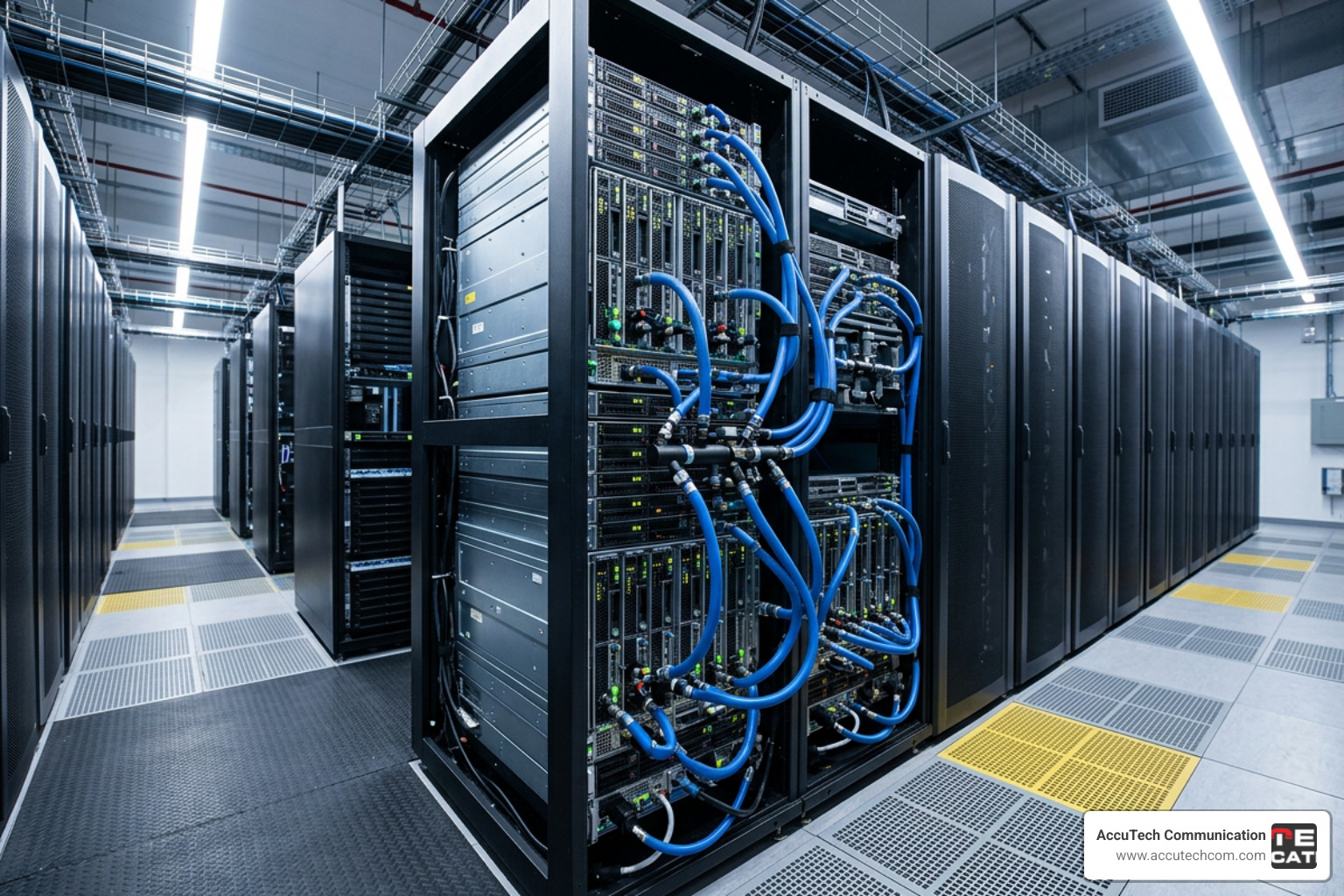
Artificial intelligence and high-performance computing (HPC) are completely rewriting the rules of data center engineering. Traditional data centers were designed for rack densities of 5 kW to 15 kW. Today’s AI workloads demand infrastructure that can support exponentially higher thermal and electrical loads. To see how these cooling architectures are evolving, read about Data Center Cooling Technologies.
Power Density and Extreme Cabinet Loads
Next-generation AI hardware, such as advanced GPU clusters, requires incredible power density. We are seeing rack densities race toward 1 megawatt (MW) per rack. In specialized environments, cabinet power and cooling demands can exceed 2 MW per cabinet.
Managing these extreme loads requires custom silicon integration and highly advanced power delivery systems. Specialist operators, such as those discussed on Switch – The AI, Cloud & Enterprise Data Center Experts, have designed specialized “AI Factories” specifically engineered to handle these multi-megawatt cabinet configurations safely and reliably.
Next-Generation Cooling: Liquid Cooling and Adaptive Airflow
Traditional air cooling is no longer sufficient when dealing with high-density GPU deployments. Air simply cannot transfer heat fast enough to keep modern processors from thermal throttling. This has driven a major shift toward advanced cooling methodologies:
- Liquid-to-Chip Cooling: Delivering coolant directly to a cold plate mounted on the processor, allowing for highly efficient heat transfer.
- Closed-Loop Air-Cooled Systems: Advanced systems that recycle air through internal heat exchangers, significantly reducing or eliminating water consumption compared to legacy open-loop cooling towers.
- Coolant Distribution Units (CDUs): Specialized systems that manage the flow, pressure, and temperature of cooling fluids across high-density racks.
Engineering firms are leading this thermal revolution by providing the specialized equipment needed to sustain these environments. You can view these advanced thermal and power systems at Vertiv Products – Critical Power, Cooling and Other Equipment.
Overcoming Power Constraints and Grid Challenges
The rapid expansion of high-density data centers has created a massive challenge: power availability. With regional power grids facing severe capacity constraints, data center infrastructure companies must innovate to secure the gigawatts of electricity their facilities require. Learn how operators are designing for maximum efficiency in Green Giants How To Build And Operate Energy Efficient Data Centers.
Renewable Energy Sourcing and Grid Integration
To balance their massive energy consumption with corporate sustainability mandates, operators are pursuing creative power procurement strategies:
- Power Purchase Agreements (PPAs): Operators sign long-term contracts to buy clean energy directly from wind, solar, and geothermal developers, helping bring new renewable capacity to local grids.
- Alternative Energy Sourcing: Some forward-thinking operators are securing carbon-free geothermal capacity or partnering with advanced nuclear providers to plan dedicated, on-site gigawatt-scale power generation.
- 100% Renewable Matching: Companies like Aligned Data Centers match 100% of their North American operational load with renewable energy sources, ensuring their rapid growth does not come at the expense of the environment.
Sustainability, Water Conservation, and Community Impact
Building a modern data center requires balancing corporate expansion with local community stewardship. Municipalities are increasingly scrutinizing data center developments for their environmental and social impacts:
- Water Conservation: Legacy data centers used millions of gallons of water daily for evaporative cooling. Modern facilities utilize water-free, closed-loop cooling technologies to eliminate ongoing water consumption.
- Sound Mitigation: High-powered cooling fans and backup generators can be noisy. Operators design facilities with advanced acoustic dampening and sound-mitigating walls to remain quiet, low-profile neighbors.
- Community Contributions: Once constructed, data centers operate as secure, low-traffic facilities. They strengthen local communities by creating high-paying technical jobs, contributing substantial property taxes, and supporting regional education programs.
Regional Infrastructure and Physical Layer Deployment
While global operators build massive campuses, the success of any data center ultimately relies on the physical layer — the structured cabling, fiber optic connections, and physical pathways that carry data from the server rack to the wider world. Without a robust physical foundation, even the most advanced liquid-cooled facility will suffer from latency and downtime. To plan your physical layer correctly, read our guide on Data Center Build Out.
Structured Cabling and Fiber Optic Foundations
Modern high-throughput networks require meticulous physical layer design. To support 40/100 Gig networks and beyond, infrastructure teams must deploy:
- High-Bandwidth Fiber: Utilizing single-mode and multi-mode fiber optic cables to support high-speed data transmission over longer distances. To understand why fiber is the undisputed standard for modern infrastructure, read Why Your Data Center Needs Fiber Speed Distance And Beyond.
- Category 6A (Cat6A) Cabling: Providing reliable copper connectivity for management networks, local patching, and Power over Ethernet (PoE) systems.
- Organized Cable Pathways: Utilizing overhead and below-floor raceways to route thousands of copper and fiber cables systematically, preventing airflow blockages and simplifying future maintenance.
- Meticulous Documentation: Ensuring every fiber termination and copper run is labeled, tested, and documented so that local teams can troubleshoot issues instantly. You can follow our step-by-step framework in the Data Center Cable Installation Complete Guide.
Local Deployment in Massachusetts, New Hampshire, and Rhode Island
For businesses operating in the New England market, digital infrastructure is highly concentrated around key regional hubs. Massachusetts alone is home to a robust network of digital infrastructure, with detailed listings available at Massachusetts Data Center Locations (61).
Key regional hubs include:
- Boston Metro and Surrounding Areas: Serving as the primary economic and connectivity engine of New England. Facilities like the Boston Data Center | Boston Colocation provide critical regional colocation and hybrid-cloud capabilities.
- Andover, MA: Hosting major regional facilities, including the Boston – Andover Data Center, which provide secure, redundant disaster recovery and enterprise hosting for businesses across northern Massachusetts and New Hampshire.
- Marlborough, MA: A critical technology corridor that has grown into a major hub for enterprise data storage and network routing. You can read our complete regional breakdown in The Ultimate Guide To Marlborough Data Center.
For businesses in these areas, partnering with a local physical layer expert who understands New England’s unique building codes, older structural footprints, and regional networking requirements is essential.
Frequently Asked Questions About Data Center Infrastructure
What is the difference between a hyperscaler and a colocation provider?
A hyperscaler (like AWS, Microsoft, or Meta) owns and operates massive, dedicated cloud infrastructure built exclusively for their own services. A colocation provider (like Equinix or Digital Realty) builds multi-tenant facilities where multiple different companies lease secure space, power, and cooling to host their own physical hardware.
Why is liquid cooling becoming necessary for modern data centers?
As AI and HPC workloads push rack densities toward 1 MW per rack, traditional air cooling can no longer dissipate the extreme heat generated by modern GPUs. Liquid cooling delivers coolant directly to the processor or server chassis, providing far more efficient thermal management, preventing hardware damage, and reducing overall Power Usage Effectiveness (PUE).
How do data center operators address power grid constraints?
Operators address grid constraints by securing long-term Power Purchase Agreements (PPAs) with renewable energy developers, utilizing on-site microgrids, investing in Battery Energy Storage Systems (BESS), and exploring alternative, carbon-free energy sources like geothermal energy or advanced nuclear power.
Conclusion
The rapid evolution of data center infrastructure companies highlights a fundamental truth: your software and AI applications are only as reliable as the physical infrastructure supporting them. Whether you are utilizing a massive global colocation platform or upgrading your local server room in Boston, Andover, or Marlborough, success starts at the physical layer.
At AccuTech Communications, we have spent over 30 years delivering certified, reliable, and competitively priced network cabling and data center technology solutions for commercial clients across Massachusetts, New Hampshire, and Rhode Island. We specialize in designing and installing the robust structured cabling, fiber optic networks, and organized cable pathways that keep your business connected to the digital backbone.
Ready to build or upgrade your physical infrastructure? Request an Estimate for Data Center Build Outs with AccuTech Communications today, and let us build a foundation engineered for the future.