Boston’s Data Center Building Boom: Who’s Building and Why It Matters
If your business is evaluating a data center build out in Boston, MA, here’s a quick look at the top builders and operators active in the region right now:
| Provider | Location | Facility Size | Key Strength |
|---|---|---|---|
| CoreSite (BO1) | Somerville | 273,000+ sq ft | High-density, hyper-connected colocation |
| Equinix (BO2) | Boston metro | Multiple sites | AI-ready interconnection, Fortune 500 reach |
| Iron Mountain (BOS-1) | Northborough | 22,000 sq ft | LEED Gold certified, 58.3-acre campus |
| Markley Group | Lowell | 350,000 sq ft | Massachusetts’ largest data center |
| Digital Realty | Boston metro | Multiple sites | Global scale, enterprise colocation |
Boston has quietly become one of the most important data center markets in the United States. The metro area ranks as the 9th largest in the US by GDP putting it in the company of cities like Chicago and Dallas when it comes to digital infrastructure demand.
The numbers tell a clear story. There are currently 51 data centers operated by 26 providers across the Boston metro area. And demand is only accelerating — driven by AI workloads, cloud computing, and the region’s massive concentration of biotech, finance, and research institutions.
But building here isn’t simple. Communities in Lowell and Everett have pushed back hard against new facilities. One neighbor famously described living next to a data center as hearing “a constant rumbling, like an idling jet.” Lowell even passed a one-year moratorium on new data center development. Zoning rules, environmental concerns, and power grid capacity are all live issues for anyone planning a build-out in Massachusetts today.
That’s exactly why choosing the right infrastructure partner — one who understands the local landscape — makes all the difference.
I’m Corin Dolan, owner of AccuTech Communications, and I’ve been helping commercial clients across Massachusetts plan and execute data center build out in Boston, MA and throughout New England since 1993. In the sections below, I’ll walk you through everything from site selection and cabling standards to regulatory hurdles and sustainability requirements.
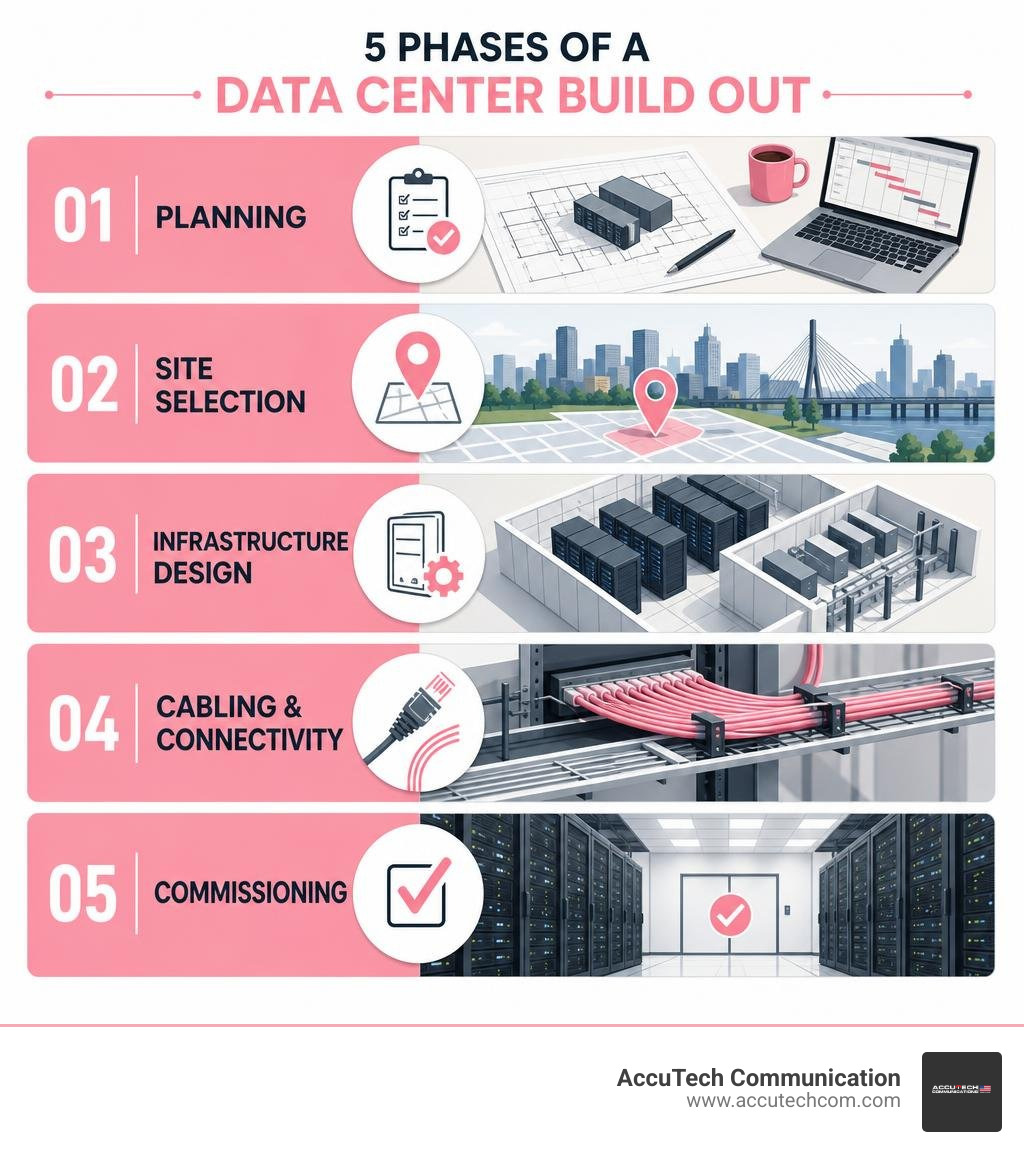
Data center build out boston ma terms simplified:
Key Considerations for a Data Center Build Out in Boston MA
When planning a Data Center Build Out, the Boston metro area offers a unique mix of advantages and challenges. The region’s thriving digital economy is fueled by world-class universities, a massive tech talent pool, and a booming life sciences sector. However, the physical realities of building in New England require careful strategic decisions from day one.
One of the first decisions any enterprise faces is choosing between colocation, wholesale, or custom-built private facilities. Because land in dense urban areas like Cambridge and downtown Boston is scarce and expensive, many organizations look to suburban submarkets like Northborough, Andover, or Billerica, where larger footprints and scalable power are more readily available.
Additionally, the workforce pipeline is a major driver of data center investment here. With over 100 colleges and universities in the Boston metro area, operators have direct access to highly skilled engineers, network architects, and technicians. This talent density is critical for managing the sophisticated physical security, complex networking, and high-density power requirements of modern deployments.
Planning Your Data Center Build Out in Boston MA
A successful build-out begins with rigorous site selection. In Massachusetts, this means analyzing the local power grid, utility capacity, and fiber path diversity. The New England grid has its own unique reliability and pricing structures, making energy efficiency a top priority.
When evaluating potential sites, we must look at:
- Power Grid Proximity: Access to redundant utility feeds (N+1 or 2N redundancy models).
- Fiber Paths: Proximity to major carrier routes and internet exchange points (IXPs).
- Environmental Risks: Boston’s coastal location requires structural resilience against severe winter weather and hurricane-rated wind profiles.
To understand how regional dynamics shape these projects, check out our guide on Beyond the Bean: Unpacking Data Center Services Across New England.
Colocation, Wholesale, and Hyperscale Models
The model you choose dictates your infrastructure requirements:
- Colocation Suites: Ideal for enterprises that want to lease space (cabinets, cages, or private suites) within a shared facility. This model reduces capital expenditure while offering access to dense carrier ecosystems.
- Wholesale Deployments: Larger enterprises lease entire data halls or buildings, giving them greater control over power configuration, cooling, and security.
- Hyperscale Demand: Driven by massive cloud providers and AI companies. While true hyperscale campuses (like the massive 240MW campuses built in Southwest markets like Phoenix) are rare in dense New England, regional hyperscale nodes are increasingly being deployed to keep latency low for Northeast users.
To see how global networks interconnect in our region, explore Boston Data Centers | Internet Exchange Point & Colocation … .
Infrastructure and Technical Specifications for Modern Facilities
Modern data centers are no longer just rooms filled with servers; they are highly specialized environments designed to support dense, compute-intensive workloads. As we look at data center builds in 2026, the technical specifications have evolved rapidly to keep pace with high-performance computing.

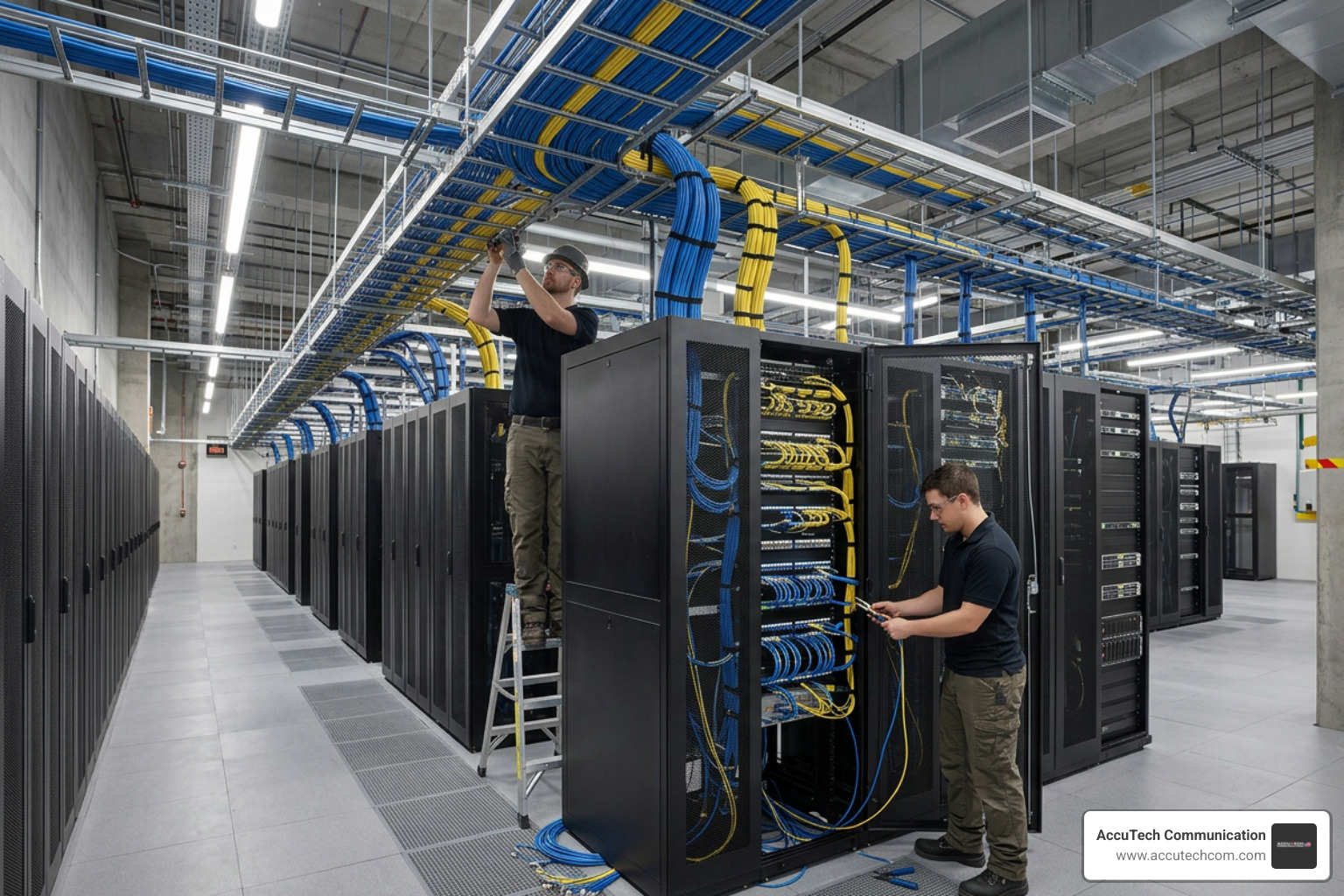
To support these complex environments, physical layer infrastructure must be flawless. High-density power distribution, advanced cooling, and structured cabling are the backbones of any modern facility. Without precise design, even the most advanced hardware will suffer from latency, packet loss, or thermal throttling. Our team specializes in designing and installing these high-performance systems to ensure maximum uptime. Learn more about our approach to Data Center Cabling Services.
Technical Standards for a Data Center Build Out in Boston MA
The physical cabling infrastructure is the nervous system of the data center. Modern builds rely on a mix of high-performance copper and fiber optic cabling:
- Category 6A / 10X Systems: Copper cabling designed to support speeds up to 10 Gbps and bandwidth up to 500 MHz, offering vital shielding against electromagnetic interference (EMI) in high-density rack environments.
- Single-Mode Fiber (SMF): Featuring a narrow core of 8-10 microns, SMF uses laser light to transmit data over long distances (often greater than 10 miles) with virtually zero signal degradation. This is crucial for linking facilities or connecting to subsea cable landing stations.
- Multi-Mode Fiber (MMF): Utilizing a wider core (62.5 microns or larger), MMF is perfect for high-bandwidth, shorter-distance runs (up to 10 miles) within the data center, connecting switches, routers, and server racks.
For a deeper dive into cabling architecture, refer to our Data Center Cable Installation Complete Guide.
AI-Ready and High-Density Workloads
The rise of AI has pushed average rack densities from 5–10 kW up to 20 kW or even 40+ kW per cabinet. Standard air cooling cannot keep up with these thermal loads. As a result, modern build-outs frequently incorporate:
- Liquid Cooling Capabilities: Direct-to-chip or immersion cooling systems that transfer heat far more efficiently than air.
- Low-Latency Interconnection: Direct, physical cross-connects to cloud partners and financial networks.
- Subsea Cable Access: Direct links to subsea transatlantic cables (such as Hibernia Express or Amitié/AEC-3) to provide ultra-low latency connections to European markets.
To see how these high-density, resilient standards are put into practice, view the specifications for the Boston Data Center | Boston Colocation | Iron Mountain United States .
Navigating Regulatory, Zoning, and Environmental Challenges in Massachusetts
Building a data center in Massachusetts requires navigating a complex web of local regulations, community expectations, and environmental standards. Municipalities are increasingly scrutinizing these projects, making early community engagement and smart engineering non-negotiable.
In cities like Lowell and Everett, local opposition has grown due to concerns over noise pollution from massive cooling systems and emissions from emergency backup diesel generators. For instance, Lowell’s recent moratorium on data center development highlights the friction between digital infrastructure needs and residential quality of life. To understand the community perspective and operational realities of these facilities, you can Take a rare look inside the largest data center in Massachusetts … .
Sustainability and Energy Efficiency
Data centers are massive consumers of resources. In 2024, U.S. data centers consumed as much energy as the entire country of Pakistan, and that demand is projected to more than double by 2030. To mitigate this impact, operators in Massachusetts are adopting aggressive sustainability initiatives:
- LEED Gold Certification: Building facilities with sustainable materials, energy-efficient lighting, and optimized airflow containment.
- Waterless Cooling Systems: Traditional cooling towers can consume millions of gallons of water daily. Modern builds utilize closed-loop, waterless cooling systems to preserve local municipal water supplies.
- 100% Renewable Energy Matching: Procuring green power or purchasing renewable energy certificates (RECs) to offset carbon footprints.
If you want to build a facility that balances performance with environmental responsibility, read our guide on Energy Efficient Data Centers.
Urban Renovation and Construction Logistics
In dense, historic urban areas like Cambridge and Boston, building a brand-new facility from the ground up is often impossible. Instead, many projects focus on renovating existing structures.
These urban renovations present extreme logistical challenges:
- Occupied Facilities: Upgrading MEP/FP (Mechanical, Electrical, Plumbing, and Fire Protection) systems while existing tenants (like telecom carriers) remain fully operational requires surgical precision.
- Zero-Lot-Line Sites: Construction adjacent to busy city streets or municipal buildings means there is no room for staging equipment, requiring highly coordinated, phased logistics.
- Dewatering and Structural Upgrades: Historic buildings often require creative dewatering solutions for below-grade excavation and structural reinforcement to support heavy backup generators and battery systems.
A prime example of this complex urban engineering can be seen in the recent multi-phase upgrades of mission-critical facilities in Cambridge. You can read about how builders overcame these tight spatial constraints here: Nauset Construction Completes Kendall Square Data Center Renovation | Cambridge, MA Patch .
Frequently Asked Questions About Boston Data Centers
What are the average costs for a data center build out in Boston MA?
Disclaimer: The pricing details mentioned below represent average industry costs compiled from publicly available online data. They do not represent the actual pricing or guaranteed rates of AccuTech Communications.
The cost of a data center build-out in the Boston market varies wildly based on tier rating, power density, and whether you are renovating an existing urban space or building a suburban shell. On average, industry data shows that light commercial server room renovations can start around $150 per square foot, while high-density, highly redundant Tier III or Tier IV enterprise facilities can exceed $1,500+ per square foot at the high end. This wide range reflects the immense variability in HVAC cooling systems, backup power generation, and structural reinforcement costs.
What compliance standards must Boston data centers meet?
Depending on the industries they serve (especially Boston’s massive biotech, healthcare, and financial sectors), local data centers must comply with several strict standards:
- SOC 1 Type II & SOC 2 Type II: Verifies operational security, availability, and processing integrity.
- HIPAA: Essential for life sciences and healthcare clients storing patient data.
- PCI DSS: Required for financial and e-commerce companies processing credit card transactions.
- ISO 27001 / NIST 800-53: Global standards for information security management and federal-grade security controls.
How do Boston data centers handle high-density cooling?
To manage the intense heat generated by modern AI and high-performance computing (HPC) hardware, operators utilize advanced cooling methodologies. These include hot/cold aisle containment systems, in-row cooling units that sit closer to the heat source, and direct-to-chip liquid cooling systems. In water-scarce or highly regulated municipalities, closed-loop, waterless air-cooled chillers are preferred to avoid heavy water consumption.
Conclusion
Executing a successful data center build out in Boston, MA requires a balance of high-performance engineering, local regulatory expertise, and flawless physical installation. From laying the first foot of fiber optic cable to configuring redundant power systems, every detail matters when uptime is on the line.
At AccuTech Communications, we have been New England’s trusted commercial infrastructure partner since 1993. We provide certified, reliable, and competitively priced network cabling, fiber optic installations, and data center technologies across Massachusetts, New Hampshire, and Rhode Island. Whether you are upgrading an active facility in Cambridge, expanding a corporate server room in Worcester, or starting a new build in Northborough, our team of experts is ready to deliver.
Ready to plan your next infrastructure project? Learn more about our regional services at Data Center Build Out Boston MA and Request an Estimate today to get started.