
Why Cat 5 Cable External Installations Demand the Right Approach
Cat 5 cable external runs are one of the most common ways businesses extend reliable, wired network connections between buildings, to outdoor access points, or across commercial campuses in Massachusetts, New Hampshire, and Rhode Island.
Here is a quick answer to what you need to know:
| Question | Quick Answer |
|---|---|
| What is outdoor Cat5e cable? | A weatherproof Ethernet cable with UV-resistant and moisture-resistant jacket, rated for exterior use |
| What speeds does it support? | Up to 1 Gigabit (and 2.5 Gbps) over a maximum of 328 feet (100 meters) |
| Can it be buried directly? | Only if rated for direct burial (gel-filled or water-blocked jacket) — standard CMX is not rated for burial |
| Is shielding necessary outdoors? | Strongly recommended near power lines, HVAC, or other EMI sources |
| Should you use pure copper or CCA? | Always pure copper — CCA is not UL/TIA certified and fails with PoE |
| Does it need conduit? | Not always, but conduit is best practice for protection and future cable pulls |
Most businesses don’t realize that running a standard indoor Cat5e cable outside — even temporarily — leads to rapid UV degradation, moisture intrusion, and eventual signal failure. The jacket material, conductor type, and installation method all matter just as much as the cable category itself.
Outdoor-rated Cat5e is purpose-built to survive rain, ice, sunlight, and temperature swings. But not all outdoor cables are equal. Choosing the wrong type for your specific installation — aerial, buried, or conduit — is one of the most costly mistakes in commercial network infrastructure.
I’m Corin Dolan, owner of AccuTech Communications, and I’ve spent decades designing and installing structured cabling systems for commercial clients across Massachusetts, New Hampshire, and Rhode Island — including countless cat 5 cable external runs in demanding environments. In the sections below, I’ll walk you through everything you need to make the right call for your facility.
Simple guide to cat 5 cable external:
Understanding Cat 5 Cable External Specifications
When we talk about cat 5 cable external installations, we are almost always referring to Category 5e (Enhanced). While the original Category 5 cable was the standard for years, it has been largely deprecated in favor of Cat5e, which offers better performance against crosstalk and supports Gigabit speeds.
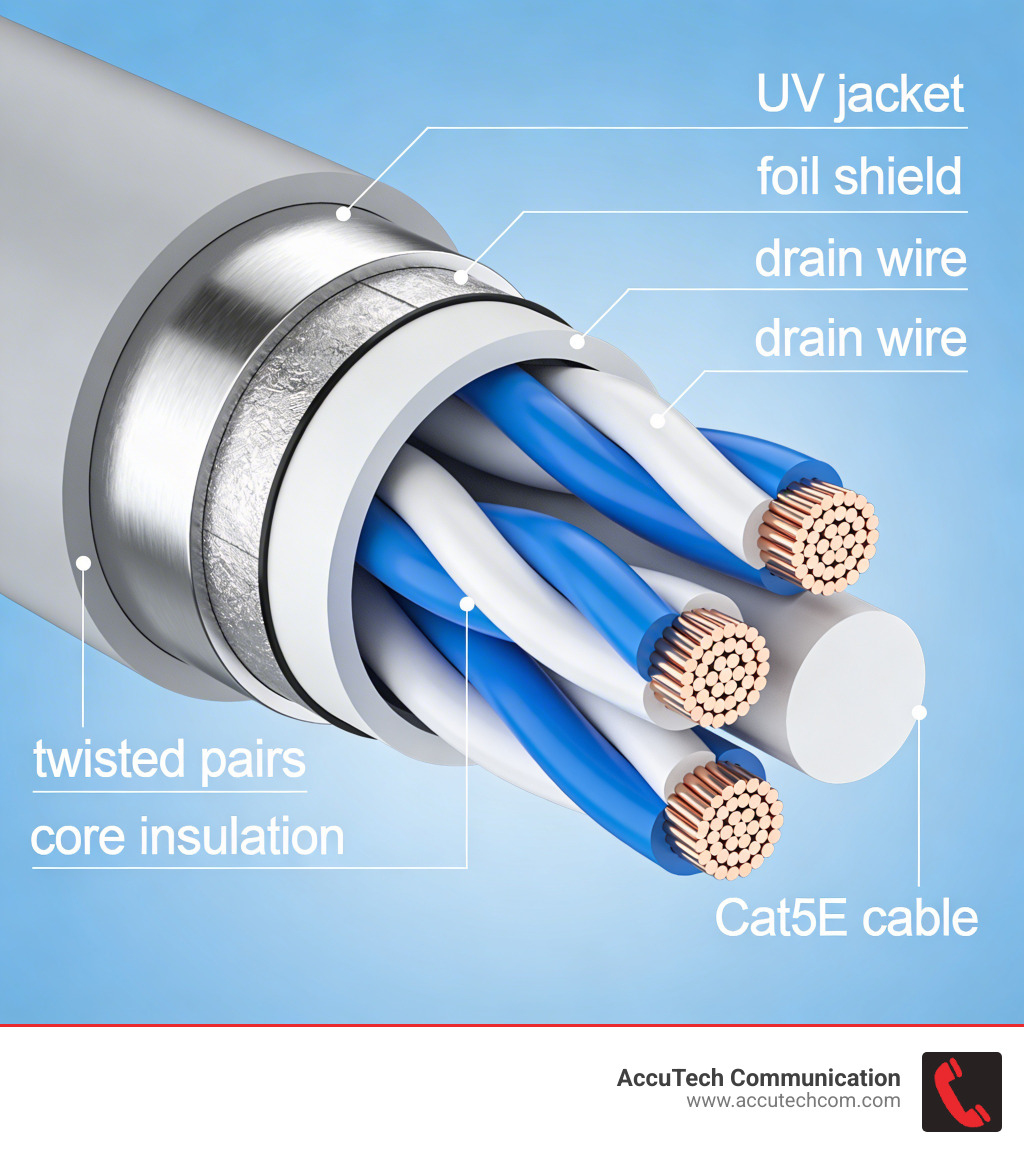
The biggest difference between indoor and outdoor cable isn’t the speed—it’s the protection. Standard indoor cables use a PVC jacket that becomes brittle and cracks when exposed to the sun’s ultraviolet (UV) rays. Outdoor-rated cables utilize a specialized UV-resistant Polyethylene (PE) jacket. This material is designed to withstand extreme temperature swings and moisture without degrading.
A common rating you will see is CMX. This is a limited-use residential and commercial rating for outdoor applications. CMX-rated cables are tested to withstand sunlight, rain, and snow, but they are generally not designed for direct burial unless they have additional moisture-blocking features. For a deep dive into the technical standards, you can check out our complete guide to Cat5e cables.
Key Features of Cat 5 Cable External for Businesses
For commercial environments in areas like Boston or Worcester, we often recommend shielded cable (F/UTP). This type of cable includes an overall aluminum foil shield wrapped around the four twisted pairs. This shielding is vital for protecting your data from electromagnetic interference (EMI), which is common near heavy machinery, HVAC units, or power lines.
Another critical component is the drain wire. In a shielded setup, the drain wire carries unwanted electrical noise to the ground, ensuring that your network remains stable even in high-interference zones. You can find more detailed Cat5e specifications on our dedicated specs page to see how these layers work together.
Environmental Ratings and Durability
The “weatherproof” aspect of cat 5 cable external goes beyond just the outer jacket. High-quality outdoor cables often feature:
- Water-block tape: A specialized wrap that swells if it comes into contact with moisture, preventing water from traveling down the length of the cable.
- Gel-filled cores: A petroleum-based “icky pic” gel that fills the gaps between wires to physically repel water.
- Temperature Tolerance: Most quality outdoor cables are rated for operation between -55°C and +60°C, which is essential for the harsh winters we experience in New Hampshire and Massachusetts.
These physical protections ensure the cable maintains the IEEE Ethernet standards for speed, supporting 1000BASE-T (Gigabit) performance over the full 100-meter distance.
Types of Outdoor-Rated Ethernet Cabling
Choosing the right cable type depends entirely on how it will be routed. We generally categorize these into three main installation methods:
| Installation Type | Description | Best Use Case |
|---|---|---|
| Direct Burial | Cable designed with gel-filling or water-blocking tape to be placed directly in the earth. | Extending network to a secondary building without conduit. |
| Aerial | Features an integrated “messenger wire” (steel cable) for support. | Spanning distances between poles or rooftops. |
| Conduit-Only | Standard outdoor-rated (CMX) cable intended for use inside protective piping. | Runs along the side of a commercial building or through parking lot structures. |
For many of our clients, burying network cable is the cleanest solution for campus-wide connectivity. However, this requires a specific LLDPE (Linear Low-Density Polyethylene) jacket that can handle the pressure and moisture found underground.
Pure Copper vs. CCA in Cat 5 Cable External Runs
This is a point where we never compromise: always use solid bare copper. You may find cheaper options labeled as CCA (Copper Clad Aluminum). CCA is an aluminum wire coated in a thin layer of copper. While it might work for a short time, it presents significant risks:
- PoE Failure: CCA has much higher resistance than copper. When used for Power over Ethernet (PoE++), it can overheat, causing equipment failure or even fire hazards.
- Fragility: Aluminum snaps easily when bent or subjected to the vibrations of outdoor wind.
- Signal Loss: CCA suffers from higher signal attenuation, meaning your 100-meter run might fail to reach Gigabit speeds.
The industry consensus is clear: Copper Clad Aluminum (CCA) is counterfeit and does not meet UL or TIA safety standards. At AccuTech, we only install 100% pure copper conductors to ensure long-term reliability for our clients.
Shielding Requirements for Industrial Environments
In industrial settings—such as manufacturing plants in Nashua or distribution centers in Rhode Island—shielding is a necessity. Foil shielding (FTP) reduces “alien crosstalk” and mitigates interference from nearby electrical infrastructure. When we perform shielded cable testing, we look for consistent grounding and signal integrity to ensure the environment’s “noise” isn’t corrupting your data packets.
Professional Installation and Performance Standards
A cat 5 cable external run is only as good as its termination and installation. The TIA/EIA 568 standards dictate a maximum segment length of 100 meters (328 feet). This includes the horizontal cabling and the patch cords at both ends. If you exceed this distance, you will see a significant drop in performance, or the link may fail entirely.
Modern Cat5e is surprisingly capable, supporting not just Gigabit Ethernet but also 2.5GBASE-T in many scenarios. However, achieving these speeds outdoors requires strict adherence to bending radius rules (typically 4x the cable diameter) and the use of conduit for outdoor network cable whenever possible to protect the physical integrity of the line.
Best Practices for External Conduit and Burial
While direct burial cable exists, we often recommend installing network cable in conduit. Conduit provides several advantages:
- Physical Protection: Guards against landscaping equipment, rocks, and rodents.
- Future-Proofing: If you ever need to upgrade to Cat6a or Fiber, you can simply pull the new cable through the existing pipe rather than re-trenching.
- Expansion Joints: In regions with heavy frost heave like New Hampshire, expansion joints prevent the conduit from snapping as the ground shifts.
For burial, we typically recommend a trench depth of at least 18 to 24 inches to avoid accidental damage from surface-level activity.
Grounding and Surge Protection for Outdoor Lines
One of the most overlooked aspects of cat 5 cable external wiring is surge protection. An outdoor cable acts as a giant antenna for static electricity and nearby lightning strikes. Even a strike several hundred yards away can induce a surge that travels down the copper wire and fries your switches, servers, and connected devices.
We recommend:
- Surge Protectors: Installing gas-discharge tube (GDT) or silicon avalanche diode (SAD) protectors at both ends of the run.
- Metal Conduit: In some high-risk areas, network cable metal conduit can provide an extra layer of shielding and a path to ground.
- Shielded Connectors: Ensuring that the internal foil shield is properly bonded to a shielded RJ45 connector and grounded at the patch panel.
Cost Considerations for Commercial Outdoor Wiring
When planning a project, it’s important to understand the variables that affect the total investment. For a commercial-grade installation, costs are driven by the quality of materials and the complexity of the route.
Estimating Your External Cabling Project
Based on industry averages and publicly available data, the cost for outdoor-rated materials can vary significantly. For example, a 1000ft spool of high-quality, pure copper, shielded outdoor Cat5e typically ranges from $200 to $600 depending on the specific ratings (direct burial vs. CMX).
Labor is the other major factor. A simple “wall-flip” where a cable goes through an exterior wall to an AP is much less labor-intensive than a 200-foot trench through New England’s rocky soil. To get an accurate picture for your specific facility, we always suggest a professional consultation to walk the site and identify potential obstacles. You can read more about Cat 5 cable cost factors to understand how distance and shielding requirements impact the bottom line.
Frequently Asked Questions about External Cat 5
Can I use indoor-rated Cat 5e cable outside?
Technically, it will work for a few months, but we strongly advise against it. The PVC jacket will crack under UV exposure, and moisture will wick into the pairs, causing “slow” internet, intermittent drops, and eventual total failure. It is a “pay now or pay much more later” scenario.
What is the maximum distance for a cat 5 cable external run?
The maximum distance is 100 meters (328 feet). This is a hard limit for standard Ethernet. If you need to go further, we recommend using fiber optic cabling or a mid-span Ethernet extender, though fiber is the superior choice for inter-building links due to its immunity to lightning and electrical interference.
Does outdoor Ethernet cable require conduit for direct burial?
If the cable is specifically rated for “Direct Burial” (usually containing gel or water-blocking tape), it does not require conduit. However, in our professional opinion, conduit is always the best practice for commercial properties to prevent damage and make future upgrades easier.
Conclusion
Running cat 5 cable external lines is a vital part of modern commercial networking, but it requires more than just standard office-grade supplies. From choosing UV-resistant jackets to ensuring proper grounding against New England thunderstorms, every detail matters for the longevity of your network.
At AccuTech Communications, we have been providing certified, reliable structured cabling services since 1993. Whether you are in a high-rise in Boston, a medical facility in Providence, or a warehouse in Manchester, our team of experts is ready to design a weatherproof solution that keeps your business connected.
Ready to extend your network? Learn more about our structured cabling services or contact us today for a site evaluation.
