
What a Low Voltage Wiring Company Does — and Why Your Business Needs One
A low voltage wiring company specializes in installing and managing the cabling systems that power your business’s network, security, communications, and AV infrastructure — all operating at 50 volts or less.
Here’s a quick overview of what these companies typically handle:
| Service Area | Common Applications |
|---|---|
| Network & Data | Cat6a, fiber optic, structured cabling |
| Security | Surveillance cameras, access control, alarms |
| Communications | VoIP phones, intercom, paging systems |
| AV & Automation | Video conferencing, digital signage, sound masking |
| Power over Ethernet | Wireless access points, IP cameras, door locks |
Low voltage systems are the backbone of modern commercial operations. Without them, your network slows down, your security gaps widen, and your team can’t communicate efficiently.
Yet many businesses are running on aging, disorganized wiring that wasn’t designed for today’s bandwidth demands. That creates real problems — dropped connections, security vulnerabilities, and costly downtime.
Getting it right from the start — with properly installed, labeled, and tested cabling — is far less expensive than fixing a messy infrastructure later.
I’m Corin Dolan, owner of AccuTech Communications, and I’ve spent decades helping commercial businesses across Massachusetts, New Hampshire, and Rhode Island build reliable low voltage wiring infrastructure that performs and scales. In this guide, I’ll walk you through everything you need to know to make smart decisions when hiring a low voltage wiring company for your business.
Explore more about low voltage wiring company:
Understanding Low Voltage Wiring for Commercial Environments
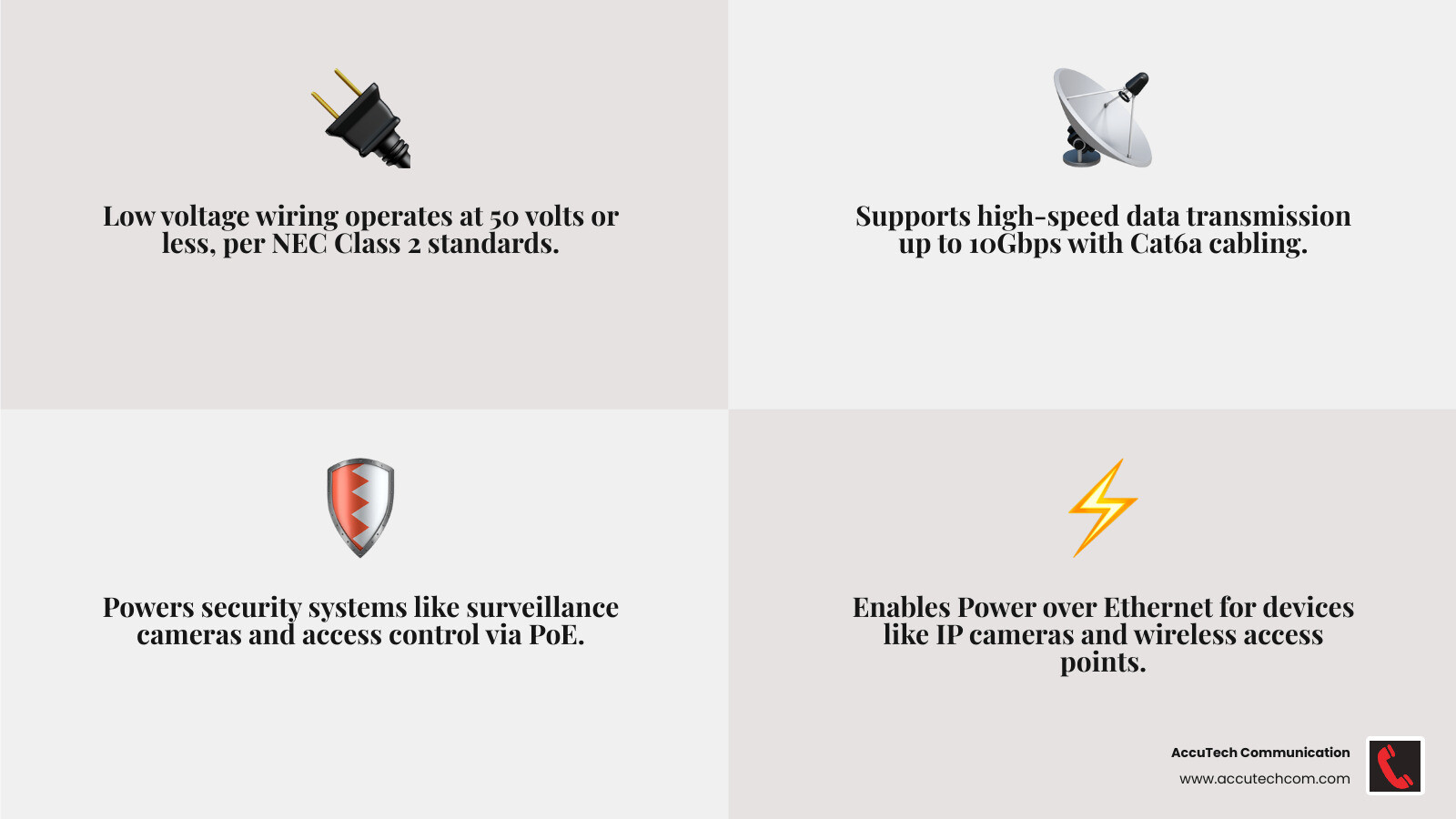
When we talk about low voltage wiring, we are referring to any electrical system that operates on 50 volts of electricity or less. While standard electrical contractors handle the “high voltage” stuff—the 120V or 240V lines that power your lights, heaters, and heavy machinery—a low voltage wiring company focuses on the “brains” of your building.
The 50-Volt Threshold and NEC Class 2 Circuits
In commercial construction and facility management, most low voltage systems fall under NEC (National Electrical Code) Class 2 circuits. These are designed specifically to limit the risk of fire and electric shock. Because the power levels are lower, the focus shifts from “how do we keep this from starting a fire?” to “how do we keep this signal crystal clear?”
Signal integrity is everything. When we pull copper or fiber optic lines through a commercial ceiling in Boston or a warehouse in Manchester, we have to ensure that external interference doesn’t scramble your data. High-voltage lines generate electromagnetic fields that can “bleed” into data cables if they are run too close together. A professional low voltage wiring company knows exactly how to maintain separation to ensure your internet doesn’t drop every time the HVAC system kicks on.
Comparing Standard Electrical vs. Low Voltage Wiring
To help visualize the difference, consider this comparison:
| Feature | Standard Electrical Wiring | Low Voltage Wiring |
|---|---|---|
| Voltage | 120V, 240V, 480V | 50V or less (often 12V, 24V, or 48V) |
| Primary Goal | Delivering high power | Transmitting data and signals |
| Shock Risk | High; requires conduit/heavy protection | Low; safer to handle |
| Common Cables | Romex, THHN, MC Cable | Cat6, Cat6a, Fiber Optic, Coaxial |
| Regulatory Focus | Fire prevention and life safety | Signal integrity and bandwidth |
The Power of PoE (Power over Ethernet)
One of the most exciting developments we’ve seen in recent years is the rise of Power over Ethernet (PoE). This technology allows us to send both data and electrical power over a single Ethernet cable. Think about your office’s VoIP phones, wireless access points, or security cameras. Instead of needing an electrician to install a power outlet at every camera location, a low voltage wiring company can run one Cat6a cable that does it all.
This not only saves on installation costs but also makes your infrastructure much more flexible. If you want to learn more about the technical specifics, check out this more info about low voltage cabling.
Why Your Business Needs a Professional Low Voltage Wiring Company
It is tempting to think that “wiring is just wiring,” but in a commercial environment, the quality of your cable plant determines the speed of your business. If your network is the highway for your data, a professional installation ensures there are no potholes or closed lanes.
Structured Cabling: The Foundation of Efficiency
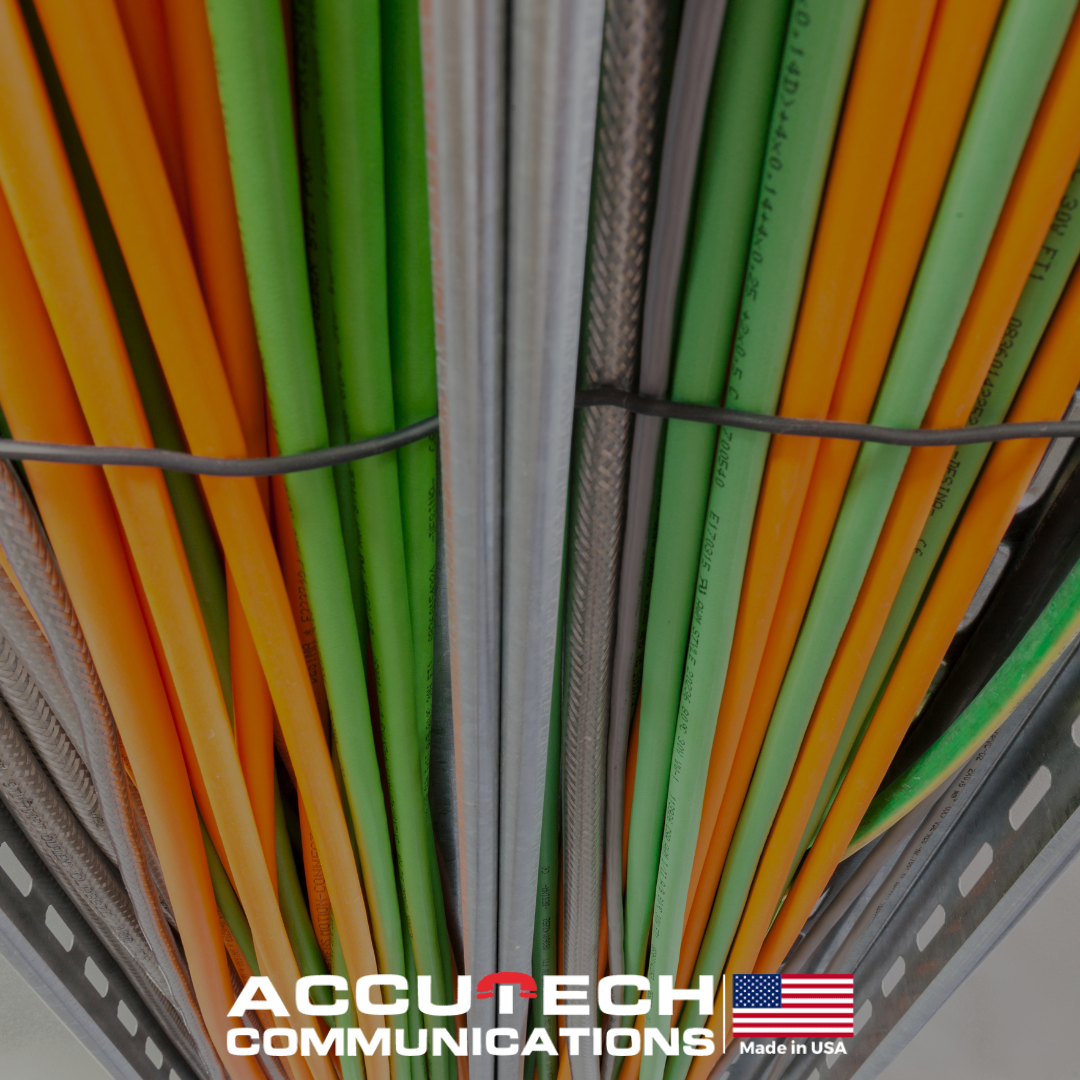
The biggest mistake we see businesses make is “point-to-point” wiring. This is when a cable is run directly from a server to a desk, then another from a camera to a recorder, without any central organization. Over time, this leads to a “spaghetti” mess in the server room that is impossible to troubleshoot.
A professional low voltage wiring company implements structured cabling. This is a standardized architecture that uses patch panels, racks, and labeled “drops” to create a clean, organized system. When everything is labeled and tested, identifying a broken port takes seconds rather than hours. You can find more info about structured cabling services on our dedicated service page.
Reduced Downtime and Interference Mitigation
Every minute your network is down is money out the door. Professional installers use high-quality materials and specialized testing equipment to ensure every “drop” meets industry standards. We don’t just plug it in and see if the light turns on; we use Level 3 certification testers to verify that the cable can actually handle the speeds it’s rated for.
Furthermore, we understand the nuances of “plenum-rated” cabling. In many commercial buildings across Massachusetts and Rhode Island, the space above the drop ceiling is used for air circulation (the plenum). Using the wrong type of cable jacket in these spaces is a major code violation and a fire hazard. A reputable low voltage cable installer will always ensure your project is code-compliant.
Professional Labeling and BICSI Standards
We follow standards set by BICSI (Building Industry Consulting Service International). This ensures that whether we are working in a small office in Waltham or a massive data center in Providence, the work is consistent, professional, and easy for any future technician to understand. For more on the importance of professional standards, you can visit industry guidelines.
The Role of a Low Voltage Wiring Company in Security and AV
While data is a huge part of what we do, a low voltage wiring company is also responsible for the systems that keep your building safe and your meetings running smoothly.
Access Control and Surveillance
Security isn’t just about the cameras you see; it’s about the wiring you don’t see. Modern IP-based surveillance systems require robust cabling to handle high-definition video feeds without lag. Access control systems—the badge readers and electric door strikes that keep your premises secure—rely on low voltage triggers. If the wiring is poor, your doors might not lock, or your footage might be too grainy to be useful. You can learn more about these integrations by reviewing industry security standards.
Audio-Visual and Communication Systems
In the modern office, video conferencing is no longer optional. We integrate high-quality microphones, speakers, and cameras into a seamless AV network. This includes:
- Digital Signage: Powering the screens in your lobby or breakroom.
- Sound Masking: Using white noise to ensure privacy in open-office plans.
- Intercom and Paging: Vital for warehouses and large retail spaces.
- Mass Notification: Ensuring safety protocols can be communicated instantly during an emergency.
Many of these systems are now moving to VoIP (Voice over IP) platforms. Check out more info about business phone systems to see how low voltage wiring supports modern communication.
Future-Proofing with a Reputable Low Voltage Wiring Company
Technology changes fast. A cable that was “fast enough” five years ago might be a bottleneck today. When we design a system, we aren’t just looking at what you need today; we’re looking at what you’ll need in 2030.
Cat6a vs. Cat8: What’s the Difference?
While Cat5e is still found in many older buildings, we almost exclusively recommend Cat6a or higher for new commercial installs. Cat6a supports speeds of up to 10Gbps at distances of 100 meters. This is a massive performance increase over standard Cat6.
For specialized needs, such as rack-to-rack connections in a data center, we may even use Cat8. Cat8 can handle up to 40Gbps, though it is limited to shorter distances. A professional low voltage wiring company helps you navigate these choices so you don’t overspend on tech you don’t need, but also don’t under-equip your office.
The Power of Fiber Optics
For businesses with large campuses or high-bandwidth requirements, fiber optic cabling is the gold standard. Unlike copper, fiber uses light pulses to transmit data. This means:
- Zero Interference: Fiber is immune to electromagnetic interference.
- Incredible Distance: Fiber can run for miles without signal degradation.
- Massive Bandwidth: Fiber provides thousands of times the bandwidth of copper.
If you are planning a large-scale project, read more info about fiber optic cabling installation. You can also see how professionals approach these complex installations.
Critical Infrastructure for Massachusetts, New Hampshire, and Rhode Island Businesses
Operating in the Northeast brings unique challenges. From the historic buildings in Boston’s North End to the modern industrial parks in southern New Hampshire, a low voltage wiring company must understand regional building codes and environmental factors.
Regional Code Compliance
Each state has its own nuances. In Massachusetts, we strictly adhere to the Massachusetts Electrical Code (MEC), which is based on the NEC but has specific amendments. New Hampshire and Rhode Island also have their own inspectors and requirements. Whether we are working in Abington, Andover, or Arlington, we ensure that every wire pull is permitted and inspected where required.
Data Center Build-Outs
For our clients in the “Route 128” tech corridor and beyond, data center infrastructure is a top priority. This involves more than just pulling cables; it requires precision cooling management, uninterruptible power supply (UPS) integration, and high-density racking. We handle everything from the initial site survey to the final labeling. Explore more info about data center services for a deeper look at our capabilities.
Lighting and Specialty Wiring
While we focus on data and security, we also handle low voltage lighting solutions. These are increasingly popular in commercial settings for energy efficiency and smart control.
Average Costs and Factors for Commercial Installations
We are often asked, “How much does it cost to wire an office?” Because every building is different, there is no one-size-fits-all answer. However, we can provide some industry averages based on publicly available data to give you a sense of scale.
Note: These prices are industry averages sourced from internet data and do not reflect the specific rates of AccuTech Communications.
The Project Range
For a typical commercial installation, project costs can range anywhere from $2,500 to $45,000+.
Why such a wide range? Several factors influence the final quote:
- Distance and Scale: A 2,000-square-foot office in Braintree will cost significantly less than a 50,000-square-foot warehouse in Worcester.
- Cable Type: Fiber optic and Cat6a materials are more expensive than standard Cat6.
- Building Environment: Pulling cable through an open-ceiling warehouse is much faster (and cheaper) than “fishing” wires through the finished walls of a historic building in Salem.
- Plenum Requirements: If your building requires plenum-rated cable for fire safety, material costs can increase by 30% or more.
- Labor Complexity: Working after hours to avoid disrupting your business or working on high-reach lifts adds to the labor cost.
The Importance of the Site Survey
This is why we always recommend a professional site survey. A reputable low voltage wiring company will walk your space, identify potential obstacles (like firewalls or lack of conduit), and provide a transparent bid. You can see how other professionals approach this site survey process.
Frequently Asked Questions about Low Voltage Systems
What is the difference between Cat6 and Cat6a cabling?
Cat6 is designed for gigabit speeds and works great for most standard office needs. However, Cat6a (the “a” stands for augmented) can handle 10Gbps speeds at the full 100-meter distance. It also has better shielding to prevent crosstalk. We recommend Cat6a for any business that relies on heavy data transfer or wants to future-proof their office.
Why is structured cabling better than point-to-point wiring?
Structured cabling is an organized system that uses patch panels and standardized layouts. It makes your network easier to manage, faster to troubleshoot, and much simpler to expand. Point-to-point wiring is a “quick fix” that eventually turns into a maintenance nightmare.
How does fiber optic cabling improve business performance?
Fiber optic cables use light instead of electricity, allowing for much higher speeds and much longer distances. It is also completely immune to electromagnetic interference, making it the most reliable choice for connecting different floors of a building or different buildings on a campus.
Conclusion
Your business’s technology is only as good as the wiring that supports it. From the smallest VoIP phone to the largest server rack, every piece of equipment depends on a clean, reliable signal.
At AccuTech Communications, we’ve been the go-to low voltage wiring company for businesses in Massachusetts, New Hampshire, and Rhode Island since 1993. Whether you are moving into a new office in Boston, upgrading a warehouse in Manchester, or building out a data center in Providence, we have the expertise to get the job done right—on time and on budget.
Don’t let a “spaghetti” mess of cables hold your business back. Request an estimate for your next project today and let us build the foundation your business deserves.
