
What Is a Fiber Optic System? (Quick Answer)
A fiber optic system is a network that transmits data as pulses of light through thin strands of glass or plastic, delivering faster speeds, longer distances, and greater reliability than traditional copper cabling.
Here’s what you need to know at a glance:
| Feature | Fiber Optic System |
|---|---|
| How it works | Sends light pulses through glass/plastic strands |
| Max speed | Up to 800 Gbps (current commercial deployments) |
| Max distance | Up to 100 km without signal repeaters |
| Key advantage | Immune to electromagnetic interference |
| Common uses | Data centers, telecom, healthcare, manufacturing |
| Cable types | Single-mode (long distance) and multimode (short distance) |
Whether you’re managing a corporate office, a healthcare facility, or a manufacturing operation in Massachusetts, New Hampshire, or Rhode Island, your network infrastructure is the foundation everything else depends on. When that foundation is slow, unreliable, or constantly maxed out, it costs you — in downtime, in productivity, and in missed opportunities.
Fiber optic technology has become the standard backbone of modern commercial networks, and for good reason. Over 5 billion kilometers of fiber optic cable have been deployed globally. Optical fiber has largely replaced copper in backbone networks across the developed world. The performance gap between fiber and copper is simply too large to ignore.
This guide covers everything a business decision-maker needs to understand about fiber optic systems — from how they work to how they’re installed, maintained, and future-proofed.
I’m Corin Dolan, owner of AccuTech Communications, and I’ve spent decades helping commercial clients across Massachusetts, New Hampshire, and Rhode Island design and install fiber optic systems that support real business needs. If you want straightforward, expert guidance — not a sales pitch — you’re in the right place.
Essential fiber optic system terms:
What is a Fiber Optic System and How Does It Work?
A fiber optic system is a complete communications pathway that uses light instead of electrical current to move information. In a commercial network, that information might be voice traffic, internet access, security camera feeds, cloud applications, storage traffic, building automation data, or all of the above.
The basic process is simple:
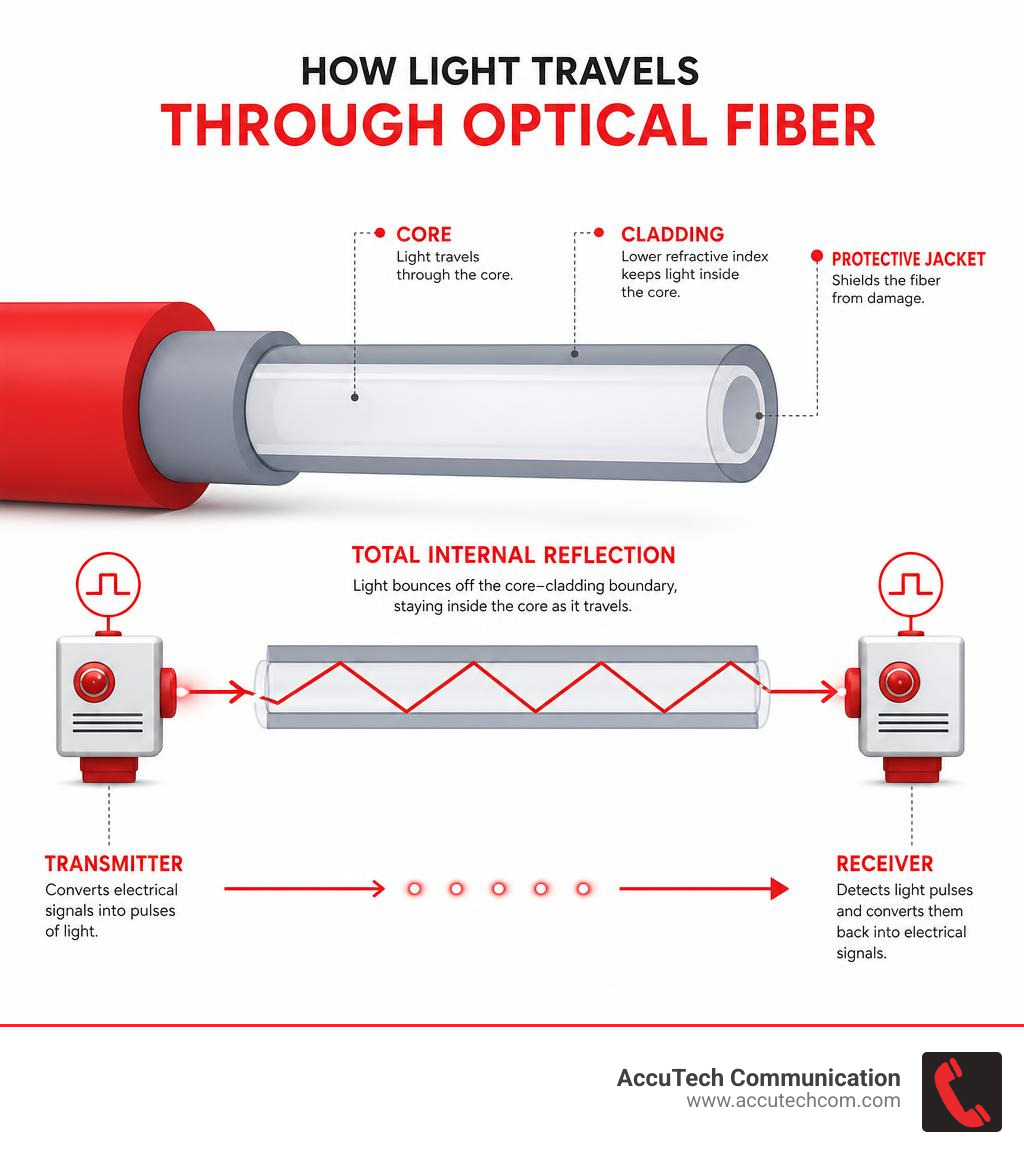
- A transmitter or transceiver converts electrical data into light pulses.
- Those light pulses travel through a fiber optic strand.
- The fiber guides the light down the cable with very little loss.
- A receiver or transceiver converts the light back into electrical data.
- Switches, servers, routers, phones, access points, cameras, or other systems use that data.
Think of it like sending Morse code with a flashlight, except the flashlight is a laser, the path is a hair-thin strand of glass, and the message is moving at extremely high speed. Thankfully, no one has to stand in the server room blinking a flashlight all day.
For a deeper beginner-friendly explanation, see our guide: Fiber Optics Explained: How Your Internet Gets Super Speed.
Core Principles of a Fiber Optic System
Fiber works because of a physics principle called total internal reflection. A fiber strand has several layers:
- Core: The center of the fiber where light travels.
- Cladding: A surrounding glass layer with a different refractive index.
- Buffer coating: A protective coating that helps shield the fiber from moisture, abrasion, and handling damage.
- Strength members and jacket: Outer protection that depends on the cable design and installation environment.
The core and cladding are engineered so light entering the fiber at the correct angle keeps reflecting inward instead of escaping. This allows the signal to travel through bends and long cable runs while staying inside the fiber.
The refractive index difference is what makes the magic happen. The cladding reflects the light back into the core, keeping the signal moving forward. Good cable design, correct bend radius, clean connections, and proper installation all help preserve that signal.
Want to go deeper into the construction side? Read Fiber Optic Cable Technology.
Key Components of the Optical Network
A fiber optic system is more than just cable. The full optical network usually includes:
- Fiber optic cable: Single-mode or multimode strands inside a protective jacket.
- Optical transmitters: Devices that create light signals, often using laser diodes or LEDs.
- Optical receivers: Devices that detect incoming light and convert it back into electrical signals.
- Optical transceivers: Combined transmitter and receiver modules used in switches, routers, servers, and storage equipment.
- Fiber patch panels: Organized termination points that make the system manageable.
- Connectors: Common types include LC, SC, ST, and MTP/MPO.
- Splices: Permanent fiber joints, often made with fusion splicing.
- Optical amplifiers: Equipment used in long-haul systems to boost optical signals without converting them back to electrical form.
- Wavelength division multiplexing equipment: WDM technology sends multiple wavelengths of light over the same fiber, increasing capacity.
- Cable management: Trays, enclosures, labels, and routing hardware that protect the system and make maintenance easier.
In commercial buildings, the patch panel is often the unsung hero. It does not look exciting, but without clean labeling and cable management, even a high-performance network can turn into a bowl of spaghetti with blinking lights.
Types of Fiber Optic Cables and Their Business Applications

Choosing the right fiber cable depends on distance, bandwidth, equipment, environment, and future growth. The two primary categories are single-mode and multimode fiber.
For a broader comparison, visit Types of Fiber Optic Cable.
Single-Mode vs. Multimode Fiber
Single-mode fiber has a very small core, typically about 9 microns. It carries one primary light path, which reduces modal dispersion and allows long-distance, high-bandwidth transmission. It is commonly used for:
- Building-to-building links
- Campus backbones
- Telecom and carrier connections
- Data center interconnects
- Long-distance commercial network links
- High-speed future-ready backbone cabling
Multimode fiber has a larger core, commonly 50 microns or 62.5 microns. It allows multiple light paths, which makes it useful for shorter distances inside buildings and data centers. It is commonly used for:
- Equipment room connections
- Data center rows and racks
- LAN backbones
- Shorter high-speed links
- Commercial building network upgrades
Here is the practical business takeaway:
| Fiber Type | Typical Core Size | Best For | Common Light Source |
|---|---|---|---|
| Single-mode | About 9 microns | Long distances and highest scalability | Laser |
| Multimode | 50 or 62.5 microns | Shorter commercial and data center runs | LED or VCSEL laser |
Single-mode is often the better long-term choice for distance and future capacity. Multimode can still be the right fit for shorter controlled environments, especially where existing hardware supports it.
For data center planning, see Why Your Data Center Needs Fiber: Speed, Distance, and Beyond.
Specialized Cable Designs for Commercial Environments
Commercial environments are not all the same. A fiber run in a clean office ceiling is different from a fiber run between buildings, through a warehouse, or near industrial equipment.
Common fiber cable designs include:
- Tight-buffered fiber: Often used indoors. The protective coating is applied closely around the fiber, making it easier to terminate and handle.
- Loose-tube fiber: Often used outdoors or in environments with temperature swings. Fibers sit inside tubes that help isolate them from moisture and mechanical stress.
- Plenum-rated cable: Used in air-handling spaces where fire and smoke requirements apply.
- Riser-rated cable: Used for vertical runs between floors.
- LSZH cable: Low-smoke zero-halogen cable used where reduced smoke and toxic gas emissions are important.
- Armored fiber: Includes additional physical protection for harsh or high-risk environments.
- Pre-terminated fiber: Factory-terminated assemblies that can reduce field termination time when designed correctly.
- Ultra-low-loss assemblies: Used where power budgets are tight or multiple connection points are required.
High-density systems are also becoming more common in commercial data centers and enterprise environments. Products such as OPT-X Unity Ultra Low Loss Fiber Optic System | Leviton Network Solutions show how modern fiber infrastructure supports higher speeds, multiple connection points, and migration paths beyond current network requirements.
The key is not choosing the fanciest cable. It is choosing the right cable for the environment, pathway, equipment, and growth plan.
Why Businesses Choose Fiber Over Traditional Copper Cabling
Copper cabling still has a place in commercial networks. We install and support copper systems all the time for workstations, phones, wireless access points, cameras, and other endpoint devices. But for backbone, high-speed, long-distance, and high-density applications, fiber has major advantages.
For more background, read What Is Fiber Optic Cabling and Why Is It Important?.
| Category | Fiber Optic Cabling | Copper Cabling |
|---|---|---|
| Signal type | Light pulses | Electrical signals |
| Distance | Long-distance capability, often kilometers depending on design | Typically shorter Ethernet limits without active equipment |
| Bandwidth | Very high, scalable to modern high-speed networks | Strong for many LAN uses, but more limited over distance |
| EMI resistance | Immune to electromagnetic interference | Can be affected by EMI and electrical noise |
| Security | Difficult to tap without detection | Easier to intercept electrically |
| Size and weight | Thin and lightweight | Heavier and bulkier |
| Electrical isolation | Does not conduct electricity | Conductive |
| Best use | Backbones, data centers, inter-building links, high-speed networks | Horizontal cabling, PoE devices, endpoint connections |
Performance and Bandwidth Advantages
Fiber supports high-speed data transmission because light can carry enormous amounts of information with low attenuation. In commercial environments, fiber is commonly used for 10G, 40G, 100G, 400G, and higher-speed migration planning.
Current commercial deployments can reach extremely high speeds, and research keeps pushing the limits. Researchers have demonstrated massive bandwidth-distance records in lab environments, including Bell Labs work exceeding 100 petabit-kilometers per second and Japanese research transmitting 319 terabits per second over 3,000 kilometers using multi-core fiber.
Those are not everyday office network speeds, of course. Your accounting team probably does not need petabit capacity to open spreadsheets. But these milestones show why fiber is the foundation for long-term network growth.
Key performance advantages include:
- Higher bandwidth: More capacity for cloud apps, video, storage, VoIP, security systems, and analytics.
- Longer reach: Fiber can support long runs that copper cannot handle without active equipment.
- Lower signal loss: Optical signals degrade less over distance than electrical signals.
- Low latency: Useful for data centers, real-time communications, financial systems, and cloud workloads.
- EMI immunity: Excellent for manufacturing, healthcare, labs, and facilities with electrical noise.
- Better security profile: Fiber is difficult to tap without disrupting or detecting the signal.
- Smaller cable size: More capacity in crowded pathways.
Cost-Effectiveness and Long-Term ROI
Fiber used to be viewed as a premium option only for large carriers, campuses, or specialized facilities. That has changed. As manufacturing, installation methods, pre-terminated systems, and optical equipment have matured, fiber has become a practical choice for many commercial networks.
We are avoiding specific pricing here because commercial fiber costs vary widely based on building conditions, pathway availability, fiber count, distance, fire rating, termination method, testing requirements, and whether construction work is needed. A small interior backbone upgrade is very different from a multi-building campus deployment.
The long-term value usually comes from:
- Longer useful life
- Higher upgrade ceiling
- Less susceptibility to interference
- Lower need for repeaters over distance
- Reduced pathway congestion
- Better support for future network speeds
- Improved uptime for business-critical systems
The right way to evaluate cost is not “fiber versus copper by the foot.” It is “which infrastructure will support the business reliably for the next decade and beyond?”
In many commercial projects across Massachusetts, New Hampshire, and Rhode Island, a hybrid approach makes sense: fiber for the backbone and copper for endpoint device connections where copper is still the best fit.
Designing and Installing a Commercial Fiber Optic System
A successful fiber optic system starts long before the first cable is pulled. Good design prevents expensive rework, downtime, bottlenecks, and future limitations.
For planning help, see Fiber Optic Network Design.
Critical Considerations for Fiber Optic System Design
When we design commercial fiber networks, we look at the full business environment, not just the cable route.
Important design factors include:
- Current bandwidth needs: What applications are running now?
- Future growth: Will the network need 40G, 100G, 400G, or beyond?
- Topology: Point-to-point, star, redundant ring, or hybrid design.
- Distance: Link length affects fiber type, optics, and loss budget.
- Pathways: Conduit, tray, risers, sleeves, innerduct, and outside plant routes.
- Environment: Indoor, outdoor, plenum, industrial, wet, aerial, or underground.
- Redundancy: Critical systems may need diverse paths or ring architecture.
- Port density: Data centers and equipment rooms may need high-density panels.
- Polarity: Especially important with MTP/MPO and parallel optics.
- Loss budget: Every connector, splice, and cable segment adds loss.
- Documentation: Labels, test results, as-builts, and port maps matter.
Network topology is especially important. A star topology may be ideal for a commercial office where all links return to a main equipment room. A redundant ring may be better for a campus, healthcare facility, or manufacturing operation where uptime is critical.
Modern systems are also designed with migration in mind. High-density platforms such as OPT-X HDX Unity Global Fiber System | Leviton Network Solutions demonstrate how structured fiber systems can support higher port density, multiple connection points, and migration to 400G and beyond.
That does not mean every business needs a hyperscale data center design. It means smart infrastructure planning should avoid painting the business into a corner.
Installation Best Practices and Testing Standards
Fiber installation is not a good place to “wing it.” The glass is thin, the tolerances are tight, and dust is the villain. Seriously – one dirty connector can create a troubleshooting mystery worthy of a detective novel.
Professional installation should include:
- Proper cable handling and pulling tension control
- Bend radius protection
- Correct pathway and fire rating selection
- Clean terminations
- Fusion splicing where appropriate
- Connector inspection and cleaning
- Patch panel organization
- Clear labeling
- OTDR testing where required
- Insertion loss testing
- Polarity verification
- Complete documentation and test reports
Two common test methods are:
- Insertion loss testing: Measures how much signal is lost across the link.
- OTDR testing: Uses reflected light to locate events such as splices, breaks, bends, and connector issues.
Certified testing matters because it gives the business proof that the installed system meets performance requirements. It also creates a baseline for future troubleshooting.
Learn more about professional installation here: Fiber Optic Installation.
Future Trends and Advancements in Fiber Optic Technology
As of May 2026, fiber optic technology is still advancing quickly. The big trend is simple: more data, over longer distances, using less space and energy.
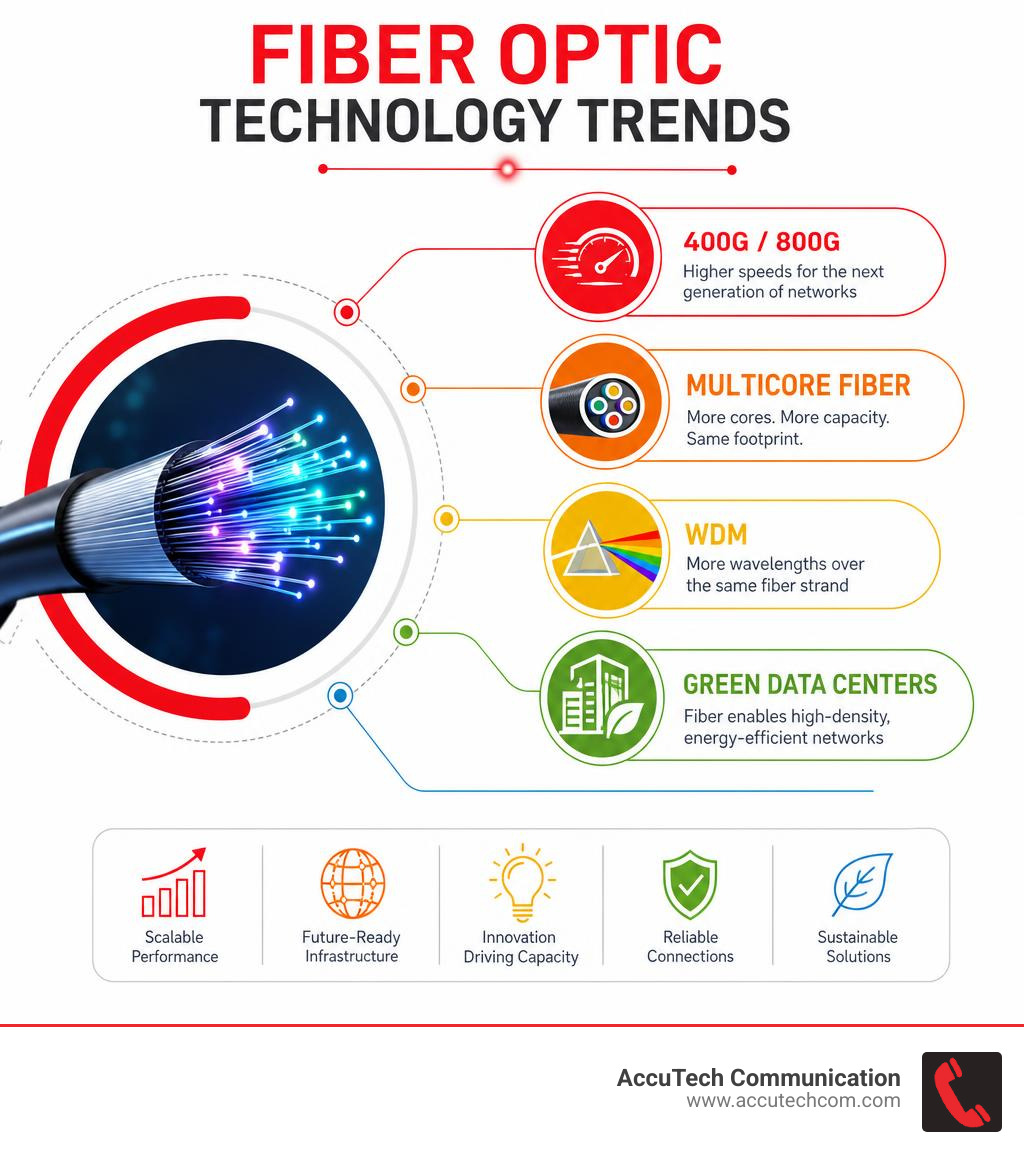
Important developments include:
- 400G, 800G, and 1.6T network migration: Data centers and high-performance enterprise networks are planning for faster links.
- Multi-core fiber: Multiple cores inside one fiber can greatly increase total capacity.
- Advanced wavelength division multiplexing: More wavelengths can be carried over the same strand.
- Coherent optics: Improved transmission over long distances with better signal processing.
- Silicon photonics: Integrating optical components more tightly with electronic systems.
- Lower-loss connectors and assemblies: Helpful when designs include multiple patching points.
- Fiber sensing: Fiber can measure temperature, strain, vibration, acoustics, and pressure.
- Green data centers: Fiber supports high-density, efficient designs that can reduce power and cooling pressure compared with bulkier alternatives.
- Improved pre-terminated systems: Factory-tested assemblies can speed installation and improve consistency when engineered properly.
Research continues to push remarkable limits. In recent years, lab demonstrations have reached hundreds of terabits per second, and multi-core fiber has shown enormous capacity potential. Commercial networks will not instantly jump to every lab record, but these breakthroughs shape the equipment and design standards businesses will use in the future.
For businesses in Massachusetts, New Hampshire, and Rhode Island, the practical lesson is this: install fiber with tomorrow in mind. The cable you place today may support several generations of electronics if it is designed and installed correctly.
Frequently Asked Questions About Fiber Optic Systems
How far can a fiber optic system transmit data without signal loss?
No cable transmits with zero signal loss, but fiber has very low attenuation compared with copper. Depending on the fiber type, optics, wavelength, connectors, splices, and network design, fiber can support very long distances. Some systems can reach up to 100 kilometers without signal repeaters under the right conditions.
In commercial buildings, the more common question is not “Can fiber go far enough?” It usually can. The better question is “What optics, fiber type, and loss budget do we need for this specific link?”
Single-mode fiber is typically used for longer distances. Multimode fiber is typically used for shorter building or data center links.
For more detail, see How Far Can Fiber Optic Cable Run?.
What is the difference between active and passive optical networks?
An active optical network uses powered equipment to manage or direct signals. Examples include:
- Ethernet switches
- Optical transceivers
- Media converters
- Optical amplifiers
- Routers
- Active distribution equipment
A passive optical network uses unpowered optical components between endpoints. Examples include:
- Fiber cable
- Connectors
- Splices
- Passive splitters
- Patch panels
In broad terms:
| Network Type | Uses Powered Field Equipment? | Common Use |
|---|---|---|
| Active optical network | Yes | Enterprise networks, data centers, switched Ethernet |
| Passive optical network | No, not in the passive distribution path | Shared fiber distribution architectures |
Commercial networks often use active Ethernet designs because they provide dedicated switching, management, segmentation, and performance control. Passive components are still part of nearly every fiber system, even when the overall network is active.
How often do fiber optic cables need to be replaced?
Properly installed fiber optic cabling can last for decades. A reasonable planning range for many commercial installations is 20 to 30 years, though actual lifespan depends on environment, handling, cable quality, pathway protection, and whether the system still meets performance needs.
Fiber may need replacement or repair sooner if there is:
- Physical damage
- Water intrusion
- Excessive bending
- Rodent damage
- Crushed cable
- Improper pulling tension
- Contaminated or damaged connectors
- Outdated fiber type for required speeds
- Poor documentation that makes maintenance impractical
Often, the cable itself lasts longer than the electronics connected to it. Switches, optics, and transceivers may be upgraded several times while the fiber backbone remains in service.
What maintenance does a fiber optic system require?
Fiber is low-maintenance, but not no-maintenance. A good maintenance plan includes:
- Keeping connectors clean
- Inspecting patch cords before reconnecting
- Protecting bend radius
- Maintaining patch panel organization
- Updating documentation after changes
- Testing after moves, adds, and changes
- Keeping spare patch cords and approved cleaning tools available
- Avoiding unnecessary handling of fiber connections
Most fiber problems we see come from physical damage, dirty connectors, poor labeling, or changes made without documentation. In other words, the fiber is usually innocent. The closet chaos is guilty.
What are common fiber optic system problems?
Common issues include:
- Dirty connector end faces
- Excessive insertion loss
- Broken or kinked patch cords
- Incorrect polarity
- Poor splices
- Damaged cable
- Mismatched transceivers
- Incorrect fiber type
- Exceeded distance or loss budget
- Unlabeled or mislabeled ports
Troubleshooting should start with documentation, visual inspection, connector cleaning, and testing. OTDR testing and insertion loss testing can then help pinpoint the issue.
Is fiber optic cabling secure?
Fiber has a strong security profile because it does not radiate electromagnetic signals the way copper can, and tapping fiber typically causes detectable signal changes. That said, no network medium is a complete security strategy by itself.
Commercial security still requires:
- Network segmentation
- Access control
- Monitoring
- Physical protection of pathways and rooms
- Secure patching areas
- Proper firewall and switch configuration
- Documentation and change control
Fiber helps, but it does not replace cybersecurity best practices.
Can fiber and copper work together?
Yes. Most commercial networks use both. Fiber often serves as the backbone between equipment rooms, buildings, floors, or data center areas. Copper often connects endpoint devices such as:
- Desktop workstations
- VoIP phones
- Wireless access points
- Printers
- Access control panels
- Surveillance cameras
- Building systems
A well-designed structured cabling system uses each medium where it makes the most sense.
Conclusion
A fiber optic system is one of the most important infrastructure investments a business can make. It supports high-speed data transmission, long-distance communication, network reliability, cloud applications, data centers, security systems, healthcare technology, manufacturing operations, and future growth.
The essentials are straightforward:
- Fiber sends data as light through glass or plastic strands.
- Single-mode fiber is best for long distance and future scalability.
- Multimode fiber is useful for shorter commercial and data center links.
- Fiber outperforms copper for bandwidth, distance, EMI resistance, and backbone capacity.
- Good design, installation, testing, and documentation are critical.
- Future trends point toward even faster, denser, and more efficient fiber networks.
At AccuTech Communications, we design, install, test, and support commercial network cabling systems across Massachusetts, New Hampshire, and Rhode Island. Since 1993, we have focused on certified, reliable service, competitive pricing, and quality workmanship for business environments.
If your organization is planning a fiber upgrade, data center build-out, office network improvement, or commercial cabling project, we can help you choose the right system and install it correctly.
Start here: Fiber Optic Cabling Installation
