
Ethernet Port Tester: Ultimate 101 Guide
Why Ethernet Port Testers Are Essential for Network Reliability
An ethernet port tester is a diagnostic tool that verifies cable connections, identifies faults, and validates network performance to ensure infrastructure reliability. These devices range from simple continuity checkers to advanced analyzers that test everything from basic wiring to Power over Ethernet (PoE).
Key Functions of Ethernet Port Testers:
- Cable Verification – Test wiremap, continuity, and proper termination
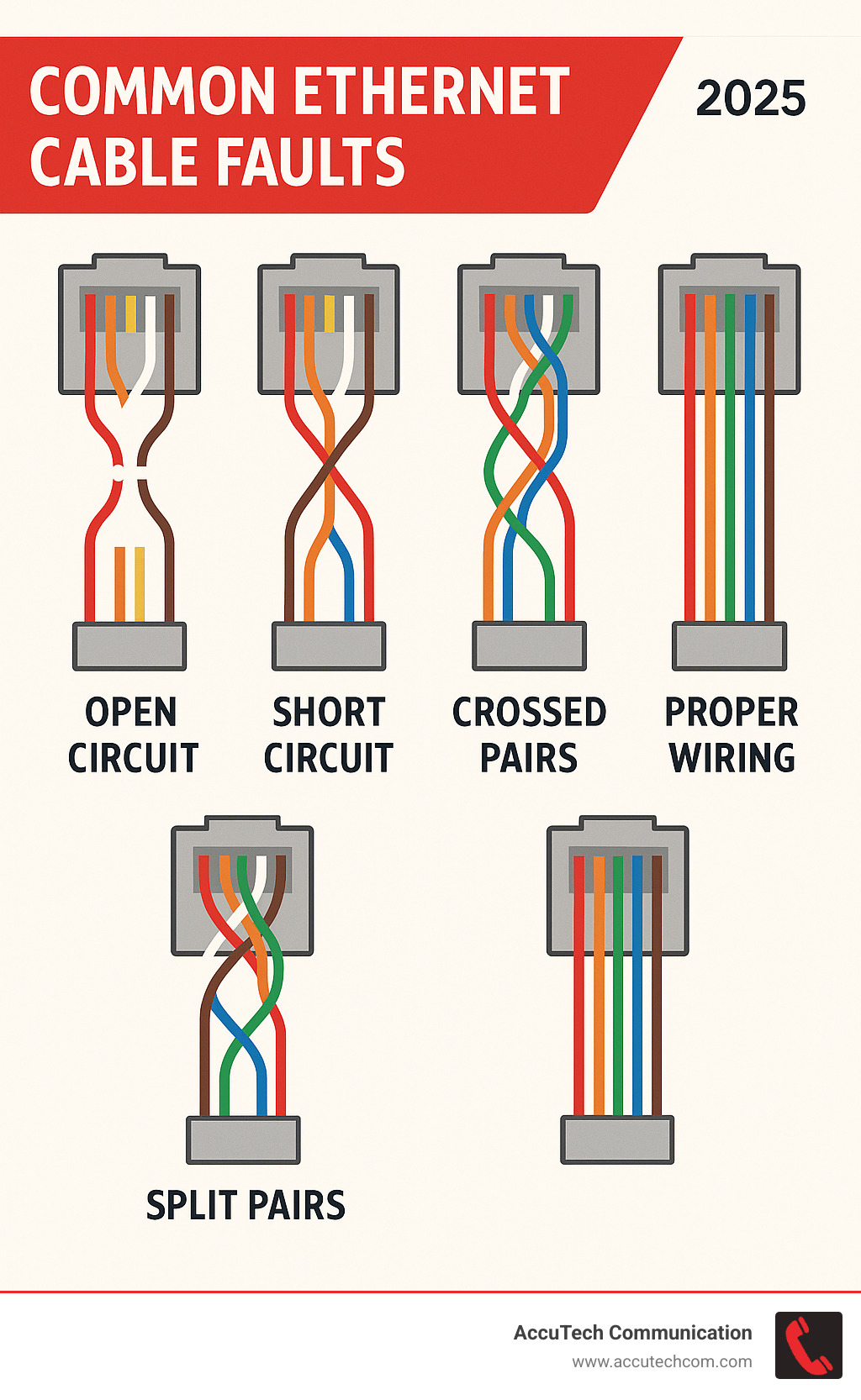
- Fault Detection – Identify opens, shorts, crossed pairs, and split pairs
- Network Diagnostics – Validate link speed, PoE functionality, and active connections
- Documentation – Generate professional reports for compliance and troubleshooting
In mission-critical environments like healthcare and manufacturing, network downtime is costly. An ethernet port tester prevents hours of troubleshooting by quickly identifying if issues stem from faulty cables or network equipment.
Whether installing new cabling or troubleshooting, the right testing tools save time and ensure professional results. Solutions range from simple verifiers under $20 to advanced multi-gigabit testers, fitting every need and budget.
I’m Corin Dolan, owner of AccuTech Communications. For over 30 years, I’ve used ethernet port tester tools to validate network installations across Massachusetts, New Hampshire, and Rhode Island. The right equipment is essential for the reliable communication systems that healthcare, manufacturing, and educational facilities depend on.
Find more about ethernet port tester:
What is an Ethernet Port Tester and What Does It Do?
An ethernet port tester is like a diagnostic doctor for your network. Its primary functions are cable verification, fault detection, and network diagnostics. These essential tools help determine if problems stem from faulty cables, poor connections, or configuration issues when troubleshooting or validating new installations.
Modern testers are versatile, working with RJ45 connectors (ethernet), RJ11 connectors (telephone), and coaxial connectors, making them invaluable for diverse network environments. A crucial function is signal integrity testing, which ensures data signals travel cleanly without corruption or interference, preventing network slowdowns.
If you’re curious about the different types of cables these testers work with, check out our guide on What Are Ethernet Cables? for a comprehensive overview.
Identifying Cable Faults
Cable faults cause mysterious network problems. An ethernet port tester detects the exact location and type of fault.
- Open faults occur when a wire breaks or is disconnected, completely blocking signal transmission.
- Short faults happen when two wires touch, causing data signal chaos that can lead to intermittent issues or complete connection failure.
- Miswires, where wires are in the wrong sequence, are sneaky. The connection might seem to work, but data transmission will be unreliable or slow.
- Crossed pairs (swapped transmit/receive pairs) and split pairs (mixed wires from different pairs) are subtle issues that require a tester to find. Both severely impact high-speed network performance.
- For shielded cables, shield continuity testing ensures the protective barrier against electromagnetic interference is intact from end to end.
If you want to learn hands-on testing techniques, this helpful guide on How to test an Ethernet Cable provides step-by-step instructions for basic cable testing.
Diagnosing Network Issues
Modern testers go beyond cable checks to diagnose the active network, changing them from simple verifiers into sophisticated diagnostic tools.
- Link status detection shows if a port is active, while port speed detection reveals the negotiated speed (10/100/1G/10G).
- For frustrating connectivity problems, advanced testers can ping devices, check DHCP, and verify gateways to quickly isolate issues to the cable, switch, or configuration.
- Power over Ethernet (PoE) issues are common with devices like IP cameras and VoIP phones. Advanced testers detect PoE presence and perform loaded tests to ensure the power source can deliver adequate wattage under real-world conditions.
These diagnostic capabilities are particularly valuable in complex business environments where network reliability is critical. For more information about comprehensive network solutions, visit our Business IT Network page to see how we approach complete network infrastructure management.
Basic vs. Advanced Testers: Finding the Right Tool for the Job
Choosing the right ethernet port tester can feel overwhelming. The choice depends on your needs: are you a DIYer setting up a home office or a professional managing large network installations? The landscape has changed over 30 years; powerful tools that once cost $10,000 now fit in your pocket. Still, not every tool is right for every job.
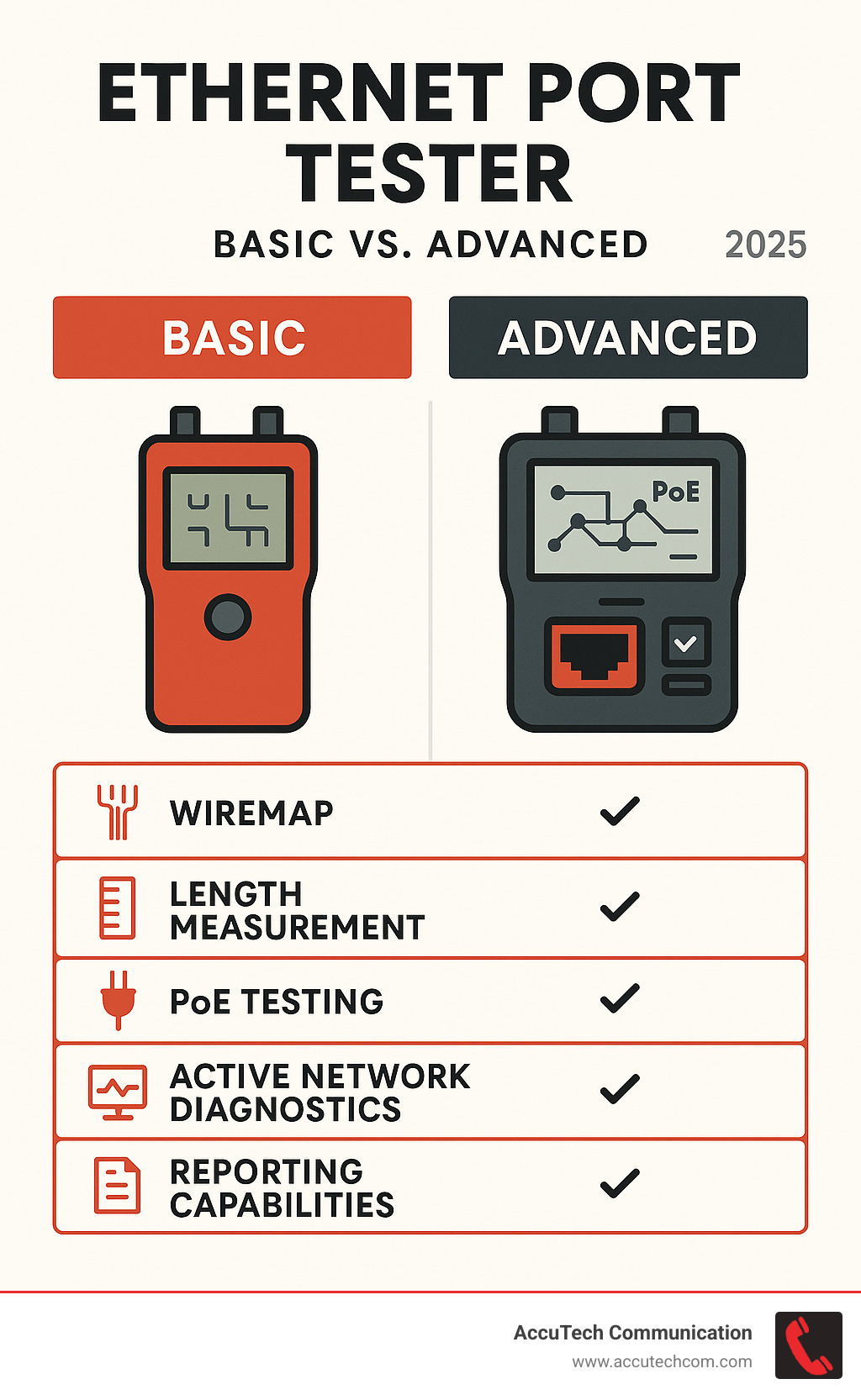
Key factors for choosing a tool include network complexity, frequency of use, and the need for documentation. Different Network Cable Categories also require different testing precision.
| Feature | Basic Verification Testers (Verifiers) | Advanced Network Testers (Qualifiers/Certifiers) |
|---|---|---|
| Wiremap | Yes | Yes |
| Length Measurement | Basic (often TDR-based) | Advanced (precise TDR, graphical TDR) |
| PoE Testing | Basic (presence, voltage) | Comprehensive (TruePower™ loaded, 90W 802.3bt) |
| Active Network Diagnostics | Limited (link light) | Extensive (link speed, switch port ID, VLAN, DHCP, Ping) |
| Reporting | Minimal (LED patterns) | Comprehensive (PDF reports, cloud sync) |
| Cost | Lower | Higher |
Basic Testers (Verifiers)
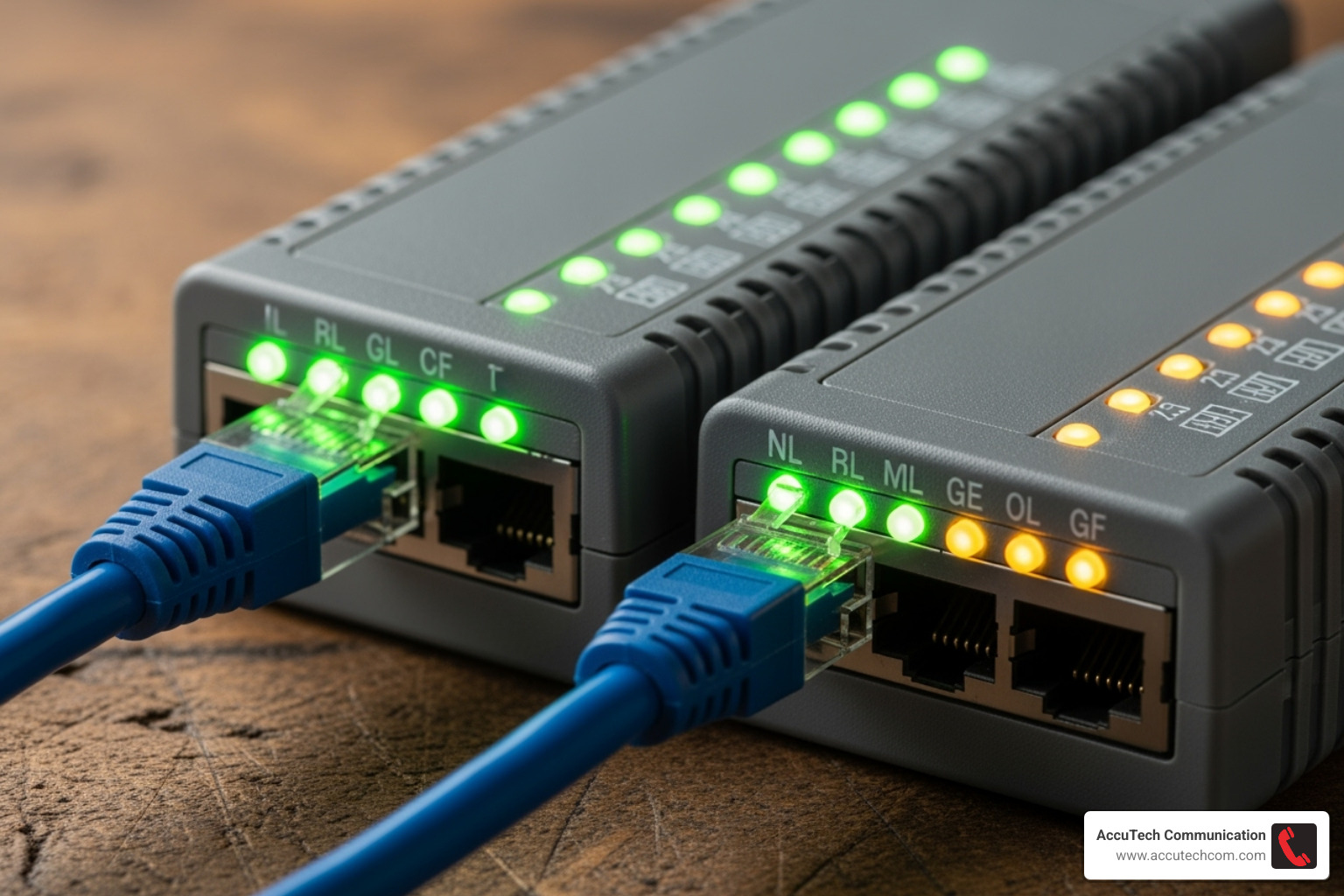
Basic ethernet port tester units, or verifiers, are affordable tools that reliably handle the most common testing tasks. These two-piece sets (main and remote unit) are simple to use. Plug each end of a cable in, and sequential LEDs from 1 to 8 indicate that all wire pairs are correctly connected.
They excel at continuity testing. An unlit LED indicates a broken wire (open fault), while multiple lights indicate a short fault. The wiremap function easily spots crossed or miswired connections. Their practicality is a key benefit: they are portable, have long battery power, and their low cost makes them accessible for regular cable verification. They are ideal for new cable installations to confirm successful termination and offer excellent value for DIYers and small businesses.
Advanced Testers (Qualifiers & Certifiers)
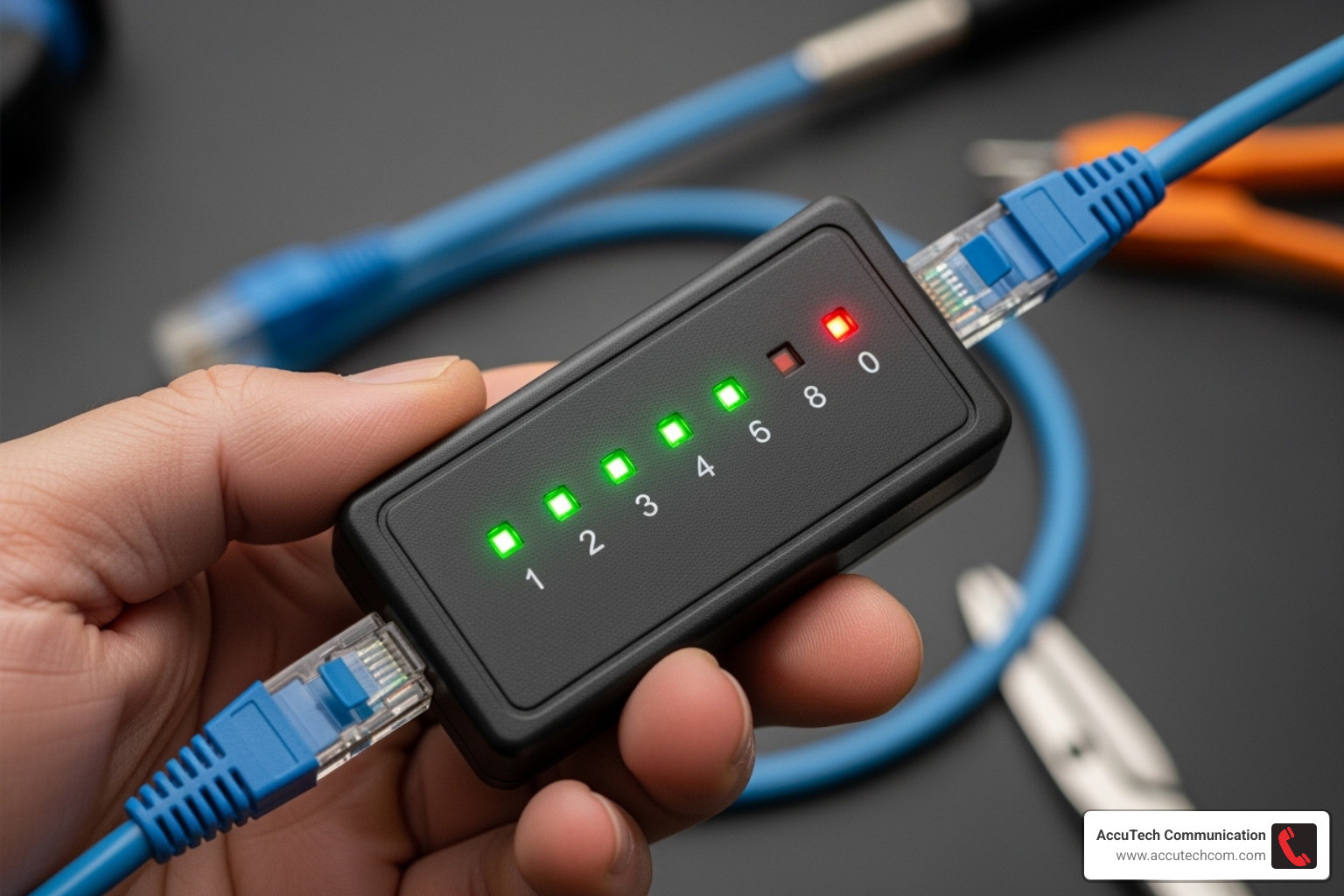
When basic testing isn’t enough, advanced ethernet port tester models validate complex installations and troubleshoot stubborn issues. Active network testing is a key feature, where tools communicate with network devices to verify real-world performance.
Critical for modern networks, PoE load testing goes beyond simple presence detection. Advanced testers perform TruePower™ loaded testing to verify the delivery of promised wattage, essential for high-power applications needing up to 90W 802.3bt validation. Time-Domain Reflectometry (TDR) acts like sonar for cables, sending a signal to pinpoint the exact distance to faults.
Link speed validation confirms if your infrastructure supports required speeds, from gigabit to 10G, as needed for our Gigabit Ethernet Solution. They also detect VLANs and perform DHCP testing. For professional installations, these tools generate detailed reports (PDFs, cloud sync) that provide essential documentation for compliance and clients, changing testing into a full quality assurance process.
The Ultimate Ethernet Port Tester Feature Checklist
Choosing the right ethernet port tester can be overwhelming. With three decades of experience, I can guide you through the key features that make a tester efficient and accurate. A good tester must have compatibility for various cable types, from new Cat6A to legacy coax. Durability is also crucial; look for rugged construction and drop protection. Don’t overlook battery life, as a dead tester mid-job is a major problem. A clear, readable display is also essential for working in poorly lit areas.
Cable and Connector Compatibility
Your ethernet port tester must handle the mix of cables and connectors found in modern networks. Key compatibilities include:
- RJ45 connectors for Cat5e through Cat6A ethernet cables.
- RJ11/RJ12 connectors for telephone systems.
- Coaxial connectors (BNC/F-type) for video and legacy systems.
- The ability to distinguish between Ethernet Cable Types like Cat5e, Cat6, and Cat6A.
- Support for both shielded (STP) and unshielded (UTP) cables, including shield continuity verification for STP.
Advanced Diagnostic Capabilities
Advanced diagnostics pinpoint what’s wrong and where to find it.
- Power over Ethernet (PoE) testing is critical. Look for TruePower™ loaded testing and 90W 802.3bt validation to ensure high-power devices work reliably.
- Time-Domain Reflectometry (TDR) provides X-ray vision for cables, sending signals to pinpoint the exact distance to faults.
- Cable length measurement via TDR is essential for documentation and ensuring compliance with distance standards.
- Port blinking is a simple but valuable feature that blinks a switch port’s LED, helping you instantly identify the connected cable.
- A built-in tone generator injects a signal into a cable, which can be traced with a probe for easy identification.
Active Network and Port Analysis
Powerful testers analyze how physical infrastructure performs in a live network environment.
- Link speed and duplex detection (10/100/1000/10G) identifies negotiated connection speeds to spot mismatched configurations. Learn more in our guide to Network Cable Speeds.
- Switch port identification (CDP/LLDP) automatically finds the switch name, port number, and VLAN information.
- VLAN monitoring helps validate network segmentation and identify configuration issues.
- DHCP and DNS testing verifies that devices can obtain network configurations and resolve names.
- Integrated ping and traceroute functions provide immediate connectivity verification, replacing the need for a separate laptop.
Benefits of Using a Tester for Network Installation and Troubleshooting
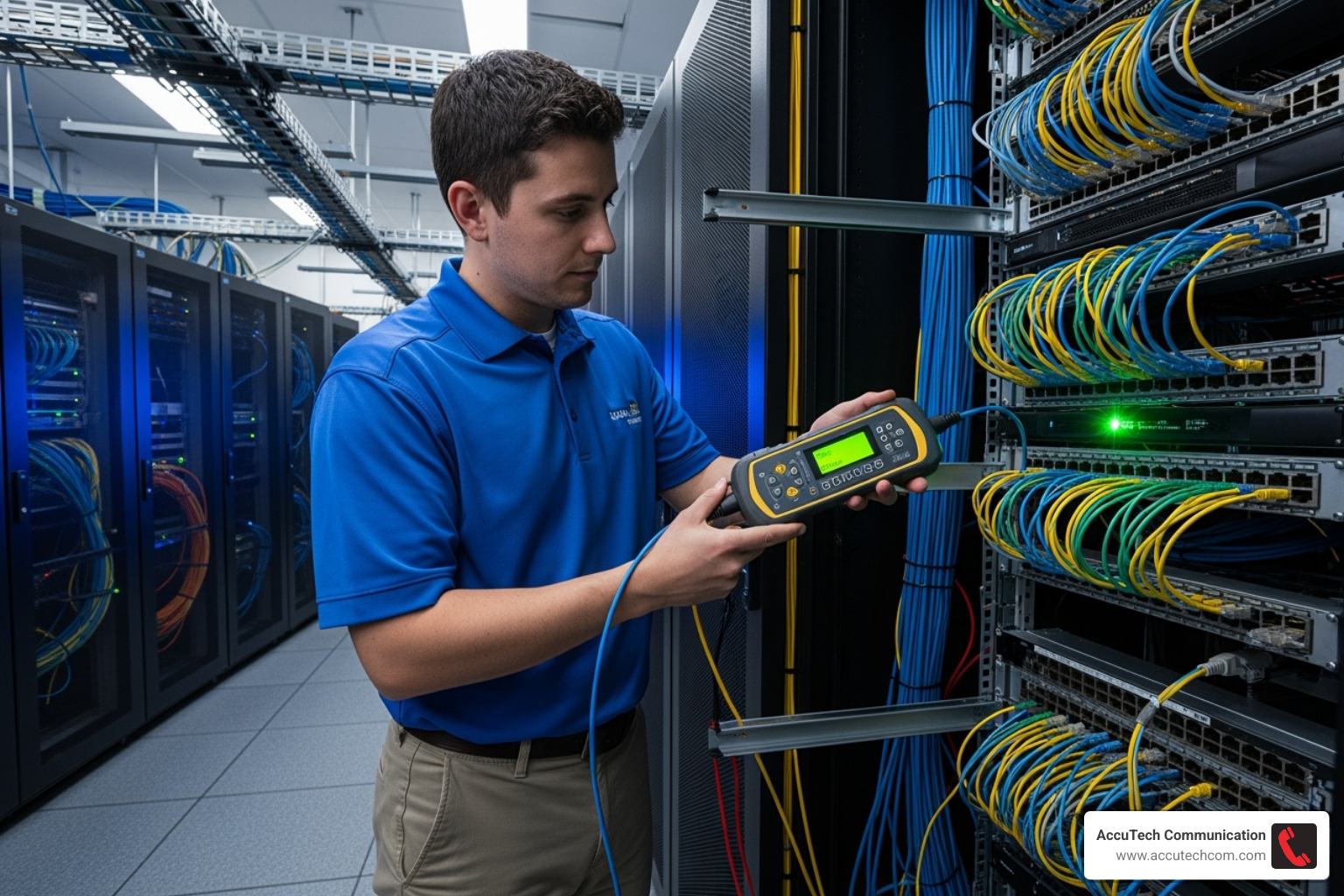
The right ethernet port tester transforms your approach to network projects. It replaces guesswork with knowledge, saving hours of frustration and ensuring professional results. Key benefits include increased efficiency, reduced downtime, accurate installations, and professional documentation.
Streamlining Network Installations
On any Data Cable Installation project, an ethernet port tester is a trusted companion. Validating every connection as you go provides confidence that each cable meets required standards. Ensuring standards compliance (e.g., TIA/EIA 568) builds a reliable network and helps prevent future problems. Fixing a miswired cable during installation takes minutes; troubleshooting it later can take hours. Documenting the physical layer with an advanced tester provides detailed performance records invaluable for future troubleshooting and upgrades.
Accelerating Troubleshooting
When network problems strike, an ethernet port tester helps you quickly pinpoint physical layer issues. A good tester helps differentiate between cable and network device problems, saving time and preventing unnecessary equipment swaps. For intermittent issues, advanced testers can perform continuous monitoring, testing for intermittent faults to catch elusive problems. The result is reduced downtime and increased efficiency. Our Network Cabling Services are built on this principle of quick, accurate problem resolution.
Generating Professional Reports
A key benefit of modern ethernet port tester technology is comprehensive documentation. Automated test result management eliminates manual record-keeping. PDF report generation creates professional documents showing standards compliance, demonstrating the quality of your work. Cloud synchronization automatically uploads test results to secure platforms, making them accessible anywhere and ensuring they are backed up. Most importantly, detailed reports provide proof of performance to clients, which is crucial for installations following Structured Cabling Definition standards.
Frequently Asked Questions about Ethernet Port Testers
Here are the questions that come up most often during our network installations and troubleshooting calls.
Can a basic ethernet port tester detect network speed?
No. Basic testers (verifiers) focus on the physical cable. They excel at checking continuity and wiremap functions using simple LED indicators to confirm that all wires are connected correctly. However, they cannot measure network performance. While they may have a link light indicator, they do not perform speed negotiation with network equipment.
To detect if a connection is running at 10/100/1000Mbps, you need an advanced tester. These tools actively communicate with network equipment to negotiate link speeds and verify bandwidth.
What does TDR mean on an ethernet port tester?
Time-Domain Reflectometry (TDR) is a feature where the ethernet port tester sends a signal pulse down a cable. When the pulse hits a fault like an open or short circuit, it creates reflections. The tester measures the return time of these reflections to calculate the precise distance to faults.
This advanced feature is highly practical, pinpointing the exact fault location. It also provides accurate cable length measurement for documentation and compliance.
How do I test a wall port if the other end is in another room?
Testing a wall jack when the other end is in a different room (e.g., at a patch panel) is a common scenario. This is why ethernet port tester kits include a main tester and a remote unit.
Connect a patch cable from the main tester to the wall jack. Then, plug the remote unit into the corresponding port on the patch panel. This system allows for efficient one-person operation. The main and remote units communicate across the cable run, providing a complete test of the connection. This method is essential for validating proper Ethernet Cable Wiring.
Conclusion
When building or maintaining a network, an ethernet port tester is your insurance against downtime. These tools have evolved from simple continuity checkers to sophisticated devices that validate everything from wiremap integrity to complex PoE delivery and multi-gigabit performance.
Modern ethernet port tester technology is versatile, with solutions for every need and budget. Basic verifiers catch common installation mistakes, while advanced certifiers provide the comprehensive analysis and documentation modern networks require. These tools transform guesswork into certainty, providing precise answers about network issues. The time savings and peace of mind often justify the investment.
For businesses in Massachusetts, New Hampshire, and Rhode Island, professional testing during Network Cabling Installation projects protects your investment. At AccuTech Communications, our certified technicians use the latest ethernet port tester technology to deliver reliable networks.
With three decades of experience, I’ve learned that prevention is key. A good tester helps build reliable infrastructure that keeps your business running smoothly for years to come.
